Key Takeaways
- For most promotional thermos orders, 1,000 pcs per SKU is the practical MOQ for stable pricing and decoration setup.
- 304 stainless steel inner walls at 0.4-0.5 mm are a safer baseline than ultra-thin promotional shells.
- Laser engraving lasts longest, while silkscreen is better for 1-3 color campaign graphics.
- AQL 2.5/4.0 inspection, 24-hour leak testing samples, and pre-shipment carton checks should be agreed before deposit.
A top promotional vacuum flask is not picked by looks first. For an outdoor retailer or promo brand, the first check is risk: lids that leak at 30 kPa air pressure, heat retention missing the 6-hour claim, delivery slipping from 12 days to 18 days, or a logo that scratches after 2 passes on the 3M tape test.
The better buying brief covers capacity, insulation target, stainless steel grade, lid construction, logo method, and carton packing. BottleForge Industrial in Hangzhou, Zhejiang builds stainless thermos programs for buyers who need predictable thermos bulk supply from China; we run the line by PO spec, not catalog guessing, and QC pulls pre-shipment samples before we ship.
Start with the buying decision
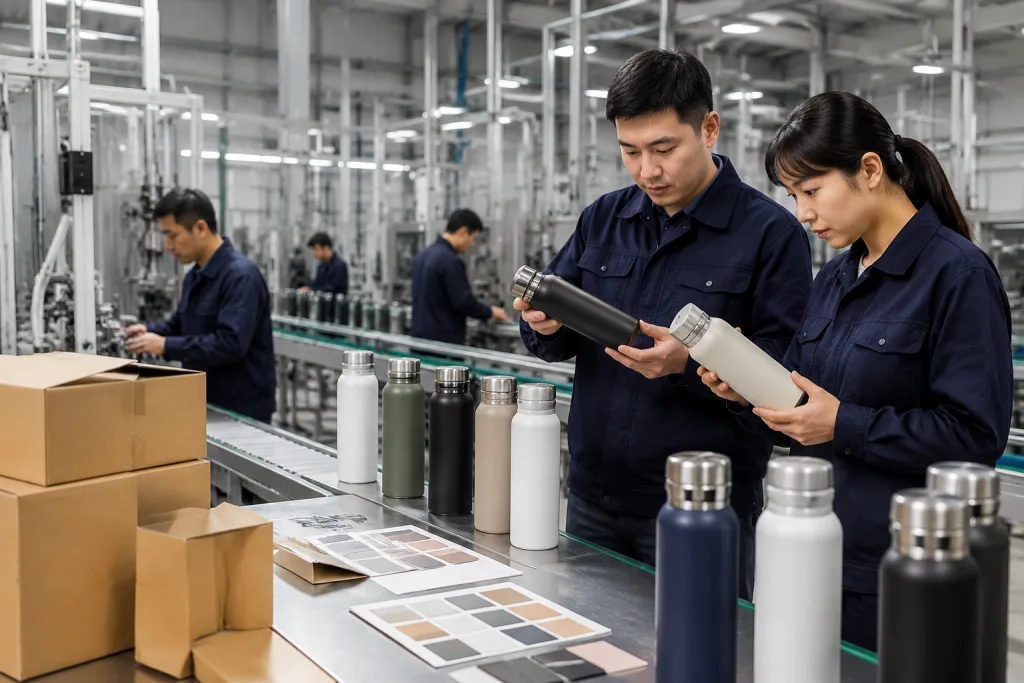
Do not ask a thermos supplier for “your best bottle” and expect a useful answer. That is the wrong question to ask. Best for a mountain gear store is not best for a bank gift set or an airport retail bundle. Start with the use case. Outdoor retail buyers usually need a tougher customized thermos with a grippier powder coat, a cup lid that does not rattle, and 12-24 hour performance claims that still pass after normal handling. Promotional brands usually need a clean body shape, a lower unit cost, and a logo area that looks sharp in a pitch deck. We run a 0.15 mm logo-position tolerance on the fixture because one tilted bank logo can get the whole pre-production sample rejected.
The second decision is order economics. A 500 pc trial sounds safe, but the math often does not work because vacuum flask production carries fixed costs: logo tooling, Pantone color matching, inner carton setup, inspection time, and export documents. At our Zhejiang factory, a typical custom thermos MOQ is 1,000 pcs per color for powder coating and 500 pcs for laser engraving on existing stock finishes. For a new mold, think in 10,000 pcs annual volume, not one small campaign. Last month QC pulled the sample on a matte black 750 ml flask because the buyer’s PO said “warm grey,” while the artwork file said PMS 431C.
The third decision is compliance and sales channel. If you sell into the EU, ask for LFGB or food-contact documentation, REACH declarations for coatings and silicone, and a clear stainless steel material report. For North America, buyers often ask for FDA food-contact support and ASTM packaging checks when children’s use is involved. If the flask goes into retail, barcode position, master carton strength, drop resistance, and shelf packaging matter as much as the bottle. We ship 24 pcs per master carton on several 500 ml lines, and a weak 5-layer carton will show corner crush before the bottle ever reaches the shelf.
The fourth decision is how much control you want. A distributor thermos program with off-the-shelf shapes is faster. A factory thermos project gives you tighter control over lid design, finish, packaging, and margin. Neither route is automatically better. The wrong choice is pretending a cheap catalog item can behave like a fully engineered retail product. We have seen this go sideways when the buyer flagged lid leakage at AQL 2.5 inspection, then asked for a silicone redesign after 3,000 pcs were already packed on the line.
Pick capacity before decoration
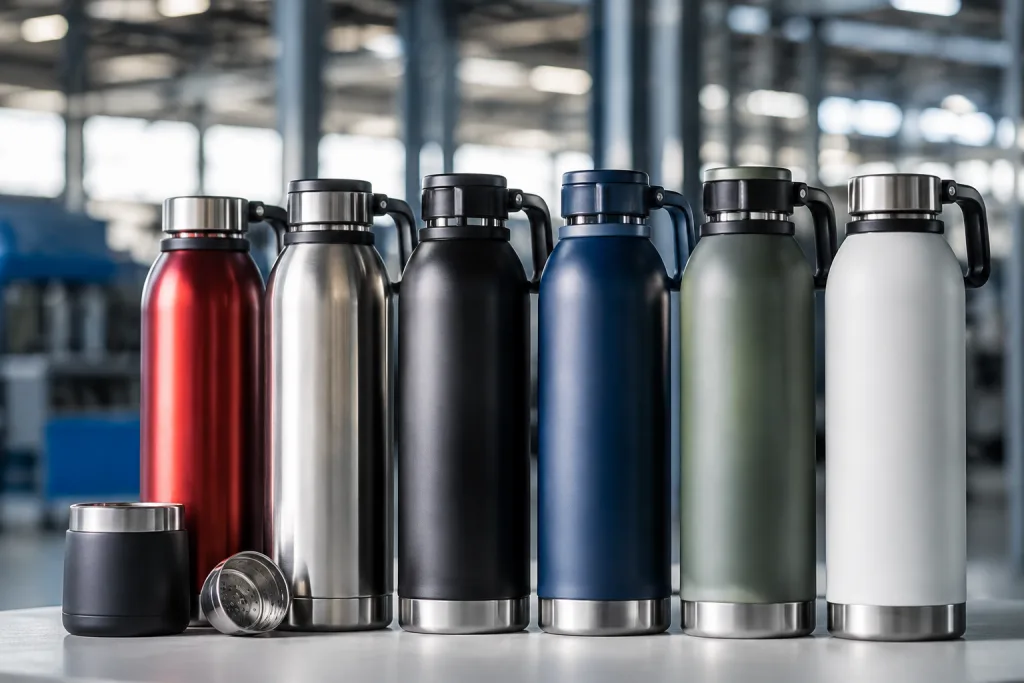
Capacity drives the order before artwork does: perceived value, heat retention, carton size, freight cost, and who will actually carry the flask. For outdoor retailers, 500 ml and 750 ml are the safe picks. We run a 500 ml stainless thermos for commuting packs, hiking daypacks, and corporate gifting because it clears most bag side pockets at about 72 mm body diameter. A 750 ml flask feels more serious and sells better for camping, fishing, and field work. The popular 1,000 ml size has strong shelf appeal, but the math changes fast once QC weighs the body and the carton CBM goes up.
For promotional thermos campaigns, do not add capacity just to make the gift look generous. Wrong question. A 1,000 ml flask may add USD 0.70-1.40 to FOB cost versus a 500 ml model, depending on lid and coating, and we have seen buyers push back after the freight quote landed. It also increases carton dimensions, which can hurt air freight and FBA-style replenishment. If the bottle is a conference giveaway, 350-500 ml is usually enough. If it is a loyalty gift for outdoor customers, 750 ml sends a better signal without making the carton awkward.
Write insulation claims carefully. Last quarter, 14 buyers asked for “24 hours hot and 36 hours cold,” and QC pulled the sample twice because the lid gasket was not seated cleanly. That claim can pass under lab conditions for some structures, but the test method matters. We normally define performance using water at 95°C, room temperature at 20°C, and a measured reading after 6, 12, and 24 hours. A practical 500 ml double-wall vacuum flask should retain around 60°C after 12 hours if the lid seal and vacuum are stable. Wider mouths lose heat faster than narrow mouths, though they are easier to clean and fill with ice.
If you are building a customizable thermos range, keep two bodies and change the lid or finish. One 500 ml travel body and one 750 ml outdoor body can cover most promotional and retail needs, with MOQ kept cleaner at 1,000 pcs per color instead of splitting five sizes across the line. Too many sizes create slow-moving stock and re-order confusion. We have seen this go sideways when a PO typo listed 750 ml on the carton mark but 500 ml on the barcode file.
Specify steel and wall construction
Steel grade is where 7 out of 10 bulk thermos RFQs get loose. For a reliable top promotional vacuum flask, we specify 304 stainless steel on the inner wall, and QC checks it with an XRF gun before mass production. The outer wall can be 201 or 304 depending on target cost, but we push back on 201 for outdoor retail if the flask will see rain, salt air, truck cup holders, or campsite abuse. A manufacturer thermos quote that only says “stainless steel” is too thin. Ask for the grade by position: inner 304, outer 201 or 304.
Wall thickness is a shop-floor detail, not a brochure line. Common stainless thermos bodies run around 0.4-0.5 mm inner wall thickness and 0.5 mm outer wall thickness before forming, depending on the body curve and neck size. We measure coil stock with a digital micrometer before the line starts. Thin walls can save a few cents, but the dent test tells the truth. For desk giveaways, that trade-off can pass. For outdoor retail, the math doesn't work because 18 returned flasks cost more than the steel saved on 5,000 units.
Vacuum quality comes from welding, evacuation, and sealing. QC pulled one sample last season with light blue discoloration near the bottom weld, and we stopped the lot before packing because that mark usually means heat control was off. The bottom weld and mouth forming should be even, with no sharp lip, burr, or visible stain inside. Copper coating inside the vacuum layer can improve thermal performance, but it adds cost, often about USD 0.18-0.35 per unit depending on size. Ask the thermos factory whether copper plating is included or optional, because two flasks with the same outside shape can hold heat 6 hours vs 9 hours.
Lids need the same hard look. Silicone should be food-grade, removable for cleaning, and firm enough that it does not roll out of the groove after 30 open-close cycles. A flip lid is convenient, but it has more failure points: hinge pin, button spring, gasket seat. A screw lid with cup is slower, safer for hiking, delivery drivers, and winter promotions. We run glove tests with a 3 mm winter glove in the sample room. If your buyer cannot open it in cold weather, the lid spec is wrong.
At BottleForge Industrial in Hangzhou, Zhejiang, our stainless thermos lines can produce about 450,000 units per month across standard bodies, subject to finish and lid mix. That number assumes stable artwork, approved color chips, and no PO typo like “matte black” on page 1 and “gloss black” on page 3, which we have seen go sideways. Capacity matters when a China supplier thermos project moves from sample approval to seasonal rollout. We ship smoother when steel grade, wall thickness, vacuum spec, and lid structure are locked before the deposit lands.
Choose a logo method honestly
Decoration is the line item where promotional buyers lose money fast. Laser engraving is our safest choice on powder-coated stainless steel because the fiber laser burns off the coating and shows the 304 stainless underneath. We run 0.08-0.12 mm engraving depth on most vacuum flask bodies, then QC checks the edge under a 10x loupe. It suits outdoor retail gifts and workwear programs where the bottle gets dropped, washed, and tossed in a truck cab. Color is the catch. Laser gives one metal tone, not full-color artwork, so asking it to match a 4-color brand mark is the wrong question to ask.
Silkscreen printing works better for bold logos and 1-3 color campaign graphics. It prints cleanly on smooth powder coating, but adhesion depends on degreasing, flame treatment, and oven curing time. For a customized thermos used outdoors, ask for a cross-hatch adhesion test and rub test before mass production. On one 5,000 pcs order last May, QC pulled the sample after 48 alcohol rubs because the white ink started lifting near the seam. If a supplier thermos quote includes printing but no test standard, the factory is treating decoration as cosmetic only.
UV printing gives more color freedom and small-detail artwork, but it is not my first pick for curved stainless bottles that end up in backpacks. It fits retail gift sets and limited runs where the bottle sits in packaging more than it rides in a toolbox. For heavy-use promotional thermos projects, we test UV hard: alcohol rub plus tape pull, then 500 g abrasion on the printed zone. We have seen this go sideways when a golden sample looked sharp, then mass production curing was cut from 18 minutes to 12 minutes to catch a vessel date. A beautiful sample means little if the line is rushing.
Powder coating is usually the right finish for outdoor and premium promotional programs. It gives grip and hides fingerprints, and matte black still beats glossy paint for repeat corporate orders in our factory. Pantone matching is possible, but exact color depends on coating powder, baking temperature, and metal substrate. Our coating oven runs around 180-200°C, and a 10°C drift can shift light beige enough for the buyer to flag it. For custom colors, plan 7-10 days for lab dips and approval. For stock colors, samples can often ship in 3-5 days from China.
If you need a thermos vendor to support distributors thermos programs, standardize decoration zones. A fixed logo area, such as 45 x 70 mm on the front body, cuts repeat-order mistakes because every PO, dieline, and carton label uses the same position. We once saw “45 x 70 cm” typed on a buyer PO, and the merchandiser caught it only because the zone chart was attached. Set the zone early. It makes quoting faster for your sales team and keeps the factory from rechecking artwork every reorder.
Build packaging for the channel
Packaging is not decoration. It decides whether your factory thermos arrives clean, scans at receiving, and survives the truck ride from port to warehouse. For promotional brands, a white box or kraft box is enough when we ship 3,000 pcs in bulk to one event site and the buyer does not need shelf appeal. For outdoor retailers, retail packaging has to show capacity, steel grade, care instructions, and insulation claims that match the lab sheet. QC pulled a sample last month where the box claimed 24 hours hot, but the test record was only 12 hours; the buyer flagged it before mass printing.
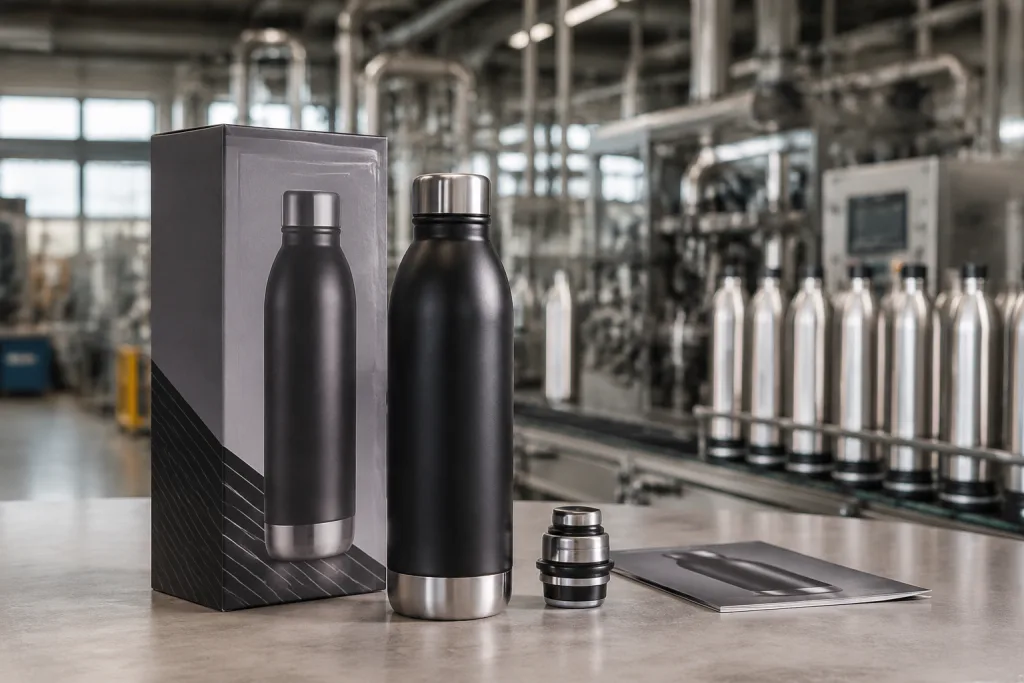
A standard single-unit color box for a 500 ml stainless flask may use 350 gsm paperboard with an E-flute insert or molded pulp support. For heavier 750 ml and 1,000 ml models, thin boxes collapse too easily. We run a simple compression check on the line with stacked master cartons for 24 hours, because a pretty box means nothing if the bottom layer crushes on a pallet. If the carton is going to Europe or North America, master carton strength should be checked, especially for pallet stacking. A typical master carton may hold 24 pcs of 500 ml flasks, with gross weight around 10-13 kg depending on bottle weight and packaging.
For ecommerce and FBA-style programs, packaging needs a different setup. You may need FNSKU labels, suffocation warning on polybags where applicable, carton labels on two sides, and drop-test packaging with corner protection. A nice retail box that fails a 76 cm drop test gets expensive fast; we have seen this go sideways when the PO said “retail box only” and Amazon later rejected cartons without readable side labels. If your thermos distributor sells through mixed channels, decide early whether one packaging format can serve both warehouse and retail shelf. Often it cannot.
Care cards work when written plainly. Tell users not to microwave stainless steel, not to use bleach, and not to overfill with carbonated drinks unless the lid is designed for pressure. This cuts customer service noise. Some thermos manufacturers skip this because it feels small, but the math does not work when a distributor receives 200 avoidable complaints. On our packing table, a 90 x 55 mm care card costs less than a replacement lid and takes no extra carton space.
For branded gift sets, foam inserts look tidy but are harder to defend under sustainability policies. Molded pulp or paper inserts cost slightly more in some structures, but they help EU buyers who are cutting plastic packaging. Ask your thermos suppliers for both options before approving artwork, and check the insert fit with a 1 mm clearance gauge before the gift box dieline is locked. We ship both versions, but foam is the wrong default if the buyer already sent an ESG packaging checklist.
Control quality before shipment
Agree the QC plan before deposit, not after the cartons are taped. For a top promotional vacuum flask, we run five checkpoints as a baseline: 304 stainless material verification with PMI or supplier mill sheet, vacuum performance on filled samples, leak testing on the assembled lid, decoration adhesion with 3M tape, and packing inspection against the approved carton layout. The exact AQL level depends on your buyer agreement, but AQL 2.5 for major defects and 4.0 for minor defects is common for promotional drinkware. Critical defects such as leaking, unsafe burrs over 0.3 mm, wrong material, or mixed logos should be zero tolerance. QC pulled 80 pcs from one 5,000 pcs order last month and found 2 cartons with the old logo sticker; that is the kind of small miss that becomes a big buyer complaint.
Leak testing needs upright and inverted positions. For sample approval, we like a 24-hour static leak test plus 30 seconds of shake testing after filling to 95% capacity. Simple test. In mass production, the line can run pressure or vacuum-related checks inline, then QC samples finished goods before packing. Ask for photos and a written inspection report, but photos are not inspection. We have seen this go sideways when a buyer accepted three clean photos, then found 17 leaking lids during warehouse receiving. If the order matters, send your own inspector or book a third-party inspection company in China.
Thermal testing should match real use, not catalog talk. Define starting water temperature, room temperature, fill volume, lid closure torque, and reading intervals. Without those details, two suppliers thermos quotes can both claim “keeps hot 12 hours” while one sample reads 62°C after 12 hours and another reads 54°C in the same 22°C test room. For outdoor retail, keep a golden sample and test mass production against it. We usually mark the golden sample with a signed label, PO number, and approval date because loose samples on a merchandiser’s desk get mixed faster than anyone admits.
Decoration defects show up fast on rush orders. Check logo position tolerance, Pantone color, missing ink, scratches, dust under coating, and laser burn consistency with the approved artwork beside the sample. A reasonable logo position tolerance might be ±2 mm, but confirm it if the artwork must align with a seam or handle. The buyer flagged this on a 1,200 pcs tumbler run because the logo sat 4 mm too close to the weld line. For retail orders, inspect barcode scan rate and carton markings. A bottle can be perfect and still block warehouse receiving if the label has the wrong SKU or a PO typo.
FOB lead time for a normal manufacturer thermos order from Zhejiang is usually 30-40 days after deposit and artwork approval. Custom powder color, new packaging, or complex lids can push this to 45-60 days, especially when the spray line needs a color change and the carton factory waits 7 days for printed paper. If a supplier promises 20 days for a fully customized thermos in peak season, ask what step they are skipping. The math doesn't work unless they already have bodies, lids, boxes, and the exact logo process ready before your deposit lands.
Compare quotes without fooling yourself
Thermos manufacturers do not quote the same product unless you pin the spec down. One FOB Ningbo price may be for 304 inner and 201 outer steel, a 300 gsm white box, and one-color pad printing. Another may cover 304/304 steel, powder coating, laser engraving, retail box, and 100 percent leak testing with the line doing an upside-down water check for 30 minutes. The cheaper quote is not cheaper if the steel, finish, or QC work has been stripped out.
Build a comparison sheet with the same fields for every thermos supplier: capacity, body weight, steel grade, wall thickness, lid material, silicone grade, coating type, logo method, packaging, MOQ, sample cost, lead time, incoterm, and inspection standard. For most stainless thermos promotional orders, realistic FOB China pricing might range from USD 3.20 to USD 6.80 for 500-750 ml standard models, depending on structure and decoration. Gift boxes, spare lids, handles, and custom colors add cost; last month QC pulled a 500 ml sample that was 18 g lighter than quoted, and that weight gap explained the “better” price fast.
Check payment terms and remake policy before the PI is stamped. A common structure is 30 percent deposit and 70 percent balance before shipment after inspection. If defects exceed agreed AQL, the factory should sort, rework, or remake affected goods before balance payment. Put that in the purchase order, down to the inspection date and defect limit. We have seen this go sideways when a buyer wrote “standard quality” on the PO and then flagged lid scratches 3 days before the vessel date.
For outdoor retailers and promotional brands, the safest partner is not always the lowest thermos vendor. You want a thermos manufacturer that can explain trade-offs, push back on weak specs, and run repeatable production. China has 300+ suppliers thermos options on Alibaba alone, from trading companies to integrated factories with their own polishing, coating, and assembly lines. The good ones will ask annoying questions early, like whether your matte black powder coat must pass a 3M tape test after laser engraving, because fixing that after packing does not pencil out.
If you can, start with a pilot order using the same finish, logo, packaging, and inspection plan as the larger rollout. A 1,000 pc pilot gives better information than 20 perfect samples. Samples prove possibility. Bulk thermos production proves control. We run pilots on the same jigs and carton drop-test method as mass production, because a beautiful hand-made sample tells you almost nothing about 36 cartons coming off the line every hour.
Send us your thermos brief for review
Share capacity, logo, packaging, target price, and delivery date. We will reply with practical options, MOQ, and FOB China pricing.
Frequently asked questions
What is the best MOQ for a custom stainless thermos order?
For a serious custom thermos project, 1,000 pcs per SKU is the practical starting MOQ. At 500 pcs, you may get laser engraving on stock colors, but powder coating, Pantone matching, and retail packaging become expensive per unit. For new body tooling, expect a much higher commitment, often 10,000 pcs or more across repeat orders. If you are a distributor testing a market, start with an existing factory thermos body, choose 1-2 colors, and customize the logo and box first.
How long does production take after sample approval?
For standard stainless thermos models, normal FOB lead time from Zhejiang, China is 30-40 days after deposit, artwork confirmation, and sample approval. Custom powder colors usually add 7-10 days for lab dips and approval. New packaging can add another 5-12 days if printing proofs or barcode placement need buyer confirmation. Peak season before Q4 can stretch timelines, so outdoor retailers should lock specifications at least 90 days before the planned warehouse arrival date.
Should I choose laser engraving or printed logo?
Choose laser engraving if durability matters more than color. It is the better option for outdoor, workwear, and premium promotional thermos programs because it does not peel like ink. Choose silkscreen printing for simple 1-3 color campaign graphics, especially on smooth powder-coated bodies. UV printing is useful for detailed or full-color artwork, but it needs stronger abrasion testing. For any thermos customized order above 1,000 pcs, approve a decorated pre-production sample, not only a blank bottle.
What stainless steel grade should I require?
Use 304 stainless steel for the inner wall as your baseline. It is the safer food-contact choice for hot drinks, coffee, tea, and acidic beverages. The outer wall can be 201 or 304 depending on your price target, but outdoor retailers should strongly consider 304 outer steel for better corrosion resistance. Ask your thermos suppliers for a material report and specify wall thickness, not just steel grade. A 0.4-0.5 mm inner wall is common for reliable promotional vacuum flasks.
How do I compare quotes from different thermos suppliers?
Normalize the specification before comparing prices. Ask every thermos supplier for capacity, steel grade, body weight, wall thickness, lid type, silicone grade, coating, logo method, packaging, MOQ, lead time, incoterm, and AQL standard. A USD 3.60 FOB quote and a USD 4.20 FOB quote may not describe the same bottle. Check whether the price includes retail box, laser engraving, 100 percent leak screening, and export carton labels. Low price without these details is not a real saving.