Key Takeaways
- A 500 ml double-wall 304 stainless bottle usually needs 0.45-0.55 mm inner wall and 0.50-0.60 mm outer wall for stable mass production
- MOQ for a new color with logo is commonly 1,000-3,000 pcs per SKU, while a new mold can start at 10,000 pcs
- Reliable thermal claims should be tested at 95°C start temperature over 6, 12, and 24 hours
- Use AQL 2.5 for major defects and AQL 4.0 for minor defects unless your retail channel requires tighter limits
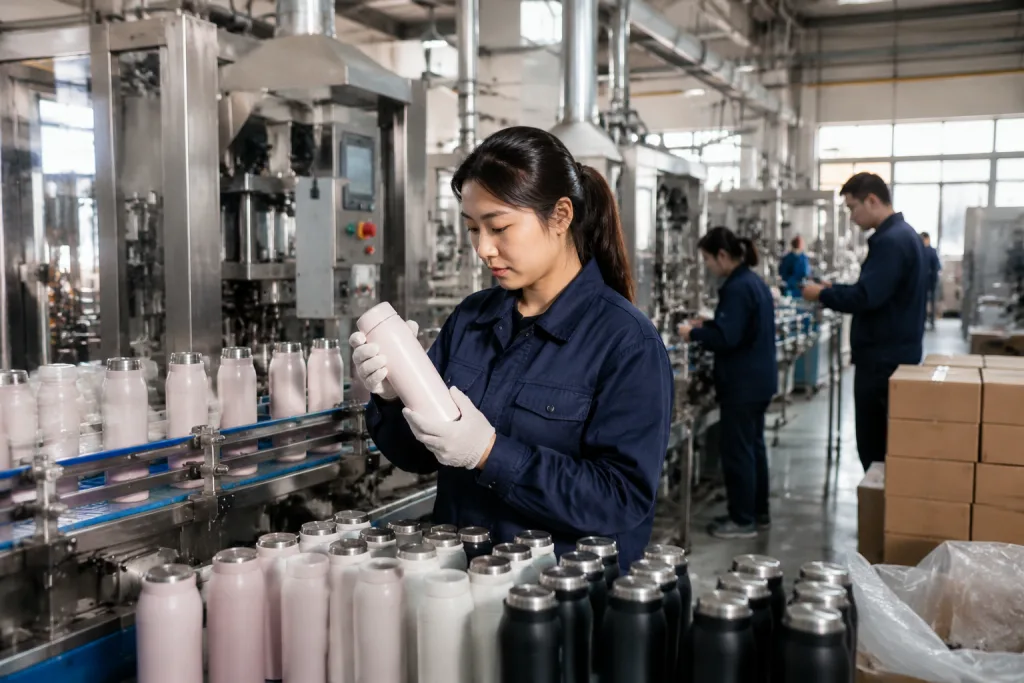
A top promotional vacuum bottle is not a logo slapped on a metal shell. For outdoor retailers and promo brands, it has to get through 9 retail shelf touches, warehouse drops from 1.2 m cartons, car cup holders, trail packs, and the dishwasher your user was told not to use. We see this on the line: QC pulled a black powder-coated sample last month after the 3M tape test lifted ink near the rim. If the coating scratches, the lid leaks, or the print rubs off, your buyer blames your brand, not the factory thermos line that made it.
From Hangzhou, Zhejiang, we run into the same procurement problem about 14 times each peak season: buyers compare FOB prices before they lock the real specification. Wrong question. A 500 ml custom thermos can be USD 3.20 or USD 6.80 depending on steel grade, vacuum performance, lid structure, coating, packaging, AQL level, and thermos bulk quantity. The math does not work until the spec sheet is tight; even a 0.2 mm wall change or a PP lid instead of Tritan can move cost, lead time, and failure rate. The questions below are the ones worth asking before you issue a PO in China, especially before someone types “same as last order” on the PO and leaves out the coating code.
Start with the use case
Buyer question: What makes a top promotional vacuum bottle different from a cheap giveaway bottle?
Insulation time is only one line on the spec sheet. We have shipped one-day event bottles with lighter 300 g white boxes, single-color pad printing, and a basic screw lid; that is fine when the buyer just needs 5,000 pieces for a trade show. A bottle for an outdoor retailer, loyalty program, or paid brand merchandise line is a different order: better scratch resistance, tighter lid fit, and packaging that looks like retail stock, not leftover event goods. QC pulled a sample last month where the lid rocked 1.2 mm on the thread, and the buyer flagged it before we even reached the carton drop test.
Write the use case before asking a thermos supplier for price. Hiking, gym, office commuting, ski club membership, employee gifting, Amazon FBA, and distributor thermos resale do not belong on the same quote sheet unless the specs are split. This is the wrong question to ask: “What is your cheapest 750 ml bottle?” Ask what the bottle must survive. For outdoor retail, we run 500 ml, 600 ml, 750 ml, and 1,000 ml as core sizes, with different lid and carton choices by channel. The 500 ml size ships well and fits most gift budgets; the 750 ml size feels right for outdoor shelves; the 1,000 ml size needs stronger lid engineering because the filled weight can pass 1.3 kg. On the line, we check the mouth thread with a go/no-go gauge before the powder coating oven, because fixing a bad thread after coating wastes both bottle and labor.
A proper manufacturer thermos quotation should state capacity tolerance, material, lid material, coating type, logo process, carton packing, gross weight, and FOB port. If you receive one photo and one price, you are not comparing products. You are comparing guesses. We have seen this go sideways when a PO said “304 stainless” but the attachment named 201 stainless on page 3, and nobody caught the typo until pre-production sample review.
- Checklist: confirm target retail price with currency, sales channel, drink type, required capacity, dishwasher claim, and packaging style before artwork starts.
- Risk point: low thermos custom prices often cut steel thickness from 0.5 mm to 0.4 mm, reduce vacuum rejection allowance, downgrade coating, or switch the lid gasket to cheaper silicone.
- Practical note: our Zhejiang line can produce about 450,000 stainless vacuum units per month across thermos factory orders, but peak-season capacity is reserved by confirmed deposit and artwork approval date, not by chat history.
Steel grade is not decoration
Buyer question: Do we need 304 stainless steel on every part of a custom thermos?
For most EU and North American drinkware orders, we run 304 stainless steel as the default for all inner contact surfaces. Some factories quote 201 stainless on the outer shell to shave about USD 0.18-0.35 from a 500 ml bottle; that is workable for a dry exterior if the quotation says it plainly. The inside is different. Use 304 or 316 there, especially if the bottle will touch coffee, tea, electrolyte drinks, lemon water, or other acidic beverages. “Food grade stainless steel” is the wrong wording to accept on a PO. Last March, QC pulled a pre-production sample where the supplier wrote “S/S food grade” on the spec sheet, but the handheld XRF gun read 201 on the inner wall. We rejected it.
Wall thickness catches buyers more often than steel grade. A typical 500 ml or 600 ml customizable thermos uses around 0.45-0.55 mm for the inner wall and 0.50-0.60 mm for the outer wall. Go thinner and the approval sample can still look fine on a desk, then bulk cartons arrive with 30-40 dented pieces after drop handling. We have seen 0.38 mm outer shells pass photo review and fail the thumb-press test on the line. Too thick is not smart either. The math does not work when a bottle gains 45 g, freight jumps, and the end user says it feels like camping gear instead of an office gift.
Ask your thermos manufacturer to confirm whether the body is seamless or welded, how the vacuum is created, and whether copper lining is included. For welded bodies, we check the seam under a 10x magnifier before polishing, because one uneven seam can turn into a leak after vacuum pumping. Copper plating inside the vacuum gap can improve thermal retention, usually by 2-4°C after 12 hours in our lab test, but it adds cost. Use it for premium outdoor programs. Skip it for a basic corporate giveaway where the buyer only needs warm coffee through a morning commute.
Do not approve a sample only because it feels heavy. Weight can hide weak vacuum performance, and a lighter bottle can still hold heat if the structure is right.
For China export programs, we normally prepare material declarations and can support LFGB, FDA food-contact requirements, REACH screening for coatings, and CA Prop 65 documentation where needed. Outdoor brands selling across Europe should ask about LFGB and REACH before the deposit, not after the first 3,000 pcs are already welded. We have seen this go sideways: the buyer flagged a missing coating report two days before shipment booking, and the vessel plan moved from 12 days lead time to 18 days because the carton labels had to be held back.
Ask how insulation is tested
Buyer question: What thermal performance should I require for a top promotional vacuum bottle?
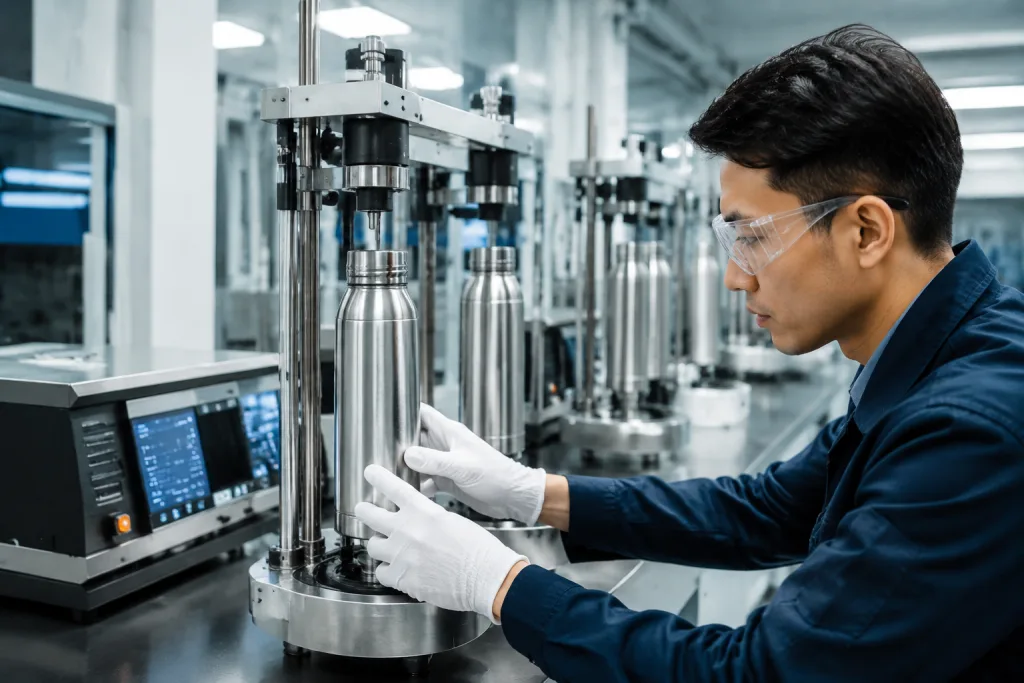
Write the insulation claim as a test method, not a sales line. “Keeps hot for 12 hours” is the wrong question to ask unless the PO states the start water temperature, ambient temperature, fill level, lid position, and reading times. We run the hot test with 95°C water from a calibrated digital thermometer, filled to rated capacity, lid closed, sitting in a 20°C test room, then record readings at 6, 12, and 24 hours. For cold testing, use 4°C water or an ice-water setup, with the same reading intervals and the same lid fitted on the bottle.
A practical 500 ml stainless vacuum bottle might hold hot water above 65°C after 6 hours and around 45-55°C after 12 hours, depending on mouth diameter and lid structure. A 38 mm narrow mouth usually beats a 55 mm wide mouth in our line tests. A straw lid loses heat faster than a sealed screw lid because the air path is harder to block. If the buyer wants hot coffee in winter plus cold sports drinks in summer, the math does not work with one cheap lid; we have seen this go sideways after QC pulled the sample and the 12-hour reading came back 8°C short.
The factory should test random production samples, not only the clean “golden” samples made before mass production. At BottleForge Industrial in Zhejiang, our standard inspection flow includes vacuum leak screening on the line, lid leak testing with inverted bottles, coating adhesion checks by 3M tape, plus sample thermal retention tests from each batch. For large thermos bulk orders above 10,000 pcs, ask for a written test report with batch numbers and retained samples; one EU buyer once flagged a PO typo where “65°C after 6 hours” became “56°C,” and that small mistake nearly changed the acceptance standard.
- Checklist: define the 95°C hot test, the 4°C cold test, the pass mark at each reading time, the number of samples per batch, and what happens if 1 sample fails.
- Failure action: if vacuum failure exceeds the agreed limit, hold packing at the carton stage and re-check the affected production lot before shipping.
- Buyer tip: wide-mouth bottles are easier to clean, but they usually need a tighter lid seal and better stopper design to protect insulation performance.
Logo choice changes durability
Buyer question: Which logo method will survive a custom thermos program without complaints?
There is no single “best” logo process. That is the wrong question to ask. Match the method to the bottle finish, PO quantity, artwork style, and wear test target. Laser engraving holds up well on powder coating or bare 304 stainless; on our 30W fiber laser, QC checks logo depth and edge burrs under a 10x loupe before the line packs. It works for outdoor retailers because nothing peels, but the contrast is usually silver-gray or dark metal, not full-color artwork. Silk screen printing fits one- or two-color logos on smooth bodies, especially when the logo sits inside an 80 mm × 45 mm panel. Ink matching and oven curing matter on powder coating; we have seen black ink pass on white coating, then fail a 3M tape pull after poor curing. Heat transfer and water transfer can carry multi-color graphics, but run scratch and adhesion tests before approving a large customized thermos order.
For a top promotional vacuum bottle, I usually push powder coating plus laser engraving when the buyer wants a rugged giveaway and fewer after-sale photos in their inbox. Simple works. For campaign merchandise with strict Pantone colors, silk screen or UV print is the cleaner choice, as long as the buyer accepts the setup time and color tolerance. One US buyer flagged a 1.2 mm logo shift on a tapered bottle sample; the artwork looked fine in the PDF, but the jig position on the curved wall exposed the issue. If the artwork wraps around the bottle, confirm print area, seam position, and handle clearance before sample approval. Cylindrical bottles run faster; tapered shapes need tighter tooling and slower alignment on the line.
MOQ changes with decoration. A stock color with laser logo may start from 500-1,000 pcs, depending on inventory. A new Pantone powder coat usually needs 1,000-3,000 pcs per color because the coating room has to clean the gun, screen the powder, and reserve one batch rack. Full custom thermos packaging may add another 1,000 pcs MOQ because box printing has its own setup cost. We ship plenty of first orders where the buyer wanted four bottle colors, three lid colors, and two box versions; the math doesn't work when the retail test is only 600 pcs. If you are a thermos distributor testing a new retail account, do not over-customize the first run. Start with one proven body, two colors, and one strong logo method.
- Checklist: request a pre-production sample with final coating, final logo size, final logo position, and final packaging; QC should pull one sample from the first decorated tray, not from the sales office shelf.
- Artwork format: send AI, EPS, or vector PDF files; JPEG logos cause rough edges, and we have had POs where “matte balck” became a coating-room question at 9 p.m.
Lids cause most complaints
Buyer question: Why do 6 out of 10 thermos promotional complaints involve the lid?
The stainless body gets the showroom attention. The lid causes the email chain. We’ve shipped bottles with mirror-clean 304 stainless bodies, then QC pulled the sample because the silicone gasket measured 1.8 mm instead of 2.2 mm and seeped at the thread. A soft gasket, loose thread tolerance, weak hinge pin, or straw valve that starts leaking after 200 flips will turn a good-looking order into after-sales work. For outdoor and promotional brands, lid testing needs the same pressure as logo approval.
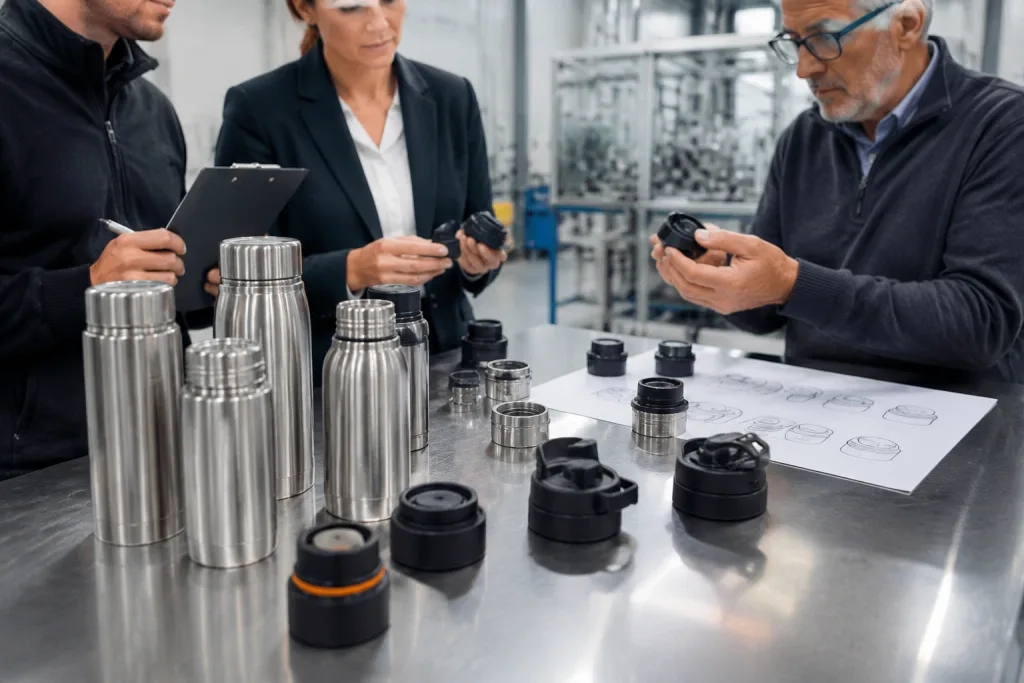
Common lid materials include PP, Tritan, stainless steel, and silicone. Ask your thermos vendor to name every food-contact part, including the gasket and straw, not just “plastic lid” on the spec sheet. For Europe, request LFGB-relevant documentation where applicable. For North America, FDA food-contact compliance is usually expected. If the lid has a carry loop, carabiner, flip mechanism, or push button, ask for cycle testing on the actual mold, not a nicer lab sample. We run 3,000-5,000 open-close cycles for moving parts as a normal internal check; on one 20,000 pcs promo order, the buyer flagged hinge whitening at 1,200 cycles, and the math didn’t work until we changed the pin material.
Leak testing should be practical. Fill the bottle with room-temperature water, close the lid, invert for 30 minutes, shake for 30 seconds, then check thread and gasket areas with dry tissue. Simple test. Good filter. For carbonated drinks, most vacuum bottles should not be marketed as suitable unless the lid is built for pressure; we’ve seen this go sideways when a PO only said “sports bottle” and the end user put soda inside. Hot liquid with a straw lid is also a safety risk because pressure can push liquid up the straw.
If you are buying from thermos manufacturers in China, ask whether replacement lids can be supplied after the main order. Distributors thermos programs do better with 1-2% spare lids in the shipment, especially when selling to outdoor clubs and retail chains. We usually pack spare lids in a marked inner carton, 50 pcs per carton, so the warehouse team does not lose them during receiving. Spare parts cost less than handling 8 kg urgent air shipments later.
MOQ and price reality check
Buyer question: What FOB price should I expect from a real thermos manufacturer?
For a standard 500 ml double-wall 304 stainless bottle with powder coating and a one-position laser logo, we usually see FOB Ningbo or Shanghai at USD 3.80-5.80 for 3,000 pcs. Lid design moves the number fast. So does the box. Last month QC pulled a 500 ml sample with 0.38 mm outer steel instead of the quoted 0.45 mm, and that “cheap” offer explained itself in 2 minutes. A lower quote can be real if the lid is basic, the steel is thinner, the color comes from shared stock powder, or the export carton uses lighter 5-ply board. A higher quote can still be clean business if it covers premium lid tooling, copper lining, retail box, recycled stainless content, or tighter inspection.
MOQ is not a punishment. It comes from setup time on the coating line, logo fixture setup, packaging print setup, and material purchasing. We run about 18-22 minutes just to adjust the spray gun and hanging pitch when changing from matte black to a new Pantone color, so 500 pcs does not carry the line well. A supplier thermos factory may accept 500 pcs for stock color laser engraving, but a new Pantone color below 1,000 pcs is the wrong question to ask because the math does not work. For a new mold, expect 30-45 days tooling time and a total first-order lead time of 60-75 days after sample approval. For existing molds, normal production lead time is 25-35 days after deposit and artwork confirmation, or 40-50 days during August to October peak season in China.
When you compare thermos suppliers, ask for one quotation table using the same bottle wall thickness, same lid, same coating, and same packaging at 1,000, 3,000, 5,000, and 10,000 pcs. This shows where the real price breaks sit. We have seen buyers compare a retail-box quote against a white-box quote and then flag a USD 0.42 gap as “too high.” That goes sideways. Separate the one-time charges too: sample fee and mold fee on one line, then Pantone coating setup, logo plate, carton drop test, and lab testing with clear ownership.
- Checklist: compare FOB port and Incoterms first, then payment terms, carton quantity, net weight, gross weight, and CBM from the packing data.
- Do not ignore: a USD 0.25 cheaper bottle can cost more after freight if the carton cube is 15% larger; our forwarder once flagged 62 cartons where the PO listed 0.058 CBM but the measured carton was 0.067 CBM.
Inspection before the balance payment
Buyer question: What should I inspect before shipping a top promotional vacuum bottle order?
Run the inspection before balance payment, not after the container has rolled out of the China factory. For most promotional and outdoor retail orders, we run ANSI/ASQ Z1.4 sampling with AQL 2.5 for major defects and AQL 4.0 for minor defects. If the bottles are going into a strict retail chain, set AQL 1.5 for major defects on the PO before mass production starts. The math changes. On one 12,000 pcs thermos order, the buyer asked for tighter AQL after packing, and QC had to reopen 480 cartons with a tape gun and carton knife at the loading bay. Tell the thermos manufacturer early, because tighter AQL means extra internal sorting, more QC hours, and usually 2–3 days added to the schedule.
Major defects mean leakage, sharp edges, wrong material, poor vacuum, wrong logo, wrong color beyond the approved limit, missing accessories, broken lids, or unsafe contamination. Minor defects mean coating specks under 0.5 mm, slight print alignment drift inside tolerance, light carton scuffing, or small cosmetic marks away from the main logo area. Photos help. For strict buyers, we attach defect photos to the inspection standard and mark the limit sample with a red sticker, because “small scratch” means one thing to the factory and another thing to a retail buyer in Germany.
For a customized thermos order, the inspector should check capacity with a measuring jug, weight on a 0.1 g scale, dimensions with a digital caliper, logo position, barcode, retail box, carton marks, FNSKU if used for FBA, and packaging drop performance if required. Carton labels are not paperwork. They are receiving tickets. If you are a thermos distributors group shipping to 3 warehouses, carton labeling matters more than buyers expect. We have seen this go sideways: bottles passed, but the buyer flagged a PO typo on the side mark, and inbound receiving sat for 9 days.
Ask for production photos, but do not treat photos as inspection. This is the wrong question to ask after problems show up. A factory thermos line can show 20 clean units under a light box while 5,000 pcs still need proper sampling from sealed cartons. We recommend final random inspection when at least 80% of goods are packed and 100% are finished. For high-value thermos customized programs, add an in-line inspection after coating and before logo application. QC pulled the sample at that stage on a 6,000 pcs job last month and found color drift of about 1.2 mm on the spray edge, before the most visible branding step made the loss bigger.
Send your thermos spec and target order quantity
We will quote realistic FOB pricing, MOQ, logo options, and lead time from our Hangzhou stainless drinkware production base.
Frequently asked questions
Can I order 500 pcs of a top promotional vacuum bottle with my logo?
Yes, if you use an existing bottle body, stock color, and a simple logo method such as laser engraving. For 500 pcs, expect a higher unit price because setup cost is spread across fewer bottles. A realistic MOQ for a stock-color custom thermos is 500-1,000 pcs. If you need a new Pantone powder coat, custom box, or special lid color, the MOQ usually moves to 1,000-3,000 pcs per SKU. For outdoor retail programs, I usually advise 1,000 pcs minimum so you can afford proper pre-production sampling, carton marks, and AQL inspection without making the unit cost look distorted.
What lead time should outdoor retailers plan for thermos bulk orders?
For an existing stainless vacuum bottle mold, plan 25-35 days production after deposit, artwork approval, and sample confirmation. Add 5-10 days if you need a physical pre-production sample shipped to Europe or North America. During China peak season, especially August to October, use 40-50 days because coating lines and packaging suppliers get crowded. New mold development is slower: 30-45 days for tooling and sample adjustment, then production time after approval. Ocean freight can add roughly 25-40 days to North America or Europe depending on port and routing.
Which logo method is safest for an outdoor promotional thermos?
For outdoor use, powder coating plus laser engraving is usually the safest combination. It handles abrasion better than many printed logos and has fewer color-matching risks. The tradeoff is that laser engraving does not deliver full-color artwork. If your promotional brand requires Pantone color logos, silk screen or UV printing can work, but ask for tape test, cross-hatch adhesion test, and rub test before bulk approval. For orders above 3,000 pcs, pay for a final pre-production sample using the real coating, real logo process, and real carton. Do not approve decoration from a digital mockup only.
Do I need third-party testing for a customized thermos?
If the order is for retail sale in Europe or North America, third-party testing is worth budgeting. Common checks include food-contact compliance, LFGB or FDA-related testing, REACH screening for coatings, BPA-free confirmation for plastic parts, and sometimes CA Prop 65 review. For children’s products, requirements become stricter and may involve ASTM or CPSIA-related checks. Testing cost can range from a few hundred USD to over USD 1,500 depending on scope. Ask your thermos supplier for existing reports first, but make sure the tested material, coating, lid, and model match your actual order.
How do I compare two thermos manufacturers fairly?
Give both manufacturers the same specification sheet: capacity, 304 stainless inner wall, outer material, wall thickness target, lid type, coating, logo method, packaging, MOQ, AQL, FOB port, and required certificates. Ask for prices at 1,000, 3,000, 5,000, and 10,000 pcs. Then compare CBM, carton strength, lead time, sample cost, spare parts availability, and inspection support. A thermos supplier that is USD 0.30 cheaper may not be cheaper after freight, rework, or rejected goods. For distributor thermos programs, stable repeatability matters more than winning the first quote by a few cents.