Key Takeaways
- Start a top promotional Tritan bottle order with a 3,000-piece MOQ and 12-18 day sample-to-approval window
- Specify Eastman-grade Tritan, food-contact compliance, lid torque, and drop testing before price negotiation
- Use AQL 2.5/4.0 inspection, not just nice photos from the canteen factory
- Budget USD 1.45-2.85 FOB China for most 600-750 ml promotional Tritan bottles
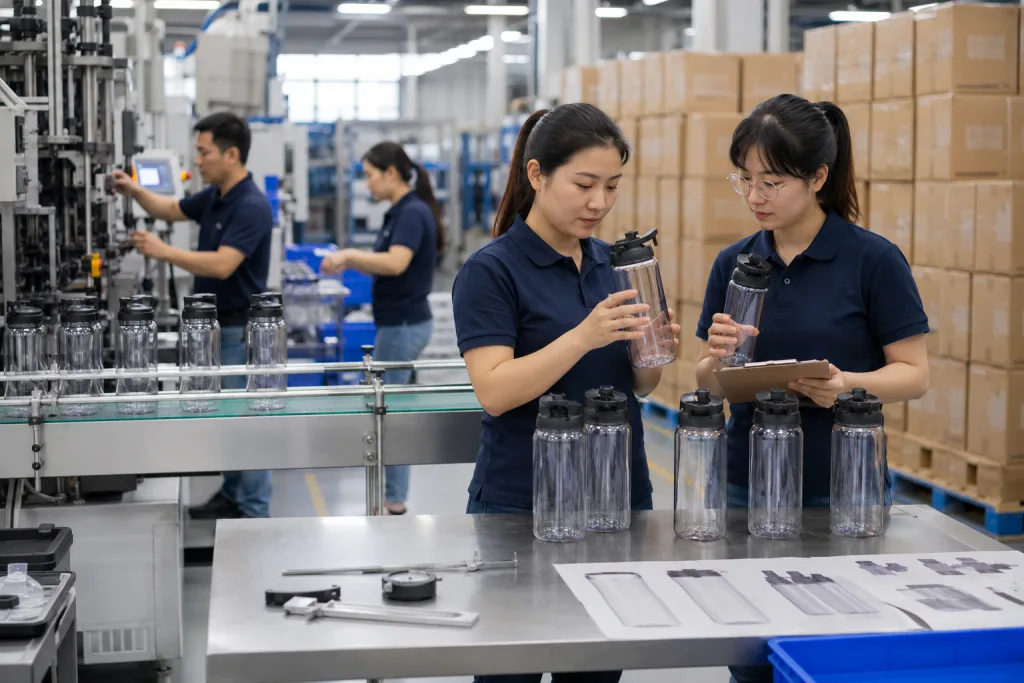
You are not buying “a bottle.” You are buying 5,000 to 50,000 pieces that need the same clear body, the same lid feel, a logo that survives carton rub, and delivery before the campaign date. Miss one detail and the math gets ugly. On the line, QC pulls the approved sample with a digital caliper and checks mouth ID, lid thread bite, and logo position in mm; that is where a top promotional Tritan bottle either matches the catalog promise or starts creating after-sales noise for your sales team.
Here is a real buyer scenario: a 650 ml clear Tritan sports bottle for a European fitness client, one-color branding, retail-ready packing, shipment from China within 45 days. BottleForge Industrial in Hangzhou, Zhejiang runs custom drinkware projects like this every week, with typical MOQ from 3,000 pieces and monthly output around 420,000 plastic and stainless drinkware units. We ship these jobs, but 45 days only works if artwork, packing dieline, and PO specs line up by day 3; we have seen this go sideways over a “clear” body note that the buyer meant as water-clear, while the PO typo said “smoke clear.”
Start With The Use Case
The first mistake is asking a canteen supplier for “your best Tritan bottle” before the job is defined. Wrong question. Best for a gym chain is not best for a university welcome pack. For this buyer scenario, the end client wants a 650 ml bottle for fitness giveaways, so we spec one-hand opening, a leak-resistant lid, clear water scale, and a flat print window that holds a 45 mm logo without wrapping into the curve. On our line, QC checks the logo area with a 60 mm steel ruler before artwork approval. It does not need a premium gift box. It does need a clean retail look: no cloudy body, no lid flash, no barcode sticker slapped over the brand mark.
For a top promotional Tritan bottle, I would write the specification before asking any canteen vendors for price. Keep it short. Make it measurable. We run this as a 6-line spec on the RFQ sheet, because long briefs get copied wrong; last month a buyer sent “650 m” on the PO, and the merchandiser had to catch it before mold confirmation:
- Capacity: 650 ml nominal, tolerance ±3%, checked with a graduated measuring cylinder before packing.
- Material: BPA-free Tritan body, PP lid, silicone gasket, with resin brand and batch number listed on the pre-production sample tag.
- Wall thickness: 1.8-2.2 mm at the body, checked at three points with a digital caliper.
- Logo: one-color silk screen, 45 x 55 mm, Pantone reference required, with 2 mm clearance from the curved edge.
- Leak test: filled bottle inverted for 30 minutes, no visible leakage on kraft paper.
- Drop test: 1.0 m drop on three sides with water filled to 80%, then lid thread and hinge checked by hand.
This is where distributor drinkware projects go sideways. We have seen vendors quote a cheaper 600 ml mold with a thinner wall and call it “same style.” It is not the same if your client approved a heavier hand feel; the buyer flagged this once after QC pulled the sample and found 1.45 mm at the shoulder. A serious canteen manufacturer in China should confirm resin source, mold number, lid material, gasket color, and available logo area before quoting. If they cannot answer those questions, the USD 0.12 saving is not real. The math does not work after one re-sample and 7 days lost.
Lock The Commercial Frame
After the spec sheet is locked, pricing stops drifting. Use this working case: 10,000 pieces, one-color print, individual polybag, white inner box optional, export carton, FOB Ningbo. For a standard 650 ml Tritan model, a practical FOB China range is USD 1.45-2.85, based on resin grade, lid parts, carton style, and whether we run silk screen or heat transfer. If a supplier quotes USD 0.88 for the same bottle, this is the wrong question to ask: do not ask for a discount first, ask for the resin name and wall thickness in mm. QC pulled one sample last year marked “Tritan” on the PO, but the burn test and transparency check told us it was low-grade PC blend.
At BottleForge in Zhejiang, our normal MOQ for canteen custom plastic bottles is 3,000 pieces per color when we use existing molds. For a new body color, 5,000 pieces is more realistic because the color masterbatch trial, purge material, and first-shot adjustment can eat 60-90 kg of resin before the line runs clean. For a fully private mold, the tooling fee often starts around USD 6,000-18,000, and lead time adds 30-45 days before mass production. Most promotional buyers do not need that unless the campaign requires a protected shape. We have seen this go sideways: one buyer paid for a private grip pattern, then changed the logo panel after T1 samples, which cost 12 days and another mold insert charge.
Define payment and shipping terms early. Clean terms are 30% deposit and 70% before shipment after inspection. FOB Ningbo or FOB Shanghai works well for experienced canteen distributors because your forwarder controls the freight and sailing schedule. DDP looks easy, but the math often does not work; some quotes assume thin 5-layer cartons, weak dividers, or freight declared below the real bottle value. For North America and Europe, ask for carton dimensions, gross weight, HS code, and estimated CBM before confirming. A 10,000-piece order may occupy roughly 18-26 CBM depending on bottle shape and packing, and our packing table uses a tape measure and carton drop notes, not a guess from sales. The buyer flagged this once when a PO typo showed “18 cartons” instead of “18 CBM”; catching it before booking saved a missed vessel.
Sample Approval Without Guesswork
The pre-production sample is not a souvenir. It is the bulk reference we put beside the line when QC checks cartons. For a top promotional Tritan bottle order, ask the canteen factory for two samples: one blank physical sample, then one printed pre-production sample after artwork approval. The blank sample checks grip, lid torque, 650 ml fill line, clarity, and whether the bottle sits tight in the color box. The printed sample checks logo position, ink adhesion, Pantone match, and whether the curved wall stretches the artwork. QC pulled one sample last year where the logo looked fine on the PDF but shifted 4 mm after screen setup.
Normal sample timing from China is 3-5 days for available blank stock and 7-10 days for printed samples after vector artwork is confirmed. International courier to Europe or North America usually adds 3-5 working days. Put 12-18 days into your project calendar before mass production. Not “a few days.” If your campaign date is fixed, do not let your client spend two weeks debating whether the logo should be 38 mm or 42 mm wide; we have seen that go sideways on a 5,000 pcs order.
For artwork, send AI, EPS, or PDF vector files. If you only have a PNG, the print edge may look soft, especially when the operator burns the silk screen at 120 mesh. For silk screen printing on Tritan, one-color logos are the safest and cheapest. Multi-color logos need tighter registration and create more rejects on cylindrical bottles. The math does not work for a low-MOQ rush order. Laser marking is not suitable on clear Tritan the way it works on 304 stainless. UV printing works for full-color customized drinkware, but approve scratch resistance on the actual bottle surface; a flat test plate tells you almost nothing.
My rule: do not release deposit for mass production until the signed sample includes bottle, lid, gasket, logo, color, and packing. Verbal approval is where disputes begin; one buyer once approved by WhatsApp, then flagged the 1 mm gasket color difference during final inspection.

Compliance Is Not Decoration
For promotional drinkware, compliance is not paperwork for the folder. It decides whether the order ships. Tritan sells well because it is clear, impact-resistant, and BPA-free, but the finished bottle still needs food-contact documents that match your market. For the EU, ask for LFGB or EU food-contact test reports where applicable, plus REACH and packaging material declarations if your client requires them. For the United States, ask whether materials are FDA food-contact compliant and whether the bottle is for cold drinks only. We had one buyer flag “dishwasher safe” on a 20,000 pcs PO after QC pulled the sample and found the print softened after 10 cycles at 70°C. Do not print that claim unless the test report says it.
A canteen manufacturer should provide material declarations for the body, lid, gasket, straw if used, and ink, with the material grade written clearly, not buried in a supplier email. If you are buying for children, the rules get tighter. For kids’ drinkware, ASTM, CPSIA, lead, phthalates, and small-parts concerns may apply. Your 650 ml fitness bottle is adult promotional merchandise, so the compliance path is simpler, but you still need clean records if a retailer or corporate client audits the order. On our line, QC checks the lid gasket with a 0.02 g scale after assembly because one missing silicone ring can turn into a carton-level complaint.
Factory social compliance also matters for promotional programs going into retail or corporate gifting. European buyers often request BSCI, Sedex, or similar audit records before they release artwork. Not every canteen supplier owns every process. Printing, silicone parts, and packaging may be handled by approved subcontractors, which is normal in Zhejiang and wider China manufacturing. Ask who controls final assembly and inspection. This is the wrong question to skip. If the logo printer uses the wrong Pantone or the color box arrives 2 mm short, the export factory still needs to own the QC result, even when one component comes from a specialist supplier.
If a canteen vendor says “we have all certificates” but sends a five-year-old report for a different material, push back. We have seen this go sideways when the report said PC, the bottle was Tritan, and the buyer noticed it 3 days before vessel closing. A report is useful only when it matches the product, material, and market you are selling into.
Production Checks On The Line
Mass production for a canteen customized order normally starts after the deposit lands, artwork is approved, and the signed pre-production sample is on our sample rack. For 10,000 pieces of an existing Tritan bottle, we would quote 25-35 days after sample approval. In peak months before summer campaigns and Q4 gifting, add 7-10 days. If a factory promises 12 days, ask one question: are the clear bodies already molded and sitting in cartons? If not, the math does not work. We run this check on our ERP before confirming the PI, because one PO typo on Pantone 186C vs 186U once cost a buyer 6 extra days.
During production, set checkpoints where problems actually appear. Incoming inspection should cover the Tritan resin batch, lid components, silicone gasket color, and carton board thickness, usually checked with a 0.01 mm caliper and a resin lot label photo. After injection and assembly, QC should pull samples from the line for bottle clarity, black specks, flash on the mouth, lid thread fit, and gasket placement. Final inspection comes after printing and packing. This is where customized canteen orders often fail: the bottle seals fine, but the logo sits 4 mm off-center or the ink scratches off after packing friction.
Use tests a line inspector can repeat without drama. Rub the printed logo 50 cycles with a dry cloth and 20 cycles with a damp cloth. Apply 3M tape once to check ink lift. Fill 20 bottles from the line and invert them for 30 minutes on a white inspection tray. Open and close lids 30 times if the design uses a flip cap, because hinge fatigue shows up fast on cheap PP lids. Measure 10 bottles for capacity and weight. If the approved sample weighs 118 g and bulk pieces average 101 g, something changed. Stop the line.
For formal inspection, AQL 2.5 for major defects and 4.0 for minor defects is common for promotional drinkware. Critical defects should be zero. Critical means sharp edges, contamination, wrong material, severe leakage, or unsafe parts. Minor scratches can be discussed with photos and defect mapping; leaking lids cannot. We have seen buyers push back on one tiny scuff, then accept a weak gasket by mistake. That is the wrong trade.

Packing For Real Distribution
Buyers often stare at the bottle drawing for 3 days and leave packing to the last email. Bad habit. A canteen distributor order can move from our Hangzhou line to Ningbo port, sit in a damp CFS warehouse for 6 days, cross the ocean, then get split into parcel or pallet networks. Weak cartons turn good bottles into a claim; QC pulled one sample last May where the bottle passed, but the outer carton crushed at the bottom corner after a 1.2 m drop test.
For this 650 ml bottle, we usually run one bottle in a polybag, 50 pieces per export carton, five-layer corrugated carton, gross weight around 9-12 kg depending on design. Carton wall thickness is normally 6-7 mm, and the tape should be 48 mm wide, not the thin office-style tape some buyers try to approve. If the bottle has a glossy body, add tissue or a thin protective sleeve to reduce scuffing; we have seen black Tritan show hairline rub marks after only 300 km of truck vibration. If your client needs retail handling, use an individual kraft box or white box, but expect extra cost of USD 0.12-0.35 per piece and higher CBM. For Amazon or marketplace programs, request FNSKU labeling, carton labels, and drop-test-ready master cartons before production starts.
Carton markings should include item number, quantity, gross weight, net weight, carton size, made in China, and any customer PO reference. Check the PO spelling too; we once had “Trian” printed on 420 cartons because the buyer’s artwork file had the typo and nobody flagged it before carton printing. For mixed colors, do not allow random cartons unless your warehouse can handle it. Mark color and quantity clearly on two sides, with letters at least 20 mm high so the warehouse team can read them on a stacked pallet. If you are a canteen distributor shipping to 8 branches, ask the supplier to pack by destination or create a packing list by pallet. This takes planning, but it is cheaper than re-sorting 10,000 bottles in a European warehouse.
For ocean freight, palletization is optional but useful when your client has strict receiving rules. For LCL shipments, I prefer stronger cartons and corner protection over saving USD 0.03 per unit. The math doesn't work. One rejected carton photo from the buyer, usually with a forklift bruise or wet bottom panel, costs more time than the packing upgrade we should have quoted at the start.
Final Release And Reorders
Before final payment, ask for a finished goods inspection report with carton photos, random unit photos, logo close-ups, leak test results, capacity readings, and carton drop notes if the drop test was run. If you book a third-party inspector, send the approved sample, artwork, packing instruction, and AQL level before they enter the warehouse. We run this check against the golden sample under a 6000K light box; a sales invoice will not tell the inspector that the logo was approved at Pantone 286C, 38 mm wide.
For a 10,000-piece top promotional Tritan bottle order, inspect at least general level II under ANSI/ASQ Z1.4 or ISO 2859-1 sampling. If defects exceed the limit, hold balance payment until the factory sorts or reworks the stock. The factory may say promotional bottles allow loose tolerance, and some tolerance is fair. The math does not work for wrong logo color, cracked caps, or leaking bottles; QC once pulled 14 leaking caps from a 200-piece sample after a 30-second inverted leak test, and the buyer flagged it before we shipped.
After shipment, save the full production file: quotation; PI; artwork; sample approval photos; material declarations; inspection report; carton labels; final packing list. This is not paperwork for fun. It keeps the reorder clean and protects your margin. We normally run a repeat customizable drinkware order in 20-25 days when the Tritan body, cap color, mold rack label, and silk-screen fixture are unchanged; with missing files, the same reorder can stretch to 32-40 days because prepress starts again. Bad files turn the second order into another first order.
For brand owners building a wider custom drinkware range, the same workflow fits a custom canteen, customizable growler, customized growler, or distributor growler program. The shape changes. The buying discipline stays the same: define the use case with temperature and drop-risk details, approve a real sample from the line, test the risks that matter, and tie the factory to measurable standards. On our line, the growler cap torque gauge reads in kgf·cm, while a Tritan bottle cap may need a different fixture; skipping that detail is where we have seen projects go sideways.
Send your Tritan bottle brief for factory review
Share capacity, quantity, logo method, market, and delivery date. We will respond with MOQ, FOB pricing, sample timing, and QC notes.
Frequently asked questions
What is a realistic MOQ for a top promotional Tritan bottle?
For an existing mold, 3,000 pieces per color is a realistic MOQ from a capable canteen supplier in China. Some canteen suppliers may accept 1,000 pieces, but the unit price usually rises because setup, printing, and export packing costs are spread over fewer bottles. For custom body colors, 5,000 pieces is more practical because resin color matching creates waste during injection molding. For a private mold, expect 10,000 pieces or more for the first production run, plus tooling cost. If your client only needs 500 pieces, choose stock color bottles with simple logo printing rather than a full customized canteen program.
How long does a custom Tritan bottle order take from artwork to shipment?
For a standard canteen customizable order, plan 12-18 days for sample approval and 25-35 days for mass production after deposit and signed sample. Add 3-5 working days for courier samples to Europe or North America. Ocean freight is separate and can take 25-45 days depending on destination port and route. If the order uses a new mold, add 30-45 days for tooling and mold trial. Rush orders are possible when blank bottles are in stock, but you should still allow time for print curing, QC, packing, and booking. A promise of 15 days door-to-door for 10,000 pieces deserves careful questioning.
Which logo method is best for promotional Tritan bottles?
For most canteen promotional orders, one-color silk screen printing is the safest choice. It is economical, clean, and works well on a flat or gently curved print area. Typical logo cost is already included or adds around USD 0.05-0.15 per piece depending on size and color count. UV printing is useful for full-color designs, but you should test scratch resistance on the actual Tritan surface. Heat transfer can produce strong graphics but may be overkill for short campaigns. Laser engraving is better suited to stainless steel than clear Tritan. Always approve a printed sample and run tape and rub tests before mass production.
How do I compare quotes from different canteen manufacturers?
Compare the whole specification, not only the FOB unit price. Ask each canteen manufacturer to confirm material grade, capacity, bottle weight, wall thickness, lid material, gasket type, logo method, packing, carton quantity, lead time, payment terms, and inspection standard. A USD 1.62 quote may be cheaper than USD 1.50 if it includes stronger cartons, better resin, and lower defect risk. Also ask whether the supplier is a real canteen factory or a trading office. A trading office can be useful, but it must still control QC. If two quotes differ by more than 20%, assume the product is not identical until proven otherwise.
Can one supplier handle Tritan bottles, custom growler orders, and other drinkware?
Yes, but check whether the supplier truly manages those categories or only collects catalogs. A factory strong in Tritan injection molding may not produce stainless vacuum growlers in the same workshop. That is normal in China; the key is project control. For a custom growler, customizable growler, or customized growler, you need different checks: vacuum insulation test, 304 or 316 stainless steel confirmation, powder coating adhesion, and lid thread fit. For distributor drinkware programs, one coordinated vendor can simplify artwork, packing, inspection, and export documents. Just make sure each product category has its own measurable QC standard rather than one generic inspection checklist.