Key Takeaways
- Start with a 500 ml or 750 ml custom thermos if you need retail appeal and a stable unit cost under USD 4.80 FOB Ningbo at 3,000 pcs
- Confirm 304 stainless steel, 0.4 mm inner wall, vacuum retention targets, and lid material before approving artwork
- Use AQL 2.5 for major defects and AQL 4.0 for minor defects on promotional thermos inspections
- Plan 7 days for sampling, 25-35 days for mass production, and 3-5 days for final inspection and rework buffer
Your buyer wants a stainless bottle that looks ready for a retail shelf, your sales team wants the logo to sit clean at 38 mm wide, and finance wants landed cost fixed before the campaign calendar closes. This is where promotional thermos orders get messy: 3 capacity requests on one RFQ, artwork sent as a 72 dpi JPG, and no AQL 2.5 plan until the line is already polishing shells. Bad timing.
Here is the shop-floor version we use at BottleForge Industrial in Hangzhou, Zhejiang when an outdoor retailer or promotional brand asks for a top promotional thermos program. We follow one real-style order from spec sheet to final inspection, with MOQ, carton drop notes, export terms, and the awkward details buyers learn late—like the PO that says “matte black” while the approved sample is Pantone 426C powder coat.
The buyer brief is not enough
Say you are buying 5,000 pcs for an outdoor retailer’s spring camping promo. The brief reads: top promotional thermos, matte black, logo on front, gift box, ship to Germany. Clear enough for a buyer meeting. Not clear enough for our costing sheet. Last month QC pulled a similar sample and found the “matte black” was actually semi-gloss under the light box, which changed the coating spec and the quote.
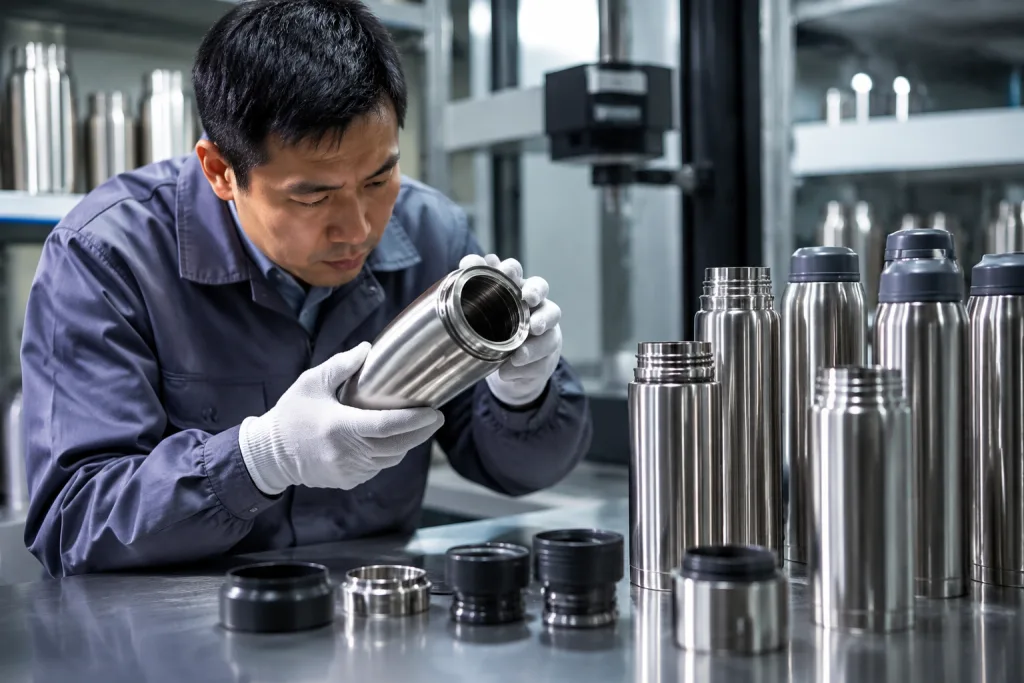
The first job is to turn that brief into a working specification. For this order, we would start with a 750 ml double-wall vacuum stainless thermos, 304 food-grade inner and outer body, 0.4 mm inner wall thickness, 0.5 mm outer shell, powder-coated finish, PP lid with silicone seal, and a leak test requirement of 0 ml leakage after 30 minutes upside down. If the buyer needs a lower shelf price, a 500 ml model normally saves USD 0.25-0.45 per unit depending on lid design. We run the wall thickness check with a micrometer before the sample goes to vacuum testing.
As a China factory thermos supplier, we quote from structure first, not from a photo. A product photo does not show steel gauge, vacuum time, coating grade, or whether the lid needs a carry loop. Those details move cost fast. We have seen this go sideways when a buyer approved a photo, then flagged the production lid because the loop felt weak under a 5 kg pull test.
For a promotional brand, the target may be USD 3.60-4.80 FOB Ningbo for 3,000-5,000 pcs. For outdoor retailers, the same customized thermos may need 2H scratch-resistant coating, a 5-layer export carton, barcode labels, and REACH or LFGB paperwork, pushing cost up by USD 0.20-0.55. That is normal, not a factory trick. The math does not work if the brief asks for retail-grade packaging but the target price is built like a giveaway item.
Our Hangzhou, Zhejiang team will ask for the retail channel, destination market, expected use, logo method, packaging, and inspection standard before giving a serious price. We also check the PO line by line; one buyer once typed “Germany” in the email and “Greece” on the shipping mark file. If a supplier thermos quote arrives in 10 minutes with no questions, assume something important is missing.
Lock the thermos before artwork
Too many buyers start with logo color. I get it; that is what the end customer notices first. For a bulk thermos order, lock the bottle platform before the designer spends 2 hours on branding. We have seen this go sideways: one buyer approved artwork on a screw-lid sample, then changed to a push-button lid, and QC pulled the counter sample with the logo sitting 11 mm too high. The mockup was useless because the lid height changed the visible print area by 8-15 mm.
For this buyer scenario, the retailer picks a 750 ml customizable thermos with a narrow base for cup holders, 7.2 cm diameter, 28.5 cm height, and about 380 g empty weight. We run the heat test with a calibrated probe and record sheet: hot water should stay above 65°C for 6 hours, and cold water should stay below 10°C for 12 hours, tested at 20-22°C room temperature. That is a realistic promotional thermos target. Printing “24 hours hot” on the carton without testing the exact model is the wrong question to ask; the buyer flagged that claim on a PO last March, and the math did not work for that structure.
Next, choose the branding method based on the finish and order size. Laser engraving is clean on powder coating and usually costs USD 0.08-0.18 per position at 3,000 pcs; our line checks contrast under a D65 light box before we release the sample. One-color silkscreen works better for a large visual logo, normally USD 0.06-0.12 per position, but the coating needs a 3M tape adhesion test after curing. Full-wrap heat transfer can look retail-grade, but it adds setup time and reject risk, usually USD 0.35-0.80 per unit; on a 5,000 pcs run, even a 3% wrinkle rate means 150 bottles go back to sorting.
A PO-ready thermos custom order needs vector artwork in AI, EPS, or PDF format, with Pantone references for printed logos. For laser, send black vector only and approve the real engraved contrast on the sample, not the screen mockup. Simple rule. Matte black with laser engraving often shows silver-grey, while navy coating can give a softer mark; last week our sample room measured a 0.4 mm line gap where the customer’s small text filled in after engraving.
At this stage, the manufacturer thermos quote must name the exact model code, material grade, finish, logo process, packaging, MOQ, sample charge, production lead time, and FOB port. If those details are not written down, you do not have a PO-ready offer yet. We ship from Ningbo or Shanghai, but the quote still has to say it; one PO typo changed “FOB Ningbo” to “FOB Qingdao,” and accounting stopped the file for 1 day.
Sampling proves the uncomfortable details
For this order, we would run two pre-production samples: one blank functional sample and one logo sample. If the bottle body is already in our mold library, normal sample lead time is 5-7 working days; last month our 750 ml straight-body sample took 6 working days because the powder coating line was already set for matte black. A new lid mold is a separate job. Expect 25-40 days and tooling cost from USD 1,500 depending on thread depth, silicone seal design, and whether the mold needs a slide core.
The sample is not a souvenir. It is a test object. Fill it with boiling water, weigh it on a 0.1 g bench scale, check the lid thread with 5 open-close cycles, put it in a backpack side pocket, then scratch the coating the way a buyer will after 2 weeks of use. If your outdoor retailer sells to hikers or fishing customers, the lid grip matters as much as the logo. We have seen this go sideways: one buyer loved the print, then QC pulled the sample and the lid was hard to open with wet hands. A pretty custom thermos that fights cold fingers will create returns.
For QC, define acceptance criteria before mass production. In our scenario, the buyer signs off capacity at 750 ml ±5%, assembled height tolerance at ±2 mm, no visible dents at 50 cm viewing distance under the inspection lamp, logo position tolerance at ±2 mm from the center line, no coating peel after 3M tape test, no leakage after 30 minutes inverted, and vacuum performance meeting the agreed hot or cold target. This is the wrong question to ask: “Can you make it look like the sample?” Ask what gauge, fixture, tape, timer, and viewing distance the inspector will use.
This is where working with a China thermos factory directly saves trouble. You can ask for a signed golden sample and keep one sample at your office, one at the factory, and one with the inspection company. We usually mark the carton with buyer code, color code, and sample date, because a PO typo like “mat black” instead of “matte black” has already caused a 12-hour hold on our line. If you work through a thermos vendor or distributor thermos middle layer, make sure the same approved sample reaches production, not just the sales desk.
BottleForge Industrial runs stainless drinkware production in Zhejiang with monthly capacity around 300,000 units across thermos and travel tumbler lines. Our normal MOQ for stainless thermos customized orders is 1,000 pcs per color, but 3,000 pcs gives better coating and logo efficiency because we run fewer color changes on the spray booth and fewer screen adjustments on the logo table. Small orders are possible. Cheap small orders are usually not; the math doesn't work once you add sample freight, coating setup, logo plate, and AQL inspection cost.
Packaging changes the real cost
Promotional buyers often compare only the bottle price. Outdoor retailers cannot do that. A thermos bulk order can get rejected at receiving if 600 gift boxes arrive crushed, even when every bottle passes vacuum test. Packaging is part of the product for retail and distributor thermos programs; we have seen QC pull clean bottles from a carton and still fail the shipment because the corner crush on the box measured 18 mm.
For the 5,000 pc order, you might choose a white tuck-end gift box, 350 gsm paperboard, one-color print, with a polybag around the bottle. Cheap and workable. We run this pack for price-driven promotional thermos jobs when the bottle goes straight into a giveaway tote, not onto a shelf. If it goes to retail shelves, I would move to a 400 gsm color box with E-flute insert or molded pulp insert, adding roughly USD 0.18-0.45 per unit. For North America e-commerce or Amazon FBA style routing, add FNSKU labels, 80 cm carton drop-test checks, and tighter master carton weight control; the buyer flagged this on one PO after the barcode sat 12 mm too close to the carton seam.
A typical master carton for 750 ml stainless thermos may pack 24 pcs, around 58 x 40 x 32 cm, gross weight 12-15 kg depending on bottle and box. Keep cartons below 15 kg if warehouse handling is strict. The math does not work if the carton saves USD 0.06 but creates repacking labor at the 3PL. For Europe, ask whether the importer needs Green Dot, FSC paper claims, or local packaging registration information. For California or broader US promotional programs, review food-contact requirements and warning label expectations with your compliance team; we usually check the carton mark artwork on a 1:1 printout before the line starts sealing boxes.
Do not let packaging be quoted as “standard box” unless you have seen the dieline and material. Standard for one thermos suppliers group may mean thin 300 gsm paper; for another, it may mean a retail-grade box. Those two packages can differ by USD 0.20 per unit and create different customer reactions. Ask for the box bursting strength or at least a photo of the paperboard caliper reading; we use a digital caliper on incoming packaging because “same as last order” has gone sideways more than once.
Before mass production, approve a packing instruction sheet showing unit pack, carton quantity, carton marks, barcode placement, pallet requirement, and spare parts if any. One page is enough. It should list details like 24 pcs/ctn, desiccant position, spare lid quantity, and whether the master carton needs two side marks or four. This sheet prevents shipment delays; last quarter, one typo on a PO changed “neutral carton” to “retail carton” and cost 2 extra days before we could release the goods.
QC starts before final inspection
Final inspection matters, but catching the wrong lid, wrong coating color, or a 42 mm logo printed at 48 mm after packing is too late. For a top promotional thermos order, we start QC at incoming material and keep it on the line through forming, welding, vacuuming, polishing, coating, printing, assembly, and packing; last month QC pulled a sample where the PO said matte black but the approved color panel was Pantone Black 6C.
On stainless thermos production, the risk points are plain. Vacuum failure, coating chips, lid leakage, silicone smell, rough mouth edge, logo drift over 1.5 mm, and crushed export cartons drive most complaints. We check these before sealing cartons, because we’ve seen this go sideways when a buyer flagged 312 leaking lids only after the goods reached Rotterdam.
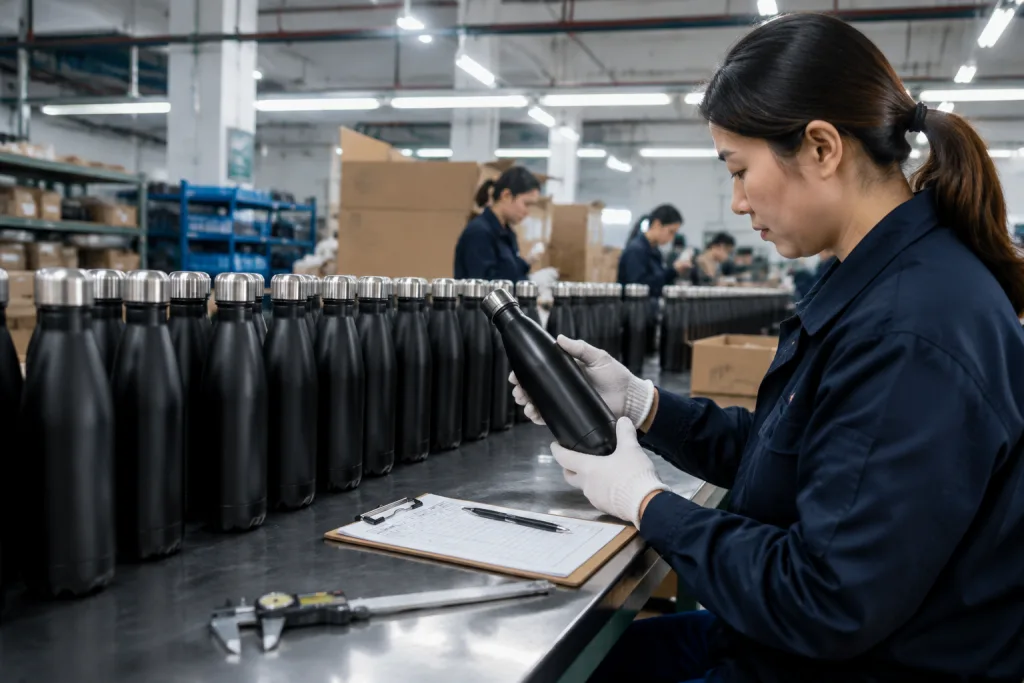
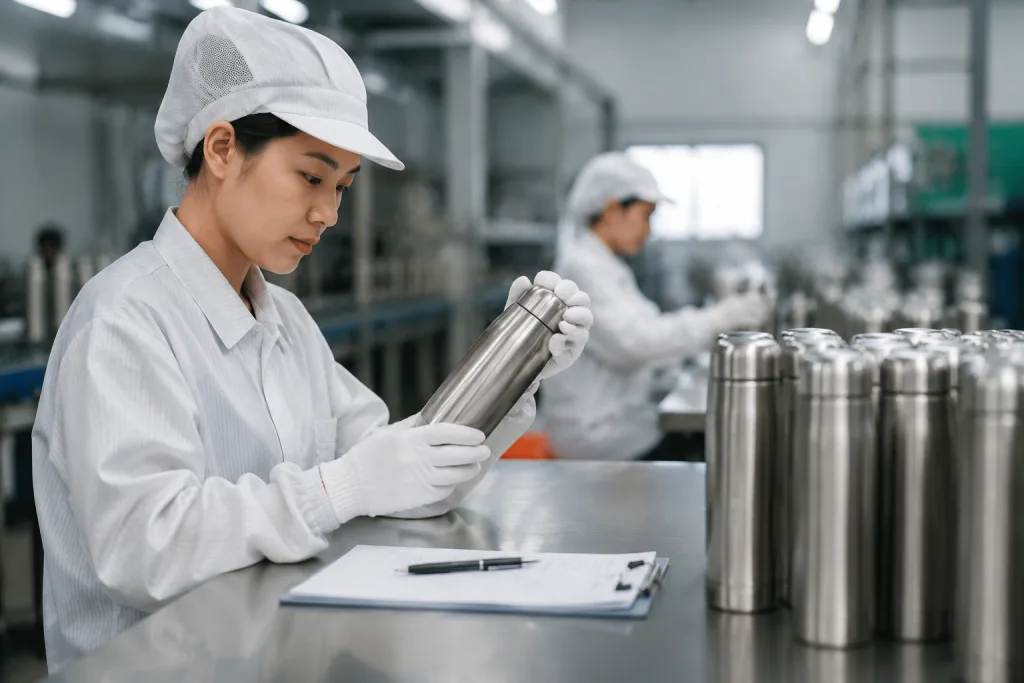
For our 5,000 pc order, we run inline checks at three stages, not just one desk inspection at the end. First, material and component check: 304 stainless body with thickness gauge reading, lid resin match against the BOM, silicone seal fit on the go/no-go fixture, coating powder reference, and signed color panel approval. Second, post-coating and logo check: surface scratches under 600–800 lux light, dust marks, color deviation under a D65 light box, logo adhesion by 3M tape test, and print registration against the artwork ruler. Third, final packed goods inspection using ANSI/ASQ Z1.4 sampling, normally AQL 2.5 major and AQL 4.0 minor unless your retailer requires stricter terms.
The final inspection should cover capacity measurement, packed-carton drop check, torque or thread feel, leakage test, coating visual inspection, logo size and location, barcode scan, carton mark review, and quantity count. No shortcuts. For food-contact programs, collect FDA, LFGB, or EU 1935/2004 related test reports depending on market; REACH screening is often requested for coatings and plastic components in Europe, and we usually match the report name to the importer name on the PO to avoid customs pushback.
Be careful with “we inspect 100%” claims from thermos manufacturers. This is the wrong question to ask. Some stations do get 100% checks, such as basic leakage on the water-test bench or visual sorting before inner boxes, but no factory can run full laboratory heat-retention testing on every piece; the math doesn’t work on a 5,000 pc order when one test ties up a sample for 6 hours. You need a written control plan, not a slogan.
Production timing and shipping reality
Assume the sample is approved on Monday and the deposit lands Tuesday. For a customized thermos order, we normally plan 25-35 days after sample approval and deposit, then 3-5 days for inspection, small rework, carton marking checks, and vessel booking. In April and Q4, add 7-15 days if the powder coating line is already booked; last May we had 6 jobs waiting behind a matte-black 750 ml bottle run, and the buyer flagged the delay because his PO showed “ship by 5/18” instead of “ETD 5/18.”
FOB Ningbo and FOB Shanghai both work for our Zhejiang production base. Ningbo is usually the cleaner route for drinkware exports from eastern China; we truck 40HQ containers there in about 3.5 hours from Hangzhou when the G92 is clear. Some forwarders still push Shanghai for consolidation, especially when they mix bottles with bags or electronics. For Europe, ocean freight often takes 30-40 days port-to-port. For North America west coast, 18-28 days is common; inland delivery adds another 5-12 days in our quotes when the consignee is not near the port. Air freight is the wrong question to ask for a full thermos order. Use it for urgent samples, 200-500 pcs replenishment, or a high-margin promotional deadline, because the freight can exceed the bottle cost.
Payment terms for new buyers are usually 30% deposit and 70% before shipment after inspection. Established distributors thermos accounts may negotiate better terms after 3 or 4 clean orders with no overdue balance and no chargeback games. For a first manufacturer thermos project, expect the standard China export structure. If a price looks low but the supplier asks for full payment before production and gives no inspection window, slow down. We have seen this go sideways: QC pulled the sample, found 0.4 mm logo drift on 38 pcs in the AQL 2.5 check, and the buyer had no payment hold left to push rework.
For outdoor retailers, schedule backward from the shelf date. If goods must be in a German warehouse by May 1, approve samples by early February, not late March. For a North American promotional launch in September, do not wait until August to discuss logo samples. Stainless thermos production is faster than apparel, but vacuum drinkware still needs coating cure time, assembly checks, packing, and export booking. On the line, a powder-coated bottle usually sits 12-24 hours before we run tape adhesion and drop the first packed carton from 76 cm; rushing that step saves one day and creates two days of complaints.
The best buyers treat the thermos supplier as part of the launch calendar. Share the delivery deadline, not only the PO date. A good suppliers thermos team can tell you where the schedule is tight and where it is still safe. We run this check with a simple date sheet: sample approval, deposit, bulk start, inline QC, final inspection, ETD, and warehouse arrival. If the math does not work, better to know before artwork is locked.
What makes the order worth repeating
A first order is only successful if we can run it again without rebuilding the job from scratch. After the first 5,000 pcs land, save the final spec sheet, approved artwork, golden sample photos, inspection report, carton dimensions, HS code, test reports, and customer comments in one file. We do this on our side too. QC pulled the last golden sample from the sample room last month and found the PO had “mat black” typed once and “matt black” twice, which is exactly the kind of small mistake that slows the next thermos promotional order by 3 days.
If returns show lid confusion, rewrite the lid instruction insert and print it at 90 x 120 mm so the folding line does not cover the diagram. If the matte coating scuffs after retail handling, do not argue about it for two weeks. Upgrade the powder or move to a textured finish. We run a 3M tape pull and a 50-cycle rub test on the line for this reason. If the 750 ml size sells but feels too tall for commuters, add a 500 ml companion item instead of forcing one bottle to fit every shelf. That is how a one-time promotional thermos turns into a steady outdoor retail range.
For distributors, the cleaner play is a small family: 500 ml and 750 ml first, then 1,000 ml once the repeat order is proven. Use the same finish, same logo window, and the same cap mold if the structure allows it. Your sales team quotes thermos distributor requests faster, and the factory keeps materials under control. On our floor, that means one powder batch, one laser jig, and fewer carton mark mistakes. For brand owners, one hero model in 2 colorways usually beats 6 weak colors at 300 pcs each. The math does not work.
Do not chase the lowest unit price every season if your customers reorder. Switching thermos suppliers for USD 0.06 can cost more in color mismatch, carton changes, and new sample delays. We have seen this go sideways: the buyer flagged a 2 mm logo position shift, the new carton was 8 mm wider, and the warehouse had to change the pallet plan from 56 cartons to 48 cartons. A reliable thermos manufacturer keeps your last specs, knows your inspection tolerance, and can push production faster when you have a real deadline.
That is the practical definition of a top promotional thermos: not the fanciest bottle in the catalog, but the one your buyer can approve, your warehouse can handle, and your team can reorder without starting from zero. Simple wins. If the BOM, artwork, AQL notes, and packing method are locked, we can quote the repeat in hours instead of waiting 12 days for another full sample loop.
Send your thermos spec before you request pricing
Share size, quantity, logo method, market, packaging, and deadline. We will return a factory quote with MOQ, lead time, and QC notes.
Frequently asked questions
What MOQ should I expect for a custom stainless thermos order?
For BottleForge Industrial in Zhejiang, the practical MOQ is usually 1,000 pcs per color for a custom thermos using an existing mold. At 1,000 pcs, logo and coating options are available, but the unit price is higher because setup costs are spread over fewer bottles. At 3,000 pcs, a promotional thermos order becomes more efficient for powder coating, laser engraving, and carton printing. At 5,000 pcs or more, you can usually negotiate better packaging, spare lids, or lower logo cost. If a thermos supplier offers 100 pcs with fully customized color and retail packaging, check whether it is stock goods with limited control rather than true factory production.
Which size is best for outdoor promotional brands?
For outdoor retail and promotional programs, 750 ml is the safest starting size. It feels substantial, fits many day-hike and camping use cases, and still ships efficiently in cartons. A 500 ml thermos is better for corporate gifts, commuter campaigns, and lower landed cost targets. A 1,000 ml stainless thermos works for fishing, jobsite, and long outdoor use, but it is heavier and may exceed the budget for mass promotional giveaways. If you are building a small range, use 500 ml and 750 ml first, then add 1,000 ml after sell-through data. Keep the same lid system where possible to simplify spare parts and QC.
How do I choose between laser engraving and silkscreen printing?
Laser engraving is the safer choice when durability matters. It cuts through powder coating and creates a clean, permanent mark, usually adding USD 0.08-0.18 per unit depending on logo size and order quantity. Silkscreen printing is better when your logo needs a specific Pantone color or stronger shelf visibility, usually USD 0.06-0.12 per one-color position at 3,000 pcs. The risk is adhesion, so require a tape test and rub test on the approved sample. For a top promotional thermos sold through outdoor retailers, I prefer laser for premium matte finishes and silkscreen for high-contrast retail campaigns.
What certificates should I request for Europe or North America?
For Europe, ask for food-contact testing aligned with LFGB or EU 1935/2004, plus REACH screening for coatings, plastics, and silicone parts when required by your importer. For North America, FDA food-contact documentation is commonly requested, and some buyers ask for ASTM-related packaging or drop-test references depending on channel. If the product is for children, standards become stricter and you should clarify age grading early. BSCI or similar social audit documentation may be needed by larger retailers. Do not accept a generic test report without matching material, model, and date; reports older than 2 years may be rejected by cautious buyers.
How long does a thermos bulk order take from sample to shipment?
For an existing stainless thermos model, sample production normally takes 5-7 working days after artwork confirmation. Mass production usually takes 25-35 days after sample approval and 30% deposit. Add 3-5 days for final inspection, possible sorting, and export booking. Ocean freight then adds roughly 30-40 days to many European ports and 18-28 days to the US west coast, before inland delivery. If you need custom tooling, add 25-40 days before normal sampling. The safest planning window for a new promotional thermos program is 10-14 weeks from first spec discussion to warehouse arrival.