Key Takeaways
- A 500 ml stainless top promotional thermos flask usually lands at USD 3.20-6.80 FOB China depending on grade, finish, lid, and packaging
- Stock-shape custom thermos MOQ can start at 1,000 pcs/color, while private mold or new coating normally needs 5,000-10,000 pcs
- Normal lead time is 35-55 days after sample approval; urgent repeat orders can ship in 25-30 days if components are reserved
- Laser engraving is slower but clean; silk screen is cheaper above 3,000 pcs when the logo has 1-2 colors
A top promotional thermos flask is not expensive because stainless steel is rare. The bill climbs when the brief says “premium matte black” but gives no Pantone, when the logo method is decided after the PP sample, or when the carton insert changes from white box to kraft sleeve after we have cut the knife die. We have seen a USD 0.18 color-card decision turn into 9 days of rework. The math does not work. Outdoor retailers and promo brands lose margin on laser marks that fail rub testing, air freight booked to save a launch date, weak forecasts, and packaging that looked simple in a PDF but jammed on the packing line.
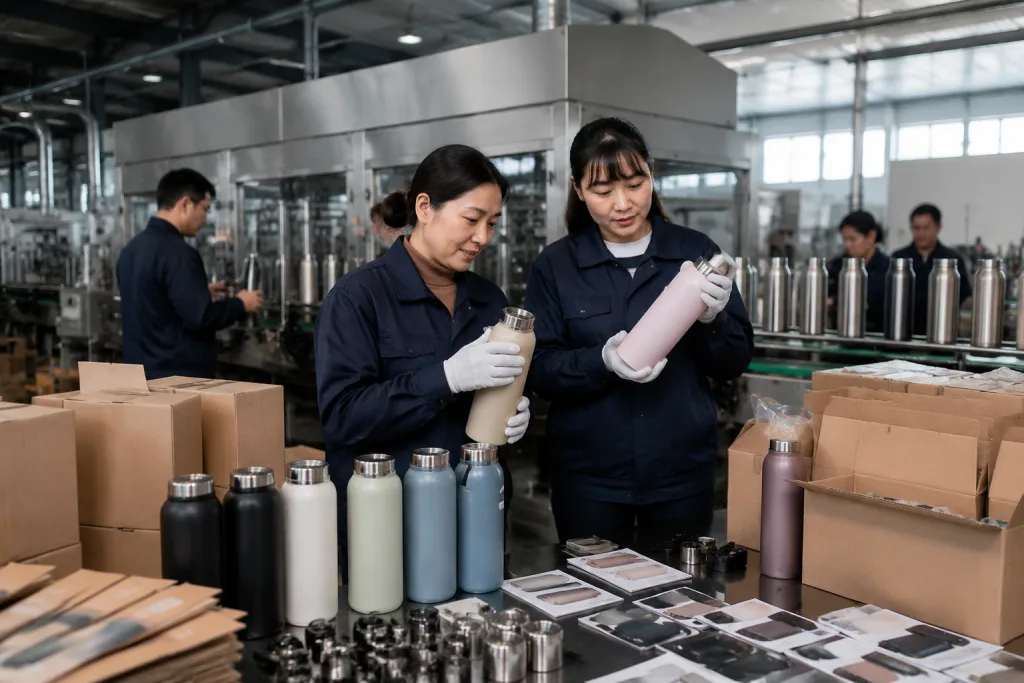
At BottleForge Industrial in Hangzhou, Zhejiang, we quote custom thermos projects every week for Europe and North America. We run about 420,000 stainless units/month, with typical MOQ from 1,000 pcs per color for stocked shapes and 5,000 pcs for new color coating. For one UK buyer, QC pulled the sample because the logo sat 3 mm too close to the bottom curve; small detail, big argument. China can still be cost-effective, but only when the coating, logo process, carton size, and lead time are locked before deposit.
Start with the real unit cost
For a top promotional thermos flask, the first quote on the sheet is rarely the landed unit cost. A basic 500 ml double-wall stainless thermos with 304 inner wall, 201 outer wall, powder coating, and one-color logo may quote around USD 3.20-4.10 FOB Ningbo or Shanghai at 3,000 pcs. Change it to full 304 stainless steel, 65-75 μm powder coating, leakproof push-button lid, retail box, and stricter AQL inspection, and the same capacity can reach USD 5.20-6.80 FOB. We see this on the line every week: the buyer asks for “same as sample,” then the PO leaves out the 304 outer shell and the box insert, and QC pulls the sample before mass production can start.
The largest cost drivers are plain once you price the BOM. Stainless grade changes the base cost by roughly 8-18%. Wall thickness matters too: 7 out of 10 promotional thermos projects we run use 0.40-0.45 mm inner wall and 0.38-0.45 mm outer wall; heavier retail-grade bodies may use 0.50 mm or more. Vacuum yield also affects price. If the vacuum tester kicks out 4.5% after the 24-hour heat-retention check, the factory has to price that loss somewhere. Asking only for the lowest FOB is the wrong question to ask.
Logo and packaging are the next two levers. Laser engraving may add USD 0.18-0.45/pc depending on size and position. Silk screen can be USD 0.06-0.16/pc for a simple one-color mark, but setup and registration get ugly with full-wrap artwork or fine gradients; the buyer flagged a 1.2 mm logo drift on a matte black run last month. A kraft box might add USD 0.18-0.35, while a printed gift box with insert can add USD 0.45-0.90. If you are buying thermos bulk for an outdoor campaign, decide whether the box sells the product or just protects it. Overbuilt packaging kills margin fast.
MOQ tiers change the quote
MOQ is where buyers get China sourcing wrong. A thermos quote at 1,000 pcs is not the 10,000 pc price cut into ten pieces. We run the powder-coating line with 8-12 kg of purge loss after each color change, the logo jig still needs the same setup, and carton packing wastes space when the order does not fill a full pallet pattern. The math doesn't work.
For stocked stainless shapes in Zhejiang, our workable tiers are usually clear: 1,000 pcs/color when the body and coating color already exist; 3,000 pcs/color when the buyer wants sharper FOB pricing and a cleaner production slot; 5,000 pcs/color when we need new Pantone powder coating and a sprayed approval panel; 10,000 pcs or more for a private lid, special grip, or new mold. A customized thermos with a new cap tool can require USD 2,000-8,000 tooling depending on complexity, plus 20-35 days for mold trial before mass production. Last month QC pulled a cap T1 sample because the silicone groove was 0.35 mm shallow.
If you are a distributor thermos buyer serving several end clients, ask whether the factory can split logo versions under one production run. For example, 6,000 pcs total in black can often be split into three logos of 2,000 pcs each if the body, coating, lid, and packaging stay identical. That is a cleaner job than six colors at 1,000 pcs each. Color fragmentation creates delays; we have seen a PO with “matte balck” typed in one line and “black satin” in another, then the buyer flagged the shade after pre-production samples.
Outdoor retailers should not buy like event agencies. Retail assortments need carton consistency, spare lids, barcode control, and repeatable color from batch to batch; one wrong EAN sticker can stop a warehouse receiving team for 48 hours. Promotional brands usually care more about fast artwork approval and lower packaging cost, so we quote a white box with logo print separately from a retail color box. A good thermos manufacturer prices these jobs separately instead of burying the risk inside one vague unit price.
Lead time by project stage
A realistic timeline for a top promotional thermos flask starts before the deposit. Quotation takes 1-3 working days if you send capacity, lid type, stainless grade, finish, logo artwork, packaging, Incoterm, and destination. If the brief only says “premium bottle with logo,” this is the wrong question to ask; our sales desk will send back 6-8 questions, and the first price will be soft. Last month one PO even wrote “matte black” in the email and “gloss black” on the attachment, so QC held the sample request until the buyer confirmed the finish code.
Pre-production sampling usually takes 7-12 days for laser engraving or silk screen on an existing bottle. Add 3-5 days if you need a new powder coating color matched to Pantone. Add 10-15 days for a customized thermos with a special lid insert, silicone part, or printed sleeve because the line has to check fit, smell, and shrinkage, not just color. For new mold work, 20-35 days is normal before a proper sample can be reviewed. We run the first sample with a caliper check on the mouth diameter, often down to 0.2 mm, because a nice-looking lid that leaks is still a failed bottle.
Mass production for 3,000-10,000 pcs usually takes 30-45 days after sample approval and deposit. Peak season in China, especially before summer outdoor campaigns and Q4 gifting, can push this to 50-60 days. Zhejiang factories move fast, but coating, vacuum testing, logo work, final assembly, and packing still run in sequence. No shortcut there. You cannot laser engrave bottles still waiting for powder coating, and we have seen this go sideways when a buyer asked for carton photos 12 days before the bottles had passed the 24-hour vacuum test.
Sea freight adds its own clock. Ningbo to Los Angeles is often 18-28 days port-to-port, while Ningbo to major Northern Europe ports may be 30-40 days. Add 5-12 days for trucking, customs clearance, and warehouse receiving. If your campaign date is fixed, plan backward from the in-hand date, not the factory ship date. We ship from Ningbo often, and the buyer usually flags the delay only after the forwarder asks for AMS or ISF details 48 hours before cutoff.
Decoration choices affect speed
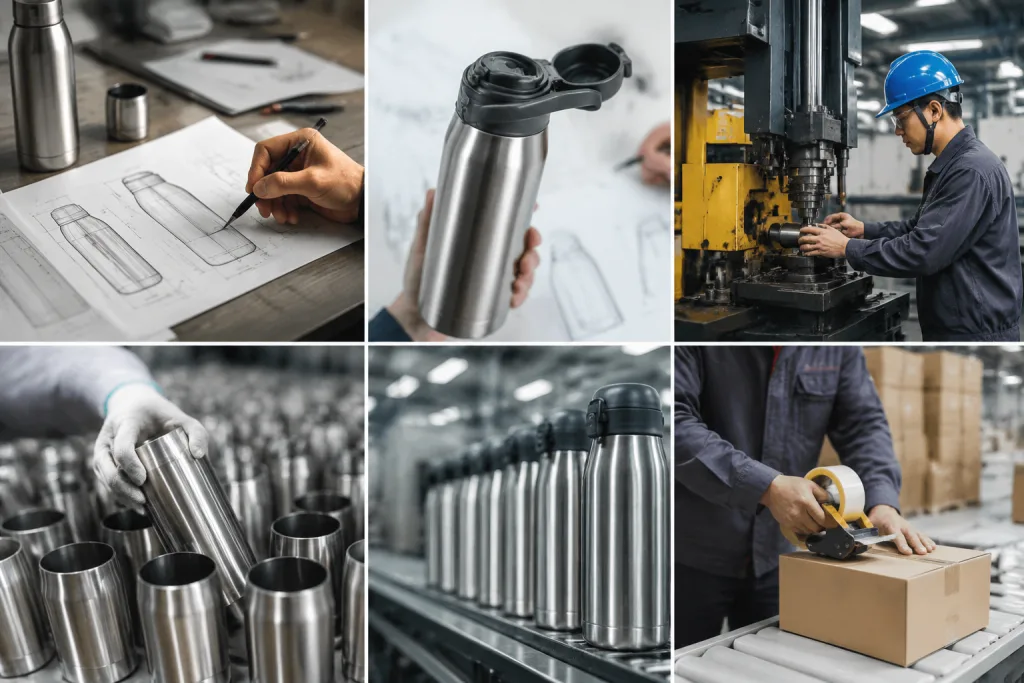
Decoration on a custom thermos is a production decision, not just artwork. It changes unit cost, lead time, reject rate, and compliance risk. For outdoor retailers, we usually push laser engraving first: it will not peel, it survives pack rub, and it looks sharp on powder coating after the line wipes the cup with alcohol. Speed is the catch. On our 30W fiber laser, a 55 mm logo normally runs 20-45 seconds per unit, so 10,000 pcs can tie up machines for 2-5 shifts. That math matters.
Silk screen is the cheaper route for a simple mark. It runs fast on a straight visual panel with one or two solid Pantone colors, and our screen room can usually hold a 0.3 mm edge without drama. It gets messy when the buyer asks for a full wrap, tight registration, metallic ink, or 5 pt legal text near the bottom radius. We have seen this go sideways. Pad printing works for curved lids and small badges, but the logo area is limited by the pad cup size. Heat transfer gives bright artwork, though QC should pull the sample for a cross-hatch tape test and a 500 g rub check before anyone prints “dishwasher safe” on the PO.
For a customizable thermos program, keep the decoration rules boring: one fixed logo zone with a drawing that shows the height from the base in mm, a maximum imprint size signed off before sampling, vector artwork only, and Pantone codes that match the buyer’s brand book. If you sell through distributor thermos channels, set a standard logo grid. Do not let every client pick a new position. We cut proofing from 6 days to 2-4 days per order when the grid is locked, because prepress stops chasing “move logo 3 mm left” emails.
Do not approve decoration from a bright studio photo only. Ask for a 10-second video under normal factory lighting and one close-up after the tape test; our QC desk uses 3M 600 tape because weak tape hides poor ink adhesion. For North America and Europe, confirm that inks and coatings can meet REACH, LFGB where relevant, and client-specific restricted substance requirements. A cheap thermos promotional order is not cheap if incoming inspection rejects 8 cartons for logo scratches or a missing compliance line on the packing list.
Packaging and compliance add days
Packaging gets treated like the last detail, and that is how a manufacturer thermos order slips 7 days. A plain egg-crate export carton is fast; we can usually lock it after one carton drop test from 80 cm. A printed retail box with molded pulp tray, instruction leaflet, barcode label, warning text, and master carton shipping mark needs artwork approval, CTP proofing, and a packaging supplier slot. Last month QC pulled a 500 ml sample set because the PO said “matte black” but the box artwork said “black matt.” Small typo. Lost 2 days.
For promotional brands, the safer pack is a white or kraft individual box with one-color print, plus an outer carton of 24 pcs or 48 pcs depending on bottle capacity and carton weight. The math does not work if a buyer wants a heavy 1,000 ml bottle packed 48 pcs per carton; the carton hits 19 kg and the forwarder complains. For outdoor retailers, expect a color box, hang tag, EAN or UPC barcode, item number, country of origin, and multilingual care instructions if the SKU goes into EU shelves. If you ship to Amazon FBA or a 3PL, put FNSKU labels, carton weight limits, carton dimensions, and pallet rules into the brief from day one. We have seen this go sideways when the buyer flagged a 62 cm carton height after mass packing.
Compliance should be quoted with the product, not after mass production. For stainless thermos sold into Europe, buyers commonly ask for LFGB food contact testing, REACH screening for coating and silicone, and BSCI or Sedex factory audit status. For the United States, FDA food-contact expectations and ASTM-related claims may apply depending on product positioning. Standard food-contact checks take 5-10 working days; expanded chemical screening can push it to 15 working days if the lab asks for extra coating samples. We cut 304 stainless test pieces from the same production lot, not from a cleaner sample sitting in the showroom.
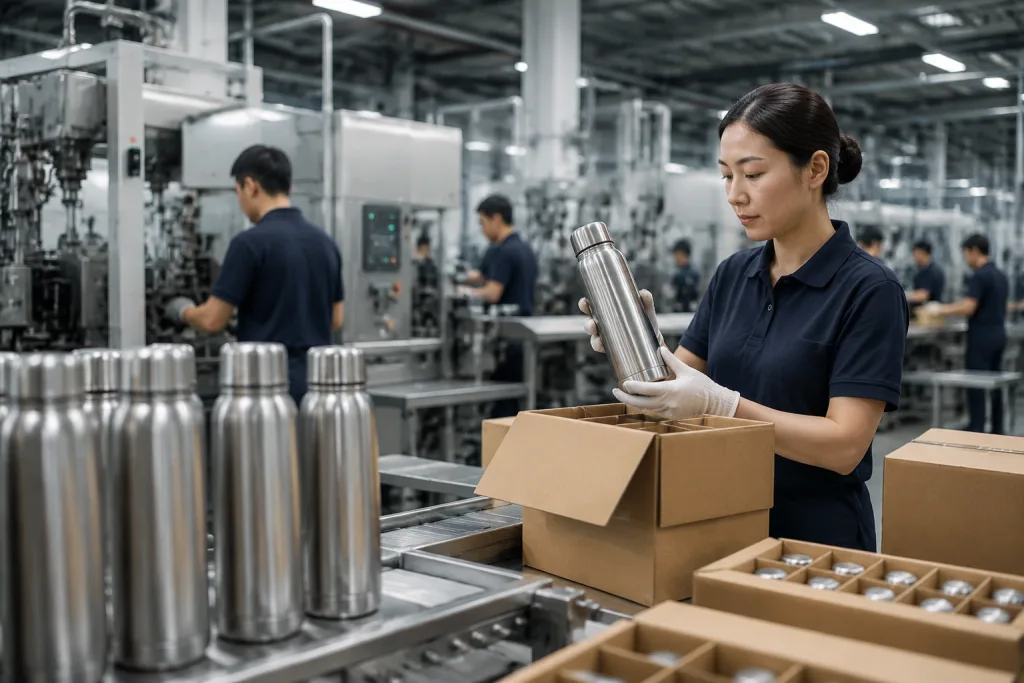
A serious thermos supplier will define inspection terms before the line starts packing. We recommend AQL Level II for final random inspection, with critical defects at 0, major defects often 2.5, and minor defects 4.0. Vacuum performance, leakage, coating adhesion, logo position, carton drop condition, and barcode scan belong on the checklist. QC should test hot water retention with a probe thermometer, run a 360-degree leak check, and scan 10 barcodes from random cartons. We ship only after the buyer and factory agree what fails the order.
How to compare factory quotes
Do not compare thermos suppliers by the lowest FOB line first. That is the wrong question to ask. Make each quote describe the same bottle: capacity in milliliters, body diameter, height, stainless grade, wall thickness, lid material, silicone grade, coating type, logo method, packaging, MOQ, sample fee, lead time, Incoterm, and inspection standard. We run a quote sheet with caliper checks in mm, and QC pulled one 500 ml sample last month that was 68 mm wide on the buyer drawing but 71 mm in the supplier photo. If a thermos vendor leaves 6 of these fields blank, the price is not comparable.
A manufacturers thermos quote should also state whether it uses 304/201 or 304/304 stainless steel. Both can work at the right price point, but they should not be mixed quietly. Ask for gross weight per carton and carton size before you approve the PI. For a 500 ml bottle, a carton of 24 pcs may weigh around 9-12 kg depending on body weight and packaging. We ship samples by DHL, and a 2 kg carton mistake can turn a clean USD 0.08/pc saving into a freight headache for ocean freight, courier samples, or FBA planning.
Payment terms matter. A common China factory structure is 30% deposit and 70% balance before shipment, or before release of original documents. For repeat buyers with stable volume, some factories discuss 20/80 or credit insurance-backed terms, but new buyers should not build a launch plan around that. We have seen this go sideways when a PO said “30% desposit” and the buyer’s finance team held the bank slip for 3 days because the company name did not match the proforma invoice.
Ask who owns the problem if a component is late. Short question. A thermos factory with in-house vacuum forming, coating coordination, and assembly control can recover faster than a trading-only supplier because the line manager can move 2 coating racks or recheck lids with a torque gauge the same afternoon. Trading companies can still do good work, but you need transparency. If your order is a distributor thermos program with fixed event dates, recovery speed is worth more than saving USD 0.08/pc.
Budgeting a safe launch order
For a first order, we push buyers toward a controlled launch: use a bottle shape already running on the line, keep colors to 1-2, choose laser or screen print that our jigs already fit, and pack in a box style we have passed drop tests on. A 3,000 pc 500 ml promotional thermos order with black powder coating, laser logo, kraft box, and AQL inspection might sit around USD 4.10-5.20 FOB China, depending on steel weight, lid structure, and whether the logo needs a second positioning fixture. Add sample fee of USD 80-200, testing at USD 250-600 if required, and inspection at USD 180-300 per man-day. QC still checks the first 30 pcs with a digital caliper before we let the coating batch move forward.
If you need thermos bulk pricing for retail distribution, the math works better at 10,000 pcs split across two colors than 2,000 pcs across five colors. Less sexy on the sales deck, yes. But the cost, lead time, and defect control are cleaner because powder coating changeover takes about 45 minutes per color and each changeover adds scratch risk. We have seen this go sideways when a buyer asked for 8 colors on a launch order, then flagged shade variation under store lighting. Save the wider palette for the second purchase order, after sell-through data proves which colors deserve shelf space.
For a customized thermos with private cap, special texture, or exclusive body shape, budget more time and cash: USD 2,000-12,000 for tooling, 20-45 days for development, 5,000-10,000 pcs MOQ, and at least one extra sample round. A private cap usually means CNC mold work, gasket testing, and a leak test at 0.6 MPa before we trust it in cartons. That is normal for a thermos manufacturer in China; by itself, it is not a red flag. The red flag is a supplier promising custom tooling in 12 days when the mold shop has not even opened the 3D file.
The practical rule is simple: freeze the commercial parts first. Capacity sets the steel draw; color count affects coating slots; logo method decides fixtures; packaging changes carton size; compliance decides testing; ship date controls the whole schedule. Asking for the cheapest customized thermos before those points are fixed is the wrong question to ask. We have had POs where the buyer wrote “matte black” but the artwork file said “satin black,” and that 1-word typo can hold the line for 2 days. Once those details are stable, a solid suppliers thermos team can engineer the rest without drama.
Send your thermos brief for a grounded factory quote
Share quantity, logo, packaging, and delivery date. We will price the custom thermos project with MOQ, sampling, and lead time shown clearly.
Frequently asked questions
What is the normal MOQ for a custom stainless thermos?
For an existing stainless thermos shape, MOQ is usually 1,000 pcs per color with a simple logo, though the better price tier starts around 3,000 pcs. If you need a new Pantone powder coating, plan on 5,000 pcs per color because coating-line setup and powder waste are real costs. A private lid, new handle, or exclusive body shape normally requires 5,000-10,000 pcs plus tooling. Some thermos suppliers will accept 500 pcs, but the unit price often rises by 20-40%, and color choices are limited to current stock.
How long does a top promotional thermos flask order take?
For a stock-shape top promotional thermos flask with laser or silk screen logo, expect 7-12 days for sample and 30-45 days for mass production after sample approval. Add 3-5 days for a new color match and 5-10 working days for food-contact testing if required. New mold projects can add 20-35 days before production even starts. Sea freight from Ningbo, China, adds about 18-28 days to the U.S. West Coast and 30-40 days to Northern Europe before inland delivery.
Is laser engraving better than silk screen for promotional thermos orders?
Laser engraving is better when durability matters, especially for outdoor retailers selling bottles that will be handled hard. It typically adds USD 0.18-0.45 per unit and is slower on large logos. Silk screen is better for simple, low-cost promotional thermos work, often adding USD 0.06-0.16 per unit for one color at 3,000 pcs or more. If your logo has small text, gradients, or a wraparound layout, request a real pre-production sample and tape test before approving mass production.
What stainless steel grade should I specify?
Most good custom thermos projects use 304 stainless steel for the inner food-contact wall. The outer wall may be 201 or 304 depending on budget and positioning. A 304 inner and 201 outer structure is common for promotional campaigns because it controls cost. Full 304/304 construction can increase unit cost by roughly 8-18%, but it is easier to position as a premium retail product. Ask the thermos manufacturer to state the grade in the quotation and support it with material declarations or test reports when needed.
What should I send to get an accurate factory quote?
Send capacity, target FOB budget, order quantity, number of colors, logo artwork in AI or PDF vector format, preferred decoration method, packaging style, destination country, compliance requirements, and required delivery date. If you need FNSKU, barcode labels, pallet rules, or retailer carton marks, include them immediately. A complete brief lets a thermos factory quote within 1-3 working days and avoids later add-ons. Without packaging and compliance details, the first price may be USD 0.30-1.00 per unit too low.