Key Takeaways
- For a 750 ml top promotional sport bottle, target 0.5-0.6 mm stainless wall thickness and 304 inner steel
- Most custom sport bottle projects need 1,000-3,000 pcs MOQ per color, depending on coating and cap
- Use AQL 2.5 for major defects and AQL 4.0 for minor defects before shipment
- Standard FOB China lead time is 30-45 days after deposit and artwork approval
A top promotional sport bottle is not judged by the sample photo. It is judged by the spec sheet, a 1.2 m carton drop test, logo rub result after 3M tape pull, leak rate after 24 hours upside down, and whether the reorder matches the first shipment. If you are buying custom drinkware for a campaign, retail shelf, distributor catalog, or e-commerce bundle, the wrong 2 mm on a straw tube or gasket seat can create 10,000 small problems.
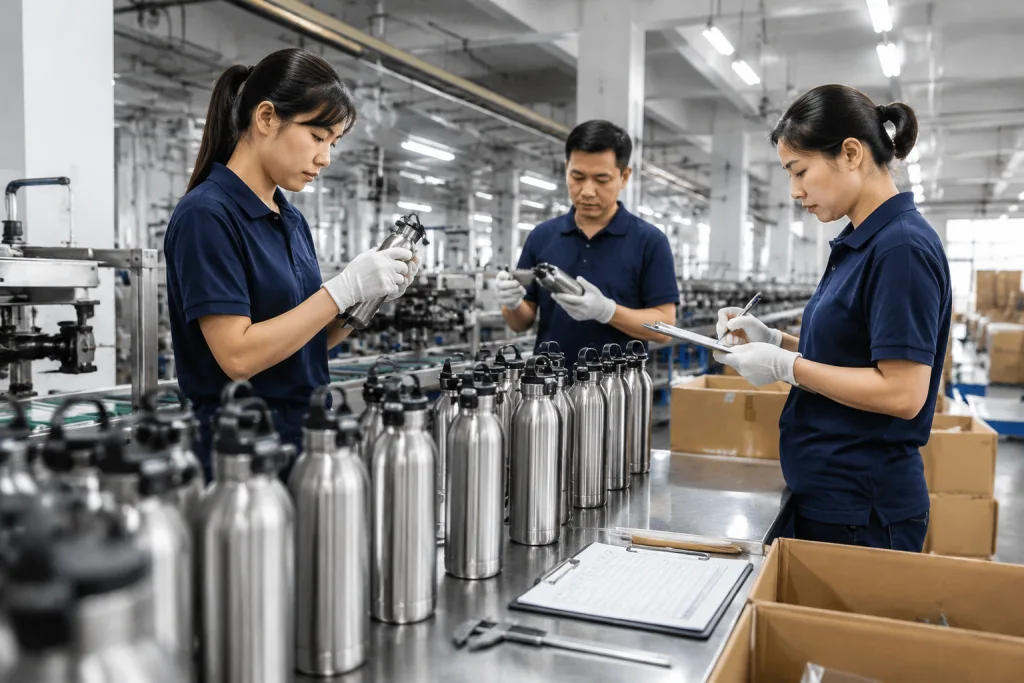
We manufacture in Zhejiang, China, and we see buyers spend 30 minutes on Pantone color but skip the boring lines: steel grade, wall thickness, cap material, coating process, AQL level, and packing method. This is the wrong question to ask if the bottle has to survive a school promo or gym retail shelf. Those lines decide whether your canteen customized order feels premium or cheap. Our Hangzhou team runs up to 600,000 drinkware units/month, with typical MOQ from 1,000 pieces per color for standard sport bottle molds; last week QC pulled a sample because the PO said “matte black” but the cap BOM showed glossy PP.
Start With Capacity And Use
Capacity is the first spec line, and it is not decoration. For a top promotional sport bottle, 650 ml, 750 ml, and 1,000 ml are the sizes we run most often for export programs. A 500 ml bottle looks tidy in a gift box, but buyers flagged it twice last quarter as too small for gym and campus handouts. A 1,200 ml bottle photographs well, then QC puts it on the scale and the math gets ugly: heavier cartons, higher freight, more hand fatigue.
If you sell canteens into corporate wellness programs, 750 ml is the safe bet. It fits most side pockets, feels like a proper gift, and still packs cleanly in a 24 pcs carton. A 750 ml single-wall stainless bottle with cap normally lands around 155-210 g depending on wall thickness; our caliper check at incoming material is usually 0.5 mm or 0.6 mm. A double-wall vacuum version may reach 330-420 g, but it gives insulation value and a stronger retail shelf feel.
Lock the use case before asking a canteen factory for price. A school promotion does not need the same cap or finish as a festival refill bottle, and an outdoor retail custom canteen should not share the same carton spec as a mass giveaway. We quote two versions for many distributor drinkware programs: a lighter 0.5 mm single-wall bottle for volume orders, and a 0.6 mm double-wall version for premium clients. We have seen this go sideways when the PO says “matte black” but the artwork file says “gloss black.”
Buyer impact: capacity drives steel weight, carton CBM, container loading, and FOB cost. A 750 ml stainless sport bottle may load about 18,000-24,000 pcs in a 40HQ depending on packing; the line checks this against the master carton size before we release the PI. A 1,000 ml model may cut that by 15-25%. That gap matters more than saving USD 0.04 on a cap.
Material Lines Worth Reading
Do not accept loose wording like “stainless steel bottle” on a purchase order. We have seen a PO arrive with “SS bottle” typed in the material column, and QC had no enforceable line to check against. Your spec sheet should say 304 stainless steel for the inner food-contact wall, or 316 stainless if the bottle is sold for saltwater, marine, or upper outdoor channels. For roughly 8 out of 10 promotional canteen projects we quote, 304 is the practical standard. It is food-safe, stocked by most Zhejiang tube suppliers, and keeps the cost sheet under control.
For outer walls, some canteen manufacturers run 201 stainless on double-wall bottles to cut cost, while keeping 304 inside. That is not automatically wrong. Hiding it is. If your customer expects a premium customized canteen, write 304 inner and 304 outer on the PI and artwork approval sheet. It may add roughly USD 0.15-0.45 per piece depending on size and market steel price. We had a German buyer flag this after a magnet test on a 750 ml sample; the math was fine, but the disclosure was late.
Wall thickness is the next line to read with a caliper, not a smile. For single-wall sport bottles, 0.45 mm is common in budget projects, 0.5 mm is a solid promotional baseline, and 0.6 mm feels stronger in hand. For double-wall bottles, the inner and outer gauges are often thinner one by one, but the bottle becomes more rigid after vacuum forming. Ask your canteen supplier to confirm measured thickness, not just nominal gauge. On our line, QC pulled the sample and checked three points around the body with a Mitutoyo digital caliper before approving the pre-production sample.
Plastic parts also need real names. Tritan is used for clear flip lids, PP is common for food-contact caps, PE shows up in some straws, silicone belongs in seals, and ABS is better kept away from direct drink contact unless the design is clear. Food-contact caps should normally use PP or Tritan with LFGB or FDA-grade silicone seals. If you sell into Europe, ask for REACH and LFGB-related material declarations where applicable. For North America, FDA food-contact compliance and CPSIA review may be relevant if children’s use is implied. We have seen this go sideways when a buyer approved a black lid by photo only, then found the seal had no grade marking in the incoming inspection report.
Cheap material language creates expensive arguments. Put the steel grade, each plastic resin, and the silicone grade into the signed PI before production starts.
Cap, Seal, And Leak Risk
The cap is where 7 out of 10 leak complaints start on promotional bottles. A body can look good on the light box, but one weak hinge or a silicone ring sitting 0.3 mm proud can turn a 20,000 pc order into chargebacks. For a top promotional sport bottle, lock the lid choice before artwork: screw cap for the lowest risk, flip straw cap for gym use, chug lid for faster drinking, loop handle for school and travel kits, or carabiner-style lid when the buyer wants retail shelf appeal. We run cap trials with a torque meter, because “feels tight” is the wrong spec.
Screw caps give the fewest headaches. Easy to clean, fewer loose parts. They work well for a custom canteen used in outdoor campaigns, corporate gift sets, or travel programs where the bottle sits sideways in a bag. Flip straw caps are easier during workouts, but they add a straw, valve, hinge pin, button spring, and sometimes a dust cover; QC has to check each part, not just the print. Chug lids are the middle option: better water flow than a screw cap, lower assembly risk than a straw lid. Last month QC pulled 32 samples from the line because the hinge pin was 1 mm short on a black flip cap batch.
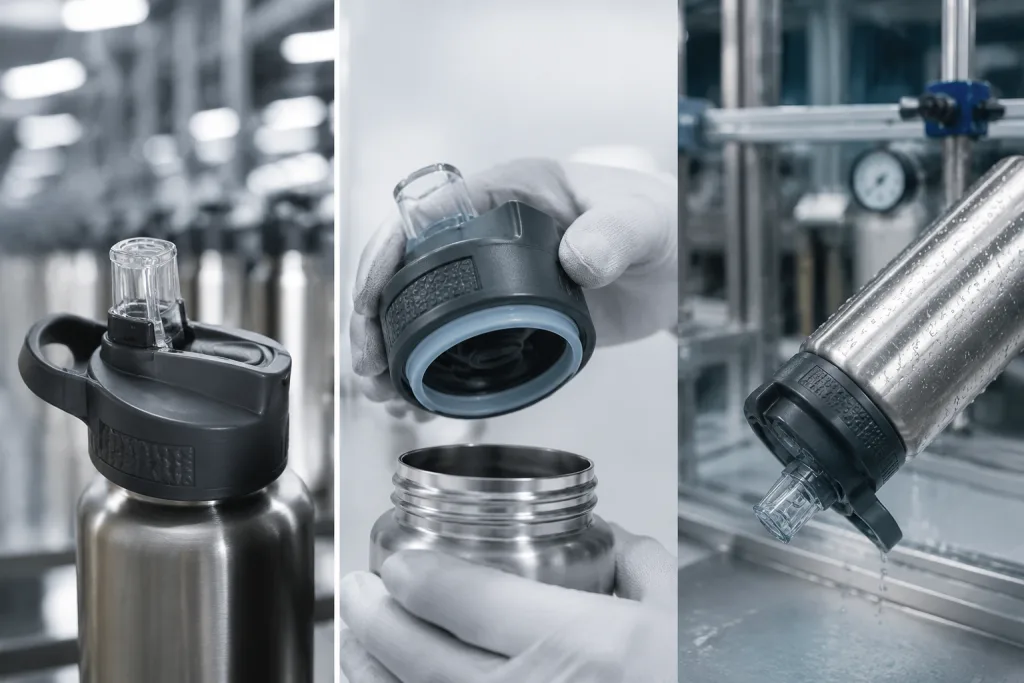
For canteen customizable projects, ask your canteen vendor for the leak test method, not just “passed leak test” on a checklist. A practical factory test is filling with room-temperature water, closing the cap, laying the bottle horizontally for 30 minutes, then shaking or inverting samples. We also stand samples upside down on white tissue so a slow drip shows fast. For vacuum bottles, we recommend hot water tests at around 90°C, but only on caps designed for hot liquid. Most sport straw caps should stay away from hot drinks because pressure can push liquid up through the straw; we have seen this go sideways in courier tests.
Seal hardness matters more than buyers expect. Silicone rings are commonly around 40-60 Shore A. Too soft, and the ring can flatten after 500 open-close cycles. Too hard, and it will not compress well against a slightly oval cap groove. Our incoming QC uses a Shore A durometer and checks ring OD with a digital caliper, usually to ±0.1 mm on repeat orders. For large distributor canteen orders, request spare silicone rings at 0.5-1% of shipment quantity if your after-sales channel can use them.
Buyer impact: a cheaper lid may save USD 0.08-0.20 per unit, but the math does not work if complaints double after the first mailing. If the bottle will be mailed individually, choose simpler sealing and stronger threads over fancy one-touch features. The buyer flagged this exact issue on a PO once: “gift box packed, no leak allowed,” but the selected lid had a soft button and thin thread wall. We changed the cap before mold sign-off.
Surface Finish And Logo Method
The finish line decides the shelf look and how fast the bottle shows scratches. Powder coating is the safer choice for a premium sport bottle because the hand feel is grippy and the color hides small handling marks. On our Hangzhou line, QC pulled a matte black 750 ml sample last month after the rim picked up silver dots in the carton drop check. Spray painting saves cost, but the scratch math does not work for repeat catalog programs. Rubberized soft-touch feels good on day one, then we see fingernail marks and sticky coating when the resin mix is weak. For customized drinkware that stays in a distributor catalog for 2 to 3 seasons, we run powder coating first unless the buyer has a hard price ceiling.
Logo method should follow the finish, order quantity, and artwork file. Silk screen printing is fine for 1-3 color logos on a straight wall or a mild curve; our screen room normally asks for 300 dpi vector artwork and a 3 mm bleed. Heat transfer handles gradients, but adhesion must be checked with tape pull after curing, not just by looking at the first sample. Laser engraving is clean on powder-coated 304 stainless because the beam cuts through the coating and shows the metal below. Corporate buyers often read laser as a higher-grade gift, but this is the wrong question to ask if the brand color must be visible from 2 meters away.
For a customizable canteen with full-wrap artwork, confirm print area and distortion before mass production approval. A taper or shoulder curve stretches logos near the edge; we have seen round badges turn oval after the buyer approved only a flat PDF mockup. Ask for a dieline in millimeters. Not just a mockup. A typical 750 ml bottle allows about 80 mm wide by 100 mm high on one side, while the safe zone still depends on diameter and curvature; our engineer checks it with a flexible ruler and a 1:1 paper wrap before opening the screen.
Color tolerance causes more arguments than buyers expect. If the brand owner requires Pantone 186C, write the acceptable Delta E into the PO or approve a physical color chip. Digital photos from Zhejiang production lines can lie under 6500K lamps and green floor reflection; the buyer flagged this once when a red sample looked orange in WeChat. We recommend pre-production samples for custom colors when order value exceeds USD 8,000. The math is simple: one sample round costs less than remaking 3,000 coated bottles.
Buyer impact: logo durability is not judged on day one. Run a 3M tape pull after full curing, use a cross-hatch cutter on printed areas where the finish allows it, and write dishwasher warnings the same way you expect end users to treat the bottle. We ship most promotional coated bottles as hand-wash only unless the coating and print have passed repeated dishwasher cycles; otherwise, we have seen this go sideways after the first retail complaint.
Pricing, MOQ, And Lead Time
A proper quote from a canteen supplier should split product price, logo cost, mold or setup cost, packing cost, and freight term. For FOB Ningbo or FOB Shanghai from Zhejiang, China, a 750 ml single-wall stainless promotional sport bottle usually lands around USD 1.80-3.20, depending on steel thickness, cap, finish, and logo. A double-wall vacuum version often sits around USD 3.80-7.50. We run a 0.02 mm wall-thickness check on the line, and the math changes fast when steel, exchange rate, or order quantity moves.
MOQ follows the part that is hardest to change. If we use existing molds and standard colors, 1,000 pcs per color is often workable. For custom powder coating, our coating booth usually wants 2,000-3,000 pcs per color because the first setup burns paint and time. For a custom growler or customizable growler, MOQ can go higher if the body size is unusual or the lid tooling is special; the buyer flagged this on a PO once and the order had to be reworked.
Lead time should be split into stages. Sampling usually takes 7-12 days for logo samples from stock or existing molds. Pre-production samples with custom coating may take 12-18 days. Mass production commonly takes 30-45 days after deposit and sample approval. Add 3-7 days for final inspection, booking, and container loading. QC pulled the sample on a Friday, and we still missed one show date because artwork came in late on day 20. That is the wrong question to ask if the event is fixed.
Payment terms are usually 30% deposit and 70% balance before shipment for new buyers. Established distributor growler or distributor drinkware accounts may get different terms after some order history. If a canteen manufacturer throws out a very low price with a very short lead time, check whether they are using stock bodies, outsourcing printing, or skipping incoming material checks. We have seen that go sideways on a 304 stainless order when the mill cert was missing.
Buyer impact: the cheapest quote often leaves out one line item. Ask each canteen supplier to quote the same spec sheet, same Incoterm, same packing, and same inspection requirement.

Compliance And Inspection Details
Compliance is dull until a shipment gets held. For Europe, we line up LFGB food-contact testing, REACH, and packaging rules before the sample leaves the bench; for the United States, FDA food-contact expectations, California Proposition 65 screening, and ASTM checks may apply depending on claims and user group. If the bottle is for children, CPSIA and small-parts risk move to the front. A kids bottle is not just a smaller sport bottle with bright artwork. On our line, QC pulled the sample because the cap edge came in at 0.3 mm above spec.
Factory audits matter when the buyer wants proof, not promises. BSCI, Sedex, ISO 9001, or similar paperwork helps, but ask whether the certificate belongs to the factory making your order or only to a trading company in the middle. We had one buyer flag a PO because the audit report named the wrong site, and the math did not work. At BottleForge Industrial in Hangzhou, Zhejiang, we state which steps stay in-house and which are outsourced, like special coatings or gift-box printing.
Your inspection standard needs to be fixed before the first run. AQL 2.5 for major defects and AQL 4.0 for minor defects is common for promotional drinkware, and we stick to that unless the buyer writes something tighter into the PO. Critical defects such as sharp metal burrs, leakage, contamination, or unsafe odor need zero tolerance. Inspection should cover carton drop checks, barcode scan checks if needed, logo position measurement, cap torque feel, coating defects, capacity verification, and random leak testing. We use a torque meter set to 1.2 N·m on the cap station.
For Amazon or retail distribution, packaging inspection needs the same discipline. FNSKU labels must scan cleanly. Master cartons need the right gross weight, dimensions, and shipping marks, and polybags may need suffocation warnings depending on market and bag opening size. We once caught a typo on a carton mark that would have sent the pallet to the wrong warehouse, and that is the kind of mistake that burns days. If you handle multiple SKUs, tight carton label control saves warehouse labor fast.
Buyer impact: inspection costs less than returns. A third-party inspection on a 10,000 pc order may cost USD 250-400 in China, which is usually cheaper than air-shipping replacements. We run that comparison every week, and the buyer who skips inspection usually pays twice.
Packing Specs Buyers Forget
Packing is part of the product spec, not a shipping afterthought. We have seen a sport bottle pass final QC at AQL 2.5, then arrive with rubbed coating on the shoulder because the carton wall sat 3 mm from the bottle body. Your packing spec should name the unit pack: polybag, tissue wrap, white box, kraft box, color box, or retail sleeve. For powder-coated bottles, we run individual protection between the bottle and the carton wall, usually a PE bag plus divider or a paper sleeve. Bare bottles in egg-crate dividers work for price-sensitive bulk jobs, but only when the coating survives a 3M tape rub test and the truck route is short. We’ve seen this go sideways.
Gift box paper needs a real GSM figure on the PO. A 300-350 gsm paperboard box is common for mid-range promotional packaging, and QC should check it with a digital caliper, not by hand feel. For retail shelves, ask for E-flute corrugated or a reinforced structure if the bottle is heavy. A 1,000 ml stainless bottle in a weak folding carton looks tired before your customer opens it. The buyer flagged that exact issue last April after 6 cartons showed corner crush during our drop test.
Master carton strength matters just as much. Export cartons should usually be 5-ply corrugated for drinkware, with edge crush strength matched to pallet stacking height. Gross weight should stay practical; 8 of our EU buyers cap cartons at 15 kg because one warehouse worker handles them all day. A 24 pc carton may be fine for 500 ml bottles, while 12 pc per carton is often safer for larger customized growler or custom growler orders. On the line, QC pulled a 17.8 kg carton last month and asked us to split the pack before sealing with 48 mm tape.
If you sell through distributors, add SKU separation rules. Mixed-color cartons create picking errors unless your warehouse asks for them in writing. For canteen distributors serving different client logos, never mix logos in one master carton without a clear carton mark and packing list. One PO came in with “blue lid” typed as “blue logo,” and the buyer caught it only after we sent the carton mark PDF. Basic stuff. Still where rush orders fail.
Buyer impact: good packing adds USD 0.08-0.60 per unit depending on box type, but it protects the margin you already spent on coating, printing plates, and rework time. The math does not work if you save USD 0.12 on a box and then replace 300 dented units by air. Treat packing as an engineering line, not a decoration choice.
Send your sport bottle spec sheet for review
We will check capacity, material, logo method, packing, MOQ, and FOB China pricing before you lock the purchase order.
Frequently asked questions
What is a realistic MOQ for a top promotional sport bottle?
For an existing mold, a realistic MOQ is usually 1,000 pcs per color for standard stainless sport bottles. If you need custom powder coating, custom cap color, or a canteen customized retail box, expect 2,000-3,000 pcs per color. For small logo-only orders, some factories can use stock bottles at 300-500 pcs, but color selection is limited and unit cost is higher. A custom canteen mold is different: tooling may cost USD 3,000-12,000 depending on body shape, lid complexity, and testing needs. For most B2B buyers, start with an existing body and customize finish, logo, and packing first.
How do I compare quotes from different canteen manufacturers?
Make every canteen manufacturer quote the same spec sheet. Include capacity, steel grade, wall thickness, cap resin, silicone type, finish, logo method, packing, MOQ, Incoterm, inspection standard, and lead time. If one quote says USD 2.10 and another says USD 2.45, the cheaper one may use 201 outer steel, thinner 0.45 mm walls, spray paint instead of powder coating, or bulk packing instead of individual boxes. Ask for FOB port, not just EXW, if you want cleaner comparison. Also ask whether the supplier is a factory, trading company, or hybrid vendor. The commercial label matters less than whether they control QC.
Is laser engraving better than printing for promotional bottles?
Laser engraving is more durable on powder-coated stainless bottles because it removes the coating and exposes the metal underneath. It is excellent for corporate logos, outdoor clubs, and premium distributor drinkware where a one-color metal mark is acceptable. Silk screen printing is better when you need exact brand colors or multi-color artwork. Heat transfer works for complex graphics, but it needs adhesion testing. Cost depends on logo size and quantity, but laser engraving often adds roughly USD 0.10-0.35 per unit for normal logo sizes. For a top promotional sport bottle, choose laser for durability and print for color accuracy.
What testing should I request before shipment?
Request an inspection using AQL 2.5 for major defects and AQL 4.0 for minor defects, with zero tolerance for critical safety defects. The checklist should include leakage, cap fit, sharp edges, odor, coating scratches, dents, logo position, color match, carton marks, barcode scanning, and packing count. For insulated bottles, add vacuum performance testing, such as checking water temperature after 6 or 12 hours against your agreed standard. For canteen promotional orders shipped to Europe, confirm food-contact documentation such as LFGB-related test reports if required. For North America, ask about FDA food-contact materials and Prop 65 risk review.
Can one supplier handle bottles, growlers, and canteens together?
Yes, but check whether the supplier actually produces all categories or coordinates partner factories. A canteen supplier may be strong in stainless sport bottles but outsource a custom growler, glass bottle, or plastic lid assembly. That is not automatically bad if QC ownership is clear. For a mixed order, align materials, coating colors, logo placement, and carton labels across SKUs. MOQ may differ: sport bottles may start at 1,000 pcs per color, while a customizable growler could require 2,000 pcs or more. If you are a distributor growler or distributor canteen buyer, ask for one consolidated production calendar with separate inspection points.