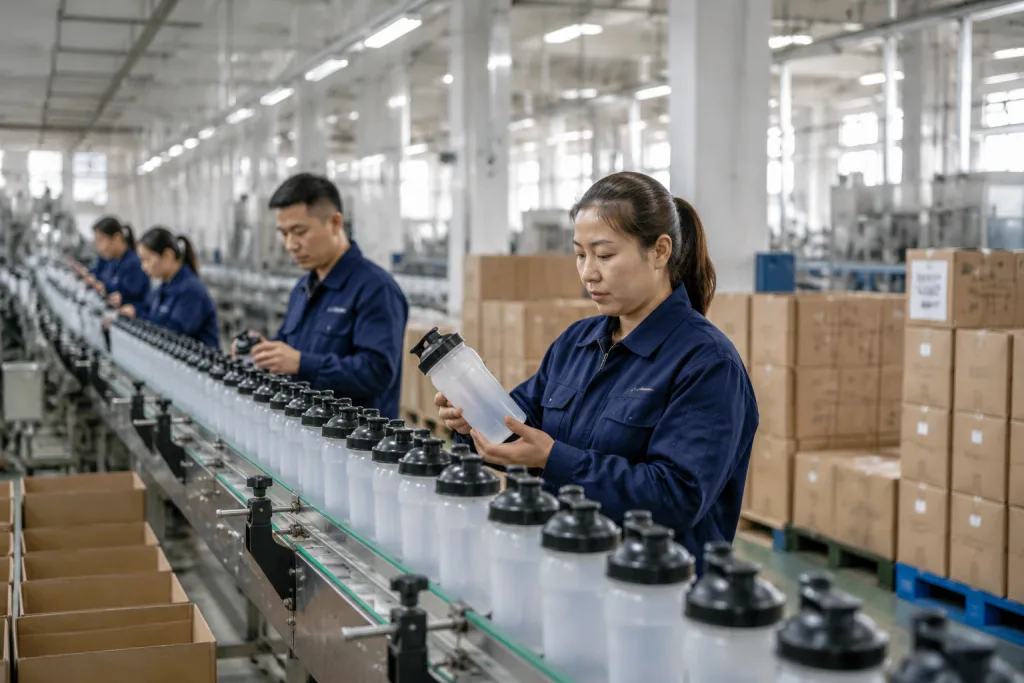
Key Takeaways
- Typical MOQ for a custom polypropylene canteen order is 3,000-5,000 units per color
- PP bottle wall thickness should usually sit around 1.2-1.8 mm for promotional use
- Plan 25-35 days production after artwork approval for standard logo programs
- Use AQL 2.5/4.0 inspection and request REACH or LFGB documentation for EU shipments
A top promotional polypropylene bottle looks simple until the PO says 20,000 units for a campaign that ships in 32 export cartons per pallet. Then the real questions start: PP resin grade, lid torque, print adhesion after tape test, carton burst strength, lead time, and whether the supplier still replies after the 30% deposit lands. QC pulled one 650 ml sample last month with a 0.6 mm parting-line burr on the cap thread. Small issue. Big complaint if it reaches a school order.
If you buy custom drinkware for retail, schools, events, gyms, or corporate giveaways, polypropylene is often the right bottle, but not for every brief. It is lighter than 304 stainless steel and handles drops better than brittle AS plastic; the math works for 5,000–50,000 piece canteen promotional programs where freight cost matters. From our Hangzhou, Zhejiang line, these are the buyer questions that decide whether we ship cleanly in 18 days or lose 12 days fixing artwork, lid fit, or a carton spec the buyer flagged too late.
What makes PP worth buying?
Polypropylene, usually written as PP, is not the showroom material in custom drinkware. That is the point. We run PP when the buyer needs 5,000 event bottles that stack cleanly in a carton, pass a basic drop check, and keep the unit price steady after artwork changes. A top promotional polypropylene bottle is bought for usable volume, low weight, stable unit cost, and safe everyday handling, not for luxury positioning.
For most canteen custom programs, PP sits between throwaway plastics and heavier stainless steel. A 500-750 ml PP bottle can ship at a lower freight cost than a metal bottle because the net weight is usually 62-95 g instead of 180-260 g. The line feels that difference when we pack 24 pcs per export carton. PP also handles flex better than rigid SAN or brittle low-grade plastics, which matters when bottles are packed into school bags and event kits, then stacked 6 cartons high in the warehouse.
The practical question is not simply “Is PP good?” Wrong question. Ask what grade of PP is used, whether it is food-contact suitable, whether the color masterbatch stays stable after 3 dishwasher-style wash cycles, and how the cap seals after repeated opening. Last April QC pulled the sample because the silicone ring sat 0.4 mm proud of the groove; the bottle looked fine, but the leak test failed after 12 flips. A canteen manufacturer that cannot answer those points is not ready for your purchase order.
For Europe, ask for REACH and LFGB or EU food-contact support where applicable. For North America, ask about FDA food-contact material declarations and, for children’s programs, relevant ASTM or CPSIA considerations. Not every project needs every certificate, but your canteen supplier should know which documents match your market; we have seen this go sideways when a PO says “FDA approved” while the buyer actually needs LFGB for Germany.
Our opinion: PP is a strong promotional material when you need 5,000-100,000 usable bottles at a controlled cost. It is a weak choice if your brand promise is premium insulation or long-term hot beverage performance; the math does not work against 304 stainless for that brief.
How should you specify the bottle?
Do not send a factory one photo and write “same like this.” We have seen that go sideways: 500 ml requested, 620 ml sampled, cap torque too loose, logo sitting 8 mm off center. A proper RFQ for a top promotional polypropylene bottle should start with function, then move to branding.
Start with capacity. Common promotional sizes are 500 ml, 650 ml, 750 ml, and 1,000 ml. For schools and outdoor events, 650-750 ml is usually the safe range; buyers in this channel often reject cartons over 14 kg because kids or event staff have to move them. For a custom canteen aimed at sports clubs or camping channels, 1,000 ml can work, but check carton weight and shelf depth before the mold team cuts steel.
Next, define wall thickness. For a normal promotional PP bottle, 1.2-1.8 mm is a realistic range depending on shape and mold. Thin walls save resin, but the math does not work if QC pulls 32 deformed shoulders from a 200-piece pre-shipment check. Ask your canteen factory for weight per unit in grams, not only capacity in milliliters.
Then check the closure. A screw cap with silicone gasket normally seals better than a simple flip cap, but it costs more and gives QC one more part to pull, stretch, and inspect under the light table. If you want a canteen customizable with carabiner, strap, straw, or measuring marks, put it in the RFQ because the line needs different fixtures and packing slots.
- Minimum RFQ data: capacity and tolerance, full dimensions in mm, unit weight in grams, Pantone color, logo method with print size, cap type, packing, target market, expected order quantity.
- Useful extra data: drop-test height, dishwasher claim wording, max liquid temperature, barcode position, carton marks, pallet requirement, and any buyer note such as “no loose straw in polybag.”
At BottleForge Industrial in Zhejiang, China, our standard MOQ for PP promotional bottles is usually 3,000-5,000 units per color, with 25-35 days production after sample and artwork approval. We run color chips before mass production; last month QC stopped a blue order because the approved Pantone swatch and the PO file had one digit different.
Which logo method survives use?
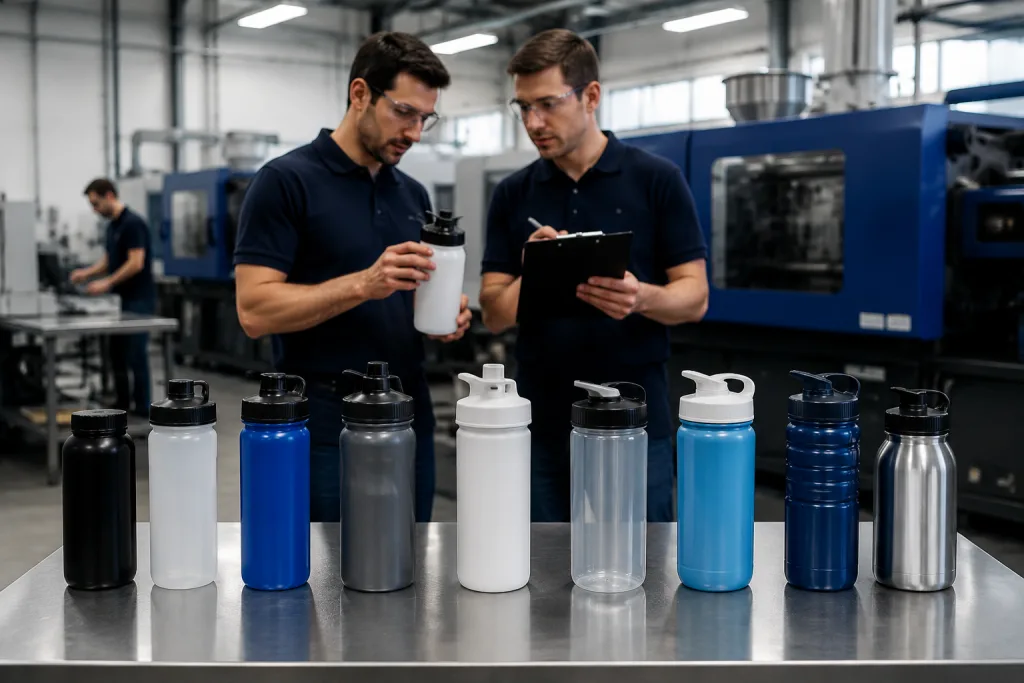
Decoration is where 7 out of 10 customized drinkware claims start, at least in our Hangzhou sample room. The bottle body passes, then the buyer flags the logo: scratched after packing, shifted 2 mm off center, or too small once it wraps around the curved PP wall. For a top promotional polypropylene bottle, pick the print method by artwork file, target cost, and how the bottle will be handled. Chasing the lowest print quote is the wrong question to ask.
Silkscreen printing is our normal workhorse for simple one- or two-color logos. We run it on straight-wall bottles with a screen frame and positioning jig, and a 60 mm wide logo usually stays sharp if the wall is not tapered. It fits high-volume canteen promotional orders because setup cost is low and the line moves fast. The weak point is shape. If the bottle has a hard waist or shoulder curve, the safe print area may drop from 70 mm to 45 mm, and registration gets messy after the third color.
Heat transfer handles more colors and gradients, which helps when the brand owner sends a full-color mascot or event graphic. It costs more per unit, and QC needs to check adhesion on the selected PP surface before we release the pre-production sample. Last season, QC pulled a sample after a 50-cycle rub because the edge lifted 1.5 mm near the seam. For distributor drinkware sold through event agencies, heat transfer looks closer to retail packaging. Approve the physical sample. A PDF mockup will not show edge lift or gloss mismatch.
In-mold labeling fits large programs, not small MOQ jobs. It gives a clean integrated look, but the mold trial, label film, static control, and feeding position all need tighter planning. For 50,000 units and above, the math can work if the launch date gives us 25 to 30 days for tooling and label prep. For 3,000 units, it usually does not. We have seen this go sideways when a PO typo listed “IML” but the artwork was built for screen print size.
Ask your canteen vendor to run a tape test and a rub test on the decorated sample. A simple 3M tape pull and 50-cycle dry rub test will catch weak prints before mass production; on our line, QC records the pull angle and checks the logo under a 10x loupe. If the bottle will be handled in gyms, schools, or outdoor events, request a wet rub test too. A canteen customized with poor print durability damages your buyer’s brand faster than a slightly higher unit price ever will.
What price should be realistic?
Price comes down to PP resin, bottle gram weight, cap build, logo process, carton spec, and order quantity. Buyers still need a number before they push the factory. For a standard 650-750 ml top promotional polypropylene bottle from China, FOB pricing often sits around USD 0.55-1.20 per unit for 5,000-20,000 units, depending on design and logo method. On our line, a common 700 ml body runs about 72-88 g before the cap, checked on a 0.1 g bench scale during first-piece approval.
If a quote lands far below that range, do not celebrate yet. QC pulled samples last month where the wall was 0.62 mm at the shoulder instead of the agreed 0.80 mm, and the buyer only saw the problem after drop testing. Cheap pricing may mean thinner walls, low-grade silicone gaskets, fewer checks, soft cartons, or missing compliance papers. If a quote is much higher, the canteen manufacturer should show the reason in writing: private mold, complex flip cap, multi-color heat transfer, gift box packing, or a low MOQ such as 1,000 pcs.
A practical buyer should split the quote into cost lines. Ask for bottle price, logo cost, setup cost, sample cost, carton cost, and optional inspection cost, with each line shown in USD per pc or per order. We run into this weekly: a distributor approves one-color printing, then the end client sends 3-color artwork at 6:40 p.m. with a typo on the PO. If you are a canteen distributor or distributor canteen buyer serving several end clients, this breakdown protects margin when artwork changes at the last minute.
Packaging can move the landed cost more than buyers expect. Bulk packing may be 100-200 pcs per master carton for small bottles, but retail individual boxes add unit cost and CBM; we measured one 650 ml project at 0.054 CBM per 100 pcs in bulk versus 0.083 CBM with color boxes. If you ship to Amazon FBA, club stores, or a North American 3PL, carton drop strength and barcode placement matter. For FBA-style prep, ask about FNSKU labeling, suffocation warnings for polybags if used, and carton weight below your warehouse limit, often 15-18 kg.
Our view from Hangzhou, Zhejiang: squeezing the last USD 0.03 from a canteen supplier is the wrong question to ask if the launch date is fixed. We have seen this go sideways when a buyer saved USD 180 on a 6,000 pc order, then lost 12 days vs 18 days in rework and re-inspection. Spend that money on gasket control, a 5-layer export carton, or pre-shipment inspection.
How do you check the factory?
Forty vendors can send a clean product photo before lunch. Far fewer can repeat the same bottle color, cap fit, carton mark, and vessel date after date. Before you approve a top promotional polypropylene bottle order, check whether the seller is a trading desk, a canteen factory, or a manufacturer running stable subcontracted molding and decoration. Any of those setups can work. The part I do not like is silence. On our Hangzhou floor, the first clue is simple: if the line cannot show the mold number on the injection press card, the buyer should ask harder questions.
Ask for operating data, not a sales story. Monthly output, standard MOQ, molding machine count, daily decoration capacity, and main export markets are normal facts. We run PP bottle jobs at 5,000 pcs MOQ for repeat colors, and a capable canteen manufacturer should be able to say, for example, that a PP line can produce 300,000-600,000 units per month depending on model mix, with logo printing capacity booked on a separate pad-print or screen-print schedule. If the answer is “no problem” but nobody can name the machine tonnage or print jig count, the math does not work.
For compliance and social responsibility, BSCI, Sedex, ISO 9001, or equivalent audit status matters for European retailers. Not every promotional order needs a full audit, but a factory supplying serious canteen distributors should have a documented quality system. Ask for recent inspection reports with the defect table still attached, not only certificates. QC pulled one sample last season with a 0.4 mm lid gap and light flash on the mouth thread; that kind of finding tells you more than a polished PDF.
Communication speed is a factory metric. During sampling, your supplier should answer technical questions within 24 hours on working days. If they dodge wall thickness, gasket material, or test standards before deposit, they will not get clearer after deposit. We have seen this go sideways: one buyer flagged a PO typo on “PP lid with silicone ring,” and the vendor replied 3 days later after the wrong gasket had already been ordered.
Factory questions worth asking
- What PP grade and color masterbatch will be used, and can you show the material lot label?
- What is the standard AQL level for appearance and function?
- Can you provide REACH, LFGB, FDA, or ASTM support for my market?
- How many days from artwork approval to pre-production sample?
- Who controls final packing: molding workshop, print workshop, or QC team?
China has thousands of canteen manufacturers. The useful ones do not hide process details. Ask for one workshop photo with today’s job card beside the mold; a real line can send it in 10 minutes.
What belongs on your checklist?
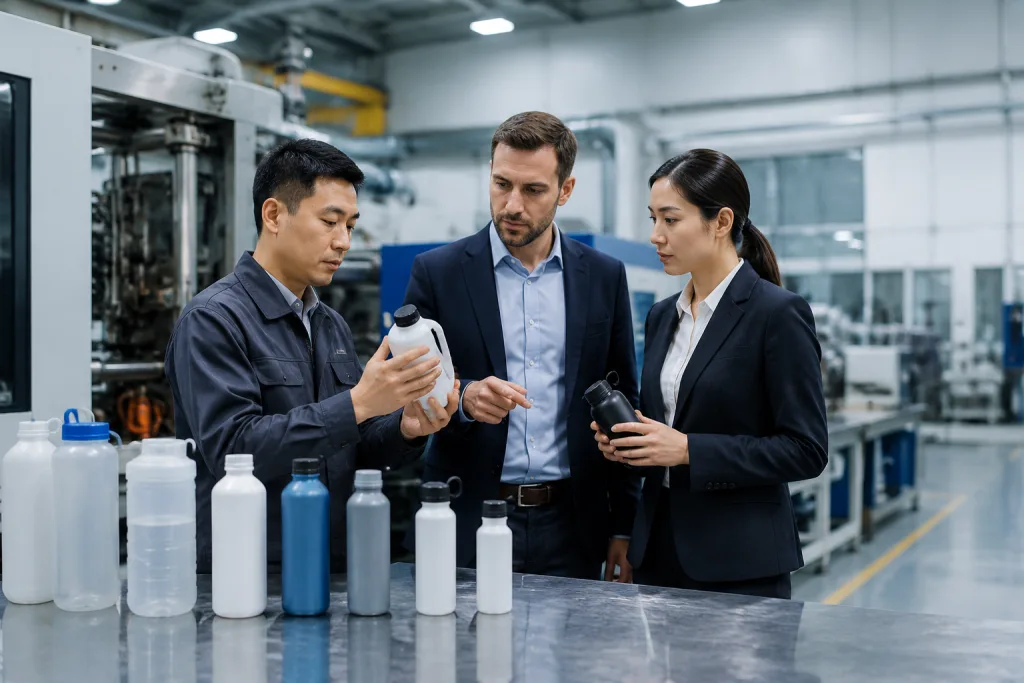
A checklist is not office paperwork. It is how we stop one casual “same as last order” from turning into a 40HQ of bottles nobody can sell. Use it before you issue the PO for a customized canteen, customizable growler, or distributor growler program; last month QC pulled a pre-production sample where the PO said “blue” but the approved chip was Pantone 293C.
Product: confirm capacity tolerance in ml, body height in mm, PP grade, wall thickness at the shoulder, cap material, gasket material, leak test standard, plus maximum liquid temperature. We run a simple 24-hour inverted leak test on the line, then weigh-check samples on a 0.1 g digital scale. If the bottle is sold as dishwasher safe, ask for test evidence. The wrong question is “can PP handle washing?” The better question is whether the logo ink, gasket, and cap thread survive 10 dishwasher cycles at 65°C.
Branding: approve logo size in millimeters, Pantone color, print position from the seam line, print method, plus sample photos from front and side. For canteen customizable projects, lock the artwork file version before the silk-screen plate is made; changing 1 mm after plate output costs time. We have seen “logo-final-final2.ai” on a PO, and the buyer flagged the old slogan only after 3,000 bottles were printed.
Quality: set AQL before production. A common setup is AQL 2.5 for major defects and 4.0 for minor defects, with critical defects not accepted. Major defects include leakage, wrong logo, sharp edges, badly deformed bottle, or cap failure. Minor defects include small print specks, light flow marks, or slight color variation inside the approved range. On the factory floor, QC uses a 3M tape test for print adhesion and a go/no-go thread check before cartons move to sealing.
Packing: confirm polybag or no polybag, divider requirement, carton size, gross weight, shipping marks, pallet plan, plus barcode position. If you are buying distributor drinkware for multiple customers, separate carton marks by SKU and logo version; mixed marks are how 2 pallets go to the wrong warehouse. We ship export cartons at around 12 kg when the buyer’s DC rejects anything over 15 kg, so get that limit onto the packing spec early.
Commercial: agree Incoterms, usually FOB Ningbo or Shanghai for Zhejiang production, payment terms, sample approval date, production lead time, inspection date, plus latest vessel booking date. A clean custom canteen order looks boring on paper and moves smoothly in the warehouse. That is the point. The math does not work if sample approval slips from May 6 to May 13 and the buyer still expects the same vessel; we usually need 18 days for production, not 12 days, once printing and final inspection are counted.
Send your PP bottle brief for a factory quote
Share capacity, logo, quantity, market, and deadline. Our Zhejiang team will return practical options, MOQ, lead time, and FOB pricing.
Frequently asked questions
What is the normal MOQ for a top promotional polypropylene bottle?
For a standard mold, a realistic MOQ is 3,000-5,000 units per color. Some canteen suppliers may accept 1,000-2,000 units if the color is stock and the logo is simple silkscreen, but the unit price will usually rise by 15-35%. For a custom color, custom cap, or new mold, expect higher minimums. A canteen customized with special Pantone resin often needs enough volume to justify purging and color setup on the molding machine.
Can polypropylene bottles be used for hot drinks?
PP has better heat resistance than some common plastics, but most promotional PP bottles should not be sold as hot drink bottles unless tested for that purpose. For normal promotional use, we usually recommend cold or room-temperature liquids, and a practical maximum around 60-80°C only if the cap, gasket, print, and structure are verified. If your buyer needs hot coffee performance, look at stainless steel instead. Do not let a canteen vendor make broad heat claims without test data.
How long does sampling and production usually take?
For an existing PP mold, digital mockup usually takes 1-2 working days, physical logo sample takes about 5-10 days, and mass production takes 25-35 days after approval and deposit. Add 3-7 days if you need special color matching, complex heat transfer, or retail packaging. Sea freight from China to Europe or North America can add roughly 25-45 days depending on port and season, so build the calendar backward from your event date.
What defects should inspectors check before shipment?
Inspectors should check leakage, cap fit, gasket placement, sharp flash, odor, deformation, wrong color, wrong logo, print adhesion, carton marks, and quantity per carton. For AQL, many buyers use 2.5 for major defects and 4.0 for minor defects. A leak test can be done by filling samples, tightening caps, and placing them upside down for a defined time such as 30 minutes. For promotional orders, also compare the mass production logo against the signed sample.
Is a custom growler or canteen better than a PP bottle?
It depends on the sales channel. A custom growler or customizable growler is better for higher perceived value, outdoor retail, breweries, or insulated drink programs, but it costs more and ships heavier. A top promotional polypropylene bottle is better for volume campaigns, schools, races, gyms, and budget-sensitive giveaways. If you are a canteen distributor handling both retail and promotional accounts, keep PP bottles for high-quantity campaigns and stainless or larger growler formats for premium customer segments.