Key Takeaways
- Specify glass wall thickness at 2.0-3.2 mm and inspect shoulder variance before mass production
- Logo failures usually come from artwork tolerance, curing temperature, and poor fixture control
- For promotional orders, AQL 2.5/4.0 is usually the minimum inspection level worth using
- Carton drop strength matters as much as bottle strength when shipping 3,000-20,000 units
A top promotional glass bottle looks simple on a quote sheet: capacity, logo, lid, carton, price. The trouble starts when 5,000 pieces land with logos 2 mm off center, leaking caps, thin glass at the shoulder, or retail boxes crushed because the outer carton was spec'd at 5-ply but packed like 3-ply. Unit price is the wrong question to ask. For B2B buyers, the real bill is rework, a campaign launch slipping from 12 days to 18 days, distributor drinkware shipments rejected at AQL 2.5, and the kind of client call nobody wants after QC pulled the sample too late.
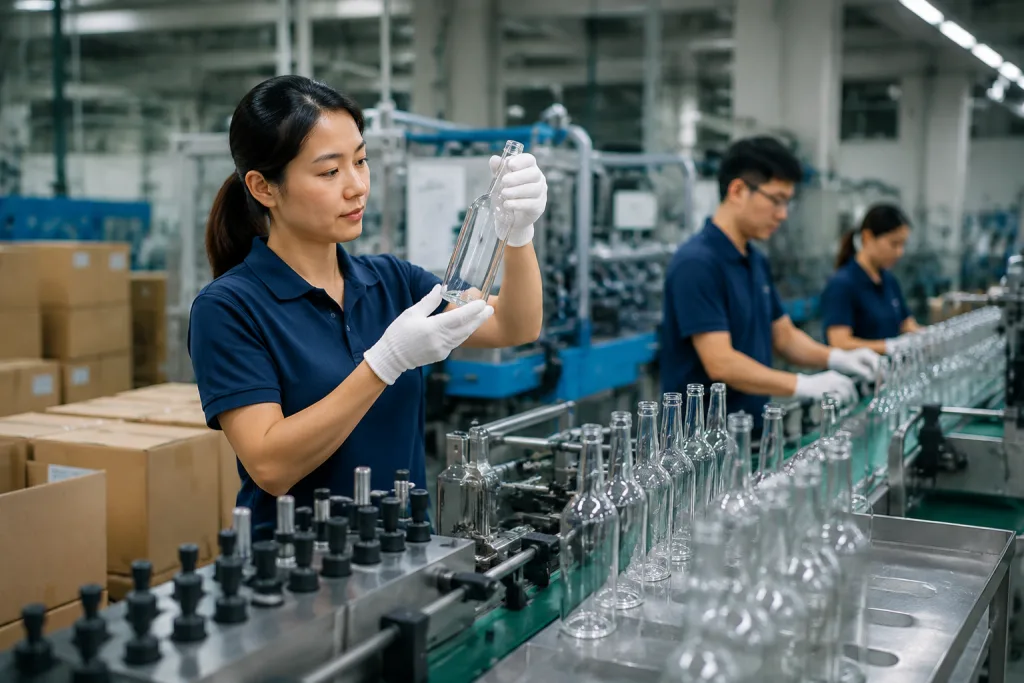
We manufacture custom drinkware in Hangzhou, Zhejiang, and we see the same 6 failure modes repeat with new buyers from Europe and North America. China can produce strong promotional glass bottles, but the PO has to spell out the boring stuff: print position tolerance, cap torque, glass weight, insert card size, and carton drop-test requirement. Our Zhejiang line runs up to 300,000 glass bottles per month, with typical MOQ from 3,000 units and 30-45 day lead time after artwork approval. We run the line with a torque tester on caps and a digital caliper at the print station; when a buyer sends “same as last order” but changes the lid code by one letter, we’ve seen this go sideways.
The glass fails before the logo
Buyers spend 80% of the call arguing about logo size and 20% on the bottle body. That is the wrong question to ask first. If the glass body runs out of spec, the rest of the line fights it: pad printing shifts 1-2 mm, silicone sleeves wrinkle at the lower radius, lids rock on the mouth finish, and QC pulls more broken pieces during inner-box drop checks.
The repeat offender is uneven wall thickness. A 500 ml borosilicate bottle may be quoted at 2.0 mm wall thickness, but low-cost production can drift below 1.6 mm near the shoulder or base push-up. That thin zone is where cracks start after thermal shock or carton vibration; we have seen QC catch hairline cracks with a 10X loupe after the bottles sat overnight beside the annealing lehr. For soda-lime glass, be stricter because it is heavier and less forgiving when a buyer pours hot water into a bottle sold as “general drinkware.”
Ask your canteen manufacturer or glass bottle supplier for three numbers before approving a sample: target wall thickness with gauge point locations, acceptable tolerance by mm, and finished bottle weight tolerance by gram. For example, a 500 ml borosilicate promotional bottle might be specified as 2.0 mm nominal wall, +/-0.2 mm tolerance, and 185 g +/-8 g finished weight without cap. If the vendor cannot answer, the math does not work; they are likely pulling stock bottles from a carton marked “500ML CLEAR” with no process card on the line.
For custom drinkware used in events, schools, gyms, or corporate gifting, confirm whether the bottle is cold fill only or rated for hot water. A promotional glass bottle is not automatically a tea flask. If you need hot fill, request borosilicate 3.3 material and a thermal shock test, such as 20°C to 80°C; our lab tech logs this with a digital thermometer and a 30-minute room-temperature rest before packing. If you do not need hot fill, write “cold fill only” on the PO, because over-specifying can add USD 0.25-0.60 per unit with no commercial payback.
Do not approve a pretty sample unless the supplier confirms the production glass composition, wall gauge, bottle weight, and thermal-use limitation in writing.
Caps leak for boring reasons
Caps leak for plain shop-floor reasons. We see thread mismatch, the wrong gasket hardness, loose torque settings, or a cap copied from a different mold set. This matters when you order a top promotional glass bottle for trade shows, retail bundles, or distributor canteen programs. One leaking bottle in a 24-piece carton can soak sleeves, E-flute boxes, paper inserts, and barcode labels. QC pulled a sample last May where the label looked fine at packing, then the barcode failed after 40 minutes in the drop-test room.
Start with the mouth finish. If your PO only says “bamboo lid” or “stainless cap,” the canteen factory has too much room to guess. Write the mouth diameter, thread type, gasket material, and whether the cap is leak-resistant or fully leakproof. A common screw mouth for promotional bottles is 38 mm or 45 mm, but similar-looking caps can vary by 0.3-0.5 mm on thread depth. That is enough to create failures that pass 8 samples and fail the ninth. On our line, we check this with a digital caliper before the cap goes to the torque meter.
For gaskets, food-grade silicone is the normal choice. Ask for LFGB or FDA-grade silicone depending on your market. Hardness around Shore A 50-60 is typical for a flexible seal. Too soft, and it flattens after repeated use. Too hard, and it will not cover mouth tolerance. If your order is going into Germany, France, or the Netherlands, REACH and LFGB documentation will usually be requested by serious canteen distributors. We had one Dutch buyer flag a missing LFGB line on the test report, not the bottle itself, and the shipment sat 6 days while paperwork was corrected.
Leak testing belongs in the quality plan, not in a WeChat promise after production starts. For mass production, we normally recommend filling with water, tightening to a defined torque, inverting for 30 minutes, then checking for visible leakage. For travel-oriented customizable drinkware, add a shake test for 30 seconds. If the product is marketed as leakproof, test harder. If it is only “spill-resistant,” do not let marketing language overpromise. The wrong question is “will it leak?” The better question is “at what torque, after how many samples, and under which test?” We run this with a simple torque wrench and record failures by cavity number.
Decide who assembles the cap, carry strap, and sleeve before the first carton is sealed. If your canteen vendor ships components separately to save USD 0.03 per unit, your warehouse takes the QC risk. The math often does not work. Assembly at the factory is safer for promotional campaigns with fixed launch dates, especially when the MOQ is 3,000 pieces and the buyer wants all cartons palletized by Friday. We have seen this go sideways when a PO typo changed “assembled” to “assorted,” and 126 cartons arrived with straps loose in a separate inner box.
Decoration drifts across the run
The first 50 pieces can look clean, then the last 2,000 pieces walk 3 mm to the right, lose ink density, or show pinholes around small text. We have seen this go sideways on a 500 ml glass bottle order when QC pulled the sample at carton 38 and the buyer flagged the logo drift against the signed PPS. Decoration is not an artwork file. It is a production process with fixtures, ink viscosity, curing time, and line checks.
For glass bottles, we run silkscreen printing, heat transfer, decal, laser marking on metal lids, and sleeve printing. Silkscreen works best for one- or two-color logos, and a typical logo print area may be 60 x 90 mm on a 500 ml bottle. Wraparound artwork needs tighter bottle jigs, usually checked with a caliper and a printed alignment film on the line, so reject rates climb fast. If your artwork crosses the mold seam or curved shoulder, push back. It may be possible, but it is the wrong question to ask for a low-risk promotional spec.
Color matching needs discipline. “Blue logo” is not a spec; our printing room needs Pantone Solid Coated or an approved physical sample sealed in a PE bag with the PO number. On transparent glass, ink color shifts when the bottle is empty, filled, or sitting over a white insert. For a canteen customized with pale corporate colors, request drawdown samples before mass printing. You may need a white underbase, which adds one screen and usually USD 0.05-0.12 per unit.
Curing is another weak point. Low-temperature curing can pass visual inspection, then fail after dishwasher cycles or a 3M tape rub test at the QC table. If the bottle is hand-wash only, print it on the care label. If dishwasher resistance is required, specify the test: for example, 20 cycles at 65°C with no major peeling, cracking, or color loss. Do not assume dishwasher-safe decoration unless it is tested on the actual bottle and ink system.
For a custom canteen, customized growler, or promotional glass bottle, approve a golden sample and define logo tolerance before we release the line. A practical tolerance is +/-1.5 mm for vertical and horizontal placement on straight-wall bottles. For curved bodies, +/-2.0 mm may be more realistic, because the bottle can rock slightly in the fixture even after we adjust the rubber pads. A professional canteen supplier should be comfortable documenting this before production starts.
Packaging breaks the margin
Glass bottle projects usually lose money in the carton, not on the line. We have shipped 18,000 pcs with clean logos, tight caps, and no leak issue, then QC pulled the arrival photos and found 4% breakage from a soft export carton. That kills the job. For distributor drinkware or canteen promo orders, 720 broken bottles on an 18,000 pc shipment can wipe out the margin before the buyer even counts the warehouse labor.
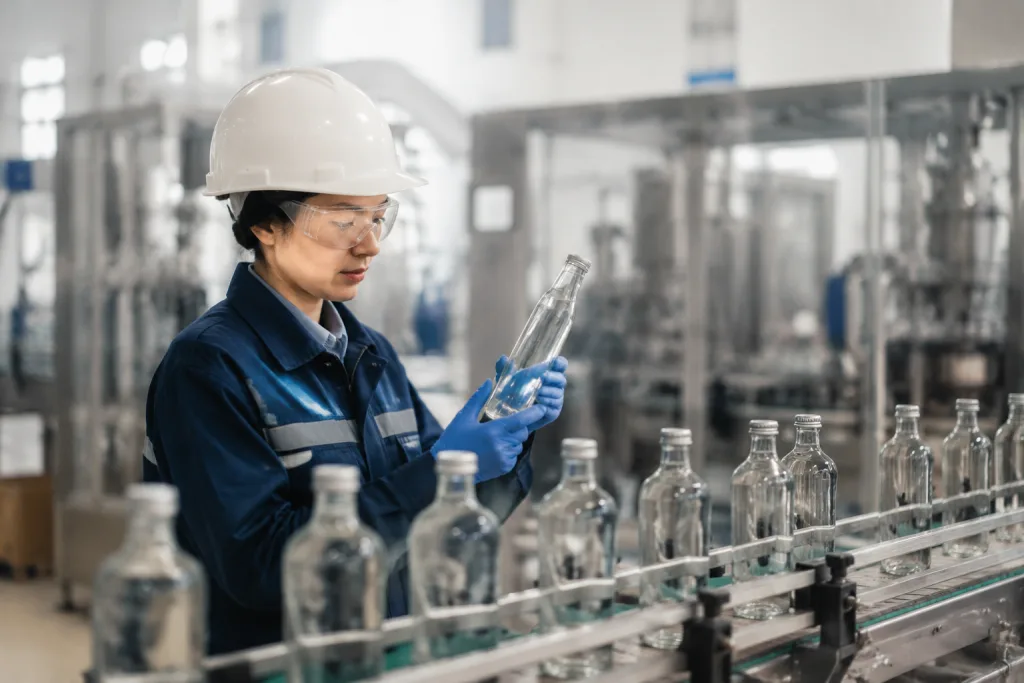
Control two things first: bottle movement inside the box and carton strength outside it. For a standard 500-750 ml promotional glass bottle, we run individual white box or kraft box, corrugated dividers when bottles are packed naked, and a 5-ply export carton for sea freight. Our carton room checks flute crush with a simple edge press gauge, and we reject cartons with loose glue at the side seam. A 3-ply carton is fine for Hangzhou to Shanghai domestic delivery. For LCL export loads, the math doesn't work because the carton may be touched 12 times before it reaches the buyer's pallet rack.
Ask for carton specs you can measure: carton size in mm, gross weight, board grade, packing quantity, and pallet plan if needed. A carton with 24 glass bottles often lands at 9-14 kg depending on capacity and lid type. Over 15 kg, we see more corner collapse, especially when the forwarder stacks mixed cargo on top. If your canteen distributor needs retail-ready cartons, confirm barcode label placement and FNSKU or EAN requirements; last March a PO typo put the EAN on the short side, and the buyer flagged it during inbound scanning.
Drop testing is not just for e-commerce. For export orders, we use an ISTA-style internal test: one corner, three edges, plus six faces from 60-80 cm based on carton weight. QC marks the impact corner with a red Sharpie, then opens the carton and checks the glass shoulder, cap thread, and bottom ring. If the buyer wants Amazon FBA or direct-to-consumer fulfillment, tighten the pack. A single polybag is the wrong spec for glass. Bubble bag, molded pulp, or honeycomb paper may add USD 0.08-0.25 per unit, but replacing 300 bottles across North America costs more than the packaging upgrade.
China factories can build strong packaging when the RFQ says so. We've seen this go sideways when packaging is discussed only after FOB Ningbo or Shanghai is squeezed by USD 0.03. Put the carton drawing, drop-test level, label position, and MOQ packaging style into the RFQ from day one. Otherwise 5 suppliers will quote 5 protection levels, and the lowest price is usually just a thinner carton with nicer wording.
Compliance paperwork arrives too late
About 7 out of 10 buyers we talk to ask for certificates after the order is packed. Too late. Compliance changes the glass recipe, logo ink, lid coating, gasket, glue, carton ink, and sometimes which line we run. Last month QC pulled a 500 ml sample with a nice logo, but the PO only said “EU market” in the remarks column after mass production. If you are buying for Europe or North America, put the target market in the RFQ.
For glass drinkware, we first check heavy metals in the glass and decoration, food-grade silicone on the gasket, and coating safety on the lid. For the EU, buyers usually ask for LFGB, REACH, and sometimes Regulation (EC) No 1935/2004 declarations. For the United States, FDA food-contact suitability and California Proposition 65 screening may apply. Children’s drinkware brings ASTM and CPSIA into the job, especially with painted logos or novelty parts. We once had a buyer flag a 0.8 mm raised cartoon decal because the bottle was going into a kids’ back-to-school set.
Do not accept a generic PDF without checking the scope. This is where projects go sideways. A 2021 test report for a clear glass bottle does not cover your new customized drinkware with a painted logo, colored silicone sleeve, bamboo lid, and printed gift box. Ask if the report covers the exact material, color, and finish on your order. Dark pigments, metallic inks, and soft-touch coatings need a separate look; our lab once rejected a gold ink sample after the cross-hatch tape test lifted 3 squares out of 100.
Factory social compliance can matter too. Large distributors and retail buyers ask for BSCI, Sedex, ISO 9001, or their own audit form. Not every canteen manufacturer in China holds every audit, and paying for a new audit on a 3,000-unit job often makes the math fail. Be practical. If your customer requires BSCI, say it before sampling, not after we cut the mold or print the first 20 gift boxes. If not, ISO-style quality procedures plus a final AQL inspection may be enough.
For BottleForge Industrial in Zhejiang, we build the compliance checklist before quoting the final price. It saves arguments. We have seen buyers approve USD 1.85 FOB, then discover the required silicone, ink, or lid coating moves the real cost to USD 2.10. On a 10,000-piece order, that gap is USD 2,500, and nobody wants to reopen the PI because one line on the PO said “Prop 65 needed” after approval.
Inspection catches what emails miss
A purchase order is not a quality system. It is only the starting paper. For promotional glass bottle orders, we run control at sample approval, on-line production, and final random inspection before the truck leaves Hangzhou. Miss one checkpoint and the math does not work: saving 3 days can kill a 20,000 pcs campaign when QC pulls cartons with the wrong logo height.
The pre-production sample should match the final glass material, the actual cap, the gasket hardness, the confirmed logo process, export packaging, and the care label text. If the supplier sends a stock bottle with a temporary logo, treat it as a look-and-feel sample only. A real pre-production sample normally takes 7-12 days after artwork confirmation for standard silkscreen or decal work. Custom mold projects take 25-35 days for the mold and first article samples; last month one buyer flagged a 2 mm cap overhang on the first article, and fixing it before mass production saved the order.
During production, check the first 200-500 units for glass defects, mouth finish, logo position, and cap fit with a caliper, torque gauge, and a simple flat-table wobble test. We see stones, bubbles, scratches, wavy glass, chipped rim, dirty inner wall, and unstable base. Some small bubbles are normal in commercial glass production, but define limits in writing. Be specific. For example, no bubble larger than 1.0 mm in the logo area and no sharp chip anywhere on the drinking rim.
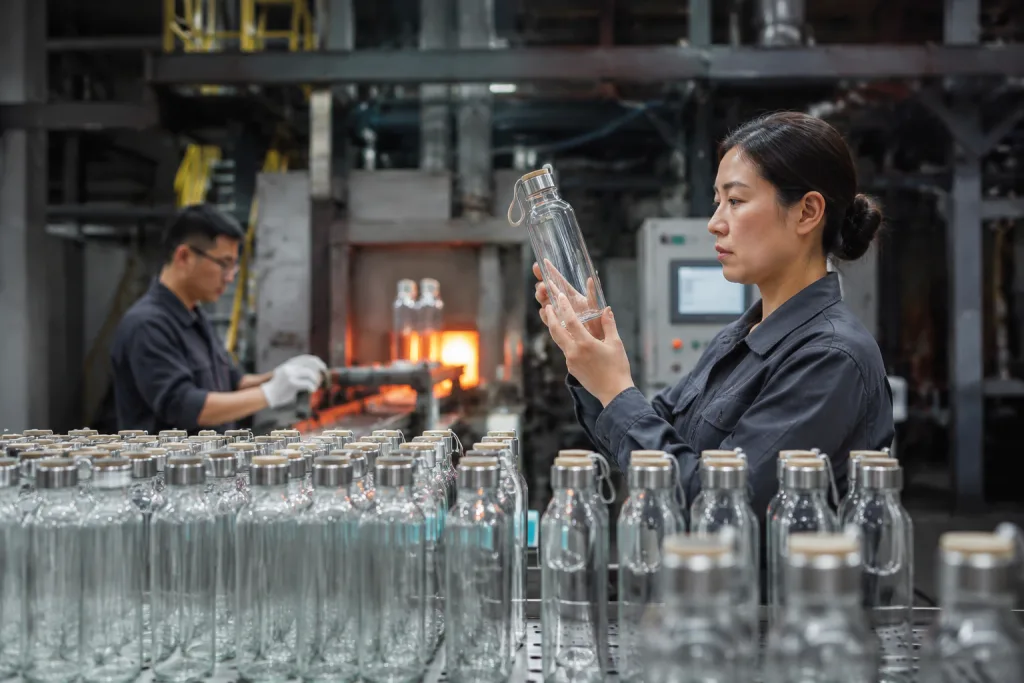
Final inspection should use AQL, not a quick “looks fine” photo from the line. For most B2B promotional orders, AQL 2.5 for major defects and 4.0 for minor defects is a reasonable baseline. Critical defects, such as broken glass inside packaging, sharp edges, severe leakage, wrong logo, or unsafe odor, should be zero tolerance. If your client is a premium retail account, tighten the standard or inspect more cartons; we have seen this go sideways when only 5 cartons were opened from a 600-carton lot.
Use a checklist, not a casual video call. A good inspection report includes quantity verification, carton drop condition, product dimensions, capacity test, leakage test, logo rub test, barcode scan, packing method, and defect photos with carton numbers. QC should record the bottle height in mm, filled capacity in ml, carton gross weight in kg, and any PO typo such as “matte black lid” while the approved sample says “gloss black.” Whether you buy from canteen suppliers, canteen vendors, or a direct canteen factory, inspect against written specs, not memory.
Price pressure creates hidden substitutions
Hard negotiation is normal. Procurement should push. The problem starts when the target price drops below the real BOM. Then the cut usually shows up in places you never signed off: 1.8 mm glass instead of 2.2 mm, a loose silicone gasket, 5-layer carton changed to 3-layer, 8-hour curing pulled at 5 hours, mixed bamboo lids, or QC checking 32 pcs instead of the agreed AQL 2.5 sample size. We have seen this go sideways after QC pulled the sample and found the lid seal leaking at 45 degrees.
For a standard 500 ml top promotional glass bottle with one-color print, bamboo or stainless lid, individual kraft box, and export carton, a realistic FOB China price might sit around USD 1.60-2.40 depending on glass type, lid, packaging, and order quantity. A 750 ml bottle or customizable growler format may run higher because the gross weight jumps by about 3-5 kg per export carton and the carton CBM gets ugly fast. A custom growler with swing top hardware, printed sleeve, and retail box can move into the USD 3.50-6.00 range. If a quote is 25% below the pack, ask what changed. Ask line by line. Last April, a buyer flagged a USD 1.28 offer for a 500 ml bottle; the supplier had quietly removed the kraft box and changed the lid from 304 stainless to plated steel.
MOQ also affects honesty. For our Hangzhou, Zhejiang production, 3,000 units is a common MOQ for standard glass bottle customization, while custom color silicone sleeves or special lids may require 5,000-10,000 units. Below MOQ, we still pay for screens, fixtures, line cleaning, packing materials, and inspection. Someone pays for that. If it is not shown on the quote, the math does not work, and the factory may recover it through weaker materials. We once had a PO typo showing 300 pcs instead of 3,000 pcs; the screen charge alone was RMB 650, before the line even warmed up.
The wrong question is “same quality, lower price” every round. Choose the trade-off instead. Use a 45 mm logo instead of a wraparound print. Switch from gift box to white box. Take the standard lid already on the shelf. Cut print colors from 3 to 1. Keep the bottle shape from an existing mold. These moves protect the bottle while pulling cost out cleanly, and the packing bench does not need to fight a fragile retail box with a 0.5 mm tight insert.
A good canteen supplier or distributor growler partner should tell you where cost can be removed safely and where it cannot. If every request gets “yes, no problem,” slow down. Real manufacturing has limits. Honest limits save claims later. On our line, if the buyer asks for rush curing from 18 hours to 12 hours for a heavy ink logo, we push back because tape test failures at final inspection are more expensive than 1 extra production day.
Send your glass bottle spec before you quote
Share capacity, logo, market, packaging, and target quantity. We will flag the risky parts before sampling starts.
Frequently asked questions
What MOQ should I expect for a top promotional glass bottle?
For standard shapes with custom logo, expect 3,000 units as a practical MOQ from a direct canteen manufacturer in China. Some canteen vendors may accept 1,000 units by using stock bottles and digital decoration, but unit price usually rises by USD 0.30-0.80 and color control may be weaker. Custom silicone sleeves, special caps, tinted glass, or retail packaging often push MOQ to 5,000-10,000 units because material suppliers have their own minimums. If you need only 500 pieces for a test campaign, ask for stock custom drinkware rather than a true factory production run.
Is borosilicate always better than soda-lime glass?
Not always. Borosilicate is better for thermal shock and is usually the safer choice if users may add hot water or tea. It is also lighter at similar capacity. Soda-lime glass can be perfectly acceptable for cold-fill promotional bottles, especially when budget matters. The difference can be USD 0.20-0.60 per unit depending on size and wall thickness. For a top promotional glass bottle sold as office or event drinkware, borosilicate 3.3 with 2.0 mm or thicker walls is a stronger spec. For low-cost cold-water campaigns, soda-lime may be enough if packaging and rim finishing are controlled.
Which logo method is safest for glass bottle promotions?
For 3,000-20,000 units, one- or two-color silkscreen printing is usually the most stable and cost-effective. It gives clean branding and manageable setup cost. Decals work better for multicolor or detailed artwork, but curing and edge visibility must be checked. Heat transfer can look good but needs rub and dishwasher testing. Laser engraving is mainly used on stainless lids, not clear glass bodies. If you need a canteen customized for retail, request a golden sample and set placement tolerance at +/-1.5 mm on straight-wall bottles. Also specify Pantone color and whether a white underbase is required.
How should I inspect a promotional glass bottle order?
Use AQL final inspection, not only production photos. A common baseline is AQL 2.5 for major defects and 4.0 for minor defects, with zero tolerance for critical safety issues such as sharp rim chips, broken glass, severe leakage, wrong logo, or chemical odor. The inspector should check capacity, dimensions, wall appearance, cap fit, leakage, logo rub resistance, barcode scanning, carton strength, and packing quantity. For a 5,000-unit order, inspection usually samples a few hundred pieces depending on the selected inspection level. If your customer is a large canteen distributor, add carton drop testing before release.
Can I order glass bottles for Amazon FBA or retail distribution?
Yes, but the packaging spec must be stronger than normal bulk promotional packing. For Amazon FBA, you may need FNSKU labels, scannable carton labels, individual protection, suffocation warnings if polybags are used, and cartons that stay under practical handling weights, often 15 kg or less. Glass bottles should have bubble bag, molded pulp, honeycomb wrap, or a tested retail box structure. Ask your canteen supplier to perform a 60-80 cm carton drop test and send photos before shipment. For retail distribution, also confirm EAN/UPC barcode placement, country-of-origin marking, care instructions, and recycling symbols.