Key Takeaways
- A realistic MOQ for custom drinkware is 500-1,000 units per SKU for repeatable factory pricing
- Laser engraving often adds USD 0.18-0.45 per unit, while full-wrap print can add USD 0.60-1.20
- Standard production lead time from Zhejiang, China is usually 25-40 days after sample approval
- FOB pricing is cleaner than DDP when you compare quotes from multiple canteen suppliers
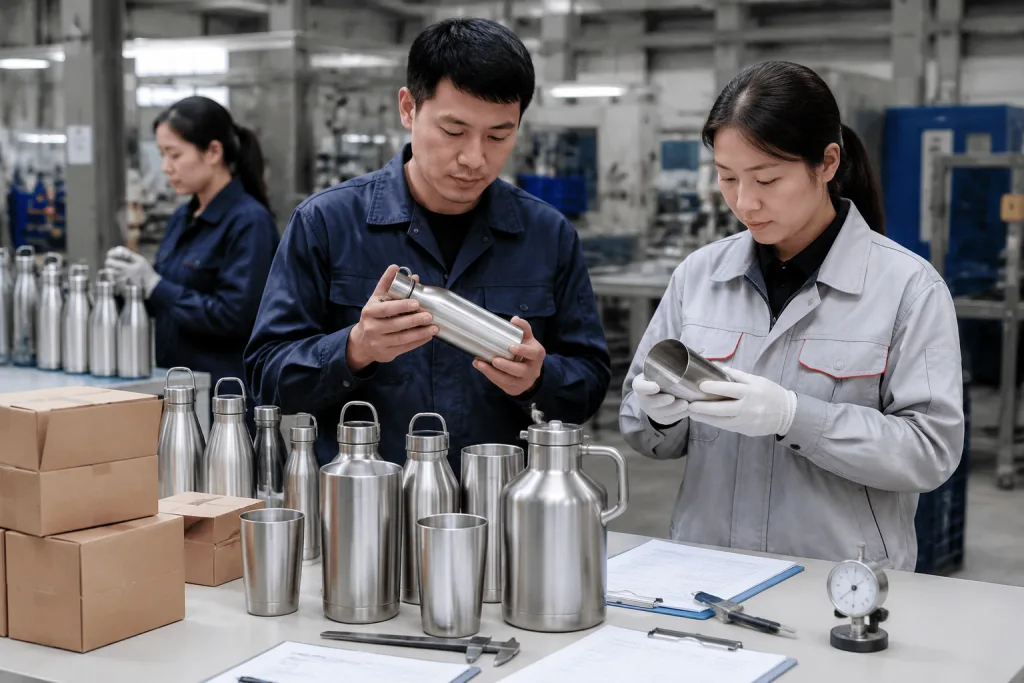
Top promotional drinkware looks simple on a quote sheet until you put a caliper on the cup wall, check lid tooling, confirm the logo method, count the carton layers, and read the delivery terms line by line. We had a buyer flag two bottles at USD 2.10 and USD 3.40 because they looked close in the PDF; QC pulled the sample, ran 200 open-close cycles, and only one held water while still matching REACH and AQL 2.5 inspection.
If you buy for a brand, distributor, or retail promotion, get the real cost and lead time before you promise dates to your customer. Fast is not the plan. Our Zhejiang, China team sees this 6 to 8 times a month: buyers ask for customized drinkware in 12 days, then the line stops because the artwork is 1 mm off, the PO has a carton typo, or the sample approval arrives after the packing material has already been booked.
Start With The Real Unit Cost
For top promotional drinkware, the unit price is not one clean number. It is the body material, forming loss, surface finish, logo process, lid set, carton pack, inspection, and export handling sitting on one line of the PI. Last month a buyer sent us a PO with “500 ml bottle, logo printed” and no lid drawing; QC pulled the sample and found a push-button lid that cost USD 0.18 more than the screw lid quoted. If a canteen vendor gives you one flat price without a spec sheet, you are not comparing products. You are comparing guesses.
For stainless steel bottles, steel grade and weight move the price first. Common promotional bottles use 201 or 304 stainless steel. For Europe and North America, 304 stainless steel is the safer default for food-contact perception and corrosion resistance. A 500 ml double-wall vacuum bottle may run 0.4 mm on the inner wall and 0.5 mm on the outer wall; we check this with a digital thickness gauge on the line, not by eye. Shaving the wall to 0.32 mm saves a few cents, but the math does not work if you get dent claims after a 1,200-carton sea shipment.
At a practical China canteen factory, baseline FOB ranges often look like this for plain stock shapes before heavy decoration: 500 ml single-wall stainless bottle at USD 1.60-2.40, 500 ml double-wall vacuum bottle at USD 2.80-4.20, 20 oz travel tumbler at USD 3.20-5.10, 64 oz custom growler at USD 8.50-14.00, and borosilicate glass bottle at USD 2.20-3.80. Treat these as filters, not promises. If a quote lands 30% lower, ask what changed: 201 instead of 304 stainless, 24-hour vacuum test instead of 6-hour spot check, thinner 5-layer carton, or a cheaper PP lid gasket. We have seen this go sideways when the buyer flagged rust dots on the rim after SGS opened only 8 samples.
Good canteen manufacturers break out the body, lid, logo, packaging, and testing cost. That makes the quote easier to defend in your buyer’s spreadsheet. It also lets you cut the silicone boot or switch from laser engraving to 1-color silk print when the customer cuts the budget by USD 0.30 per unit. We run this exercise often: MOQ 3,000 pcs, carton 24 pcs, 11.5 kg gross weight, AQL 2.5 inspection booked 3 days before loading.
MOQ Tiers Change The Math
MOQ is where 7 out of 10 promotional projects start to pinch. A buyer asks for 300 units in six colors, with a custom canteen lid and retail box. On our side, that means 50 units per color, six powder changes, six sets of Pantone checks under the D65 light box, and extra packing checks at the end of the line. Both sides are rational. The math does not work unless the SKU plan gets simpler.
For BottleForge Industrial in Hangzhou, Zhejiang, normal MOQ starts around 500 units for stock-color customized canteen projects and 1,000 units per color for custom powder coating. For fully custom molds, special caps, or a new customizable growler shape, expect 3,000-5,000 units because tooling, fixtures, and production line setup must be recovered. We run 380,000-520,000 units per month across bottles, tumblers, growlers, and kids bottles, but a 6-color small order still eats line time. Last month QC pulled a 600-piece trial because the cap gasket sat 0.4 mm high after the buyer changed the lid drawing twice.
The first tier, 500-999 units, fits distributor drinkware trials and seasonal tests. It is the wrong tier for six-color artwork unless the buyer accepts the surcharge. You will pay more per unit, often 8-18% above the 1,000-unit tier, because setup cost is spread over fewer pieces. The 1,000-2,999 unit tier is where most canteen promotional orders start to run cleanly. At that volume, we can usually support custom colors, laser engraving, silkscreen, or one-color carton marks without painful surcharges, and the line leader can keep changeovers under 35 minutes instead of stopping twice before lunch.
Above 5,000 units, a canteen manufacturer can buy stainless sheet and PP components better, run coating batches for 12 hours instead of 3 hours, and cut changeover waste. Ask for stepped pricing at 5,000, 10,000, and 20,000 units. If you are a canteen distributor serving several regional clients, combine demand into one body shape with different logos. We have seen this go sideways when a PO says “same bottle” but the artwork file names hide two different lid colors, so lock the body, lid, carton, and insert spec before asking for the final quote.
Decoration Costs Are Not Equal
Logo method is where custom drinkware budgets get punched first. We see this every week: buyer asks for a 90 mm tall logo because the mockup fills the screen nicely, then the unit cost jumps USD 0.40 and the line slows down. Big print is not always better. Match decoration to the bottle curve, MOQ, coating type, and real use; otherwise QC pulls samples with broken edges, ghosting, or logos sitting 3 mm off center.
Laser engraving looks clean and holds up well on 304 stainless steel and powder-coated bottles. It usually adds USD 0.18-0.45 per unit depending on logo size, position, and whether the item needs a rotating fixture; our rotary jig takes extra setup when the logo wraps past 55 mm wide. Silkscreen is cheaper for simple one-color logos, often USD 0.10-0.30 per unit, but curved bodies and textured coatings need the right mesh count and ink hardener. Heat transfer or full-wrap printing can add USD 0.60-1.20 per unit and needs tighter artwork control, especially when the seam lands near a handle. UV print works for short runs and multi-color logos, but for outdoor canteen customized products, this is the wrong question to ask if the buyer only cares about color count. Ask about scratch life.
For canteen customizable programs, ask for artwork limits before the PO: printable area in millimeters, Pantone tolerance, minimum line width, and whether the factory will provide a digital proof plus a physical pre-production sample. We normally flag lines under 0.25 mm because they fill in after coating texture and ink spread. On powder coating, a Delta E color difference of under 2.0 is a reasonable target for many branded programs, but neon colors and metallic finishes are harder. We have seen this go sideways when a buyer approved “blue” on the PI, then rejected cartons because the logo was PMS 3005 C instead of PMS 2995 C.
Packaging decoration also costs money. A white tuck box may add USD 0.18-0.35. A printed retail box may add USD 0.35-0.90 depending on board grade and quantity; 350 gsm grey board behaves differently from 400 gsm white card when cartons are stacked 5 layers high. If your customer only needs giveaway stock, do not pay for retail packaging. If the order is for store shelves, do not save USD 0.20 and end up with crushed boxes after we ship 18 kg master cartons.
Lead Time From Artwork To Vessel
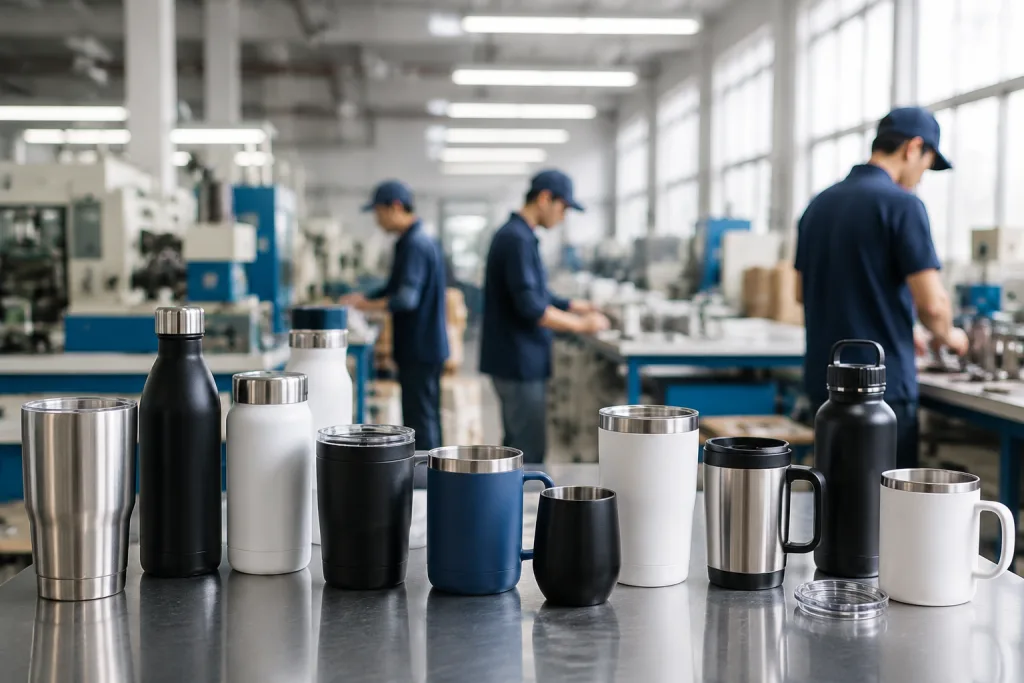
A workable schedule for top promotional drinkware starts before the line sees a blank cup. Artwork check takes 1-2 working days when the file is clean: AI, PDF, or EPS, with outlined fonts and Pantone references. We check it on a calibrated monitor against our Pantone C book, then measure logo placement in mm against the print jig. Send a 72 dpi PNG copied from a website and the clock changes. We can rebuild a simple one-color logo in 30 minutes; a crest with gradients, tiny text, and 6 colors should come from your customer or agency.
Sample timing depends on what you are asking us to prove. A digital mockup is same day or next day if the PO names the bottle SKU correctly; last month a buyer typed “750ML-BK” instead of “750ML-BLK” and QC pulled the wrong black sample from the shelf. A physical logo sample for a stock stainless bottle normally takes 5-8 days. A custom coated sample takes 10-15 days because the powder coating booth, 180°C curing oven, and decoration station all need a slot. For a customized growler with a new lid insert or special handle, prototype timing can run 18-30 days before mass production is safe to confirm.
After sample approval and deposit, standard mass production in China needs 25-40 days for common drinkware. Orders above 20,000 units need 45-60 days, especially in September-November when promotion orders and retail holiday programs fight for the same coating line. Add 2-4 days for final inspection, carton labeling, and container loading; our inspectors usually work to AQL 2.5 and still open cartons to check barcode position by ruler. If you need Amazon-style FNSKU labeling, polybag rules, or mixed cartons by destination, add another 2-5 days. The math does not work if the buyer approves samples on Friday and asks us to ship next Wednesday.
Sea freight to North America often takes 18-35 days port-to-port, while Europe can be 28-45 days depending on port and routing. Air freight is possible, but a stainless bottle is heavy for its value; one 24 oz bottle can be 0.38 kg before the gift box. Paying USD 2.00-4.50 per unit for air freight can wipe out the promotion margin. We ship urgent cartons by air when the in-hands date is fixed, but we have seen this go sideways when the sales team plans from the event date instead of working backward from warehouse delivery.
Testing And Compliance Costs
Compliance is not a box to tick after the sample lands. It changes the resin, ink, coating, lid plastic, gasket, and even the carton spec. For Europe, buyers usually ask for LFGB or EU food-contact papers, REACH on restricted substances, and sometimes BSCI or Sedex factory audit status. For the United States, food-contact checks often point to FDA, while kids’ bottles may need ASTM or CPSIA review depending on the product and age claim.
A proper canteen manufacturer should hand over material declarations, past test reports, and batch support without a song and dance. Old reports are where deals go sideways. A 2021 report on a different lid does not cover your 2026 order, and we’ve had buyers flag that after QC pulled the sample from the packing table. For a larger distributor program, budget for fresh testing on the exact build. A basic food-contact or heavy metals test often runs USD 150-500 per material set. More complete EU or US programs can hit USD 800-2,000 when you test several components.
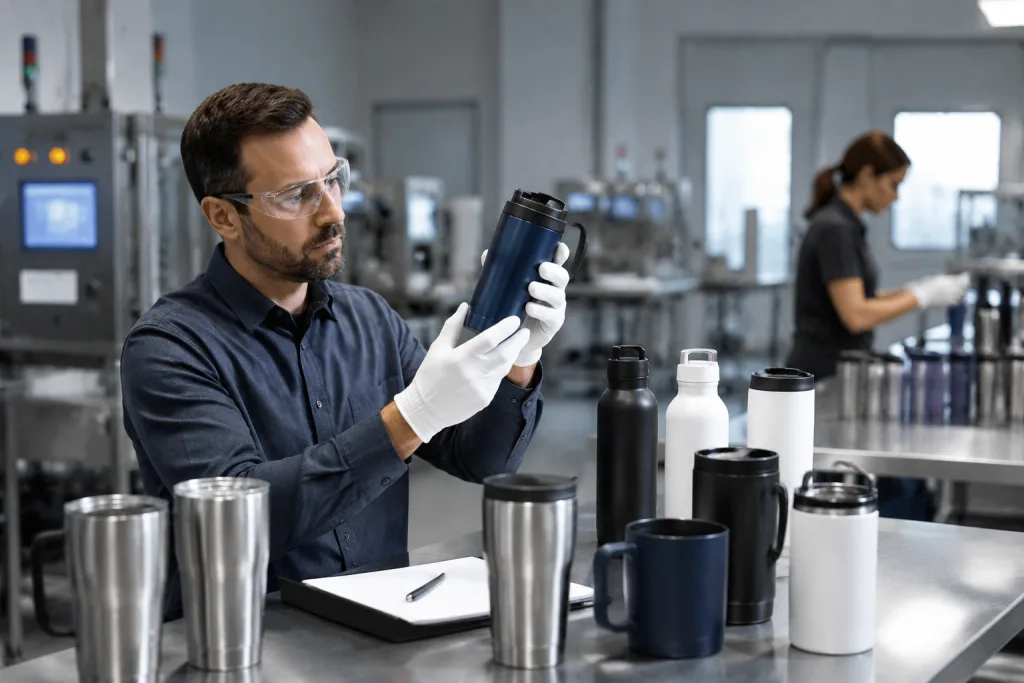
Inspection is another line item that saves headaches. We usually run AQL inspection before shipment, often AQL 2.5 for major defects and 4.0 for minor defects. The inspector checks leakage, vacuum retention, coating adhesion, logo position, carton drop condition, barcode readability, and random capacity measurement. On a 5,000-unit order, third-party inspection in China may cost USD 250-400. That is cheaper than handling 5,000 complaints because a cap seal failed on the line.
Do not accept vague words like “eco-friendly” or “food safe” without documents. We’ve seen a PO typo turn “food safe” into “food save,” and that sort of thing creates a mess when customs or the buyer asks for proof. Zhejiang factories can ship solid drinkware, but the specs and test scope need to sit in the purchase order, with the exact product code and carton count.
Choosing Supplier Terms Wisely
Compare canteen suppliers on the same Incoterms, or the price sheet lies. We usually quote FOB Ningbo or FOB Shanghai for buyers with their own forwarder; our Ningbo truck is booked by 4:00 p.m. the day before loading, and the VGM weight comes from the floor scale, not a guess. EXW may show USD 0.18 less per piece, then you inherit local trucking, export declaration, warehouse loading, and one scratched pallet that nobody wants to own. DDP works for a 300-piece trial order, but duty rate, freight lane, and customs value sit inside one blended number. If one canteen vendor quotes EXW and another quotes FOB Ningbo, the “cheaper” offer is the wrong comparison.
Payment terms change the real cost. Standard China factory terms are 30% deposit and 70% balance before shipment. For canteen distributors with 3 repeat orders and clean payment history, we may run 30/70 against bill of lading copy, or a small credit-insurance line; first orders almost never get that. Last March, one buyer asked for 60 days after delivery on a 5,000-piece PO while his own customer paid him 60 days later. The math doesn’t work. A factory line still has to buy 304 stainless coil, lids, cartons, and powder coating before QC pulls the first sample.
Give every canteen factory the same quote format: product code, capacity, steel grade, wall thickness, coating type, logo method, carton size, units per carton, gross weight, MOQ, lead time, sample cost, tooling cost if any, FOB port, and validity date. Better yet, ask them to fill your sheet, not their pretty PDF. We check wall thickness with a digital caliper in mm, and carton gross weight on a 30 kg bench scale before releasing the offer. A serious canteen supplier answers these items without drama. If the quote says “same as picture,” push back; we’ve seen that turn into 0.4 mm body steel instead of the 0.5 mm the buyer expected.
Check communication speed, but judge the content too. Fast replies mean nothing if nobody flags the risk. A practical export sales engineer should call out artwork 3 mm from the taper, lid color off by one Pantone chip, carton weight above 15 kg, or a handle design that fails torque testing at 8 N·m. QC pulled a sample on our line last year because the buyer’s PO had “mat black” instead of “matte black,” and the buyer flagged it only after the pre-production photo. The cheapest canteen vendor gets expensive when they stay quiet until production is already wrong.
Where To Save Without Regret
You can cut cost on customized drinkware without making the cup feel cheap. Start with SKU control. We run cleaner orders when the buyer picks one body shape, two colors, and one logo method instead of four bodies, six colors, plus mixed decoration. On a distributor growler or distributor drinkware program, that usually cuts setup waste by 10-20%; last month QC pulled 6 extra color chips from one PO because “navy” was typed three different ways.
Use stock tooling where it makes sense. A custom canteen mold sounds good in a meeting, but this is the wrong question to ask unless the shape drives real sales. Existing proven molds save tooling cost, often USD 1,500-8,000 depending on cap and body complexity, and skip the 20-45 day tooling delay. Our mold room already has gauges for the neck finish, cap thread, and silicone ring fit, so a stock bottle with a strong color and clean logo will beat a risky new shape for most promotional campaigns.
Packaging is another place to save, but not blindly. If the bottle goes into a corporate welcome kit, a kraft box or bulk carton may be enough. If it is sold in retail, pay for a stronger printed box and ISTA-style drop considerations. We have seen this go sideways: a buyer saved USD 0.18 per unit on cartons, then their distributor flagged scuffed powder coating after a 1.2 m drop test.
Be honest with the forecast. Tell your canteen manufacturer if the first order is 1,000 units but the annual plan is 12,000. A factory can hold raw material pricing for a set window, build fixtures, or suggest a canteen promotional body that scales better on the line. Good suppliers in Zhejiang, China prefer repeatable orders over one difficult rush order; the math works better when we can plan steel sheet, caps, and cartons 30 days ahead instead of chasing them after a typo on the PO.
Get a practical drinkware quote before production slots fill
Send your target quantity, logo file, delivery country, and in-hands date. We will return a realistic FOB quote and lead-time plan.
Frequently asked questions
What is the normal MOQ for top promotional drinkware?
For most custom drinkware, a realistic MOQ is 500 units for stock colors and 1,000 units per color for custom powder coating. A canteen customized project with a new lid, special handle, or molded silicone part usually starts at 3,000-5,000 units. If you need only 200-300 pieces, ask for stock bottles with laser engraving or one-color print. You will pay a higher unit price, often 10-25% above standard MOQ pricing, but you avoid tooling and coating setup charges. For distributor canteen programs, consolidating several customer logos on one bottle body is the easiest way to reach efficient MOQ.
How long does a custom canteen order take from China?
A normal timeline is 5-8 days for a physical logo sample, then 25-40 days for mass production after sample approval and deposit. Custom coating samples can take 10-15 days. A canteen custom mold or customized growler lid can add 20-45 days before production. Add inspection, carton labeling, and loading time of 2-4 days. Sea freight is separate: roughly 18-35 days to North America and 28-45 days to Europe port-to-port. If your event date is fixed, start sourcing at least 90 days ahead for sea freight orders.
Which logo method is best for canteen promotional orders?
For durable corporate gifts, laser engraving is usually the safest choice on stainless steel or powder-coated bottles. It costs about USD 0.18-0.45 per unit and does not peel like poor ink. One-color silkscreen can be cheaper at USD 0.10-0.30 per unit, but it needs the right ink and curing process. Full-wrap heat transfer or UV print is better for colorful campaigns, often adding USD 0.60-1.20 per unit. If the bottle will be washed often, handled outdoors, or sold as premium merchandise, test adhesion before approving mass production.
Should I buy from a canteen manufacturer or a trading company?
A direct canteen manufacturer gives you better control over wall thickness, coating, leak testing, and production timing. A trading company can be useful if you need many unrelated promotional products in one shipment. For drinkware-focused orders above 1,000 units, direct factory communication usually reduces errors. Ask for production photos, factory audit status, sample room capability, and monthly capacity. A serious canteen factory should explain MOQ, AQL, FOB port, carton specs, and lead time clearly. If the supplier cannot confirm material grade or lid plastic type, the low price is not worth much.
What documents should canteen distributors request before ordering?
At minimum, request a specification sheet, quotation with Incoterms, artwork proof, sample approval record, material declaration, and relevant food-contact test reports. For Europe, ask about REACH and EU food-contact or LFGB suitability. For North America, confirm food-contact compliance and whether any ASTM or CPSIA concerns apply to kids items. Before shipment, use an AQL inspection report with photos of leakage testing, logo position, coating adhesion, carton marks, and random capacity checks. For larger orders, require batch numbers and carton labels that match your purchase order exactly.