Key Takeaways
- 304 stainless steel at 0.4-0.5 mm body wall is a safer baseline than vague food-grade steel
- A practical MOQ for custom drinkware is 1,000-3,000 pcs per color depending on finish and logo process
- Expect 25-35 days production after sample approval for standard insulated bottles from Zhejiang, China
- Use AQL 2.5 for major defects and AQL 4.0 for minor defects on promotional drinkware orders
A top promotional drink bottle is not the one that looks sharp in a mockup. It is the bottle that hits the vessel date, passes AQL 2.5, keeps the logo clean after 50 dishwasher cycles, and still leaves margin after freight, duty, and any rework. Most bad buys start with a thin spec sheet: capacity, color, logo, quantity. Too thin. For custom drinkware, this is the wrong question to ask; last month QC pulled a 750 ml sample from the line and found the “matte black” 0.18 mm coating scratched through after a simple cross-hatch tape test.
At BottleForge Industrial in Hangzhou, Zhejiang, we review about 35 RFQs from brand owners, distributor drinkware teams, and canteen distributors every week. The buyers who get stable results ask dull, exact questions before the PI is signed. Steel grade and wall thickness need real numbers, lid material needs a resin name, the AQL level needs to be written on the PO, carton drop test height should be agreed, and barcode placement must match the buyer’s warehouse rule. FOB port matters too. We’ve seen this go sideways over one typo: a PO said Ningbo, the buyer expected Shanghai, and the shipment sat 4 days while the forwarder recalculated.
Start With The Body Material
The first line of a spec sheet should not say stainless steel bottle. It should say the steel grade, the exact position, and the compliance paper you want attached to the lot file. For a top promotional drink bottle, we usually run 304 stainless steel on the inner wall and 304 or 201 stainless steel on the outer wall. If the drink contact surface is not 304, ask why before you approve the PI. “Food-grade” is the wrong answer; last month QC pulled a sample where the PO said 304 stainless, but the mill certificate only covered 201 outer sheet.
For Europe, ask for LFGB or EU food contact documentation where applicable, plus REACH for coatings and silicone parts. For North America, request FDA food-contact statements and, for kids or school programs, ASTM and CPSIA-related checks if the design falls into those categories. China suppliers can provide test reports, but check whether the report covers the same material, color, coating, and factory process as your order. We have seen buyers send a black powder-coated bottle order, then accept a report for plain brushed steel; the lab file looked clean, but it did not match the 5000 pcs shipment.
Wall thickness is where price differences show up fast. A typical vacuum bottle body uses around 0.4-0.5 mm stainless steel. Drop below that and dent resistance suffers. Go heavier and your unit cost and freight weight rise. For a custom growler or customized growler in 32 oz to 64 oz, 0.5-0.6 mm makes sense depending on the shoulder shape and handle design. On the line, we check the cut shell with a digital caliper; thin metal on a large growler rings hollow and feels cheap even when the logo print passes the 3M tape test.
If you are comparing canteen manufacturers, do not compare only the FOB price. Ask each canteen manufacturer to list inner steel grade, outer steel grade, body wall thickness, lid material, gasket material, and coating type, with the thickness shown in mm, not “standard.” A USD 0.22 difference often sits in those lines. We’ve seen this go sideways when a buyer approved the lower quote, then flagged dents at AQL 2.5 inspection because the body had been trimmed from 0.5 mm to 0.4 mm.
Capacity, Shape, And Real Volume
Capacity sounds simple until QC fills the bottle with a 1,000 ml graduated cylinder. A 500 ml bottle may hold 500 ml to the brim, but only 470-480 ml at a comfortable fill level below the thread. If your retail carton, Amazon listing, or distributor catalog says 20 oz, define nominal capacity and usable capacity on the spec sheet. We ask buyers to sign off on both because the wrong wording turns into a chargeback, not a production problem.
The common promotional range is 500 ml for events, 750 ml for outdoor retail sets, 1,000 ml for sports channels, and 1.2 L when the buyer wants shelf impact. For travel tumblers, 20 oz and 30 oz dominate. For a custom canteen or canteen customized project, 600 ml and 1 L work well because they balance perceived value with shipping efficiency. Big bottles look good in a sales deck. The math can go sideways. A 1,000 pc order of 1 L bottles may require 2.5-3.2 CBM depending on whether we run white box, egg-crate insert, or color box packaging. That changes LCL cost and warehouse handling fast.
Shape changes factory risk. Straight-wall bottles polish cleaner on the buffing wheel and give the pad-print jig a flatter landing area. Tapered shoulders and deep curves look premium, but QC pulled samples last month with thin powder coverage near a 28 mm shoulder radius and small dents around the curve after drop testing. A wide-mouth bottle is easier to clean and handles ice better, but the lid is larger, costs more, and leaks sooner if the silicone gasket groove is shallow.
For distributor canteen programs, keep the neck size and lid platform consistent across several capacities if the design allows it. One lid family across 500 ml, 750 ml, and 1 L reduces spare part confusion and speeds up reorders. Boring engineering sells. We ship fewer mixed-lid complaints when the line uses the same thread gauge and gasket spec across the range, and distributors care about that after the first 3 warranty emails land.
Insulation And Leak Testing
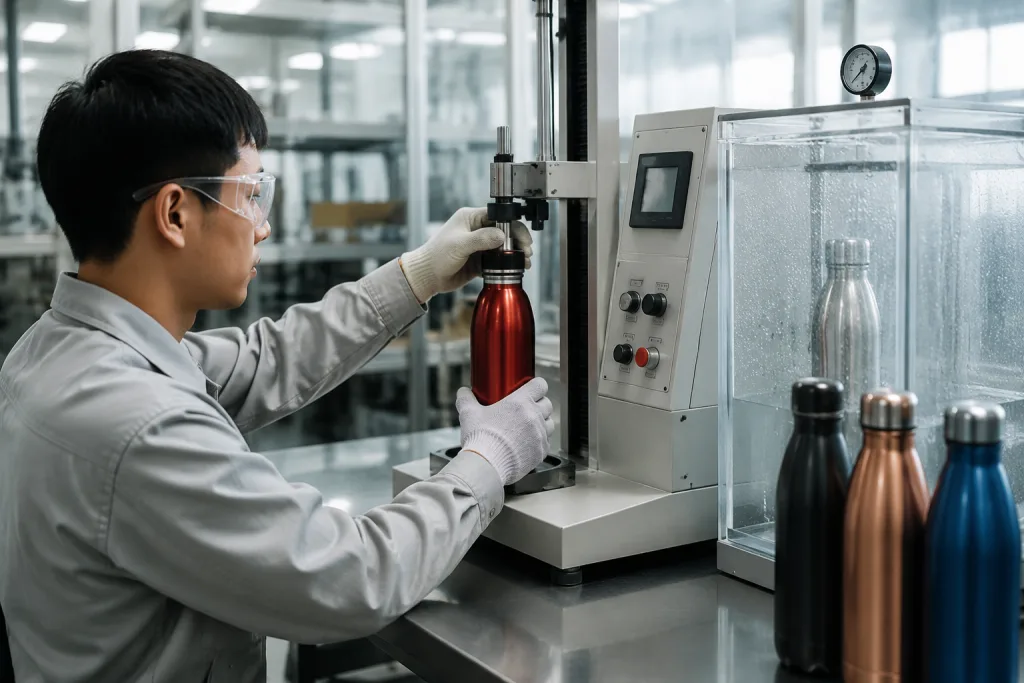
Vacuum insulation is not a line on a catalog page. We test it. Put the method in writing: starting temperature, room temperature, test hours, and pass mark. For example: hot water at 95°C, ambient at 20°C, after 6 hours water stays above 60°C. For cold tests, we often see 4°C water at 20°C ambient for 12 or 24 hours, with a probe reading logged every 2 hours. If a canteen supplier says “keeps hot for 12 hours,” ask for the temperature curve; our QC team uses a calibrated K-type thermometer, not a hand-feel check.
Double-wall vacuum bottles need stable welding, clean vacuuming, and copper plating only when the spec calls for it. Copper plating improves heat retention, but it cannot save a weak vacuum. We have seen this go sideways. One buyer pushed for a cheaper body, then QC pulled the sample at 6 hours and the water had already dropped to 52°C. At BottleForge Industrial, our Zhejiang line can produce about 450,000 stainless bottles per month across standard models, with order scheduling based on finish, decoration, and inspection load. Standard lead time is 25-35 days after sample approval, not after your first email.
Leak testing belongs in the purchase order. A normal factory process is 100% air-pressure or water leak testing for vacuum bodies before final assembly, then random finished-product leak checks after lid installation. On the line, we run 0.6 MPa air-pressure checks and mark failed bodies before polishing. For screw lids, test inverted and shaken. For straw lids, define the claim: closed straw only, upright carry, or any orientation. About 8 out of 10 straw-lid complaints we see come from this wording gap. Most straw lids are spill-resistant, not fully leakproof.
If you sell canteen promotional items into events, universities, or outdoor retail, insulation failures turn into public complaints fast. A bottle that sweats on a conference table or leaks in a backpack hurts the brand more than a USD 0.18 higher unit price. The math does not work. Last season, one event buyer flagged 37 leaking caps during incoming inspection because the PO said “leakproof” but the approved sample was a flip straw lid. This is where a serious canteen vendor earns its margin.
Decoration That Survives Handling
Logo method changes cost and claim risk. Laser engraving works well on 304 stainless steel, powder coating, and some plated finishes; we run it on a 20W fiber laser and QC checks the mark with 3M tape after cooling. It is slower than basic screen printing, often 12 seconds vs 4 seconds per side on the line, but we get fewer adhesion complaints. Silk screen printing is the cheaper choice for one-color logos on straight bodies, usually adding around USD 0.08-0.18 per position depending on size and quantity. Heat transfer and water transfer can carry full-color artwork, but test abrasion and dishwasher wording before your catalog promises 500 washes. We have seen that go sideways.
Powder coating is the standard finish for premium promotional bottles. Specify matte, semi-matte, or gloss; color code by Pantone or RAL; and define acceptable color tolerance with a signed color chip, not a phone photo. Our coating line hangs 480-520 pcs per rack batch, and one buyer once flagged “matte black” because the PO said Black C but the artwork file said 6C. A delta E target below 1.5 may be unrealistic for low-MOQ promotional work, while delta E 2.0-3.0 is more practical. For a canteen customizable project with 4 or 6 brand colors, request pre-production color chips before mass coating.
Minimum logo line width matters. Fine text under 0.25 mm may fill in during screen printing or look weak after laser engraving on textured coating; QC pulled one sample last month where the “®” mark became a dot. Small details fail first. If your client wants a QR code, test scan distance on the real bottle curvature, at 15 cm and 30 cm, under warehouse lighting. A QR code that scans on a flat PDF may fail on a tapered 750 ml bottle, and the buyer will not care that the file was “print-ready.”
For customizable drinkware sold by distributors, set up decoration zones in the spec sheet: front logo maximum 60 x 80 mm, back compliance text 35 x 20 mm, bottom batch code by laser. This gives your sales team a repeatable rule and saves the merchandiser from redrawing the same bottle 17 times across reorders. We mark the zones on a dieline in mm, then the line uses a curved jig to hold placement within 1.5 mm. For a customizable canteen or customizable growler, the same discipline prevents each reorder from becoming a new engineering job. The math doesn't work if every repeat order needs fresh artwork checking.
MOQ, Price, And Payment Lines
MOQ is not just a sales policy. It comes from the line: coating batch size, logo screen setup, carton plate cost, silicone mixing, and changeover time. For standard stainless bottles from China, we run 1,000 pcs per SKU for existing shapes with simple logo work. Custom Pantone powder coating often starts at 2,000-3,000 pcs per color because the powder room does not like 300 pcs trial colors; last month QC pulled a 500 ml sample and measured 0.18 mm coating build with the Elcometer before we approved mass spraying. A new mold, unusual lid, or custom growler handle can push the practical MOQ to 5,000 pcs or more. Below that, the math usually breaks.
FOB pricing should state the port, currency, included packaging, decoration, inspection support, and whether tax rebate changes affect quote validity. Zhejiang factories commonly quote FOB Ningbo or FOB Shanghai. A standard 500 ml double-wall stainless bottle may sit around USD 3.20-5.80 FOB depending on steel grade, finish, lid set, packaging style, and order quantity. A large customized growler can be USD 7.50-14.00 FOB before premium packaging. Ask for the packaging line item; one buyer flagged a quote because the PO said “white box,” but their artwork file showed 350 gsm color box with matte lamination.
Payment terms for new buyers are usually 30% deposit and 70% before shipment after inspection. Established canteen distributors sometimes negotiate 20/80 or partial balance against bill of lading copy, but not on the first order. If a canteen vendor offers a low deposit on a custom project, this is the wrong question to ask: ask how they pay for steel, powder, lids, cartons, and labor before your balance arrives. We have seen this go sideways. A 12,000 pcs bottle order can tie up 3.2 tons of 304 stainless before packing, and weak cash flow becomes your late shipment.
When you compare canteen suppliers, request a price ladder at 1,000, 3,000, 5,000, and 10,000 pcs. You will see where the real savings start. Sometimes 3,000 pcs reduces unit cost by 8-12% because coating and decoration run cleanly in one shift. Sometimes the saving is only 2%, and it is smarter to keep inventory lean. On our costing sheet, the setup charge for a laser logo is spread across the PO; if the buyer’s forecast is soft, 1,000 pcs now and a 1,000 pcs repeat 45 days later beats sitting on slow stock.

Inspection, Packing, And Barcodes
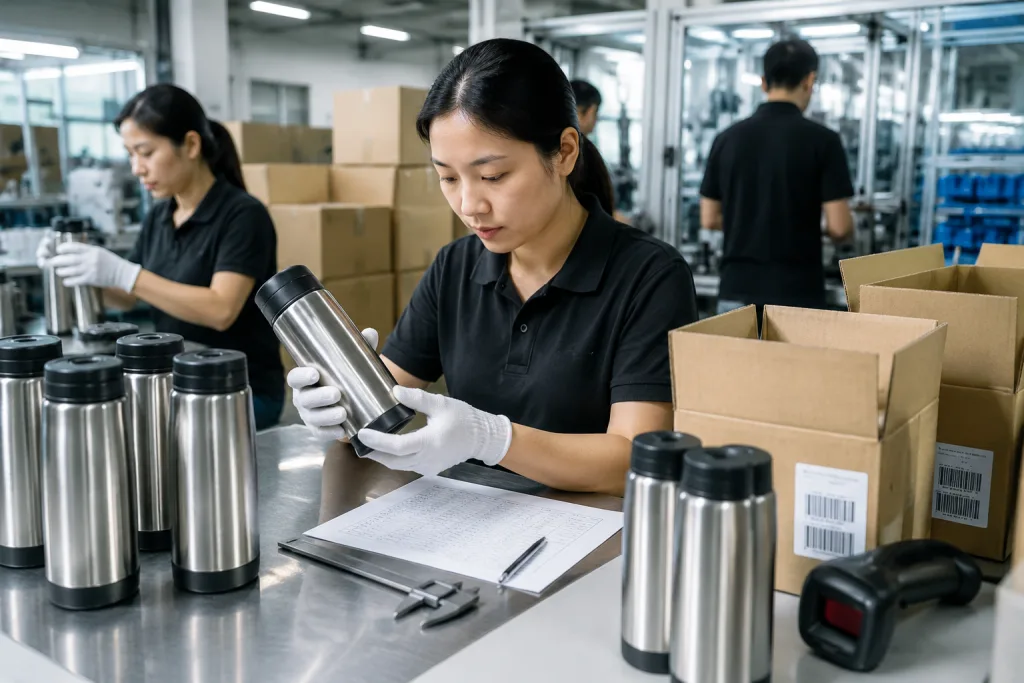
Write QC terms before the line starts. For most promotional drinkware, we run ANSI/ASQ Z1.4 sampling with AQL 2.5 for major defects and AQL 4.0 for minor defects. Critical defects stay at zero tolerance. Major defects include leaks, sharp edges, wrong logo, wrong capacity, failed vacuum, severe dents, and unsafe material mismatch; QC pulled a 304 stainless tumbler sample last month because the laser logo sat 3 mm off the approved artwork. Minor defects include small specks, light coating orange peel, carton scuffs, and tiny print variation inside the signed limit.
Packing is not clean-up work after production. Define whether each bottle goes into a polybag, kraft box, color box, or egg-crate divider, and put it on the PO instead of a WeChat message. For North American retail and FBA-style distribution, you may need FNSKU labels, suffocation warning on polybags, carton labels on two sides, and carton weight under 15 kg if your warehouse requires it. For EU programs, packaging waste rules and language requirements may apply. We have seen this go sideways: a distributor growler in a weak single-wall carton looked fine at our Hangzhou packing table, then arrived ugly after two truck transfers and 18 cartons had corner crush.
Drop testing should match the route. A common export standard is ISTA-style carton drop testing from 76 cm for cartons under 10 kg, adjusted by weight. If the order is LCL, use stronger master cartons because mixed cargo gets rough handling; the math does not work when 9 kg cartons sit under 28 kg auto parts for 12 days. If the order is direct container, you still need compression strength for stacking, so ask for the carton burst rating and let QC photograph the 5-layer carton after the drop.
Ask your canteen supplier for photos of the packing line, carton dimensions, gross weight, net weight, and palletization plan if needed. A good canteen manufacturer in Zhejiang will not be offended. We usually send a scale photo, a tape-measure shot showing 42 × 32 × 28 cm, and one pallet layout before booking space. The weaker canteen vendors say “no problem” instead of giving numbers, and that is the wrong answer when the buyer flagged a barcode typo on the PO two days before vessel closing.
Compliance And Supplier Proof
Supplier claims need paperwork, not screenshots. If you are buying from a canteen factory in China, ask for the business license, export records from the last 12 months, product test reports, and social audit files such as BSCI, Sedex, or ISO 9001 when your customer asks for them. Not every order needs the full stack. Still, check that the company name, factory address, report date, and product description match; QC once pulled a test report for “plastic lunch box” on a PO for 304 stainless bottles, and the buyer flagged it in 6 minutes.
For custom drinkware, compliance sits in separate parts: bottle body, lid, coating, packaging, and sometimes ink. A stainless body may pass, while the colored powder coating raises REACH questions. A silicone gasket may be fine, while a plastic straw needs its own food-contact confirmation. Put each material on the spec sheet with the expected standard and thickness where it matters, such as 0.5 mm body wall or 70 mm lid diameter. This matters when we ship parts from 2 canteen manufacturers and present one finished product to a retail or corporate buyer.
Factory visits help, but 9 buyers out of 10 do not fly to Hangzhou for a 3,000 pcs order. A remote audit can still check daily capacity, polishing lines, powder coating control, vacuum testing, assembly flow, and finished-goods storage. Ask for production photos with date stamps and a 20-second video of your actual pre-production sample on the vacuum tester, not a clean showroom clip. Serious canteen suppliers can send this within 2-3 working days; if they need 12 days, something is stuck on the line.
The best supplier relationship is not blind trust. It is controlled trust. You give clear specs, the canteen vendor confirms manufacturability, the pre-production sample freezes the standard, and inspection checks the shipment under AQL 2.5 if that is your rule. We run this process because the math does not work when a 5,000 pcs promotional job turns into lid leakage claims after delivery. That is how a canteen promotional project becomes a reorder instead of a one-time firefight.
Send Your Bottle Spec For A Factory Review
Share capacity, quantity, logo files, market, and target FOB price. We will flag risk points before sampling starts.
Frequently asked questions
What MOQ should I expect for a top promotional drink bottle?
For existing stainless steel models, expect 1,000 pcs per SKU as a workable starting MOQ. If you need Pantone powder coating, 2,000-3,000 pcs per color is more realistic because coating lines need batch efficiency. A custom lid, custom growler handle, or new body mold can push MOQ to 5,000 pcs or higher. Some canteen suppliers offer 500 pcs, but the unit price usually rises and color control may be weaker. For distributor drinkware programs, ask for a price ladder at 1,000, 3,000, 5,000, and 10,000 pcs before you promise a quote to your customer.
How long does production take after I approve the sample?
For standard customized drinkware from Zhejiang, China, a normal lead time is 25-35 days after sample approval and deposit. Add 5-10 days if you need custom Pantone coating, special packaging, or multiple logo positions. Pre-production samples usually take 7-12 days for existing molds and longer if tooling is involved. Shipping is separate: sea freight to Europe or North America often adds 25-45 days port to port, depending on route and season. If your promotion has a fixed event date, work backward from delivery, not from factory completion.
Is laser engraving better than screen printing for logos?
Laser engraving is usually better for durability, especially on powder-coated stainless bottles. It will not peel, and it handles frequent hand contact well. Screen printing is cheaper for simple one-color artwork, often around USD 0.08-0.18 per logo at volume, but adhesion depends on surface preparation, ink, and curing. For fine artwork under 0.25 mm line width, both methods need testing. If your customer wants retail-grade customized canteen branding, approve a physical decorated sample and run tape, rub, and wash checks before mass production.
What documents should a canteen manufacturer provide?
At minimum, request a business license, product specification sheet, material declaration, and food-contact test reports relevant to your market. For Europe, ask about LFGB or EU food contact and REACH for coatings and plastic parts. For North America, FDA food-contact statements are common, and kids programs may require ASTM or CPSIA-related checks. If your customer has ethical sourcing rules, request BSCI, Sedex, or similar audit documents. The report should match the actual material, coating, and lid used in your order, not just a similar old model.
How do I compare quotes from different canteen vendors fairly?
Build a one-page comparison table. Include inner steel grade, outer steel grade, wall thickness, capacity measured to brim and usable fill, lid material, gasket material, coating type, logo method, packing, FOB port, MOQ, sample time, mass lead time, and AQL terms. A USD 3.90 bottle and a USD 4.35 bottle may not be the same product. One canteen supplier may include color box, laser logo, and 100% leak testing, while another quotes plain packing and vague QC. Force every canteen vendor to quote against the same spec.