Key Takeaways
- For stainless top custom water bottles, 0.40-0.50 mm inner wall and 0.50-0.60 mm outer wall are common B2B ranges
- Realistic MOQ starts at 1,000 pcs per color for powder coating and 3,000 pcs for fully custom molds
- Logo method affects both cost and durability: laser is usually +USD 0.08-0.25 per pc, full-wrap print can add USD 0.35-0.90
- AQL 2.5/4.0 inspection and LFGB, REACH, or FDA documentation should be agreed before deposit
Buying top custom water bottles is the wrong question if the spec is loose. For B2B orders, the spec sheet decides margin, complaint rate, carton size, customs documents, and whether the launch date holds. A 500 ml bottle and a 750 ml bottle can look close in a PDF, but 304 stainless, 0.5 mm vs 0.6 mm wall thickness, lid thread pitch, powder coating, and screen printing can move landed cost by 20%. QC pulled one sample last month because the buyer’s PO said “matte black,” while the approved Pantone note on our line card said 6C.
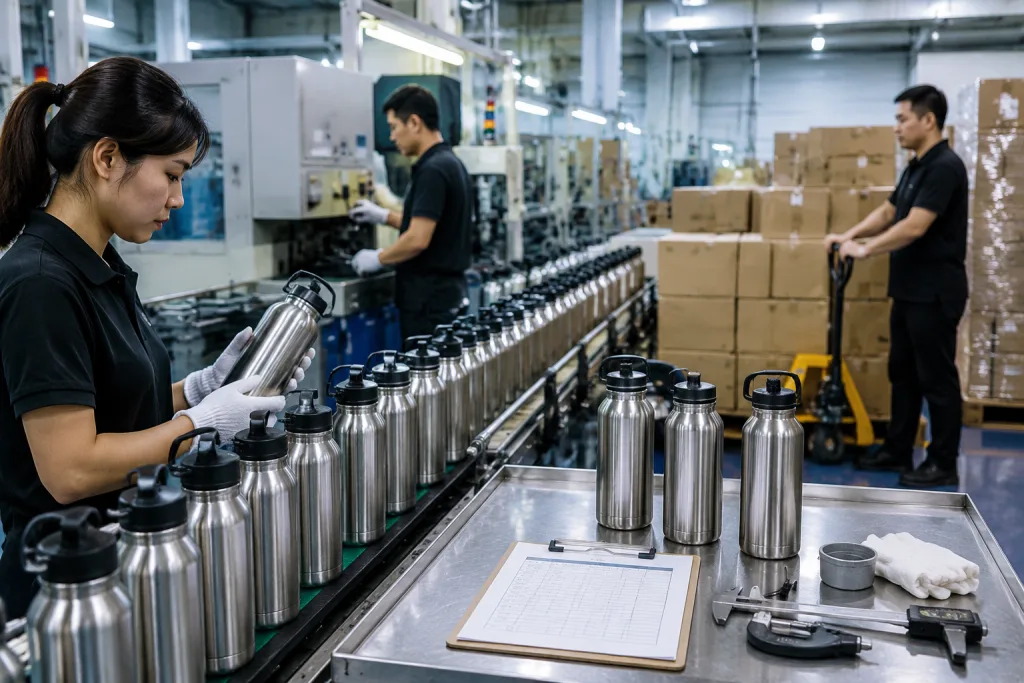
At our Zhejiang facility in China, we run into the same issue about 18 times each peak season: buyers ask for “premium custom drinkware” without freezing the technical details before tooling, sampling, and carton drop test. Too much gets guessed. A proper canteen factory quote should read like an engineering document, not a mood board; otherwise the line waits, the sample room reprints, and the math does not work.
Material Line: What You Are Really Buying
The first line on your spec sheet should not stop at “stainless steel bottle.” Too loose. For top custom water bottles, we ask for the real food-contact grade: SUS304 on the inner wall, then SUS201 or SUS304 on the outer wall. For premium European and North American programs, we run 304/304 unless the buyer is chasing a tight promo price, because the cost gap is clear but still workable, often USD 0.18-0.45 per unit depending on capacity and finish. On the line, QC checks the coil tag against the material record before deep drawing; if the tag says 0.50 mm and the PO says 0.45 mm, the buyer will flag it later.
If you are sourcing from a canteen manufacturer in China, ask whether the material certificate is mill-level or just a supplier declaration. This is the wrong question to ask only after a lab test fails. A serious canteen supplier should provide stainless steel composition records, food-contact test reports, and production batch traceability down to the work order number. For plastic lids, lock down PP or Tritan by part, then silicone gaskets and any TPE soft-touch parts by color code. The mouthpiece and straw usually fail first; last month QC pulled 32 samples from a 5,000 pcs run and found gasket flash over 0.3 mm on 6 lids.
Glass, aluminum, and plastic still earn their spot. Glass works for wellness retail and office gifting, but breakage risk moves the math: we often add 5-ply export cartons and 12 mm egg-crate dividers, which can push carton cost up fast. Aluminum is light, but it needs an internal liner for acidic drinks; we have seen this go sideways when a buyer used it for lemon water samples. Tritan fits sports and kids programs when transparent bodies and lower weight matter. For a custom canteen or canteen promotional order, match the material to the drinking habit, not the catalog photo.
Buyer impact: material grade controls compliance risk, perceived value, corrosion resistance, and how confidently you can sell into supermarkets, corporate gifting, and distributor drinkware channels.
Capacity, Shape, and Carton Math
Capacity is not a marketing detail. It changes tooling, carton count, freight cost, and shelf fit. We run the common B2B sizes for top custom water bottles at 350 ml, 500 ml, 650 ml, 750 ml, 1,000 ml, and 1,900 ml. A custom growler or customized growler usually starts at 1,200 ml and runs to 2,000 ml or 64 oz. Bigger looks good in a buyer deck. The carton math can bite. Last month our packing line measured a 1,900 ml sample at 112 mm body diameter, and the buyer flagged the extra pallet space before they even asked about the logo.
For example, a 750 ml stainless vacuum bottle may pack 24 pcs per export carton, while a 1,000 ml wide-mouth bottle may pack only 12 or 18 pcs. That can change the CBM per 1,000 pcs by 30-45%. If your selling channel charges by storage volume, especially Amazon FBA or 3PL warehousing, this matters more than a USD 0.10 unit price difference. We have seen this go sideways: one PO showed 2,400 pcs, but the carton quantity was copied from the 750 ml SKU, so QC pulled the pre-shipment packing sample and the freight quote had to be rebuilt.
Shape also affects decoration. Straight walls work well for silk screen and UV print; heat transfer and full-wrap artwork need a cleaner printable band with less taper. Tapered bodies feel nice in hand, but registration tolerance gets harder, especially for multi-color logos. If you need a canteen customizable for several brands, choose a body with a stable printable zone of at least 80 mm height and 180-220 mm circumference. That gives your design team room without paying for a custom holding jig on the pad-print table.
For distributor canteen and distributor growler programs, I would rather see three proven capacities with shared lids than eight shapes that look clever but complicate spare parts, MOQ, and reorder planning. This is where the math does not work: eight bodies can mean eight lid gaskets, eight color cards, and 8 separate 500 pcs MOQ lines. Shared components reduce stock risk for you and cut assembly mistakes for the factory; on the line, one mixed lid tray can turn into 120 reworked bottles before lunch.
Wall Thickness and Vacuum Performance
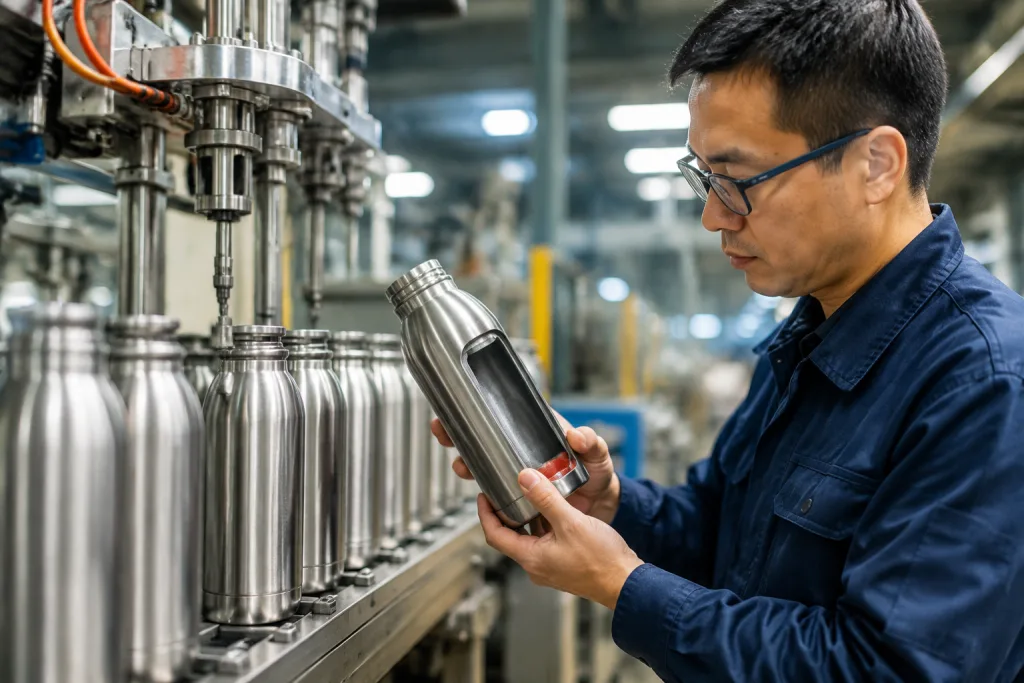
Wall thickness is not the sexy line on a spec sheet. It is the line that tells us whether the bottle survives repeat use or becomes a dented giveaway after one trade show. For stainless vacuum bottles, common inner wall thickness is 0.40-0.50 mm, and outer wall thickness is 0.50-0.60 mm. We still see low-cost canteen vendors quote thinner gauges to win by USD 0.12 per pc; the math doesn't work once QC pulls 32 dented samples from a 500 pc pre-shipment check and the buyer starts asking for a credit note.
Vacuum performance needs a test condition, not a marketing line. A practical benchmark is hot water at 95°C, tested after 6 hours and 12 hours in a 20°C room. For 500-750 ml double-wall bottles, we expect above 60°C after 6 hours when the vacuum furnace and leak test are under control; on our line, QC checks random pieces with a digital probe thermometer before packing. For cold retention, define ice-water or chilled-water testing as a separate item on the PO. Do not accept “keeps hot 24 hours” unless the factory gives the exact method.
Copper plating between walls can improve thermal performance, usually adding USD 0.20-0.45 per unit. Good upgrade. Not for every order. If you are a canteen distributor selling into outdoor retail, it can justify the added cost, especially when the buyer compares your sample against a branded 18/8 bottle on the shelf. If you are buying canteen promotional bottles for a 10,000 pc event, standard vacuum insulation is often enough; we have seen this go sideways when a promo buyer approved copper plating, then pushed back because the carton mark budget had already been cut.
At BottleForge Industrial in Zhejiang, China, our monthly stainless drinkware capacity is about 450,000 units, with standard lead time of 30-40 days after artwork approval for repeat models. That capacity only helps if the spec sheet is locked before sampling. Last month a PO typo changed the outer wall from 0.50 mm to 0.40 mm, and the line stopped for 6 hours while sales, tooling, and QC matched it back to the approved sample.
Lid System, Gaskets, and Leak Risk
The lid is where 7 out of 10 custom drinkware complaints start. Buyers like to approve the powder coat first, but end users write the bad reviews for leaking lids, loose carry handles, rattling straws, and gaskets that drop into the sink after one wash. For a retail canteen, we lock the lid material, gasket Shore hardness, thread type, straw ID in mm, hinge-cycle target, and spare-lid plan before we open the mold. QC pulled one sample last month where the PO said “silicon ring,” not “silicone ring,” and that typo would have sent the wrong spec to the line.
For screw lids, check thread engagement with an actual bottle, not only the CAD drawing. Two full turns are safer than a shallow half-turn cap when the bottle rides in a school bag with 4 kg of books. For flip lids, ask for hinge pin material and cycle testing; our basic internal test is 3,000 open-close cycles, while outdoor and school bottles are better pushed to 5,000 cycles. Simple test. Fill it, invert it, shake it 30 seconds over kraft paper. Silicone gaskets should come out for cleaning, but if the groove is 0.3 mm too loose, consumers lose the ring during the first wash.
If you are buying from canteen suppliers for children’s products, small parts are not a box-ticking issue. The math does not work if a cute lid passes the buyer’s photo review but fails age-grade testing after 18 days in the lab. In the U.S., ASTM and CPSIA requirements may apply depending on age grading. In the EU, LFGB, REACH, and food-contact migration testing are usually requested by serious importers. A lid with painted parts, metallic coatings, or soft-touch rubber needs more test planning than plain PP, and we have seen this go sideways when a buyer added a colored button after PP sample approval.
For a customizable canteen line, lid compatibility protects margin. One body accepting a sports lid, straw lid with 8 mm tube, and loop lid can give you three SKUs from one bottle shell, with fewer changeovers on the line. We run this setup often because the same carton insert and 304 stainless body stay in place while only the lid bin changes. It also gives canteen distributors a cleaner spare-parts story after sale, especially when MOQ for replacement lids is set at 1,000 pcs instead of forcing a full bottle reorder.
Decoration Line: Logo Method and Tolerance
Decoration is where “customizable drinkware” makes margin or creates chargebacks. The spec sheet should lock the logo method, artwork size, Pantone color, position tolerance, and approval standard. For simple corporate logos, laser engraving is clean and durable; we run it on a rotary fiber laser with a silicone jig, usually holding position within ±0.5 mm if the bottle body is straight. It usually adds USD 0.08-0.25 per pc depending on logo size and bottle finish. On powder-coated stainless bottles, the mark cuts through the coating and gives a sharp silver contrast.
Silk screen still makes sense for one- or two-color logos on straight bodies. Cheap and steady. Buyers should expect registration tolerance of around ±1 mm on standard production, and QC pulled the sample last month because a 2-color logo shifted 1.4 mm at the rim side. UV print handles gradients and more color, but adhesion depends on coating quality and plasma or alcohol wipe pretreatment. Full-wrap heat transfer gives strong shelf impact, often adding USD 0.35-0.90 per pc, but the seam needs a clear limit, such as ≤1.5 mm overlap and no white line after shrink.
For canteen promotional campaigns, I would avoid complicated full-wrap artwork on the first order unless you have time for a pre-production sample. The normal sequence should be digital mockup, physical sample, signed golden sample, mass production, then inspection. Don’t skip the golden sample. A custom canteen with a logo placed 5 mm too low can still hold water, but your brand owner may reject the shipment if the retail mockup promised a higher logo position; we have seen this go sideways on a 3,000 pc rush PO where the buyer flagged the mark after carton packing.
Define the coating in writing. Powder coating is the default for premium hand feel, and we normally check it with a dry film thickness gauge at 60-80 μm before printing. Spray painting costs less but loses abrasion resistance faster. Rubberized coating feels good on day one, then the math doesn’t work if the formula scratches or turns sticky in warehouse heat. For customized canteen and customized growler projects, request cross-hatch adhesion testing and a 3M tape pull test before mass production.
MOQ, Price, and Lead-Time Reality
A usable quote for top custom water bottles should show base product cost, decoration cost, packaging cost, testing cost, inland freight, and FOB port as separate lines. One blended number looks neat, but it hides the pain point; change laser engraving to 1-color silk screen, or swap a white box for a 350 gsm color box, and nobody can see where the extra USD 0.18 went. We run quotes in RMB first, then convert to USD after checking the coating loss rate on the last 3 batches. For standard stainless models, a realistic MOQ is 1,000 pcs per color. For custom Pantone powder coating, 1,000-2,000 pcs per color is normal. For a new mold, expect 3,000-5,000 pcs and tooling from USD 1,200 to USD 6,000 depending on body and lid complexity.
Typical FOB Ningbo or Shanghai pricing for a 500-750 ml double-wall stainless bottle may range from USD 3.20 to USD 6.80 before premium packaging. A customized growler can land higher, often USD 7.50-14.00 depending on capacity, handle, lid, and coating. These are not promises. They are working ranges for spotting bad math, like the buyer who pushed us for USD 2.95 on a 750 ml 304 stainless bottle with powder coating and gift box; the line cost alone did not fit.
Lead time should be split into sample time and bulk time. Stock-shape sample with logo normally takes 7-12 days. Pre-production sample with custom coating may take 12-18 days. Bulk production is usually 30-45 days after deposit and sample approval, and before Christmas or summer outdoor season we plan closer to 45 days, not 30. QC pulled one pre-production sample last May because the logo sat 2 mm off the center line, so sample approval lost 2 days before the buyer signed the artwork. If you are a distributor drinkware buyer, build in 10-15 days for inspection, booking, and port handling before vessel departure.
Payment terms also matter. About 8 out of 10 China drinkware factories work on 30% deposit and 70% before shipment. For long-term canteen distributors with repeat orders, staged payment or credit insurance can be discussed after 2-3 clean shipments, but not on a first PO. We have seen this go sideways when a first-time buyer asks for net 60 and the PO still has the wrong lid code typed in line 4.
Testing, Inspection, and Shipment Documents
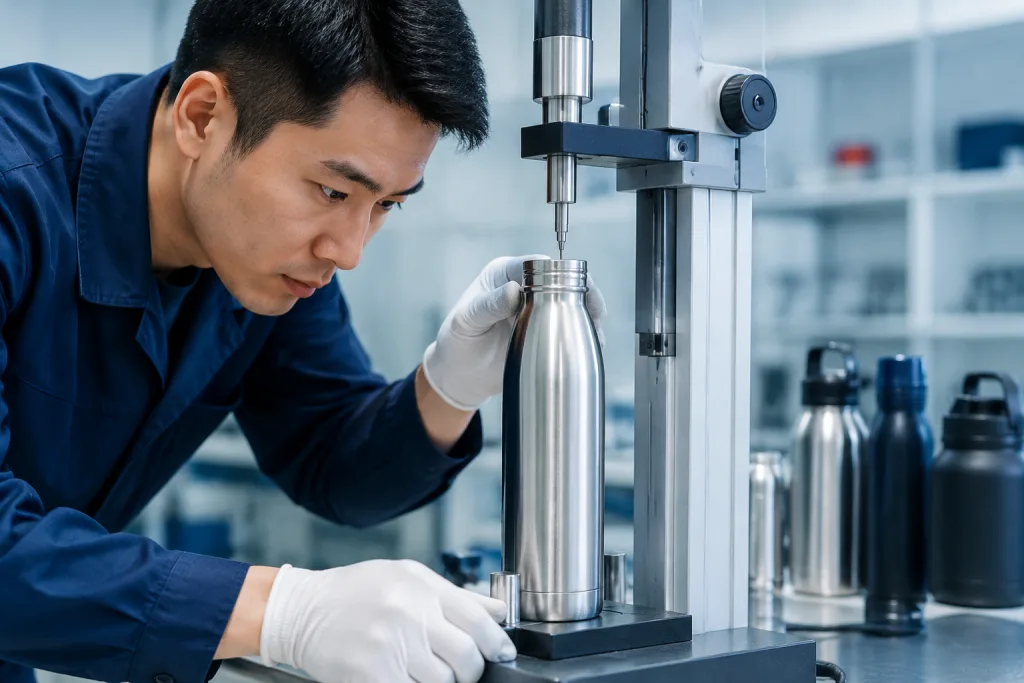
Put QC terms on the PO before we cut steel or print artwork. For top custom water bottles, we normally run AQL 2.5 for major defects and AQL 4.0 for minor defects under ANSI/ASQ Z1.4. Critical defects get zero tolerance: sharp rims, leakage, contamination, or the wrong food-contact material. The checklist should call out capacity in ml, net weight in g, coating color against the approved Pantone chip, logo position within ±1.5 mm, leakage after 5 minutes upside down, vacuum performance, odor, carton drop result, barcode scan, and packing quantity. QC pulled one 500 ml sample last month because the laser logo sat 3 mm low; small miss, big argument.
Testing follows the sales market, not the buyer’s mood after goods are packed. EU buyers usually ask for LFGB and REACH, with EN 14350 when the bottle is for children. U.S. buyers need FDA food-contact compliance, CPSIA for children’s items, and California Proposition 65 evaluation when the sales channel requires it. For Amazon FBA, confirm FNSKU labels, carton limits, suffocation warnings, and master carton strength before the packing line starts. We have seen this go sideways: 120 cartons were ready, then the buyer flagged a missing FNSKU on the PO attachment.
Factory audits belong in the spec, not in a late email 6 days before shipment. BSCI, Sedex, ISO 9001, or retailer-specific audits are common for brand owners. Not every canteen manufacturers group carries every certificate, so ask before you quote the program to your customer. A good canteen supplier will state what is current, what expired, and what needs renewal, instead of sending a random PDF from three years ago. We keep audit files by expiry month in the sales folder; if a supplier cannot name the audit date, push back.
Shipment documents usually include the commercial invoice, packing list, bill of lading, certificate of origin if required, and test reports. If you need FOB China pricing from Zhejiang through Ningbo, say it before quotation. If you need DDP, give the factory the destination ZIP code, HS code expectations, and who owns compliance risk. The math does not work when one quote includes duty and final-mile delivery while another stops at Ningbo port. Last week we caught a PO typo showing 24 pcs/carton while the approved carton mark said 25 pcs/carton; that single digit would have broken the packing list.
Send your bottle spec sheet for review
We will check material, MOQ, decoration, testing, packaging, and FOB assumptions before you lock the purchase order.
Frequently asked questions
What MOQ should I expect for top custom water bottles?
For standard stainless steel models, expect 1,000 pcs per color as a practical MOQ. If you only need laser engraving on an existing black, white, or silver body, some factories may accept 500 pcs, but the unit price usually rises. For custom Pantone powder coating, 1,000-2,000 pcs per color is more realistic because coating lines need setup time and color cleaning. For a new body mold or new lid system, plan on 3,000-5,000 pcs and tooling from about USD 1,200 to USD 6,000. A serious canteen manufacturer should explain which part of the MOQ is driven by coating, packaging, logo method, or component sourcing.
How do I compare quotes from different canteen suppliers?
Do not compare only the FOB unit price. Ask each canteen supplier to quote the same capacity, steel grade, wall thickness, lid material, coating, logo method, packaging, AQL level, and test reports. A USD 3.85 bottle with 201 outer steel, thin wall, plain carton, and no LFGB report is not equal to a USD 4.45 bottle with 304/304 steel, powder coating, retail box, and inspection included. Also check carton quantity and CBM per 1,000 pcs. Freight can easily move your landed cost by 8-15%, especially for large 1,000 ml bottles or custom growler programs.
Which logo method is best for customized drinkware?
For long-term customized drinkware, laser engraving is usually the safest because it does not peel and has low setup risk. It is best for stainless bottles with powder coating and simple logos. Silk screen is cost-effective for one- or two-color artwork, usually good for canteen promotional orders. UV print handles gradients and multi-color marks, but adhesion must be tested on the exact coating. Full-wrap heat transfer gives the strongest retail look but adds cost and requires tight seam control. For first orders above 1,000 pcs, approve a physical pre-production sample before bulk production.
Can one bottle design work for retail, corporate gifts, and distributors?
Yes, but the spec needs to be balanced. A 500 ml or 750 ml double-wall stainless bottle with a straight body, wide printable zone, powder coating, and interchangeable lids can serve retail, corporate gifting, and distributor canteen channels. Keep the body shape stable and vary the decoration, lid, and packaging. For example, use laser engraving and kraft box for corporate gifts, full-color retail box for store programs, and bulk master carton packing for distributor drinkware orders. This keeps MOQ under control and helps you reorder components faster. Shared lids and gaskets also reduce after-sales headaches.
What lead time should I plan before a seasonal launch?
For a repeat model with confirmed artwork, plan 7-12 days for sampling and 30-40 days for mass production. If you need custom coating, retail packaging, or a new lid, allow 12-18 days for pre-production samples and 40-55 days for bulk. Add 10-15 days for inspection, export booking, and port handling before the vessel leaves China. Sea freight to Europe or North America can add 25-45 days depending on route and congestion. For Christmas, summer outdoor, or back-to-school programs, start the custom canteen process at least 100-120 days before your required warehouse date.