Key Takeaways
- Start with 500-1,000 pcs MOQ for most custom drinkware programs before opening private tooling
- 304 stainless steel at 0.45-0.55 mm wall thickness is the normal baseline for insulated bottles
- Use AQL 2.5/4.0 inspection plus 3-5 pre-shipment carton drop tests for retail orders
- Standard custom logo lead time is 25-35 days after artwork, deposit, and sample approval
You are not buying a bottle. You are buying a supply program that has to pass retail claims, freight delays, logo approvals, 1.2 m carton drop tests, and margin pressure. A top custom water bottle order looks clean on a quotation sheet, but the risk hides in small checks: 304 stainless thickness at 0.45 mm vs 0.50 mm, lid torque, coating adhesion, capacity tolerance, and who pays when 3% of cartons arrive crushed. We have seen this go sideways.
From our Zhejiang production base, BottleForge Industrial works with brand owners, distributor drinkware teams, and canteen suppliers that need straight answers before they send a PO to China. Last month, QC pulled a pre-shipment sample where the buyer’s Pantone code was correct, but the PO had the logo size typed as 42 mm instead of 24 mm. The questions below are the ones procurement managers ask when they are serious, not just collecting prices.
What Makes A Bottle Top Tier?
Buyer question: What actually separates a top custom water bottle from a cheap promotional bottle?
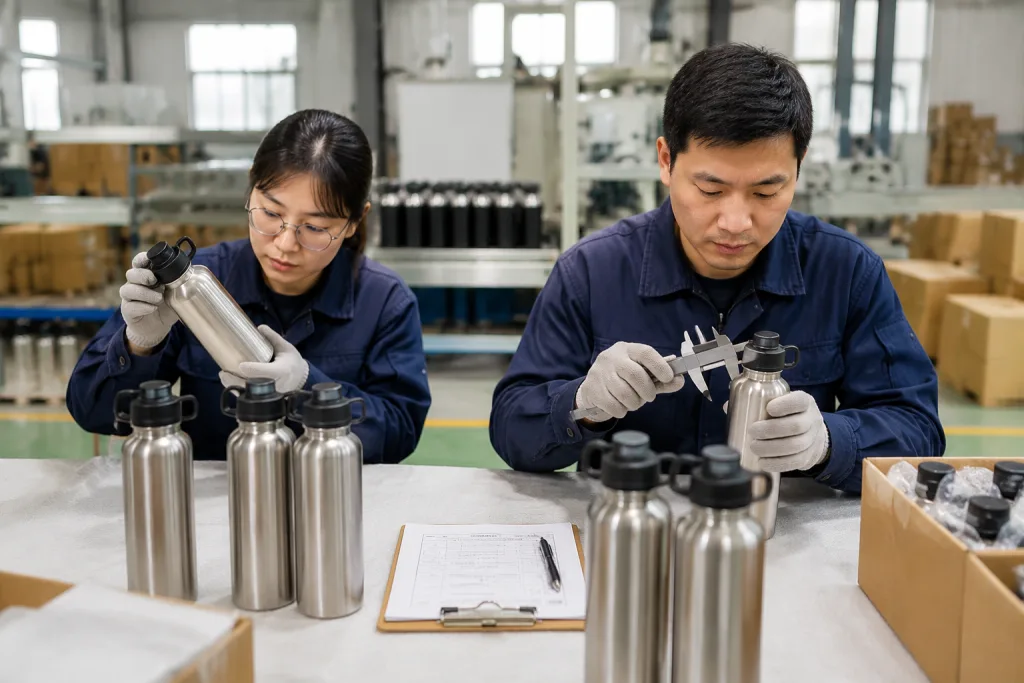
The short answer is repeatability. Asking “does the sample look good?” is the wrong question to ask. A low-price canteen promotional order can pass one desk sample, then show crooked logos, loose lids, and dented shoulders when 5,000 pieces hit the packing line. For B2B buying, the bottle is top tier only if carton 500 matches the signed golden sample in color, weight, logo position, and lid fit. We run that check with a caliper, a 0.01 g scale, and a packing table that is not forgiving.
Start with the body. For insulated stainless steel bottles, 304 stainless steel is the usual food-contact material for inner and outer walls. For cost-sensitive programs, some buyers accept 201 stainless on the outer wall, but we push back on that for humid markets or 6-month retail shelf life. Typical wall thickness is 0.45-0.55 mm for 500 ml, 750 ml, and 1,000 ml bottles. Drop below that, save USD 0.08, then pay for dent complaints. QC pulled one 750 ml sample last month at 0.38 mm on the shoulder, and the math did not work.
Then check vacuum performance. A decent double-wall bottle should hold hot water above 60°C after 6 hours when tested from a 95°C fill under controlled room temperature. Do not accept “keeps hot all day” unless the supplier writes the test method on the quotation. For cold retention, ask for condensation checks after ice-water filling, then leave the bottles on kraft paper for 30 minutes. Wet rings tell the truth fast.
The lid is where programs go sideways. Threads should turn smoothly, silicone gaskets should seat flat, and PP or Tritan parts need to be named on the BOM, not guessed after tooling. If you are buying from a canteen factory for outdoor use or school programs with bite valves, ask for 2-3 lid options during sampling. One lid design can lift the perceived quality more than a 10% thicker carton. The buyer flagged this on a PO once because the artwork said “straw lid,” while the sample room sent a screw cap.
Quick checklist:
- Confirm 304 stainless steel or declared plastic resin grade, then match it against the material report number.
- Ask for wall thickness, not just capacity; measure the cut sample in mm before mass production.
- Test 5 filled samples for leakage upside down for 2 hours, with white tissue under each lid.
- Check coating adhesion with cross-hatch tape test, then record any edge lift around the logo area.
- Keep one signed golden sample at the factory and one at your office, both marked with PO number and approval date.
Which Custom Format Fits Your Channel?
Buyer question: Should I choose a water bottle, custom canteen, or custom growler for my market?
Start with the sales channel, not the catalogue shot. This is the wrong question to ask if the buyer has not fixed packing limits, logo size, and landed cost. A top custom water bottle for corporate gifting usually sits at 500-750 ml, ships cleanly in a 24 pcs carton, and gives enough straight wall for a 45 mm logo. A custom canteen for camping, schools, or outdoor clubs needs different thinking: carry strap, wider mouth, impact-resistant powder coating, and a cap that survives being dropped on concrete. A custom growler or customizable growler is another deal altogether. It is heavier, costs more per unit, and QC pulled the sample twice last season because the silicone gasket leaked after a 30-minute inverted test.
For distributors, we usually start with one proven mold, two capacities, and two lid choices. Simple sells. A 600 ml and 900 ml stainless bottle using the same diameter can share packaging, silicone gaskets, and outer carton design, so the warehouse is not holding 6 gasket sizes for one program. We run this setup often for canteen distributors and distributor growler programs because it cuts mixed-carton mistakes and keeps spare lids manageable. One buyer once asked for 11 colors across 3 lids on the first PO; the math did not work at a 1,000 pcs MOQ.
If you sell through retail or ecommerce, weight will bite you. A 750 ml insulated bottle may be 320-420 g depending on shape and wall thickness. Add a gift box, insert, polybag, and export carton, and the freight cost can wipe out the saving from a lower quote. We have seen this go sideways on a 38 kg master carton that looked fine on paper but failed the corner after a 76 cm drop test. For Amazon-style fulfillment, carton strength and barcode placement are fixed work, not decoration; FNSKU labels must be flat, scannable, and placed where the warehouse scanner can catch them.
Channel fit checklist:
- Corporate gifts: prioritize a 40-60 mm logo area, Pantone tolerance, and MOQ flexibility.
- Outdoor canteen customized programs: prioritize wet-hand grip, cap thread security, and scratch resistance after tape testing.
- Retail custom drinkware: prioritize shelf-ready packaging, compliance files, and a clean front panel with no crushed corners.
- Distributor canteen lines: prioritize repeat molds, spare lids, and reorder pricing that holds for at least 90 days.
- Customizable drinkware for ecommerce: prioritize 5-ply carton drop resistance and barcode control before the goods leave the line.
Do not ask every canteen manufacturer for every model at once. Send a tight brief with 2-3 target products, annual volume, market, logo method, and target FOB price. Good canteen manufacturers in China will quote faster when your brief is narrow, because the engineer can check the mold rack, coating line schedule, and current gasket stock in one pass. We once received a PO with “mat black” instead of “matte black”; the buyer flagged it only after the pre-production sample, which cost 7 extra days.
What MOQ And Price Are Realistic?
Buyer question: What MOQ should I expect from a canteen supplier or canteen vendor?
For open molds, we usually quote 500 pcs per color for simple laser engraving, with the logo checked on a 0.02 mm vernier caliper after the first 20 pcs come off the fiber laser. Powder coating with a custom Pantone shade is more realistic at 1,000 pcs per color because the spray booth needs a color cleanout and the oven line does not like tiny batches. For full custom packaging, 1,000-3,000 pcs is where the math starts to work; printing plates, carton batching, barcode stickers, and packing table setup all cost money. Private mold projects often start at USD 3,000-12,000 tooling cost, depending on bottle body, lid complexity, and number of plastic components.
FOB China pricing has a wide spread, but these ranges are useful for checking a quote. A 500 ml single-wall stainless bottle may sit around USD 1.20-2.20 FOB for basic export quality. A 600-750 ml double-wall vacuum bottle often lands around USD 3.20-6.80 FOB depending on coating, lid, and packaging. A customized growler in 1.2-1.9 L capacity can run USD 7.50-15.00 FOB, especially with heavy-duty lids or handles. If a buyer pushes for USD 2.90 on a coated 750 ml vacuum bottle with gift box, the math usually does not work unless steel thickness, coating grade, or QC time gets cut.
BottleForge Industrial’s Zhejiang line can produce about 450,000 stainless drinkware units per month across standard bottles, tumblers, canteen customizable programs, and growlers. Big capacity sounds nice on a website. It does not replace scheduling. If your order is 2,000 pcs, we still need a production slot, coating slot, logo slot, assembly slot, and inspection date; last month QC pulled the sample because the PO said “matte black” but the artwork file named the finish “satin black.” That small typo cost 2 days before mass coating.
Quote comparison checklist:
- Ask whether price is FOB Ningbo, FOB Shanghai, EXW, or DDP, and check the port code on the PI before you sign.
- Separate bottle cost from logo, packaging, and spare parts cost so a cheaper unit price does not hide a USD 0.18 color box charge.
- Confirm MOQ by color, not only total order quantity; 3 colors at 500 pcs each is not the same job as 1,500 pcs in one finish.
- Ask if sample cost is refundable after bulk order, and whether the refund needs the same logo file and coating spec.
- Lock price validity for 15-30 days because steel and exchange rates move, and our purchasing team updates coil quotes every Friday.
Be careful with canteen suppliers that quote 30% below the market without explaining material, inspection, or packing differences. We have seen this go sideways: thinner cartons fail a 10 kg drop test, lids arrive with loose silicone rings, or the vacuum rate drops after AQL 2.5 inspection. In China, someone can always make it cheaper. The real question is what they removed.

How Should You Customize Branding?
Buyer question: Which logo method should I choose for customized drinkware?
For stainless steel, we usually steer buyers to laser engraving when the brief says “durable, clean, corporate.” It does not peel. It also works well on a 300 pcs trial order because we run it on the fiber laser station without making screens. The trade-off is color: the beam exposes the steel or the coating layer below, so you are not getting a full-color mark. For 8 out of 10 distributor programs we see, laser gives the best mix of finish, lead time, and unit cost.
Silkscreen printing makes sense for a solid one- or two-color logo on a smooth bottle wall. The math works best around 500-1,000 pcs, after the screen and setup cost get spread out. Curved bottles are where jobs go sideways. The line needs a proper jig; otherwise QC pulls samples with a 2-3 mm logo drift or uneven ink at the edge. For fine gradients or photo-style graphics, heat transfer or UV printing is the better route, but we still run cross-hatch adhesion and 3M tape tests on the actual coating first.
Powder coating gives the bottle a better hand feel and stronger shelf presence, especially on 304 stainless bodies. It also adds risk. Matte black, navy, white, and olive are stable in our spray room, with fewer reworks after the 60-minute oven cure. Custom Pantone coating should be sampled before order confirmation, and a practical tolerance is needed. Matching coated metal to a paper Pantone chip under D65 light and warehouse LED light is the wrong question to ask; the surface reflects differently.
For a canteen customized program, the logo is only one line on the approval sheet. You may also need a custom color lid, woven strap, bottom mark, insert card, retail box, carton mark, and barcode label, and each one needs its own artwork file. We have seen a shipment sit 2 days because the PO said “SKU-18OZ-BLK” while the carton mark artwork showed “SKU-180Z-BLK” with a letter O. A small logo scratch is annoying; a wrong barcode can stop receiving at the buyer’s warehouse.
Branding checklist:
- Send vector artwork in AI, EPS, or PDF format, with fonts outlined before we open it on the prepress computer.
- Specify logo size in mm and placement from bottle base or seam; “centered” is not enough for the jig operator.
- Approve one pre-production sample before mass printing, and ask QC to photograph it beside a steel ruler.
- Test printed logos with 3M tape and 24-hour water exposure on the selected coating, not on a random stock bottle.
- Keep packaging dielines under version control, especially for multiple SKUs, because one old barcode file can hold the whole pallet.
Which Compliance Files Do Buyers Need?
Buyer question: What certificates should I request before placing a PO?
Start with the market and the parts touching the drink. For Europe, we usually send LFGB or EU food-contact test reports, REACH declarations for powder coating, lid resin, gasket silicone, plus a packaging material statement. For the United States, FDA food-contact compliance is the baseline. Kids’ bottles are a different job; CPSIA or ASTM can come into play, and treating a 350 ml school bottle like a 750 ml gym bottle is the wrong question to ask. Last month QC pulled a PP lid sample from the line because the color masterbatch code on the PO was typed as “Pnatone 299C,” not “Pantone 299C.” Small typo. Big testing headache.
BSCI, Sedex, or similar social audit reports matter when your customer is a retailer or a corporate gift program with a sourcing team. They do not prove the bottle is food-safe. They show factory management, working-hour records, dormitory checks, and labor practice status. ISO 9001 has value, but it will not replace incoming material checks with a vernier caliper on lid fit or final inspection on 80 cartons before loading. We’ve seen this go sideways when a buyer accepted an ISO file and skipped the component test reports.
Ask whether each report is model-specific, material-specific, or factory-general. A report for one stainless tumbler does not automatically cover the plastic lid, painted body, silicone straw, or printed ink on your new custom drinkware. If your order uses a new coating, plastic color, or ink, budget for new testing. Typical third-party testing takes 5-10 working days after samples are received; in our Hangzhou line, samples usually need 2 extra days for logo curing before SGS or Intertek pickup. The math doesn’t work if your ship date is already locked for next Friday.
Document checklist:
- Food-contact test reports for stainless steel body, PP or Tritan plastic lid, silicone gasket or straw, and powder coating.
- Factory audit reports for retail listings, supermarket tenders, or corporate programs above 3,000 pcs.
- Material declarations for BPA-free, lead-free, and phthalate-related claims, matched to the actual resin and pigment codes on the BOM.
- Artwork and packaging proof approvals signed before production, including Pantone number, logo size in mm, barcode, and carton mark.
- Pre-shipment inspection report using AQL 2.5 major and 4.0 minor as a normal starting point, with photos of leak test, rub test, and carton drop findings.
A serious canteen manufacturer should tell you where existing reports apply and where they stop. If a canteen supplier says “all certificates available” but will not show report numbers, test dates, tested components, or the lab name, slow down. We ship better when the buyer flags compliance before deposit, not after 12,000 pcs are already powder coated.

How Do You Control Production Risk?
Buyer question: How do I stop surprises after deposit payment?
Use gates. Do not let a canteen vendor jump from sample to bulk production without written approvals on the PO and artwork file. We run it this way: quotation, artwork check with logo size in mm, sample invoice, sample approval, proforma invoice, 30% deposit, signed pre-production sample, mass production, inline photos, final inspection, 70% balance, shipment release. Slow? A little. Cheaper than arguing later about a 52 mm logo printed at 58 mm.
Lead time for standard custom drinkware from Zhejiang is usually 25-35 days after deposit and sample approval. Add 7-12 days for custom color coating, retail gift boxes, or third-party testing, because the coating line needs its own slot and the lab will not rush LFGB-style paperwork just because a buyer’s launch date moved. Sea freight to the US West Coast runs about 18-28 days port to port; Europe often needs 30-40 days depending on routing and congestion. These are planning numbers. Not promises.
Inspection should be physical, not just photos from the packing table. For a 5,000 pcs order, an AQL inspection may pull 200 samples depending on inspection level, and QC should open cartons with a blade, not just read the carton marks. The inspector should check appearance, capacity, logo position, leakage, coating defects, lid fit, barcode scanning, carton marks, and carton drop resistance. For ecommerce orders, we like a 3-side or 6-side drop test from 76 cm on packed cartons, adjusted to carton weight and the buyer’s test standard.
Risk control checklist:
- Write acceptable defect definitions before production starts, including logo shift in mm, scratch length, and color tolerance.
- Keep approved samples sealed and signed; we put the date, PO number, and buyer initials on the hang tag.
- Require inline production photos at body forming, coating, logo, and packing stages, with one carton label visible in the frame.
- Book final inspection 3-5 days before planned loading, not the morning the truck arrives at the gate.
- Do not pay final balance until inspection issues are closed or discounted in writing on the revised PI.
Good canteen vendors will not be offended by clear inspection rules. The wrong question is whether the factory “trusts” the buyer. The better question is whether both sides can point to the same sealed sample when QC pulled the sample and the buyer flagged a lid-fit gap of 1.5 mm. Factories that resist basic AQL checks are usually the ones that need them most.
What Should Your RFQ Include?
Buyer question: How do I get accurate quotes from canteen manufacturers and canteen suppliers without 6 rounds of email cleanup?
A vague RFQ gets a vague price. Send “please quote top custom water bottle” and the factory has to guess. We have seen one canteen factory price a 0.45 mm single-wall bottle in a paper box while another prices a 0.5 L vacuum bottle with powder coating and a swing lid. The cheap line looks good in the buyer’s spreadsheet, then QC pulls the first sample and everyone asks why the hand feel is wrong.
Your RFQ should let the supplier build the same product in their head that you expect on your shelf. Include capacity, material grade, lid drawing or reference photo, coating, logo method, packaging, sales market, compliance needs, estimated annual volume, first order quantity, delivery term, and target ship date. If you are a canteen distributor or distributor growler buyer, say whether you need exclusivity, spare lids packed at 2%, mixed colors by carton, or reorder price protection for 12 months. We run costing from a BOM sheet, not from hope.
State your decision process too. If you will shortlist 3 canteen vendors, sample 2, and award 1 after a 24-hour leak test, put that in the RFQ. Good factories respect a clean process. They get less excited when buyers collect 20 quotes with no target price, no PO window, and no timeline; we had one PO come back with “matte black” typed in the email but “gloss white” on the attachment.
RFQ checklist:
- Product type: bottle, custom canteen, customized canteen, or customized growler, with a reference photo if the shape matters.
- Capacity and dimensions: for example 750 ml, under 290 mm height, cup holder friendly, plus mouth diameter if ice cubes matter.
- Material: 304 stainless, Tritan, glass, silicone, PP, or mixed construction, with wall thickness if you already have a benchmark sample.
- Decoration: laser, silkscreen, UV print, heat transfer, embossing, or sleeve; attach logo files in AI or PDF, not a 42 KB JPG.
- Packaging: bulk pack, white box, color box, insert card, master carton, FNSKU label, and drop-test requirement if your retailer asks for it.
- Commercial terms: MOQ, target FOB price, payment term, lead time, and destination port, with Incoterms written the same way on the RFQ and PO.
When the RFQ is clear, a canteen manufacturer can quote honestly. Short RFQs feel faster, but this is the wrong question to ask if you need a stable launch. Give us the spec sheet, and we can tell you whether the line ships in 35 days or slips to 48 days because the lid mold needs rework.
Send Your Bottle RFQ For Factory Review
Share capacity, logo, market, MOQ, and target price. Our Zhejiang team will check feasibility and quote practical production options.
Frequently asked questions
What is the normal MOQ for a top custom water bottle order?
For existing molds, plan on 500 pcs per color for laser engraving and 1,000 pcs per color for custom powder coating or silkscreen printing. If you need a retail color box, many China factories prefer 1,000-3,000 pcs because box printing, carton setup, and packing line changeover add cost. Private mold projects are different: tooling may cost USD 3,000-12,000 before the first production order. If you are testing a new channel, start with a standard mold and spend money on better branding, packaging, and inspection instead of opening tooling too early.
How long does custom drinkware production take in China?
For a standard stainless bottle from our Zhejiang facility, the usual lead time is 25-35 days after deposit, artwork approval, and sample confirmation. Add 5-10 working days for third-party testing and 7-12 days for custom Pantone powder coating or complicated retail packaging. Sea freight then adds roughly 18-28 days to the US West Coast and 30-40 days to many European ports. If your launch date is fixed, build a calendar backward from warehouse arrival, not factory completion.
Should I use laser engraving or printing for my logo?
Use laser engraving when durability matters and your design works in one metallic tone. It is reliable for 500-1,000 pcs orders and usually adds around USD 0.10-0.35 per piece depending on logo size and position. Use silkscreen for simple color logos on smooth bottles, and use heat transfer or UV printing for larger multi-color graphics. For any printed method, require adhesion testing before mass production. A good customized drinkware program should approve both artwork file and physical logo sample before the factory prints 5,000 pieces.
What inspection standard should I require before shipment?
AQL 2.5 for major defects and AQL 4.0 for minor defects is a practical starting point for most B2B custom water bottle orders. Inspectors should check leakage, capacity, coating scratches, dents, logo position, lid fit, barcode scanning, carton marks, and packaging condition. For ecommerce or retail shipments, add carton drop testing from about 76 cm, adjusted to carton weight and buyer standard. For a 5,000 pcs order, the inspection sample size may be around 200 pcs depending on inspection level, so plan inspection 3-5 days before loading.
How do I compare quotes from different canteen vendors fairly?
Put every quote into the same format: FOB port, material grade, wall thickness, capacity, lid material, logo method, packaging, MOQ by color, lead time, sample cost, and payment term. A USD 3.80 bottle and a USD 4.40 bottle may not be comparable if one uses 304 stainless inside and outside, thicker coating, and a tested silicone gasket. Ask each canteen vendor to list exclusions. The cheapest quote often excludes custom boxes, barcode labels, spare lids, or third-party inspection support, which can add USD 0.20-0.80 per unit later.