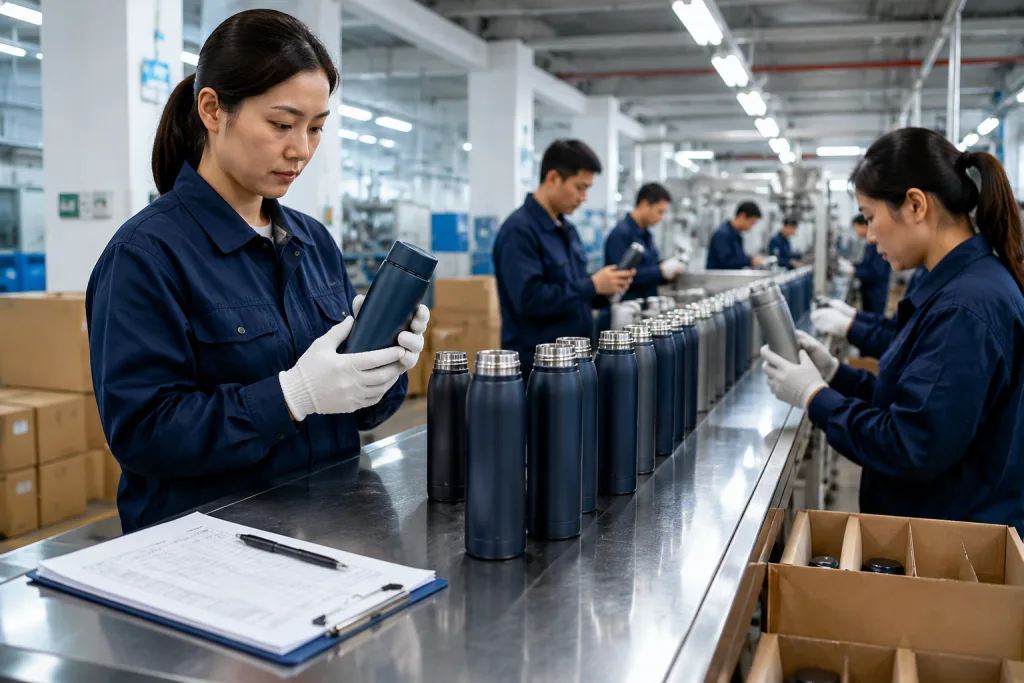
Key Takeaways
- Lock capacity, lid type, and finish before RFQ; changing them later can add 7-14 days
- For a custom thermos, 304 stainless steel is standard and 316 is useful for saltwater or premium outdoor lines
- MOQ for a customized thermos usually starts at 1,000 pcs per color, with 35-50 day production after sample approval
- Use AQL 2.5/4.0, LFGB or FDA food-contact tests, and drop tests before releasing thermos bulk shipments
If you are buying a top custom vacuum flask for an outdoor retail line or a promo thermos order, the catalog is not the bottleneck. The hard part is choosing what you will give up: 500 ml light body or 750 ml better heat retention, laser logo that survives 1,000 dishwasher-style rubs or full-color print that needs gentler packing, 500 pcs MOQ or a unit cost that holds steady after the first reorder. We had one buyer flag a 38 mm mouth opening because their ice cubes jammed during a shelf demo. Small detail. Big complaint.
At BottleForge Industrial in Hangzhou, Zhejiang, we see orders lose 7 to 12 days when the buyer asks for a customized thermos before the basics are locked. A workable stainless thermos brief should fix the capacity range, wall construction, branding method with artwork size in mm, and the compliance route such as FDA or LFGB before we open the sample job. QC pulled one sample last month with the logo 3 mm off-center; the PO also had “matte black” typed as “mate black.” This is where sourcing goes sideways, not in the catalog search.
Start With Four Buying Decisions
A top custom vacuum flask is not one decision. It is 4 buying decisions stacked together, and each one changes the mold cost, line speed, lead time, and complaint rate. Start here before anyone argues about a 38 mm logo or whether the carton mark should say “matte black” or “matt black”; we have seen that typo on a PO hold a booking for 2 days.
First, choose the use case. A 500 ml flask for commuters is not the same product as a 1,000 ml outdoor flask for hunters and work crews. Outdoor retailers usually need a tougher lid, a 52-58 mm grip zone, and powder coat that can take shelf rub; QC pulled one sample last March after the lid hinge cracked at 8 kg pull force. Promotional buyers usually care more about a clean print window and a price that still works at 5,000-20,000 pcs.
Second, choose the construction. Most bulk thermos programs run double-wall vacuum insulation with 304 stainless steel inside and outside. For coastal, fishing, marine, or premium camping channels, 316 stainless steel inside can make sense, but the math does not work for every order. Expect a clear cost increase; on our line, the buyer flagged it when the 316 inner pushed the sample quote up by about 8-12% before packaging.
Third, choose decoration. Laser engraving, silkscreen, powder-coat color, UV print, and full-wrap designs do not age the same after dishwasher cycles, abrasion, and warehouse handling. This is the wrong question to ask: “Which logo method looks best?” Ask what survives your channel. We run a 3M tape test, a 500 g rub test fixture, and a 60°C wash check before we trust a finish for retail cartons.
Fourth, choose the compliance path. A thermos supplier in China should know whether your market needs FDA, LFGB, REACH, Prop 65 review, or CPSIA-related packaging checks. If your brief says only custom logo flask, the supplier thermos quote will be loose, and we will spend 3 emails guessing the real spec. If your brief says 750 ml, 304 inner, powder coat, laser logo, FDA food-contact report, AQL 2.5/4.0, FOB Ningbo, the quote becomes usable; our merchandiser can load it into the costing sheet the same day, not 4 days later.
Capacity And Lid Drive Real Cost
Capacity looks simple on a cost sheet. It is not. On our line, a 350 ml custom thermos can run with a compact shell, 0.38 mm 304 stainless, and a short PP stopper. A 1,200 ml outdoor flask pulls more steel, needs about 58 minutes in the vacuum furnace versus 42 minutes for a 500 ml body, and often needs an EVA insert or thicker color box to survive a 1.2 m drop test. That is why thermos bulk pricing does not scale neatly by milliliter.
For outdoor retail, the common capacities are 500 ml, 750 ml, 1,000 ml, and 1,200 ml. For promotional thermos programs, we push buyers toward 500 ml or 750 ml because one master carton stays under about 13 kg and the gift value still looks decent. The 750 ml stainless flask is the practical middle: enough volume for hiking, but cup holder fit only works when the base sits near 74 mm or below. Do not assume it fits. Last month a buyer flagged this after sampling because their PO said “car cup holder,” but the approved drawing showed 82 mm.
Lid choice changes the quote fast. A screw stopper costs less and gives fewer leak complaints in AQL 2.5 inspection. A push-button lid feels nicer on the shelf, but it adds a spring, silicone valve, button housing, and one more assembly station; QC pulled 3 leaking samples from a 200 pcs pre-shipment check when the valve seat had flash. A cup lid helps outdoor use, then carton volume jumps. A carry handle works for a distributor thermos line, but we have seen it go sideways when the handle blocks the retail front label.
For a manufacturer thermos quote, ask for body diameter in mm, total height, net weight, lid material, silicone grade, and the exact leak test method. We run 100% inverted leak checks for 30 minutes on some OEM orders, not just a quick shake at the packing table. A typical 750 ml double-wall flask may weigh 430-520 g depending on wall thickness, bottom structure, and coating. If a thermos vendor offers a low price, the wrong question is “how cheap can it be?” Check steel gauge and vacuum retention data first. Thin steel looks fine in photos, then dents during the first warehouse transfer.
Material Choices Worth Paying For
In China quotes, 304 stainless steel is the default answer from roughly 8 out of 10 thermos factories we run into. That works for coffee, tea, water, and outdoor use. The real check is where the 304 goes: inner liner, mouth thread, and any food-contact surface. QC pulled a cut-open sample last March where the PO said “SUS304 body,” but the outer shell tested as 201 on the XRF gun. 304 inside with 201 outside can work for a budget promo order. Just do not approve it by accident.
If your brand sells through outdoor specialty retail, hidden downgrades are the wrong place to save USD 0.18. Specify 304/304, or 316 inner with 304 outer if the channel needs a cleaner story. For saltwater use, high-mineral drinks, or premium positioning, 316 inner steel is a defensible upgrade. For a conference giveaway, 304 inner and 201 outer may pass if the powder coating holds 2H pencil hardness and the buyer accepts the risk. We have seen this go sideways when the buyer flagged rust spots around the bottom seam after 45 days.
Wall thickness is the quiet argument on the line. A lot of vacuum flasks sit around 0.4-0.5 mm stainless wall thickness, though the number changes with capacity and deep-drawing method. Thicker steel cuts dents, but it adds cost and weight. Outdoor buyers often accept 20-40 g more weight if it prevents returns; promo buyers usually push back once freight jumps by one carton per 500 pcs. Our caliper check on a 750 ml body usually starts at the straight wall, not the curved shoulder, because that shoulder reading lies.
Vacuum performance comes from welding, degassing, and copper lining or reflective layer choices. For a good 750 ml flask, a fair target is hot water above 60°C after 12 hours when filled with 95°C water at room temperature around 20°C. Be careful with 24-hour claims unless the supplier shows the test protocol, fill volume, lid torque, and starting temperature. The math does not work if the catalog says “24H hot” but the lab sheet stops at 12 hours. A factory thermos should be judged by repeatable test data, not a line in a catalog.
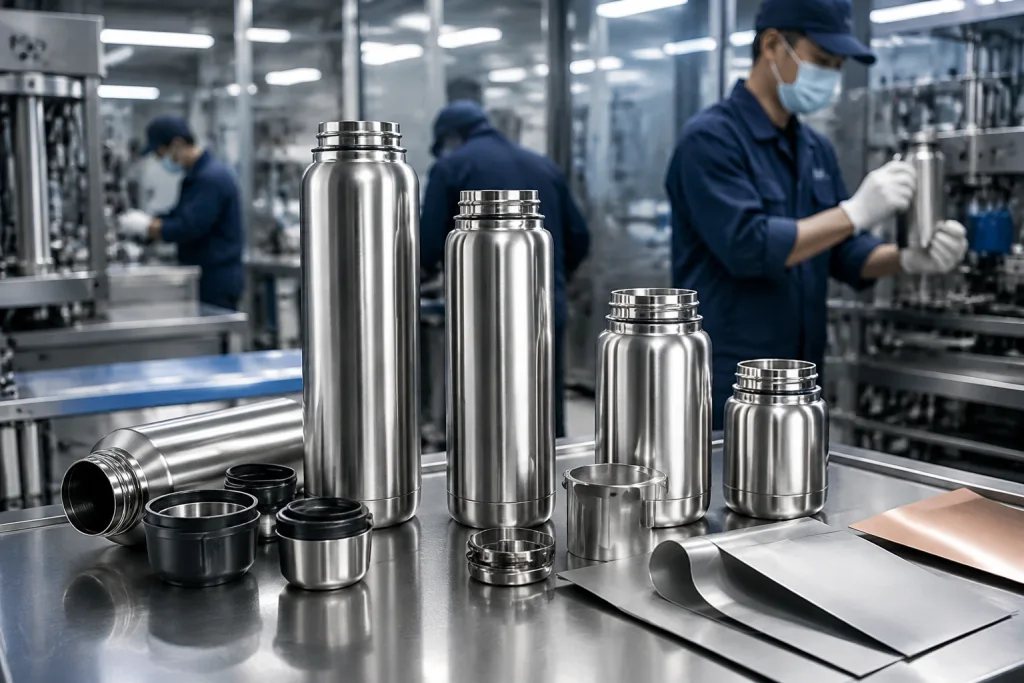
Decoration Is A Durability Decision
Branding is where 7 out of 10 custom thermos projects start leaking cost. The logo is rarely the hard part. The trouble comes when buyers pick decoration before checking the finish, color count, abrasion, and retail handling. A customizable thermos for outdoor shelves still needs to look clean after 200 shoppers twist the lid and rub the body. A thermos promotional giveaway has to survive carton packing, event handout tables, and daily desk use. We had one buyer flag tiny black scuffs after a carton rub test because the logo sat too close to the shoulder curve.
Laser engraving is the safest choice for powder-coated stainless steel. We run it on a 30W fiber laser, and it cuts through the coating to show the 304 stainless underneath, so there is no ink layer to peel. The tradeoff is color. You get a metal-tone mark, not a full-color brand block. Silkscreen costs less for one-color logos on smooth bodies, but curved cups and orange-peel powder coating need slower jig setup. UV print gives sharper color and small text down to about 1.2 mm, but QC still needs adhesion testing on matte powder coats. We have seen UV pass on white gloss and fail on black matte from the same PO.
Full-wrap artwork can look premium, but it adds sampling time and raises rejection risk. Registration, seam alignment, and color matching all need tight control. If your distributor thermos order has 3,000 pcs in six colors, full-wrap design can turn a normal 12-day sampling job into 18 days. The math does not work if launch photos are already booked. On the line, QC checks the seam with a 0.5 mm tolerance gauge, and one shifted wrap can make the whole carton look cheap.
For a thermos custom program, ask your supplier thermos team for a decoration proof with logo size in millimeters, Pantone codes, print position from base or rim, and a scratch test standard. A simple 3M tape adhesion check and 500-cycle rub test tells you more than a polished mockup. At BottleForge in Zhejiang, we push buyers to approve a real decorated sample, not just a digital render. We have seen this go sideways when the PO said “navy,” the artwork file said Pantone 2965C, and the approved render looked almost black on screen.
MOQ, Price, And Lead Time
MOQ is not about being difficult; it is about setup time. For a customized thermos, we run separate setups for powder coating, logo fixture, retail box die-line, AQL 2.5 inspection, and line scheduling. At BottleForge Industrial in Hangzhou, Zhejiang, our workable MOQ is usually 1,000 pcs per color for standard stainless thermos models, with monthly capacity around 300,000 units across drinkware lines. Custom molds, private lids, or special coatings usually move the MOQ to 3,000-5,000 pcs, because the coating line needs a full tank change and QC pulled the sample twice last month for a 0.3 mm lid-fit gap.
For reference, a standard 750 ml double-wall stainless flask with powder coating and one-position laser logo might quote around USD 4.20-6.80 FOB Ningbo at 3,000 pcs, depending on steel grade, lid structure, packaging spec, and inspection level. Cheap can be real. The wrong question is “why is your price higher?” Ask what was removed: 5-layer carton instead of 3-layer, 0.42 mm wall instead of 0.50 mm, food-grade silicone test report, coating adhesion time in the oven, or final QC hours. We have seen a buyer save USD 0.18 per unit, then lose the claim because the PO had “white box” typed instead of “color box.”
Sampling usually takes 7-12 days for logo samples if the base model exists. Pre-production samples with final packaging take 12-18 days, not the same schedule. Mass production is commonly 35-50 days after deposit and sample approval. If a thermos manufacturer promises 15 days for a new powder-coated, printed, retail-packaged order in peak season, ask which coating booth is already open and whether the 3M tape test, leak test, or carton drop test is being skipped. We have seen this go sideways in October.
Payment terms for a first China order are commonly 30% deposit and 70% before shipment, with FOB Ningbo or Shanghai. For outdoor retailers and promotional brands, compare quotes on a landed basis: unit price with packaging spec, inner carton count, master carton size, CBM, gross weight, duty code, inspection cost, and freight. The math does not work if a thermos suppliers quote saves USD 0.25 per unit but the master carton jumps from 12 pcs to 8 pcs and carton volume rises 18%. Our merchandiser checks this with a tape measure and a 30 kg platform scale before we ship.

Quality Checks Before Shipment
A top custom vacuum flask should not leave China based on factory photos. Photos show the logo position and surface finish; they do not prove leak resistance, vacuum performance, coating adhesion, or carton strength. We have seen QC pull 32 pcs from a 3,000 pcs lot and find 2 lids sweating after a horizontal leak test. For thermos distributors selling into Europe or North America, one failed shipment costs more than a proper pre-shipment inspection.
Run AQL inspection with fixed levels on the PO. A common setup is AQL 2.5 for major defects and 4.0 for minor defects, with critical defects not accepted. Define critical defects before production: leakage; sharp edges over 0.2 mm burr; wrong material; contamination; broken lid function; unsafe packaging; incorrect barcode. For retail or Amazon-style logistics, scan FNSKU or barcode labels on at least 8 cartons with a handheld scanner, not only the artwork file. We once had a buyer flag a PO typo where “matte black” became “mate black” on the carton mark. Small thing. Big delay.
Functional testing should cover leak testing, lid torque, vacuum retention, coating adhesion, odor check, and carton drop test. A practical leak test is simple: fill the flask with water, close the lid, lay it horizontally, then shake or hold it for 30 minutes. For lid torque, the line should use a torque meter, not a worker’s hand feel. Vacuum testing needs a written protocol: starting water temperature; fill level; room temperature; test duration; pass criteria. Without that sheet, every thermos factory can claim excellent insulation, and the math does not work when a 12-hour spec becomes 6 hours in a buyer’s warehouse.
Compliance depends on destination. For the United States, request FDA food-contact documentation and check Prop 65 risk when coatings, inks, or packaging are involved. For Europe, LFGB, REACH, and packaging requirements may apply. BSCI or Sedex factory audits matter when your retailer asks for social compliance before issuing the order. The wrong question is “Can you send all certificates?” The better question is “Which report matches this 304 stainless body, this PP lid, this silicone gasket, and this market?” A serious thermos supplier will push back there, even if it slows the quotation by 1 day.
Choose The Right Supplier Role
Not every thermos vendor should be treated the same. A trading company works when the PO has mixed SKUs, say 6 bottle shapes plus lunch boxes, and the buyer wants one English-speaking contact chasing accessories. A manufacturer thermos partner is the better fit when you need repeat orders, private packaging, stable powder color, and engineering changes that stay under control. We have seen buyers push back on this after a lid insert changed 0.3 mm and the second shipment no longer matched the first sample. For outdoor retailers and promotional brands, volume matters, but risk matters more.
If you plan one seasonal campaign of 1,000-2,000 pcs, a flexible supplier thermos setup can cover it. If you are building a permanent stainless drinkware range, stay closer to the thermos factory. You will need reserved capacity, shared QC history, and version control on lids, gaskets, coatings, and export cartons. Small changes bite later. QC pulled a sample last March where the silicone gasket was 0.2 mm thinner than the approved part, and the leak tester showed failures after 3 minutes at 45 degrees.
Ask direct questions before awarding the order: Who owns the mold? Where is coating done? Is vacuum testing 100% or sampled? What is the monthly capacity for this model? Can you hold the same powder color for repeat production? What happens if inspection fails? A serious thermos manufacturers team will answer with numbers, not slogans. On our line, we run vacuum checks piece by piece, then record failed pcs by carton number because “checked by factory” on a PI does not mean much when the buyer flagged leakage at AQL 2.5.
For a top custom vacuum flask project, the wrong question is “who is cheapest today?” Score the suppliers thermos offers on specification fit, compliance readiness, decoration proof, lead time, carton data, and communication speed, then negotiate from that sheet. We usually ask for carton size in mm, gross weight in kg, and loading quantity before price is final, because a 0.08 USD saving disappears when the 40HQ count drops by 1,200 pcs. Price matters, but a reliable thermos customized program comes from controlled decisions, not lucky sourcing.
Send Your Flask Brief For A Practical Quote
Share capacity, logo method, market, MOQ, and target price. We will return a realistic FOB quote and sampling plan.
Frequently asked questions
What MOQ should I expect for a top custom vacuum flask order?
For an existing stainless thermos model, expect MOQ around 1,000 pcs per color for laser logo or one-color print. If you need a custom powder color, retail gift box, or full-wrap artwork, 2,000-3,000 pcs is more realistic. A private mold, special lid, or unique body shape can move MOQ to 5,000 pcs or more because tooling, testing, and production setup need to be amortized. Some thermos suppliers will accept 500 pcs, but the unit price can rise sharply and color consistency may be harder to control. For outdoor retail, I would rather run 1,000 pcs with proper samples and AQL inspection than push a factory into a tiny order where every setup cost gets squeezed.
How long does a customized thermos project take from artwork to shipment?
A normal schedule is 7-12 days for a logo sample on an existing model, 12-18 days if final packaging and coating confirmation are included, and 35-50 days for mass production after approval and deposit. Add 3-7 days for third-party inspection, booking, and export paperwork. During peak China production periods before summer promotions or Q4 retail shipping, lead time can stretch by 10-15 days. If you need sea freight to Europe or North America, allow roughly 25-40 additional days depending on port and route. Air freight is faster but often damages the economics of thermos bulk orders unless the order is small or urgent.
Which logo method is best for outdoor retailers?
For outdoor retailers, laser engraving on powder-coated stainless steel is usually the safest option. It is clean, durable, and does not rely on ink adhesion. It works especially well for one-color brand marks, coordinates, product names, or badge-style graphics. Silkscreen is fine for simple promotional thermos orders, but it can wear faster on textured coatings or high-touch areas. UV print is useful when you need color detail, but you should require adhesion testing before approving production. For any thermos custom order, ask for a decorated sample and run a tape test, rub test, and basic scratch check. Do not approve mass production from a PDF mockup alone.
Should I choose 304 or 316 stainless steel for a custom thermos?
For most custom thermos programs, 304 stainless steel is the right default for the inner liner and food-contact parts. It handles coffee, tea, water, and normal outdoor use well when properly cleaned. Choose 316 stainless steel if your product is positioned for marine use, fishing, salt air, or a premium outdoor line where corrosion resistance is part of the selling story. The cost increase varies by capacity and market, but it is real. For budget promotional orders, some buyers accept 304 inner and 201 outer to reduce cost. That can work, but you should label the specification internally and make sure the coating quality is strong enough for the channel.
What quality standard should I put in my purchase order?
Put measurable standards in the purchase order, not just good quality. Use AQL 2.5 for major defects, AQL 4.0 for minor defects, and zero tolerance for critical safety defects. Define leak failure, sharp edges, wrong logo, coating peel, odor, dented body, and incorrect barcode as inspection items. Add a vacuum retention test with starting temperature, room temperature, test duration, and minimum final temperature. For food-contact compliance, specify FDA for the United States or LFGB and REACH where needed for Europe. If the order uses retail packaging, include a carton drop test and barcode scan check. These details protect both you and the thermos manufacturer.