Key Takeaways
- Use 18/8 stainless steel at 0.45-0.55 mm body thickness for most outdoor thermos bulk programs
- Vacuum performance should be tested at 95°C fill temperature with 6-hour and 12-hour checkpoints
- Logo method changes cost, durability, and lead time; laser engraving is usually slower by 3-5 days
- For North America and Europe, confirm FDA, LFGB, REACH, Prop 65 risk, AQL level, and carton drop test before PO
A top custom vacuum bottle is not judged by the catalog photo. We’ve seen this go sideways on the spec sheet: “304 stainless” written only for the inner wall, PP lid material left blank, 500 ml capacity allowed to drift by 35 ml, or a laser logo that looks clean on the render but starts fading after 200 dishwasher cycles. QC pulled one sample last winter where the silicone gasket measured 1.8 mm instead of 2.2 mm. That tiny gap leaked in the carton drop test.
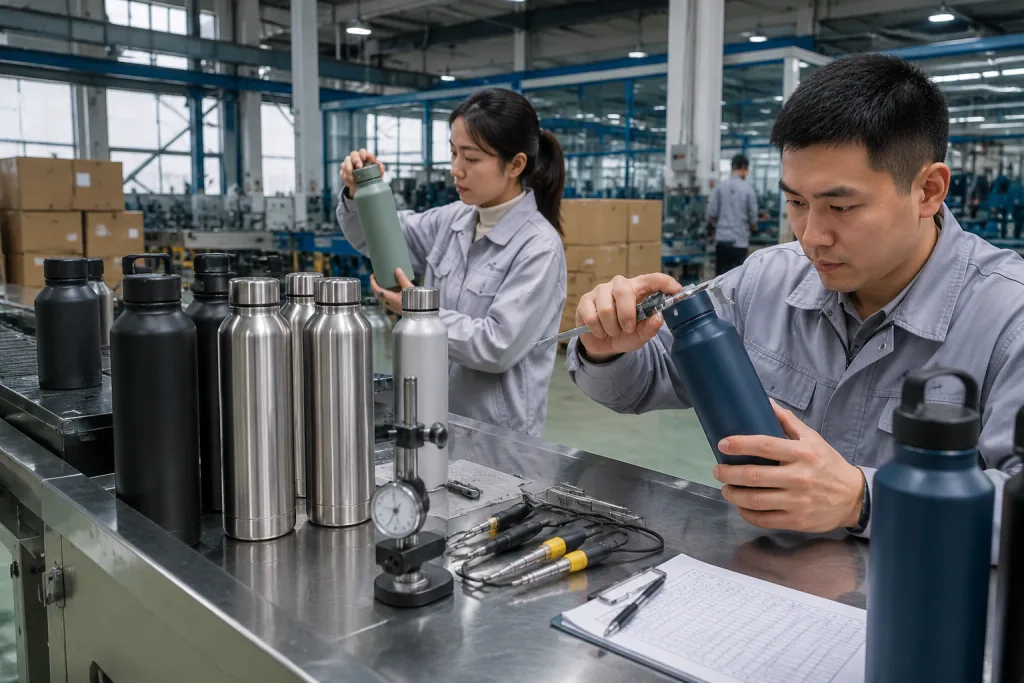
We manufacture stainless drinkware in Hangzhou, Zhejiang, China, and this is the wrong question to ask first: “How cheap can you make it?” Lock the steel grade, lid resin, gasket hardness, logo process, packing drop standard, and inspection level before you pay for tooling or a bulk thermos deposit. Our factory output is about 420,000 units/month, standard MOQ starts at 1,000 pcs per SKU, and normal lead time is 35-45 days after artwork approval. On the line, we run calipers, torque checks, and AQL 2.5 final inspection before we ship.
Start with steel grade
The first line on a serious top custom vacuum bottle spec sheet should be the steel grade, not the color. For a custom thermos used by outdoor retailers, we run 18/8 stainless steel, also called SUS304, for both the inner wall and outer shell. It holds up better against coffee, tea, sports drinks, and normal cleaning detergents. A cheaper thermos factory may quote 201 stainless on the outer shell; we’ve seen this go sideways after 6 weeks in a wet camping channel, when QC pulled the sample and found rust spots around the bottom seam under a 10x loupe. It can pass for a low-cost promotional thermos project, but the math doesn’t work for marine, snow, or wet camping retail.
Wall thickness is where buyers miss money. For 500-750 ml bottles, 0.45-0.55 mm outer wall and 0.35-0.45 mm inner wall are common. Going thinner can cut unit cost by USD 0.12-0.25, but dent resistance drops fast; on our line, a 0.40 mm outer shell shows ring dents after the 1.2 m drop check far more often than 0.50 mm. Going thicker gives better hand feel and shelf value, but it adds material cost and can push a 73 mm body to 75 mm, which one EU buyer flagged because it missed their car cup holder test.
Ask your thermos manufacturer to state the steel grade on the proforma invoice and pre-production sample report. If you are buying from China through a thermos vendor, do not accept wording like “food-grade stainless” by itself. That phrase is not a spec. Better wording is: inner SUS304, outer SUS304, PP lid, silicone gasket, copper-coated vacuum layer. We once caught a PO typo that said “S/S 304 inner, 201 outer” after the buyer had approved SUS304/SUS304 artwork; that small line would have changed the whole BOM before the first 300 pcs pilot run.
For outdoor retailers, stainless sourcing is a brand issue, not just a material line. A returned rusty customized thermos costs more than the steel you saved; one carton of 24 returned bottles can eat the margin from 1,000 units. For promotional brands, the risk is different: one failed campaign can block repeat orders from a corporate account, and we’ve had buyers push back hard when an AQL 2.5 inspection found orange staining on the base after a salt-spray spot check.
Capacity, diameter, and hand fit
Capacity looks simple on a spec sheet; it gets messy once retail use enters the order. A 500 ml bottle carries well, fits more cup holders, and works for promotional thermos giveaways where the buyer wants 24 pcs per carton instead of bulky shipping. A 750 ml or 1,000 ml customized thermos suits hiking, worksite, hunting, and winter sports channels, but the lid insert and shoulder area need more strength because QC often finds dents near the bottom after a 1.0 m carton drop test. For North American outdoor retail, 600-750 ml is the safer range. For European corporate programs, 500 ml still wins because cartons stack cleaner on a 1200 x 800 mm pallet.
Do not approve capacity by catalog name. Ask for brimful capacity and recommended fill capacity. A “750 ml” manufacturer thermos may hold 780 ml to the brim but only 720 ml at the safe fill line, and the packaging claim must match that number. We usually control capacity tolerance within ±3% for standard models; the line checks this with a calibrated measuring cylinder, not by eye. We have seen this go sideways when a PO said 750ML in one cell and the color box artwork said 800 ml.
Diameter is the spec that sales teams underestimate. A body diameter around 70-74 mm fits a lot of car cup holders; our sample room uses a 73 mm cup-holder gauge before we send commuter bottles out. A 78-85 mm bottle feels heavier in the hand and holds more liquid, but commuters complain when it will not sit in the console. Outdoor retailers should check glove grip too. Powder coating gives better hand friction than gloss paint in cold conditions, and one buyer flagged gloss black after QC pulled the sample with wet cotton gloves.
For bulk thermos orders, request a dimensional drawing before artwork approval. It should list height, base diameter, mouth diameter, net weight, and packing size, with mm and g shown clearly. Small numbers matter. If your custom vacuum bottle needs to fit bike cages, backpack side pockets, or retail shelf trays, a 3 mm difference can create a warehouse return, not just a design complaint. We run this check on the 2D drawing first because cutting a new silk-screen film costs less than reworking 3,000 printed bottles.
Vacuum performance numbers that matter
Insulation claims are where thermos quotes get sloppy. “Keeps hot for 12 hours” is the wrong line to trust if the test sheet does not show the setup. We run the check with 95°C water, lid locked, bottle standing in a 20°C room, then QC records the reading at 6 hours and 12 hours with a calibrated probe thermometer. For a solid 500-750 ml stainless vacuum bottle, we look for above 65°C after 6 hours and above 50°C after 12 hours. Bigger bottles often hold heat better because 750 ml of water loses heat slower than 500 ml, assuming the same mouth diameter and lid structure.
Cold retention needs the same discipline. Use chilled water at 4°C, then measure after 12 or 24 hours, not after someone adds ice in the sample room. If your product page says “24 hours cold,” ask the thermos supplier for the actual temperature rise, such as 4°C to 9°C after 24 hours, not just the sales phrase. We had one buyer flag this last May because the carton spec said “24H cold” while the lab sheet only showed a 12-hour result. Ice retention is messier because a 20 mm ice cube and a 35 mm ice cube give different answers.
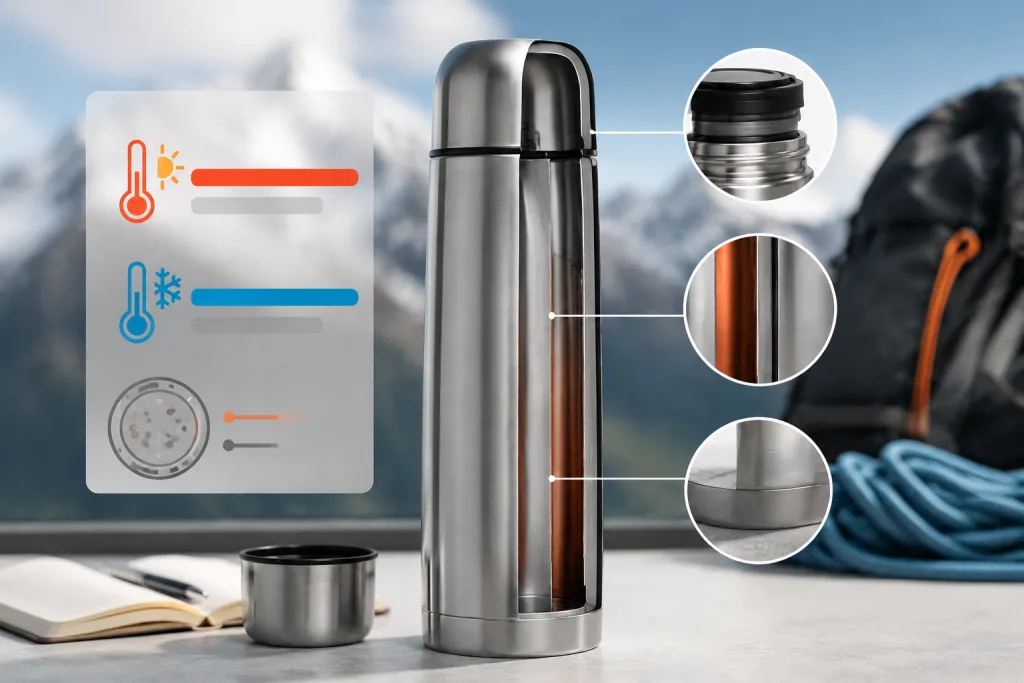
The vacuum layer is often upgraded with copper coating on the inner side of the outer wall. It cuts radiant heat transfer. Simple. The added cost is often USD 0.15-0.35 per unit, depending on size and production volume. On the line, the coating is checked before body matching, and QC pulled 8 samples from a 3,000 pcs run last week to confirm the finish was even around the shoulder. For a top custom vacuum bottle sold at retail, copper coating usually pays for itself. For a one-day event giveaway, the math may not work.
Leak testing should be separate from insulation testing. We use 100% air-pressure leak checks on vacuum bodies before assembly, then water inversion checks on finished goods, usually 3 minutes upside down with the lid fully tightened. For export orders from Zhejiang, China, this is not optional. AQL 2.5 final inspection still catches cosmetic issues, but leak control has to happen earlier at the body and lid stages. We have seen this go sideways: one loose silicone ring in a backpack creates a complaint faster than a weak temperature claim.
Lids, gaskets, and failure points
The lid is the part buyers under-spec most often. The body can pass polish, vacuum, and coating checks, then a wobbly hinge or loose thread makes the whole customizable thermos feel cheap in the hand. For outdoor retail, we run a screw lid with a 2.5-3.0 mm silicone gasket before we trust a flip structure. For promotional brands, push-button lids look sharper in photos, but one extra spring and one extra mold insert can add 12 days vs 18 days to sampling when the button fit is off. This is the wrong place to save USD 0.08.
We see four lid material choices on the line: PP for stable hot-drink lids, Tritan when the buyer wants a clear window, stainless steel cap shells for gift-set weight, and silicone for sealing. PP is the safe cost choice. Tritan looks clean, but QC pulled one sample last quarter with a 0.6 mm stress crack after drop testing, so impact testing cannot be skipped. Silicone gaskets need food-contact grade material and should pop out for cleaning without a screwdriver. Ask for spare gaskets by SKU; we usually pack 1,000 pcs per polybag for distributor after-sales orders.
Thread design decides how the bottle feels after the first week. Coarse threads are easier with gloves, while fine threads feel smoother and punish bad molding tolerance. For a thermos custom project, we check lid torque with a digital torque meter, run open-close cycles, then test leakage after thermal cycling. Our practical gate is 500 open-close cycles plus a 30-minute upside-down leak test after hot fill at 95°C. Simple test. Good filter.
If you are comparing thermos manufacturers, ask for the lid drawing and material declaration before deposit. Around 7 out of 10 lid complaints we see come from small parts nobody named in the purchase order; one PO even wrote “silicon ring” but missed hardness, so the buyer flagged leakage after launch. The spec sheet should name the lid body material with grade, gasket material with Shore A hardness, strap material if used, and dishwasher-safe status. For kids or family outdoor lines, check applicable ASTM or EN requirements when the design has straws or detachable parts under 31.7 mm.
Finish and logo durability
The finish decides how a custom thermos looks after it has bounced around in a backpack for 6 months. Powder coating is still the workhorse for outdoor bottles because it beats standard spray paint on scratch resistance and grip. We run most retail bottles at 60-80 micron powder coating thickness, checked with a coating thickness gauge before assembly. Go too thick and the math doesn't work: fine logo edges get soft, and QC has pulled samples where the coating jammed the lid threads by 0.3 mm.
Logo method should match the use case, not the sales render. Laser engraving is durable and clean, especially on powder-coated bottles where it cuts through to the stainless steel below. It suits outdoor retail and premium promotional thermos programs, but it adds setup time and normally costs USD 0.18-0.45 per logo depending on size. Silk screen printing is cheaper for one-color logos, often USD 0.08-0.18, but abrasion resistance comes down to ink choice and oven curing. Heat transfer handles full-color graphics. Approve a real sample first; we have seen a buyer flag a blue logo that looked right on the PDF but shifted after the 160°C transfer press.
For a thermos customizable program with 5 or 6 brand clients under one PO, keep the printable area realistic. Curved bottle bodies distort artwork. A 40 mm wide logo on a straight section is safer than a 90 mm wrap on a tapered body, especially when the operator lines it up by jig instead of camera positioning. If you need a retail-level all-over pattern, talk through hydro dipping or full-wrap transfer and allow extra sampling time. This is the wrong question to ask: “Can you print anywhere?” The better question is where the logo still looks straight after packing, shipping, and shelf display.
Our Zhejiang production team needs 7-10 days for pre-production samples with logo, and 35-45 days for mass production after approval. For urgent China export orders, simpler decoration wins. Last November, one PO had the event date typed as 12/08 instead of 18/12, and the line could only save it by switching from full-wrap transfer to laser engraving. A good-looking finish that misses your event date is not a successful supplier thermos decision.
Packaging for retail and freight
Packaging is not just a box around the bottle. It decides freight cost, retail damage rate, barcode work, and how the buyer reads the product on arrival. For distributor thermos orders, we run one bottle in a white box or kraft box, then 24 pcs per export carton. A 500 ml bottle carton may measure around 48 x 33 x 28 cm and weigh 8-10 kg gross, depending on the model. On the line, QC checks the carton with a 5 m tape and weighs the packed master carton on a 30 kg scale before we release the packing spec. Gift boxes and pulp inserts look better on shelf, but they can push carton volume up by 15-25%. The math doesn't work if the buyer only compares bottle unit price.
If you sell through outdoor stores, ask for retail-ready packaging with EAN or UPC barcode placement, hangtag options, and product claims matched to test data. The buyer will flag it fast if the hangtag says “keeps hot 24 hours” but the lab report supports 12 hours. If you sell through online channels, request carton drop testing. A common baseline is ISTA-style 1A handling or a 10-drop carton test from 76 cm, adjusted by carton weight. For Amazon FBA-style shipments, FNSKU labeling and suffocation warnings on polybags need to be finished before the goods leave China. We have seen this go sideways when a PO typo changed FNSKU last minute and 3,000 pcs needed relabeling at the warehouse.
Thermos bulk projects often lose margin in packaging because the buyer prices only the bottle. A color box may add USD 0.18-0.45. A molded pulp insert may add USD 0.12-0.30. A printed manual, barcode label, master carton mark, and inner carton add small costs that show up later. Across 10,000 pcs, USD 0.22 becomes USD 2,200. QC pulled the sample last month because the molded pulp tray was 2 mm too tight around the powder-coated bottle, leaving rub marks after the vibration test. Small part. Big complaint.
Ask your thermos suppliers to quote packaging as a separate line. It makes FOB Ningbo and FOB Shanghai offers easier to compare, especially when one supplier hides the inner box inside the bottle price. Hangzhou, Zhejiang is close to both Ningbo and Shanghai ports, so we choose the route by vessel schedule and final destination. For Europe, we often ship through Ningbo when the sailing is 12 days earlier; for some U.S. West Coast bookings, Shanghai can be 4-6 days faster depending on the carrier. Before booking, our merchandiser checks the carton CBM sheet against the forwarder’s cut-off time.
Compliance, AQL, and order terms
For Europe and North America, talk compliance before we cut the first sample. FDA or LFGB testing usually covers the food-contact stainless liner, lid PP, gasket silicone, and straw parts by market. Coatings, plastics, and silicone may also need REACH and SVHC screening; for California, we check Prop 65 risk on powder coating and printed inks before artwork goes to the UV printer. Kids’ bottles are stricter. If the buyer is selling to children or family outdoor accounts, confirm CPSIA, ASTM, or EN child-safety rules against the exact cap, straw, carry loop, and small parts design; QC pulled one 350 ml kids sample last year because the silicone plug came out under a simple 90 N pull test.
Quality control needs AQL wording, not “good quality” on a PO. For stainless drinkware, we usually run AQL 2.5 for major defects and AQL 4.0 for minor defects, with critical defects at 0. Spell out the defects: leakage, vacuum failure, wrong logo, sharp edge, coating peel, serious dent, barcode error, carton damage. Use real checks. The line should do a 100°C hot-water leak test, vacuum retention spot check, 3M tape pull on the logo, and carton drop review before final inspection. A third-party inspection normally costs USD 250-350 per man-day in China; the math doesn’t work if you save that fee and then reject 1,200 pcs after arrival because 8 cartons have mixed barcodes.
Order terms need the same hard edges. For standard models, our MOQ is usually 1,000 pcs per color and 3,000 pcs total order value target, but exact MOQ depends on finish and logo. Powder coating in one Pantone is simpler than gradient spray or laser plus wraparound print, so the setup cost changes. New mold work for a fully customized thermos can require USD 2,000-8,000 tooling and 45-60 days development; we’ve seen this go sideways when a buyer writes “matte black” on the PO but sends glossy black artwork 6 days before mass production. Payment is commonly 30% deposit and 70% before shipment, with FOB Ningbo or FOB Shanghai terms.
A good thermos manufacturer will push you to approve a sealed pre-production sample. That sample should match the signed spec sheet, AI artwork file, packaging file, and inspection checklist, down to logo size in mm and carton mark layout. No shortcut here. If your thermos distributor network needs repeat orders, keep the approved sample and Pantone records; we keep one golden sample in the QC room and one in the sales cabinet, because the buyer flagged a lid color drift once after the second 5,000 pcs repeat order. Repeatability separates a one-time promotional item from a manufacturer thermos program that we can ship again without arguments.
Send your bottle spec sheet for factory review
We will check steel, lid, logo, packaging, MOQ, and FOB pricing before you commit to a bulk stainless thermos order.
Frequently asked questions
What MOQ should I expect for a top custom vacuum bottle order?
For an existing stainless bottle model, a realistic MOQ is 1,000 pcs per SKU or color. If you need three colors, many factories will ask for 3,000 pcs total because powder coating setup and logo alignment take time. For special finishes, full-wrap graphics, or private mold work, MOQ can move to 3,000-5,000 pcs. At BottleForge in Zhejiang, China, we quote standard custom thermos projects from 1,000 pcs when the bottle mold already exists. A new shape is different: tooling can run USD 2,000-8,000 and development may take 45-60 days before mass production.
How much does a custom stainless thermos cost in bulk?
For a 500-750 ml stainless vacuum bottle, FOB China pricing often ranges from USD 3.20 to USD 7.80 depending on steel grade, lid complexity, coating, logo method, packaging, and order quantity. A basic promotional thermos with silk screen logo and white box sits near the low end. A retail-ready top custom vacuum bottle with SUS304 body, copper-coated vacuum layer, powder coating, laser logo, color box, and barcode lands higher. Freight, duty, and inspection are not included in FOB pricing. Always ask suppliers thermos quotes to separate bottle, decoration, packaging, tooling, and testing fees.
Which logo method is best for outdoor retail bottles?
Laser engraving is usually the safest for outdoor retail because it will not peel like ink and it handles abrasion better in backpacks, cup holders, and campsites. On powder-coated bottles, laser exposes the stainless layer underneath and gives a clean permanent mark. Silk screen printing is fine for simple promotional thermos orders, especially one-color logos, but you should test abrasion and dishwasher exposure if you claim long-term durability. Heat transfer works for full-color artwork but needs careful approval on curved surfaces. For a 3,000 pc order, expect laser to add roughly USD 0.18-0.45 per unit depending on logo size.
How do I compare thermos suppliers without being fooled by low quotes?
Compare the same spec line by line: inner and outer steel grade, wall thickness, lid material, gasket material, coating thickness, insulation test method, logo process, packaging, AQL level, and FOB port. A cheap thermos supplier may remove copper coating, use 201 stainless outside, reduce wall thickness to 0.35 mm, or quote a plain box while another supplier includes a retail box. Ask for a pre-production sample, material declaration, and inspection checklist before deposit. If two suppliers are more than 15% apart on the same-looking bottle, the specs are probably not the same.
What lead time should outdoor retailers plan for?
For existing molds, plan 7-10 days for logo sample and 35-45 days for mass production after sample and artwork approval. Add 3-7 days if you need special color matching, full-wrap artwork, or extra compliance testing. Ocean freight to Europe or North America may add 25-45 days depending on port and season. For holiday or event campaigns, do not place a customized thermos order with only 30 days total schedule unless you are using air freight and a very simple decoration. For repeat distributor thermos orders, keeping approved color chips and artwork files can save about one week.