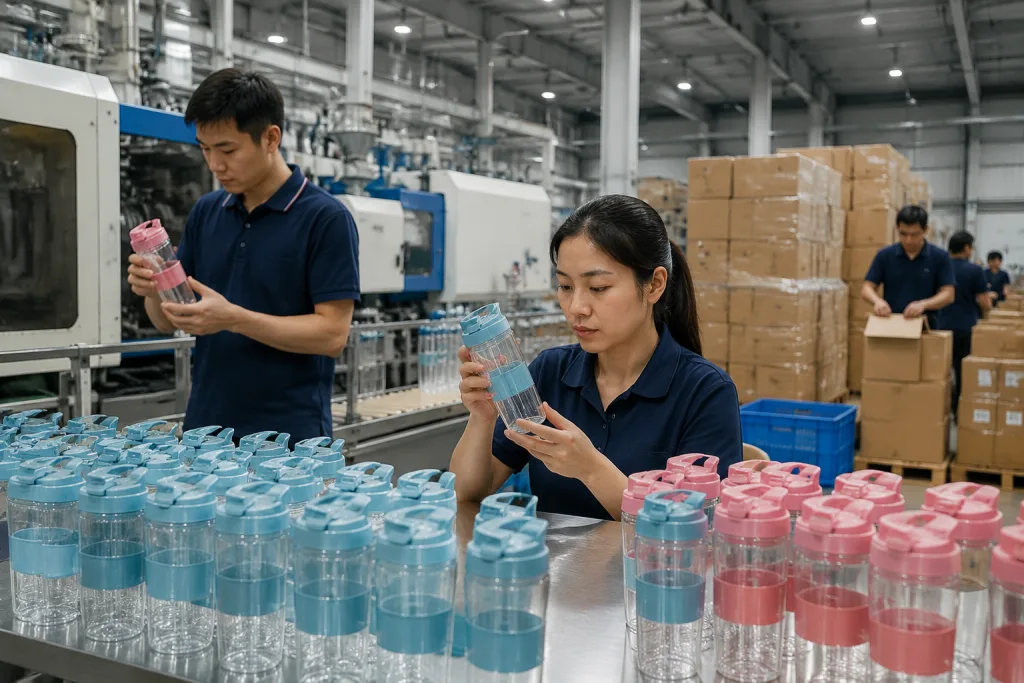
Key Takeaways
- Specify Eastman Tritan copolyester with 1.8–2.2 mm body wall for most retail bottles
- A realistic MOQ is 1,000 units/color for stock molds and 5,000 units for new color-matched lids
- Budget USD 1.35–2.80 FOB Ningbo for standard 500–1,000 ml custom Tritan bottles
- Use AQL 2.5 for major defects and AQL 4.0 for minor cosmetic defects before shipment
A top custom tritan bottle is not bought from a glossy 3D rendering. It is bought from a spec sheet that protects your margin, ship date, and brand name. We have seen this go sideways when the quote looked clean, then QC pulled the pre-production sample and found the lid gasket 0.4 mm short on compression. If you are comparing a canteen supplier in China with a quotation from Europe, check the resin grade, lid sealing method, print area in mm, carton drop-test standard, and who pays for FDA or LFGB testing before you compare unit price.
Our Hangzhou, Zhejiang team sees this every week. One buyer writes “custom canteen,” another writes “customizable drinkware,” and both still need hard numbers before the purchase order lands. BottleForge Industrial produces up to 450,000 Tritan and stainless drinkware units/month in Zhejiang, China, with typical MOQ from 1,000 units per color and 30–45 day mass-production lead time after sample approval. Small details matter: last month a buyer flagged a PO typo listing 650 ml while the approved sample was 600 ml, and catching it before mold engraving saved 12 days of argument on the line.
Resin line: not all clear plastic
Your spec sheet should name the resin on line 1, not hide behind “BPA-free plastic.” For a top custom tritan bottle, write Eastman Tritan copolyester, food-contact grade, BPA-free, EU 10/2011 and FDA compliant. If a canteen vendor writes “PC style material” or “new eco plastic,” stop the price talk and ask for the resin brand, grade, and migration test history. We run incoming resin checks against the lot label and COA; QC once pulled 6 cartons because the bag label said TX1001 while the PO typed TX1001T.
Tritan gets picked for clear walls, stronger drop performance than acrylic, and no BPA problem like old polycarbonate. For a distributor drinkware range, that matters because returns eat margin fast. A bottle that survives a 1.2 m drop onto plywood on our line is less likely to get complaints after retail handling. It still scratches if the buyer packs it loose with stainless straws or metal carabiners, and we have seen this go sideways, so the inner bag, divider, and carton load spec belong in the material discussion.
Common body wall thickness is 1.8–2.2 mm for 500–1,000 ml bottles. Below 1.6 mm, the bottle looks thin and can deform after 7 days in a hot warehouse rack at 45°C. Above 2.5 mm, the hand feel improves, but the resin math does not work for every promo order. For children’s bottles, we push impact resistance and rounded edges checked with an R gauge; for a canteen promotional project, a lighter wall may pass if the target is 5,000 pcs event giveaway pricing.
Do not approve production from a photo. Ask the canteen factory for a physical pre-production sample using the same resin, same colorant, same cap gasket, and same decoration method. We ship only after the PP sample matches the signed spec, down to cap torque checked with a 0–10 N·m torque meter. China has strong Tritan molding capacity, but the difference between a serious canteen manufacturer and a trading-only canteen vendor shows up fast when you ask for resin traceability and lot records.
Capacity, mold, and tooling math
Capacity looks easy on a PO, then the buyer, designer, and canteen manufacturer measure it three ways. Your spec sheet should state nominal capacity and full-brim capacity. We check this on the line with a 1,000 ml graduated cylinder; a 750 ml Tritan bottle often reads 790–820 ml to the lip depending on shoulder shape. If your retail label says 750 ml, the usable fill line needs to hold that volume without weeping when QC closes the lid and tips the sample for 30 seconds.
Stock molds move fastest. A canteen supplier in Zhejiang can usually quote 350 ml, 500 ml, 650 ml, 750 ml, and 1,000 ml bodies from existing tooling. For these, MOQ is commonly 1,000 units per color, sample time is 7–10 days, and mass production is 30–45 days after artwork and sample approval. We run those jobs often. If you ask for a private silhouette, grip texture, or unique base shape, the mold room gets involved and the math changes. A single-cavity Tritan body mold often starts around USD 6,000–12,000; multi-cavity tooling can exceed USD 18,000 but lowers unit cost once orders pass 30,000–50,000 units. Last spring a buyer flagged a 0.6 mm base-radius change after T1 samples; small on paper, expensive in steel.
This is where 7 out of 10 new custom drinkware buyers over-customize too early. The math doesn't work if the first order is only 3,000 pcs. A custom growler or customized growler with a large handle and wide mouth may need drop testing, torque checks on the cap, and higher tooling spend. A standard customizable canteen with a private cap color and printed logo may hit the shelf target with less risk. We have seen this go sideways when a PO says “wide mouse” instead of “wide mouth,” and the buyer still expects the factory to guess the lid structure.
If you are a canteen distributor building a seasonal range, ask your canteen suppliers to quote two options: stock molds and exclusive tooling. Compare total landed cost across 12 months, not just the first PO. Tooling amortized over 5,000 units looks painful; over 80,000 units it can be sensible. Good canteen manufacturers will show the cavity count, cycle time in seconds, carton CBM, and expected scrap rate instead of pushing the most expensive mold first. QC pulled one sample from our 750 ml line last month because the silicone ring sat 1.2 mm proud; that kind of detail matters more than a fancy new outline.
Lid, gasket, and leak claims
The lid is where we see most customized drinkware failures, not the Tritan body. Buyers push hard on Pantone body color and a 45 mm logo, then the return claim comes back for leaking, odor, cracked flip hinges, or a straw set that traps juice pulp. Put the lid material, gasket material, sealing structure, hinge cycle target, and carbonated-drink limit into the spec line. Tritan bodies take abuse. Cheap lids don’t.
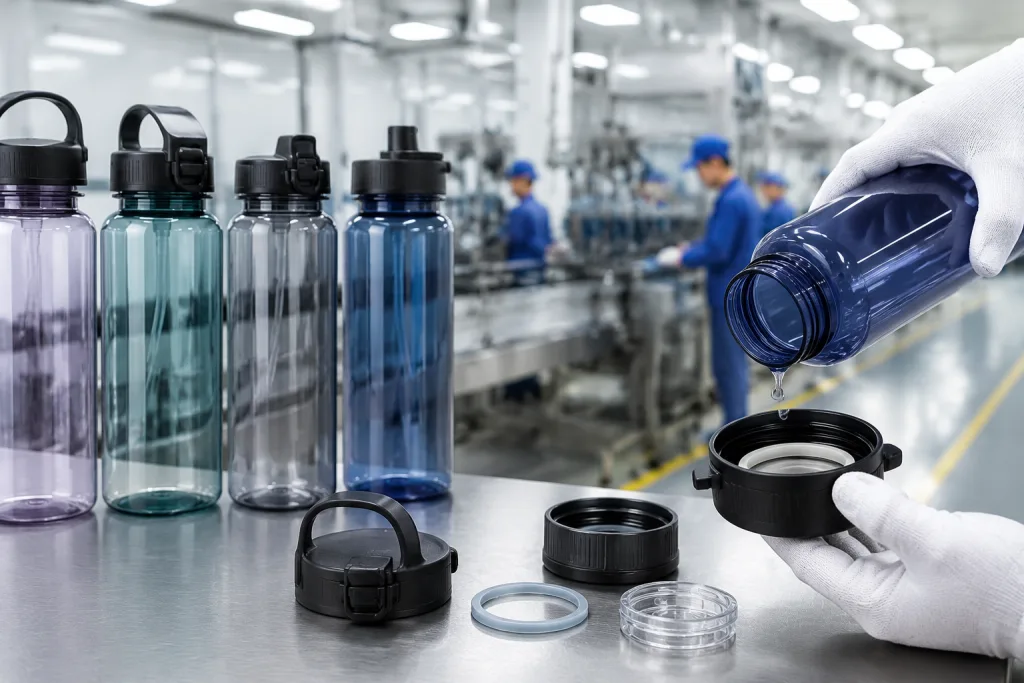
For a daily-use lid, we run PP or Tritan cap parts with a silicone gasket. Specify food-grade silicone at 50–60 Shore A; our QC checks this with a Shore durometer before assembly. If the gasket is too soft, it can roll out in washing. If it is too hard, the seal can fail after a drop. For flip lids, ask for 3,000–5,000 open-close cycles on the hinge jig. For screw lids, check thread smoothness after dishwasher simulation if you plan to print “dishwasher safe” on the carton.
Write the leak test like an inspection method, not a sales promise: fill to nominal capacity, close the lid, invert for 30 minutes at room temperature, then shake 20 cycles. For better programs, add a 1.0 m drop test with water filled to 80 percent, followed by a leak check. We’ve seen this go sideways when a PO says “leakproof” but the approved sample had a straw vent. If the canteen customized design uses a straw, bite valve, or pressure release, set a separate failure standard because each small part adds another leak path.
Be careful with “100 percent leakproof” on packaging. This is the wrong question to ask unless you define the liquid and test condition. It can pass for still water under normal use, but not for hot tea, carbonated drinks, or a gasket nicked by a 0.3 mm burr on the mold parting line. A responsible canteen factory will help write wording that matches the test sheet. That protects the buyer and the canteen manufacturer.
Decoration limits and logo durability
Decoration is not just logo placement. It changes scrap rate, lead time, and compliance risk on the line. For a top custom tritan bottle, we usually run silk screen printing, pad printing, heat transfer, UV printing, in-mold color effects, or laser marking on stainless lid plates. On a 10,000 pcs order last month, QC pulled 230 bottles for ink pinholes before packing, so the decoration choice hit the shipment date harder than the bottle molding.
Silk screen is cost-effective for simple logos, usually USD 0.05–0.18 per position depending on color count and size. It fits canteen promotional orders where the buyer wants one-color artwork and a low landed cost. Pad printing handles curved or smaller areas better, but the math doesn't work for a large wrap design over 110 mm wide. UV printing gives cleaner gradients and photo detail, but it costs more and needs adhesion testing on Tritan; we use 3M 610 tape, not generic office tape from the packing desk. If you want retail-quality customizable drinkware with full-color branding, ask for a 3M tape adhesion test and 50-cycle hand-wash rub test before mass production.
Color matching needs discipline. Write the Pantone number, tolerance under D65 light, and whether the match applies to the bottle body, lid, straw, silicone loop, or every visible part. Tritan transparent colors look different at 1.8 mm wall thickness than on a flat color chip, and the buyer usually flags this when the approved chip sits beside a molded bottle under a light box. A customized canteen in smoke grey or amber often needs 2–3 sampling rounds, not because the factory is slow, but because resin thickness changes the shade.
For distributor canteen programs, we recommend approving decoration on the actual molded bottle, not a flat sheet. We've seen this go sideways. One PO even said “logo 45mm” while the artwork file was 54 mm, and the screen frame was already made before the merchandiser caught the typo. If you work with several canteen vendors, force them to quote the same print area, ink count, packing method, and AQL level. Otherwise the cheaper quotation is often just thinner ink, loose color tolerance, or no adhesion test.
Compliance lines buyers should require
Compliance belongs to the exact bottle and sales market, not a PDF someone reused from a 2021 order. For Europe, require EU 10/2011 food-contact migration testing on the Tritan body and lid-contact parts, LFGB when Germany or premium retail is on the PO, plus REACH/SVHC declarations for coating, woven straps, cartons, and printing inks. For North America, ask for FDA food-contact compliance and California Proposition 65 review when the label, coating, or colorant makes it relevant. Kids’ bottles need ASTM F963 checks for small parts and sharp edges; last quarter QC pulled a flip-lock sample because the hinge pin measured 2.8 mm proud after drop testing.
A solid canteen manufacturer in China should quote testing before resin is booked, not after the line is full. Typical third-party lab cost for a Tritan bottle set runs USD 350–900, based on material count, color count, and target market. Change the resin color from clear to smoke grey, switch silicone from 70A white to black, or revise UV ink after testing, and partial re-testing is usually back on the table. Annoying, yes. Cheaper than a shipment hold; we have seen one buyer lose 12 days at port because the PO said “blue lid” while the tested sample file said “navy lid.”
Factory audits still matter. BSCI, Sedex, ISO 9001, or a customer audit will not guarantee a perfect bottle, but they show whether the canteen factory can follow a process when 18,000 pieces are moving through the line. For customized drinkware, ask how incoming Tritan resin lot numbers are recorded, how first-article inspection is signed off with calipers and torque gauges, and whether packing uses metal detection or 100% visual checks for caps and straws. BottleForge Industrial’s Zhejiang inspection team runs incoming material checks, in-process leak checks at 0.3 MPa, and final AQL inspection before FOB Ningbo shipment.
If you buy as a canteen distributor or distributor growler account, file compliance by SKU, not only by supplier. This is where the math doesn’t work if one PDF covers 6 colors, 3 lid styles, and 2 print methods. Retailers and customs brokers ask fast, often within 24 hours. A messy file can delay a container even when the bottle is fine; we have had a broker flag one typo where the carton mark showed SKU TBN-750B, but the test report listed TBN-7508.

Price, MOQ, and delivery reality
For a standard top custom tritan bottle from China, a workable FOB Ningbo or FOB Shanghai price is USD 1.35–2.80 for 500–1,000 ml. The spread comes from resin weight, lid structure, print method, packing, and order quantity. A simple canteen promotional bottle with one-color silk screen print and polybag packing lands near the low side; we run those on a 120 mm print fixture and the setup is quick. A retail boxed customizable canteen with locking flip lid, silicone sleeve, full-color UV logo, and barcode label costs more because QC has to check lid lock tension, sleeve fit, scan code readability, and box crush strength before we ship.
MOQ is not just a factory preference. This is the wrong question to ask if the only question is “Can you do 300 pcs?” The real cost sits in resin color batching, injection machine setup, print fixture setup, carton production, and inspection cost. For stock molds, expect 1,000 units per color. For custom-matched lids or silicone parts, 3,000–5,000 units per color is more realistic because the color masterbatch supplier usually will not mix 12 kg just for one tiny run. For fully new mold projects, 5,000–10,000 units per first production run is a common ask from canteen suppliers, or the tooling setup and first-shot adjustment on the injection line do not make sense.
Lead time should be split into sample and production stages. Digital artwork confirmation takes 1–2 days if files are clean; last month one PO had “Pantone 299C” in the email and “Pantone 229C” on the artwork, and the buyer flagged it before we burned a screen. Prototype or pre-production samples take 7–15 days for stock mold projects. Mass production normally takes 30–45 days after sample approval and deposit. Add 3–7 days for final inspection, booking, and loading. If you need Amazon FBA prep with FNSKU labels, carton limits, and suffocation warnings, add that time at the start and put the specs on the PI, not in a late WhatsApp message.
Cheap quotes usually cut something: carton thickness, resin grade proof, gasket testing, print durability testing, or proper QC. We have seen this go sideways when a buyer saved USD 0.08 per bottle, then QC pulled the sample and found the lid gasket leaking after a 30-minute inverted water test. As a canteen distributor, you do not need the most expensive canteen vendor. You need a quotation that names every assumption. Boring is good here: clear spec, clean sample, controlled production, no surprise invoice.
Inspection checkpoints before shipment
Do not let the PO stop at “quality must be good.” That line is useless on the inspection table. We ask buyers to write measurable terms: for most customized drinkware shipments, AQL 2.5 for major defects and AQL 4.0 for minor defects is a practical baseline. Critical defects should be zero. Define major defects as leaking, cracked body, wrong resin, wrong capacity, unsafe sharp edge, unreadable mandatory marking, or failed barcode scan. Minor defects include small print specks, light flow marks, tiny color variation, or carton scuffing within an agreed tolerance, such as 1 speck under 0.5 mm outside the logo area. Last month QC pulled a Tritan sample after a 30-second upside-down leak test because the silicone gasket sat 1.2 mm proud of the lid groove.
Ask for three inspection stages, but make each one tied to a record sheet. First, incoming material check: resin certificate, color masterbatch, silicone gasket, and packaging materials, with resin lot numbers matched against the supplier COA. Second, in-process check: injection molding appearance, lid fit, torque feel, and random leak testing; on our line we run the first 20 pcs after mold start-up before approving mass shots. Third, final random inspection: capacity, weight, dimensions, logo position, packing, carton drop test, and barcode/FNSKU scan if used. We have seen this go sideways when the buyer approved the bottle shape but forgot to approve the FNSKU size, then the Amazon warehouse flagged 37 cartons at receiving.
Carton packing deserves its own line. Export cartons for Tritan bottles are commonly 5-ply corrugated, around 12–16 kg gross weight depending on bottle size. If bottles are retail boxed, confirm the box board gsm, insert type, and master carton quantity; 350 gsm white card behaves differently from 400 gsm kraft after a 76 cm drop test. Loose bottles need polybags or dividers to prevent scratching during the inland trip from Zhejiang to Ningbo or Shanghai port. The math does not work if a buyer saves USD 0.018 per polybag and then rejects 4% of bottles for rub marks after the truck ride.
For private-label custom drinkware, keep golden samples at both sides: one with you and one sealed at the China factory. We sign across the sample label with a marker, add the PO number, and keep it in the QC cabinet beside the digital caliper and Pantone book. When a dispute happens, the golden sample cuts down long email arguments about color, gloss, logo size, or lid feel. Serious canteen manufacturers welcome this because it removes guesswork and keeps the production team honest; we once caught a PO typo that changed a 42 mm logo to 24 mm before the pad-printing plate was made.
Send your Tritan bottle spec for a practical quote
Share capacity, color, logo method, MOQ, and target market. We will reply with FOB pricing, sample timing, and compliance notes.
Frequently asked questions
What MOQ should I expect for a top custom Tritan bottle?
For a stock mold top custom Tritan bottle, expect 1,000 units per color as a workable MOQ from a canteen manufacturer in China. If you need Pantone-matched lids, silicone loops, or custom straw colors, 3,000–5,000 units per color is more realistic because the small components have their own batching and setup cost. A new body mold usually pushes the first run to 5,000–10,000 units. Some canteen vendors quote 500 units, but check whether they are using existing colors, charging higher unit prices, or skipping proper packaging and AQL inspection.
Is Tritan better than stainless steel for promotional canteens?
Tritan is better when you want clarity, low weight, color visibility, and a lower FOB price. A 750 ml canteen promotional Tritan bottle may land around USD 1.60–2.40 FOB, while a vacuum stainless bottle often costs more because of double-wall forming and insulation testing. Stainless is better for heat retention and premium positioning. Tritan is not for boiling water or long hot-liquid storage. For event giveaways, gym bottles, school programs, and distributor drinkware ranges where users want to see water level, Tritan is usually the cleaner commercial choice.
How do I compare quotations from different canteen suppliers?
Force every canteen supplier to quote the same spec sheet: resin brand and grade, capacity, wall thickness, lid structure, gasket material, logo method, carton packing, MOQ, lead time, FOB port, testing responsibility, and AQL level. A USD 0.18 cheaper quote may use thinner walls, no resin certificate, single-wall export cartons, or no adhesion testing. Ask each canteen vendor to confirm whether tooling, samples, lab testing, FNSKU labels, and inner boxes are included. Once all assumptions are visible, price comparison becomes fair.
Can I make a customized growler from Tritan?
Yes, but treat a customized growler differently from a 500 ml sports bottle. Larger capacities such as 1.5 L or 2 L need stronger base geometry, better handle design, and more careful drop testing because the filled weight is much higher. A customizable growler may need 2.3–3.0 mm wall thickness and a reinforced lid thread. It is fine for cold water, juice, or dry storage, but not for pressurized beer unless the closure and pressure testing are designed for that use. Ask the canteen factory for filled drop tests and leak tests before tooling.
What documents should a distributor canteen buyer keep?
Keep documents by SKU: final signed spec sheet, approved artwork, golden sample photos, resin compliance certificate, EU/FDA or LFGB test reports, REACH declaration if relevant, factory audit certificate, pre-shipment inspection report, packing list, commercial invoice, and bill of lading. For Amazon or retail distribution, also keep barcode or FNSKU confirmation and carton measurement records. A distributor canteen buyer handling 10–20 SKUs can lose days if files are stored only by supplier name. SKU-level records make customs, retailer audits, and repeat orders much easier.