Key Takeaways
- A practical top custom thermos MOQ starts at 1,000 pcs per color for most powder-coated stainless models
- 304 stainless steel is enough for most outdoor and promotional thermos programs; 316 is worth paying for in saltwater or premium ranges
- Laser engraving is stable at 7-10 working days for logo setup, while full-color wrap printing needs longer sampling control
- A good factory thermos order should include AQL 2.5/4.0 inspection, 100% leak testing, and carton drop-test records
A top custom thermos is not picked from catalog photos. You are buying four controls: bottle structure, decoration process, production discipline, and landed-cost exposure. Miss one and the order can go sideways: we had QC pull 12 samples from a 3,000 pcs pilot run last April because the silicone gasket sat 0.4 mm proud, enough to fail the 45° leak test after hot filling.
For outdoor retailers and promotional brands, stainless vacuum drinkware looks simple on the shelf, but the line makes dozens of small calls before packing. Capacity tolerance, 304 versus 316 stainless steel, copper coating thickness, lid torque, 5-ply carton strength, REACH paperwork, and AQL inspection decide whether the bottle sells cleanly or turns into claims. The wrong question is “which model is cheapest?” From our Hangzhou, Zhejiang team, we usually start with the use case, target MOQ, logo method, and delivery window; last month a buyer flagged a PO typo showing matte black body with glossy black lid, and catching that before pre-production saved 18 days of rework.
Start with the buying decision
You do not need 40 models to start a custom thermos program. You need a buying tree your team can actually use on a PO. Start with the use case: hiking retail shelf, corporate gift, club merchandise, or distributor thermos repeat stock. Then set the performance level: basic heat retention, premium insulation, or rugged outdoor use with a lid that survives a drop test. Decoration comes next: a one-color logo is a different risk from full retail artwork with Pantone matching. Last, check the order math: MOQ, unit price, sampling time, FOB term, and how many cartons fit a 20GP. We had one buyer flag a 6 mm logo shift on a pre-production sample, and they were right. This is where small decisions get expensive.
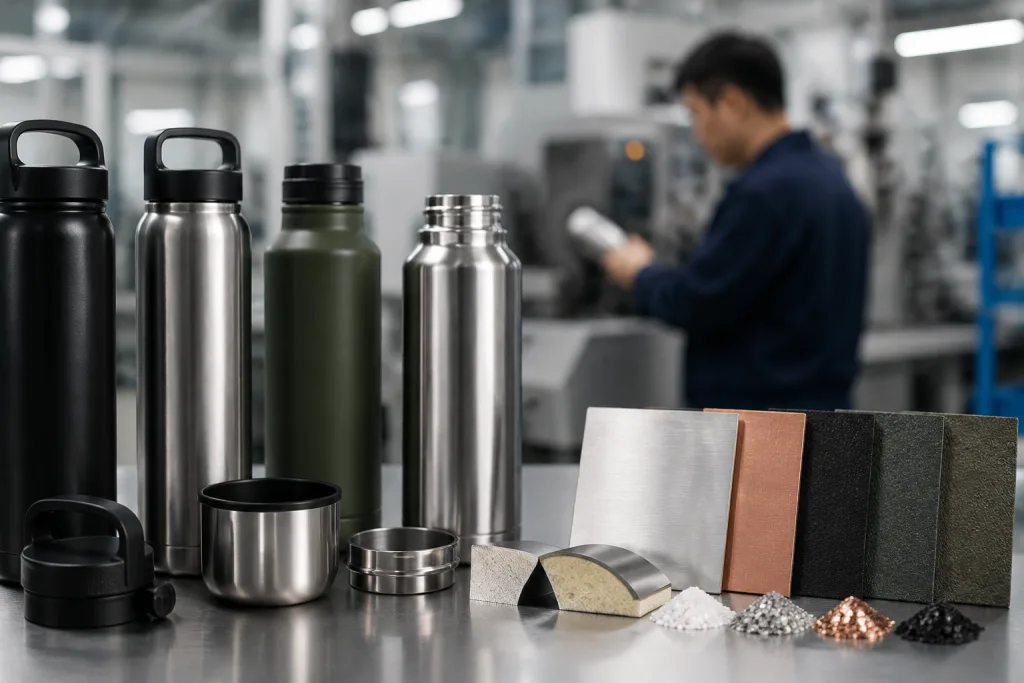
For a mainstream 500 ml to 750 ml stainless custom thermos, we usually run 304 stainless steel inner and outer wall, 0.4-0.5 mm wall thickness before forming, vacuum insulation, food-grade silicone gasket, and powder coating around 60-80 microns. Not the cheapest build. Still, the math works better than chasing a low quote and paying for dent claims later. On the line, QC checks coating thickness with an Elcometer gauge and pulls random bodies for vacuum retention testing. This structure cuts the complaints we see most often: denting, paint chips, weak insulation, and lid odor.
If you are building a promotional thermos for a short campaign, a standard mold, one-color logo, and 25-30 day production after sample approval can be fine. If you are an outdoor retailer, that is the wrong question to ask. You need to ask about lid replacement, spare gaskets, handle strength, and batch consistency across the second and third reorder. We once had a PO typo listing matte black in the header and PMS 186C in the item line; production stopped for 7 hours until the buyer confirmed. A thermos supplier that only talks about price is not giving you enough to decide.
At BottleForge Industrial in Zhejiang, China, our stainless thermos lines are set up for around 450,000 units/month across vacuum bottles, travel tumblers, and sports bottles. A normal MOQ is 1,000 pcs per color for standard colors and 3,000 pcs for custom powder coating. Capacity is not a brochure number for us; we plan it by welding stations, vacuum ovens, spray line slots, and carton packing tables. We ship tighter when the buyer locks artwork early, because 12 days for sampling is not the same as 18 days after three logo revisions. A supplier thermos quote without stable capacity is just a spreadsheet number.
Choose capacity and insulation honestly
Capacity is where buyers over-order fastest. For outdoor retail, 500 ml and 750 ml are the safer sizes; we run those two bodies more than any other on the line. A 500 ml customizable thermos fits most backpack side pockets, standard car cup holders in the US and EU, and gift budgets that still have room for a box insert. A 750 ml or 1,000 ml model makes sense for hiking, camping, fishing, and worksite use, but the carton weight jumps fast: 24 pcs of 1,000 ml bottles can push a master carton past 15 kg. For promotional brands, 350 ml to 500 ml gives the cleaner balance between shelf value and freight cost. Bigger is not always better.
Insulation claims need clean numbers, not copywriting. Buyers often ask for “24 hours hot and 48 hours cold” because they saw it on 6 competitor listings, but this is the wrong question to ask without a test condition. The result changes with capacity, mouth diameter in mm, lid type, ambient temperature, and test method. We usually test hot water at 95°C, filled to rated capacity, ambient 20°C, then record at 6, 12, and 24 hours with a probe thermometer. For a good 500 ml customized thermos, expect roughly 65°C or higher after 6 hours and 40°C or higher after 24 hours, depending on construction. If a supplier will not share the curve, the math doesn’t work.
Lid choice is where we’ve seen projects go sideways. A narrow screw lid usually holds heat better and leaks less; QC pulled one 500 ml sample last month after a 30-minute inverted leak test because the silicone ring sat 0.4 mm proud. A push-button lid is convenient, but it adds gasket complexity and gives the buyer more parts to complain about after retail returns start. A straw lid works for cold drinks. Not hot drinks. If you sell through outdoor retailers, the packaging and instruction sheet should say that in plain language, ideally next to the lid icon.
For thermos bulk projects, ask the thermos factory for three documents before you approve the specification: insulation test report with conditions, leak test method with time and angle, and bill of materials with steel grade and lid components. We ship repeat distributor thermos orders where the second shipment must match the first, down to the gasket color and thread feel. If the answer is vague, the model may be assembled from whatever components are available that week; one buyer flagged this after PO line 3 said “black lid” but the sample tag read “BK push cap B2.” That risk is avoidable.
Material choices that affect claims
Start with 304 stainless steel for 8 out of 10 custom thermos projects. It is food-safe, easy to source in China, steady on the deep-drawing line, and the price usually makes sense for a manufacturer thermos program. For coffee, tea, water, and sports drinks, 304 stainless steel does the job. 316 stainless steel gives better corrosion resistance, but it usually increases cost by USD 0.25-0.70 per piece depending on size and steel market pricing. We use 316 for marine retail, high-end outdoor positioning, or brands that need a premium material story the sales team can defend. QC still checks the coil certificate against the PO; one buyer once wrote “SUS306” on the artwork spec, and that typo delayed sample approval by 2 days.
The inner surface matters more than buyers expect. A rough interior can hold odor or show tea staining after a few uses. Electropolishing improves cleanliness and appearance, but the math does not work for every giveaway order. For most promotional thermos programs, a clean mechanical polish is acceptable. For premium retail, ask for interior roughness control and check random samples after filling with hot tea for 24 hours. On our line, QC pulled the sample after the tea test and found brown staining near the weld seam on 3 of 20 pieces; that is the kind of issue a glossy product photo will never show.
Paint is another claim area. Powder coating beats basic spray paint in daily handling, but not all powder coating is equal. A 60-80 micron coating with proper pre-treatment performs better in cross-hatch adhesion and abrasion tests. For outdoor retail, ask for adhesion test results and run your own coin scratch comparison during sample review. Do not rely only on beautiful renderings. We run a coating thickness gauge on the shoulder and base because the base often comes in 12-15 microns thinner, and that is where the buyer flags chipping first.
Lids and gaskets are where cheap suppliers thermos programs often fail. Food-grade silicone should be odor-controlled and removable for cleaning. PP or Tritan-style plastic components should be specified clearly and tested to the market requirement. For Europe, check LFGB or EU food-contact expectations along with REACH. For North America, consider FDA food-contact compliance and, for children’s items, CPSIA or ASTM requirements if applicable. A serious thermos manufacturer will not treat compliance as decoration. We have seen this go sideways when a supplier changed a gasket compound to save USD 0.03; the carton passed AQL 2.5 for appearance, then the buyer rejected 1,200 pcs after a vinegar soak odor check.
Logo method is a risk choice
Decoration is production risk, not just branding. For a top custom thermos project, pick the logo method after checking artwork detail, coating color, order quantity, and defect tolerance. Laser engraving is still our safest choice on 304 stainless and powder-coated bottles; on the line, QC checks the engraving depth with a 10× loupe and rubs the mark with alcohol before approval. It wears well and keeps rejects low, usually under 1% on repeat orders. The limit is simple: no full-color graphics.
Silkscreen printing fits simple one- or two-color logos. We run it often for 1,000 pcs and up because the unit cost makes sense and the contrast on matte black or white coating is strong. Curved bodies still fight back. The buyer flagged this last month on a 500 ml bottle: 1.2 mm slogan text looked sharp in the PDF, then broke up near the curve after screen printing. If your logo has fine text below 1.5 mm height, expect readability problems. Heat-transfer printing and water-transfer printing can handle wraparound artwork, but film stretch, oven temperature, and left-right alignment need tighter control. UV printing works for short runs and color logos, but adhesion must be tested on the exact coating panel, not a “close enough” sample from another job.
For promotional thermos orders, we usually push one-color silkscreen or laser engraving unless the campaign needs full-color artwork. The math is cleaner. It cuts sampling time and gives both sides fewer reasons to argue over small defects. For retail programs, we’ve seen the better setup go this way: laser logo on the bottle body, printed retail sleeve with product claims, and branded gift box with barcode. That gives a premium shelf look without forcing every design element onto a curved bottle surface.
Sampling timing needs to be honest. A blank stock sample can ship in 3-5 days. A custom logo sample normally needs 7-10 working days after artwork confirmation. A customized thermos with new powder color, new lid color, and printed packaging can take 12-18 working days for proper approval. We once had a PO typo showing “Pantone 186C” while the artwork file said “Pantone 185C”; QC pulled the sample before mass production, and that one digit saved a full rework. If a thermos vendor promises everything in 3 days, ask what they are skipping.
Check factory control before price
Price matters, but factory control decides whether that price still works after mass production. A thermos supplier should be able to walk you through incoming 304 stainless inspection with a handheld thickness gauge, vacuum test timing, coating check points, leak testing, and the final AQL procedure. If the answer is only “we have QC,” push back. We’ve seen this go sideways on a 3,000 pcs order when the quoted price looked good, then QC pulled 47 bottles with pinhole leaks before packing.
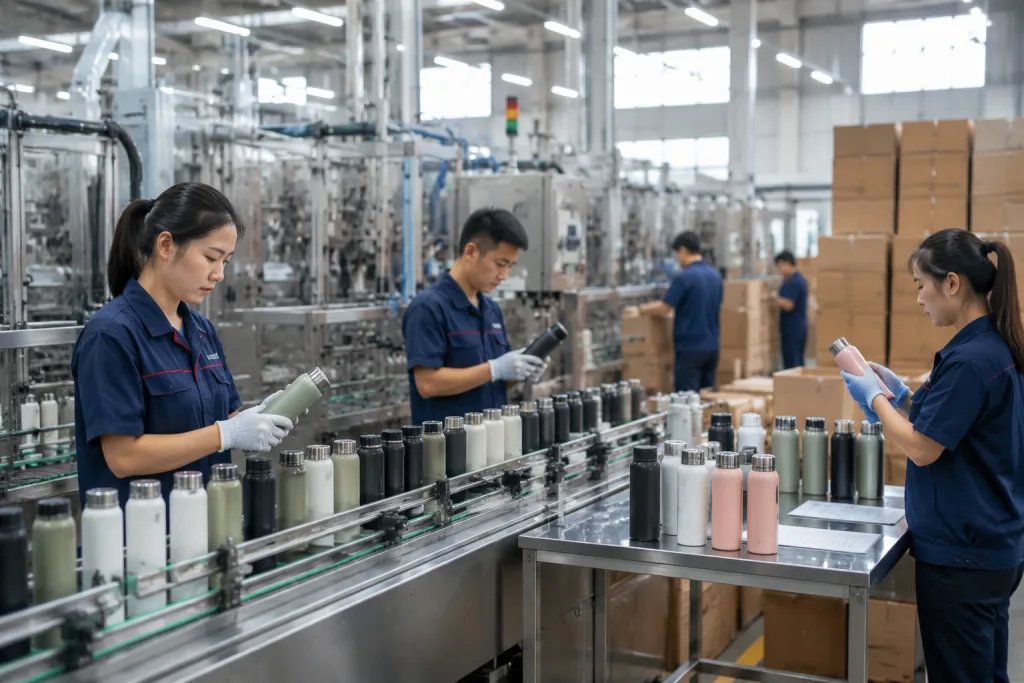
For stainless vacuum drinkware, the key checks are not complicated. Inner and outer shells are drawn, trimmed, welded, then washed before vacuum processing. Vacuum integrity must be tested because one weak weld can turn a premium thermos custom order into a normal metal bottle with nice paint. On our line, we run vacuum hold checks after brazing and spot-check insulation with 95°C water for 6 hours. After coating, the factory should check color difference against the approved sample, coating thickness in microns, adhesion by cross-cut tape, and visible defects under a light box. Before packing, every bottle should pass leak testing. Final inspection usually follows AQL 2.5 for major defects and AQL 4.0 for minor defects, unless your contract says otherwise.
For outdoor retailers, standard appearance inspection is not enough. Add functional checks. Test lid opening and closing for at least 500 cycles on selected samples; a cheap hinge can feel fine at 20 cycles and fail at 300. Run a 1.0 m carton drop test for export cartons, with the master carton weighed and sealed the same way it will ship. Fill samples with hot water and invert for 4 hours. Check handle pull strength if the lid includes a loop or carrying handle; we usually test with a 10 kg hanging weight for loop lids. These tests do not add much cost, but they catch problems before the goods leave China.
Audit documents also matter, but asking “do you have all certificates?” is the wrong question to ask. BSCI, ISO 9001, and Sedex-style social compliance records may be required by European and North American accounts. Not every manufacturer thermos project needs every audit. Your supplier should tell you what is valid, what expired, and what factory name appears on the report; one buyer once flagged a PO because the audit showed an old Zhejiang plant address. In Zhejiang, China, we see the best results when buyers confirm compliance needs before sampling, not after the purchase order is issued.
Calculate real landed cost
The lowest FOB unit price is often the wrong number to chase. A 500 ml stainless thermos may quote at USD 3.20 FOB Ningbo for a basic powder-coated model at 3,000 pcs, while a safer lid, 0.08 mm more coating thickness, and a 5-layer K=A export carton may push it to USD 3.65-4.20. On a quote sheet, that gap stings. On the line, QC pulled 80 pcs from one cheap-lid batch last March because the silicone ring sat 1.5 mm proud; one leakage claim plus 6 cartons of air freight wiped out the USD 0.28 saving.
Carton design changes freight fast. A typical 500 ml bulk thermos may pack 24 pcs/carton with an export carton around 45 x 34 x 28 cm, depending on shape and gift box. Add a handle lid or a wide body and we sometimes drop to 18 pcs/carton, so 3,000 pcs becomes 167 cartons instead of 125. That is real money. For distributors thermos stock, the buyer flagged pallet count because their warehouse charges by pallet position, not just CBM. For promotional brands, a gift box that grows from 78 mm to 88 mm wide can turn a clean budget into a freight surprise.
Ask for pricing in layers: product FOB with exact material grade, logo setup with artwork size in mm, sample cost with courier account, packaging cost by box style, spare parts cost per 100 lids, inspection cost under AQL 2.5, and estimated carton volume from the packing drawing. For North America, check duty code assumptions with your broker before the PI is signed. For Europe, confirm packaging waste obligations and buyer labeling rules; we once had a PO typo saying “dishwasher safe” while the approved artwork said “hand wash only,” and the buyer caught it at pre-shipment. If you need Amazon-style prep, put FNSKU labels and master carton label format into the packing instruction before we run cartons.
A realistic schedule for a thermos manufacturer order is 7-15 days for sampling, 25-35 days for mass production after deposit and approval, and 20-40 days ocean freight depending on destination port. Peak season in China before major holidays can add 7-14 days. We run sampling faster when the buyer approves the Pantone chip and laser logo file on day 1; waiting 6 days to confirm a 2 mm logo move is how schedules go sideways. If your campaign date is fixed, build the calendar backwards and do not spend the whole buffer debating USD 0.08. The math doesn't work.
How to shortlist suppliers
Compare thermos suppliers with a scorecard, not a gut feel. We run a 100-point sheet: 25 for product fit, 20 for engineering answers, 15 for compliance files, 15 for decoration and packaging, 15 for MOQ and lead time, 10 for reply speed. A thermos distributor or brand buyer who picks from the lowest 3 quotes is asking the wrong question. The real test is whether the same factory can repeat the same lid fit, color ΔE under 1.0, and vacuum performance 6 months later.
Send the same brief to every supplier thermos candidate. Keep it tight: target capacity in ml, 304 stainless or other grade, coating type with Pantone code, lid style with leakproof requirement, logo method, order quantity, destination market, packaging requirement, compliance requirement, and launch date. Ask each factory thermos team for a spec sheet, not just FOB Ningbo pricing. If they cannot give wall thickness in mm, steel grade, carton dimensions, gross weight, and lead time such as 32 days for samples plus 45 days for mass production, QC will be guessing before the line even starts.
For first orders, do not stack 8 custom points into one PO. Use an existing mold, a proven lid, 1 custom body color, and 1 logo method. We have seen this go sideways when a buyer wanted powder coating, new silicone, gift box, sleeve, spare straw set, and 6 colors on a 1,000 pcs trial order; QC pulled the sample and found the lid torque felt different after the new gasket change. Start clean. Once the first batch sells through, add retail packaging or move into a fully thermos customizable design.
As a Hangzhou-based manufacturers thermos partner, we prefer direct technical briefs because they cut quoting games. “Send catalog” is usually too loose for a top custom thermos project for outdoor retail or promotional distribution. Send a 1-page decision brief with use case, market, quantity, artwork file format, and quality standard such as FDA, LFGB, or AQL 2.5. The right supplier will answer with trade-offs: 500 pcs MOQ for stock color vs 3,000 pcs for custom powder coating, 12 days for a laser logo sample vs 18 days for a new color panel, not just a cleaner product photo.
Send your thermos brief for a grounded quote
Share capacity, logo, quantity, market, and deadline. We will return practical options with MOQ, lead time, compliance notes, and FOB pricing.
Frequently asked questions
What MOQ should I expect for a top custom thermos order?
For most stainless custom thermos models, expect 1,000 pcs per color if you use an existing mold and standard powder colors. If you need a custom Pantone powder coating, 3,000 pcs is more realistic because the coating line has setup loss and color-change cleaning time. For full custom mold work, the MOQ can move to 5,000-10,000 pcs depending on lid complexity and tooling cost. Some suppliers thermos offers below 500 pcs are possible from stock, but decoration choices and color consistency are limited. For outdoor retail or distributor thermos repeat programs, 1,000-3,000 pcs is the practical starting range.
How much does a customized thermos usually cost FOB China?
A mainstream 500 ml powder-coated stainless customized thermos with 304 stainless steel, vacuum insulation, silicone gasket, and one-color logo often sits around USD 3.20-4.50 FOB Ningbo or Shanghai at 3,000 pcs. A 750 ml model may run USD 4.20-6.20 depending on lid, coating, and packaging. Laser engraving may be included or charged around USD 0.10-0.25 per piece. Gift boxes can add USD 0.25-0.60. Very low quotes usually remove something: thinner steel, cheaper lid plastic, weak coating, lighter carton, or less inspection.
Which logo method is best for a promotional thermos?
For a promotional thermos, laser engraving and one-color silkscreen are usually the safest. Laser engraving is durable and has low defect risk, especially on powder-coated stainless bottles. Silkscreen gives stronger color contrast and is cost-effective for bulk thermos orders, but it is not ideal for tiny text or complex gradients. UV printing and heat-transfer printing work for colorful artwork, but you should approve adhesion on the final coating and run a tape test. If the delivery date is tight, avoid complicated full-wrap graphics unless your supplier has already produced the same structure successfully.
What compliance documents should outdoor retailers request?
For Europe, request food-contact documentation, REACH compliance, and relevant migration test reports for stainless steel, silicone, and plastic components. LFGB testing may be requested by German or premium accounts. For North America, ask for FDA food-contact support and check CPSIA or ASTM requirements if the thermos is marketed to children. Retailers may also request BSCI, ISO 9001, or Sedex-type social compliance records from the thermos factory. Do not wait until shipment to ask. Compliance should be confirmed before sample approval because changing a lid material later can delay production by 10-20 days.
How do I reduce risk on my first thermos bulk order?
Start with a proven mold, standard lid, 304 stainless steel, one body color, and one decoration method. Confirm a golden sample and keep one at your office, one at the factory, and one with the inspection company if used. Put AQL 2.5/4.0, 100% leak testing, carton drop testing, and insulation test requirements into the purchase order. Order 1-2% spare lids or gaskets if the product will be sold through outdoor retail. For the first thermos bulk shipment, use pre-shipment inspection instead of relying only on factory photos. The cost is small compared with a failed launch.