Key Takeaways
- Start most custom thermos projects at 1,000 units per model and 35-45 days after sample approval
- Use 304 stainless steel for the inner wall and confirm wall thickness before quoting
- Match laser, silkscreen, powder coating, or full-wrap print to the retail price point
- Set AQL inspection levels before deposit, not after cartons are packed
A top custom thermos flask is not a bottle with a logo slapped on. Your buyer carries it in cold rain, drops it on a truck tailgate, leaves coffee in it for 9 hours, then scrubs the lid with a cheap brush. If the lid leaks at the silicone ring or the powder coat chips after one season, they blame your brand. Not our line in China. QC pulled a 750 ml sample last month after a 1.2 m drop test; the cup was fine, but the push-button lid showed a 0.6 mm gap. That is where bad reviews start.
From our Hangzhou, Zhejiang factory network, the hard part is not finding a customizable thermos. The hard part is locking the right steel grade, vacuum insulation target, print process, carton layout, and AQL level before the PO is signed. We have seen this go sideways when a buyer approved laser engraving on a curved 500 ml body, then asked why the logo looked 2 mm off-center in mass production. Our standard MOQ starts at 1,000 units per model, with 35-45 day production after sample approval.
What makes a flask retail-ready
A retail-ready top custom thermos flask starts with the body, not the logo. For outdoor retail, we run double-wall vacuum bodies with 304 stainless steel on the inner wall and 304 or 201 stainless steel on the outer wall, depending on the price target. Inner wall thickness is commonly 0.4 mm; outer wall thickness is usually 0.5 mm on mid-range models. QC checks wall thickness with a digital caliper before polishing, because a 0.1 mm cut looks small on paper but changes dent resistance fast. If a thermos vendor quotes 15-20% below market, ask where the saving came from: steel thickness, vacuum time, coating powder, or lid material.
For a 500 ml to 750 ml custom thermos, a realistic FOB China range is often USD 3.20-6.80 depending on cap structure, coating, packaging, and decoration. A promotional thermos with simple silkscreen on a stock body sits near the lower end. A customized thermos with powder coating, laser engraving, retail box, and spare gasket is higher. Compare the packed product, not only the unit price. We have seen buyers accept USD 0.18 lower pricing, then lose it on a thin white box that failed a 1.2 m carton drop test.
Your checklist should cover: capacity tolerance at ±5%, confirmed steel grade, 100% cap leak test, vacuum heat-retention result, coating adhesion cross-cut, logo rub test, 5-ply carton drop resistance, and barcode placement checked against the PO. For outdoor retailers, check whether the flask fits common backpack side pockets and car cup holders. A 90 mm base may look strong in a catalog but can be awkward on the shelf and in use. The buyer flagged this on one 750 ml sample after it jammed in a Subaru cup holder during their fit test.
As a manufacturer thermos partner in Zhejiang, we see at least 6 out of 10 new brands over-customize too early. If this is your first thermos custom program, use a proven factory thermos mold, adjust color and logo, and put the budget into inspection and packaging. Tooling a new shape makes sense later, when reorder data proves the SKU can move. Otherwise the math does not work; a new mold can add 18-25 days before mass production, while a stock mold with a PMS coating usually keeps sampling around 7-10 days.
Which customization actually matters
Customization should sell the bottle, not give the line a headache. For most orders we run laser engraving for permanent logos, silkscreen for 1-2 color jobs, UV print for sharp photo-style artwork, heat transfer for larger coverage, powder coating for brand colors, plus private-label boxes when the buyer needs shelf presentation. Laser engraving is still the safest outdoor choice because there is no ink layer to peel; on our 20W fiber laser, a 45 mm logo on 304 stainless usually takes under 18 seconds per cup. It works best on bare stainless steel or a stable powder-coated surface, and distributors like it for premium thermos programs. Silkscreen costs less, but the math doesn't work if the logo sits across a curved shoulder. It needs a flatter area, a clean screen, and proper oven curing.
For a promotional thermos campaign, logo visibility and ship date often matter more than 10-year durability. We ship those orders with stock colors, one-position print, and standard white box when the event date is fixed; last month a buyer flagged a 12 days vs 18 days lead-time gap, and stock black saved the order. For outdoor retail, a customizable thermos should usually get a tougher coating and a printed retail box with EAN or UPC. If the product goes to marketplace fulfillment, confirm FNSKU labels, carton labels, and polybag warnings at the artwork stage. We have seen this go sideways from one PO typo: “FNSKU on unit” written as “FNSKU on carton.”
Here is the practical checklist we use before accepting a customized thermos order; our merchandiser checks it against the AI file, the color chip, and the pre-production sample on the same table:
- Logo size: confirm in millimeters, not only by PDF mockup.
- Logo position: define distance from bottom or lid seam.
- Color: use Pantone code, then approve a sprayed color chip.
- Print test: request 3M tape test and alcohol rub test where relevant.
- Packaging: confirm retail box paper weight, usually 300-350 gsm for better shelf feel.
A serious thermos manufacturer will push back when artwork is risky. Thin gold lines on rough powder coating, large wrap prints across curved shoulders, and 8 mm QR codes on textured paint are bad ideas. QC pulled the sample under a D65 light box last week and the gold line broke at the radius. Good suppliers thermos teams tell you this before taking your deposit.
How to judge heat performance
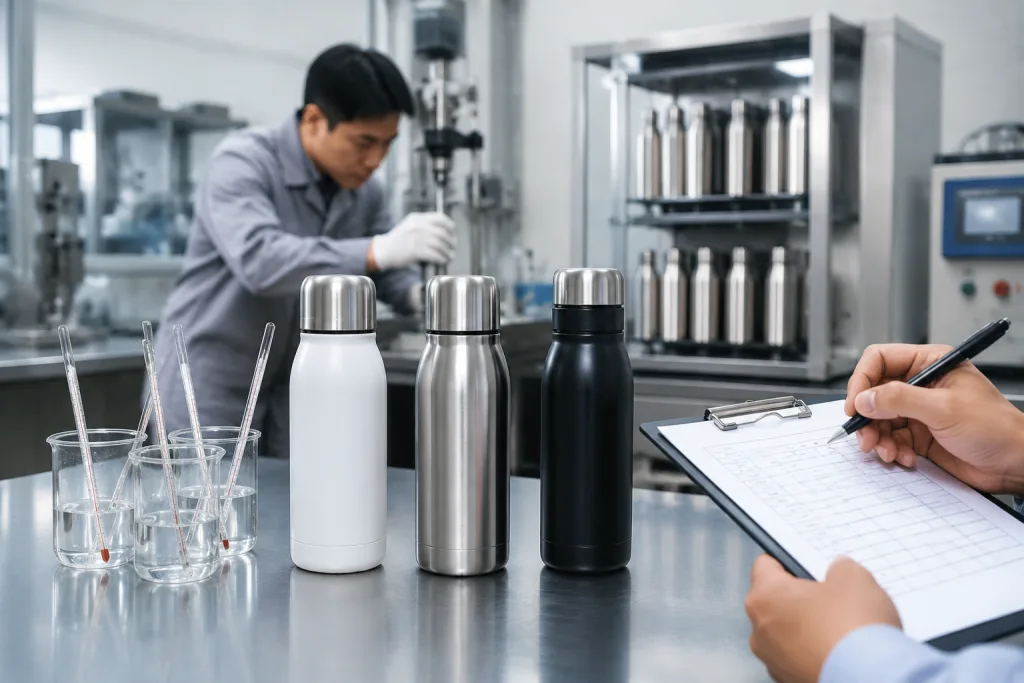
Heat retention is where 7 out of 10 thermos quotes get too brave. We run a plain bench test: fill the flask with 95°C water, lock the lid, hold it in a 20°C room, then record the reading at 6 hours, 12 hours, and 24 hours with a K-type probe through the same opening each time. For a well-made 500 ml stainless thermos, 70°C after 6 hours and 50°C after 12 hours is a fair target, depending on lid design and body diameter. Mouth size matters. A 58 mm wide-mouth bottle will lose heat faster than a 42 mm narrow-mouth flask, and the buyer flagged this twice last winter after comparing two samples side by side.
If a thermos factory promises “24 hours hot” without a test curve, ask for the starting temperature, room temperature, capacity, thermometer position, and whether the lid was opened during testing. A top custom thermos flask for outdoor retail needs a claim customers can repeat at home. The math doesn’t work if the sample starts at boiling water in a 15°C lab but the carton copy says “hot for 24 hours” with no conditions. We’ve seen this go sideways: 1,200 pcs shipped, then the distributor sent back screenshots from buyers saying coffee was lukewarm by lunch.
Cold retention is easier to pass. In our line, 500 ml and 750 ml double-wall stainless models usually keep iced water cold for 24 hours when the ice-to-water ratio is fixed at 1:1 by weight. Cap structure still decides the result. A flip lid sells well for gym and school channels, but a screw cap with a 2.5 mm silicone seal usually gives better leak resistance and thermal retention. For hiking and workwear buyers, this is the wrong question to ask if they only chase one extra hour on the cold curve. QC pulled the sample after 30 seconds of inverted shaking because one push-button lid left a wet ring on the tissue.
Use an incoming sample checklist before you approve mass production. We recommend testing at least 5 pre-production samples for vacuum performance and leak resistance, then checking odor, cap fit, and coating under the same light box used for color approval. Shake each filled flask upside down for 30 seconds. Leave samples on white tissue for 2 hours. Put one sample in a freezer at -18°C and one in 80°C hot water to check coating stress; last month, a matte black sample showed hairline cracking near the bottom radius after 12 minutes. These are not laboratory standards, but they catch 80% of real order problems before your thermos bulk order becomes expensive inventory.
What certifications buyers ask for
For Europe and North America, the certificate list changes by market and sales channel. Start with food-contact test reports for every wet-touch part: 304 stainless inner wall, PP or Tritan lid, silicone gasket, powder coating if it touches the mouth area, plus any straw or tea infuser. For the EU, buyers usually ask for LFGB and REACH; PAHs comes up when there is black plastic, rubberized paint, or a soft-touch grip. For the US, we check FDA food-contact compliance and California Proposition 65 risk before we open the mold file. Kids’ bottles can trigger CPSIA or ASTM checks. QC pulled one 600 ml sample last May because the PO said “silicon gasket,” not “silicone gasket,” and the lab would not accept the material line.
Factory audits are separate from product compliance. If you sell to major retailers, BSCI, Sedex, or ISO 9001 documents may be requested, but they do not replace LFGB or FDA reports. A supplier thermos company can pass food-contact testing and still have no valid social audit on file. Ask early. Audit scheduling in China can add 2-4 weeks if the factory does not already have a valid report; we have seen a clean Zhejiang line wait 18 days just for an auditor slot after the buyer’s system rejected an expired Sedex PDF.
Do not accept a generic report that does not match your product. This is where orders go sideways. Check the report date, applicant name, material description, model number, and tested components against the actual BOM. A report for a black plastic lid is not valid for a new transparent Tritan lid unless the lab report names that material. A report for uncoated stainless steel does not cover a new exterior coating with metallic pigment. We run this check with the exploded drawing open, down to gasket diameter in mm, because buyers flag these gaps during pre-shipment document review.
Our Zhejiang team normally reviews compliance before quotation is finalized, because it changes material choice and price. A thermos suppliers quote that ignores compliance may look cheaper by USD 0.20-0.50 per unit, then costs more when retesting, material swaps, or shipment delays hit the schedule. The math does not work. For outdoor retailers, compliance documents are part of the product, not paperwork to chase after production. On a 3,000 pcs MOQ, one failed coating report can push the line back 12 days vs 18 days if the replacement powder is not in stock.
MOQ, pricing, and lead time
For most factory thermos projects, the real starting point is 1,000 units per model and color. We can sometimes run 500 units on a stock-body promotional order, but the math gets ugly once the pad-print screen, inner carton labels, and mixed-pallet handling hit the job sheet. Small orders look cheap on email. They are not cheap on the line. For private color powder coating, 1,000-2,000 units is the practical range because the coating booth still needs setup, color purge, and a 30-piece color limit sample before mass run. For a new mold, expect 8,000-20,000 units annual volume before the tooling talk makes commercial sense; we had one buyer ask for 1,200 pieces on a new lid mold, and the math did not work.
Our Hangzhou, Zhejiang production partners can handle about 180,000 stainless drinkware units per month across thermos, tumbler, and sports bottle lines. A normal custom thermos lead time is 35-45 days after deposit and approved sample, not after the first WhatsApp mockup. Add 7-12 days for pre-production sampling, 3-5 days for packaging proofing, and 1-2 weeks if third-party testing is needed. QC pulled a sample last month with a 0.6 mm logo shift against the artwork; fixing that before bulk print saved 6,000 bottles from rework. Ocean freight to Europe or North America can add 25-45 days depending on port and season, and Hamburg in October is not the same as LA in March.
FOB pricing is usually the cleanest way to compare thermos supplier quotes. Ask each factory to quote the same carton quantity, box type, logo method, spare parts, and inspection support, or you are not comparing the same product. We still see POs where “1pc white box” becomes “brown box” because one word was missed in the buyer’s file. If you need DDP pricing, give the destination postal code, HS code, duty responsibility, and customs exam terms in the first request. DDP works for a 500-piece promotional shipment, but larger distributors usually prefer FOB or FCA because they control the forwarder, sailing date, and claim process better.
Price pressure is real, but there is a floor. Below that floor, the thermos manufacturer has to cut something: 304 stainless thickness by 0.1 mm, vacuum hold time on the aging rack, powder coating pass count, AQL 2.5 inspection hours, carton burst strength, or line labor. A USD 0.30 saving can disappear fast if 4% of lids leak. We have seen this go sideways. Set the target price, then ask the thermos vendor which specification changes are needed to reach it, because “same quality, lower price” is the wrong question to ask.

Inspection points before shipment
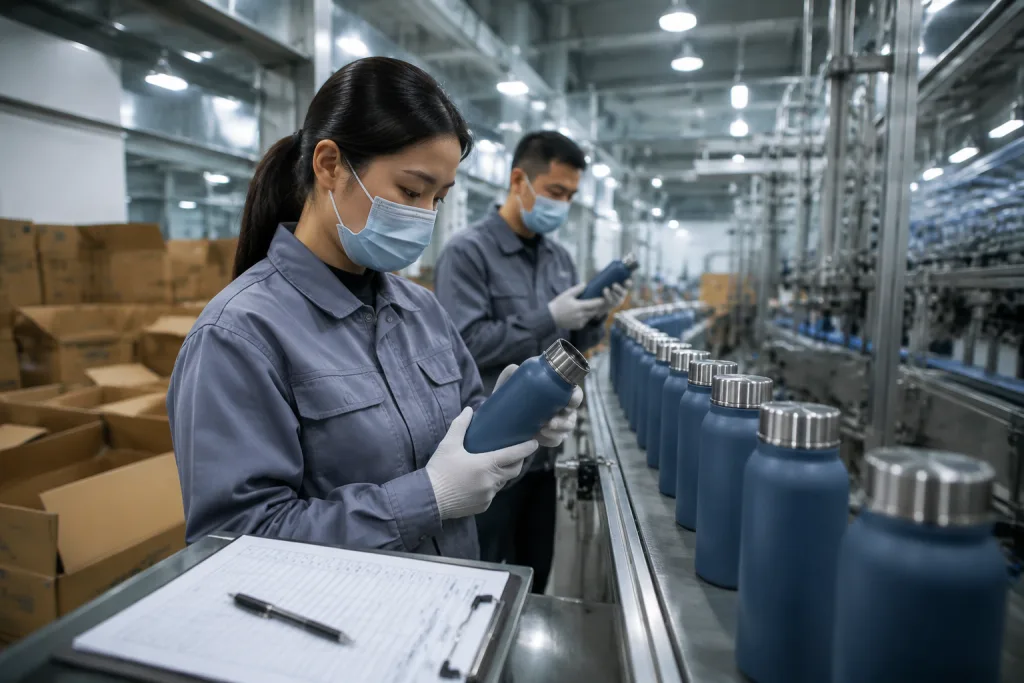
A pre-shipment inspection is not optional for a serious bulk thermos order. We run AQL before shipment, usually General Inspection Level II with AQL 2.5 for major defects and 4.0 for minor defects. Critical defects such as unsafe sharp edges, heavy leakage, wrong material, or mold contamination should be zero tolerance. Last month QC pulled 200 bottles from a 5,000 pcs lot and found 3 lids with burrs over 0.3 mm on the drinking edge. If your buyer manual uses another level, send it before production starts, not after the cartons are sealed.
The inspection checklist should cover appearance scratches under 600 lux light, capacity with a measuring cylinder, weight on a 0.1 g scale, dimensions with a digital caliper, color against the approved sample, logo position within the agreed mm tolerance, barcode scan, packaging, carton marks, drop test, smell test, leak test, and cap opening torque. For thermos customized projects, add coating adhesion with 3M tape and print durability after 50 rubs. For retail orders, inspect the retail box too. We have seen this go sideways: the bottle passed, but the buyer flagged crushed gift boxes because the PO said “Amazon-ready packaging.”
Ask the factory thermos team to keep golden samples at the production line. One approved sample should stay with QC, one with the sales engineer, and one with you. Simple rule. During mass production, line workers need a real bottle beside the line to check color, logo height, lid fit, and silicone gasket direction. PDF artwork is not enough; on one black powder-coated order, the printed logo shifted 4 mm because the jig stop was set from an old sample.
Do not wait until the final 10% of production to ask for quality photos. By then, the factory can only sort defects, not correct the process.
For distributor thermos programs, we suggest an inline inspection when production reaches 20-30%. It costs less than rejecting finished cartons. If coating dust, logo misalignment, or lid torque issues appear, the line still has time to adjust the spray gun pressure, reset the pad-print fixture, or change the silicone ring batch. We ship fast from China, but the math does not work if feedback arrives after 480 cartons are packed and strapped.
Questions to ask before deposit
Before you pay the 30% deposit, pin down what is being built. Is the body from an existing mold, or are we cutting new tooling on the CNC? Ask for the steel grade on the inner and outer walls; for food-contact orders we normally quote 304 stainless inside, and the buyer should see that written on the PI. Ask the cap material, gasket material, spare gasket availability, and whether replacement lids can be ordered 12 months later. For outdoor retail, parts matter. We have seen a 38 mm cracked lid kill a whole SKU because nobody locked the replacement lid code before mass production.
For a thermos distributor or promotional brand, ask how the supplier handles repeat orders. Can they keep the Pantone color inside Delta E 1.5 to 2.0, checked with a color meter instead of one person’s eyes under office lighting? Do they archive your logo screen, laser file, and box dieline? Can they run the same 24 pcs carton packing method on the next PO? A good manufacturer thermos process makes reorders boring. Boring is good when you need 5,000 more units before winter season, and the buyer is already pushing for 12 days while the line needs 18 days.
Use this buyer checklist before deposit:
- Approved sample signed and dated by both sides; QC pulled the sample and sealed it with a label, not just a phone photo.
- Proforma invoice lists capacity, color, logo method, packaging, MOQ, and Incoterm; check small typos like “matte black” becoming “mate black” on the PO.
- Compliance reports match the actual materials; gasket, coating, and inner liner should not be mixed with another model’s report.
- AQL level and inspection party are agreed in writing; if you need AQL 2.5, write AQL 2.5 instead of “normal inspection.”
- Lead time starts after sample approval, not after deposit only; we run the purchase plan after the signed sample hits the sample rack.
- Carton marks, barcodes, and FNSKU labels are confirmed before packing; one wrong 60 mm label position can slow the whole packing table.
The right thermos supplier does not need to be the biggest in China. It needs stable production, clear engineering feedback, and straight talk when the math does not work. If you are sourcing a top custom thermos flask for outdoor retail or promotional distribution, this is where glossy catalog suppliers go sideways: the bottle looks fine, then inspection finds loose powder coating around the bottom seam at 0.8 mm thickness variance.
Send your thermos brief for a factory quote
Share capacity, logo, quantity, market, and target FOB price. We will reply with practical options, MOQ, lead time, and sample plan.
Frequently asked questions
What MOQ should I expect for a custom stainless thermos?
For most custom thermos orders, expect 1,000 units per model and color. If you use a stock body with one-color logo printing, some suppliers thermos teams can accept 500 units, but the unit price is usually higher. For private powder coating, 1,000-2,000 units is more realistic because the coating line needs setup time and color control. New mold projects are different; a thermos manufacturer may ask for tooling fees plus an annual forecast of 8,000-20,000 units. If you are testing a new outdoor retail SKU, start with a proven mold, approve one color, and keep packaging simple.
How long does a bulk thermos order take from China?
A normal bulk thermos order from China takes 35-45 days for production after deposit and approved sample. Sampling usually takes another 7-12 days, depending on logo method and coating color. Third-party testing can add 7-14 days if reports are not already available for the exact materials. Shipping is separate: ocean freight to North America or Europe commonly takes 25-45 days port to port, plus customs and inland delivery. If you need product for a fixed launch date, work backward by at least 90 days. Rush orders are possible, but coating, inspection, and packaging should not be skipped.
Is laser engraving better than printing for outdoor thermos bottles?
Laser engraving is usually better for outdoor use because it does not peel, crack, or fade like surface ink can. It works well on stainless steel and powder-coated bottles, especially for premium customized thermos programs. Printing still has a place. Silkscreen is cheaper for large, simple logos, and heat transfer or UV print can show more colors. The decision depends on your retail price and use case. For a promotional thermos giveaway, printing may be enough. For an outdoor retailer selling a USD 25-40 flask, laser or high-quality coating plus controlled print testing is safer.
What defects are common in thermos factory production?
The common defects are small but expensive: lid leakage, weak vacuum performance, coating dust, color variation, logo misalignment, dents, scratches, barcode errors, and crushed retail boxes. On a 3,000-unit thermos bulk order, even a 3% major defect rate means 90 problem units. Use AQL inspection, usually Level II with 2.5 major and 4.0 minor, unless your retailer specifies stricter rules. Ask for inline photos when production reaches 20-30%. If you wait until final inspection, the factory can sort cartons but may not have time to fix the root cause.
Can one supplier handle both promotional and retail thermos programs?
Yes, but only if the thermos supplier understands the difference. A promotional thermos program may prioritize low price, fast lead time, and simple logo placement. A retail custom thermos program needs stronger packaging, better coating control, cleaner compliance files, barcode accuracy, and repeat-order consistency. Ask your supplier for examples of both order types, plus their monthly capacity and normal MOQ. Our Zhejiang partners produce about 180,000 stainless drinkware units per month, but capacity alone is not enough. The supplier must separate retail QC requirements from giveaway-level production habits.