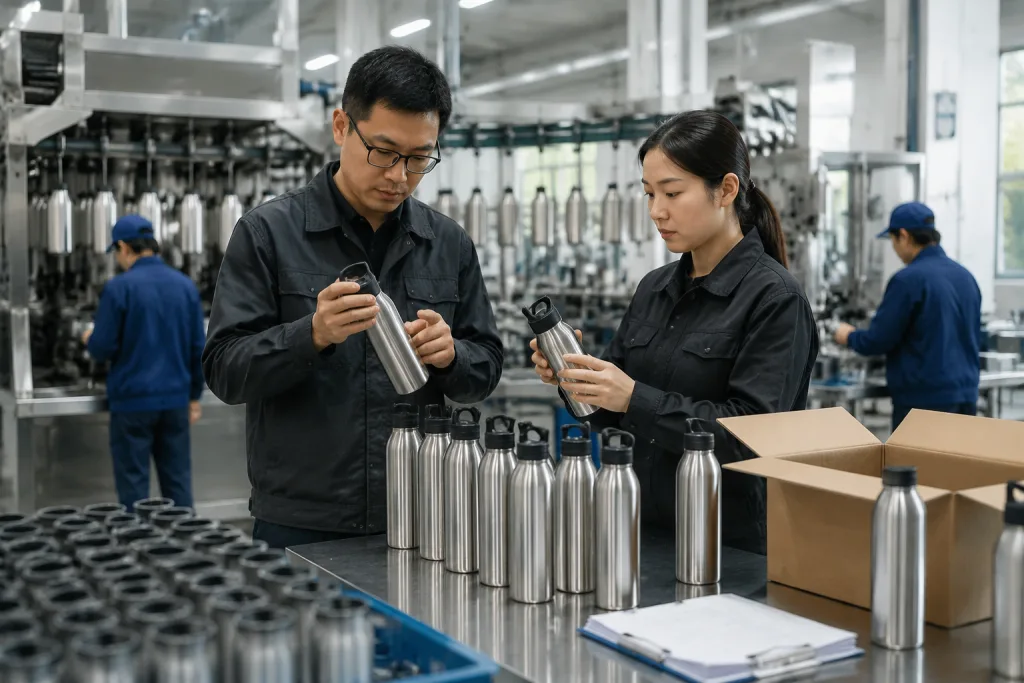
Key Takeaways
- Lock capacity, steel grade, wall thickness, finish, logo method, and carton specs before asking for FOB pricing
- A realistic MOQ for custom sport bottles is usually 1,000-3,000 units per color depending on mold, coating, and logo process
- Plan 7-10 days for artwork proofing, 10-15 days for samples, and 30-45 days for bulk production after approval
- Use AQL 2.5/4.0 inspection, REACH/LFGB or FDA documents, and PO line items to avoid shipment disputes
A top custom sport bottle is not just a bottle with a logo. For a distributor, retail brand, gym chain, or promo program, it is a PO carrying material, compliance, freight, and launch-date risk. If your RFQ says only “500 ml stainless bottle, logo, best price,” the math doesn’t work: 6 suppliers will quote 6 different wall thicknesses, 2 lid grades, and at least 3 carton specs. Cheap on paper. Painful at AQL 2.5 inspection.
At our Hangzhou, Zhejiang factory, we see this often with new buyers from Europe and North America. The project starts loose, then the buyer flags every missing detail after sampling: powder coating gloss, straw length in mm, logo position, inner 304 stainless grade, even a PO typo like “matte black” on page 1 and “black gloss” on page 3. We run smoother jobs when the PO is built line by line from RFQ to pre-production sample to bulk inspection, with QC pulling the sample before the line opens.
Start With A Usable RFQ
Your RFQ should make a canteen manufacturer quote the same bottle you plan to buy. Obvious, yes. Still, we see about 7 RFQs out of 10 come in as one lifestyle photo, “750 ml,” and a target price copied from Alibaba. That is the wrong question to ask. A top custom sport bottle can be single-wall stainless steel, vacuum insulated, Tritan, aluminum, or squeezable PE, and the line setup changes fast: vacuum bottles need leak testing and temperature checks, Tritan needs mold condition review, PE squeeze bottles need wall rebound checks after compression.
For a serious RFQ, send a table with these fields: capacity in ml or oz, body diameter, height limit, lid type, drinking mouth size, material grade, coating, logo position, carton requirement, target market, and annual volume. Add tolerances if you have them, even “body diameter max 78 mm” helps our engineer avoid a cup-holder complaint later. If you are sourcing customized drinkware for the EU, say whether you need LFGB, REACH, and food-contact declaration. For the US, ask for FDA food-contact materials and relevant ASTM checks if the bottle is for children; QC once pulled a kids bottle sample because the straw cap failed the small-parts check after 6 drops.
Useful RFQ line item example: 750 ml double-wall vacuum sport bottle, 304 inner/outer stainless steel, 0.4 mm inner wall and 0.5 mm outer wall, powder coating, leakproof straw lid, laser logo 45 x 30 mm, individual kraft box, 24 pcs master carton, FOB Ningbo, MOQ 3,000 units, target delivery 45 days after sample approval.
That gives a canteen supplier or canteen factory in China enough detail to quote with fewer guesses. We run into trouble when the PO says “same as sample” but the approved sample sticker says matte black and the PO line says glossy black; the buyer flagged it only after carton printing was finished. It also lets you compare canteen suppliers fairly. If one canteen vendor quotes 0.3 mm steel and another quotes 0.5 mm, the math does not work if you treat those prices as equal.
Convert Requirements Into PO Lines
Before sampling, turn the RFQ into draft PO lines. Split the bottle body, lid, print, packaging, and freight instead of burying them inside one unit price. We run this check with a simple Excel costing sheet and a 0.01 kg scale reading from the sample room, because finance will ask why a custom canteen is not priced like a stock black bottle with a 30 mm logo.
A clean draft PO usually has these lines: product body with capacity and 304 stainless spec, lid assembly with gasket material and leak-test requirement, surface finish with Pantone or powder code, logo process with position size in mm, retail packaging with barcode placement, compliance testing, spare parts, inspection, and shipping terms. For distributor drinkware programs, add barcode labels and FNSKU labels if needed, plus mixed carton rules and pallet height limits. For a canteen promotional order, add gift-box artwork, insert card, and master carton mark requirements; last month QC pulled one sample carton because the PO said “matte balck” and the carton factory copied the typo.
Here is how the economics usually move on our line. A plain 750 ml stainless sport bottle might quote at USD 3.20-4.10 FOB Ningbo at 3,000 units. Powder coating may add USD 0.25-0.45, and the line needs a color plate check under a D65 light box before bulk. Laser engraving may add USD 0.08-0.18 per position; full-wrap heat transfer can add USD 0.60-1.20 depending on coverage and scrap rate. A custom mold lid can add USD 1,200-3,500 tooling before the first bulk order, so if the buyer only wants 1,000 units, the math does not work.
Do not wait until production to ask for spare lids or silicone gaskets. Put them on the PO as separate lines, usually 1%-3% of order quantity, with color and packing method stated clearly. Good canteen distributors care about after-sales parts because a USD 0.08 gasket can prevent a USD 6 refund; we have seen this go sideways when a buyer asked for loose spare lids after final inspection. Zhejiang factories can usually source lids, straws, gaskets, and brushes locally, but lead time still changes if the accessory color is custom, often 12 days for stock black versus 18 days for a matched PMS color.
Sample Approval Is Not Decoration Only
About 7 out of 10 buyers approve the sample because the logo looks clean. That is the wrong question to ask. Sample approval should lock down drinking function, material grade, decoration result, packing method, and the test plan for bulk goods. For a top custom sport bottle, QC should fill it to the marked line, run a 30-minute inverted leak test, check cap torque with a torque meter, cross-cut the coating with 3M tape, smell the liner after hot-water rinsing, and measure real capacity with a 1L graduated cylinder. If it is vacuum insulated, test hot water retention at 95°C for 6 hours and record the temperature drop on the inspection sheet.
Ask your canteen manufacturer for two sample types. Start with a stock-shape sample to check grip, lid thread feel, filled weight in grams, and how the spout drinks during a quick walk test. Then approve a pre-production sample with your coating, logo, insert card, and carton layout. The first can often ship in 3-5 days. The second usually takes 10-15 days because the line needs coating setup, printing plates, laser fixtures, or a custom color match. We had one buyer flag a “matte sand” finish because the sprayed sample read 18 gloss units higher than their retail set.
Your sample approval form should include PO references, Pantone number, logo size tolerance in mm, acceptable color difference, packaging dimensions, and signed artwork. Small typos matter. We once saw a PO list 750ml while the artwork said 700ml, and QC pulled the sample before the carton die-line was cut. For customized growler or custom growler projects, also confirm cap sealing pressure and carrying handle strength with a loaded swing test, because larger bottles fail more often at the lid and handle than at the body.
For Europe, keep one approved sample in your office and require the factory to keep one sealed golden sample in China. At BottleForge Industrial in Hangzhou, Zhejiang, we label golden samples with item code, revision number, approval date, and buyer signature, then seal them in a PE bag with red QC tape. Simple habit. It saves arguments later. If bulk coating gloss is 20% lower than the sample, nobody should be guessing from a phone photo taken under warehouse LED lights.

Check Factory Capacity And Controls
A canteen supplier might be a trading company, a logo-printing workshop, or a real canteen factory that controls forming, welding, polishing, powder coating, and assembly. None is automatically bad. The buyer needs the truth. If your PO says 20,000 units in six weeks, a 12-person decorating shop with two laser machines will not repair TIG welding pinholes after bottles have already reached the packing line.
Ask for monthly capacity by product type, not one big number on a slide. Our Zhejiang production network can handle about 300,000 stainless drinkware units per month across standard sport bottles, travel tumblers, and growlers, with typical MOQ from 1,000 units for stock colors and 3,000 units for custom powder coating. Standard bulk lead time is 30-45 days after sample approval, assuming packaging artwork and deposit are not late. We run capacity by line: for example, a 500 ml sport bottle with powder coating usually moves faster than a 1.2 L growler with handle welding and gift box packing.
For factory control, request recent BSCI or ISO 9001 documents if your retailer requires them. Ask about incoming steel inspection, vacuum testing rate, coating line curing temperature, and final leak test. A practical factory should be comfortable discussing AQL 2.5 for major defects and AQL 4.0 for minor defects. If a canteen vendor only says “quality is no problem,” push harder. We have seen this go sideways when QC pulled the sample and found the coating oven set 8°C below the approved curing window.
Canteen manufacturers in China often share component suppliers, so the difference is not equipment alone. The difference is whether the factory records revisions and rejects bad parts before assembly. For customizable drinkware, uncontrolled revisions are dangerous. A lid may look identical but use a softer silicone ring, changing leak performance after 500 open-close cycles. One buyer flagged this on a repeat order because the old lid passed a 1.2 m drop test, while the revised ring leaked after 3 minutes in the carton shake test.
Price The Landed Cost Early
FOB price is only the first line on the sheet. A top custom sport bottle eats space fast, and space becomes freight. A 750 ml vacuum bottle in a retail box may pack 24 pcs per master carton, roughly 53 x 36 x 28 cm, with gross weight around 10-12 kg. At 3,000 units, we run about 125 cartons before pallets, and QC usually checks carton burst strength with a 275 lb test stamp before we release packing. Air freight on that load hurts. If the launch date is already missed, paying it rarely fixes the real problem.
Ask each canteen supplier to quote EXW, FOB Ningbo or Shanghai, and DDP as a separate estimate if your buyer needs a door price. Keep product cost and freight on different lines, because this is where cheap quotes hide bad math. For North America, carton strength matters; distributor growler and sport bottle shipments often pass through 3 warehouses before final delivery. Use 5-ply export cartons for heavier stainless orders, not thin domestic cartons. We have seen a buyer flag crushed corners after a 1.2 m drop test, even when the bottle inside was fine.
For Amazon or marketplace fulfillment, price FNSKU labels, suffocation warnings for polybags, carton weight limits, and drop-test packaging before you approve the PO. Small labels slow the line. On one 5,000 pcs run, the packing team lost half a day because the FNSKU file had “matte balck” in the artwork name and the buyer wanted every carton relabeled. For retail distribution, ask for GS1 barcode placement and carton marks by SKU, color, and quantity. A canteen customized for a promotion may only need a plain export carton, but a retail program needs shelf-ready packing control.
Currency terms need plain writing on the proforma invoice. Common terms are 30% deposit and 70% before shipment, but established distributors may negotiate payment against inspection results or bill of lading copy. If you are comparing canteen vendors, include payment terms, Incoterms, carton specs, and inspection cost in the same table. AQL 2.5 inspection can add 1 day at the factory and a few hundred dollars, depending on city and order size. Skip it, and the cheapest quote often turns average after the correction list lands.
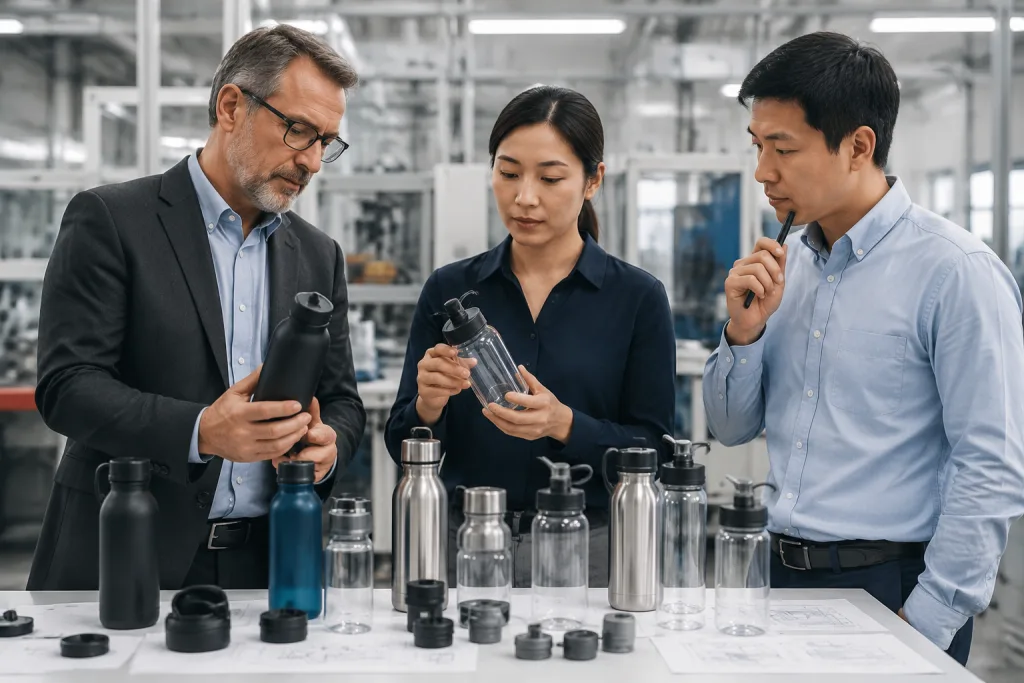
Run Pre-Shipment Inspection Properly
Inspection is not a stamp after cartons are sealed. We run it against the PO lines the buyer signed off, including the ugly details like “PMS 186C” typed as “PMS 168C” on one order last March. For customized drinkware, check OD and height with a digital caliper in mm, fill capacity with a graduated jug, logo size against the artwork file, coating scratches under 600-800 lux light, lid thread fit, odor, barcode scan, carton marks, and packed quantity. For vacuum bottles, pull samples for thermal retention. For sports caps, run leak tests upright, upside down, and after a 30-second shake.
A normal inspection standard is ANSI/ASQ Z1.4 with AQL 2.5 for major defects and 4.0 for minor defects. Critical defects, such as sharp burrs, food-contact contamination, or severe leakage, should be zero tolerance. Inspection should start when at least 80% of goods are packed and 100% are finished. Not before. If the inspector comes too early, QC only sees the neat 200 cartons near the line, not the 3,000 pcs still waiting for logo touch-up or lid assembly.
Give the inspector your golden sample and PO checklist, not just a product photo. A canteen distributor buying for 6 retail accounts should use SKU-level inspection sheets because color mix mistakes still happen. We have seen QC pull a carton marked “navy” and find 24 pcs of black lids inside; the factory calls it a small swap, but the buyer flagged it as an inbound failure. One carton of wrong color does not look dramatic on the factory floor. At the retailer DC, the math doesn't work.
If defects are found, ask for a corrective action list with quantities and photos. Logo or packing rework usually takes 2-7 days; coating scratches can push shipment from 12 days to 18 days, and welding leaks can kill the batch if the line cannot isolate the station. Do not release final balance until re-inspection passes or the concession is written down with defect limits. A serious canteen manufacturer accepts this process because it protects both sides and keeps the next PO clean.
Place Bulk Orders Without Guesswork
The final PO should be boring. Good. That means nobody on our side is guessing at 9:40 p.m. before the line opens. Repeat the approved sample in plain terms: item code, product description, material, capacity, finish, logo method, packaging, carton quantity, barcode, compliance documents, Incoterm, port, payment terms, inspection standard, delivery date, and penalty or remedy language if your company uses it. We once had a PO typo showing 650ml in the description and 750ml in the item code; QC pulled the sample, and the order sat for 2 days while the buyer confirmed by email.
For a custom canteen or customizable canteen program with several colors, write each color as its own SKU line with Pantone or RAL reference and exact quantity. Do not write “assorted colors” unless you accept factory allocation. That wording usually means trouble. For canteen promotional projects, add the event deadline and the last acceptable vessel departure date, not just “ship ASAP.” Factories in China can move fast, but the math does not work if artwork approval sits in your inbox for 10 days and the coating oven already has 18,000 pcs booked ahead of you.
Bulk production should run in a clean rhythm: deposit received, material purchase, coating schedule, logo setup, in-line QC, packing, final inspection, balance payment, booking, loading. Ask for milestone photos at material arrival, first finished units, 30% production, and packed goods. We ship better when the buyer asks for dated evidence, not daily drama. A normal photo set from our floor includes steel coils or finished bodies on pallets, the first laser-marked bottle under the fixture, the carton mark checked with a 300mm ruler, and one packed master carton on the scale.
For repeat distributor canteen and distributor drinkware orders, freeze a specification sheet and revise it only with version numbers. Your second and third orders should improve, not restart from zero. We have seen this go sideways when a buyer changes the lid gasket by chat message and the PO still shows the old drawing. The best customized canteen projects are not won by chasing the lowest USD 0.05. They are won by writing the product clearly enough that the factory can build the same bottle 50,000 times without stopping the line for questions.
Send us your sport bottle RFQ for review
We will check specifications, MOQ, decoration, packaging, and lead time before you lock the purchase order.
Frequently asked questions
What MOQ should I expect for a top custom sport bottle?
For stock shapes with a one-position logo, a practical MOQ is often 1,000 units per style. For custom powder coating, Pantone-matched colors, or mixed retail packaging, expect 3,000 units per color. A custom lid or body mold usually needs higher volume because tooling can cost USD 1,200-8,000 depending on complexity. If you are testing a new channel, ask the canteen supplier for a stock-color pilot order first, then move to a canteen customized program after sales data is proven.
How long does sampling and bulk production take?
A stock sample can usually ship in 3-5 days if the shape is available. A pre-production sample with your logo, coating, and retail box normally takes 10-15 days after artwork approval. Bulk production for stainless custom drinkware is usually 30-45 days after sample approval and deposit. Add 3-7 days for inspection, rework if needed, and export booking. Sea freight to Europe or North America can add 25-45 days depending on port pair and season.
Which logo method is best for sport bottles?
Laser engraving is durable, clean, and cost-effective, usually around USD 0.08-0.18 per position on stainless bottles. Silk screen works well for simple one- or two-color logos but needs good coating adhesion. Heat transfer or sublimation is better for full-wrap graphics, but cost and defect risk are higher. For canteen promotional orders, choose the method based on campaign life. A 3-month event giveaway can use simpler printing; retail customized drinkware should prioritize scratch resistance and wash testing.
What compliance documents should I request?
For EU buyers, request LFGB or EU food-contact documentation, REACH declarations for coatings and plastic parts, and packaging material statements if required by your customer. For US buyers, ask for FDA food-contact material compliance and any relevant ASTM testing for children’s products. If your retailer requires social compliance, request BSCI, Sedex, or factory audit documents before placing the PO. A reliable canteen manufacturer should provide current test reports tied to material type, not a random certificate from five years ago.
How do I compare quotes from different canteen vendors?
Normalize the quote first. Make every canteen vendor quote the same capacity, steel grade, wall thickness, lid type, finish, logo size, packaging, carton count, Incoterm, and payment terms. A USD 3.60 bottle with 0.5 mm outer steel, 5-ply carton, and AQL inspection may be cheaper in real terms than a USD 3.35 bottle with weaker packaging and vague coating specs. Ask each canteen supplier to separate product, decoration, packaging, testing, and freight so hidden differences become visible.