Key Takeaways
- A realistic MOQ for custom polypropylene bottles is 3,000-5,000 units per color
- PP bottle tooling usually runs USD 1,200-4,500 depending on mold complexity
- Pre-production samples should be checked for 24-hour leak testing and color Delta E under 1.5
- Bulk lead time from approved sample is typically 30-45 days FOB Ningbo or Shanghai
A top custom polypropylene bottle looks easy on paper until you are buying 20,000 units with a spot-matched Pantone, food-contact files, and cartons that still hold after a 12-day sea move. Most quoting errors start before the factory even opens the drawing. The RFQ says “custom canteen, 750 ml, logo,” but leaves out wall thickness, cap resin, leak test standard, and whether the buyer wants EU food-contact and REACH screening. That is the wrong question to skip.
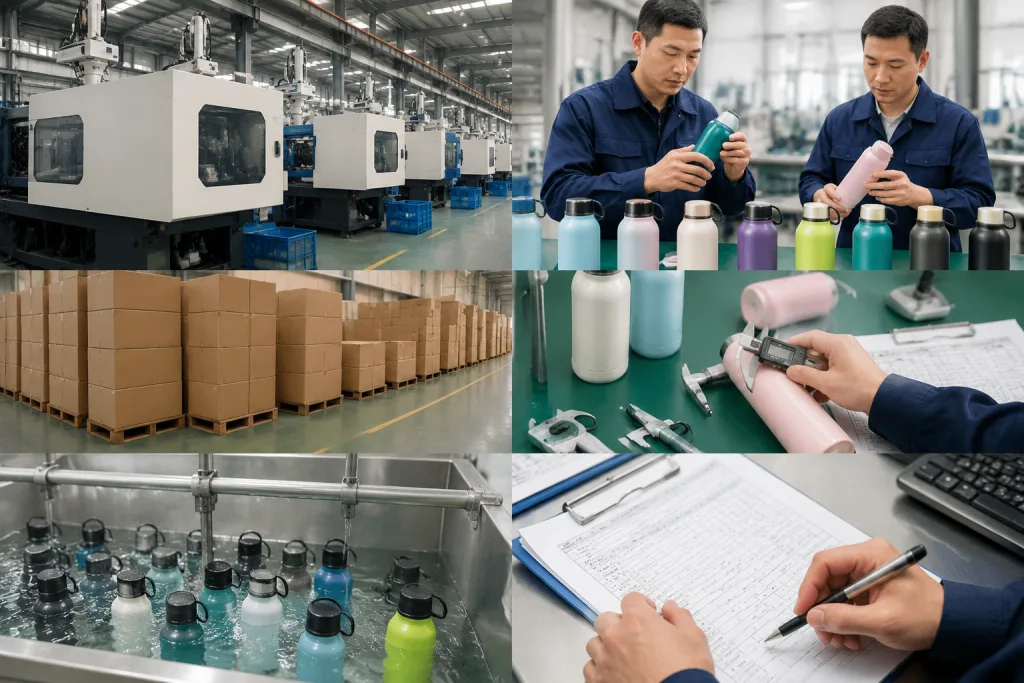
We run drinkware production in Hangzhou, Zhejiang, and we see the same gap from new B2B buyers in Europe and North America: they need a clean sourcing path, not marketing copy. On our line, QC pulled the sample and checked cap torque at 0.8 N·m before we released the mold trial. Below is the order we use from RFQ to sample to bulk PO, with the points that decide whether the job ships on time or gets stuck in revision.
Start With A Usable RFQ
An RFQ is not a hunt for the lowest neat-looking price. It is the first technical file we run on the line. If you want a top custom polypropylene bottle quote you can compare between a canteen manufacturer and a canteen supplier, send the same measurable spec to each factory; last month QC pulled a 650 ml sample with a 1.05 mm side wall because the buyer’s RFQ only said “standard thickness.”
For polypropylene, start with resin grade and sales market. For EU buyers, ask for food-contact compliance under Regulation (EU) No 10/2011 where applicable, plus LFGB migration if your retailer asks for it. For North America, ask whether the canteen factory can support FDA food-contact documentation and ASTM-style drop or impact testing if needed. PP is light, tough, and cheaper than stainless steel, but the grade matters. Random copolymer PP takes impact better than basic homopolymer PP for school bottles and sports bottles; we usually see the difference after a 1.2 m drop test onto the concrete floor beside the assembly table.
Your RFQ should include capacity, target weight, bottle diameter, neck finish, cap type, gasket material, logo method, Pantone color, packaging, delivery term, and target quantity. That list is long for a reason. Do not write “BPA free” only. Say whether you need a declaration and which test lab format your customer accepts; we once had a PO typo saying “BPA fee,” and the buyer flagged the missing declaration 4 days before booking the vessel.
RFQ line items to include:
- Capacity: 500 ml, 650 ml, 750 ml, or 1,000 ml with tolerance of ±3%
- Wall thickness target: usually 1.2-1.8 mm for PP bottles, checked with a Mitutoyo caliper at cut sample points
- Material: food-grade PP body, PP or HDPE cap, silicone gasket if leakproof
- Logo: 1-color silkscreen, heat transfer, IML, or molded logo, with artwork size in mm
- MOQ and price breaks: 3,000, 5,000, 10,000, and 30,000 units
- Trade term: FOB Ningbo, FOB Shanghai, or EXW Zhejiang
A good canteen customized program starts with this discipline. Asking “what is your best price?” is the wrong question to ask. Without a fixed spec, the math does not work: one quote may be based on a 24 g cap, another on a 19 g cap, and the cheap one often has no compliance cost included.
Match Product Design To Channel
A distributor drinkware order for outdoor retail is not the same as a canteen promotional order for an event agency. Before design approval, pin down how the bottle will be sold, handled, packed, and returned. PP canteen products fit lightweight, price-sensitive programs, but channel fit comes first. We learned that after QC pulled 32 scratched samples from a 5,000 pcs trial where the buyer had planned shelf display, not giveaway cartons.
For promotional campaigns, we usually run a 500-650 ml bottle with a single-wall body, flip cap, and 1-color logo. Cost, carton cube, and repeat speed drive the PO; one buyer flagged a 0.04 m³ carton increase because it pushed his freight math over budget. For school, sports, or outdoor distribution, specify a stronger cap hinge, carry loop, wider mouth, and thicker body. If you are a canteen distributor selling into retail, saving USD 0.06 with a weak lid is the wrong question to ask. One return carton costs more than that saving.
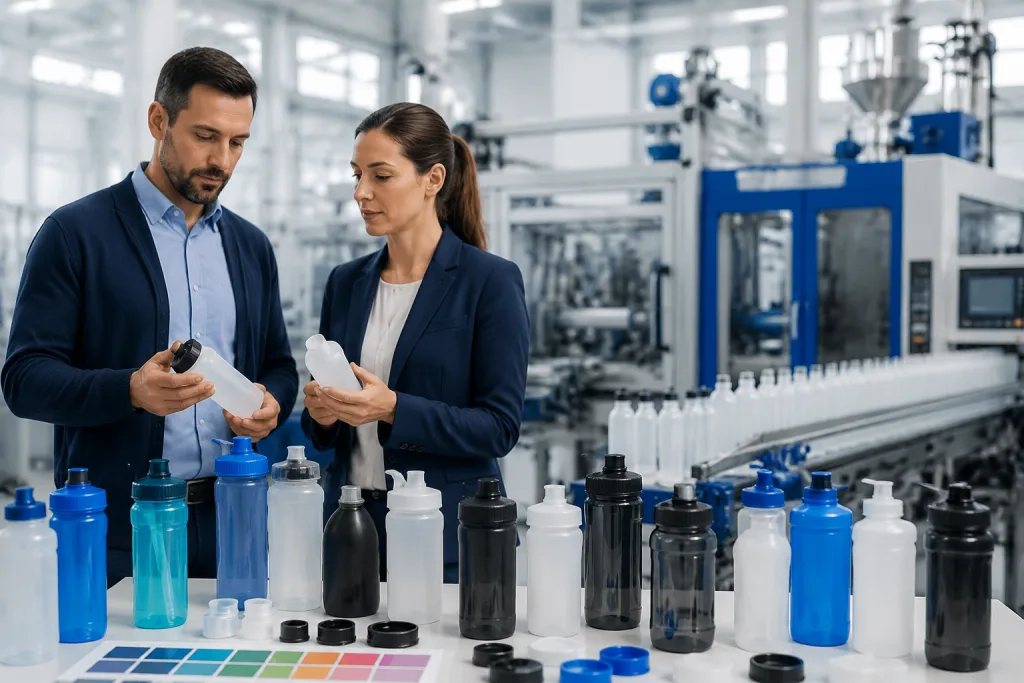
For custom drinkware brands, color matters more than 7 out of 10 RFQs admit at the start. Request PP color chips before sample molding. Pantone matching in translucent PP is harder than in opaque PP because pigment loading changes light transmission; our mixer operator checks the chip beside a D65 light box, not under the office LED. A practical tolerance is Delta E under 1.5 for solid colors and visual approval for translucent colors under D65 light.
Decide early whether the program is a custom canteen only or part of a wider customizable drinkware line. If you plan to add a custom growler or customized growler later, align cap colors, logo size, carton labeling, and brand language now. We have seen this go sideways when a PO used “sky blue” on the bottle spec and “light blue” on the carton mark, then the buyer rejected 12 cartons during pre-shipment inspection. Fix it before tooling.
In Zhejiang, China, our PP bottle lines run about 450,000 units/month across standard and customized drinkware models. That capacity helps distributor canteen replenishment, but only when the first design is locked clearly enough for repeatable production. On the line, that means cap torque written in kgf·cm, logo position marked in mm, and a signed golden sample sitting at the injection machine before we ship the next lot.
Price The Quote Line By Line
Ask what the price covers before you compare two quotes. We see this every week: one canteen manufacturer writes USD 0.82, another writes USD 1.04, and the buyer says the cheaper one “looks the same.” Bad question. On our costing sheet, a missing inner bag can cut USD 0.018, barcode labels add USD 0.012, and a 5-ply export carton for 50 pcs costs more than a thin 3-ply carton that QC can crush by hand. Tooling, logo setup, test reports, spare gaskets, and export cartons are often outside the first price.
For a top custom polypropylene bottle, a realistic FOB China price for a 650-750 ml single-wall PP model is often USD 0.75-1.60 at 5,000-20,000 units. Cap structure and resin weight move the number fastest. A molded handle cap with a silicone seal can add USD 0.09-0.18; two-shot lids need slower cycle time on the injection line. Last month QC pulled a 720 ml sample at 82 g when the approved sample was 96 g, and the math was obvious: cheaper resin weight, weaker hand feel, more leakage complaints after the drop test.
Break the quotation into product cost, mold cost, decoration cost, packaging cost, compliance testing, and inland logistics, then make every canteen supplier quote the same Incoterm. Comparing EXW Zhejiang against FOB Ningbo is how budgets go sideways. FOB includes export handling and port-side costs; EXW leaves trucking, customs docs, and warehouse loading on your side. For Hangzhou to Ningbo, we usually run 2.5-3.5 hours by truck, and one 20GP loading plan can change when the master carton grows by 8 mm.
Quote line items to request:
- Unit price at 3,000 / 5,000 / 10,000 / 30,000 units, with resin weight and carton quantity shown
- New mold fee and mold ownership terms, including who keeps the mold after the last shipment
- Logo setup charge, screen charge, or IML film charge, with print size in mm
- Packaging: OPP bag, color box, kraft box, master carton, plus carton ply and gross weight
- Testing: migration, BPA-free declaration, REACH SVHC screening if required
- Payment: usually 30% deposit and 70% before shipment, tied to pre-shipment photos or inspection release
If a canteen supplier refuses to itemize, expect trouble when your customer asks for a small change. We had one PO where “black lid” was typed as “black loop,” and without a line-item quote the buyer flagged the USD 0.06 lid difference three days before loading.
Control Samples Before Tooling Risk
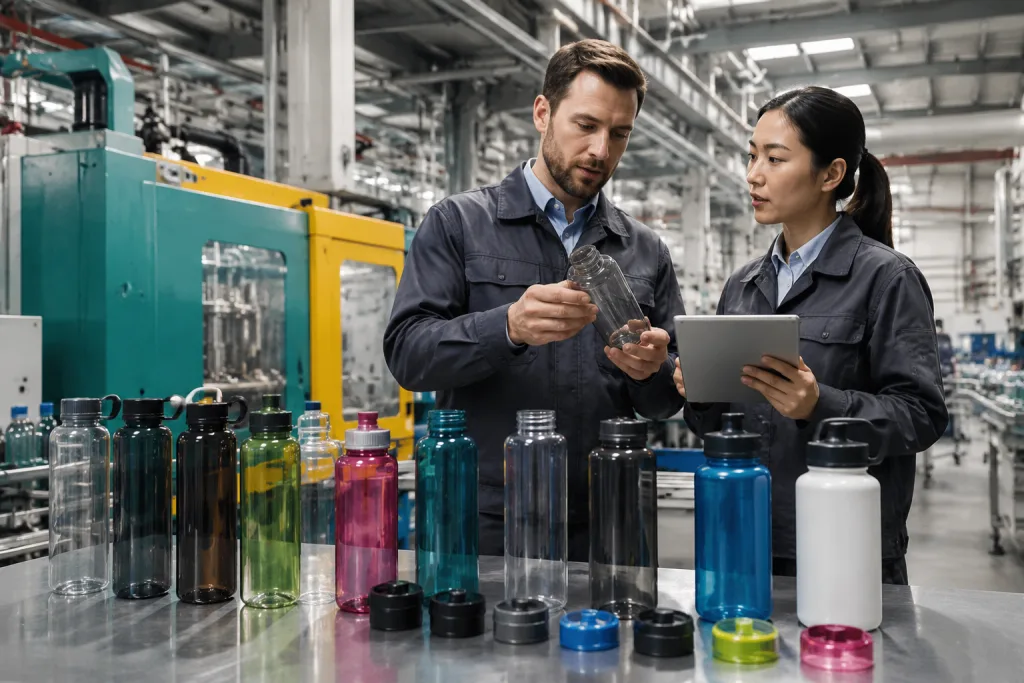
Sampling is where buyers either cut risk or fool themselves. Approving a PP bottle because one hand-picked piece has a clean logo is the wrong question to ask. Before tooling payment or bulk PO release, we run a written sample checklist with caliper readings, filled weight, cap torque, and photos under the same light box QC uses on the line.
We normally control 3 sample stages, and each one answers a different question. A stock sample checks the basic bottle: 72 mm body diameter, grip feel, mouth opening, cap thread structure, and rough gram weight on a 0.1 g bench scale. A custom color or logo sample checks Pantone against the swatch book, print adhesion after curing, and whether the logo sits 2 mm too high once the bottle is held in hand. The pre-production sample comes from the final mold and final resin batch. Treat that one as the control standard for bulk, not the pretty sales sample from the showroom shelf.
For PP bottles, run a 24-hour inverted leak test at room temperature, then repeat it with 60°C water if the buyer plans to sell it for warm drinks. Simple test. No shortcuts. PP handles moderate heat, but we have seen lids pass at 23°C and leak after the silicone ring softened at 60°C. Drop the filled bottle from 1.0 meter onto plywood or a concrete-like surface at nominal capacity; QC should record cap cracks, hinge failure, and white stress marks at the impact point with close-up photos.
Logo testing has to match the decoration method. For silkscreen, we use 3M tape pull after full curing, then a 50-rub alcohol wipe when the customer spec calls for it; one EU buyer flagged a logo because the edge lifted after only 18 rubs. Laser engraving is not our first pick on PP. Molded logo or silkscreen is safer for most bottle programs, while heat transfer or in-mold labeling fits larger runs where the MOQ and scrap rate still make sense.
Sample PO line items:
- Sample type: stock sample, color match sample, logo sample, or pre-production sample
- Sample quantity: 3-10 pieces per SKU, with 1 piece kept by factory QC as the sealed control
- Approved weight: for example 82 g ±5 g, checked on a calibrated bench scale
- Leak standard: no visible leakage after 24 hours inverted, with photos before and after test
- Courier term: prepaid by buyer or deducted from bulk order, written clearly so nobody argues over a USD 38 DHL charge later
Write The Bulk PO Clearly
A bulk PO is not just quantity and price. It is the job card our canteen factory runs through purchasing, mold setup, printing, packing, and QC. If the PO is loose, the line will guess. We have seen this go sideways over a “blue” bottle that the buyer meant Pantone 2935C, while production used the approved resin chip from an older 750 ml order.
For each SKU, list item number, capacity, color, logo artwork version with file name, packaging, barcode requirement, carton marks, shipping mark, and inspection standard. Be specific. If you sell through e-commerce or distributor growler and bottle channels, carton labels matter more than buyers think; QC pulled 120 cartons once because the PO said “Amazon label” but did not say FNSKU or carton-side placement in mm. For marketplace shipments, request FNSKU labels, suffocation warnings on polybags where required, and carton weight under the platform limit. For wholesale canteen distributors, shipping marks and mixed carton rules usually beat individual barcode labels.
Set the AQL level before production. A common approach is General Inspection Level II with AQL 2.5 for major defects and 4.0 for minor defects, though stricter programs may use 1.5/2.5. Define critical defects as leakage, sharp edges, contamination, missing gasket, wrong material, and unsafe cap failure. Cosmetic defects need a viewing rule, normally 30-50 cm under normal light, not a buyer’s phone photo taken 5 cm from the bottle wall. The math does not work if you argue scratch standards after 20,000 pcs are packed.
Lead time should start from approved pre-production sample and deposit received, not from the day you ask for a quote. In China, a normal bulk lead time for customized canteen production is 30-45 days after approvals. Peak season before summer promotions can add 10-15 days, especially for colored PP resin and carton supply. On our floor, a custom color PP bottle with logo screen printing usually needs resin booking first, then sample sign-off, then the line slot; “ASAP” on the PO does not move a 380 kg resin batch ahead of paid orders.
Bulk PO line items: SKU table with capacity and color code, final unit price, MOQ, deposit amount, delivery term, shipment window, inspection clause, document list, plus penalty or remake agreement for confirmed nonconformity. Check the PDF before sending. We once caught a PO typo where 1,000 pcs became 10,000 pcs, and nobody wants that call after cartons are printed.
Inspect, Ship, And Reorder Smarter
Do not wait until the container reaches Hamburg, Rotterdam, Los Angeles, or Toronto to find cracked lids or weak printing. For a new canteen manufacturer, book pre-shipment inspection when production is 100% finished and at least 80% packed. We run this check before the forwarder books the final gate-in slot, usually 3 to 5 days before loading. For repeat orders with stable quality, reduce inspection from every order to every 2 or 3 orders, but never skip it on a new mold, new cap, new color, or new packaging format. QC pulled the sample once on a new flip cap and found 7 leaking bottles in 125 pieces. That shipment stayed in Hangzhou.
The inspector should check quantity, workmanship, color, logo position, cap torque, gasket fit, leakage, barcode scanning, carton drop condition, and carton dimensions. Ask for random sampling based on AQL, not the 12 clean samples the factory leaves on the packing table. If the order is split across 4 colors, sample each color, not just the black and white units. PP color variation can happen between resin lots; our line has seen a 0.8 Delta E shift after the resin supplier changed batch numbers. Use a torque meter on the cap and a 30-minute upside-down leak test. Simple tools catch expensive claims.
Shipping terms need practical handling, not just a neat line on the proforma invoice. FOB Ningbo or Shanghai is common for Zhejiang factories, and for our Hangzhou plant the truck to Ningbo port is usually 1 day, not 3. If you buy DDP, confirm who handles customs classification, duties, VAT, and product compliance responsibility. DDP looks easy, but this is the wrong question to ask if you already have an import team. The buyer flagged it on one PO because the HS code was typed one digit wrong, and the math did not work after duty was recalculated. Most distributor drinkware buyers we ship for prefer FOB because their forwarder controls consolidation and landed cost.
For reorders, keep a golden sample and a production data sheet. Record resin grade, net bottle weight, cap mold number, gasket size, Pantone code, logo file version, carton size, and pieces per carton. We also add the injection machine number and the approved wall thickness in mm because those two lines save arguments later. This matters when you move from one canteen supplier to another or when your canteen suppliers in China restart production after six months. We have seen this go sideways when a reorder used the old AI logo file instead of the final CDR file; the buyer spotted the 2 mm logo shift only after 18 cartons were packed.
A serious customizable canteen program gets cheaper over time because the mistakes are removed. Fewer sample rounds and cleaner PO data usually cut approval from 18 days to about 12 days on repeat colors. QC approval moves faster when the line has the same resin grade, same cap mold, and the same carton spec on file. Air freight drops too; one 22 kg carton sent by air to fix a missing barcode label costs more than checking the barcode with a scanner during packing. We ship smoother when the reorder file is boring.
Send your PP bottle RFQ for a line-item quote
Share capacity, quantity, logo method, market, and target price. We will return practical MOQ, tooling, sample, compliance, and FOB options.
Frequently asked questions
What MOQ should I expect for a top custom polypropylene bottle?
For a standard mold with custom logo and custom color, expect 3,000-5,000 units per color as a practical MOQ. If you use stock PP colors and 1-color printing, some canteen suppliers may accept 1,000-2,000 units, but the unit price is higher and color choice is limited. For a new mold, 10,000 units is a healthier first order because the tooling fee, color setup, and production changeover are spread across more bottles. For distributor canteen programs, we usually quote 5,000, 10,000, and 30,000 units so you can see the real price curve.
Is polypropylene safe for custom drinkware in Europe and North America?
Food-grade PP is widely used for bottles, caps, lunch boxes, and other food-contact items. Safety depends on resin grade, pigments, additives, and finished-product testing. For Europe, ask for EU food-contact migration testing and REACH SVHC screening if your retailer requires it. For North America, request FDA food-contact support and BPA-free documentation. Do not accept a generic “safe material” statement without a report or declaration tied to PP and the finished item. If the bottle includes silicone gaskets, colored lids, or printed decoration near the drinking area, those parts should also be covered in the compliance file.
Which logo method is best for a customized canteen?
For most PP custom canteen orders, 1-color or 2-color silkscreen is the best balance of cost and durability. Setup is usually USD 30-80 per color, and unit decoration can be a few cents depending on size. Heat transfer gives better full-color graphics but costs more and needs careful adhesion testing. In-mold labeling looks clean for large retail programs, but film tooling and MOQ are higher, often better above 10,000-20,000 units. Molded logos are durable and good for brand-owned shapes, but you need tooling and cannot change artwork easily.
How long does sampling and bulk production take?
Stock samples can usually ship in 3-7 days from Zhejiang, China. Custom color and logo samples normally take 7-15 days after artwork and Pantone approval. If new tooling is required, allow 20-35 days for mold making and first trial samples. Bulk production usually needs 30-45 days after deposit and pre-production sample approval. Add 5-10 days if you need third-party testing before shipment. Sea freight timing is separate: roughly 25-40 days to many European ports and 18-35 days to North American ports, depending on route and season.
What defects should I put in the inspection checklist?
List critical, major, and minor defects before production. Critical defects include leakage, cracked caps, missing gaskets, sharp edges, contamination, wrong material, and strong odor. Major defects include wrong color, unreadable logo, poor cap fit, deformation, incorrect capacity, or barcode failure. Minor defects include small print specks, light scratches, or carton mark issues within agreed limits. For AQL, many B2B buyers use General Level II with 2.5 major and 4.0 minor. For a new canteen vendor or new mold, consider tighter limits or add an inline inspection at 20-30% production.