Key Takeaways
- For mixed custom drinkware programs, 1,000 pcs per SKU is a realistic MOQ for stable pricing
- A 0.45-0.55 mm 304 stainless body is usually the practical range for retail canteens
- Laser engraving lasts longer than silkscreen but costs about USD 0.18-0.45 more per unit
- Distributor drinkware should be selected by carton cube, not only FOB unit price
Choosing top custom drinkware is not about the prettiest render. It is about matching the vessel to your sales channel, target margin, compliance risk, and carton weight after packing. We had QC pull a 20 oz travel tumbler sample last month because the logo area was only 38 mm wide; fine for an online gift set, wrong for a corporate tender that needed a 55 mm mark.
We manufacture in Hangzhou, Zhejiang, and we see the same mistake about 6 times a month: buyers ask for “premium” before they lock fill volume, steel grade, decoration life, and packed cost. The line can make almost any customized drinkware shape, but this is the wrong question to ask first. If a custom canteen adds 0.4 kg per carton and pushes freight from 12 days vs 18 days depending on routing, the math can go sideways before the PO even reaches our inbox.
The head-to-head spec table
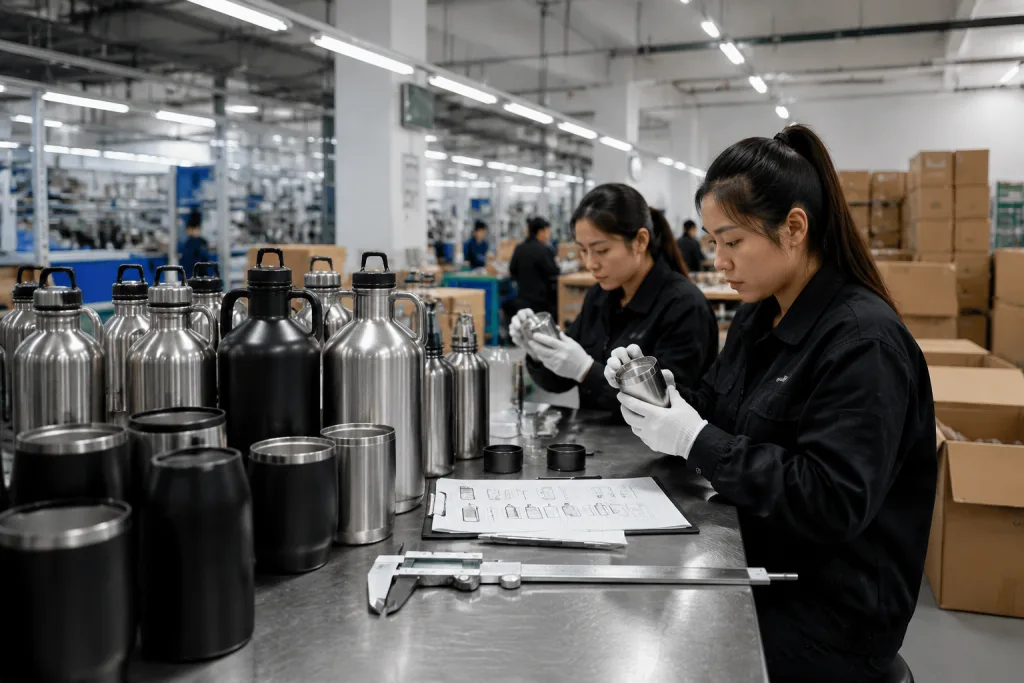
If you are comparing top custom drinkware for a B2B order, start with the numbers. This is the sheet we run before a first call with a canteen distributor or a retail buyer planning 20,000 pcs for Q3. Our sample room checks wall thickness with a Mitutoyo digital caliper first, because a nice rendering does not fix a weak shell. Design taste is one topic. Buying risk is another.
| Format | Typical volume | Best material | Wall thickness | Insulation | Typical FOB China | MOQ | Best use-case fit |
|---|---|---|---|---|---|---|---|
| Custom canteen | 600-1,000 ml | 304 stainless or Tritan | 0.45-0.55 mm steel | Single wall or vacuum | USD 2.40-5.80 | 1,000 pcs | Outdoor retail programs and school kits with logo rules |
| Travel tumbler | 350-900 ml | 304 inner, 201 or 304 outer | 0.40-0.50 mm | Vacuum, 6-12 hours hot | USD 3.20-7.50 | 1,000 pcs | Coffee programs and e-commerce bundles needing barcode labels |
| Custom growler | 1.0-1.9 L | 304 stainless | 0.55-0.70 mm | Vacuum preferred | USD 8.50-16.00 | 500-1,000 pcs | Breweries and camping gift sets with heavier cartons |
| Kids bottle | 350-500 ml | 304 stainless or Tritan | 0.40-0.45 mm | Vacuum or single wall | USD 2.80-6.20 | 1,500 pcs | Back-to-school launches and licensed artwork with color approvals |
These prices assume standard colors, one-position branding, normal export carton and FOB Ningbo or Shanghai. Ask for molded silicone parts, a retail gift box, PMS-matched powder coating and spare lids, and the math changes fast; we saw one PO where “1 spare lid” was typed as “1 spare lead,” so QC pulled the sample before carton drop testing. This is the wrong question to ask: “Can you match the cheapest quote?” A serious canteen supplier should show the cost bridge by line item, not bury USD 0.38 of packaging inside one soft number.
Canteen versus tumbler buying logic
A canteen is bought to carry water without drama. A tumbler is bought for sipping in a car, train, or office. Simple, but it changes the sourcing brief. For a custom canteen, we check leak resistance, drop impact, grip, clip fit, and whether the cap survives a fall onto concrete; QC pulled one 750 ml sample last month after the PP cap cracked from a 1.2 m drop test. A tumbler brief should start with sip comfort, cup-holder diameter, lid handling, and heat retention. Ask the wrong question here and the math doesn't work.
For canteen promotional programs, the safest stainless shape is usually 750 ml with a 70-75 mm body diameter and a screw cap. It fits most backpacks, keeps carton weight under control, and gives enough logo area for a 60 x 80 mm print. We run this size often because one 48 pcs carton stays near 14-16 kg, which keeps the forwarder quiet. If you are buying canteen customizable designs for a retail line, add a carry loop and consider a powder coat with 60-70 gloss units. Too matte looks premium on day one, then warehouse handling shows scratches before the buyer even opens the carton.
Travel tumblers punish lazy lid design. A cheap slider lid can pass a showroom demo and still leak in a courier bag. For distributor drinkware, we normally recommend a lid leak test at 45 degrees for 30 minutes, not just an upside-down shake for 10 seconds. It is not a formal international standard, but it catches weak gasket compression before production. We had one PO where the buyer wrote “spill-proof” in the artwork note, then flagged leakage after shipment; now we make the lid test line item clear before PI approval.
The canteen manufacturer should also tell you whether the quoted outer wall is 201 or 304 stainless. 201 can work for the outer shell in dry use, but for marine, outdoor, or premium retail programs, 304/304 is easier to defend. In China, 7 out of 10 factories we benchmarked quote 304 inner and 201 outer unless you specify both walls in writing. Put “304 inner / 304 outer” on the PO, not only in the email thread; one missing slash has caused more arguments than any sales manager wants at final inspection.
Growler is a different animal
A custom growler is not just a bigger bottle. On the line, the 1.9 L body pulls more steel, asks for tighter TIG welding control, and eats carton space fast; our packer measures roughly 390 mm of height before the kraft box even goes into the master carton. If you are a distributor growler buyer, a USD 1.00 lower FOB price can vanish once ocean freight, inland trucking and warehouse storage hit the landed-cost sheet. We have seen this go sideways.
For beer, kombucha or camping retailers, a customized growler should be 304 stainless inside, pass odor testing after a 95°C hot water soak, and use a cap with a proper silicone sealing ring. QC pulled one sample last season where the cap looked premium, but the ring sat 0.8 mm proud and leaked after the drop test. We normally avoid decorative caps that look clever but cannot handle pressure changes during transport. If carbonation is involved, define the intended use on the PO; standard drinkware growlers are not pressure-rated kegs.
A practical customizable growler specification is 64 oz, double wall vacuum, 0.60 mm outer shell, 0.50 mm inner shell, powder coating, laser logo and individual kraft box. At BottleForge Industrial, our normal lead time for this type is 35-45 days after deposit and approved pre-production sample. Monthly capacity for stainless bottles and tumblers is about 650,000 units across regular lines, but growlers slow the welding and polishing stations compared with a 500 ml bottle. The math doesn't work if a buyer plans growlers like tumblers; we run fewer pieces per shift because the polishing wheel spends longer on the shoulder radius.
For premium brewery merchandise, choose laser engraving or embossed metal badges. Silkscreen can work, but large logos on curved growler shoulders distort fast; the buyer flagged a 2 mm stretch on a round brewery mark during one pre-production check. If your sales channel is wholesale distribution, keep the artwork simple and put more budget into cap feel and carton protection. End users notice a bad cap first.
Decoration choices under real handling
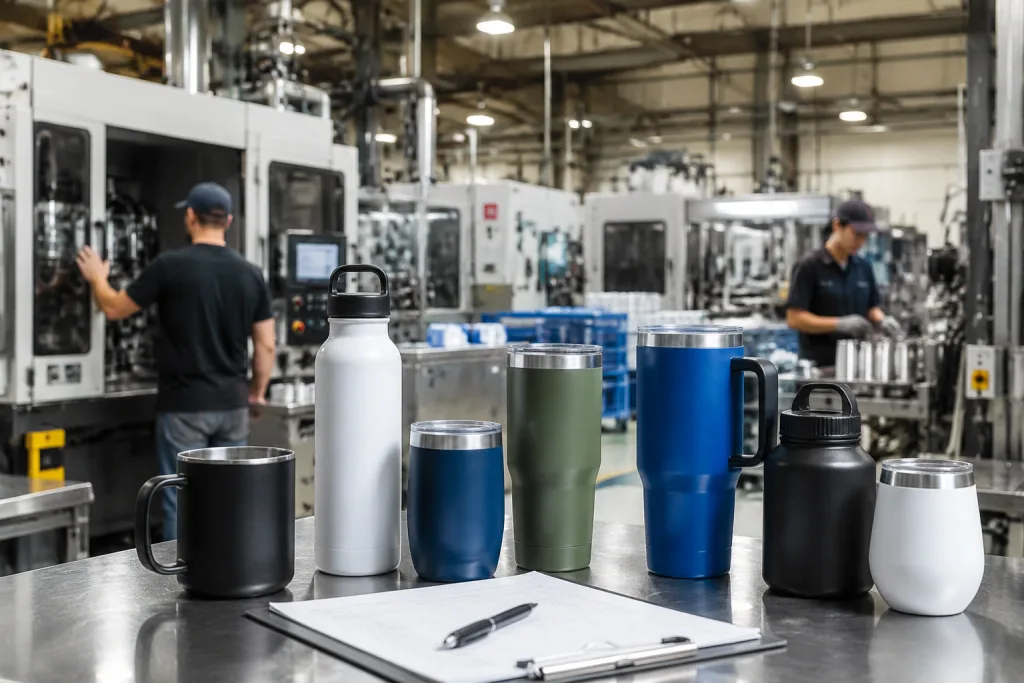
Customizable drinkware is usually sold with a logo promise. The harder question is how that logo looks after 30 dishwasher cycles, 2 weeks in a sales rep’s backpack, and one retail return with coffee stains around the lid thread. We run silkscreen for simple spot logos, laser on powder-coated or brushed 304 stainless, heat transfer for gradient artwork, water transfer for odd curves, full-wrap UV print for shelf-facing graphics, and debossed or embossed mold features when the order volume pays for tooling. None wins every job. QC pulled 12 samples last month because the logo edge lifted after a 3M 610 tape pull, even though the PDF proof looked perfect.
- Silkscreen: good for 1-2 color logos, low cost, clean on straight bodies. Budget about USD 0.08-0.20 per position, and watch curved cups where the screen frame leaves a 1.5 mm registration drift.
- Laser engraving: strongest choice for stainless visibility and durability. Budget about USD 0.18-0.45 depending on logo size and machine time; a 45 mm logo takes longer than a 20 mm icon, and the line speed shows it.
- Heat transfer: works for gradients and full-color artwork. Ask for tape test and dishwasher guidance, then check whether the supplier means hand wash, top-rack wash, or 65°C factory dishwasher testing.
- Full-wrap UV: strong shelf impact, but slower output and higher reject risk on tapered shapes. On a 10,000 pc run, even a 4% print skew means 400 pcs go back to the rework table.
- Molded features: right for large repeat orders, wrong for a 1,000 pc test run because tooling can be USD 800-3,000. The math doesn't work unless the buyer has a second PO waiting.
For canteen customized programs, powder coating plus laser is the safest premium route when the buyer wants a clean hand feel without artwork drama. We ship this combo often because the logo cannot peel, and the buyer can still choose PMS-matched coating within about 3-5 Delta E if the powder supplier is stable. For canteen promotional jobs with a tight landed cost, silkscreen on a single-wall bottle still makes sense. For a canteen vendor selling into European retail, ask for adhesion testing after 3M tape pull, boiling water exposure and 24-hour room-temperature water soak. We have seen this go sideways when a PO says “matte black” but the approved sample is satin black, so match the sample tag, not just the wording.
Do not approve decoration from a flat digital mockup only. Bad shortcut. Request a physical pre-production sample with the real coating, real logo method and real lid color. A canteen factory in Zhejiang or elsewhere in China should need 7-10 days for a normal logo sample if existing tooling is used; our line usually needs 2 days for coating, 1 day for logo setup, 1 day for curing or cleaning, then QC and packing. If they promise 48 hours for every sample, they are probably showing a similar item, not your exact build. The buyer flagged this once on a 750 ml bottle because the sample lid was 2 mm taller than the mass-production lid, and the carton insert no longer fit.
Compliance should shape the shortlist
Compliance is not paperwork you staple on after the artwork is approved. It should cut weak options before we open a sample room job. For Europe, most serious buyers ask for LFGB food contact testing, REACH screening on powder coating, ink, polybag and color box materials, plus BSCI or Sedex records when the retailer has a social-audit gate. For North America, we usually check FDA food-contact expectations, California Proposition 65 risk, CPSIA for children’s items and ASTM-related performance points by product and sales channel. Last March, QC pulled 12 coated bottle samples from the line because the black soft-touch finish looked clean, but the buyer’s lab flagged the coating formula before mass production.
If you are sourcing a kids customized canteen, adult bottle logic will get you in trouble. This is the wrong question to ask: “Can the same factory make both?” The better question is whether the straw, bite valve, paint, warning label and small removable parts match the age grade on the PO. A 350 ml kids bottle with a straw lid can need a different test plan from a 750 ml adult stainless canteen, even when both come from the same canteen manufacturer. We once had a buyer push back on a 6 mm silicone plug inside a straw cap; the caliper reading was fine for assembly, but the safety review treated it as a small-part risk.
For inspection, put AQL terms in the purchase order, not in a WeChat message after production starts. A common setup is AQL 2.5 for major defects and 4.0 for minor defects, with critical defects not accepted. Define major defects in plain words: a lid leaking after a 3-minute inverted test, a sharp burr on the rim, a rust spot on 304 stainless, wrong capacity, wrong barcode, failed vacuum test, or logo adhesion failing a 3M tape pull. We run better with canteen supplier partners who accept AQL language without drama; “our QC checks everything” usually means the defect list is still in someone’s head.
For Amazon or marketplace shipments, add FNSKU labeling, carton drop test, master carton weight limits and barcode scan checks to the spec. For distributor canteen orders, add inner carton quantity and pallet pattern, including carton size in mm and gross weight per carton, such as keeping master cartons under 15 kg when the warehouse requests hand unload. Small logistics lines stop expensive arguments after goods leave China. We have seen this go sideways over one PO typo: the buyer wrote 24 pcs per inner carton, the packing line followed it, and the US warehouse expected 12 pcs for shelf allocation.
Cost comparison beyond FOB
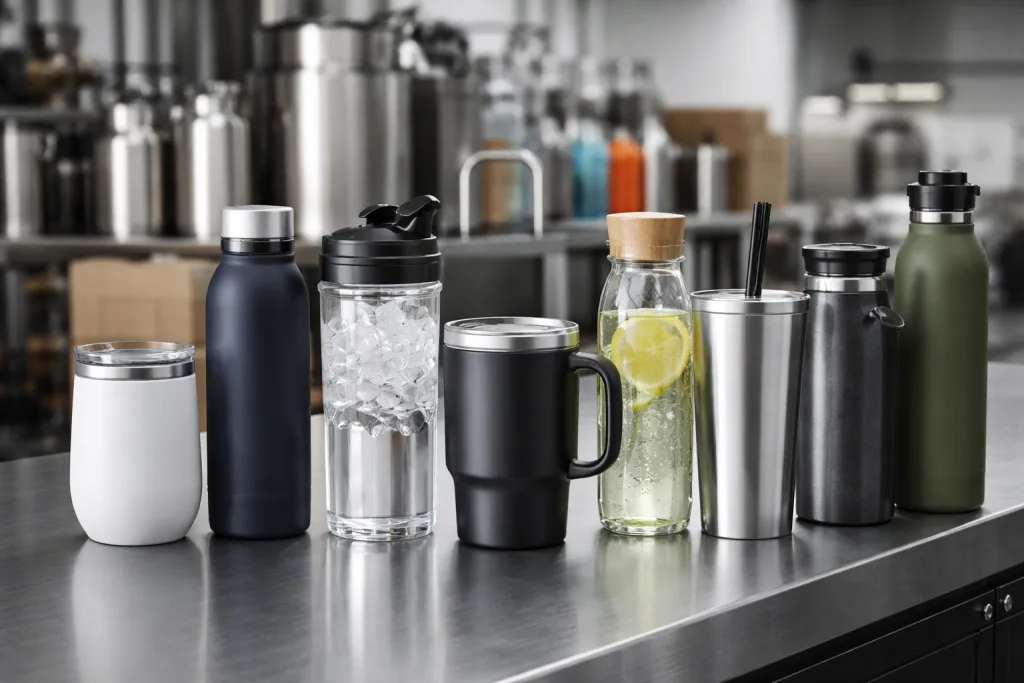
FOB price is only the first number. Judge top custom drinkware by landed cost per sellable unit, not by the quote line that looks clean on a spreadsheet. A 1.2 L canteen at USD 4.20 FOB looks good until the packing engineer measures the export carton with a tape: 24 pcs per carton, 15 kg gross weight and 0.085 CBM. That carton size eats margin. We’ve seen a 750 ml bottle at USD 3.60 FOB land cheaper because it nests tighter in the master carton and gives the warehouse fewer crushed corners to argue about on arrival.
Ask canteen suppliers for carton dimensions, gross weight, net weight, pieces per carton and estimated CBM per 1,000 pcs before you approve the item. Get it in writing. If the supplier cannot give those numbers before mass production, they are quoting from a catalog sheet, not from production engineering. Our line normally checks carton loading with a 1 mm steel ruler and a filled sample before sales sends the final PI. For distributor drinkware, this matters more than a decorative logo position you can barely see in a product photo.
A basic landed cost model should include FOB and freight first, then duty, customs brokerage, inland trucking, inspection, testing and expected defect allowance. Packaging disposal fees also belong in the file when your market charges for them. For 5,000 pcs stainless custom drinkware programs shipped by sea from China to Europe or North America, inspection and testing cost can add USD 0.05-0.20 per unit. Air freight is the trap. One buyer flagged our USD 3.80 growler as “too slow by sea,” but the DHL-style air quote added more than USD 4.00 per unit; the math doesn’t work unless the retail price is built for it.
Payment terms change real cost too. For new buyers, 30 percent deposit and 70 percent before shipment is standard. After 3 clean orders, some canteen manufacturers will discuss partial balance against bill of lading copy. Be careful with loose terms from an unknown canteen vendor. We’ve seen this go sideways: QC pulled the sample before packing, found thinner 304 stainless than the approved sample, and the factory blamed cash flow after taking a weak deposit.
How to choose your winner
For corporate gifting, pick a 500-750 ml vacuum bottle or tumbler with clean laser marking; procurement teams understand it in 30 seconds, and QC can check logo position with a 0.5 mm tolerance jig. For outdoor retail, we would run a custom canteen with a carry loop, 304 stainless body and powder coating, because buyers always grab the loop first during sample review. For breweries or premium camping bundles, a customized growler can carry the higher landed cost, but the math does not work if the cap feels thin or the color box crushes at the corner in a 12 kg carton drop test.
For canteen distributors building a line, do not launch five sizes on day one. Start with two bodies: 500 ml and 750 ml, both using shared caps where the neck thread allows it; on our line, a shared cap can cut incoming part checks from 4 bins to 2. Shared components lower spare-part risk and make repeat orders less messy. A solid canteen factory will tell you when shared tooling is possible. A weak one will quote every item like it came from a different planet.
Your first RFQ should give the factory the order volume, material, target FOB range and destination market, then add the test requirements, decoration method, packaging, annual forecast and launch date. Send a marked-up drawing if you have one; last month a buyer wrote “matte back” on the PO, and QC pulled the sample only after we confirmed they meant “matte black.” Tell the canteen supplier if you need exclusivity on shape or color. Exclusivity is possible, but expect tooling cost, an annual quantity commitment or both.
Practical rule: if you cannot describe the product in one technical paragraph, you are not ready to compare quotes; we have seen RFQs go sideways over a 3 mm lid height change.
BottleForge Industrial in Hangzhou, Zhejiang handles OEM and ODM drinkware for distributors, promotional agencies and brand owners. For standard stainless canteen customizable orders, our practical MOQ is usually 1,000 pcs per color, with 30-40 days mass production after sample approval. That is not the lowest MOQ in China, and we do not pretend it is. It is the level where we can keep coating stable, run AQL checks without rushing the line and quote pricing that still holds on the repeat order.
Send your drinkware spec for factory pricing
Share volume, market, logo method and target FOB. We will reply with practical options, MOQ and lead time from Zhejiang.
Frequently asked questions
What is the best top custom drinkware format for a first B2B order?
For most first orders, a 500-750 ml stainless vacuum bottle or custom canteen is the safest choice. It has broad use, manageable carton size and enough logo area for corporate or retail branding. Keep the first order to 1-2 colors and one decoration method. A realistic MOQ is 1,000 pcs per SKU or color for stable pricing in China. If you need a lower test quantity, ask for stock shapes with logo customization, not a new mold. Save custom growler or molded-lid development for the second order once you have sell-through data.
How do I compare canteen manufacturers without buying the cheapest quote?
Ask each canteen manufacturer for the same controlled specification: capacity, steel grade, wall thickness, lid material, coating type, decoration method, packaging, MOQ, lead time and FOB port. Then request carton dimensions and sample photos from actual production, not just catalog renders. A serious canteen factory should state whether the outer wall is 201 or 304 stainless and whether the quote includes LFGB, FDA or REACH-related testing support. If one supplier is 12-18 percent cheaper, check wall thickness, coating process, lid gasket and packaging before assuming it is a better deal.
Is laser engraving always better than printing for customized drinkware?
No. Laser engraving is usually more durable, especially on powder-coated stainless bottles, tumblers and growlers. It is a good choice for premium distributor drinkware and outdoor custom canteen orders. But silkscreen is cheaper and works well for simple 1-color logos on straight bodies, especially for canteen promotional projects. Expect laser to add about USD 0.18-0.45 per unit, while silkscreen may be USD 0.08-0.20 per unit. For full-color artwork, heat transfer or UV print may be better, but you should test adhesion and scratch resistance before approving mass production.
What lead time should I expect from a canteen supplier in China?
For an existing shape with custom logo and standard packaging, plan 7-10 days for a sample and 30-40 days for mass production after approval and deposit. For a canteen customized with new lid tooling, silicone parts or exclusive body shape, add 20-45 days for tooling and trial runs. Peak season before summer and Q4 can add another 7-15 days. If you need retail gift boxes, FNSKU labels or special palletization, confirm these before the purchase order. A canteen vendor quoting 20 days for everything may be assuming stock parts and simple decoration.
What should canteen distributors check before repeat ordering?
Before a repeat order, review return reasons, coating scratches, lid complaints, barcode errors and carton damage from the first shipment. Then update the spec sheet instead of relying on email memory. For canteen distributors, small changes matter: a gasket hardness change or carton downgrade can create leaks or crushed boxes. Confirm AQL 2.5/4.0 inspection terms, packaging dimensions, logo placement tolerance and material grade again. If the first order sold well, consider shared caps across 500 ml and 750 ml sizes to reduce spare-part complexity and improve purchasing leverage.