Key Takeaways
- Set material, capacity, and decoration first; price gaps of 8-25% often come from spec differences
- A practical B2B MOQ is usually 1,000-3,000 units per color for stainless steel bottles
- Ask for AQL 2.5/4.0 inspection, REACH or FDA/LFGB files, and carton drop-test details
- Plan 7-10 days for sampling and 30-45 days for mass production after artwork approval
If you are sourcing a top custom drink bottle, you are not buying 1 bottle. You are buying a rollout: 2 approval samples, print artwork, export cartons, compliance files, freight booking, retail handover dates, and a supplier who picks up when the buyer changes the logo at 6 p.m. The bottle matters. The buying work around it decides whether we ship in 28 days or lose 12 days chasing a missing Pantone code.
At BottleForge Industrial in Hangzhou, Zhejiang, we see buyers burn time by asking for price before locking 5 basics: material, capacity, decoration method, MOQ, and test requirements. Last month QC pulled the sample because the PO said 304 stainless, while the artwork file named “plastic bottle final.ai” showed a PP lid with no silicone color callout. China can make almost any custom drinkware spec, but this is the wrong question to ask first. A tight brief keeps cost, risk, and launch date under control.
Start with the buying decision
A top custom drink bottle is not the priciest bottle on the shelf, and it is not the lowest FOB line on a spreadsheet. For B2B buyers, the sharper question is simple: which bottle gives your customer the right perceived value, passes QC at AQL 2.5, and does not turn the line into a firefight three days before loading?
I would lock four decisions before asking any canteen supplier for a formal quote. Start with the product type: stainless vacuum bottle, single-wall sports bottle, plastic canteen, glass bottle, travel tumbler, or custom growler. Then set the capacity range. Most corporate and retail programs sit between 500 ml and 1,000 ml, while a distributor growler order may start at 1.2 L and move up to 1.9 L. Next, choose the decoration method with the factory reality attached: laser engraving needs clean artwork, silkscreen needs a Pantone callout, heat transfer needs a flat-enough print area, and powder-coated color matching should be checked under a D65 light box. Full-wrap printing is not the same lead time. Last, define the compliance market: EU, UK, US, Canada, or mixed. We once had a PO typo that said “US/EU” in the header and “Canada only” in the remarks; QC pulled the sample twice before the buyer confirmed the test plan.
These choices sound basic. They save RFQs. If you ask ten canteen manufacturers for “a premium bottle with logo,” you will get ten quotes that cannot be compared. One canteen factory may quote 304 stainless steel with 0.5 mm outer wall, another may quote thinner gauge, and another may exclude inner carton printing. The cheapest line item can become the most expensive order if it fails inspection or misses your ship window. We have seen this go sideways: a buyer pushed for 18 days instead of our normal 25 days, then flagged a 1.8 mm logo shift on pre-shipment photos after cartons were sealed. The math does not work when the spec is loose and the deadline is fixed.
For most distributor drinkware programs, I prefer a slightly conservative spec that can pass repeat orders, not a fragile spec that only looks good on a first quote.
Choose material before chasing price
Choose the material first, then talk price. Material sets the bottle weight in the buyer’s hand, the FDA or LFGB paperwork path, the scrap rate on the line, and the first impression when a retail buyer picks up the sample. For reusable custom drinkware, stainless steel is still the safer call in 8 out of 10 programs we run because it fits retail shelves, promo gifts, and outdoor kits without feeling like a cheap giveaway. For vacuum bottles, 304 stainless steel is the normal baseline for both inner and outer walls; our incoming QC checks coil thickness with a Mitutoyo micrometer before the body goes to drawing. Some buyers ask for 316 stainless steel for salty beverages or marine positioning, but it usually adds 12-20% to the bottle body cost. For coffee, water, or office use, the math usually does not work.
Plastic canteen customized projects still make sense when the target price is tight. Tritan, PP, and PE are not interchangeable materials, and this is where we see projects go sideways. Tritan gives a clearer, more retail-friendly look, but the resin cost pushes the quote up. PP works for budget sports bottles, especially when the MOQ is 5,000 pcs and the buyer wants a simple one-color logo. PE is common for flexible outdoor canteens, though it can look too soft for a corporate gift. Last month a buyer flagged a Tritan quote because their PO said “clear bottle under USD 1.60,” but the approved sample was actually PP. If you are dealing with canteen promotional orders under USD 2.00 FOB, plastic may be the only realistic route.
Glass works for wellness and premium hydration. Breakage is the bill you have to price in. A silicone sleeve, thicker carton, and better inner divider can add USD 0.20-0.45 per unit, and we usually test the packed sample with a 76 cm drop before signing off. That cost is cheaper than replacing broken stock after ocean freight. We have seen a 3% corner-crack finding at final inspection when the buyer cut the divider spec to save USD 0.08. Bad saving.
For a custom growler or customizable growler, check wall thickness and cap sealing before chasing a lower quote. A 1.9 L stainless growler with thin body walls may dent during courier delivery, especially when the filled weight passes 2.2 kg. If you sell through online channels, the packaging spec matters almost as much as the bottle spec. In Zhejiang, China, our engineering team normally checks filled weight, carton compression, and handle stress before confirming mass production on larger formats; QC pulled one 1.9 L sample last quarter because the handle rivet shifted 1.5 mm after the load test.
Match decoration to order reality
Decoration is where 6 out of 10 customized drinkware projects get overbuilt. A sharp one-color logo often looks more professional than a full-color design that flakes, shifts 0.5 mm on the jig, or pushes the MOQ past the buyer’s budget. Brand owners usually ask us for exact Pantone matching and a satin retail finish. Event canteen distributors ask a different question: “Can you ship 8,000 pcs before Friday?” That is the right pressure. We’ve seen this go sideways when the PO says “same as artwork” but the artwork file has RGB colors and no Pantone code.
Laser engraving is clean and durable on stainless steel. We run it often for corporate gifts, outdoor canteen custom programs, and bottles that will see dishwasher cycles. No bright color, though. If the buyer wants a red logo on 304 stainless, laser is the wrong method. Silkscreen works well for one to three spot colors, mainly on straight bottle walls where the screen frame sits square. Curved bodies, textured powder coating, and tapered shapes make registration harder; QC pulled one sample last month with the second color drifting 0.8 mm near the shoulder. Heat transfer and full-wrap printing give stronger shelf appeal, but the math does not work unless the setup cost and reject rate are built into the quote.
Powder coating needs a decision before artwork approval. A standard factory color may keep MOQ at 1,000 units per SKU. A custom Pantone powder coat can require 2,000-3,000 units and 10-15 extra days if the coating supplier needs a new batch. On our line, the coating supplier sends a 200 g test powder first, then we spray 3 bottle bodies for color sign-off under a D65 light box. For canteen customizable orders, build that timing into the launch plan, or you end up arguing about why mass production takes 18 days instead of 12 days.
- Laser logo: durable on stainless steel, clean edge under a 10x loupe, good for 1,000+ units when color is not required.
- Silkscreen: cost-effective for one to three spot colors, best on smooth straight walls where the fixture holds registration.
- Heat transfer: stronger retail shelf effect, needs tighter film alignment, oven temperature control, and sample approval before bulk.
- Embossed or molded parts: best for repeat programs above 5,000-10,000 units because tooling cost only makes sense across multiple POs.
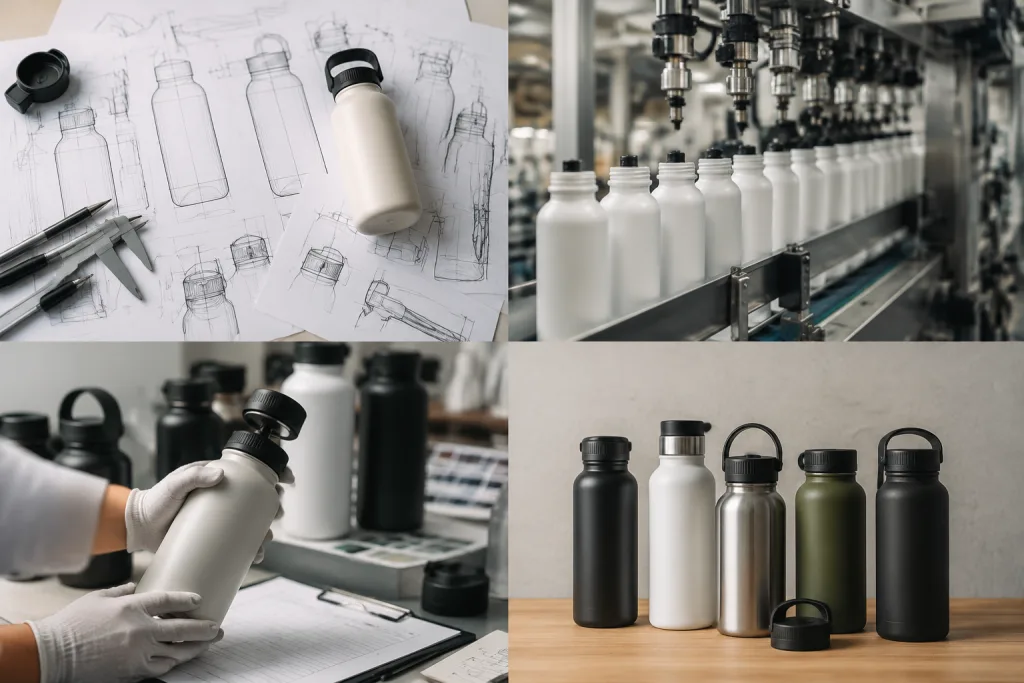
Ask your canteen vendor for printed pre-production samples if the logo is complex. A digital mockup helps with placement, but it will not show coating absorption, ink edge quality, or the slightly raised hand feel after curing. We ship 2-3 decorated samples by DHL for most new logos, and the buyer often flags things the PDF never showed, like a 1 mm logo tilt near the seam.
Check factory capability, not brochure language
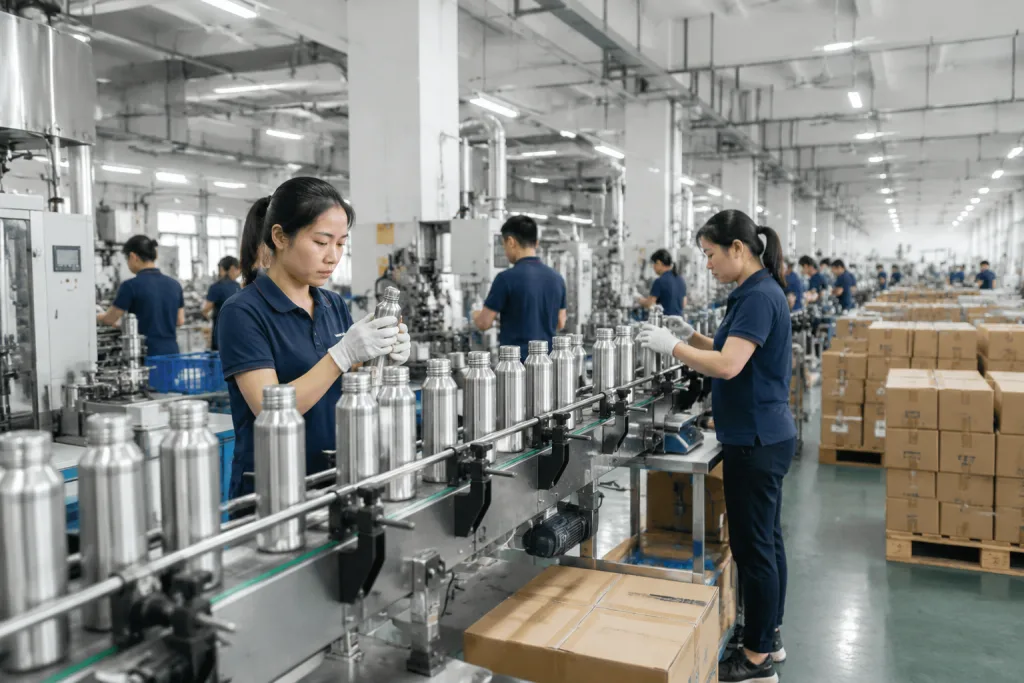
Every canteen manufacturer says it can make customized canteen products. That claim is cheap. The better question is what the line can repeat at your order quantity, tolerance, and document level after QC has pulled 32 samples from the carton. At BottleForge Industrial, our Hangzhou, Zhejiang coordination office works with production lines in China that can support about 300,000 stainless drinkware units per month across bottles and tumblers, with growlers added when the coating line is not packed. Our normal MOQ is 1,000 units for stock-shape logo orders and 3,000-5,000 units for new color or new component combinations.
When you assess canteen suppliers, ask for capacity by process, not total factory capacity printed in the brochure. Vacuum forming, polishing, powder coating, printing, and packing do not move at the same speed, and one slow station can hold the whole order. We run into this often: a factory can weld 20,000 bottle bodies per day, but in humid July weather the powder booth may pass only 8,000 acceptable units per day after 3M tape adhesion checks. That gap changes lead time from 12 days to 18 days fast.
For canteen vendors and distributor canteen programs, ask about tooling ownership, spare parts, and repeat-order control with part numbers on the PO. If your lid design uses a silicone gasket, you need to know the gasket material is food-grade, spare lids are available, and the lid color can be repeated six months later against the same Pantone chip. We have seen this go sideways when a buyer wrote “black lid” on the reorder and QC pulled the sample beside the old shipment: one was matte black, the other was charcoal. This is not paperwork; it protects your reorder margin.
Compliance documents should match the order and the sales market. For Europe, ask about REACH, LFGB where relevant, and packaging waste requirements. For North America, ask about FDA food contact, California Proposition 65 screening when needed, and ASTM-related packaging or child-use requirements for kids bottles. If a canteen factory cannot explain which tests apply, the math does not work; your customer may reject 1,000 cartons at inbound inspection because the report name, SKU, or material grade does not match the shipping mark.
Build a landed-cost comparison
FOB unit price is not the full buying decision. A bottle at USD 3.20 FOB Ningbo can land higher than a USD 3.45 FOB Shanghai quote once carton size, loading quantity, inspection, duties, and local trucking are counted. We ship from Zhejiang to Ningbo and Shanghai every week, and port distance is usually not the problem. Carton cube is. Last month the buyer flagged a “cheap” tumbler quote after our loading plan showed 18,240 pcs in a 40HQ instead of the 22,080 pcs they assumed.
Ask for carton dimensions, gross weight, units per carton, and estimated CBM before you approve the price. A 750 ml vacuum bottle might pack 24 pieces per carton at 58 x 39 x 28 cm. If another design packs only 16 pieces per carton because the handle sticks out 18 mm or the gift box uses thick foam, your ocean freight per unit can rise by 20-35%. For Amazon or marketplace orders, the gap hurts more because the line has to add FNSKU labeling, carton marks, and prep checks; QC pulled one sample last season where the PO said “FNSK” and the warehouse almost printed the wrong label.
Do not compare a bulk-packed quote against a retail gift-box quote. That is the wrong question to ask. A color box may add USD 0.18-0.55 per unit depending on paper gauge, printing, insert, and drop-test requirement. A molded pulp insert costs more than a white cardboard divider, but we have seen the cheaper divider fail a 90 cm corner drop on a powder-coated bottle, and the math does not work if 3 cartons arrive with dented lids.
For distributor drinkware, landed-cost sheets should include these lines at minimum: FOB product cost, tooling or setup, sample fee, third-party inspection, freight, duty, customs broker fee, warehousing, and expected defect allowance. I normally tell new buyers to reserve 1-2% of order value for claims, spare units, or replacement lids. If nothing goes wrong, you keep the margin. If the buyer opens 12 cartons and finds 7 scratched lids under AQL 2.5, you already have a budget instead of arguing with your sales rep at 11 p.m.
Lock quality before mass production
Start QC before the PO is signed, not after 312 cartons are taped shut. For a top custom drink bottle program, the approved sample has to turn into a spec sheet the line can measure. Keep one golden sample with your buyer team and one at the canteen manufacturer’s QC desk. We record bottle weight on a 0.1 g scale, coating color against a Pantone chip, logo size in mm, print position from the bottom seam, cap torque, capacity, and packaging layout. Photos help. Numbers end arguments faster, especially when a PO says “logo 55mm” and the artwork file shows 58mm.
Use an AQL inspection plan. For most B2B custom drinkware orders, AQL 2.5 for major defects and 4.0 for minor defects is a practical baseline. Critical defects should be zero tolerance. Major defects include leaking, wrong logo, severe dents, incorrect color, missing accessories, and poor cap fit; minor defects include small specks, light scratches outside the logo area, and acceptable carton rub marks. QC pulled a sample last month where 7 lids out of 200 felt loose on the torque meter, and the buyer was right to stop shipment. You can tighten the standard for retail launch orders, but the math does not work if nobody budgets sorting cost.
Leak testing matters. We run vacuum bottles with hot water or pressure methods depending on the structure, usually 95°C water for 30 minutes on the sample bench before the inspector signs off. Coating adhesion should be checked with cross-cut or tape testing when the finish is powder coat, spray paint, or soft touch. Printed logos need rub tests, especially on matte powder-coated bottles, because a clean logo at 9 a.m. can look tired after 50 dry rubs. For customized growler orders, handle pull strength and cap sealing need extra attention because filled weight is higher; we have seen a 1.9 kg filled growler expose weak handle rivets fast.
Pre-shipment inspection should happen when at least 80% of goods are packed and 100% are produced. If your order is split across 4 colors, inspect all colors, not just the first pallet near the door. A canteen customized order can pass in black and fail in white because coating defects show differently under the LED inspection lamp. This is the wrong question to ask: “Did the order pass?” Ask whether each color, lid type, carton mark, and barcode passed. We ship from Hangzhou every week, and we have seen this go sideways when the buyer flagged a white bottle scratch pattern only after goods reached Rotterdam.
Pick the supplier role carefully
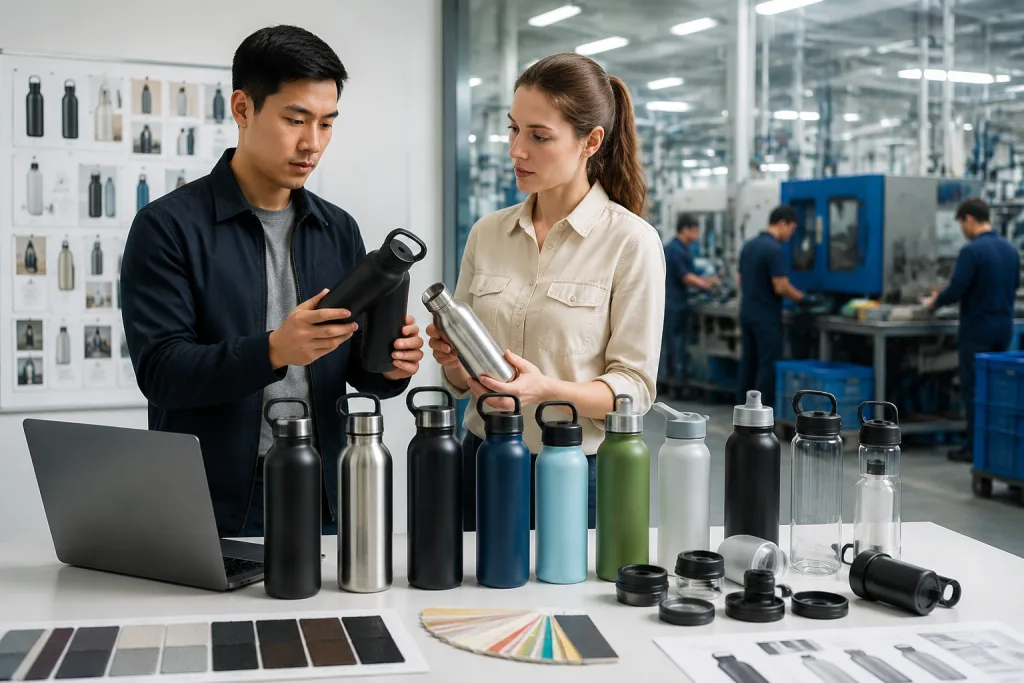
Buyers do not need the same kind of supplier. A canteen distributor usually asks us for 3 stock body shapes, stable MOQ, and plain neutral cartons with no factory mark. A retail brand needs private tooling, Delta E color control under 1.5, and compliance files ready before shipment. A promo agency cares about logo sample speed and the event date printed on the PO. This is the wrong question to ask: “Who is cheapest?” Ask which risk the supplier is built to remove. Last month QC pulled the sample because the buyer’s artwork was 62 mm wide, but the safe print area on that curved body was only 48 mm.
A trading company can give you wider catalog access and smoother English, especially if you are buying bottles, bags, and caps in one order. A direct canteen factory gives tighter control on polishing, vacuum testing, and powder coating, but the line will not switch categories just because the buyer wants one more SKU. A manufacturer with export engineering support should send clearer drawings, mark the sample comments in red, and catch hidden assumptions before deposit. No model is perfect. The bad model is the one that hides limits until PI payment lands. We have seen this go sideways when a PO said “matte black” but the approved sample was actually Pantone Black 6C with 20 percent gloss.
For a first order, I would not open a private mold unless the volume pays for it. A new lid, handle, or body shape can cost USD 1,500-8,000 in tooling and add 25-45 days before mass production. If your forecast is only 2,000 units, use an existing body and customize finish, logo, packaging, and accessories. Save tooling for a repeat program. Simple math. On our floor, a CNC lid mold trial often needs 2 sample rounds, and one small 0.3 mm sealing gap can hold the whole project for another 7 days.
Good canteen manufacturers should push back when your brief fights the production calendar. If you request a mirror-polished bottle, full-wrap print, retail gift box, 800-unit MOQ, and 20-day delivery before Christmas, a serious supplier will tell you what must change. Maybe the MOQ moves to 1,200 units, the gift box ships flat, or the finish changes to satin polish. That honesty beats a fast yes. We run pre-shipment checks under AQL 2.5, and the buyer flagged it fast when one carton label showed “750ml” while the PO said “700ml.”
Send your bottle brief for a practical quote
Share capacity, material, logo file, quantity, and destination. We will return a workable spec, MOQ, lead time, and FOB pricing.
Frequently asked questions
What MOQ should I expect for a top custom drink bottle order?
For stainless steel custom drinkware, a realistic MOQ is usually 1,000 units per design when you use an existing bottle shape and a standard color. If you need a custom powder-coated Pantone color, expect 2,000-3,000 units per color because the coating batch and line setup need enough volume. Plastic custom canteen orders can sometimes start at 3,000 units, while molded parts or private tooling often make sense above 5,000-10,000 units. Very low MOQs are possible for laser logos on stock inventory, but the unit price is higher and color choice is limited. Always ask whether the MOQ is per shape, per color, or per logo.
How long does sampling and production usually take?
For an existing bottle with laser engraving or simple silkscreen, sampling normally takes 7-10 days after artwork approval. A custom color sample can take 12-18 days because powder coating needs color matching and curing checks. Mass production is usually 30-45 days after deposit and approved pre-production sample. Add 7-14 days during peak season, especially before Christmas and summer promotional campaigns. If tooling is involved, add 25-45 days before production starts. Buyers often forget approval time on their side; if your team takes 8 days to approve artwork, the factory schedule does not pause for free.
Which logo method is best for distributor drinkware?
For distributor drinkware, laser engraving is usually the safest method on stainless steel because it is durable, clean, and repeatable across small and medium programs. Silkscreen is better when the customer needs a strong color logo and the bottle surface is smooth. Heat transfer works for larger visual designs but needs tighter inspection because alignment and adhesion can vary. If you handle many canteen promotional orders, keep a matrix of logo method, MOQ, setup fee, and lead time. For example, laser may add USD 0.10-0.25 per unit, while full-wrap heat transfer may add USD 0.35-0.90 depending on coverage and order quantity.
What compliance documents should canteen suppliers provide?
For Europe, ask canteen suppliers for REACH screening, LFGB food-contact testing when applicable, and material declarations for stainless steel, silicone, plastic, and coatings. For the US, ask for FDA food-contact support and Proposition 65 evaluation when your sales channel requires it. Kids bottles may need extra ASTM or CPSIA-related review depending on age grading, paint, and small parts. Do not accept a random old test report without checking product name, material, date, and factory name. A report for a plastic lid does not automatically cover the silicone gasket or painted metal body. For larger orders, budget USD 300-900 for updated third-party testing.
Should I buy from a canteen factory or a canteen vendor?
A direct canteen factory can be better when you have a stable spec, repeat volume, and need strong process control. A canteen vendor or export partner can be better when you need several bottle types, faster communication, consolidated inspection, and mixed-category sourcing. The wrong choice is based only on a USD 0.05 unit-price difference. For a 3,000-unit order, one inspection failure or missed sailing can erase that saving immediately. Ask who controls artwork approval, production scheduling, QC inspection, and claims handling. If the answer is vague, you are not really buying from a reliable supply chain.