Key Takeaways
- Set MOQ, capacity, material grade, lid type, and test standard before asking for a USD price
- A 3,000-unit toddler bottle order usually needs 25-35 days after golden sample approval
- Use AQL 2.5 major / 4.0 minor for routine inspection, with 100% leak testing on bottles
- Your PO should separate unit price, tooling, decoration, carton, testing, and FOB China terms
Toddler bottle wholesale bulk orders look simple until the RFQ comes back with 5 lid options, a vague “food grade” test report, and a unit price that moves after the artwork file is signed off. If you buy for a retail brand or distributor, the leaking cap is not the main risk. The bigger hit is a launch pushed from 12 days to 18 days because QC pulled the sample and found a 0.4 mm gap on the silicone straw seat.
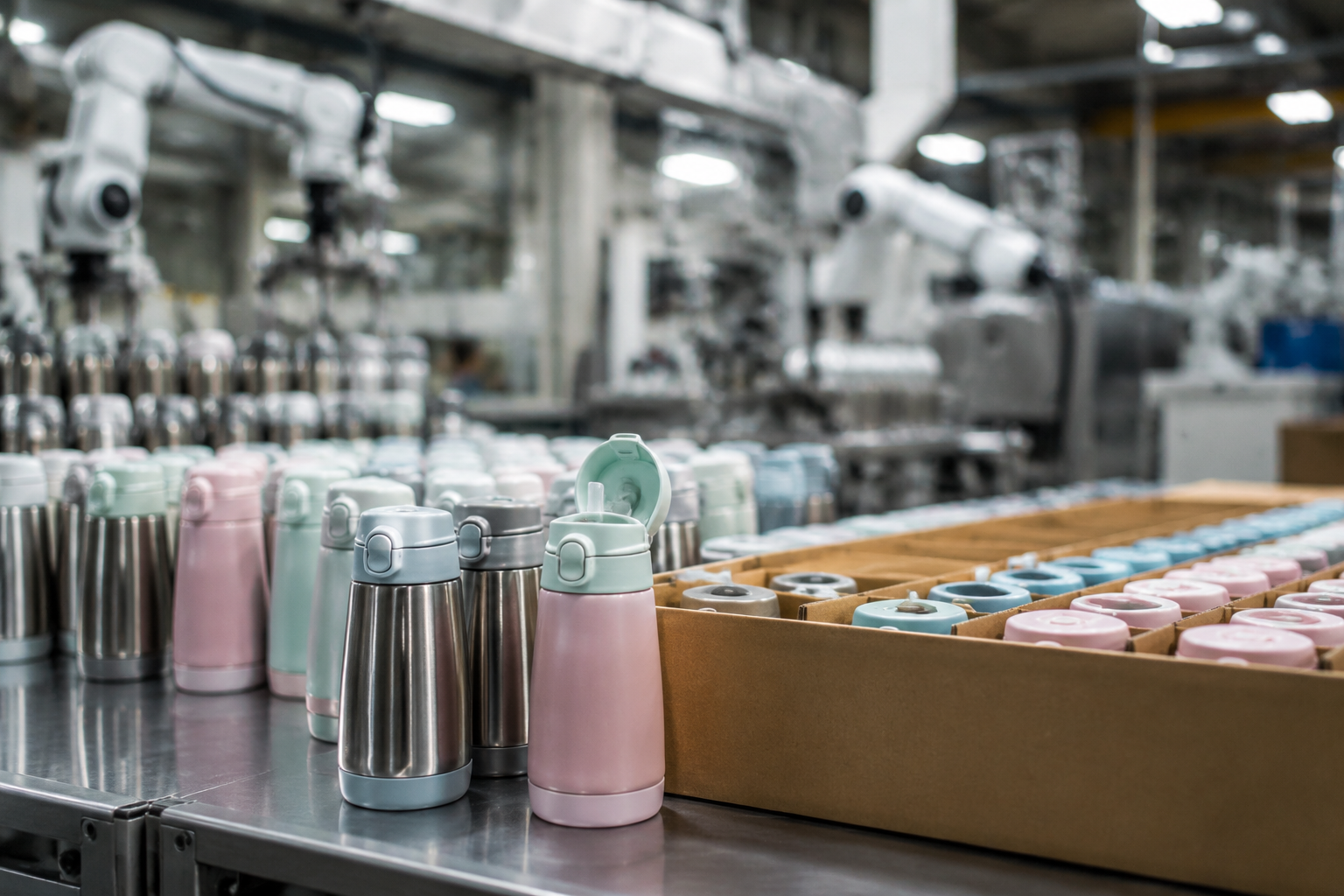
Our factory in Hangzhou, Zhejiang produces stainless steel and plastic drinkware for export programs from 3,000 to 120,000 units per month. We run toddler bottle lines with 304 stainless bodies, PP lids, Tritan or silicone parts, and carton drop checks before packing. This guide takes you from RFQ to sample to bulk PO, with the line items to lock before you pay the deposit. China sourcing can move fast, but the math does not work if your specification leaves room for the supplier to guess.
Start With A Real RFQ
A real RFQ for toddler bottle wholesale bulk is not “send best wholesale drink bottle price.” That line gets you a catalog quote and 6 guesses baked into it. Start with age band, target shelf price, sales channel, and country. A 350 ml toddler bottle for a German supermarket private label will run through different checks than a North American online bundle; last month QC pulled a sample with a 5.8 mm straw opening because the buyer’s spec forgot the age range.
Your first RFQ should name the capacity, body material, lid build, straw or spout type, handle requirement, packaging, logo process, and compliance market. Write it like a PO line, not a mood board. Example: 350 ml double-wall 304 stainless steel toddler bottle, silicone straw at Shore A 55, PP lid, two side handles, powder coating, one-color logo by pad printing, individual color box with 350 g greyboard, EU REACH and LFGB food-contact test, FOB Ningbo. We run clearer costing when the caliper, scale, and sample rack all point to the same spec.
Put the commercial terms in the same RFQ. Ask for pricing at 3,000, 5,000, and 10,000 pcs, then ask whether MOQ changes by color. This is where the math often breaks. A supplier may accept 3,000 pcs total but require 1,000 pcs per color because powder coating line changeovers waste material and time. In Zhejiang, a normal color-change setup can take 45-60 minutes, and somebody pays for that downtime; the line crew still logs it on the spray booth sheet.
If you also buy nearby bulk drinkware, say it early. Factories quote tighter when they see a 12-month program instead of one toddler bottle trial. A sourcing calendar may include toddler bottles in March, sports bottles in May, bulk canteen items before summer camp season, and drinkware bulk reorders before Q4. Keep toddler safety separate from adult products such as alcohol flask wholesale or beer growler wholesale, but show total annual volume if it is real. We’ve seen this go sideways when a buyer mixed kid SKUs and flask artwork in one PO; the typo was caught only during carton mark checking.
RFQ line items to include: capacity in ml, material grade such as 304 stainless, wall thickness in mm, lid material, silicone hardness in Shore A, logo method with print area, color count with pcs per color, packaging structure, test standard, Incoterm, port, quantity breaks, target delivery date, and expected reorder frequency.
Translate Specs Into Cost
Once the supplier answers, don’t line up quotes by headline unit price. That is the wrong question to ask. A toddler bottle with 0.38 mm stainless steel wall thickness is not the same product as a 0.45 mm body; our thickness gauge on the line will catch that in 10 seconds. A lid using ordinary PP is not equal to food-grade PP with documented migration testing. A straw using low-cost TPE is not the same as LFGB-grade silicone. These differences can move cost by USD 0.15-0.60 per unit before decoration, and we’ve had buyers flag a USD 0.22 gap that was only material, not margin.
Ask for a costed specification sheet. It should show the body material with measured wall thickness in mm, inner/outer steel grade if stainless, plastic resin grade, silicone type with test report, coating process, lid structure, gasket count, and packed accessories. For toddler bottles, the cap assembly is often the failure point. QC pulled one sample last quarter that looked fine in photos but leaked after 300 open-close cycles on the hinge tester and again after a dishwasher test at 70°C. Cheap lids save money on paper. The math doesn’t work after claims.
Decoration also needs a factory-floor view. Laser engraving lasts, but it gets weak on light colors; our 20W fiber laser looks sharp on navy powder coating and almost invisible on pale mint. Silk screen is cheap for one or two colors, but it can fail abrasion tests if the coating is thin or the curing oven runs 8 minutes instead of 12. Heat transfer can deliver cute artwork, but it needs a larger MOQ and tighter color control because scrap climbs fast when the wrap seam shifts 1.5 mm. For a 5,000-unit order, one-color screen printing may add USD 0.08-0.15 per unit. Full wrap heat transfer may add USD 0.35-0.70 depending on artwork and scrap rate.
Your PO line item at this stage should not say only “toddler bottle, blue, logo.” We’ve seen this go sideways from one typo on a PO: “PP straw” instead of “silicone straw,” and the buyer rejected 2,400 sets at pre-shipment inspection. Specify 304 inner stainless steel, 316 if required, 0.4 mm minimum body thickness, BPA-free PP lid, food-grade silicone straw, leakproof gasket design, and color code such as Pantone 551 C with approved tolerance. If you source wholesale drinkware across categories, use the same discipline for canteen bulk and growler bulk, with separate child-safety checks for wholesale canteen programs. Adult lines like alcohol flask bulk and beer tumbler bulk can share procurement structure with wholesale growler, but not child-safety assumptions.
Request Samples In Two Rounds
Split sampling into two rounds: factory reference sample and pre-production sample. Don’t skip the first round because sales is chasing a launch date. The reference sample confirms the shape in hand, lid fit after 20 open-close checks, straw length in mm, and coating coverage before you pay for custom tooling or decorated samples. We run this check on the sample table with a digital caliper and a thread gauge; QC pulled one toddler cup last month where the straw sat 6 mm above the bottom, so the last mouthful could not be reached.
For existing molds, reference samples usually take 3-7 days plus courier time. Custom color and logo samples often take 7-12 days after artwork confirmation. If a new lid mold is needed, allow 20-30 days for tooling and first shots. This part is not magic. A serious factory in China will say the timeline is tooling-driven; the wrong factory will promise “ship next week” and then send excuses after the CNC shop finds the lid slider needs rework.
Give the supplier a sample PO, even if the sample is free. It stops arguments later. The sample PO should list sample quantity, color, decoration file version, test purpose, courier account, and whether the approved sample becomes the golden sample. If the toddler bottle has measurement markings, confirm the tolerance in writing, such as ±5 ml or ±10 ml. A 10 ml marking error may not matter on an adult sports bottle, but parents notice when formula or water portions are wrong; we once had a buyer flag a PO typo where “ml” was entered as “mm,” and production stopped for 2 hours while merchandising corrected it.
Test samples like a buyer, not like a photographer. Fill with water, invert for 30 minutes, shake 50 times, drop from 80 cm onto a plywood surface, open and close the lid 200 times, and check whether the straw detaches too easily. For EU and North American buyers, check small parts risk as a separate line item. Handles, caps, and straw plugs need enough retention force to avoid obvious choking concerns; on the line, QC uses a pull-force gauge, and anything that pops loose with a light hand pull is a problem, not a “minor adjustment.”
Sample PO line items: 3-5 pcs reference samples, 2-3 pcs logo samples, artwork file name with version number, Pantone color with coating method, surface finish checked by visual board, courier terms with account number, approval deadline, and written golden sample status signed by both sides.
Lock Compliance Before Deposit
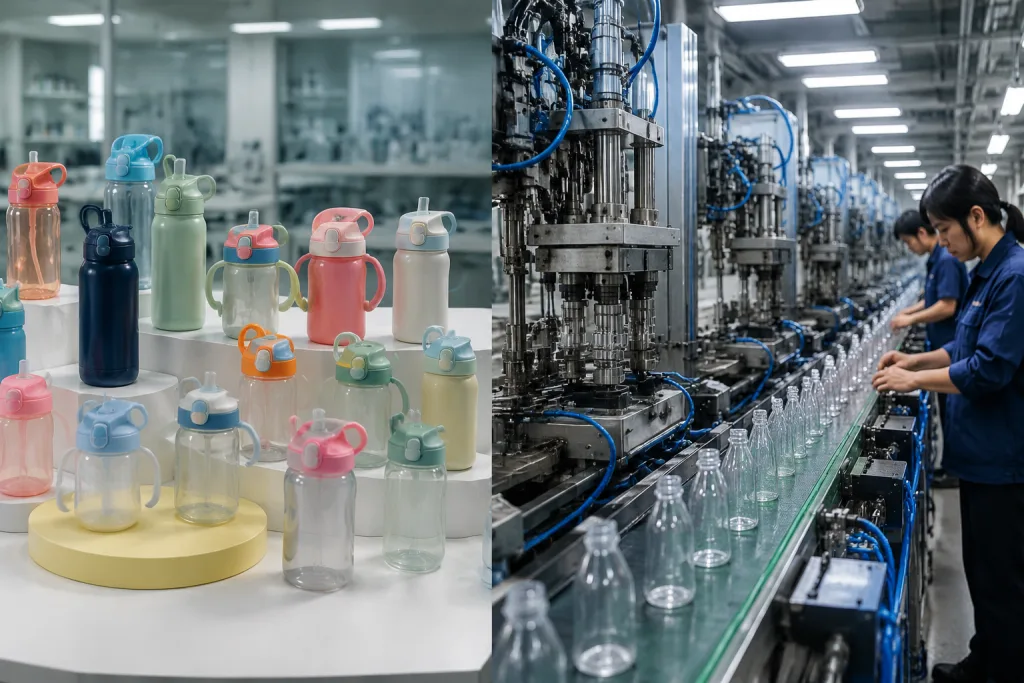
Lock compliance before you send the deposit. After the line has cut steel and molded lids, the math gets ugly: 12 days for a pre-production retest can become 18 days of rework and repacking. For toddler bottles, ask for current test reports for every food-contact part: 304 stainless body, PP or Tritan lid, silicone straw, coating, plus printed ink if a child’s mouth can touch it. EU buyers usually ask us for LFGB, EU 1935/2004, REACH, and sometimes EN 14350 when the design is positioned for younger ages. US buyers often request FDA food-contact declarations, CPSIA lead and phthalate limits, ASTM-related child-use checks, and Prop 65 for California. We had one buyer flag a 0.8 mm straw vent hole because their lab treated it as a child-use risk, so this is not paperwork theater.
Do not accept a generic report for “plastic bottle” when your order uses a new lid compound. Wrong question. Ask whether the report matches the exact resin grade, color masterbatch, silicone hardness, and ink system on your PO. Test reports should show material, supplier, standard, date, and laboratory. Reports older than 2-3 years may work as background, but 7 out of 10 chain retailers we deal with now want current testing from the production batch or the same material lot. QC pulled one lid sample last quarter where the report said PP, but the incoming bag label showed AS; that mismatch stopped the order before deposit.
Factory audits matter too. BSCI, Sedex, ISO 9001, and Walmart-type audits do not make a bottle safe by themselves, but they show whether the factory runs a basic management system. In our Zhejiang plant, we run incoming material checks with a handheld XRF for metal grades, 100% leak testing for sealed bottles at the water-test station, and final inspection under AQL. For a 10,000 pc toddler bottle wholesale bulk order, we normally recommend third-party inspection when goods are at least 80% packed. The inspector should open cartons, check straw fit with a pull gauge, and test random bottles upside down for 30 minutes, not just count master cartons.
If your wider range includes drinkware wholesale, canteen wholesale, alcohol flask wholesale bulk, or beer tumbler wholesale bulk, keep compliance files separated by category. A beer growler bulk program may focus on pressure resistance and stainless passivation, with alcohol-contact claims filed under its own SKU folder. A toddler bottle program needs food-contact safety, choking risk, leak reliability, and coating durability tied to the toddler SKU. We have seen this go sideways when a buyer attached beer tumbler LFGB files to a toddler bottle PO, then their retailer rejected the shipment at document review. China suppliers can manage both categories, but one category’s paperwork cannot cover the other.
Deposit-stage PO line items: required standards, named test lab, retest cost owner, audit documents, batch traceability code, and right to reject if reports fail. Add the SKU, color code, lid material, straw material, and MOQ to the same PO page; one typo such as “silicon” instead of “silicone” can trigger a lab question and cost 3 days.
Confirm Bulk PO Economics
After the sample is approved, the bulk PO needs more detail, not less. We have seen 8 out of 10 disputes start because the buyer points to the golden sample while the line follows the written PO and our internal production sheet. Write both into the order: “Produce strictly according to approved golden sample dated May 12 and specification sheet BF-TB350-V3.” QC pulled one toddler bottle sample last year where the PO said “pink,” but the approved Pantone chip was 1905C; that 1-word gap cost 6 days.
Break the PO into commercial line items. Unit price should state quantity, currency, Incoterm, and port, for example USD 3.25/pc FOB Ningbo for 5,000 pcs. Then list mold charge, sample charge credit, logo setup, color box, master carton, testing, inspection, spare parts, freight if quoted, plus barcode labels and inner bags if the buyer needs them. This is where the math gets clean. We had a buyer flag a USD 0.06/pc label cost after mass production started because their PO only said “retail ready,” which means nothing on a cost sheet.
Packaging is not a small detail. For toddler bottles, retail cartons must protect handles and spouts from compression, not just look good on a shelf. A typical 350 ml stainless toddler bottle may pack 24 pcs per master carton, with a carton weight around 9-12 kg depending on box board and accessories. If selling through online channels, ask for a 76 cm drop test on the final packaged unit; our lab uses a 3A drop sequence and checks spout cracks with a 0.05 mm feeler gauge. If shipping to Amazon FBA, add FNSKU, carton labels, suffocation warning if polybags are used, and carton weight limits.
Payment terms should match order risk. A common China arrangement is 30% deposit and 70% balance before shipment after inspection. For repeat buyers with stable credit, we can discuss other terms, but first orders usually stay conservative because the factory has already bought stainless tube, PP lids, silicone straws, and color boxes before final payment. Our Hangzhou, Zhejiang lead time for existing molds is typically 25-35 days after deposit and golden sample approval for 3,000-10,000 pcs. New tooling adds 20-30 days, and if the CNC shop is full, 20 days vs 30 days is the difference between a calm shipment and daily chasing.
If you combine toddler bottles with beer tumbler wholesale, beer growler wholesale bulk, or alcohol flask in bulk, do not force all items into one identical lead time. This is the wrong question to ask. Powder-coated tumblers wait on coating line capacity, insulated growlers slow down at vacuum testing, and child bottles get stuck at straw assembly and pull-force checks; we ship cleaner when the PO shows separate ready dates, even if everything loads into one 40HQ at Ningbo.
Control Production And Inspection
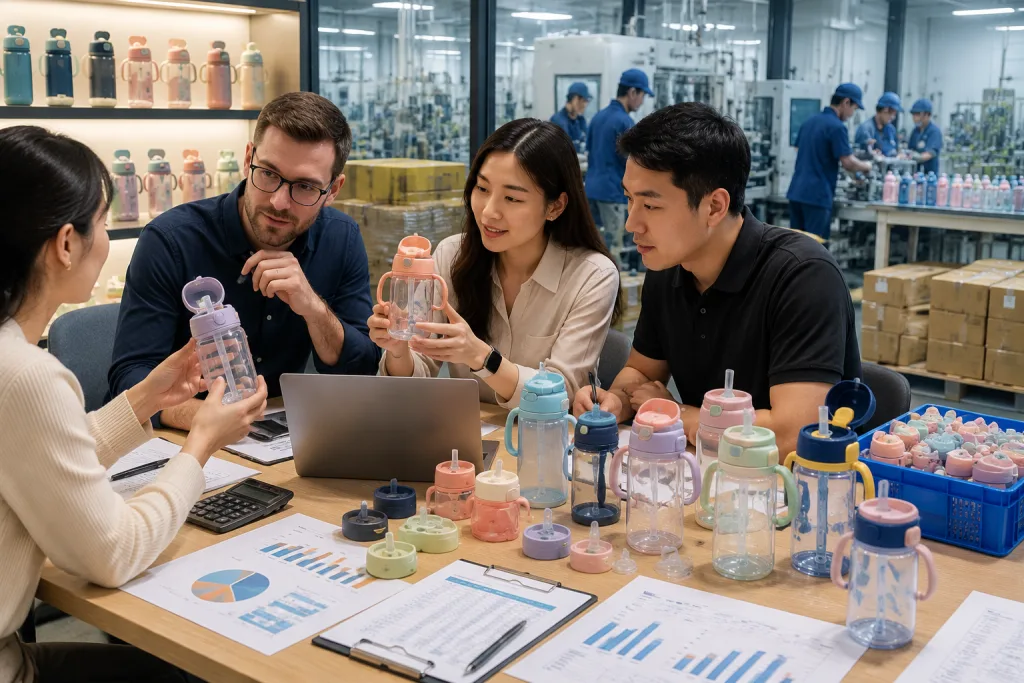
Production control starts before the first carton reaches the tape machine. Ask for a pre-production meeting record, or at least a signed production confirmation. It should show the 304 stainless lot or plastic resin batch, Pantone color panel, logo print position in mm, lid assembly drawing, gasket direction, carton packing method, and the inspection checklist the line will follow. Paper matters. If the factory cannot send this, they might still make acceptable bottles, but when QC pulls a leaking sample at 10:30 p.m., you have less room to push for sorting or rework.
For toddler bottles, the inspection plan needs clear checkpoints: appearance under a 600 lux light box, capacity by measuring cup, unit weight on a 0.1 g scale, coating adhesion by 3M tape test, logo position tolerance such as ±1.5 mm, lid torque, straw fit, handle pull strength, leak test, odor check, barcode scan, carton drop, and packing count. AQL 2.5 for major defects and 4.0 for minor defects is common for bulk drinkware. Critical defects should be zero tolerance. Any sharp edge, broken plastic, loose small part, strong odor, or serious leakage goes into critical or major. We have seen buyers argue that a loose straw plug is “minor”; for toddler bottles, that math does not work.
Leak testing needs its own line item. We prefer 100% leak testing on the factory line, then a random recheck during final inspection, for example 125 pcs pulled from a 5,000 pcs lot. A toddler bottle leaking in a parent’s bag turns into refunds fast. Ask whether the factory uses air pressure, water inversion, vacuum, or a manual shake test. Manual testing is acceptable for a 1,000 pcs trial order, but the method must be written down: fill level, upside-down time, shake count, and who signs the record. No record, no proof.
During production, request photos at 3 points: incoming raw material and components, first finished pieces, then packed cartons with shipping marks visible. Photos do not replace inspection, but they catch ugly mistakes. If the approved lid is light grey and the line starts with white lids, you want that flagged on day 3, not after 5,000 pcs are packed and palletized. One buyer once sent a PO with “gray” in the text and “white” in the attachment; the production photo saved us from shipping the wrong lid color.
This same control logic works for broader wholesale drinkware programs, including beer tumbler in bulk, beer growler in bulk, growler wholesale, and canteen bulk. The defect definitions change. The habit does not. For a growler, QC may focus on cap thread fit and 24-hour seepage; for a canteen, the buyer may flag belt clip strength after a 5 kg pull test. Define what failure looks like before the factory ships, because after loading, every fix costs more.
Ship With Traceable Documents
The last step is not booking space on a vessel. Before balance payment, collect the inspection report, packing list, commercial invoice, pending test reports, carton marks, and production batch records. We usually match the batch sticker on the inner carton against the QC sheet before releasing the balance request; one wrong batch code can slow customs by 2 days. If you use your own forwarder, send shipping marks and carton dimensions early, including the master carton size in mm. If the factory books under FOB China terms, confirm the port cutoff date and ask whether the forwarder has received the shipping order.
Your shipping PO or logistics instruction should show consignee and notify party first, then HS code, carton count, gross weight, net weight, CBM, pallet requirement, and any retail routing guide. Small typo, big problem. We once saw “notify party” copied from an old PO, and the buyer flagged it after the container had already left Ningbo. For North America, ask your customs broker if they need a material breakdown for 304 stainless, PP plastic, and silicone by weight. For Europe, keep Declaration of Conformity files ready, especially for child-use products.
Ask for spare parts if the bottle uses straws or gaskets. For toddler bottles, 1%-2% spare straws and gaskets saves the after-sales team from sending full replacement bottles. QC pulled the sample set last month and found 3 silicone gaskets missing from a 200-set accessory carton, so we now count spares on a digital scale before sealing. Decide whether spares ship in bulk cartons or retail-ready replacement kits. Put it on the PO. Last-minute favors get messy.
After delivery, record actual defect rate, customer complaints, and sell-through feedback. If leakage complaints are 0.8% on the first 3,000 pcs, reordering the same spec is the wrong question to ask. Check whether the issue comes from gasket assembly, straw bite damage, or user operation. On the line, we measure lid fit with a 0.02 mm feeler gauge and run a leak test after 24 hours at room temperature. A China factory can adjust gasket hardness, straw length, or lid tolerance on the next run, but only if you send data instead of “customers don’t like it.”
A disciplined toddler bottle wholesale bulk process makes the next program easier. Once specs, compliance files, AQL 2.5 inspection records, and logistics paperwork are stable, the same checklist works for wholesale canteen, drinkware bulk, alcohol flask wholesale, beer tumbler wholesale, and bulk growler orders. We ship mixed drinkware programs from Hangzhou every month, and the math does not work if every SKU starts from zero. Build the file once, then tighten it after each shipment.
Send Your Toddler Bottle RFQ For Review
Share capacity, market, quantity, logo method, and compliance target. We will return a practical quote with MOQ, lead time, and test options.
Frequently asked questions
What MOQ should I expect for toddler bottle wholesale bulk?
For existing molds, a realistic MOQ is usually 3,000 pcs per order and 1,000 pcs per color. Some factories quote 500 pcs, but the unit price is often 20%-40% higher because coating, printing, and packing setup costs are spread over fewer units. For custom lid tooling or exclusive shapes, expect 5,000-10,000 pcs for the first run plus tooling cost. At our Zhejiang factory, 3,000-10,000 pcs is the normal range for a first private-label toddler bottle order.
How long does sampling and bulk production take?
Reference samples from existing molds usually take 3-7 days. Logo and color samples take about 7-12 days after artwork and Pantone confirmation. If you need new plastic lid tooling, add 20-30 days. Bulk production for 3,000-10,000 pcs typically takes 25-35 days after deposit and golden sample approval. Add 3-5 days for final inspection and export paperwork. Ocean freight timing depends on port and season, so do not promise retail launch dates based only on factory production days.
Which tests are most important for toddler bottles?
Start with food-contact testing for every material touching liquid or mouth areas: stainless steel, PP or Tritan, silicone, coating, and ink where relevant. EU buyers often request LFGB, EU 1935/2004, and REACH. US buyers may request FDA food-contact support, CPSIA lead and phthalates, and Prop 65 review. Beyond lab reports, run practical tests: 100% leak test, 80 cm drop test, coating adhesion cross-hatch test, dishwasher exposure if claimed, and 200-300 lid open-close cycles.
Can I mix toddler bottles with canteen or growler orders?
Yes, but manage them as separate PO lines with separate specs and compliance files. A wholesale canteen or beer growler wholesale bulk order may share stainless steel suppliers, coating lines, and cartons, but toddler bottles need child-use risk checks, straw retention review, and stricter odor control. Combining programs can help with factory scheduling and total order value, especially if you buy 5,000 toddler bottles plus 3,000 canteen wholesale units. Do not let adult product standards replace toddler product requirements.
What should be written on the final purchase order?
Your PO should state product code, capacity, material grade, lid material, silicone type, wall thickness, color, logo method, artwork version, packaging, barcode, quantity, unit price, Incoterm, port, lead time, payment terms, inspection standard, required testing, and approved golden sample date. Add separate lines for tooling, sample credits, color box, FNSKU labels, spare straws, and third-party inspection if applicable. For a 5,000 pc order, this detail prevents USD 300-1,500 in surprise charges and reduces shipment disputes.