Key Takeaways
- Set safety requirements first: LFGB, REACH, CPSIA, ASTM F963, and 0-3 age warnings change the design
- A practical custom toddler bottle MOQ is usually 1,000-3,000 pcs per color for factory-direct orders
- Leak testing, straw pull force, coating adhesion, and AQL 2.5/4.0 inspection matter more than catalog photos
- Use one China supplier for toddler bottles and related custom drinkware only if material systems and QC are shared
Buying toddler bottles is not the same as buying a basic sports bottle. The user is 2 years old, the parent checks every bite mark, and the retailer will ask for test reports before they approve the shelf slot. A cute shape and a low FOB price do not matter if QC pulls 32 samples and finds 3 straw valves leaking at 45° tilt, the cap fails a pull test, or the coating cannot pass REACH.
As a Zhejiang, China drinkware factory, BottleForge Industrial sees the same sourcing mistake on about 7 out of 10 new toddler bottle projects: the buyer asks for a catalog first, then tries to fix safety, MOQ, branding, and packaging after the PO is already typed. This is the wrong question to ask. We run the order better when the buyer locks the safety standard, material, decoration method, and inspection plan before comparing toddler bottle suppliers; last month one buyer flagged a PO typo showing 304 stainless on the bottle body but PP on the spec sheet, and that small mismatch would have delayed samples by 12 days vs 18 days if we caught it after tooling.
Start With The Non-Negotiables
Your first decision is not color, shape, or logo position. The first gate is whether the bottle can pass toddler-category compliance in the market where you will sell it. For Europe, ask for material declarations and test reports from the last 12 months aligned with LFGB, EU 10/2011 for food-contact plastics, REACH, and EN 14350 where applicable. For North America, check CPSIA, ASTM F963, FDA food-contact compliance, and total lead/cadmium limits for coatings and printed areas. We have seen buyers send a PO with “kid bottle” typed in the description, then their lab booked toddler testing 9 days before shipment. The line stopped.
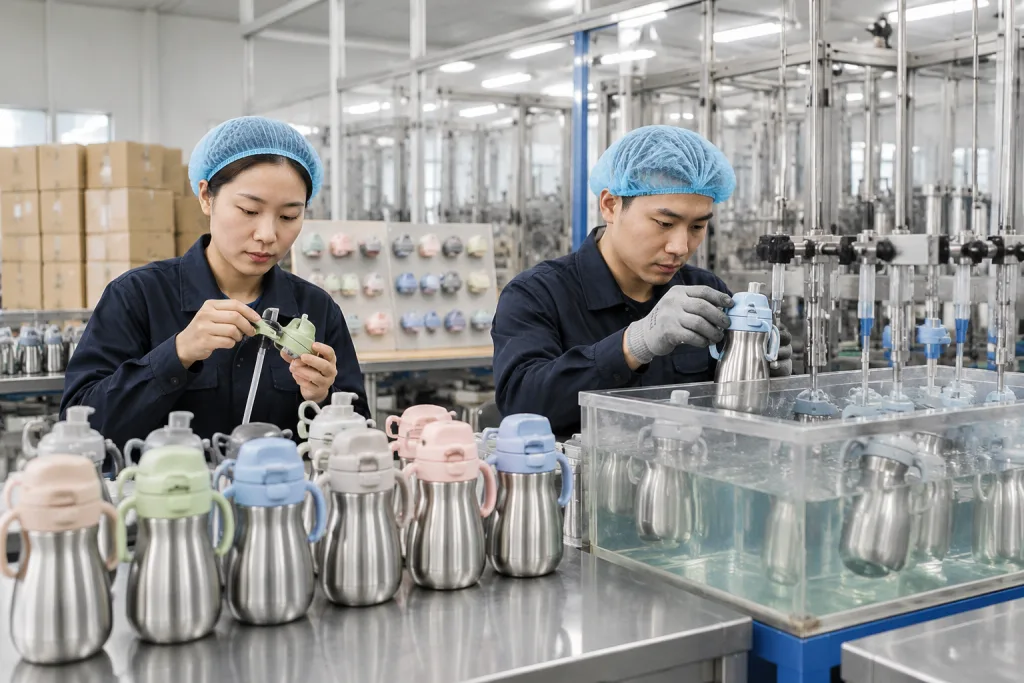
A serious toddler bottle supplier should separate every food-contact part by material: 304 stainless steel body with coil batch number, PP lid with resin grade, silicone straw with Shore A hardness, Tritan or PPSU if the design uses plastic, and TPE or silicone seals. Do not accept “BPA free material” without grade, resin supplier, and test scope. That wording looks harmless on a quote sheet, but QC pulled the sample and found two different gasket colors from two sub-suppliers in the same carton. If the bottle has a weighted straw, carry loop, flip lid, or removable gasket, each part needs a 2D drawing, material line item, and tolerance note in mm.
The trade-off is simple. More removable parts help parents clean the bottle and give retailers more selling points, but they add failure points on the line. A toddler bottle with 8 parts needs tighter assembly control than a 4-part design; this is the wrong question to ask if the only target is saving USD 0.08. For a 12 oz stainless model, we usually recommend 0.45-0.50 mm inner wall and 0.50-0.60 mm outer wall, depending on dent-resistance expectations. Too thin saves a few cents. It also comes back after the first drop from a stroller tray, and we have measured 1.8 mm rim deformation on samples that looked fine in the showroom.
Choose The Right Supplier Type
A canteen vendor, a trading company, and a canteen factory that also makes toddler bottles are not the same animal. If you need 500 mixed pieces for a school promo, a distributor canteen source or canteen distributor can handle it from shelf stock. For repeat retail programs with private-label boxes, Pantone-matched lids, and the same finish for 12 months, work with a canteen manufacturer or drinkware factory that controls the hard points: tooling in mm, welding fixtures, polishing grade, powder coating line, and final assembly. We’ve had buyers ask why a lid from batch 2 felt tighter than batch 1; the answer was a 0.15 mm mold insert change that a trader never saw.
BottleForge Industrial runs from Zhejiang, China, with monthly drinkware output around 600,000 units across stainless thermos bottles, travel tumblers, sports bottles, and kids bottles. For toddler bottle projects, our normal MOQ is 1,000 pcs per color for stock-shape logo orders and 3,000-5,000 pcs for custom mold or special lid development. Standard lead time is 25-35 days after artwork and deposit; new tooling can add 20-30 days. On the line, QC checks lid fit with a torque meter and pulls first-article samples before mass packing starts, because one wrong PMS code on a PO can turn “soft pink” into a rejected carton run.
Be careful when canteen suppliers say they can produce anything. That is usually the wrong answer. A canteen customized for adults may use a screw cap, a wide spout, a 280 g body, and a drop-test setup aimed at hiking gear. A toddler bottle needs smaller grip diameter, controlled flow, soft mouth contact, and cap geometry with no pinch points near the hinge. Some canteen manufacturers are good at outdoor metal bottles but weak on child-safe lid design; we’ve seen this go sideways when QC pulled the sample and found the straw valve popping out after a 1.2 m drop. Ask where the lid is made, who owns the mold, and whether the same QC team checks body plus lid assembly.
If you are a canteen distributor or distributor drinkware buyer carrying several categories, the best supplier is not always the cheapest one. The math doesn’t work if reorder 2 ships with different silicone hardness, a shifted Pantone color, weak 5-ply cartons, or barcodes placed 8 mm off the retail template. We ship reorders against the approved golden sample, and the buyer flagged it fast the one time a carton label used “pcs” on the PO but “sets” on the shipping mark.
Decide Customization Before Quoting
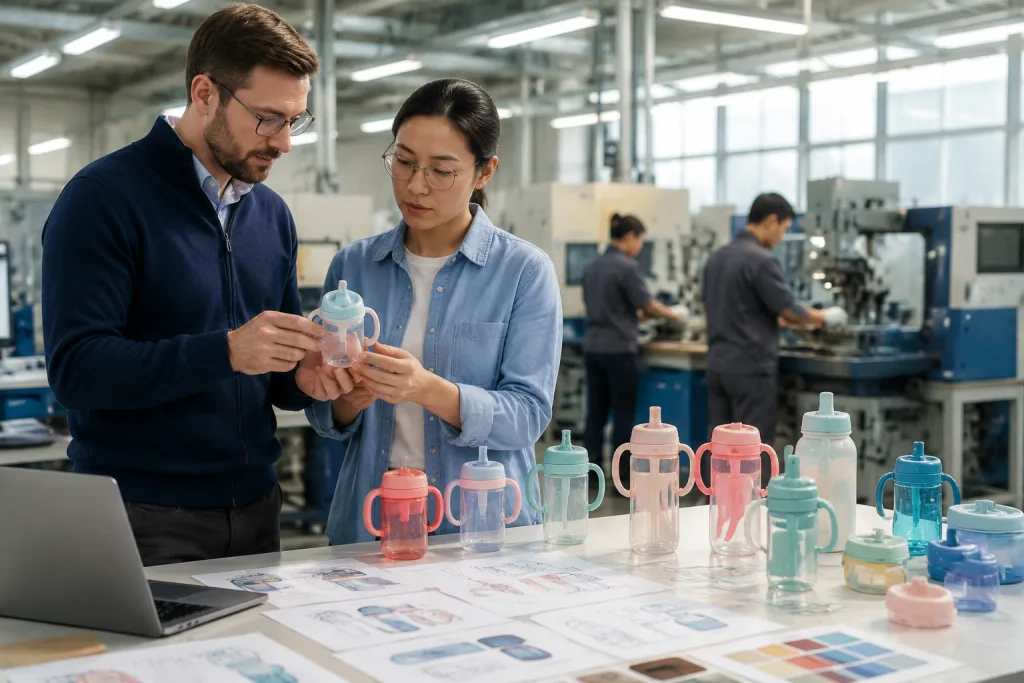
Customization moves the quote more than 7 out of 10 first-time buyers expect. A plain 304 stainless toddler bottle and a canteen promotional order with four-color printing do not run on the same line. Before asking for FOB Ningbo or FOB Shanghai pricing, decide the finish and packing details: laser engraving, silk screen, heat transfer, powder coating, water transfer, embossed logos, custom hang tags, retail boxes, or FNSKU labels for marketplace fulfillment. Last month one PO said “matte pink” but no Pantone code; our spray booth had to stop until the buyer confirmed 705C.
For logo work, laser engraving is durable and clean on stainless or coated surfaces where the contrast shows. Silk screen is cheaper for one-color logos, often USD 0.05-0.12 per position at volume, but we still run adhesion testing on powder coat because the ink can lift at the shoulder curve. Heat transfer handles full-color artwork better. Toddlers chew, scratch, and drop bottles, so QC pulled the sample for 3M tape adhesion, dishwasher simulation if claimed, and 500-cycle rub testing before mass production approval.
Custom canteen buyers often ask whether a toddler bottle can share branding with a custom growler or customizable canteen line. Yes, but forcing one decoration method across every SKU is the wrong question to ask. A 64 oz distributor growler has a wide printable wall, often 110 mm or more. A 10-12 oz toddler bottle has curves, lid parts, and silicone grip areas that cut the safe print area down fast. We ship matched programs by using the same color chip, carton artwork, and icon style while changing the factory process by item.
If you want a canteen customizable program across adults, kids, and toddlers, lock the decoration matrix before quoting: product and material, logo method and maximum print size, MOQ and setup cost, approval sample time, expected durability. One spreadsheet prevents most quote confusion. We use a 9-column sheet on the sales desk, and the line leader checks it against the approved sample tray before production. Skip this step and the math does not work; we have seen a USD 85 screen charge disappear from the buyer’s target price because it was never listed.
Price The Whole Landed Program
A low unit price can hide bad math. For a 12 oz stainless toddler bottle, realistic factory-direct FOB China pricing may sit around USD 3.20-5.80 depending on lid complexity, coating, packaging, and order quantity. On our Hangzhou line, a silicone-straw lid with two small plugs takes 18-22 seconds longer to assemble than a plain screw cap, and that labor shows up somewhere. A basic PP toddler bottle might look cheaper, but tooling, compliance testing, and retailer requirements can wipe out the saving. Compare the full landed program, not only the ex-factory price.
Include tooling, pre-production samples, lab testing, inner bags, retail boxes, master cartons, spare straws, instruction sheets, warning labels, barcodes, pallet requirements, and inspection. A custom mold lid can cost USD 3,000-12,000. Lab testing can cost USD 300-1,500 per model and material set. A stronger 5-ply export carton may add only USD 0.08-0.18 per unit but reduce crushed-box claims in long ocean freight routes. QC pulled one toddler-bottle carton last season with a 7 mm corner crush after the drop test; the buyer did not care that the bottle inside was fine.
Packaging is where 6 out of 10 toddler bottle projects get messy. North American retailers may want UPC, choking warnings, country of origin, age grading, and English/French copy. European buyers may need multilingual instructions, recycling marks, importer details, and food-contact symbols. If you sell through marketplace channels, FNSKU and carton label accuracy matter; one wrong digit on a PO carton mark can hold 42 cartons at the forwarder. A factory that already handles custom drinkware and distributor canteen orders should understand carton marks, PO numbers, and mixed-SKU packing rules.
Do not push MOQ below the process minimum unless you accept trade-offs. At 500 pcs, powder coating loss, printing setup, and QC time are spread across too few units; the math doesn't work if the buyer still wants tight Pantone matching and AQL 2.5 inspection. At 3,000 pcs, color consistency and unit economics usually become better. We run the first coating check with a gloss meter and a 60-degree angle reading, not by “looks close” under office lights. Cheap samples are easy. Stable repeat production is the real test.
Build QC Into The Purchase Order
Put quality control in the purchase order before we cut steel or buy cartons. Do not leave it for a defect argument at shipment. For toddler bottles, write the inspection level clearly: AQL 2.5 for major defects and AQL 4.0 for minor defects unless your retailer sets tighter limits. Define critical defects as sharp edges, exposed metal burrs, loose small parts, failed leak test, wrong material, serious contamination, or unreadable safety labeling. Critical defects are zero tolerance. On one Target-style toddler bottle order, QC pulled 3 lids from the first 80 pcs and found a 0.35 mm burr inside the straw hole; because the PO named burrs as critical, the line stopped in 12 minutes instead of turning into a 4,800 pcs sorting job.
Factory checks should cover incoming material verification, vacuum performance if insulated, 100% leak testing for assembled lids, straw pull-force checks, cap torque checks, coating thickness checks, and random drop tests. We run assembled lids through a simple air-pressure leak jig at 20 kPa, then the line records failures by mold cavity. For powder coating, we usually check film thickness around 60-90 microns depending on finish, using an Elcometer gauge on the body shoulder and base curve. For silk screen, run tape adhesion and alcohol rub tests. For toddler bottles with silicone straws, confirm hardness, odor, color migration, and fit after boiling-water exposure; we have seen 55 Shore A straws pass fit before boiling and then loosen after 10 minutes in hot water.
A good canteen supplier will let you review golden samples, pre-production samples, and final inspection photos before shipment. Better: hold a sealed approval sample at the factory and compare bulk production against it under the same light box. This matters when you reorder six months later and expect the same green, same lid snap, same carton layout. The buyer flagged it once because the PO said “mint green,” but the approved sample label read “Pantone 566C” and the reorder came in closer to 565C. Small wording, big headache.
If you use a third-party inspector in China, give them product-specific checks. Generic drinkware inspection misses child-specific risks, and this is the wrong question to ask if the report only says the bottle looks clean. Tell them to check straw retention, cap hinge fatigue, valve function, lid alignment, and warning labels. Ask for actual numbers: straw pull force in N, cap torque in kgf·cm, lid gap in mm, defect counts by carton, and carton drop condition. We have seen this go sideways when an inspector checked 125 pcs for scratches but never pulled the straw; the buyer found loose straws after arrival, and the math did not work for rework in the US warehouse.
Plan Reorders And Category Growth
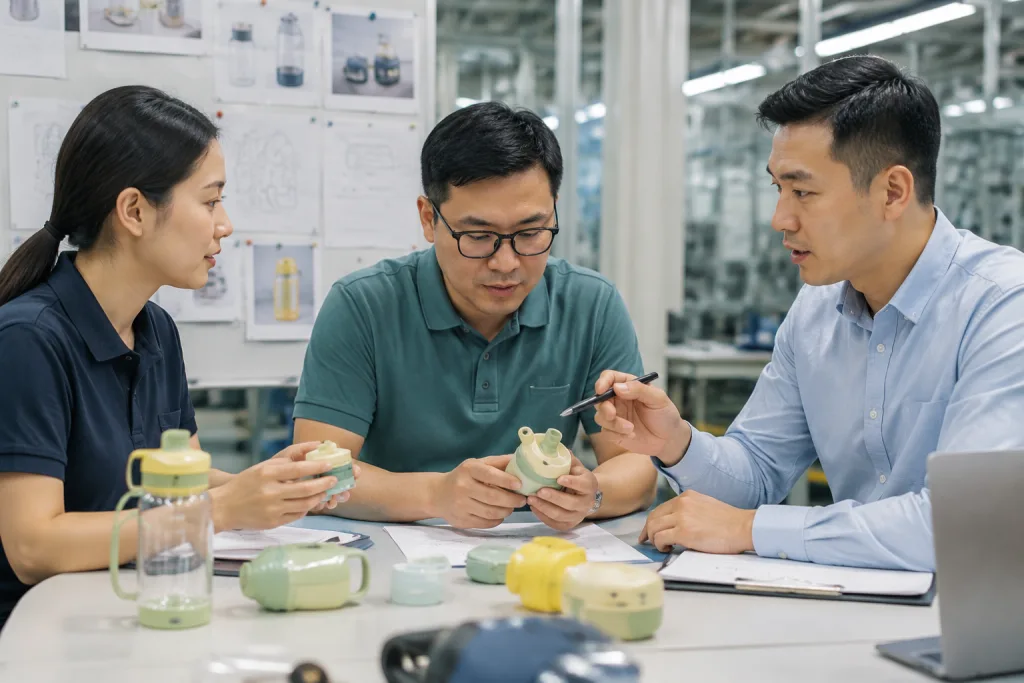
The real decision is whether this supplier can carry the next 18 months, not just the first PO. We’ve seen 7 out of 10 buyers start with toddler bottles, then add customized canteens, sports bottles, school bottles, or a customizable growler for family camping sets. That works when the factory runs the same 304 stainless control, the same coating line, and one artwork archive with version numbers. It goes sideways when every SKU becomes a fresh experiment; last spring QC pulled a toddler lid sample because the straw port was 0.6 mm off from the approved drawing.
Ask for a reorder system you can audit: retained color panels, archived artwork, mold maintenance records, packaging dielines, and a written change-notice rule. Simple stuff. If a lid resin, silicone supplier, coating powder, or carton structure changes, you should know before production, not after the goods arrive in Rotterdam, Hamburg, Los Angeles, or Toronto. For retail programs, we recommend confirming forecast bands: first order 3,000 pcs, reorder 5,000-10,000 pcs, and safety stock rules for critical lid parts. On our line, we keep 2 approved PP resin codes and 1 backup silicone vendor on file; the buyer once flagged a PO typo that said “matte blue” while the signed color panel was “mist blue.”
For broader customizable drinkware programs, do not mix adult and toddler risk into one spec sheet. This is the wrong question to ask: “Can one supplier make both?” A customized canteen for a hiking promotion is judged mostly on insulation, print rub, and dent resistance after a 1 m drop test. A toddler bottle brings age grading, small-parts checks, parental cleaning complaints, and retailer paperwork that must match the lab report. One canteen manufacturer can make both, but your specifications should not be identical; we once stopped a shared lid design because the pull tab failed our 90 N tension check.
China stays strong in this category because the supply chain is tight: stainless steel forming, plastic injection, silicone parts, coating, printing, packaging, and testing labs sit within a short truck run. In Zhejiang, we can usually correct a lid fit issue or artwork jig in 3-5 days, not 14-21 days, because the tool shop and pad-print fixture maker are nearby. We run trials with a digital caliper on the lid OD before the carton test, and that saves buyers from paying air freight for a fix that should have happened on the factory floor.
Send Your Toddler Bottle Specs For A Factory Review
Share capacity, material, target market, MOQ, and packaging needs. We will flag safety, cost, and production risks before quoting.
Frequently asked questions
What MOQ should I expect from toddler bottle suppliers?
For factory-direct sourcing in China, expect 1,000 pcs per color for an existing toddler bottle shape with a simple logo, and 3,000-5,000 pcs for custom colors, special lids, or private-label packaging. New mold work often needs 5,000 pcs or more to make the tooling cost sensible. If a supplier accepts 300 pcs with full customization, check whether they are using stock inventory, manual decoration, or trading-company consolidation. Low MOQ is useful for market testing, but it usually raises unit cost by 15-40% and limits QC control.
Which material is best for toddler bottles?
For premium B2B programs, 304 stainless steel with PP lid and food-grade silicone straw is the safest default. It is durable, odor-resistant, and supports powder coating or laser engraving. Tritan can work for lightweight transparent bottles, but buyers must verify BPA-free documentation, impact performance, and applicable food-contact compliance. PPSU is stronger and heat-resistant, but it is more expensive and usually used in baby feeding products. For stainless toddler bottles, ask for wall thickness, steel grade, coating spec, and test reports for all food-contact parts, not only the body.
How do I compare toddler bottle quotes fairly?
Create a line-by-line quote sheet before comparing suppliers. Include capacity, material grades, wall thickness, lid structure, straw material, logo method, packaging, carton quantity, spare parts, testing, inspection, FOB port, payment terms, and lead time. A USD 3.60 quote and a USD 4.20 quote may not be comparable if one includes retail box, 100% leak testing, and stronger cartons. Ask every supplier to quote the same MOQ, such as 3,000 pcs per color, and the same Incoterm, usually FOB Ningbo or FOB Shanghai for Zhejiang-area factories.
Can one supplier handle toddler bottles and custom canteen programs?
Yes, if the supplier has real drinkware production depth and not just a broad catalog. Toddler bottles, custom canteen orders, and customized drinkware programs share processes such as stainless forming, coating, printing, packaging, and leak testing. The risk profile is different, though. Toddler bottles need stronger attention to small parts, straw safety, cap hinges, and age labeling. Adult canteen promotional products focus more on print cost, capacity, and finish. Ask whether the same QC system, artwork team, and material traceability apply across both categories.
What lead time is realistic for a private-label toddler bottle order?
For an existing mold with custom logo and standard packaging, plan 25-35 days after deposit and artwork approval. Add 7-10 days for pre-production samples if color matching or new decoration is required. If you need custom lid tooling, allow another 20-30 days for mold design, trial, adjustment, and approval. Ocean freight to Europe or North America often adds 25-45 days depending on route and season. For retail launches, start at least 90 days before the required warehouse arrival date, especially if lab testing is needed.