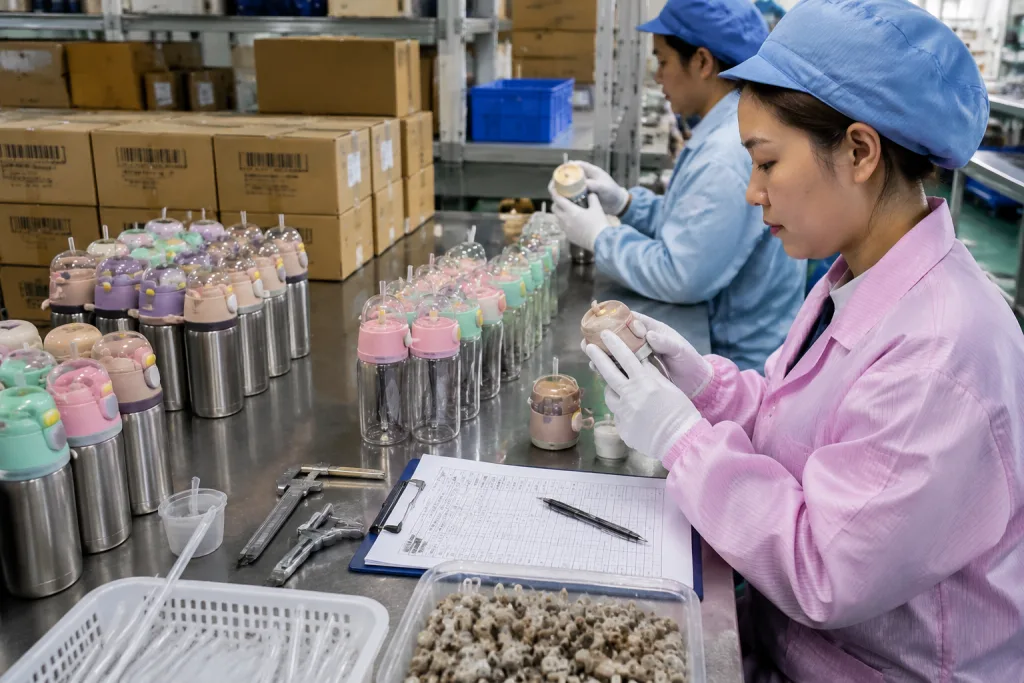
Key Takeaways
- For toddler bottles, set AQL at 2.5 for major defects and 4.0 for minor defects before production
- Ask for CPSIA, EN 14350, FDA/LFGB, and REACH test scope by material, not just by finished SKU
- A realistic custom MOQ is 1,000-3,000 units per color when tooling is already available
- BottleForge Zhejiang capacity is about 180,000 toddler and kids bottles/month with 30-45 day production lead time
A toddler bottle looks simple until it sits on a retail shelf in Germany, Canada, or the United States. Then every spec line gets checked: straw ID at 6.5 mm or 7.0 mm, cap torque in kgf·cm, silicone grade, 1.2 m drop test, warning label text, carton compression, and whether the logo ink survives 100 dishwasher cycles. QC pulled one sample last month where the straw passed fit-up, but the bite valve split after 23 pulls on the tensile tester.
If you are choosing a toddler bottle supplier in China, skip the pretty rendering at the first call. Start with the spec sheet. At BottleForge Industrial in Hangzhou, Zhejiang, we see 7 out of 10 buyer problems come from loose specs, not bad intentions. A canteen factory can make a safe bottle or a risky one using the same mold, depending on what you approve; we’ve seen this go sideways when a PO says “food-grade silicone” but leaves out LFGB or FDA, and the buyer flags it only after pre-shipment inspection.
Age Grade Drives The Design
The first line on a toddler bottle spec sheet should be age grade, not capacity or Pantone color. Start there. A bottle marked 18 months and up does not get reviewed like a school sports bottle, even if both are 350 ml and made on the same line. The buyer impact shows up fast: choking-risk review, bite resistance, warning copy, and what the carton is allowed to claim. Last month QC pulled a lid sample because the PO said “kids bottle,” while the color box artwork said “12M+.” That mismatch cost 3 days before mass print approval.
For North America, match the product to CPSIA requirements and relevant ASTM mechanical safety checks. For Europe, EN 14350 is the usual reference for drinking equipment for young children. If the retail listing says suitable from 12 months, your toddler bottle supplier should be strict with every detachable part. Straw valves, pull tabs, silicone plugs, and decorative charms cause the headaches. We run these parts through a small-parts cylinder check on the QC bench; if a loose piece drops in, the discussion with the buyer gets uncomfortable.
Our normal advice is simple: keep removable components above 31.7 mm where the design allows, skip loose decorations, and choose a one-piece silicone straw assembly if the target price has room for it. Cute does not always pay. We have seen a 0.18 USD cap charm add a second lab review, a mold tweak, and 12 days to the schedule. The math doesn’t work unless the retailer is paying for that shelf effect.
If you also buy custom canteen, customizable canteen, or distributor canteen ranges, do not paste adult bottle specs into toddler SKUs. Adult canteen customized projects often use 25 mm shoulder straps, metal hooks, and removable infusers. Fine for a camping canteen manufacturer. Wrong for a toddler bottle. We ship both categories, and the buyer flagged this exact issue on a mixed PO where line 03 was adult and line 04 was toddler. Your spec sheet should separate toddler, kids, sports, and adult custom drinkware families before sampling starts.
Material Lines Need Proof
A toddler bottle supplier should break out every food-contact material by part. One line like “BPA free material” is weak. Ask for the exact resin or alloy on the spec sheet: Tritan copolyester body, PP lid, food-grade silicone straw, SUS304 stainless steel inner wall, or SUS316 for a premium line. We run this check before tooling, because last April a buyer flagged a PO that said “TR material” while the sample tag from the injection line showed PP.
The buyer impact shows up in cost, testing, taste, and shelf life. Tritan is clear and impact-resistant, common for toddler bottles in 350-500 ml sizes. PP costs less, but it is milkier and can look worn after 30 dishwasher cycles in our lab basket. Stainless steel 304 is stable and strong, but inner polishing, weld cleanliness, and vacuum performance need control if the bottle is insulated. For a toddler bottle, 0.4-0.5 mm stainless wall thickness is common; going thinner might save USD 0.04-0.07 per unit, but we have seen this go sideways with dent claims after drop tests on the 1.2 m jig.
For silicone, ask whether it is peroxide-cured or platinum-cured. Platinum-cured silicone costs more, often USD 0.03-0.08 more per straw set, but the odor risk is lower and buyers trust it faster. Smell matters. QC pulled one peroxide-cured straw sample from a 5,000 pcs pilot run and the buyer rejected it after a hot-water soak at 70°C for 2 hours. If your retail channel is strict, the cheaper straw is the wrong place to save money.
Testing should match the material, not the finished bottle name only. FDA 21 CFR, LFGB, REACH SVHC screening, phthalates, lead, cadmium, and BPA/BPS checks should be tied to the body, lid, straw, printing ink, and coating. Zhejiang and wider China supply chains can provide these reports, but ask for the report holder, test date, tested color, and lab name. We ship this paperwork with the pre-production file now, because a canteen supplier sending a three-year-old generic report for a different item gives you no real protection when customs or a chain-store QA desk asks questions.
Capacity, Weight, And Grip
Capacity is not just a marketing number. For toddlers, 300 ml, 350 ml, and 400 ml are the sizes we see pass buyer testing without arguments. A 500 ml bottle looks stronger in a catalog, but fill it and the math gets ugly. A 400 ml bottle carries about 400 g in water before stainless steel, handles, lid, and packaging; our QC scale usually shows 610-690 g packed for a double-wall sample. Parents feel that on day one.
For a plastic toddler bottle, target finished empty weight around 95-140 g for 350 ml. For insulated stainless steel, 180-240 g is more realistic. If your brief asks for a 500 ml insulated toddler bottle under 200 g, this is the wrong question to ask. The line can shave grams with thinner 304 stainless, a lighter cap, or a smaller base pad, but we have seen that go sideways in drop testing when QC pulled the sample after a 1.2 m corner hit.
Grip is another spec line buyers miss. Toddlers do not hold bottles like adults. Handles should allow a 25-35 mm finger opening, with edges rounded to at least R1.5 where possible; we check this with a radius gauge before approving the tool texture. A silicone sleeve improves grip, but it adds assembly cost and traps moisture if the fit is loose by even 0.3 mm. For large distributor drinkware orders, we often suggest textured mold detail instead of a separate sleeve because it cuts hand assembly and avoids sleeve color mismatch the buyer flags during pre-shipment inspection.
For canteen custom programs that share a family design with kids and adult SKUs, keep the visual language consistent but change the ergonomics. A customizable growler or customized growler can use a broad loop handle and 64 oz body. That logic does not shrink safely to toddler scale. We run into this on OEM briefs where the PO says “same handle, mini size,” then the first 3D print shows a child cannot clear two fingers through the grip. The spec sheet should show child hand dimensions, not just scaled-down adult renderings.
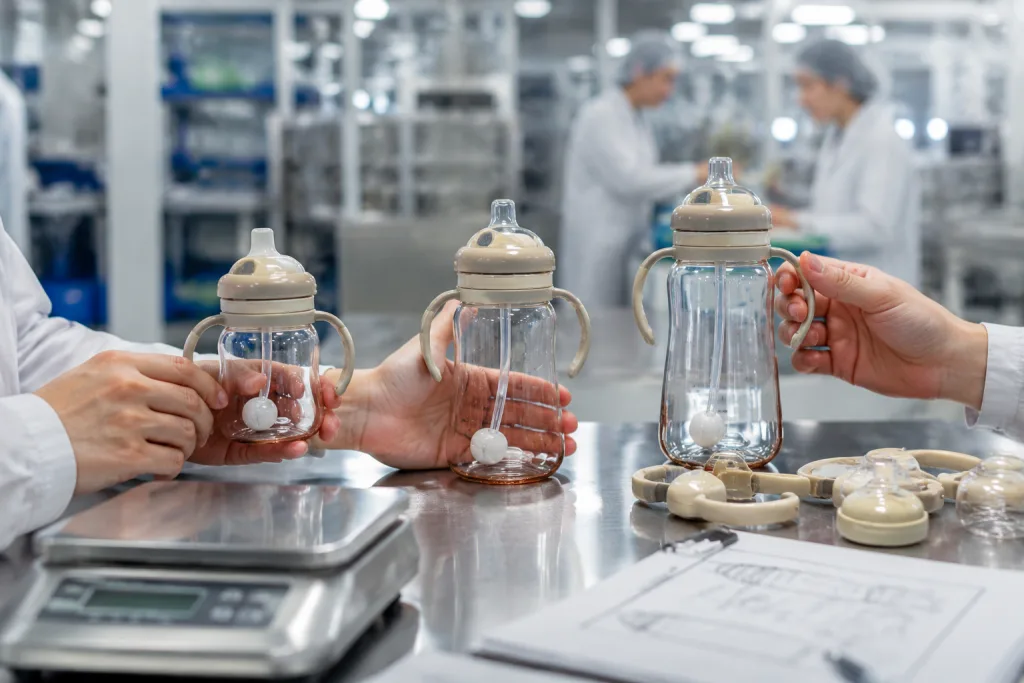
Lid, Straw, And Leak Specs
The lid assembly is where we see the most claims, usually 7 or 8 cases per 10 complaint emails. For toddler bottles, lock down open/close force, bite-valve hardness, thread engagement, leakage angle, and drop resistance on the spec sheet. No numbers, no control. A canteen vendor can pass a clean visual check at AQL 2.5 while still shipping a bottle that leaks after 12 minutes in a school backpack. QC pulled one sample last April with a perfect lid color match, but the thread only caught 1.5 turns on the go/no-go gauge.
For flip lids, we run 8-18 N as a practical opening force, checked with a digital force gauge at the front tab. Under 8 N, toddlers pop it open on the car seat. Over 18 N, parents send photos and ask why they need two hands. Silicone straw hardness usually sits around Shore A 45-60. Softer feels nicer but tears after about 3,000 bite cycles; harder can reach 5,000 cycles, but buyers have flagged the mouthfeel as “too plastic.” If replacement straw sales are planned, specify the straw SKU, mold cavity number, and tolerance from day one.
Write the leak test like an inspector will read it at 9 p.m. beside the line: filled to nominal capacity, water at 20-25°C, inverted for 30 minutes, no visible leakage. For stricter retail programs, add 45° side placement for 30 minutes and a 1.0 m drop test onto plywood or vinyl tile, three drops per unit at different orientations. We use 18 mm plywood in our lab because tile alone gives random bounce marks. Insulated stainless toddler bottles also need vacuum performance testing, usually 6 hours hot-water retention as a production control even if the product is sold for cold drinks.
If you source from 2 or 3 canteen suppliers, standardize the lid test method across all of them. This is the wrong question to ask: “Did they leak test it?” Ask how they tested it. One canteen factory may use cold water for 5 minutes before packing, while another tests for 30 minutes after a drop, then records the result on the IPQC sheet. On paper both say leak tested, but the buyer risk is not the same. We’ve seen this go sideways because a PO had “leakproof” typed in the remarks box, with no angle, time, or drop condition.
Decoration Changes Compliance Risk
Custom logo work is not just branding. On toddler bottles, decoration becomes a compliance risk because ink, coating, decals, and plating get touched, mouthed, scraped by little teeth, and washed 200+ times. A toddler bottle supplier should match each decoration method to PP, Tritan, silicone, or 304 stainless before quoting your artwork; we run a 3M tape pull and cross-hatch check on the first printed sample before the line keeps going.
For plastic bottles, one-color silkscreen is usually the safest cost option, often adding USD 0.05-0.12 per unit at 1,000 units. Heat transfer can carry full-color artwork, but QC still needs abrasion and migration checks, not just a nice photo from the printing room. UV printing looks sharp for small batches; we have seen buyers flag it after 25 dishwasher cycles when the edge of a 12 mm logo started lifting. For stainless steel, laser engraving is durable and clean. Powder coating plus laser gives a premium look, but powder coating adds cost, usually USD 0.20-0.45 per unit depending on area and color.
If the product is for toddler use, avoid large raised badges, glued labels, or metallic decals unless the test plan is clear before PO release. Lead and cadmium in surface coating are not theoretical risks; QC pulled one sample last year where a shiny gold decal failed the scratch check after 48 hours of room-temperature conditioning. Buyers in Europe should also check REACH and national retailer requirements that go beyond baseline law. The cheap decoration is the wrong question to ask here.
For canteen promotional orders, brands sometimes push bright artwork, character-style graphics, and low price at the same time. That is where mistakes happen. Customizable drinkware for adults can take more decoration methods, but customized drinkware for toddlers needs fewer materials, stronger adhesion, and test evidence the buyer can show to a retailer. If your range includes custom growler, distributor growler, or canteen promotional items, keep the toddler artwork approval flow separate; one typo on a PO, such as “metallic sticker approved,” can send the factory down the wrong decoration route for 3,000 units.

MOQ, Price, And Lead Time
Factory math decides the deal. At BottleForge Industrial in Hangzhou, Zhejiang, we run existing toddler bottle molds at a practical MOQ of 1,000 units per color for basic logo work, and 3,000 units per color when the buyer wants a custom lid color or silicone color matching. Pantone matching is where small orders get messy; our line still needs resin purging, color chips under a D65 light box, and one full trial run before QC signs off. New mold projects normally start at USD 4,000-12,000 tooling cost depending on lid complexity, with 25-35 days for tooling and first samples.
Use price ranges as a pressure test, not a quote. An existing 350 ml Tritan toddler bottle with PP lid, silicone straw, one-color print, and color box may land around USD 1.60-2.40 FOB China at 3,000 units. A 350 ml insulated stainless version with powder coating and laser logo may run USD 3.20-5.20 FOB China depending on wall thickness, cap design, and packaging. The buyer usually flags the cap first: “Can you make it cheaper?” Sometimes yes. If the straw valve needs food-grade silicone at the right hardness, the math doesn't work below a certain point. These are sanity checks before you negotiate with any canteen manufacturer or canteen suppliers.
Lead time needs separate lines for sample, approval, production, inspection, and shipping. We normally quote 7-10 days for stock-color samples, 12-18 days for custom color samples, 30-45 days for mass production after deposit and artwork approval, and 3-7 days for pre-shipment inspection and documents. QC pulled a sample last season because the printed logo was 1.5 mm off-center; fixing that took 2 extra days, not 2 hours. Sea freight to Europe or North America can add 25-40 days port to port.
If you are a canteen distributor or work with canteen distributors, do not sell a retail launch date based only on production time. That is the wrong question to ask. Add buffer for lab testing, carton marks, FNSKU or retailer labels, and possible AQL rework. We have seen this go sideways over one PO typo, with “blue lid” written in the email and “green lid” on the signed order. China manufacturing can move fast, but toddler products punish rushed approvals.
Inspection, Packaging, And Documents
Your final spec lines need inspection and packing because this is where landed quality is won or lost. For toddler bottles, we run AQL 2.5 for major defects and 4.0 for minor defects, with critical defects set to zero tolerance. Critical means sharp edges, loose small parts, contamination inside the bottle, wrong material, serious leakage, or failed function. Last month QC pulled 200 pcs from a 5,000 pcs lot and found 3 lids with flash over 0.3 mm on the drinking edge. That lot stopped.
Carton specs should name the master carton size, gross weight limit, drop test, barcode placement, and inner protection with actual values, not “standard packing.” For e-commerce, a color box should survive a 76 cm drop sequence if it may ship as a single unit. For wholesale cartons, keep gross weight below 15 kg where possible. Heavy cartons get thrown harder. Toddler bottle lids do not enjoy that. We have seen a 17.8 kg carton pass the lab drop, then arrive with 22 cracked PP dust caps after a courier hub sort.
Documentation should include commercial invoice, packing list, bill of lading, certificate of origin if needed, test reports, material declarations, and inspection report. If you ship to Amazon or a retailer warehouse, add FNSKU labels, carton labels, suffocation warnings for polybags, and pallet requirements. One buyer flagged a PO typo where “FNSKU on unit box” became “FNSKU on master carton”; fixing that after packing would have cost 2 extra days and 600 RMB in re-label labor. A professional canteen vendor should be comfortable with these details before production starts, not after the container is booked.
BSCI or ISO 9001 audits are useful, but they do not replace product testing. This is the wrong question to ask if the buyer says, “Your factory passed audit, so testing is covered, right?” A clean audit tells you the canteen factory is organized. It does not prove your silicone straw passes LFGB or your coating passes heavy metal limits. We treat audits, lab tests, and AQL inspection as separate controls: office process, material safety, and finished-goods quality. On the line, that means checking the audit file, matching the 304 stainless coil certificate, then letting QC measure leakage with a 30-minute inverted bottle test before shipment.
Send Your Toddler Bottle Spec For Review
Share your target market, capacity, material, artwork, and MOQ. We will flag cost, compliance, and production risks before sampling.
Frequently asked questions
What MOQ should I expect from a toddler bottle supplier?
For an existing mold, a realistic MOQ is 1,000 units per color for simple logo work and 3,000 units per color for custom plastic or silicone colors. If you need a private mold, expect tooling around USD 4,000-12,000 and a first production run of 5,000-10,000 units. Very low MOQs below 500 units usually mean stock colors, limited decoration, or trading-stock inventory rather than controlled factory production. For B2B buyers, MOQ should be tied to color, logo method, packaging, and test requirements, not just the bottle body.
Which material is best for toddler bottles?
There is no single best material. Tritan is good for lightweight transparent bottles around 300-400 ml. PP is economical but looks less premium. Stainless steel 304 is stronger and better for insulated products, usually with 0.4-0.5 mm wall thickness. Silicone parts should be food-grade, with platinum-cured silicone preferred for higher-end programs because odor risk is lower. Ask your supplier for FDA or LFGB food-contact reports, plus BPA, phthalate, lead, cadmium, and REACH SVHC testing where relevant. The safest choice is the material your channel can document and defend.
How long does custom toddler bottle production take in China?
For existing molds, plan 7-10 days for basic samples, 12-18 days for custom color samples, and 30-45 days for mass production after deposit and artwork approval. Add 5-10 days for lab testing if reports are not already available for the exact materials and colors. Sea freight to Europe or North America commonly adds 25-40 days port to port. If you require retailer labels, FNSKU application, palletizing, or third-party inspection, add another 3-7 working days. A safe launch calendar is usually 75-110 days from confirmed spec to warehouse arrival.
Can I use the same logo method as adult custom drinkware?
Sometimes, but do not assume it. Laser engraving on stainless steel is durable and low risk. One-color silkscreen on plastic can work if the ink passes adhesion, migration, and heavy metal checks. Heat transfer and UV printing are useful for full-color branding, but toddler products need stricter abrasion and chemical testing because children may mouth the bottle. Raised badges, glued labels, and metallic decals should be avoided unless you have a strong test plan. For toddler bottles, decoration should be treated as a safety-related material, not just a marketing finish.
How do I compare different canteen manufacturers fairly?
Give every supplier the same spec sheet: age grade, capacity, material grades, lid test method, drop test, decoration method, packaging, AQL level, and required reports. Then compare FOB price, lead time, defect control, report validity, and communication quality. A quote that is USD 0.20 cheaper may exclude LFGB testing, color box thickness, replacement straw tooling, or 30-minute leak testing. Ask for a signed golden sample and a pre-production sample before mass production. Good canteen manufacturers will challenge unclear specs; weak ones will say yes to everything and fix problems later at your cost.