Key Takeaways
- Expect 3,000-5,000 pcs MOQ for existing toddler bottle molds and 10,000 pcs for custom lid tooling
- Normal FOB ranges run from USD 1.85-4.80 depending on steel grade, plastic parts, printing, and packaging
- A realistic first order timeline is 45-75 days after artwork and deposit approval
- Use AQL 2.5/4.0 inspection and request material reports before paying the 70% balance
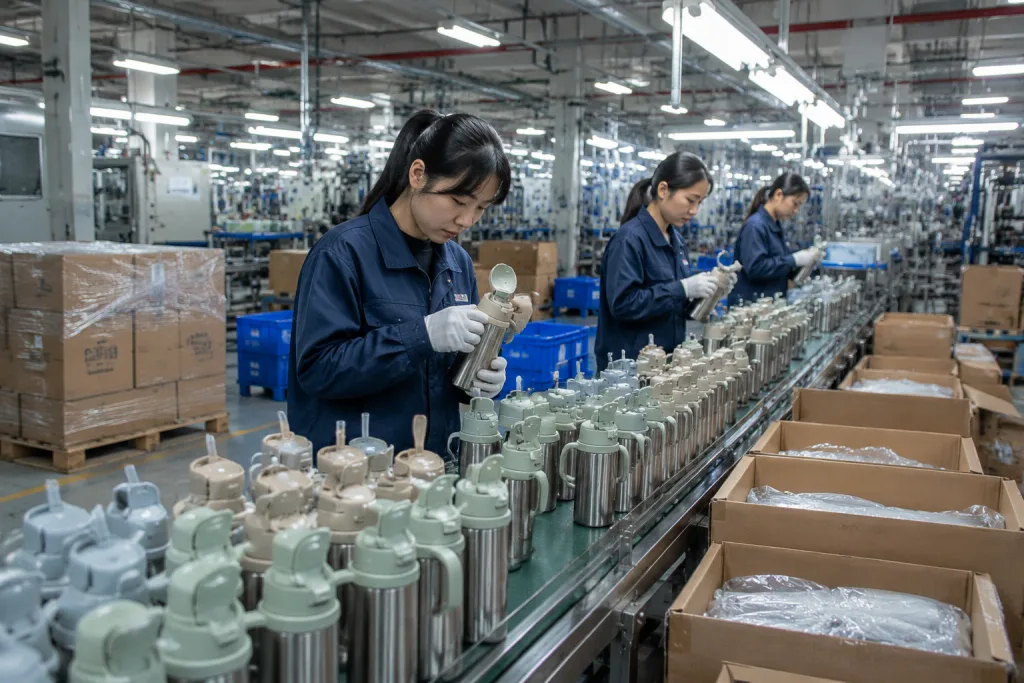
A toddler bottle supplier list is not a China name sheet. For retail buyers, school bids, promo programs, or distributor drinkware catalogs, a useful list sorts real factories from photo-forwarding traders. Toddler bottles get tougher checks than adult sports bottles: straw pull force, lid torque, paint adhesion, and loose small parts all draw attention. QC pulled one 350 ml sample last month because the silicone straw measured 2.8 mm too short after assembly. Small miss. Big problem.
From our Hangzhou, Zhejiang export desk, we do not start with color. We ask for target FOB price, test market, launch date, packaging type, and whether the file needs EN 14350, LFGB, REACH, ASTM, or CPSIA support. A 3,000-piece trial and a 30,000-piece rollout should not sit with the same supplier plan; the math does not work. We run different checks on each: carton drop at 76 cm, barcode scan on the gift box, and lid fit using a go/no-go gauge before the line packs.
Start With Landed Cost Reality
Build the toddler bottle supplier list only after you know the landed cost target: freight, duty, lab testing, warehouse pick fees, and your margin all sit on top of FOB. We see 7 or 8 RFQs a month asking for a “premium toddler bottle” at USD 1.50 FOB; the math doesn't work. At that level, QC usually finds a 0.35 mm cup body, a loose straw seat, or a carton that fails a 60 cm drop test. The factory quote is one line, not the buying cost.
For a stainless toddler bottle with PP lid and silicone straw, realistic FOB China pricing usually starts around USD 2.20-2.90 for an existing mold at 3,000-5,000 pcs. A better vacuum insulated version with 304 stainless steel inner wall, 201 or 304 outer wall, powder coating, and gift box often lands at USD 3.20-4.80 FOB Ningbo or Shanghai. Add a custom canteen shape or molded handle and the mold charge starts showing up fast; add a flip straw lid or retail display carton and the line needs extra assembly time. Last month QC pulled the sample after the straw hinge pin measured 0.2 mm short on a digital caliper.
Do not compare a toddler bottle quote directly with a general canteen promotional bottle or adult sports bottle. Wrong question. Toddler bottles have small parts that need fit testing, torque checks at the lid thread, bite resistance on the straw, and migration testing for anything touching water. A canteen manufacturer making school or outdoor bottles may be good at body forming, but toddler lid engineering is where we have seen this go sideways. One buyer flagged a clean adult catalog, then missed that the child lid had no spare gasket spec on the PO.
At BottleForge Industrial in Zhejiang, our monthly drinkware output is around 480,000 units across stainless thermos, kids bottles, travel tumblers, and custom drinkware. That scale helps stabilize pricing, but it does not remove physics. A 0.4 mm inner wall costs less than 0.5 mm because the coil weight changes by carton, not by opinion. Full-color heat transfer costs more than one-color silkscreen, and individual kraft boxes cost less than rigid gift boxes but protect worse when e-commerce cartons get squeezed under 18 kg mixed loads. We run the numbers before we run the line.
MOQ Tiers Change The Supplier List
Your toddler bottle supplier list should be sorted by MOQ first, product type second. MOQ decides which factories answer your RFQ, which decoration processes they will open, and how much production risk sits on your side. We see this every March. A trading canteen vendor may take 500 pcs, but the quote is often 25-60% higher, and the real factory may not hold a line slot once back-to-school orders fill the whiteboard in Zhejiang.
For existing toddler bottle molds, we usually see these MOQ tiers: 1,000 pcs for stock-color sampling or distributor canteen replenishment, 3,000 pcs for custom logo with standard color, 5,000 pcs for custom powder coating with a separate spray booth setup, and 10,000 pcs or more for canteen customized lid color, molded silicone parts, or special packaging. The line needs room to run. If you need a canteen customizable body shape or new straw cap, tooling usually starts around USD 1,500-4,500 for simple plastic parts and can exceed USD 8,000 for multi-cavity molds; last month QC pulled a cap sample because the straw hole was 0.35 mm tight after shrinkage.
MOQ changes payment terms too. For first orders from Europe or North America, 18 out of 20 China factories we quote against still ask for 30% deposit and 70% balance before shipment. Some canteen distributors ask for net terms on the first order; most factories refuse unless there is insured trade cover or a long-standing importer behind the PO. This is not bad faith. The math doesn't work: 304 stainless, PP lid resin, powder, labor, inserts, and printed cartons are paid before the goods leave Zhejiang or another China production base.
If your order is under 2,000 pcs, say it clearly. Ask whether the supplier is using stock bottles, semi-finished bodies, or a shared production run, because that one answer controls color tolerance, carton marks, barcode timing, and whether FNSKU labels sit flat on the retail box. We ship Amazon FBA orders where a buyer flagged a 2 mm carton mark shift after the PO had “FNSKU” typed as “FNSK”; small errors get expensive fast. For Amazon FBA, warehouse club, or school supply programs, the cheap MOQ promise is the wrong question to ask if carton relabeling starts after final inspection.
Where The FOB Price Moves
The fastest way to read a quote is to split the fixed charges from the piece-by-piece costs. Start with steel grade and wall thickness, then check the lid build, finish, logo work, packing, testing, and final inspection line by line. We run quotes in a cost sheet, not from memory. If two canteen suppliers quote the same 350 ml drawing at prices 35% apart, one side is likely leaving out the PP straw mold fee, the AQL 2.5 inspection, or the retail box. We have seen this go sideways.
For toddler stainless bottles, 304 stainless steel is the normal inner material. Some buyers specify 316 for better corrosion resistance, but it can add USD 0.25-0.60 per unit depending on capacity and current steel pricing. Body thickness also bites. A 0.4 mm shell is cheaper and lighter; a 0.5 mm shell feels stronger and takes fewer dents after the 1.2 m drop test. QC pulled a 0.38 mm body sample last month because the drawing said 0.4 mm minimum. For children’s products, chasing the thinnest gauge is the wrong question to ask unless the shelf price has no room.
Decoration changes the quote fast. One-color silkscreen may add USD 0.08-0.18 per unit. Laser engraving can run USD 0.15-0.35 depending on size. Heat transfer or full-wrap graphics often adds USD 0.35-0.80, plus setup cost. A canteen custom order with five colorways and different mascot artwork needs five artwork checks, not one quick logo file. On the line, the buyer flagged a 2 mm mascot shift on the pink bottle, and that stopped packing for half a day.
Packaging gets underestimated. A plain white box may cost USD 0.12-0.22. A printed retail box with insert can cost USD 0.28-0.65. Drop-test ready e-commerce packaging costs more, but it cuts damage claims after courier handling. We ship 24 pcs per master carton on most toddler bottles, and a weak 5-layer carton will show crushed corners before the container reaches Ningbo. For a canteen distributor or distributor growler line shipping mixed cartons to multiple retailers, barcode accuracy matters more than saving USD 0.05 on paper. The math does not work if the retailer charges back USD 45 per wrong label.
Testing belongs in the budget from day one. LFGB or FDA food-contact testing, lead and cadmium checks for coatings, REACH SVHC screening, and CPSIA-related tests can cost USD 300-1,200 per style depending on lab scope. A professional canteen manufacturer will not promise every certificate for free; the lab still sends an invoice. We usually book SGS or Intertek after the pre-production sample is signed, because a coating change after testing means paying twice. Check the PO too. We once caught “LFGB” typed as “LFBG” before the buyer’s compliance team rejected the file.
Lead Time By Order Stage
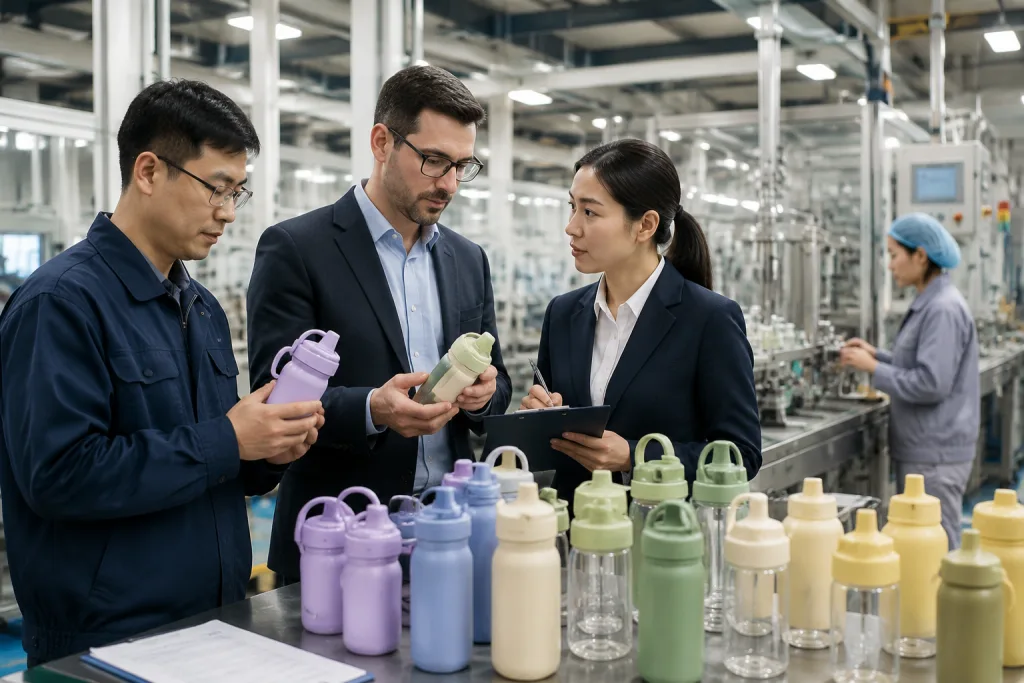
Lead time is where sourcing plans blow up. Buyers often count only the 30-45 mass production days, then forget artwork approval, PP sample, FDA or LFGB testing, material booking, AQL 2.5 inspection, inland trucking, customs, and ocean or air freight. We see this on toddler bottle projects every March: the PO says “ship before 5/20,” but the logo AI file arrives with Pantone 2925C typed as 2952C. A useful toddler bottle supplier list should separate normal lead time from peak-season lead time for each factory.
For an existing mold with a simple logo, the sample stage usually takes 7-12 days after artwork confirmation. That means the dieline is locked, the laser engraving file opens cleanly, and the buyer approves the 1:1 PDF without three rounds of cap color comments. If you need a canteen customized color, powder coating panels, or a child-resistant lid adjustment, sample timing can stretch to 15-25 days because the line has to run a small color trial, not just pull a blank bottle from stock. QC pulled one sample last season where the straw sat 2 mm too low inside the lid; that small fix cost 4 days. Lab testing adds another 5-10 working days for standard food-contact checks, or longer if a retailer requires a full protocol.
Mass production after deposit and approved sample normally takes 30-45 days for 3,000-10,000 pcs. In April to August, when China drinkware factories are packed with back-to-school and holiday orders, 45-60 days is the safer number. Our Zhejiang production planning team asks for 7 days of buffer before vessel closing because rush packing creates barcode, carton, and accessory mistakes. We have seen 12 cartons held after final inspection because the silicone spare-straw bag showed “2 pcs” while the PO requested “1 pc.” The math does not work if the buyer wants fresh tooling, custom color, retail box printing, and a fixed sailing inside 35 days.
Shipping to North America by ocean usually takes 22-38 days port to port depending on route and congestion. Western Europe is often 30-45 days. Air freight can move in 5-9 days, but for stainless bottles the freight cost often kills the margin unless you are shipping launch samples or a small replenishment under 200 kg. For one 6,000 pcs toddler bottle order, the buyer flagged a late launch and asked for air; the freight quote was higher than the bottle value. If a canteen vendor promises 20-day total delivery for a new customized drinkware order, ask whether they mean production only, not delivery to your warehouse.
A practical first-order calendar is 10 days for sampling, 7 days for testing with approval overlap, 40 days for production, 5 days for inspection and export handling, and 30 days for ocean freight. That is 92 days door-side if you count honestly. Faster is possible. But we’ve seen this go sideways when buyers remove the AQL 2.5 inspection day or push cartons onto a truck 6 hours before warehouse cutoff.
Compliance Is Not A Checkbox
Toddler bottles sit closer to children’s product rules than general custom growler or adult outdoor canteen lines. Your supplier list should separate factories that can prove food-contact testing, small-part control, coating migration, and document traceability from factories that just email a PDF. We had one buyer flag a lid plug at 5.8 mm on the caliper because it looked removable after a drop test. If a factory only sends a five-year-old FDA report for a different bottle, do not treat that as proof.
For Europe, ask about LFGB, EU 10/2011 for plastic food-contact components, REACH, and EN 14350 where relevant. For the United States, discuss FDA food-contact expectations, CPSIA if the product is marketed to children, ASTM-related retailer protocols, lead content, phthalates, and tracking label requirements. Canada often means bilingual labeling review, plus chemical checks on paint, silicone, and straw parts. We once caught “Made in Chine” on a PO artwork file 2 days before mass printing, and that small typo would have stopped a 6,000-piece carton label run. These requirements are not decorations; they decide whether your shipment can be sold.
A capable canteen factory should provide material declarations for stainless steel, PP, Tritan where used, silicone, coating powder, ink, and glue. The reports should match the actual bill of materials, right down to the 304 stainless body, the silicone straw, and the spray powder code used on the line. QC pulled the sample once and found the test report listed PP, while the production cap was Tritan. For a customizable growler, adult travel mug, or distributor drinkware project, buyers sometimes accept broader reports. For toddler bottles, that is the wrong question to ask; match every material or do not approve the order.
Factory audits also matter. BSCI, Sedex, ISO 9001, or retailer-specific audits do not guarantee product quality, but they show basic management systems. If your customer is a supermarket, school chain, or large promotional buyer, ask this before sampling, not after you have paid mold cost or booked 12,000 pieces. We have seen this go sideways when the sample passed AQL 2.5, but the buyer’s portal rejected the factory because the Sedex record was under an old company name. There is no point loving a sample from a canteen supplier that cannot pass the audit gate.
Good compliance work feels slow at the beginning and cheap at the end. Bad compliance work feels fast until the container is held, relabeled, or rejected.
How To Shortlist Real Factories
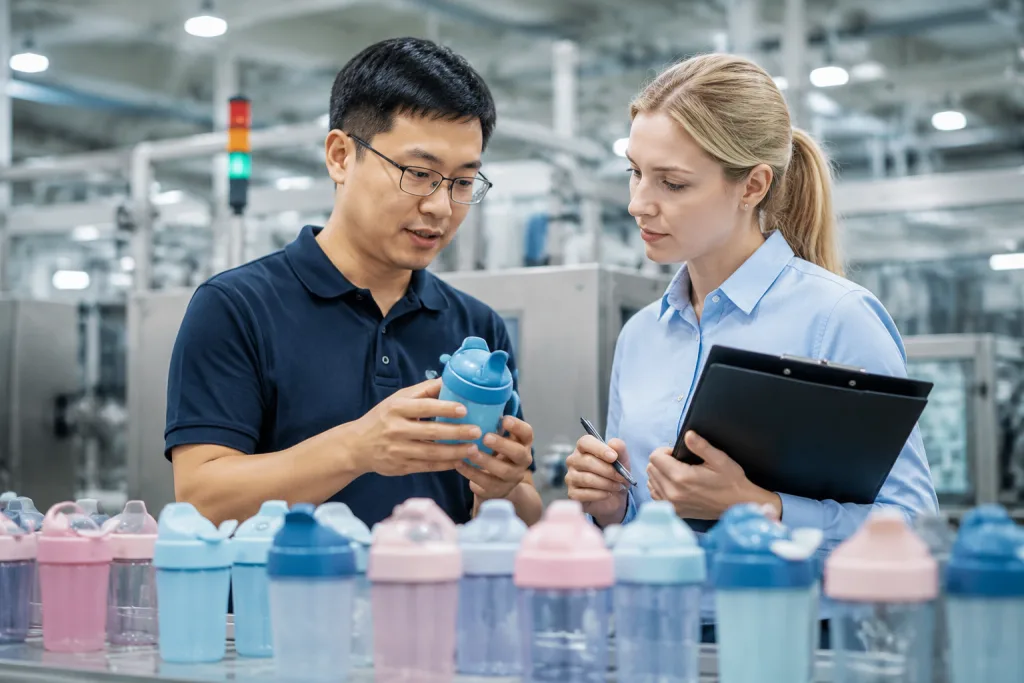
A solid toddler bottle supplier list should sort vendors into actual factories, export trading companies, and hybrid vendors with clear notes under each name. None of them is automatically a bad choice. A trading canteen vendor can work for 300–500 pcs trial orders, mixed SKU sourcing, or fast catalog testing. For a repeat toddler bottle program, though, this is the wrong question to ask: “Can you supply it?” Ask who controls tube cutting, coating, lid assembly, and final inspection. On our line in Hangzhou, QC pulled one 350 ml sample last month because the silicone straw sat 1.5 mm off-center after lid assembly.
Ask direct questions. What is your monthly capacity for kids bottles? Which processes are in-house? What is the MOQ for a custom canteen color? Can you show the injection mold room or only the showroom? What AQL level do you use for final inspection? Can you pack FNSKU labels, inner cartons, and master carton marks according to my routing guide? Real canteen manufacturers answer with numbers: 80,000 pcs/month, 3 coating lines, 1,000 pcs per Pantone color, AQL 2.5 for major defects. Weak canteen vendors answer with “no problem.” We’ve seen this go sideways when the buyer flagged carton marks only after the PO had “Amazon FNSK” typed wrong.
For a first RFQ, send a structured sheet instead of screenshots. Include capacity in ml or oz, target FOB price, material grade, lid type, decoration size, Pantone colors, packaging, compliance market, annual forecast, first order quantity, delivery port, and inspection requirement. Add drawings if you have them. This lets canteen suppliers quote the same job, using the same lid, same box, and same test standard. Without that, you will receive 10 prices based on 10 different assumptions, and the math doesn’t work when one quote includes 304 stainless and another hides a thinner body wall. Our merchandiser still keeps a red-marked RFQ where the buyer wrote “350 oz” instead of “350 ml.”
Buyers sometimes include adult items like customized growler, custom growler, or distributor growler SKUs in the same RFQ. That is fine if you want a broader customizable drinkware partner, but keep toddler bottles as a separate risk category. A factory strong on 64 oz insulated growlers may not have the right lid tooling or child-product documentation. Big bottles are forgiving. Toddler lids are not. We run torque checks on caps with a digital torque meter because a 0.3 N·m difference can turn into leakage complaints after sea freight.
Our practical filter is simple: if a supplier cannot explain cost changes, production stages, and testing limits in writing, do not put them high on your list. Ask why the price moves when the wall thickness changes by 0.1 mm, or why one coating route ships in 12 days vs 18 days. You do not need the cheapest canteen factory in China. You need one that tells you where the problems are before your customer finds them, and backs that up with inspection photos, carton weights, and a signed production schedule.
Build Your RFQ Around Timing
The fastest way to protect cost and lead time is to make the RFQ boring and complete. Good RFQ, clean quote. Zhejiang factories quote with fewer safety buffers when the buyer removes guesswork; we have seen a missing lid gasket spec add 3 days because QC pulled the sample and found two silicone hardness options on the bench. For a toddler bottle supplier list, send every factory the same RFQ file, then compare replies line by line.
Build a cost table with separate lines for bottle body, lid, straw or spout, surface finish, logo, packaging, lab testing, tooling, inspection, spare parts, and FOB port. Ask for MOQ at 3,000, 5,000, and 10,000 pcs. Ask for sample lead time, production lead time, peak-season lead time, and quote validity. Put numbers in the table: 7 days for plain samples vs 12 days for logo samples, 25 days for mass production vs 35 days in August. Stainless steel and freight pricing move fast; a 60-day price validity is already better than 6 out of 10 factories will offer.
For artwork, send vector files, Pantone codes, logo position, maximum print area, and a note saying whether the design is canteen customizable for multiple buyers or locked to one brand. A 38 mm logo on a curved 350 ml bottle is not the same job as a 55 mm logo on a flat carton sleeve. For retail, include barcode placement, warning labels, age grading, recycling marks, polybag rules, and carton drop-test expectations. For promotional programs, state whether the order is canteen promotional bulk pack or retail pack; we once had a buyer flag a PO typo where “bulk” became “box,” and the packing line had to stop for half a shift.
Write inspection terms before deposit. AQL 2.5 for major defects and 4.0 for minor defects is a common starting point. Critical defects should be zero tolerance: sharp edges, loose small parts, leaking, wrong material, odor, missing warning labels. This is not paperwork. On toddler bottles, one loose 6 mm straw valve is enough to hold the shipment. If you use third-party inspection, book it 5-7 days before the ex-factory date, not the day before vessel closing; the math does not work when rework needs 2 days and the truck is already booked.
After you compare replies, the list will shrink by itself. The stronger canteen manufacturers are not always the cheapest, but they show the real path: tooling days, sampling days, mass production days, test cost, inspection standard, shipment handoff. We ship smoother with suppliers who write “tooling 18 days, sample 7 days, production 30 days” than with suppliers who answer “fast delivery” and dodge the details. That is the supplier you want when the launch date is fixed.
Send your toddler bottle RFQ for a real factory quote
Share MOQ, artwork, compliance market, and launch date. Our Zhejiang team will return pricing, tooling cost, and lead time options.
Frequently asked questions
What MOQ should I expect from toddler bottle suppliers in China?
For existing molds, expect 3,000-5,000 pcs for a serious custom logo order. Some canteen vendors offer 500-1,000 pcs using stock bottles, but color choice, packaging, and price will be limited. For a customized canteen lid, special silicone straw, or exclusive shape, 10,000 pcs is a more realistic starting point because plastic tooling and color setup need volume. If you are testing a new market, ask for two quotes: one at 3,000 pcs and one at 10,000 pcs. The price gap often shows whether the supplier is a real canteen factory or a reseller adding margin.
How long does a first toddler bottle order normally take?
A first order normally needs 45-75 days before shipment if you use an existing mold, and 75-110 days if tooling is required. Sampling usually takes 7-15 days, testing 5-10 working days, and mass production 30-45 days after deposit and sample approval. Peak season in China can add 10-20 days, especially before back-to-school and holiday promotions. Ocean freight then adds roughly 22-45 days depending on destination. If your launch date is fixed, share it during RFQ, not after price negotiation.
What is a realistic FOB price for a custom toddler bottle?
For stainless toddler bottles, a realistic FOB range is USD 2.20-4.80 depending on capacity, insulation, steel grade, lid complexity, decoration, and packaging. A single-wall bottle with simple silkscreen can sit near the lower end. A vacuum insulated bottle with powder coating, straw lid, spare straw, printed box, and compliance testing support will sit higher. Be careful with quotes under USD 2.00 for children’s drinkware unless the supplier clearly explains material thickness, lid material, coating, packing, and test coverage.
Should I choose a factory or a trading company?
For repeat toddler bottle programs, a factory or factory-led export team is usually better because it controls production scheduling, coating, assembly, and defect correction. A trading company can still help when you need low MOQ, mixed custom drinkware, or several categories like customizable canteen, adult tumbler, and customized growler in one order. The key is transparency. Ask who owns the molds, where inspection happens, and whether you can see production photos. If the canteen supplier cannot identify the actual production site, keep them as a backup, not your main source.
Which compliance documents should I request before deposit?
Before deposit, request recent food-contact reports for stainless steel, PP or Tritan, silicone, coating, and ink. For Europe, discuss LFGB, EU 10/2011, REACH, and EN 14350 if applicable. For the U.S., ask about FDA food-contact support, CPSIA, lead, phthalates, tracking labels, and any retailer-specific ASTM protocol. Reports should match the same material and similar construction, not a random adult bottle. For a new toddler bottle, budget USD 300-1,200 for fresh lab testing depending on market and test scope.