Key Takeaways
- A safe toddler bottle promotional MOQ is usually 1,000-3,000 units per color for factory pricing
- Logo and packaging decisions can move FOB cost by USD 0.25-0.90 per bottle
- Normal China production lead time is 30-45 days after sample approval and deposit
- For EU or US toddler products, budget 7-12 days for LFGB, REACH, CPSIA, or ASTM-related checks
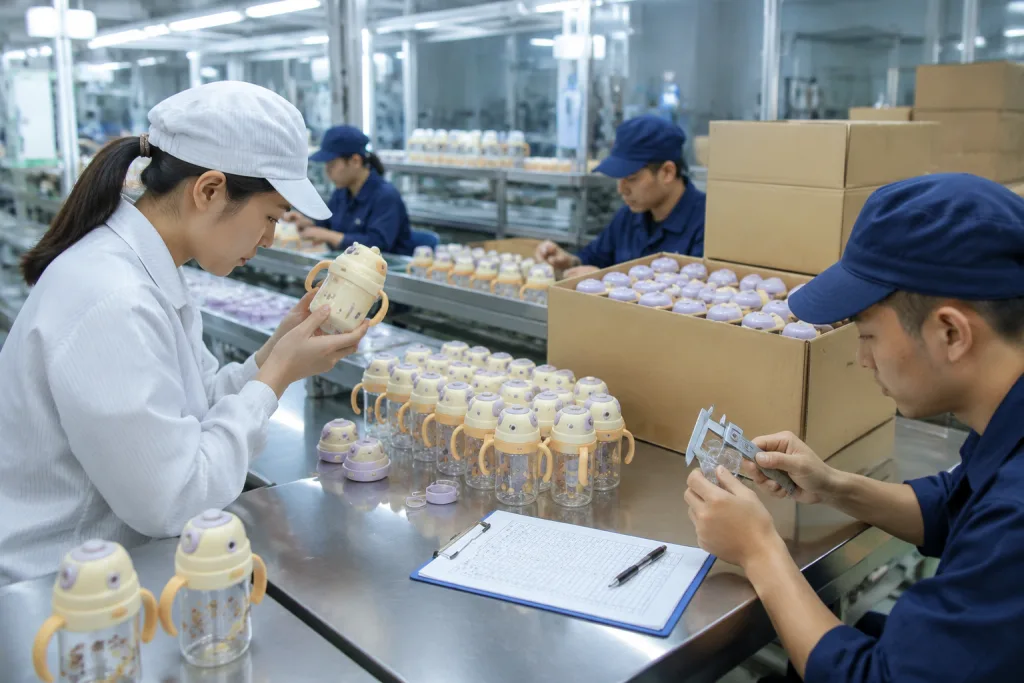
A toddler bottle promotional project looks simple until we cost the small parts: soft spout, leakproof lid, carry strap, gift box, compliance testing, and a logo that survives 3 dishwasher cycles without lifting at the edge. For a nursery brand, retail chain, insurance campaign, or distributor drinkware program, one wrong assumption on the first RFQ can add USD 0.40 per unit or move delivery from 28 days to 49 days. The line feels it fast. Last month QC pulled 12 samples after the buyer changed from a PP lid to a silicone spout, and the new spout needed a 0.3 mm mold adjustment before it sealed cleanly.
We run custom drinkware orders in Hangzhou, Zhejiang, and most delays we see do not come from welding, polishing, or packing. They come from late artwork, missing testing notes, and buyers asking for retail packaging after the FOB quote is approved. This is the wrong question to ask first: “Can you make it cute?” Start with unit cost, MOQ tiers, and a shipping calendar. On one toddler bottle order, the buyer flagged the gift box only after the PO arrived, with “matte lamination” typed as “mate lamination”; that small PO typo added 5 days for box proofing before we could book the carton line.
Start With The Real Landed Cost
The lowest FOB price is the wrong number to chase if QC later finds 4 leaking caps in a 32-piece sample pull, or if the buyer rejects the inner box after artwork approval. For toddler bottle promotional orders, we run cost in six buckets: bottle body; lid and silicone parts; decoration; packaging; testing; freight. A simple 350 ml PP toddler bottle with a flip straw lid usually quotes around USD 1.45-2.20 FOB Ningbo at 3,000 units. A double-wall stainless steel toddler bottle with food-grade silicone bumper, handle lid, and box sits closer to USD 3.20-5.80 FOB, depending on steel grade and print area. Small gap? It is not small after 20 cartons fail a carton-drop check on the line.
Material drives the first big split. PP and Tritan-style copolyester bodies are lighter and cheaper to ship, but some buyers still push back and ask, “Will this survive preschool bags?” Stainless steel answers that better. For stainless steel, 304 inner wall is the normal baseline. Wall thickness around 0.4-0.5 mm is common for small bottles; dropping to 0.35 mm saves a few cents, then QC starts seeing dents near the shoulder after the impact jig test. For toddler bottles, the cheap lid is where the math doesn't work. A poor silicone straw or weak hinge can push return rates above 3%, which hurts any canteen distributor or retail buyer.
Compliance cost also needs a line on the quote sheet, not a surprise after the PO lands. If you sell in Europe, ask about LFGB food-contact testing, REACH on coatings, and migration tests for plastics and silicone. For the US, CPSIA, ASTM child-use expectations, and total lead or phthalate checks apply based on construction and age positioning. A single test package can run USD 280-900 per material group. We have seen this go sideways when a PO listed “blue silicone” but the approved sample used grey; with three different silicone colors, one coating, and a printed box, the lab scope expands fast.
MOQ Tiers Change The Quote
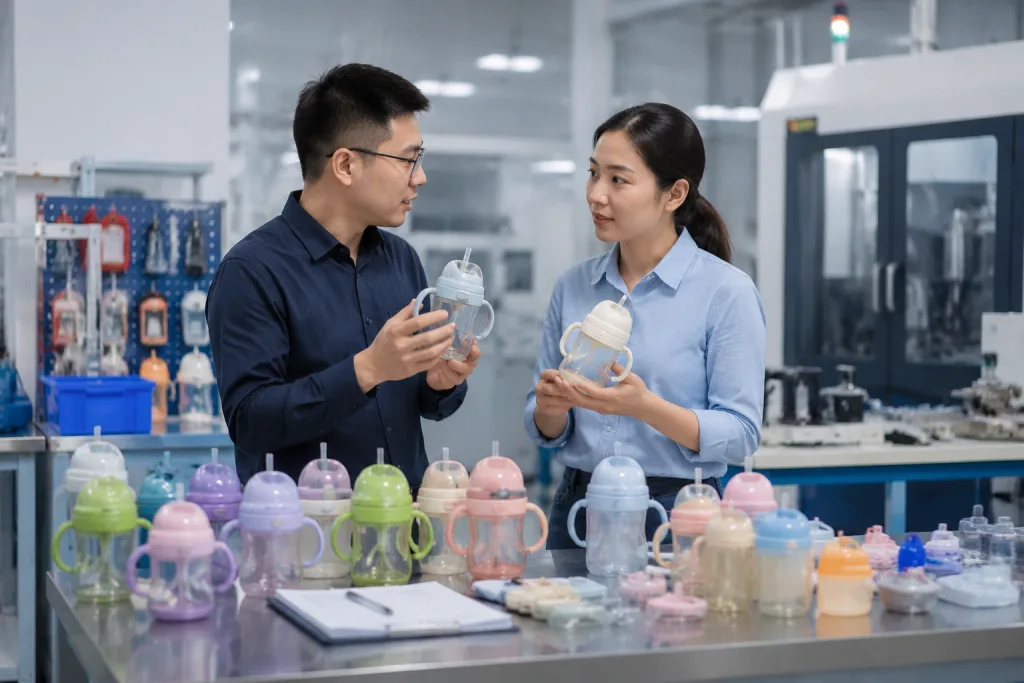
Buyers ask for 300 units because the campaign is a trial. Fair request. It is also the wrong number to quote from if you expect factory pricing. For toddler bottle promotional work, MOQ changes by mold status, body color, and lid setup. At BottleForge Industrial in Zhejiang, we run 1,000 units for existing bottle models with one logo process, 3,000 units for custom colors, and 5,000-10,000 units when the job needs a new lid color, silicone parts, or dedicated retail packaging. Last month QC pulled a 350 ml sample from the line because the buyer’s PO wrote “blue cap” while the artwork called Pantone 2925C; that small mismatch can stop a low-quantity order for 2 days.
The math moves fast. At 500 units, setup charges sit on too few bottles, so a laser logo, pad print jig, and carton mark changes can add USD 0.50-1.20 per bottle. We see this most on 70 mm diameter toddler bodies because the curved print area needs a separate jig, not the one we use for adult sports bottles. At 1,000 units, you get a cleaner promotional price, but color options are usually limited to factory stock. At 3,000 units, a canteen manufacturer can justify custom color matching with a Pantone target, though PP and silicone will not match coated stainless steel perfectly. At 5,000 units and above, a canteen customized program can carry better packaging, insert cards, and steadier inspection planning. We ship smoother at this tier.
Some canteen suppliers accept tiny orders through trading channels or mixed production. That can pass for simple adult bottles. Toddler bottles are less forgiving. Small silicone parts, bite valves, and hinge lids need batch consistency, and we have seen this go sideways when one 8 kg silicone batch came from a different subcontractor. Ask your canteen vendor who owns the mold, where the silicone is produced, and whether the order is inspected under AQL 2.5 for major defects and AQL 4.0 for minor defects. If you are a distributor canteen buyer selling to multiple accounts, include reorder stability in the MOQ talk. A cheap first run does not help if the same color is unavailable 60 days later.
Decoration Costs Are Not Equal
For a toddler bottle promotional order, the logo method changes both the unit price and the chance of rejects. Silkscreen is the cheap, safe choice for a one-color logo on a flat body panel or a light curve; we run it on a 120T mesh screen and check the first 20 pcs before the line opens. Typical setup is USD 40-80 per color, and running cost is usually USD 0.06-0.18 per unit. Pad printing is better for caps, handles, and small curved panels, but the buyer flagged this last month: 4.5 pt legal text on a PP lid looked muddy after print. Alignment tolerance is not magic. Laser engraving holds up well on 304 stainless and usually costs USD 0.15-0.35 per unit, but do not expect bright brand colors from it.
Full-wrap heat transfer or water transfer can look good for retail shelves, but it adds cost and slows inspection. Budget USD 0.45-1.10 per unit based on coverage, film quality, and reject allowance; on a 10,000 pc run, even a 3% film wrinkle rate means 300 pcs pulled by QC. If the bottle is for children, we are stricter about coating adhesion. A cross-hatch test and tape pull should be agreed before mass production; our QC team uses 3M 600 tape and logs the peeled squares on the inspection sheet. For dishwasher claims, be careful. We have seen this go sideways. Around 7 out of 10 promotional bottles survive hand washing, but repeated 70°C dishwasher cycles are a different test. If you print a bold claim on the box, test it before you pay for 20,000 boxes.
Customizable drinkware buyers sometimes ask for individual names, QR codes, or branch-level artwork. It is possible, but it changes the workflow. Variable laser marking is manageable at 1,000-5,000 units if the Excel file is clean and the QR column is not named “QRCODE final final.xlsx” on the PO. Variable printing on plastic is slower and more error-prone; one missing hyphen can stop the line for 25 minutes while the operator resets the jig. For a canteen promotional program with multiple logos, group artwork by process, not by end customer. Run all black silkscreen logos together, then run all laser logos together. This is the wrong question to ask if the only target is “lowest decoration price.” A good canteen supplier should tell you when a design is production-friendly, not just say yes to win the deposit.
Timeline From Brief To Vessel
A toddler bottle promotional order from China normally needs 45-70 days from final brief to vessel departure when no new mold is involved. The “fastest date” is the wrong number to chase; the line needs enough room to catch lid fit, color, and packing problems before they become container problems. For existing models, quotation and feasibility take 1-3 working days after we get the order quantity, destination market, editable logo file, retail box or bulk-pack request, and the compliance target. A digital mockup can go out the same day. A physical pre-production sample takes 5-10 days for standard logo work, or 12-18 days for custom color or transfer print. Last month QC pulled a sample because the PO said Pantone 487C, while the artwork file showed 486C.
After sample approval and deposit, mass production normally runs 30-45 days. Our Hangzhou, Zhejiang facility plans around 300,000 drinkware units per month across stainless steel bottles, plastic bottles, tumblers, plus related custom drinkware. Toddler bottles do not move through the line like basic sports bottles. We run lid assembly checks with a torque gauge, check silicone straws for odor after 24 hours in a sealed PE bag, and review carton drop-test logic because small bottles often ship in retail inner boxes. This is where we have seen projects go sideways: the bottle body is fine, but the flip lid feels loose after 20 open-close cycles.
Inspection adds time, but skipping it is false economy. For B2B buyers, we recommend final random inspection when at least 80% of goods are packed and 100% are produced. AQL inspection usually takes one day, plus one day if the inspector must travel outside the main China manufacturing cluster. If third-party lab testing is required, run it on approved materials or pre-production samples where possible. Waiting until finished goods are packed leaves you stuck between a failed report and a booked vessel. We have seen a 0.3 mm straw-length mismatch hold 18 cartons while the buyer’s launch date kept moving closer.
Plan shipping early. Sea freight to Europe often takes 30-40 days port to port, while US West Coast can be 15-25 days and US East Coast 28-40 days depending on routing. Air freight works for urgent launches, but the math gets ugly fast once a toddler bottle sits in a color box with insert card and spare straw. A 350 ml bottle that looks small on the desk can hit 0.065 CBM per export carton, and the forwarder will charge by volume weight before anyone asks about your promo margin.
Packaging Adds More Than Looks
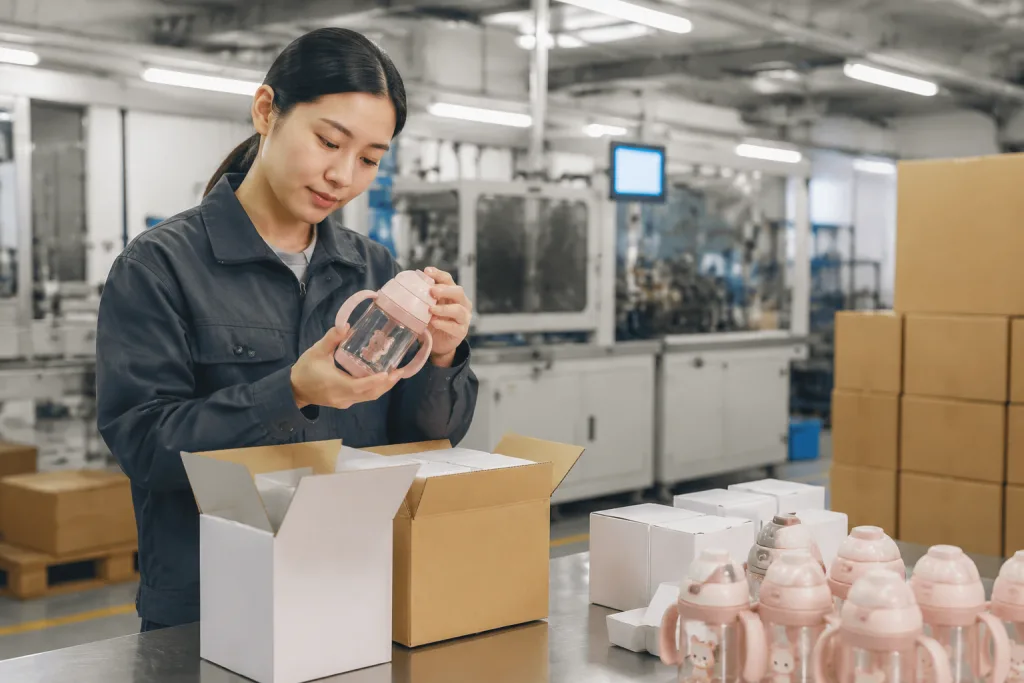
Packaging for toddler bottles is not just decoration; it protects the bottle and carries the warnings buyers get asked about later. A plain export carton with each bottle in a 0.03 mm polybag is the low-cost route, usually adding only USD 0.05-0.12 per unit. A white box may add USD 0.18-0.35. A printed retail box with insert card, barcode, warning text, and hang tab can add USD 0.35-0.90 depending on paper weight and print coverage. We run E-flute boxes for several toddler programs because the corners survive drop testing better than thin greyboard. For a 10,000 pcs promotional giveaway, retail packaging is usually the wrong question to ask. For a distributor drinkware program going to stores, the shelf box earns its cost.
For North America, buyers ask for UPC, FNSKU, suffocation warning, carton labels, and pallet labels on about 8 out of 10 toddler bottle projects we quote. For Amazon-style FBA preparation, master carton size, carton weight under 22.5 kg where possible, and scannable labels matter. QC pulled one carton last month because the FNSKU printed 4 mm too close to the box seam, and the handheld scanner missed it twice. For Europe, language requirements can turn one box file into 6 artwork versions. If you sell into France, Germany, Spain, and the Nordics, one English warning panel is not enough. Your legal team or importer should decide wording; the factory can place it correctly on the dieline.
Gift sets change the cost model fast. Adding a cleaning brush or cotton pouch looks small on the PO, but each item needs sourcing, receiving inspection, packing labor, and sometimes testing. We have seen this go sideways when a buyer added spare straws after PP sample approval and the line had to rework 3,200 packed units. A custom growler buyer can absorb accessory variation because the user is adult. A toddler bottle cannot. Loose small parts can raise choking concerns, so packaging layout matters. If you request a canteen customizable set for children, be explicit about age grade, warning labels, and whether accessories are attached, bagged, or boxed separately.
One practical rule from the packing table: freeze packaging artwork before sample approval if possible. Late box changes are one of the top 3 reasons a finished order sits in our Hangzhou warehouse for 5-7 extra days, and the math does not work when the buyer flagged only a missing accent mark after mass production.
Choosing A Factory Or Vendor
You can buy through canteen vendors, canteen distributors, trading companies, or directly from canteen manufacturers. Each route fits a different order. A distributor is useful when you need 3 warehouse drops in one country or 500 pcs shipped first for a sales meeting. A canteen vendor can bundle bottles, bags, and lunch boxes under one PO. A direct canteen factory gives tighter control over 304 stainless thickness, lid tooling, production dates, and rework decisions, but the spec sheet must be clean. We once had a buyer write “blue” on the PO; QC pulled the approved sample and found the real Pantone was 2925 C. That 1 word cost 2 days.
When evaluating canteen suppliers for toddler bottle promotional work, ask for proof, not nice words. Useful files include BSCI audit status, ISO 9001 process records if available, material declarations, past LFGB or FDA food-contact reports for similar materials, and internal leak-test procedures. Factory photos do not tell you much. Ask for a 30-second phone video showing lid assembly, the water leak tester at 80 kPa, and the packing line with carton labels facing camera. If the supplier says it can produce any canteen customized design, ask which parts are molded in-house and which parts come from outside shops.
Check communication behavior during quoting. A serious canteen manufacturer will push back on unclear points: target age in months, dishwasher claim, bite valve material, EU or US compliance route, 1.2 m packaging drop test, and spare-part policy. If a supplier quotes within 20 minutes without asking these questions, the price is probably built on guesses you will pay for later. We have seen this go sideways. For customized drinkware, the hidden cost is usually not dishonesty; it is a missing 0.5 mm gasket tolerance or a carton mark nobody confirmed.
For brand owners and distributor growler buyers moving into toddler products, do not copy adult bottle specs. That is the wrong shortcut. A customized growler can accept heavier steel, larger caps, and adult warnings. A toddler bottle needs a 55–65 mm easy-grip body, low opening force, controlled flow rate, and leak resistance after 10 shake cycles in a stroller bag test. The line checks this with a torque meter and a simple tilt test before packing. Different user, different engineering brief.
How To Lock The Final Quote
A tidy RFQ beats hard bargaining. Send the canteen supplier a brief we can price without guessing: quantity split by color, bottle capacity, material, logo file in AI or PDF, print area in mm, packaging type, destination port, compliance market, and required ship date. Put the color split in numbers, not “assorted”; our merchandiser once received 5,000 pcs with a PO typo showing “blue 5000, pink 0,” and the buyer flagged it after the PP sample. If you need a custom canteen shape or a new lid, state whether tooling cost is acceptable. Small plastic lid tooling can start around USD 1,500-4,000; more complex molds can exceed USD 8,000. Stainless steel body tooling is a separate discussion, and the math does not work if anyone assumes it is free.
For pricing terms, FOB Ningbo or FOB Shanghai is common for Zhejiang and nearby China factories. EXW looks cheaper on the first quote, but it leaves you paying local truck, warehouse handover, customs documents, and export coordination. We run into this on 30-carton trial orders when the buyer asks why the forwarder added RMB 850 for local pickup. DDP works for small promotional batches if duties, customs bond, and importer responsibilities are written clearly. For larger B2B buyers, FOB plus your own forwarder is cleaner because your team controls the vessel booking and the cut-off date.
Before paying deposit, lock four items in writing: approved sample standard, AQL level, packaging artwork, and shipment terms. QC pulled the sample should mean one dated reference sample with logo position measured in mm, not a WeChat photo from three weeks ago. If the order is canteen promotional with a fixed event date, add a penalty-free fallback plan, such as partial air shipment of 300-500 units and sea shipment for the balance. Price that option early. We have seen this go sideways when a buyer asks for air freight after cartons are packed and the carton size adds 18 kg of chargeable weight per carton.
Our opinion is blunt: toddler bottle promotional sourcing is a child-use product project, not a cheap giveaway. If your target retail or campaign price cannot support safe materials, stable lids, and proper testing, change the product before you squeeze the factory. On the line, a loose straw valve or sharp gate mark on a lid is not “minor” just because the order is for promotion; one inspection finding can hold 10,000 pcs. A good canteen manufacturer in China can cut waste and simplify construction, but it should not remove the controls that protect your customer and your brand.
Send Your Toddler Bottle Brief For Factory Pricing
Share quantity, logo, market, and delivery date. We will return MOQ, FOB cost, sample timing, and testing notes.
Frequently asked questions
What is a realistic MOQ for toddler bottle promotional orders?
For an existing toddler bottle model with one standard logo, 1,000 units is a realistic starting MOQ. If you need custom Pantone colors, plan on 3,000 units per color because plastic, silicone, and coating suppliers have their own batch minimums. For a fully customized canteen with new lid color, retail box, insert, and multiple accessories, 5,000-10,000 units is more practical. Very small runs under 500 units are possible only with stock colors and limited decoration, but the unit price can rise by USD 0.50-1.20 because setup costs are spread across fewer bottles.
How long does production take after I approve the sample?
For standard toddler bottle promotional production in China, allow 30-45 days after sample approval and deposit. Add 5-10 days before that for a physical logo sample, or 12-18 days if you need custom color matching or full-wrap graphics. Third-party testing can add 7-12 days if reports are required before shipment. Sea freight then adds roughly 15-40 days depending on destination. If your event date is fixed, work backward from delivery and keep at least 10 calendar days of buffer for inspection, booking, and customs paperwork.
Which material is better for toddler bottles: plastic or stainless steel?
Plastic is lighter and usually cheaper, with many 350-450 ml promotional bottles landing around USD 1.45-2.80 FOB depending on lid and packaging. Stainless steel is more durable and can feel more premium, but a good toddler version often costs USD 3.20-5.80 FOB before freight. For plastic, confirm food-contact grade, odor control, and migration testing. For stainless steel, specify 304 inner wall and check coating adhesion if it is painted. The best choice depends on retail price, age grade, drop resistance, and whether the bottle is a giveaway or a paid product.
Can one supplier handle toddler bottles, canteens, and growlers together?
Yes, but check whether the supplier is a true canteen manufacturer or mainly a trading company. A factory that handles custom drinkware may produce toddler bottles, sports bottles, travel tumblers, and some custom growler items, but not every line uses the same machines or quality controls. Toddler bottles need tighter lid and silicone checks than many adult products. If you are buying a mixed distributor drinkware program, ask for separate lead times, MOQ, and inspection criteria by item. Combining shipment can reduce freight cost, but it should not force unsafe shortcuts on child-use items.
What should I include in an RFQ to get an accurate quote?
Send quantity by color, capacity, material, target market, logo file, decoration size, packaging type, compliance requirements, destination port, and delivery deadline. If you need a canteen customizable option, include Pantone numbers, lid preferences, and whether accessories are required. Also state whether you need BSCI, REACH, LFGB, CPSIA, ASTM-related testing, FNSKU labels, or retail barcodes. With a complete RFQ, a Zhejiang factory can usually quote in 1-3 working days. Without those details, you may receive a low estimate that changes after sampling.