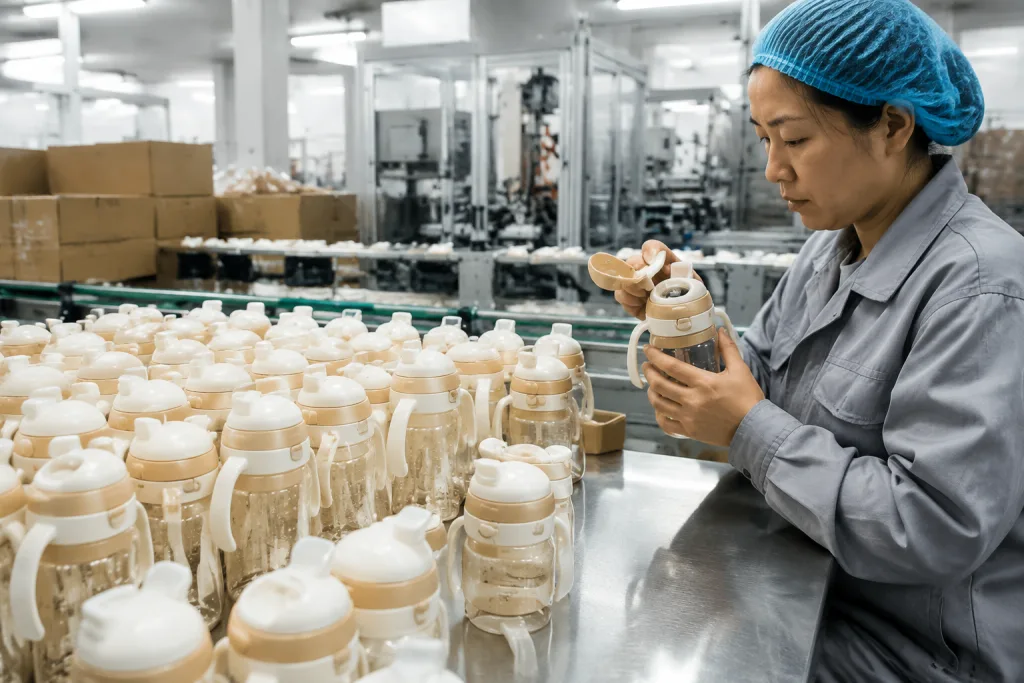
Key Takeaways
- Plan MOQ from 1,000-3,000 units per color for toddler bottle promotional products
- Use LFGB or FDA food-contact materials, plus CPSIA/ASTM review for US toddler channels
- Allow 25-35 days for production after sample approval, plus 3-7 days for pre-shipment inspection
- Check leak rate, cap torque, odor, drop test, and print adhesion before paying final balance
Toddler bottle promotional products look simple until the PO asks for PP or Tritan, a 53 mm flip cap, bite-valve pull force, pad-print rub test, carton side marks, and an ETD that matches a retail or event launch. This is not a giveaway pen. A toddler bottle sits near a child’s mouth, gets dropped from a stroller, chewed at the spout, washed at 70°C, and judged by parents who spot plastic smell, leaks, and sharp rim flash before your sales team does. QC pulled one sample last month because the straw cut had a 0.4 mm burr. Small defect. Big headache.
From our Hangzhou, Zhejiang export desk, “Can you put my logo on it?” is the wrong question to ask. Any canteen vendor can say yes. The real check is whether the factory can trace each resin batch, keep the toddler cap parts within tolerance on the line, make the decoration survive tape and alcohol rub tests, and pass AQL inspection across 5,000 to 50,000 units without turning your first order into a complaint file. We’ve seen this go sideways when a buyer approved artwork fast, then flagged carton marks after production because the PO used “blue lid” while the artwork file said “navy.”
What makes toddler bottles different
A toddler bottle is not a mini sports bottle. A 3-year-old will cross-thread a lid, bite through a straw, and never tell Mum that the silicone smells like warehouse rubber. So the sourcing logic changes. We look for a body a small hand can grip, a cap that will not pop open in a backpack, and a cleaning path parents can see in 10 seconds. On our line, QC pulled 20 pcs last month because the flip button needed only 0.8 kg of force to open. That fails the school-bag test.
For promotional use, the usual capacity range is 300 ml to 450 ml. Below 300 ml, the bottle feels like a toy and the logo panel shrinks to around 45 mm wide on most shapes. Above 500 ml, it gets heavy for 2- to 4-year-olds once filled. We usually run Tritan or PP for price-sensitive campaigns, and 304 stainless steel when the buyer wants a higher gift value. Glass with a silicone sleeve sounds nice on a mood board, but for toddler bottle promotional products we push back unless the channel is premium retail and the box says supervised use clearly. We have seen that go sideways after one carton drop test at 76 cm.
The mouthpiece is where cheap projects fail. A hard spout lasts, but some kids hate the feel. A soft silicone straw drinks better, but it has to survive pull testing and real child abuse, not just a clean lab sample. Ask your canteen supplier for silicone hardness, usually 50-60 Shore A, and ask whether replacement straws can be ordered later at 1,000 pcs MOQ. We check this with a Shore A durometer at incoming inspection; once, the buyer flagged a “soft straw” sample that measured 72 Shore A and felt like a pencil eraser.
If you are comparing canteen manufacturers in China, logo size is the wrong first question. Start with the cap assembly drawing. Count the parts. Check whether the valve comes out for cleaning. Ask if the hinge pin is stainless steel or plastic, and whether the carry handle creates a pinch point under the thumb. These small details decide whether your customized drinkware program feels professional or disposable. We once caught a PO typo calling for a 6 mm air vent instead of 0.6 mm; the sample leaked on the shake table before lunch.
Which material should you specify
Your material choice sets the cost, shelf feel, test file, and delivery date. For entry-level toddler bottle promotional products, PP is the low-cost pick. It is light, takes drops well, and we run it in translucent or solid colors on the same injection line. On a 5,000 pcs order, QC usually checks cap fit with a 0.10 mm feeler gauge before leak testing. A 350 ml PP bottle with a flip straw may land around USD 1.20-1.80 FOB Ningbo or Shanghai at 5,000 units, depending on cap complexity and decoration.
Tritan is the better mid-market choice if the buyer wants a clear body but does not want that thin “promo plastic” look. It is BPA-free, has cleaner clarity, and holds less odor than low-grade plastics. Expect USD 1.80-2.80 FOB for a 350-450 ml Tritan model with one-color logo printing. For Europe, ask for LFGB or EU 10/2011 migration test support. For North America, FDA food-contact documentation is normal, and toddler-oriented channels often push for CPSIA review; we had one US buyer flag the age-grade wording on the PO before they approved artwork.
Stainless steel fits retail packs, membership gifts, and brand programs where the bottle has to feel worth keeping. A single-wall 304 stainless bottle can be lightweight, but it will sweat with cold drinks. A double-wall vacuum toddler bottle is more expensive, often USD 4.20-6.80 FOB depending on capacity, lid style, coating, and carton quantity. For stainless steel, specify 304 interior steel, 201 or 304 exterior steel, 0.4-0.5 mm wall thickness, and a powder coating that can pass cross-hatch adhesion testing. Do not skip that test. We have seen coating claims go sideways after QC pulled a sample with edge chipping around the bottom ring.
A custom growler, customizable growler, or distributor growler project carries a different risk profile because adults use it and capacities run 1 L to 2 L. Do not copy growler specs into toddler bottles. Smaller is not easier. The cap tolerance is tighter, the safety expectations are higher, and the complaint rate is less forgiving; on toddler lids, our line will reject a straw valve if the pull force drifts by even 0.5 kg.
Logo methods that survive toddlers
Decoration is not a beauty contest on a mockup. Toddlers drop bottles into backpacks with keys, parents run 65°C dishwasher cycles, and daycare staff wipe lids with stronger cleaner than we like. If QC pulled the sample after 20 washes and the logo lifted on the 3M tape test, the bottle turns into bad advertising.
For plastic bottles, silkscreen printing is still the workhorse for canteen promotional orders. It makes sense for one- or two-color logos because the line can run 1,200-1,800 pcs per shift once the jig is set. A reasonable MOQ is 1,000 units per design, with a printing plate cost of about USD 35-60 per color. For curved bodies, keep the artwork simple; thin text under 1.2 mm line width usually fills in or breaks after the squeegee pressure is adjusted.
For stainless steel, the choice depends on the finish. Laser engraving lasts and avoids ink migration questions, but it only shows the metal color under the coating. Pad printing fits small logos on lids or handles, especially when the logo area is under 45 mm wide. Heat transfer can carry full-color graphics, but ask for a tape test and dishwasher simulation before you approve the sample. Powder-coated stainless bottles need proper surface curing before decoration, usually 160-180°C for 15-20 minutes, depending on coating chemistry; we have seen logos fail because the buyer pushed us to print before the coating fully cooled.
If you need a canteen customized in a bright Pantone body color, check the MOQ before the buyer’s presentation deck is finished. Custom plastic color often starts at 3,000 units per color, while custom powder coating on stainless steel may start at 1,000-2,000 units. The math does not work for 500 pcs in three colors. A canteen customizable by logo is a different job from a fully customized canteen with private mold, custom cap, body color, and retail packaging; the tooling list alone can add 12 days vs 18 days to the schedule if the cap mold changes.
Our practical advice from Zhejiang: send vector artwork, specify print position in millimeters, and approve a physical pre-production sample. We mark the print centerline with a caliper, not by eye. Digital renderings help the sales call, but they are not production control; one PO typo changing “front logo 35 mm” to “53 mm” once cost a full morning of rework on the line.
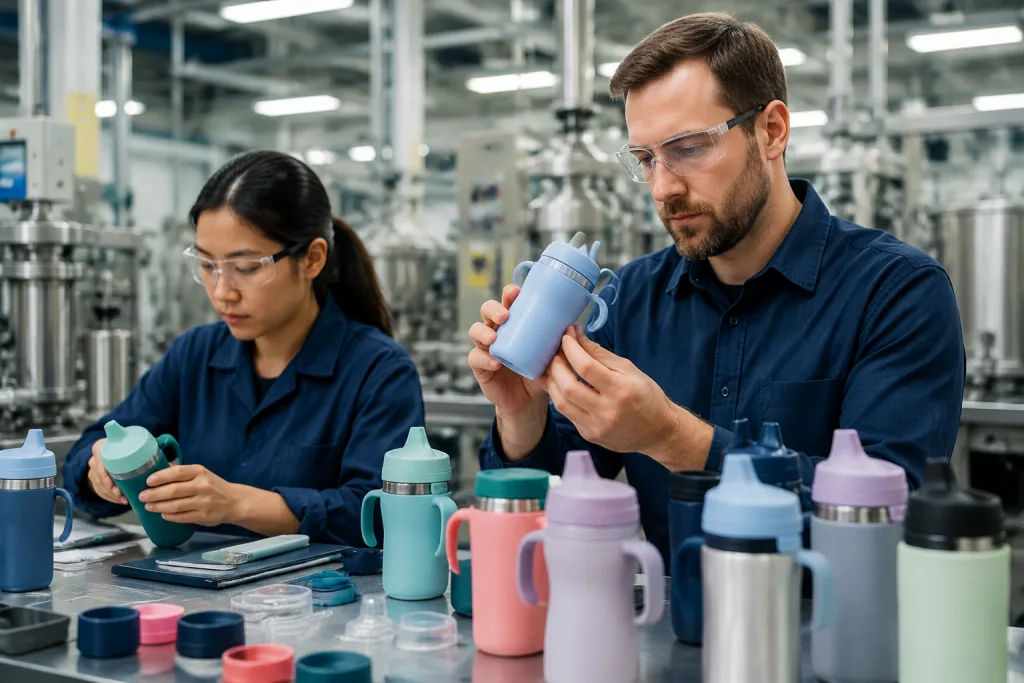
Compliance questions buyers should ask
Compliance is where 7 out of 10 first-time promotional buyers underquote the job. A toddler bottle is not just custom drinkware; it is a child product with food-contact parts. Test requirements change by market, sales channel, age grading, and the exact words printed on the carton. If the artwork says “for toddlers,” QC treats it differently from a general kids bottle. We had one PO where the buyer typed “12M+” on the color box after sample approval, and that single line changed the test discussion.
For the United States, buyers usually ask for FDA food-contact compliance, CPSIA-related checks for lead and phthalates, and sometimes ASTM F963 review if the bottle ships with toy-like charms, stickers, or handles. For California sales, Proposition 65 may enter the discussion. For the EU and UK, expect LFGB, EU 10/2011 for plastics, REACH/SVHC screening, and EN 14350 relevance for drinking equipment depending on design and age claim. On our line, we separate PP caps, silicone straws, and 304 stainless bodies into different bins before lab sample packing, because one mixed sample bag can delay testing by 5 working days.
Do not accept a random old test report without checking the tested material, color, model, and date. This is the wrong question to ask: “Do you have a report?” Ask what exact part the report covers. A report for clear Tritan body material does not cover a red PP cap, printed ink, silicone straw, or painted stainless exterior. Ask your canteen manufacturer for a bill of materials and match each food-contact component to available reports. QC pulled a sample last month where the silicone straw was 0.4 mm thinner than the approved drawing, and the buyer flagged it because the lab report named a different straw code.
For larger orders, budget for third-party testing before the deposit is locked. A basic migration and restricted substance package may cost USD 300-900. A broader child-product review can run above that, especially when the set includes a straw brush or printed gift box. The math does not work if you save USD 450 on testing and then hold 12,000 bottles in a 3PL warehouse for 18 days. If you are a canteen distributor selling into 3 or 4 countries, set the test plan against the strictest destination market before production starts. We ship cleaner when the lab scope is fixed before mold trial or pre-production sample approval.
Good factories do not fear compliance questions. We may push back on a 7-day ship date with new artwork, but we should be able to show material certificates, test report history, and process controls from the line.
MOQ, pricing, and lead time reality
We hear the same request about twice a week: 500 units, custom color, custom lid, retail box, and a “promotion price.” The math doesn't work. For toddler bottle promotional products, a workable starting point is 1,000 units for stock color with logo, 3,000 units for custom plastic color, and 5,000-10,000 units if the cap needs real changes, like a new straw angle or exclusive tooling. Last month QC pulled a 500 ml sample after Pantone matching and the buyer still wanted a private lid at 800 pcs; the mold quote alone killed it.
At BottleForge Industrial in Hangzhou, Zhejiang, we run about 420,000 units per month across mixed drinkware programs, depending on the stainless, plastic, and glass split on the line. For a stock mold toddler bottle, normal lead time is 25-35 days after sample approval and deposit. Custom color matching adds 7-12 days, because the lab needs resin chips, molded color plaques, and one signed sample under a D65 light box. New cap tooling can take 30-45 days before mass production starts; if the silicone valve cavity is off by 0.2 mm, we stop and cut again.
FOB pricing comes from resin grade, steel grade, cap part count, order quantity, packaging spec, and inspection level. Simple list. A canteen supplier quoting 30% below everyone else is probably saving money somewhere: 0.35 mm thinner carton board, recycled resin in a mouth-contact part, fewer gasket checks, or no real in-line QC. We’ve seen this go sideways. One buyer flagged a 4% leakage rate after delivery, and the factory’s “best price” disappeared once replacement freight and chargebacks landed.
For distributor drinkware and distributor canteen programs, order a common body and split the logos if your customers can accept the same bottle shape. We ship this way often: one 12 oz body, four logo versions, separate inner boxes, and carton marks by customer SKU. It helps reach the next price break without forcing every customer into the same artwork. Ask your canteen vendors whether they support mixed logo packing, barcode labels, and carton marks by purchase order; a typo on one PO line can send 60 cartons to the wrong retail DC or block an Amazon FBA booking.
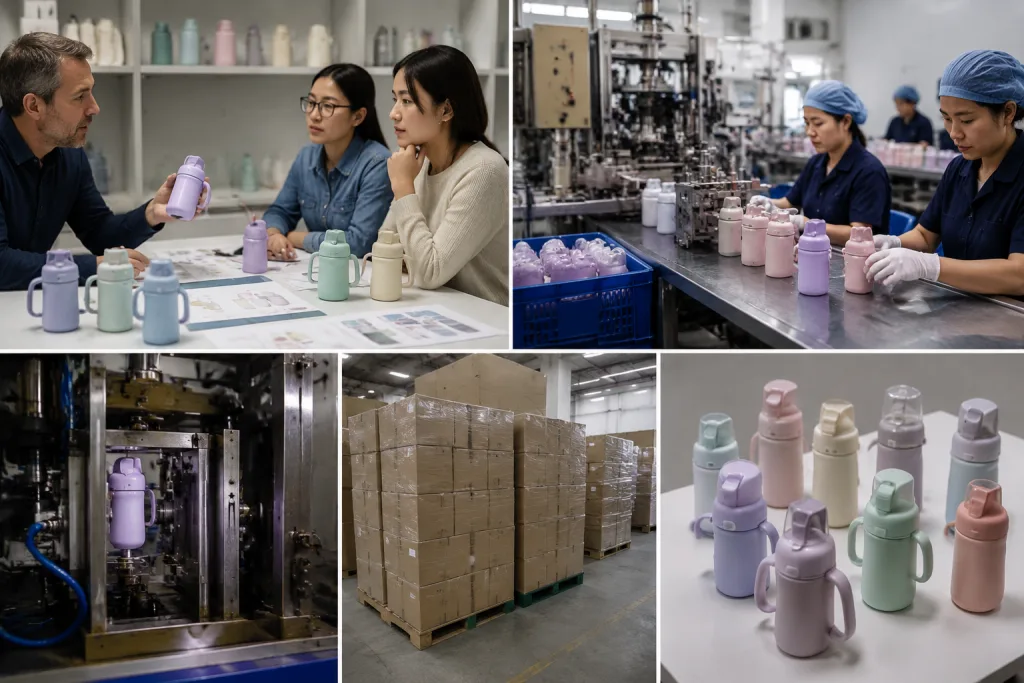
QC checklist before shipment
Inspection needs numbers. “Looks good” fails the minute QC opens the first carton with a digital caliper and a leak-test tray. Use AQL sampling and define defects before the inspector reaches the China factory floor; we run the defect sheet beside the approved sample, not from memory. For promotional toddler bottles, 8 out of 10 buyers we work with use AQL 2.5 for major defects and AQL 4.0 for minor defects. For critical safety defects, the acceptance number should be zero.
Pre-shipment checklist
- Leak test: Fill to rated capacity, close lid, invert for 30 minutes, then shake 20 times over a white paper towel so small drips show.
- Drop test: Drop packed carton from 76 cm on one corner, three edges, and six faces, then check crushed retail boxes and cracked lids.
- Odor check: Open sealed samples after 24 hours and reject strong plastic, solvent, or rubber smell; QC pulled one batch last year for a glue odor inside the straw cap.
- Cap fit: Check thread engagement, hinge movement, straw retention, and opening force with the approved sample on the table.
- Decoration: Run 3M tape pull, fingernail rub, and alcohol wipe where relevant; the buyer will flag logo peel faster than a 0.5 mm height difference.
- Dimensions: Confirm capacity, height, diameter, logo size, and barcode position against approval sample using a scale cup and caliper.
- Packaging: Verify inner bag warning, retail box print, master carton strength, gross weight, and shipping marks; a PO typo like “blue lid” versus “blue body” can stop the line.
If you are buying from a canteen manufacturer in Zhejiang or another China production base, ask for in-line photos at three points: material arrival, first finished goods, and packed cartons. Photos do not replace inspection. They catch the dumb mistakes early. We’ve seen this go sideways when a buyer skipped the first-finished-goods photo and found the wrong straw color after 20,000 units were sealed into export cartons with tape guns already stacked at the packing line.
For FBA or retail distribution, add scan checks for UPC, EAN, or FNSKU labels. One wrong barcode creates more trouble than a minor scratch; the math does not work when Amazon receives 48 cartons under the wrong child SKU. Your inspection booking should happen 3-5 days before planned shipment, not after the forwarder has already collected the goods. At that point, rework means unloading pallets, cutting straps, and losing at least 2 days.
How to brief your factory
A clear RFQ saves days. Put the capacity, body material, lid style, logo process, target market, test standard, packing, color split, and ship date in one message. We had one buyer write only, “What is your best price for custom canteen?” and our merchandiser had to send 7 follow-up questions before the line could even check the mold rack. Weak brief, weak quote.
Use plain numbers. Say 350 ml Tritan body, PP flip lid, silicone straw, one-color logo 45 x 30 mm, 5,000 units, EU market, LFGB required, FOB Ningbo, individual kraft box. With that, a canteen factory can check the 350 ml cavity set, pull the LFGB file, confirm whether pad printing or silk screen fits the 45 x 30 mm artwork, and calculate carton CBM from the kraft box dieline. If you need a customized growler in the same campaign, make it a separate SKU. Adult drinkware and toddler bottles should not share one messy PO line; we’ve seen that go sideways at pre-production sample approval.
For brand owners, decide early whether this is a short promotional run or a repeat retail item. A one-off canteen promotional order can use stock molds and standard 3-layer export cartons. A repeat program may need private mold engraving, spare straw and gasket planning, drop-test packaging, and a reserved production slot 18 days before ex-factory instead of the normal 12 days. Canteen distributors should also ask about reorder consistency: Delta E under 1.0 for color, logo position within ±1.5 mm, and whether the same resin lot and cap supplier will be used next time.
As a canteen vendor, we like buyers who challenge details before deposit. It is easier to adjust the sample than argue after shipment. If your launch date is fixed, share it. If your budget is fixed, say so. QC pulled a toddler bottle sample last month because the straw length was 6 mm short; fixing that before mass production cost 30 minutes, not a claim. A practical canteen manufacturer can offer two build options once the commercial limits are clear from the start.
Send your toddler bottle brief for factory review
Share capacity, material, quantity, market, logo, and deadline. We will reply with practical options, MOQ, FOB pricing, and lead time.
Frequently asked questions
What MOQ should I expect for toddler bottle promotional products?
For a stock mold with a standard body color and one-color logo, expect MOQ around 1,000 units. If you need a Pantone plastic body color, 3,000 units per color is more realistic because resin mixing and machine setup create waste. For stainless steel powder coating, many factories start at 1,000-2,000 units per color. Private cap tooling or a special bite-valve design usually needs 5,000-10,000 units to make the mold cost sensible. If a supplier accepts 300 units with full customization, check whether they are using leftover stock, manual decoration, or trading company consolidation.
Which bottle material is safest for toddlers?
There is no single safest material without considering design and testing. Tritan is common for clear toddler bottles because it is BPA-free, tough, and has good odor resistance. PP is economical and light, but clarity is lower. 304 stainless steel is durable and premium, especially for insulated bottles, but the cap and straw still need plastic and silicone review. For US buyers, ask for FDA food-contact support plus CPSIA-related restricted substance checks. For EU buyers, ask for LFGB, EU 10/2011 where applicable, and REACH/SVHC review. The whole bill of materials matters, not only the bottle body.
Can I use the same supplier for toddler bottles and custom growlers?
Yes, but verify that the factory actually controls both categories. A custom growler or distributor growler is usually stainless steel, larger capacity, adult-use, and less complex around child safety. Toddler bottles need smaller tolerances, safer caps, soft straw review, and often more compliance paperwork. Some canteen manufacturers are strong in vacuum stainless products but weak in plastic flip lids. Ask for current production photos, test reports, and defect history for toddler-style bottles, not only adult drinkware samples. If your program includes both, keep the specifications and inspection checklists separate.
How long does sampling and production usually take?
A logo sample from an existing mold usually takes 5-10 days after artwork confirmation. If you need custom color matching, add about 7-12 days for resin or coating approval. Mass production is commonly 25-35 days after sample approval and deposit for 1,000-20,000 units. Third-party testing can add 5-10 working days depending on lab schedule. Ocean freight to North America or Europe may add 25-45 days port to port, so do not plan a toddler bottle promotional products launch with only six weeks total unless you are using air freight or domestic inventory.
What should be in my purchase order to a canteen supplier?
Your PO should include model number, capacity, material, color, logo file reference, decoration method, packaging, carton marks, test requirements, AQL level, delivery term, payment term, and approved sample reference. Add tolerances where possible, such as logo position within plus or minus 2 mm and capacity within plus or minus 5%. For retail or FBA, include barcode type, FNSKU or UPC placement, suffocation warning requirements, and carton weight limit. A good PO prevents arguments. A vague PO gives the canteen vendors too much room to choose cheaper options you did not intend.