Key Takeaways
- Start with 304 stainless steel at 0.45–0.55 mm wall thickness for most toddler bottle programs
- Plan MOQ around 1,000 units per color, not just total order quantity
- Use AQL 2.5/4.0 inspection plus 1.2 m drop testing for retail-safe shipments
- Budget USD 2.80–5.20 FOB China depending on lid complexity, coating, and packaging
Toddler bottle private labeling looks simple until QC pulled the first PP sample from a 1.2 m drop test. The cap leaks, the silicone straw arrives without an LFGB report, the carton cube is off by 0.018 CBM for your distributor’s drinkware shelf plan, or the logo passes on a 3D mockup but looks thin on powder coating. You are not just buying a small bottle. You are buying risk control for parents, retailers, and your own brand.
At BottleForge Industrial in Hangzhou, Zhejiang, we run the project around four decisions: material grade, drinking system, decoration method, and the compliance file your buyer will actually accept. Colors come later. This is the wrong question to ask on day one, even if the buyer flagged Pantone 1767C twice on the PO. Our Zhejiang production network in China can support 80,000 toddler bottles/month, with typical MOQ from 1,000 units per color and 35–50 days lead time after sample approval.
Choose the bottle architecture first
The first decision is not logo placement. It is bottle architecture. On the factory side, we usually quote toddler bottle private labeling in three formats: single-wall stainless steel, double-wall vacuum insulated stainless steel, or Tritan plastic. That choice changes the tooling check, carton weight, LFGB/FDA test scope, and what parents expect when they open the box. QC pulled one 350 ml sample last month because the buyer approved a straw lid for Tritan, then wrote “SS vacuum” on the PO. Small typo. Big delay.
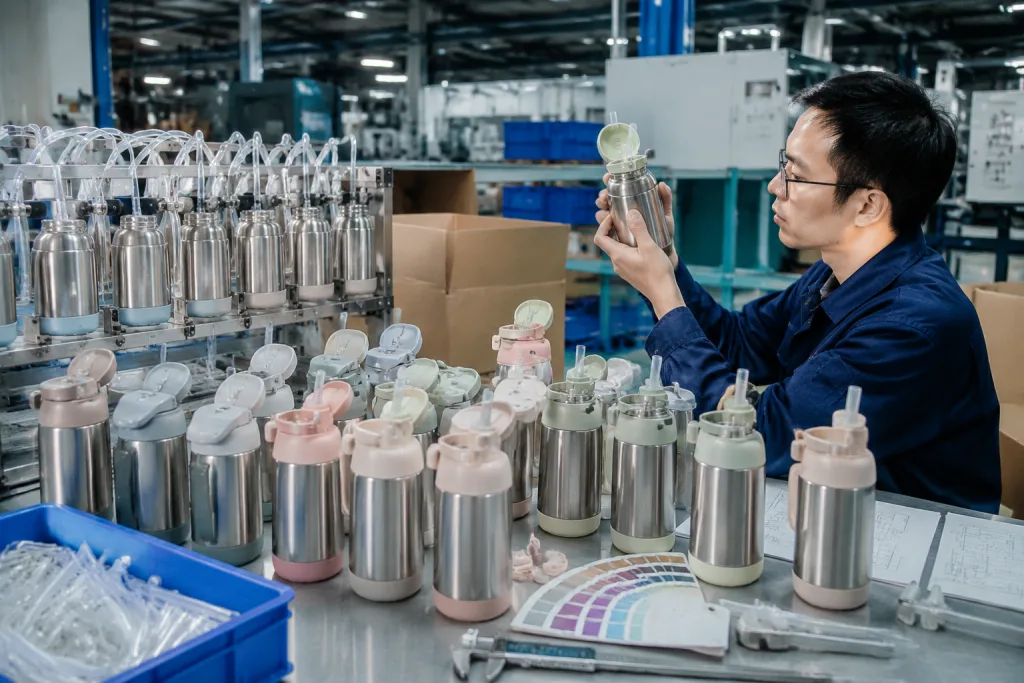
For most premium custom drinkware programs, 304 stainless steel is still the safest starting point. A 350 ml toddler bottle with 0.45–0.55 mm body wall thickness can handle normal daycare drops without feeling like a brick in a child’s hand. Double-wall vacuum insulation gives better shelf value, but it adds about USD 0.80–1.40 FOB per unit and raises dent rejection if the outer shell is cut too thin. We run outer shells through a simple caliper check before polishing; under 0.38 mm, the math does not work. For a canteen promotional campaign, single-wall stainless may be enough, but it will sweat with cold drinks and cannot claim insulation.
Tritan is lighter and lets parents see the fill level, but you need tight BPA-free paperwork, dishwasher wording, and scratch-resistance checks. We see about 6 plastic complaints for every 2 stainless body complaints on repeat school orders, mostly cloudy walls and cap odor. Plastic is not the problem. The channel is. A canteen distributor selling to schools usually wants stainless because it feels tougher after a 1.2 m drop test on the line. A gift-box retail buyer may accept Tritan if the Pantone color and landed price hit the shelf target.
Do not copy adult bottle specs into a toddler product. This is the wrong question to ask. A custom growler or customizable growler is judged by capacity and thermal performance; a toddler bottle is judged by grip, mouth safety, drop resistance, and how fast a parent can clean the straw. We have seen this go sideways when a buyer approved a nice-looking lid, then the inspection team found parents needed a pick tool to remove the silicone straw. If the bottle is hard to disassemble, the private label line will collect negative reviews even if the steel grade is correct.
Decide the drinking system
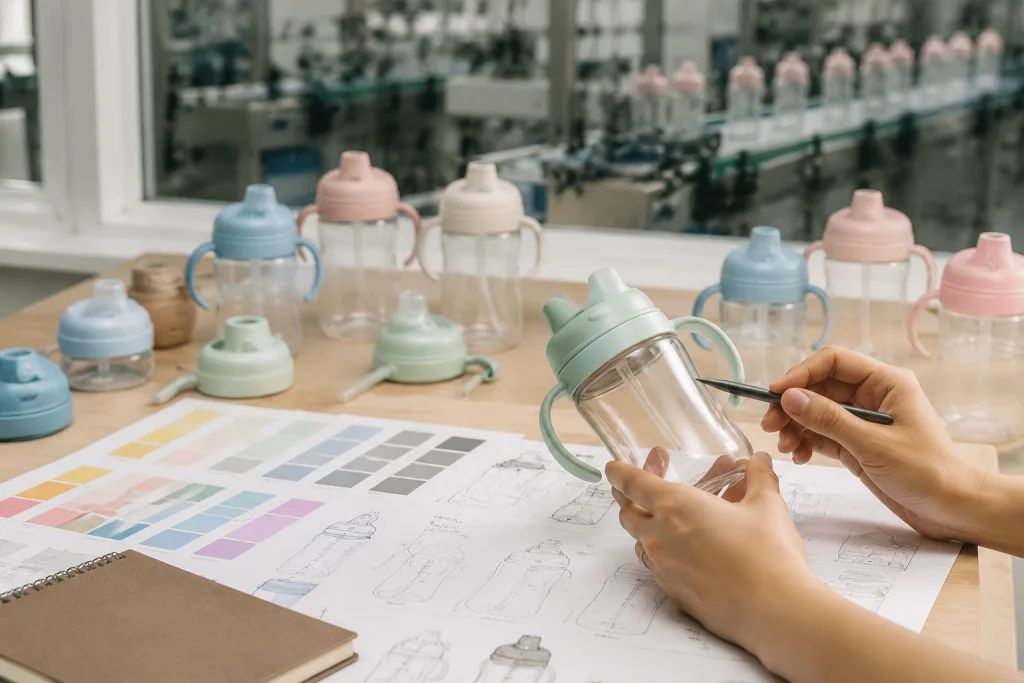
The lid is where 6 out of 10 toddler bottle projects get into trouble. Buyers ask us for a bear-ear cap or a round “cute” profile, but the real choice is a straw set for low-angle drinking, a flip spout for preschool users, or an open-sip training lid for at-home use. That choice changes the mold quote, silicone test plan, leak risk, and shelf age claim; last month QC pulled a sample with a 0.35 mm gap at the vent seat, and the buyer only noticed after asking for a lifestyle photo.
A weighted straw system fits 12–36 month users because the child can drink while tilted back in a stroller or half lying on a sofa. More pieces, more checks. We run straw tube, valve, gasket, vent plug, brush if packed, then confirm each silicone part against the assembly drawing before the line starts. For this style, we prefer food-grade silicone with LFGB or FDA test reports and a valve hardness around 50–60 Shore A, checked on a Shore A durometer at incoming QC. Too soft and it tears at the slit; too hard and toddlers fight the suction.
A flip spout is simpler and usually cheaper. It is easier for a canteen manufacturer to hold at scale, and it suits 3–5 year users. The catch is bite damage, not molding. We’ve seen this go sideways when a buyer rejected spare parts to save USD 0.018 per bottle, then got weekly retail complaints after the first shipment. If your market expects fast after-sales service, order 2–3 percent spare spouts and add replacement part SKUs to the packaging plan. The math works.
Open-sip training lids fit parenting brands, but they are weak for travel unless the seal design is conservative. If you sell through canteen distributors or distributor drinkware accounts, ask where the bottle goes: dining table, daycare cubby, or backpack. Backpack is the wrong place to trust a pretty lid. We run inverted leak tests for 4 hours, side-position tests, and vibration carton checks before mass production release; on one 5,000 pcs pilot run, the carton vibration table exposed seepage around a 1.2 mm silicone lip that looked fine on the CAD file.
Our blunt advice: never approve a toddler lid from photos. Request 10 physical samples, give them to real parents for 7 days, and ask what annoyed them. One buyer flagged a “perfect” straw cup because the cleaning brush poked through the polybag and scratched the printed logo.
Match branding to surface reality
Private labeling starts with the surface finish. Ask that first. A laser logo on raw 304 stainless survives rough use, but the mark is quiet, closer to gunmetal than black. Silk screen printing gives better color; the buyer flagged it last March when red ink scratched off a blue powder coat after only 80 rubs because the curing oven was set 10°C low. Heat transfer handles cartoon artwork and gradients, but the plate charge and extra rub test make the math tighter on small MOQs. For toddler bottle private labeling, we usually run powder coating plus one-color silk screen, or laser engraving on a flat clean panel.
If you need a canteen customized look with full character artwork, place the art on the straightest body zone. Bottle shoulders bend the face. QC pulled one 350 ml sample where the bear’s eye stretched 2.5 mm after the film crossed the curve; the buyer noticed it before we did. We normally keep critical text at least 8 mm away from the bottom radius and 12 mm below the shoulder curve. For small warning icons, avoid lines below 0.18 mm; they fill in on the screen mesh during printing.
A matte powder coat feels premium, but light colors pick up scuffs in the carton. We see it most on cream, pale pink, and light yellow after 48 hours in a 12 kg drop-test carton with paper dividers. Gloss coating wipes clean faster, but on kids’ drinkware it can look like a promo giveaway. Rubberized coating feels good in hand, yet fingernails mark it, and weak formulas fail alcohol rub tests. For retail or Amazon-style packaging, we recommend 3M tape adhesion testing, 500-cycle rub testing, and dishwasher testing only if you plan to claim dishwasher safe. Do not make that claim casually. We have seen this go sideways.
The same decoration logic applies to wider canteen custom and custom canteen programs. A canteen customizable for corporate gifts can accept a softer finish if it sits on a desk beside a laptop. A toddler bottle cannot. It gets dropped, chewed, washed, and left in a car at 45°C. On the line, we judge it after normal abuse, not under showroom lights. Good customized drinkware is not the fanciest pre-production sample; it is the decoration that still looks acceptable after 30 days with a toddler.
Set compliance before price negotiation
Quote compliance as one line package before you argue over USD 0.06 on the cap. For Europe, we put LFGB, REACH, food contact migration, and packaging requirements on the same checklist. For North America, ask about FDA food-contact suitability, CPSIA where applicable, ASTM-related physical safety expectations, and California Proposition 65 if your channel requires it. A serious canteen supplier should separate existing reports from material-level reports, then mark which tests must be run on the finished toddler bottle. QC pulled one sample last May where the silicone straw passed, but the printed body failed migration after the lab cut a 30 mm x 30 mm coating piece.
The cost gap is real. A basic material report may already exist. A finished product migration test can cost USD 300–900 per SKU depending on lab scope. A full children’s product test package costs more and takes 7–12 working days. If you plan three colors using the same ink system and silicone material, duplicate testing can be reduced. If every color uses a different coating supplier, the lab plan gets messy and the math doesn't work. We have seen a PO typo list “matte pink powder coat” while the approved sample was glossy UV print, and that one line added 9 days because the lab had to retest the outer coating.
Audit expectations matter too. About 7 out of 10 European toddler bottle buyers we speak with ask for BSCI or Sedex documentation before they release artwork. Some North American promotional buyers focus on ISO 9001 processes, AQL inspection records, and traceable material declarations. BottleForge Industrial works from Hangzhou, Zhejiang and coordinates with audited production partners in China, but we still want your compliance checklist before sampling. Do it early. Approving a nice 350 ml sample, then finding out the retailer needs a report that forces a PP lid change, is the wrong way to run the line.
For canteen suppliers and canteen vendors, the honest position is simple: do not promise certificates that do not match the exact product. A test report for a plain stainless tumbler does not automatically cover a toddler bottle with silicone straw, printed coating, PP lid, and color masterbatch. Ask for report names, dates, tested components, and lab identity before you place a deposit. We also ask the lab for the tested BOM revision, because we have seen rev A use 304 stainless and rev B switch the straw weight by 2.8 g without anyone telling sales.
Build MOQ around color and tooling
MOQ is not one number. Asking “what is your MOQ?” is the wrong question to ask. We build it from body size, body color, lid set, logo process, retail pack, and straw color if the straw is not stock clear or white. For standard shapes, we run 1,000 units per body color as a realistic toddler bottle private labeling MOQ. If you need a new molded lid, expect tooling cost from USD 2,500–8,000 and a first order quantity of 3,000–5,000 units, because the injection line needs stable shots, clean edges, and assembly trials. On the floor, QC checks the lid fit with a 0.05 mm feeler gauge before we let that sample leave Hangzhou.
For standard molds, our common sample timeline is 7–10 days for blank samples and 12–18 days for logo samples. Mass production is 35–50 days after deposit and approved pre-production sample. Peak season before back-to-school adds 10–15 days, mostly when powder coating booths and gift box printers are full. Book early. We have seen this go sideways when artwork changed after the PP sample: one buyer corrected a Pantone code on the PO from 312C to 321C, and the lost 6 days did not come back.
Price normally lands in these bands FOB Ningbo or Shanghai: USD 2.80–3.60 for single-wall stainless with simple spout, USD 3.80–5.20 for vacuum insulated straw bottles with powder coating, and more when you add custom silicone, carry straps, retail gift box printing, or barcode labeling. A customized growler or distributor growler program has more room to absorb price movement because unit value is higher. Toddler bottles are tighter. Retail buyers notice every USD 0.20. Last month the buyer flagged USD 0.18 on a 304 stainless straw bottle after our coating thickness gauge showed 72 microns and the gift box paper was upgraded to 350 gsm.
For private label planning, calculate landed cost by carton cube and defect allowance, not only FOB. A bottle packed in a large display box looks better on shelf but can reduce container efficiency by 12–18 percent. The math does not work if the box sells the product but kills the pallet count. For canteen distributors buying mixed SKUs, we measure the master carton with a tape before quoting, then check inner pack count and spare lid or straw sets against the buyer’s warehouse rule. One extra replacement straw bag per carton sounds small until it changes the carton from 8.6 kg to 9.1 kg and pushes freight into the next bracket.
Control samples like production assets
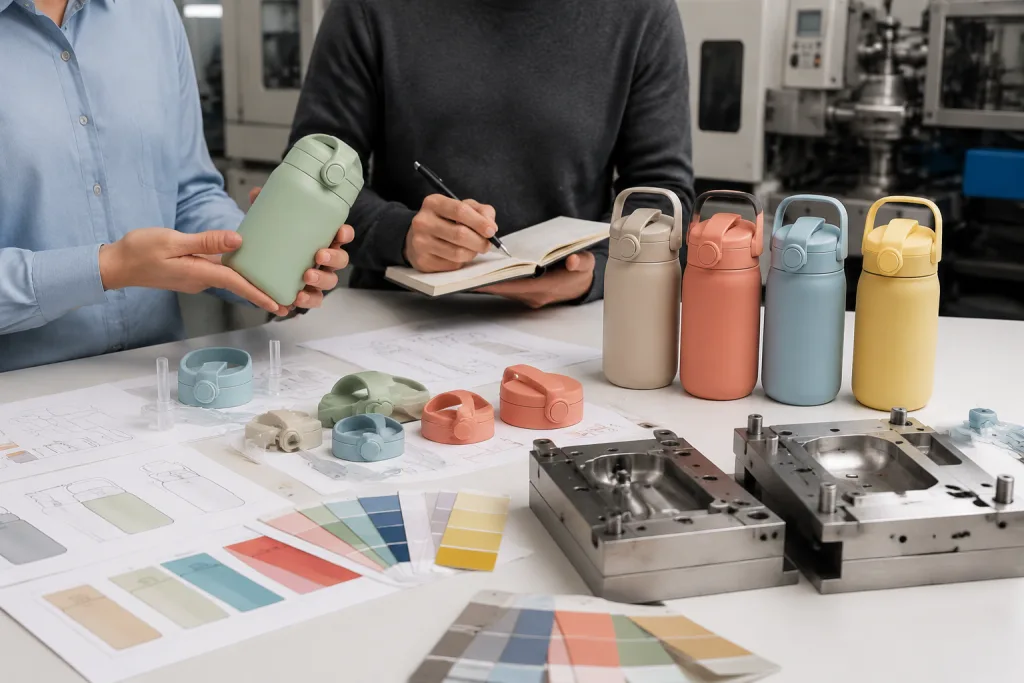
Samples are not desk souvenirs. Treat them like production assets, because the line will copy what sits in the sealed bag. We run a 3-step sample process: the reference sample locks the shape and grip feel, the logo sample checks print position on the curved body, and the sealed pre-production sample becomes the factory standard. That sealed set needs the bottle, lid, straw, manual, hangtag, carton mark, barcode, and full packaging. If QC opens the carton and the straw brush is missing, the buyer has not approved the real product.
Write approval points that a caliper and scale can check. Control color by Pantone or a physical color chip, not by phone photos under office lights. State logo size in millimeters, for example 38 mm wide with ±1 mm placement tolerance from the bottom curve. Define weight tolerance, for example 210 g ± 8 g. Agree lid torque, leak testing, and straw pull force before production starts; we have seen this go sideways when a buyer approved the art but forgot the bite-valve pull test. AQL inspection should normally use Critical 0, Major 2.5, Minor 4.0 for toddler drinkware, plus checks for sharp edges and burrs around the rim, odor inside the cap, coating damage, and any missing small part.
Drop testing matters. We normally test from 1.2 m on bottom, side, and lid positions, using a concrete slab near the assembly line, not a soft office floor. A dent can pass if the bottle still seals and stands flat. A cracked cap, exposed sharp edge, or detached silicone plug fails. For toddler products, small part risk is the wrong place to negotiate. It is a recall issue, and QC pulled one sample last year after a 6 mm vent piece came loose after the third drop.
For customizable drinkware orders going into multiple sales channels, define packaging versions before artwork release. A retail carton needs shelf-facing graphics and barcode placement, while an Amazon FBA pack needs FNSKU labels, suffocation warnings on polybags, master carton weight under 15 kg, and barcodes that scan after matte lamination. A bulk school canteen promotional pack is another job, usually with fewer printed inserts and tighter carton count. Confirm these before carton printing. We once had a PO typo showing 500 pcs per carton instead of 50, and the buyer flagged it only after the carton dieline was finished. A good canteen vendor asks boring questions here. Good sign.
Select a supplier by behavior
Out of 20 canteen manufacturers, 14 can quote a toddler bottle by photo. Maybe 5 can explain why a lid cracked at the hinge, why MOQ jumps from 1,000 pcs to 3,000 pcs by color, or why a test report for the base bottle does not cover your final SKU with straw and printed sleeve. Pick the supplier by behavior in the first two weeks, not by the lowest spreadsheet price. We have seen this go sideways when QC pulled the sample and the “same lid” was 0.4 mm thinner than the approved one.
Watch how the canteen supplier answers technical questions. Do they give the steel grade, wall thickness in mm, silicone hardness in Shore A, coating type, and master carton size with gross weight? Do they split tooling cost from unit price? Do they warn you when your requested logo sits too close to the lid thread? A solid partner will push back. Good. A quiet canteen vendor who says yes to every request usually fixes nothing until inspection day, when the torque gauge is already showing loose caps.
If you are a distributor drinkware buyer managing 30 or 80 SKUs, ask for written change control. If the factory changes a gasket material, ink supplier, box paper weight, or straw length from 135 mm to 128 mm, you need notice before the line starts. For canteen vendors shipping to Europe and North America, silent substitution kills trust fast. We once had a buyer flag a PO typo, “LFGB” typed as “LFBG,” and that small catch saved 12 days versus 18 days of retesting emails.
Our position from Zhejiang, China is simple: toddler bottle private labeling rewards disciplined buyers. Lock the architecture and lid system first, then fix the decoration method, compliance target, MOQ, and AQL inspection plan before chasing another USD 0.05 discount. The math often does not work. BottleForge Industrial can support custom canteen, customizable canteen, canteen customized, customized canteen, custom drinkware, and broader distributor canteen programs, but the best projects start with clean decisions on paper. Send target capacity, age range, sales market, packaging style, and testing requirements; we can usually turn a serious quote in 24–48 hours after checking mold fit with a digital caliper.
Send your toddler bottle brief for pricing
Share capacity, lid style, market, logo method, and target MOQ. We will return a practical FOB China quote within 24–48 hours.
Frequently asked questions
What is the best material for toddler bottle private labeling?
For most B2B programs, 304 stainless steel is the safest default because it balances durability, price, and parent confidence. We usually specify 0.45–0.55 mm wall thickness for a 300–400 ml toddler bottle. Double-wall vacuum insulation costs more, often adding USD 0.80–1.40 FOB per unit, but it improves retail positioning. Tritan can work for a lighter, transparent bottle, but you need strong BPA-free documentation and realistic scratch expectations. If your product goes through schools, daycare, or canteen distributors, stainless steel normally reduces complaints.
What MOQ should I expect for a private label toddler bottle?
For standard molds, expect 1,000 units per color as a practical MOQ. Some canteen suppliers may quote lower, but the unit price, coating control, and component sourcing usually become worse under that level. If you need a custom lid, custom straw weight, or exclusive body shape, tooling can run USD 2,500–8,000 and the first order often needs 3,000–5,000 units. Packaging also affects MOQ; custom printed boxes usually start around 1,000–2,000 pieces per artwork.
How long does sampling and production take in China?
A blank sample normally takes 7–10 days if the mold exists. A logo sample takes about 12–18 days because coating, printing, and curing must be scheduled. After you approve the pre-production sample and pay deposit, mass production is usually 35–50 days. Add 7–12 working days if finished product lab testing is required. Zhejiang and other China production zones get busy before back-to-school and Q4, so approval delays can push delivery by 10–15 days.
Which logo method is best for toddler bottles?
Laser engraving is the most durable, but it is subtle and works best on stainless or coated surfaces where a tone-on-tone mark is acceptable. Silk screen printing gives stronger brand color and is cost-effective for one or two colors. Heat transfer is better for complex artwork, but it needs rub testing and careful placement on curved bodies. For toddler bottle private labeling, we often recommend powder coating plus a one-color silk screen logo, tested with tape adhesion and 500-cycle rub checks.
What inspections should I require before shipment?
Use AQL with Critical 0, Major 2.5, and Minor 4.0 as a baseline. Inspection should include capacity, weight, logo position, coating defects, odor, burrs, sharp edges, leak testing, lid assembly, straw pull force, barcode scan, and carton drop checks. For toddler bottles, add 1.2 m drop testing on bottom, side, and lid positions. If the order ships to Amazon or a distributor warehouse, verify FNSKU labels, carton weight, carton marks, and inner packing before the final balance payment.