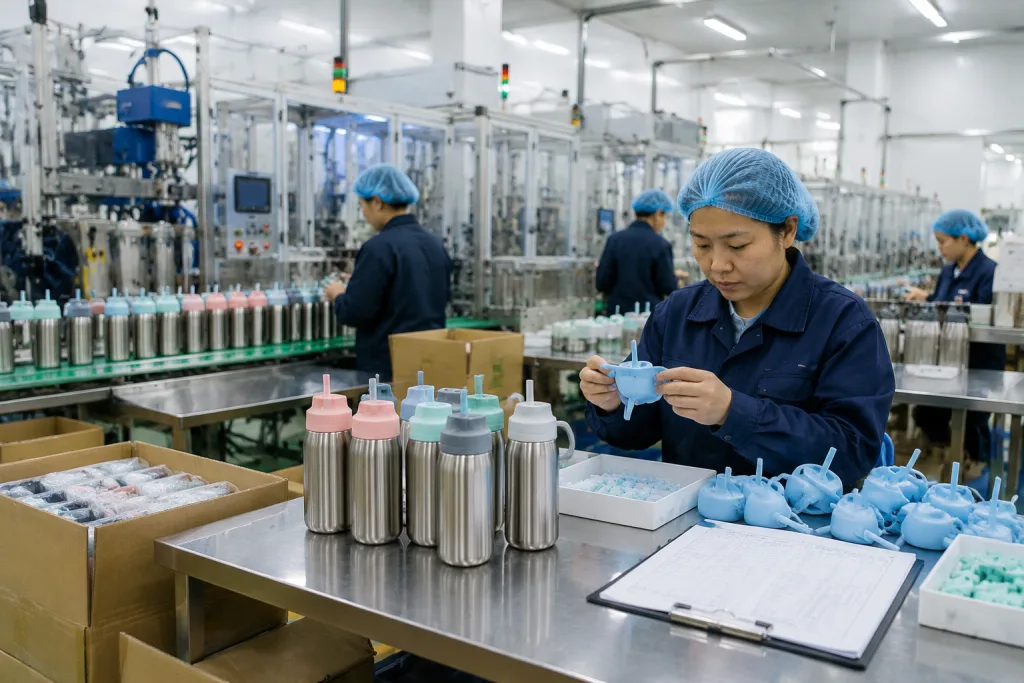
Key Takeaways
- A 3,000-piece toddler bottle private label order usually lands at USD 2.10-4.80 FOB before freight and duty
- New lid or straw mold tooling can add USD 1,200-6,500 and 15-30 days
- Standard production lead time is 30-45 days after deposit and artwork approval
- EN 14350, ASTM, CPSIA, LFGB, and REACH checks should be budgeted before mass production
A toddler bottle private label project looks simple until the first costing sheet lands on the desk. The bottle body might be USD 2.20 FOB, then the cap mold, silicone straw, Pantone color match, safety testing, and retail box add up fast. We had one buyer approve a flip-lid design 9 days after the PP sample, and the landed program moved 35% because the carton cube jumped from 0.052 CBM to 0.071 CBM per 24 pcs. The math doesn't work if the lid is treated as a small detail.
We manufacture custom drinkware in Hangzhou, Zhejiang, and we see the same issue on the line: most problems are not technical. They are timing and cost-control problems. You need to know what is included, what is charged once, and what can push shipment from China by 14 days. QC pulled one toddler bottle sample last month because the straw hole was 0.4 mm off-center; small finding, big delay when packaging artwork is already printed. Here is the practical breakdown we use with distributors, brand owners, and procurement teams.
Start With The Real Unit Cost
For toddler bottle private label, the quoted unit price is the wrong number to fall in love with. A stainless steel toddler bottle with double-wall vacuum insulation, PP lid, food-grade silicone straw, powder coating, and one-color logo normally prices at USD 2.10-3.40 FOB Ningbo or Shanghai at 3,000-5,000 pieces. Add a carry handle, flip lock, weighted straw, full-wrap print, retail box, and drop-test packaging, and the same bottle moves to USD 3.80-4.80 FOB. Last month our costing clerk caught a PO typo where “weighted straw” was written as “straight straw”; that one line changed the quote by USD 0.28 per piece.
The biggest cost drivers are not always the steel body. In our Zhejiang factory quotations, the body may be only 45-55% of the unit cost. The rest sits in lid parts, silicone, assembly labor, printing, and packaging. A toddler bottle is tougher to price than a basic adult canteen because the cap has child-use safety requirements and more leak points. We check the straw seat with a 0.05 mm feeler gauge on the line; if that fit is loose, QC pulls the sample before the buyer ever sees it.
Use this buying range before you ask a canteen supplier for a formal quote. We run the first costing in a 6-column sheet: body, lid set, silicone, logo, box, and test packing.
- Basic single-wall toddler bottle: USD 1.35-2.20 FOB at 5,000 pieces, usually with a simple screw cap and no retail box.
- Double-wall stainless toddler bottle: USD 2.10-3.40 FOB at 3,000 pieces, with vacuum testing and logo setup included.
- Premium bottle with custom cap and gift box: USD 4.00-6.20 FOB at 3,000 pieces, once you add molded cap parts and color-box packing.
- New mold private label structure: unit price plus tooling, samples, and extra validation time; 25-35 days for mold sampling is common in our shop.
If a canteen vendor quotes far below these levels, ask what material grade, wall thickness, cap resin, and testing scope are included. Cheap quotes from China are real sometimes. The math still has to work. We have seen this go sideways when a buyer flagged 0.32 mm body thickness during incoming inspection, after the supplier had quoted as if 0.40 mm was included.
MOQ Tiers That Change Pricing
MOQ is the point where a toddler bottle private label job either pays for itself or starts wasting line time. For an existing bottle shape with stock colors, we run a practical MOQ of 1,000 pieces per color and 3,000 pieces per order. For custom Pantone powder coating, MOQ is usually 2,000 pieces per color; our coating room loses 8-12 kg of powder during color change and the spray guns still need a full clean-down.
For full private label packaging, most buyers should plan at least 3,000-5,000 pieces. Below that, the math doesn't work: carton plates, insert card cutting, barcode label setup, and AQL table inspection get spread over too few bottles. For a new lid mold, do not look below 10,000 pieces unless you accept a heavy tooling payback per unit; we have seen buyers approve a mold and then argue over USD 0.18 on the next PO.
Here is how we usually see FOB pricing move on a 350 ml stainless toddler bottle after QC pulls the sample and confirms the 304 stainless body, lid fit, and coating thickness:
- 1,000 pieces: USD 3.60-4.90, limited colors, existing lid only.
- 3,000 pieces: USD 2.80-3.80, custom color and logo become realistic.
- 5,000 pieces: USD 2.55-3.45, better packaging cost absorption.
- 10,000 pieces: USD 2.30-3.10, stronger leverage on cap parts and coating.
A canteen distributor or distributor drinkware buyer often asks for 6-8 SKUs with 500 pieces each. Looks simple on a spreadsheet. On the floor, it means eight color changes, eight carton marks, and more chance the warehouse picker puts mint lids into the beige carton. If your first launch budget is tight, start with two colors and one lid configuration. Add SKUs after sell-through data is clear.
Our Hangzhou, Zhejiang facility can produce around 450,000 stainless drinkware units per month across toddler bottles, travel tumblers, sports bottles, and custom growler programs. Capacity is not the problem. Fragmented small batches are. We ship smoother when a PO has clean artwork names, fixed Pantone codes, and one carton mark file instead of six versions named “final-final”.
Tooling, Samples, And Hidden Extras
Private label can mean a logo on a stock bottle, or a bottle shape your brand owns. Different math. We run both. A laser logo on an existing toddler bottle may have no tooling charge; QC just checks the logo position with a 0.5 mm acetate gauge before packing. A new injection lid can require USD 1,200-3,500 for a simple mold. A multi-part flip lid with lock button, straw port, dust cover, and silicone valve can require USD 4,000-6,500, and the buyer usually flags the cost only after seeing the mold quote line by line.
Stainless body tooling is usually higher. A new body profile, shoulder shape, or bottom structure may require forming tools from USD 3,000-12,000, depending on diameter, taper, and whether you need both inner and outer shells adjusted. On the line, a 2 mm shoulder change can mean a new stretch die and a different trimming knife, not a quick CAD edit. First-time custom drinkware buyers often ask, “Why not just change the rendering?” Wrong question to ask. The steel does not care about the rendering.
Sampling has layers. A stock sample with logo can be ready in 5-7 days. A color sample with Pantone powder coating usually takes 10-14 days; we spray two panels first and check under a D65 light box because “close enough” becomes a dispute fast. A new cap T1 sample can take 20-30 days after mold deposit. If the straw angle leaks or the button spring feels weak, one correction cycle adds another 7-15 days. We have seen this go sideways when the buyer books a launch date before T1 parts even leave the mold room.
Budget for these extras before you approve the project internally; our merchandiser usually puts them above the unit price so nobody misses them on the PO:
- Logo screen setup: USD 30-80 per artwork or color.
- Laser engraving fixture: USD 50-150 for curved or small surfaces.
- Custom retail box die line: USD 80-250 if not using a standard box.
- Lab testing: USD 350-1,200 per material set and standard.
- Pre-shipment inspection: USD 180-350 per man-day in China.
A canteen manufacturer should separate these items clearly. If tooling, testing, and packaging are buried inside one vague unit price, you cannot compare canteen manufacturers honestly. We once saw “packing inclued” typed on a PO, with no box material, no insert card, and no drop-test requirement; the math did not work once the buyer asked for a 350 gsm color box and ISTA-style carton test.
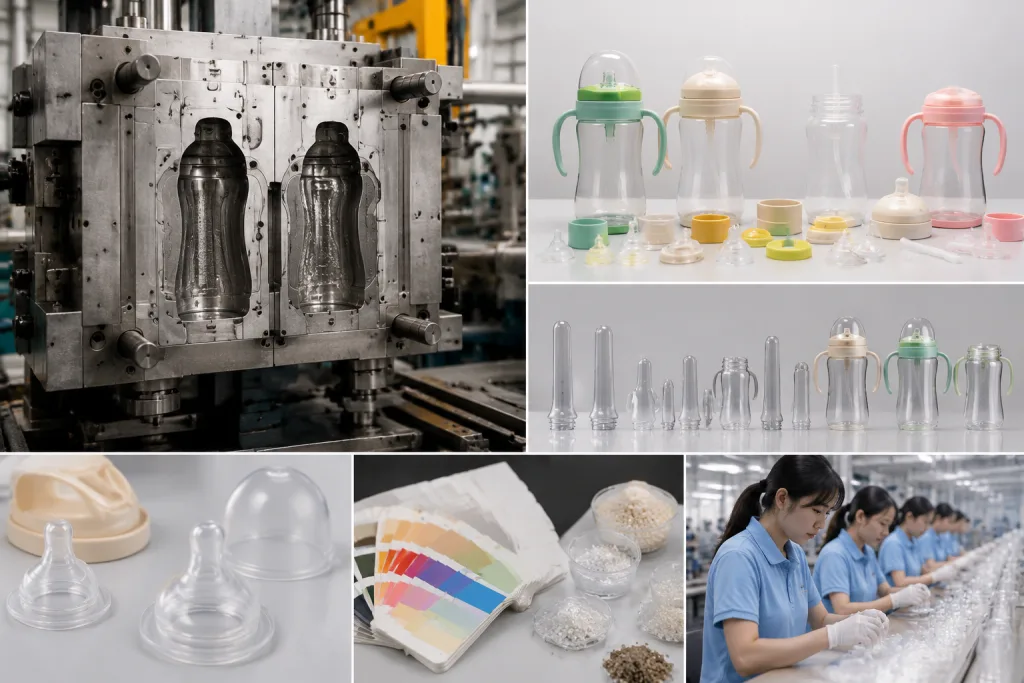
Materials Affect Safety And Margin
Toddler bottles are not promo adult bottles with smaller bodies. Kids chew straws, throw bottles off high chairs, and leave milk in the cup until Monday morning. We have had QC open a returned sample and find sour milk sitting under the straw valve. Material choice protects your margin, but it also protects the first review your buyer sees online.
For stainless toddler bottles, we run SUS304 inner wall with 0.38-0.45 mm wall thickness on most private-label orders. That spec holds shape after the drop test from 90 cm onto our rubber mat. The outer wall can be SUS304, or SUS201 on price-driven promo runs, but the math does not work for premium retail if one rust complaint triggers a 3,000 pcs chargeback. Lids should be food-grade PP, or Tritan when the buyer wants a clear look. Silicone parts need LFGB or FDA food contact reports by item, not a loose “food grade” line on a supplier statement.
Powder coating is a margin decision, not just a color decision. A basic powder coat adds roughly USD 0.25-0.45 per unit compared with a plain stainless finish, and we check film thickness with a coating gauge before cartons close. Soft-touch coating looks nice on shelf, but we have seen it go sideways after 500 rub cycles in toddler use when curing time was short by 6 minutes. For retail brands, we prefer matte powder coat, then cross-hatch adhesion testing and 3M tape pull checks during production.
For plastic toddler bottles, Tritan and PP cover most projects. Tritan gives better transparency for shelf display; PP cuts cost and handles squeezing better when small hands press the body. If your buyer asks for dishwasher-safe claims, testing only the raw resin is the wrong question to ask. We test the assembled bottle at 70°C, because heat can warp lids, loosen straw fit, or make printed marks fail after 10 wash cycles.
This is where a canteen factory with real drinkware assembly experience matters. A canteen promotional supplier may handle simple adult bottles well, but toddler caps need tighter fit control, usually within 0.15 mm on the straw hole and lid seat. We use AQL inspection with common levels such as AQL 2.5 for major defects and 4.0 for minor defects, then QC pulls samples for leakage, straw pull force, lid torque, and coating defects. Last month the buyer flagged one PO typo as “tritan lid” instead of “PP lid”; catching that before tooling saved 12 days vs 18 days on the revised sample round.
Lead Time From Artwork To Shipment
A normal toddler bottle private label order from China takes 30-45 days after deposit, artwork approval, and sample confirmation. Your own sign-off clock is outside that. We’ve had buyers spend 11 days arguing over a 6 mm logo position while the line sat ready; artwork and compliance review often eat more time than stamping, coating, and packing.
A realistic timeline for an existing bottle is:
- Day 1-3: confirm specification, target price, Incoterm, and MOQ; we normally lock the BOM in Excel and check capacity against the welding line schedule.
- Day 4-10: prepare logo mockup, box artwork, FNSKU or EAN labels if needed; one PO typo in an EAN code can cost 2 days if the carton factory has already made plates.
- Day 8-14: produce logo or color sample for approval; QC pulled the sample under a D65 light box last month because the pink coating was 1 shade off the approved Pantone card.
- Day 15: deposit paid and materials booked; without the bank slip, our purchasing team will not reserve 304 stainless coils or PP lid resin.
- Day 16-35: body production, coating, printing, cap assembly, packaging; this is where laser welding speed, curing oven time, and cap leak testing set the pace.
- Day 36-42: internal QC, buyer inspection, carton marking, booking; AQL 2.5 inspection usually catches scuffed coating, weak barcode contrast, or carton marks that do not match the shipping mark file.
- Day 43-50: container loading or LCL handover; we ship after warehouse weighs cartons, checks CBM, and sends the booking number to the forwarder.
For a new lid mold, add 25-45 days before mass production. For a new bottle body, add 35-60 days. If third-party testing is required before production, add 7-12 working days for standard food-contact reports, or 18-22 working days when SGS, Intertek, or TÜV is backed up before European retail seasons. The math doesn’t work if testing starts after bulk materials are already cut.
Peak season bites. From March to June, 40+ canteen suppliers in Zhejiang are running summer, back-to-school, and Q4 promotional orders through the same coating shops and carton plants. If you need delivery into a North American warehouse by August, production should start by late May, not mid-July; we’ve seen this go sideways when the buyer flagged a warning-label wording change after cartons were printed.
For distributor canteen and distributor growler programs, lock repeated colors and packaging templates early. Reusing dielines and approved coatings can save 5-10 days on every reorder, because the line can skip new box sampling, coating drawdowns, and another round of barcode scan checks.
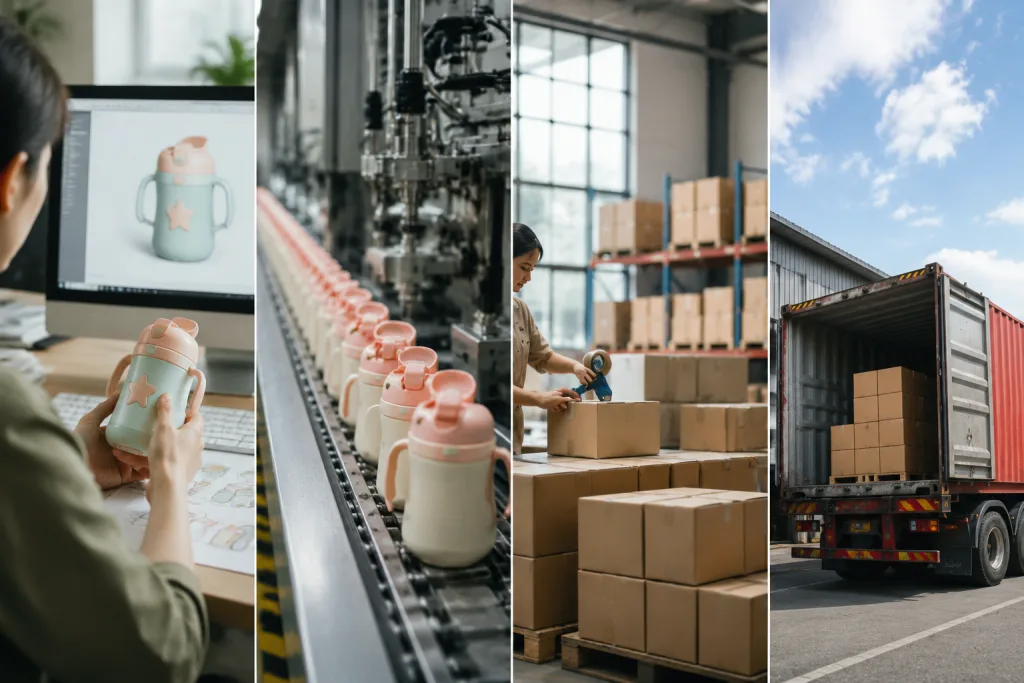
Compliance Is Not Optional
For toddler bottle private label, compliance belongs on the table before the buyer and factory lock the price. If the bottle sells in Europe, we check LFGB, EU food contact, REACH, and EN 14350 based on the exact design and the claim printed on the carton. For North America, we review CPSIA, ASTM-related checks, FDA food contact, California Proposition 65 screening, and small-parts risk. The scope changes with age grading, lid structure, sales channel, and even a 6 mm straw tip change. QC pulled one sample last year where the silicone straw passed, but the loose vent plug looked like a small-parts issue for under-3 labeling.
Do not rely on an old raw material certificate from a canteen manufacturer and assume it covers your finished product. Wrong question. A finished toddler bottle includes 304 stainless body material, coating, PP or Tritan lid parts, silicone straw, ink, adhesives, and packaging. One lab report can pass the steel sheet while another component fails migration or heavy metal screening. We run incoming checks with a digital caliper and shore hardness tester, and we still send the final assembled bottle because the lab tests what the child touches, bites, and drops.
For retail and marketplace programs, testing must match the final production specification. If you change coating color, silicone pigment, or ink system, ask whether the previous report still applies. In our line, even switching from matte pink to gloss pink means a new coating batch number on the BOM. We have seen this go sideways: the PO said “blue lid,” the approved sample was Pantone 2925C, and the buyer flagged the lab report because production used a darker resin masterbatch. Compliance is not paperwork to customs, retailers, or parents.
We usually advise the following budget range:
- Basic food contact screening: USD 350-600 per item, usually for one material set and one colorway.
- Multi-material toddler bottle test package: USD 700-1,200, covering the steel body, lid plastic, silicone straw, coating, and printed areas.
- Retailer-specific protocol: USD 1,200-2,500 if extensive mechanical testing is added, such as drop, torque, bite, and lid pull checks.
A good canteen vendor will tell you when a claim is risky. For example, “spill-proof” is safer than “leak-proof” unless the bottle passes defined inverted and pressure tests, such as 30 minutes upside down after a 1.2 m drop. Claims printed on packaging create liability. Keep them factual and tested. We ship fewer disputes that way, and the math works better than paying for a carton reprint after final inspection.
How To Buy Without Surprises
The cleanest toddler bottle private label orders start with a tight RFQ. Send capacity, target age range, lid type, insulation requirement, logo method, packaging type, destination port, compliance market, forecast quantity, and target launch date. If you ask for “best price,” 5 canteen suppliers will quote 5 different assumptions; last month QC pulled a 350 ml sample where the buyer expected a silicone straw, but the PO only said “kids lid.”
For a first order, we prefer a specification sheet with these fields: bottle capacity in ml and oz; body diameter, total height, and mouth diameter checked by caliper; inner steel grade and outer steel grade; lid material and straw material; coating color by Pantone number; logo size and print position; packing method, carton quantity, drop-test requirement, barcode location, and inspection standard. It looks fussy. It saves money. One missing barcode location can add 2 days on the line when 3,000 color boxes are already printed.
Payment terms for new buyers are usually 30% deposit and 70% before shipment. For distributor drinkware accounts with 3 clean orders and stable monthly volume, terms get better. FOB Ningbo or Shanghai is normal from Zhejiang; we ship both ports, but Ningbo often wins by 1 to 2 days on trucking from Hangzhou. DDP works for a 500 pcs e-commerce test, but serious importers should see freight, duty, and customs documents because the math gets ugly when duty codes are guessed.
If you are choosing between canteen distributors, canteen vendors, or direct canteen manufacturers, ask who controls QC. A trading office earns its margin when you need mixed products in one container, but for toddler safety, direct engineering feedback matters. The person quoting should know why a 0.2 mm change in straw hole diameter creates leakage; we have seen the line stop after the buyer flagged wet cartons during a tilt test.
For reorders, the biggest savings come from discipline: keep the same mold, same packaging dieline, same color standard, and same AQL criteria. Customizable drinkware becomes profitable when you stop redesigning every shipment. This is where buyers go sideways. If you later extend into a custom canteen, customized canteen, custom growler, or customized growler line, control the variables first, then push volume; one changed lid gasket can turn a 12-day reorder into an 18-day headache.
Send your toddler bottle specification for a factory quote
We will price MOQ, tooling, packaging, testing, and lead time clearly before you commit to production.
Frequently asked questions
What is the normal MOQ for toddler bottle private label?
For an existing toddler bottle body and lid, a practical MOQ is 1,000 pieces per color and 3,000 pieces per order. If you need custom Pantone powder coating, plan on 2,000 pieces per color. For retail box printing, carton marks, and barcode labels, 3,000-5,000 pieces is more economical. If you need a new cap mold or unique straw system, MOQ should usually be 10,000 pieces or more because tooling and validation costs need to be spread across enough units.
How much does a private label toddler bottle cost FOB China?
A basic single-wall toddler bottle can be USD 1.35-2.20 FOB at around 5,000 pieces. A double-wall stainless toddler bottle with powder coating, silicone straw, and one-color logo is more commonly USD 2.10-3.40 FOB at 3,000-5,000 pieces. A premium version with custom cap, full retail box, and more complex decoration can reach USD 4.00-6.20 FOB. Tooling, lab testing, inspection, ocean freight, duty, and inland delivery are normally separate.
How long does production take after I approve the sample?
For an existing design, mass production normally takes 30-45 days after deposit, sample approval, and final artwork approval. Add 5-14 days before that for logo, color, or packaging samples. If you need a new injection lid mold, add about 25-45 days. If you need a new stainless body shape, add about 35-60 days. Third-party lab testing can add 7-12 working days, and peak season can stretch schedules if materials are not booked early.
Which tests should I request for a toddler bottle?
For Europe, buyers often review LFGB, EU food contact, REACH, and EN 14350 requirements depending on the bottle structure and age claim. For North America, look at CPSIA, FDA food contact, ASTM-related safety checks, and California Proposition 65 if applicable. Test the finished product, not only raw materials. A toddler bottle includes steel, coating, silicone, plastic lid parts, inks, and sometimes adhesives. Budget roughly USD 700-1,200 for a multi-material toddler bottle test package.
Can I use the same supplier for toddler bottles and adult canteens?
Yes, if the supplier has strong cap assembly and QC control, not just bottle body production. Adult canteen customized projects often use simpler lids and fewer child-safety concerns. Toddler bottles need leakage checks, straw pull-force checks, small-parts review, coating adhesion control, and tighter assembly tolerances. If you already buy from a canteen factory, ask for toddler bottle test reports, AQL standards, monthly capacity, and examples of similar private label production before adding the category.