
Key Takeaways
- For toddler bottles, plan around 3,000 pcs/color MOQ and 35-50 days production after sample approval
- Ask for LFGB, REACH, CPSIA, ASTM F963, and FDA food-contact documentation before paying a deposit
- AQL 2.5/4.0 inspection should include leak testing, torque checks, drop tests, coating adhesion, and carton drop checks
- FOB Ningbo or Shanghai is usually cleaner than chasing a USD 0.08 lower EXW quote
You are not buying a cheap promo canteen with a logo slapped on. A toddler bottle gets bitten, dropped from a stroller, run through dishwashers at 70°C, and argued over by parents on review pages. Customs still wants clean paperwork. If you are a canteen distributor, nursery brand, retail buyer, or distributor drinkware team, the unit price is the wrong question to ask first. The real risk is a nice PP sample on your desk and 8,000 pieces landing with loose straws, scratched caps, or color 2 mm off the approved swatch.
Here is a real buyer-style order path from a toddler bottle OEM manufacturer in Hangzhou, Zhejiang. We follow one project from product brief to final inspection, including the spots where the buyer usually pushes back: cap leakage, silicone smell, carton drop test, and the typo on the PO that says “matte blue” while the artwork file says “milk blue.” BottleForge Industrial runs stainless and plastic drinkware lines in China, with a practical MOQ of 3,000 pieces per color for most toddler bottle projects and monthly capacity around 450,000 units across kids bottles, sports bottles, tumblers, and custom canteen work. QC pulled the first pre-production sample with a digital caliper; the straw hole was 0.4 mm tight. Small miss. Big headache if you catch it after packing.
Start with the real user
The buyer here is a North American children's lifestyle brand. They already sell lunch bags and asked us for a 350 ml stainless toddler bottle with a straw lid, carry handle, silicone boot, and two-color logo print. The wrong first move is sending a canteen factory a mood board and asking for “best price.” We saw this on a PO last March: logo marked as “2C print,” but no Pantone code, no print height in mm, and no lid leak requirement. You get a nice-looking quote. You do not get a buildable spec.
For toddler bottles, start with the child and the caregiver. A three-year-old does not grip like a seven-year-old; our sample room usually checks body diameter around 62-68 mm before we talk about colors. Parents want one-hand cleaning, no hidden mold pocket under the straw seat, and a lid that will not leak inside a daycare backpack after 30 minutes upside down. Distributor canteen buyers may also need shelf-ready packaging and barcode control. QC pulled the sample on one 350 ml lid because the straw hole edge had a 0.4 mm burr. That is not decoration. It changes tooling, assembly, and inspection.
A useful first brief gives capacity, target retail price, market, age range, washing claim, insulation requirement, logo method, packaging, and compliance country. For this order, the target is 350 ml, double-wall 304 stainless steel, no copper lining, PP straw lid, food-grade silicone straw, silicone bottom boot, and a matte powder coat. Target FOB China price is USD 3.20-3.80 depending on lid complexity and packaging. The math does not work if the buyer wants a gift box, spare straw set, and 4-color sleeve at the low end; our packing line usually adds 0.18-0.32 USD for that setup at 3,000 pcs MOQ.
If you also buy custom growler, customizable growler, or distributor growler programs, do not reuse those assumptions here. We have seen this go sideways. Growlers can take heavier wall thickness and adult handling; toddler bottles need lower weight, smaller diameter, and safer drinking parts. A hiking-bottle line may run clean welds on 800 ml bodies, then fail child-use details like straw pull force or silicone boot fit. On our bench, a loose boot usually shows up as a 1-1.5 mm gap after the first drop check.
Lock the specification before sampling
Sampling should confirm the locked spec, not become the spec. Before our Zhejiang engineering team cuts sample sheet, we freeze a one-page tech sheet and mark it against the caliper reading on the first 5 bodies. For a 350 ml toddler bottle, we usually run SUS304 inner and outer, 0.4 mm outer wall and 0.35-0.4 mm inner wall. Vacuum performance should be written as 6 hours for warm drinks at child-safe temperatures. Do not copy the 12-24 hour adult flask claim; the math doesn't work on this small body and low-fill test condition.
The lid needs more work than the bottle body. On the line, QC pulls the straw-lid sample apart and checks the PP or Tritan top, silicone gasket, silicone straw, vent hole size, hinge pin fit, locking tab bite, plus the dust cover if the design has one. Each part needs resin and hardness confirmation, not just a “food grade” stamp on the quotation. For EU buyers, we normally discuss LFGB and REACH. For the U.S., we discuss FDA food-contact, CPSIA, and ASTM F963 where relevant. If the canteen supplier cannot name the resin and test standard, push back.
Decoration needs engineering discipline too. For a toddler bottle, laser engraving lasts, but it can look weak on matte coatings; last month a buyer flagged a 0.8 mm logo line because it disappeared under sage green powder coat. Silk screen works for one or two colors, usually from USD 0.05-0.12 per position. Heat transfer is better for complex artwork, but the MOQ often jumps to 3,000 pieces per design. Powder coating adds grip and shelf appeal, but the coating must pass cross-hatch adhesion and a practical scratch check with a 1 kg load. An adult promo canteen might survive with a soft finish. A toddler bottle cannot.
For this order, the buyer approves Pantone-matched matte sage green and cream, one front logo, and an individual kraft box with a choking warning layout. We quote 6,000 pieces total, split into 3,000 pieces per color, FOB Ningbo. Sample lead time is 10-14 days using available lid tooling, with a USD 150-300 sample charge depending on print setup. We also write the color split and warning text into the PI, because we have seen one PO arrive with “sage grin” typed instead of “sage green,” and the carton artwork team almost followed it.
Price the order without hiding costs
A serious toddler bottle OEM manufacturer should show what drives price line by line. If you compare only the final number, you may pick the quote that removed the silicone boot, changed the straw from food-grade silicone to PE, or used a 5-layer carton that crushes at the corners. We run the costing sheet from body, lid assembly, coating, logo, packaging, compliance testing, carton packing, and inland delivery to Ningbo port; last month QC pulled a 12 kg master carton sample and found the inner dividers were 0.6 mm thinner than the approved spec.
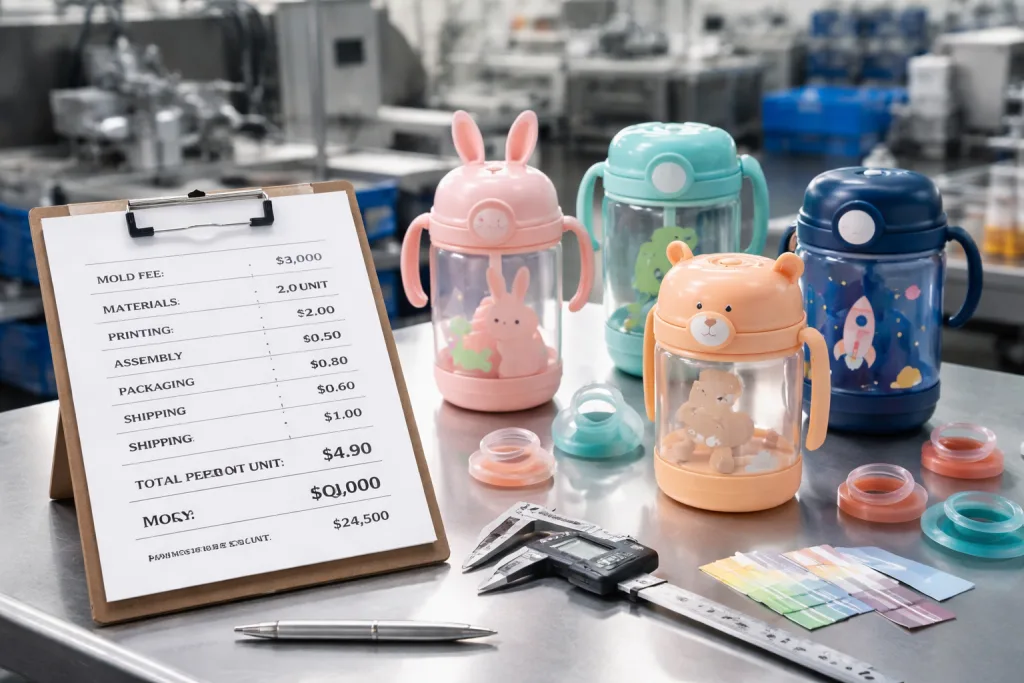
At 6,000 pieces, a realistic FOB range is USD 3.35-3.95 for a double-wall 304 stainless toddler bottle with straw lid and silicone boot. A single-wall version may sit around USD 2.10-2.80. A plastic bottle can price lower, but child-use testing and mold quality still matter; we have seen a cheap PP lid fail torque testing at 18 kgf.cm on the line. Custom mold work changes the math. A new lid mold may cost USD 4,000-12,000, while a new bottle body mold can be USD 2,000-6,000 depending on shape and cavity count.
Payment terms are usually 30% deposit and 70% before shipment after passed inspection. For established canteen distributors, we can discuss staged releases or partial shipment, but first orders should stay clean. Tooling fees are normally paid before tooling starts, because the CNC shop will not cut steel from a PO with “sillicone” typed wrong in the boot line. Testing fees are either buyer-paid at actual cost or built into the unit price if the program is large enough.
Do not ask every canteen vendor to quote DDP before the specification is stable. This is the wrong question to ask. Freight swings hide product differences, and we have seen buyers chase a USD 0.08 saving while missing a weaker carton that later failed a 76 cm drop test. FOB Ningbo or FOB Shanghai lets you compare canteen suppliers on manufacturing first. Once the product is locked, your forwarder can quote ocean freight, duties, and final delivery. If you are an Amazon or marketplace seller, add FNSKU labeling, master carton limits, and drop-test packaging requirements before price approval.
Approve samples like an inspector
The pre-production sample is not a souvenir. Treat it like a 6-piece mini inspection lot. In our Hangzhou sample room, QC checks appearance under a D65 light box, color against the Pantone card, logo position with a 0.5 mm ruler, capacity, lid fit, straw length, gasket seating, odor, and basic leakage before we ship samples. Run your own checks when the carton arrives. Your toddler in a stroller is not the same as our factory bench.
Start with dimensions. Confirm height, diameter, mouth opening, and weight with calipers and a kitchen scale. A toddler bottle that is 76 mm wide may not fit common car-seat cup holders. A bottle that stands 185 mm can tip on daycare tables if the base is narrow. Then check the lid. Open and close it 50 times. Pull the straw gently but firmly. Shake the filled bottle upside down for 30 seconds. Leave it on its side for 2 hours on white tissue. Simple tests. They still catch 8 out of 10 sample issues before the line starts.
For coating and print, use practical abuse tests. Cross-hatch the coating in a hidden area if you have a spare sample, using a 3M tape pull if your team keeps tape in the office. Rub the logo with a damp cloth and then with mild detergent. Put the bottle in a backpack with keys for a day. You are not replacing lab testing; you are seeing how the product behaves after a parent throws it into a diaper bag. If your sales claim says dishwasher safe, test at least 10 cycles before approving artwork. We have seen this go sideways when the buyer approved the print after only one rinse.
When you send approval, be specific. “Approved except logo 2 mm higher and straw shortened by 5 mm” works. “Looks good” is risky, and the math does not work once 12,000 pieces are packed. We issue a signed golden sample and keep one in Zhejiang for production reference, with the PO number written on the hang tag. One sample stays with the buyer. One sample stays with QC. That triangle prevents arguments later when QC pulled the sample and the buyer flagged the lid color.
Control production at the risky points
Production is a chain, not one event. Material incoming, body forming, welding, vacuuming, polishing, coating, printing, lid assembly, final packing, inspection. For toddler bottles, we watch the risky points first: lid sealing under a 30 kPa leak tester, coating rub resistance, silicone gasket size, and carton drop protection. A canteen manufacturer that only opens the finished carton is already late; QC pulled one sample last year where the outer carton looked fine, but 11 lids had silicone flash at the drinking spout.
For the 6,000-piece order, production lead time is 40 days after golden sample approval and deposit. Stainless bodies are formed first. Vacuum performance is checked before coating because a failed vacuum body should not receive decoration. We run the vacuum check on bare bodies, then move to powder coating, logo printing, lid assembly, and silicone boot fitting. Inline checks every 2 hours work better than one end-of-line panic; on a 3-line shift, that usually means 18-24 patrol records before packing starts.
Incoming silicone parts need checks for odor, color, flash, deformation, and fit against the PP lid groove. Small part, big trouble. A 0.3 mm gasket variation can push leak complaints above 3%, which hurts any canteen distributor. Lid torque and hinge strength should be checked during assembly with a torque meter, not guessed by hand. For printed logos, operators should check position against a jig; by eye is the wrong question to ask. If your order has two colors, cartons and inner boxes need color code control, because we have seen “blue” typed as “bleu” on a PO and the packing team nearly mixed 42 cartons.
For buyers sourcing customized drinkware, customized canteen, or canteen customizable programs from 2-4 factories, keep one written QC checklist across suppliers. It makes comparison fair. BottleForge uses AQL-based final inspection, and we still tell first-order buyers to book their own third-party inspection. A USD 250-350 inspection is cheap compared with recalling a container of leaking toddler bottles; the math doesn't work when one replacement lid kit costs USD 0.68 before freight.

Inspect before the balance payment
Run final inspection when at least 80% of goods are packed and 100% are finished. For this toddler bottle order, we would use ANSI/ASQ Z1.4 general inspection level II, with AQL 2.5 for major defects and 4.0 for minor defects. Critical defects get zero tolerance: sharp edges, foreign matter, unsafe small parts, or serious leakage. QC pulled one sample last month with a 0.4 mm burr on the inner straw hole; that carton did not move to the finished pallet.
The inspector should pull cartons from top, middle, bottom, and back pallet positions, not just the clean cartons near the aisle. Check carton marks, barcode scan, FNSKU if needed, retail box artwork, color split, quantity, appearance, logo, capacity, odor, lid function, leakage, coating defects, and drop resistance. Use room-temperature water, full fill, lid closed, upside-down shake for 30 seconds, then side-rest for 10 minutes. Simple test. For toddler products, we also check that removable parts do not detach under normal pulling; the line usually uses a basic pull gauge, and the buyer flagged this after one silicone plug came loose during a 5 kg pull check.
Carton packing matters more than 7 out of 10 new buyers expect. A good toddler bottle can arrive dented if the carton board is too thin or the retail boxes float 8–12 mm inside the master carton. We normally run 5-ply export cartons for heavier drinkware, with carton gross weight kept under 15 kg when possible. Ask for ISTA-style carton drop expectations before production, not after the goods are packed; the math does not work when 3,000 cartons are already sealed and the chain store asks for a different drop sequence.
If inspection fails, do not bargain with soft wording. Define rework items, reinspection scope, and who pays. If 2% of lids leak because one gasket batch is wrong, replace and reinspect lids with the same leak test, not a quick wipe at the packing table. If carton marks are wrong, relabel cartons under QC supervision; we have seen this go sideways from one PO typo, “blue” printed as “balue,” across 186 master cartons. Balance payment should follow passed inspection and approved shipping documents, not factory promises.
Ship documents that customs can read
After QC signs off, the headache moves from the line to the forwarder’s desk. A clean China shipment needs a commercial invoice, packing list, bill of lading, and the certificates or lab reports named on the PO. For EU buyers, LFGB and REACH files must match the real BOM: 304 stainless body, PP lid, silicone straw, coating code, every item. For U.S. kids’ bottles, CPSIA and ASTM files should sit in one dated folder, not mixed with adult tumbler reports. We once had a buyer flag a “food grade reports” folder with 19 PDFs, and 6 did not belong to the toddler bottle. Customs will not sort that out for you.
For this order, the 6,000 toddler bottles pack into about 250 master cartons, depending on retail box size and insert thickness. We run a carton drop check before sealing, then QC scans the outer label against the packing list with a barcode gun. FOB Ningbo sailing can usually be booked 7-10 days after final inspection if vessel space is normal. If delivery goes to a 3PL, send pallet height, carton label format, and appointment rules before we print cartons. If it is Amazon routing, FNSKU labels and carton content checks must happen before tape guns touch the cartons. Fixing labels after sealing 250 cartons is slow work.
This is where an export-ready canteen vendor beats a workshop that only knows how to weld bottles. HS code notes, carton dimensions in cm, country-of-origin marking, and document consistency stop small errors from becoming port delays. Zhejiang has a dense drinkware supply chain, but the math does not work if your factory saves one hour on paperwork and your container sits 3 days at destination. Ask who prepares documents, who checks carton labels, and who talks to your forwarder. We prefer one named merchandiser and one backup, because “sales team” on a shipping document chain usually means nobody owns the mistake.
Once the first order lands, collect real complaint data from CS tickets, return photos, and warehouse receiving notes. Separate true defects from user damage and packaging damage; a crushed color box from a wet pallet is not the same as a leaking lid. If leak complaints are below 0.5% and coating complaints are isolated, you have a base worth scaling. QC pulled the retained sample from shelf B-03 should match the same batch code on the complaint bottle. Then extend into canteen custom seasonal colors or customizable drinkware gift sets without rebuilding the program from zero.
Send your toddler bottle brief for factory review
We will check materials, MOQ, testing, decoration, packaging, and FOB pricing before you commit to tooling or a deposit.
Frequently asked questions
What MOQ should I expect from a toddler bottle OEM manufacturer?
For a stainless toddler bottle using existing molds, expect 3,000 pieces per color as a practical MOQ. Some China factories will quote 1,000 pieces, but the unit price usually rises by USD 0.40-0.90 and color matching becomes less efficient. If you need a custom lid, new silicone boot, or unique body shape, MOQ may move to 5,000-10,000 pieces because tooling setup and material purchasing are heavier. For printed logos only, 3,000 pieces is normally workable. For fully canteen customized packaging with retail box, barcode, and instruction sheet, keep the first order simple: two colors, one lid, one carton standard, and one approved golden sample.
Which material is best for toddler bottles: stainless steel or plastic?
Stainless steel is usually better for premium toddler bottles because it handles drops, odor, and hot-fill misuse better than many plastics. A common spec is double-wall SUS304 with 0.35-0.4 mm inner wall and 0.4 mm outer wall. Plastic can be useful for lightweight price-point programs, but you must control resin grade, migration testing, and stress cracking. Tritan, PP, and silicone are common in lids and straws. For EU sales, ask for LFGB and REACH reports. For U.S. sales, ask for FDA food-contact and CPSIA-related documentation. Do not accept “BPA free” as the only compliance statement; it is too narrow for child-use drinkware.
How long does a custom toddler bottle order take?
Using existing molds, plan 10-14 days for samples and 35-50 days for mass production after sample approval and deposit. Add 7-10 days if Pantone coating development is difficult or if your retail packaging needs several artwork revisions. New tooling can add 20-35 days before production starts. Ocean freight from China to North America or Europe can add roughly 25-45 days port-to-port, depending on route and season. A realistic first-order calendar is 75-110 days from approved brief to warehouse arrival. Buyers get into trouble when they approve samples late but keep the original retail launch date.
Can the same factory make toddler bottles and custom canteen products?
Yes, if the factory has both child-product discipline and general drinkware capacity. Many canteen manufacturers can make stainless bodies, powder coating, and logo decoration, but toddler bottles need stronger control over lids, straws, small parts, and safety documents. If you also source custom canteen, customizable canteen, customized growler, or distributor canteen programs, ask whether the factory separates QC checklists by product type. Adult drinkware inspection is not enough for toddler bottles. At BottleForge in Zhejiang, we use different inspection points for kids bottles, sports bottles, travel tumblers, and growlers because the failure modes are not the same.
What should be included in a final inspection checklist?
Use AQL inspection with clear defect definitions. For toddler bottles, include critical checks for sharp edges, foreign matter, unsafe detachable parts, serious leakage, and wrong materials. Major checks should cover lid fit, straw function, gasket seating, coating adhesion, logo placement, color match, odor, capacity, and retail box accuracy. Minor checks can include small cosmetic marks within an agreed limit. A common setting is AQL 2.5 for major defects and 4.0 for minor defects, with zero tolerance for critical defects. Inspect when 100% of goods are finished and at least 80% are packed. Do not release the 70% balance payment before the inspection report is passed.