Key Takeaways
- Set critical AQL at 0.65 for leak, choking, and sharp-edge defects
- Ask for 304 or 316 stainless steel thickness at 0.45-0.60 mm, not just “food grade”
- Plan 35-45 days for branded production after artwork and PP sample approval
- Use 1,000-3,000 pcs MOQ for real custom molding, color, packaging, and logo control
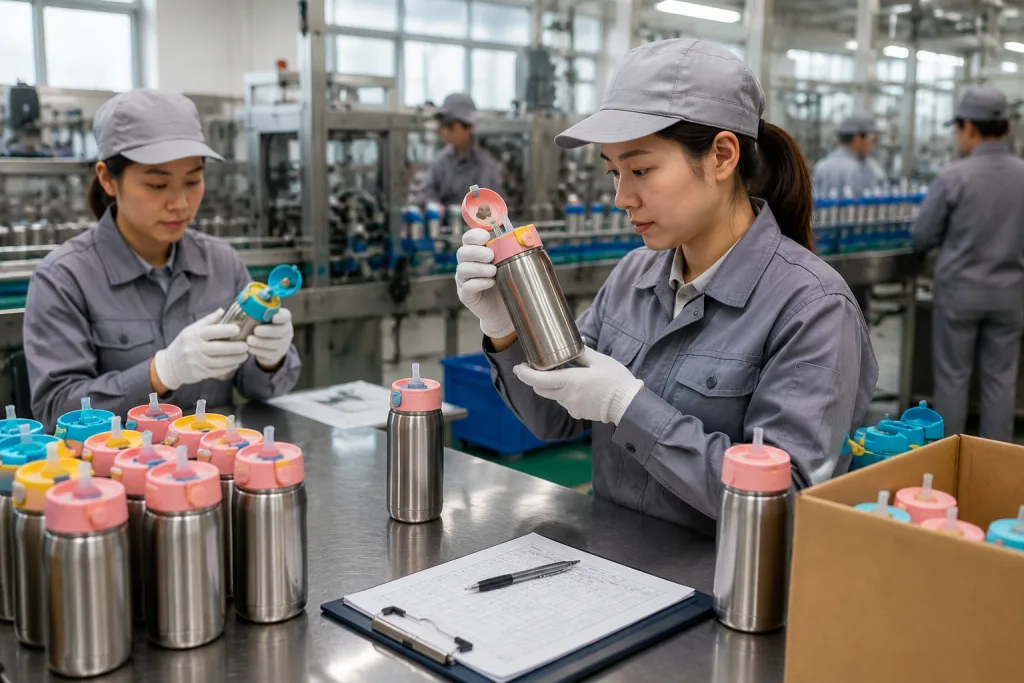
Toddler bottles fail in boring ways: a straw valve tears at the slit, a lid cross-threads after the second turn, a printed logo flakes after 20 dishwasher cycles, or a carton arrives with 4% crushed retail boxes. QC pulled one 350ml sample last month and found the silicone straw 0.6mm thinner than the approved sample. Not dramatic. Expensive, yes. These problems show up after you have paid the balance and your distributor canteen program is already locked into a retailer’s 12-week calendar.
If you are comparing toddler bottle manufacturers in China, the catalog photo is the wrong question to ask. Ask for the failure map in writing: valve durometer, thread gauge check, logo adhesion test, carton drop test, and the exact AQL line on the inspection sheet. Our Hangzhou, Zhejiang team sees the same weak points across custom drinkware, canteen custom projects, and kids bottle lines; one buyer flagged a PO typo that said “PP lid” while the approved sample used Tritan. A tight spec does not make production expensive. It makes arguments shorter when the line finds a problem at 9:40 p.m.
The lid fails before the bottle
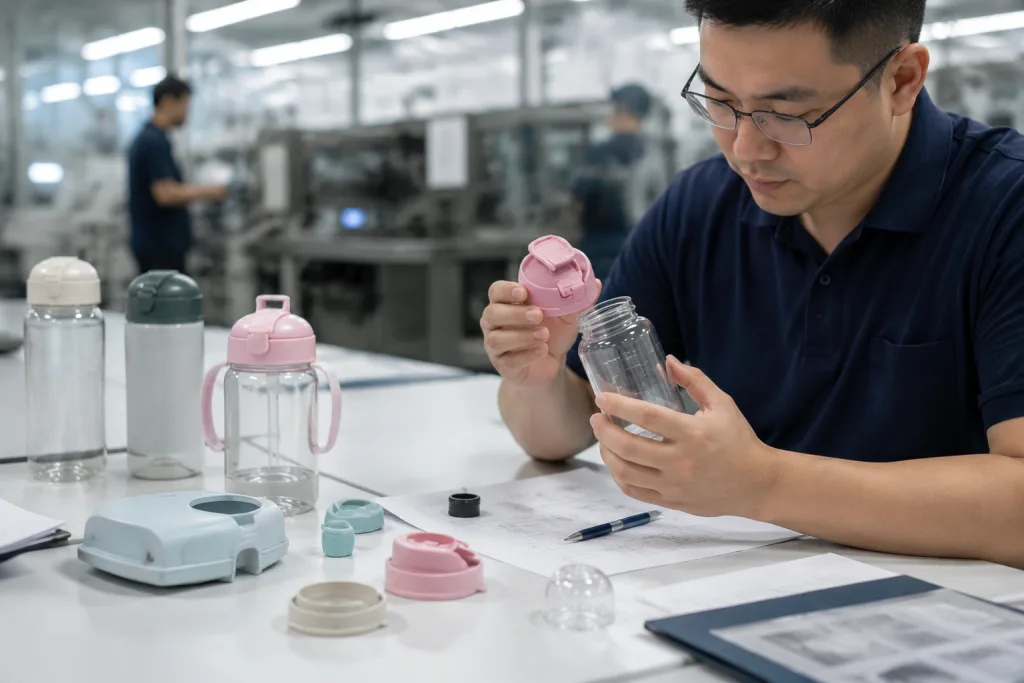
Most toddler bottle complaints start at the lid. The bottle body can pass drop testing, but one leak in a school bag is what the parent remembers. Ask toddler bottle manufacturers how they validate the cap system, not just what resin they use. We run a 200-cycle open-close check with a torque meter, and weak thread bite shows up fast after cycle 80. A quick upside-down water test is not enough. Wrong question.
For a toddler bottle, the lid stack usually means PP or Tritan parts with their own shrink rate, plus a silicone gasket, straw, bite valve, hinge pin, and sometimes a lock button with a tiny spring. Each part has a tolerance. On one new mold trial, QC pulled the sample and found the gasket groove 0.2 mm wide against the drawing. If your canteen factory does not control shrinkage, the gasket may sit 0.2 mm too loose. That small gap is enough for seepage when a child squeezes the bottle in a 3 kg backpack.
Spec the lid in measurable terms. Require food-contact silicone at Shore A 50-60 for bite parts, PP rated to 100°C for caps, and a hinge cycle test of at least 3,000 openings. For leak testing, reject “no leak by eye” as a method. Use 30 minutes inverted at room temperature, then 5 minutes shaken horizontally with 80% fill. For straw bottles, test with water and warm diluted milk because viscosity changes how valves seal. We use a 45°C milk-water mix on the line; buyers have flagged valves that held water but dripped milk after 12 minutes.
For any custom canteen or canteen customized lid, define which defects are critical. Detached straw tips and leakage belong at AQL 0.65 or tighter, while sharp flashing and broken hinge pins should be pulled as safety defects before carton sealing. Cosmetic color marks can sit at AQL 2.5. If a canteen supplier refuses to separate critical and minor defects, the math does not work. We have seen this go sideways when a PO typo listed all lid issues under “appearance,” and 6,000 pcs had to be sorted by hand.
Material claims get too vague
“Food grade” is not a specification. It is a sales phrase, and this is the wrong question to ask. A toddler bottle can use 304 stainless steel, 316 stainless steel, Tritan, PP, silicone, glass, or a mixed build with a steel body and PP lid. We run into this on RFQs about twice a week: the buyer writes “food grade material” in the PO, then QC pulls the incoming coil tag and finds no heat number matching the mill certificate. Safe material starts with traceable sourcing, not a nice word on a catalog page.
For stainless toddler bottles, ask for the steel grade, body wall thickness, and test scope. A practical body wall is usually 0.45-0.60 mm for small kids bottles; our micrometer check is taken at the straight wall, not near the rolled mouth where the reading can cheat thicker. Thinner bodies dent in export cartons after a 60 cm drop test. Thicker bodies may raise FOB cost by USD 0.25-0.60 per unit depending on capacity, so the math needs to be clear before sampling. If you need vacuum insulation, ask for copper plating, vacuum hold testing, and temperature retention data at 6 hours from that exact SKU. Not a number copied from a 500 ml adult bottle.
For plastic parts, require BPA-free documentation, but do not stop there. EU buyers should request LFGB or EU 10/2011 food-contact testing where relevant, with the lid, straw, bite valve, and gasket named in the report. North American buyers often ask for FDA food-contact compliance and ASTM F963 where the design could be treated as a children’s product. REACH and California Proposition 65 screening may be needed for coatings, pigments, and packaging inks. We have seen this go sideways when a Pantone-matched soft-touch coating passed on the body but failed on the printed sleeve ink; the buyer flagged it 9 days before ETD.
The same discipline applies to broader customizable drinkware lines. Whether you are sourcing a toddler bottle, customizable canteen, custom growler, or distributor growler, write down the material family and the exact test report you expect, line by line if the product has 5 contact parts. In Zhejiang, China, legitimate factories can usually provide recent third-party reports within 3-5 working days; if the lab has to retest a new silicone straw, plan closer to 7-10 working days before approval. If a canteen vendor sends old reports for a different item, treat that as a warning. Not a small admin issue.
Small parts become recall risks
Toddler bottles sit against a child’s mouth all day, so the failure mode changes fast. A loose decorative badge on an adult travel mug gets you a complaint email. A loose silicone straw tip on a toddler bottle becomes a choking risk in one pull. We have seen QC pull a 6 mm straw plug off with a standard Imada force gauge after the line changed silicone hardness from 50A to 45A without telling sales. General canteen factories miss this because they are thinking about stainless forming and logo printing, not child-use abuse.
Start with every removable part on the bench. Straw and valve need separate pull tests; gasket and lock button need torque or pry checks; carry loop, name tag, and bottom boot need a written retention method. For soft silicone pieces, specify a pull force target, often 70-90 N depending on geometry and market requirement, and write the test direction in the spec. For screw components, define torque values with a digital torque meter, then state whether thread-locking, ultrasonic welding, or a snap-fit rib is doing the safety work. Glue alone is the wrong answer unless aging, 60°C heat, saliva soak, and 20 dishwasher cycles have passed.
Ask your canteen supplier for an exploded drawing with part names and material codes. It does not need showroom polish. It does need to match the product on the packing table. Last season, the buyer flagged a PO typo where the gasket code read “SIL-02” but production used “SIL-20”; QC caught it because the exploded drawing had the right code printed beside the lid assembly. This drawing lets your inspector see when a factory borrows a gasket or straw from another SKU because production is 12 days late and the shared parts rack looks close enough.
Packaging matters as much as the bottle. Toddler products often ship with 2 spare straws, 1 cleaning brush, or a replacement valve, and each small accessory needs its own bag, label, and choking or sharp-point check. We run a simple carton-line check: accessory count, polybag warning, brush tip radius, then color box text against the approved artwork file. If you sell through a canteen distributor or large retailer, lock warning labels before mass printing. The math does not work when 10,000 color boxes are “almost finished” and the missing warning text forces a full reprint.
Decoration looks fine, then flakes
Brand owners often spend 2 approval calls moving the logo 3 mm left, then skip the print scratch test. Wrong priority. A toddler bottle gets chewed, dropped, washed, and dragged against lunch boxes; we see bite marks on the spout area before the carton artwork is even signed off. If your customized drinkware sells on a cute character print, decoration is not trim. It is product quality.
We run silkscreen printing, heat transfer, UV printing, powder coating with laser engraving, and water transfer on different lines. Silkscreen works for 1-3 colors and simple logos; the screen mesh and ink thickness matter more than most buyers think. Heat transfer can cover wraparound artwork, but QC pulled one sample last season where the edge lifted after a 3M tape pull. UV printing gives bright color, yet it chips on curved stainless when pretreatment is light. Powder coating plus laser engraving survives abuse, but the math does not work for every full-color toddler animal graphic.
For canteen promotional orders, lock the tests before production, not after the buyer flagged flaking photos from a retail store. Our basic set is 3M tape adhesion after 24 hours, 50 wet rubs, 50 dry rubs, and 20 dishwasher cycles if you plan to claim dishwasher-safe. For powder coating, ask for cross-hatch adhesion and salt spray if the bottle will sit in outdoor bags or school yards. For printed plastic lids, confirm ink migration and food-contact separation; toddlers put lids in their mouths, so the print area is not a harmless corner.
Artwork approval needs a physical pre-production sample, not only a PDF with a neat mockup. We have seen this go sideways over a Pantone typo on the PO: 186 C became 168 C, and the red bear turned brown under the light box. Our Zhejiang line usually needs 7-10 days for PP samples after final AI artwork, Pantone codes, and logo method are confirmed. BottleForge capacity for kids and small bottle programs is about 80,000 units per month, with typical MOQ at 1,000 pcs per color for logo-only work and 3,000 pcs for canteen customizable color matching or private mold changes.
Cartons hide expensive damage
About 7 in 10 new buyers check the bottle first and barely touch the carton. That gets expensive. A toddler bottle can pass leak testing on the vacuum tester and material testing, then land with dented bodies because the export carton used soft paper or the inner trays left 4-6 mm of movement. We have seen QC pull a clean bottle sample, then flag crushed retail boxes after a 60 cm corner drop. For distributor drinkware, damaged retail packaging can block retail allocation even when the bottle still works.
Put numbers on the packaging spec. For small stainless toddler bottles, we run 350 gsm white card for lower-cost retail boxes, or E-flute corrugated when the buyer wants better shelf protection. Master cartons should usually be 5-ply corrugated for export, with bursting strength or edge crush test agreed before the PO is signed. Keep carton weight under 15 kg if 3PL warehouse staff will handle it by hand. If you ship to Amazon-style fulfillment, lock barcode placement, FNSKU labels, suffocation warnings, and carton limits before mass packing; one buyer once sent the FNSKU with a missing digit, and the line had to stop for 6 hours.
Drop testing should match the route, not the sales deck. For normal wholesale, use ISTA 1A-style drops as a practical baseline: corners and faces at the right height for carton weight, recorded with photos after each drop. For e-commerce single packs, assume rougher handling and test the individual mailer, not only the master carton. Short test. Real answer. If the bottle has a flip lid, pack it so the latch is not taking compression load for 30 days in transit; we check this with a simple stack test and a caliper reading on lid deformation.
FOB pricing moves when you improve packaging, but the math usually still works. Upgrading a master carton or adding molded pulp support may add USD 0.08-0.20 per unit. That is cheaper than explaining to canteen distributors why 6% of units have crushed boxes and why their shelf plan has a hole. We have seen this go sideways when a buyer saved USD 0.11 per bottle and then asked for a credit note after the warehouse photos showed torn cartons at two corners. In China export work, packaging is not logistics decoration; it is part of the product you are buying.
The audit misses production reality
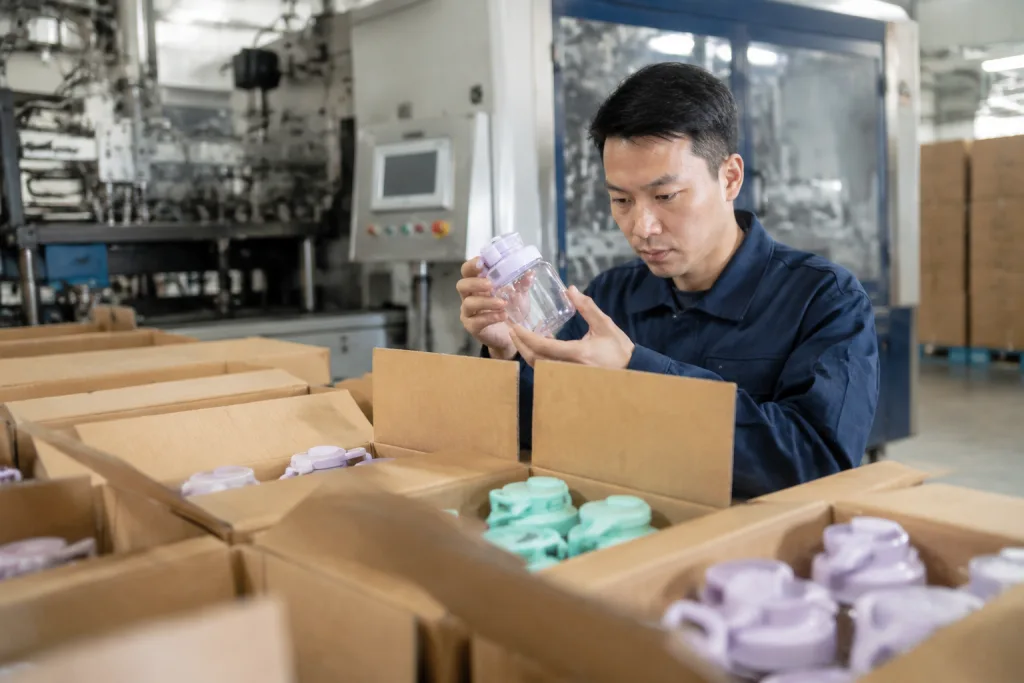
A clean audit certificate has value, but it is not a production plan. BSCI, ISO 9001, and supplier questionnaires show whether the factory has basic systems and written procedures. They do not prove that next Tuesday’s toddler bottle line will hold a 0.2 mm gasket-fit tolerance, pass 3M tape on the logo print, or survive a 12 kg carton compression check. We run audits, yes. The wrong question is “Did the factory pass?” The better question is “Who checks this order before the line packs 80 cartons wrong?” You need factory qualification tied to order-level control.
Before deposit, ask for three documents and read them like a buyer, not like a file collector: the production flow chart with each workshop named, the inspection checklist with pass-fail limits in mm or kg, and the lead-time schedule with sample approval as day zero. A realistic schedule for customized canteen or toddler bottles is 7-10 days for sample, 10-15 days for material and packaging preparation after approval, 20-30 days for mass production, and 3-5 days for final inspection and loading. Last March, a buyer flagged “matte sand beige” on the PO, while the artwork file said “warm grey”; that one typo cost 4 days before powder coating. If a canteen vendor promises 15 days for a new color, new box, and new lid assembly, the math does not work. They are probably borrowing time from QC.
Use staged approvals. First sign off construction and safety, including lid torque, spout pull force, and silicone smell after a hot-water soak. Then approve color and decoration with a signed Pantone card and a print sample kept at the line. Packaging comes last, after the drop-test carton and barcode scan are checked. During production, run first-piece inspection before the full line starts; QC pulled the sample at 9:20 a.m. on one 6,000 pcs toddler bottle order and found the straw was 4 mm short. Mid-line inspection is useful when the order is above 5,000 pcs or when the product has several accessories. Final inspection should use ANSI/ASQ Z1.4 sampling or an equivalent AQL plan. For toddler bottles, critical defects should have zero tolerance or AQL 0.65, major defects at 1.5, and minor defects at 2.5.
Good canteen suppliers will not be offended by this. Clear pass-fail rules save both sides from late-night arguments after 300 cartons are sealed. We ship smoother when the buyer writes “lid leak test: no drip after 30 seconds upside down” instead of “good sealing.” Whether you are buying a canteen customized program, customized growler, or toddler bottle range from Zhejiang, the factory should know the inspection standard before it cuts steel, orders silicone, or prints one retail box. We have seen this go sideways when the standard arrives after tooling starts.
Send your toddler bottle spec for factory review
BottleForge will check materials, lid risk, MOQ, lead time, packaging, and QC points before you commit to production.
Frequently asked questions
What MOQ should I expect from toddler bottle manufacturers?
For an existing toddler bottle body with your logo, a realistic MOQ is usually 1,000 pcs per color. If you need Pantone-matched coating, custom silicone color, retail box, and a canteen customized lid, plan on 3,000 pcs or more. Private molds can require 5,000-10,000 pcs for the first run because tooling, fixtures, and testing need to be amortized. Be careful with very low MOQ offers under 300 pcs for branded toddler bottles. They often use stock parts, limited QC, and digital decoration only. That can work for sampling or a small promotional test, but it is not the same as controlled custom drinkware production.
How much should a custom toddler bottle cost FOB China?
For a stainless toddler bottle around 300-450 ml, FOB China pricing often lands between USD 3.20 and USD 6.80 depending on insulation, lid complexity, coating, packaging, and test requirements. A simple single-wall bottle with silkscreen logo may sit near the low end. A vacuum insulated bottle with silicone boot, flip straw lid, powder coating, retail box, and LFGB or ASTM-related testing will cost more. Plastic toddler bottles can be cheaper, but tooling and material certification still matter. Ask the canteen manufacturer to separate unit price, tooling, sample fee, test fee, and packaging upgrade cost so you can compare suppliers honestly.
Which tests are most important for toddler bottles?
Start with leak, sharp edge, small parts, material safety, and decoration adhesion. For EU buyers, EU 10/2011, LFGB, REACH screening, and EN 14350 may be relevant depending on design and age claim. For North America, FDA food-contact compliance and ASTM F963 review may apply if the product is positioned for children. Internally, require 30-minute inverted leak testing, 3,000 hinge cycles, pull testing for straw and small parts, and 20 dishwasher cycles if you claim dishwasher-safe. Do not let a canteen supplier substitute a generic stainless bottle report for a toddler bottle with a different lid and silicone parts.
Can one supplier handle toddler bottles and other canteen products?
Yes, but only if the supplier understands the different risk levels. A canteen factory that makes adult sports bottles, custom growler lines, and promotional canteens may also make toddler bottles well. The key is whether they control small parts, silicone, child-use labeling, and stricter inspection. Adult distributor canteen programs usually focus on capacity, insulation, and decoration. Toddler bottles need more attention to choking risks, bite valves, lid security, and cleaning access. If you want one canteen vendor for customizable growler, custom canteen, and toddler bottle ranges, qualify each category separately instead of assuming one audit covers all products.
How long does production take after I approve the sample?
For a normal branded toddler bottle order in China, plan 35-45 days after pre-production sample approval and deposit. Existing bottle shapes with simple logo printing may finish closer to 30-35 days if materials are in stock. Orders with Pantone coating, new silicone colors, custom retail packaging, or third-party testing usually need 45-60 days. Add ocean freight separately: roughly 25-40 days to Europe or North America depending on port and season. If your canteen distributors have a retail launch date, build in at least 10 extra days for inspection, rework, booking, and customs paperwork.