Key Takeaways
- Set RFQ specs before price: capacity, material, wall thickness, cap type, silicone grade, and MOQ such as 1,000 units/SKU
- Approve samples against leak, odor, drop, dishwasher, artwork, barcode, and child-use checks before paying bulk deposit
- Use PO line items for packaging, AQL, certifications, FNSKU, spare parts, and shipment terms, not only unit price
- A realistic China toddler bottle lead time is 7-12 days for samples and 30-45 days for bulk after approval
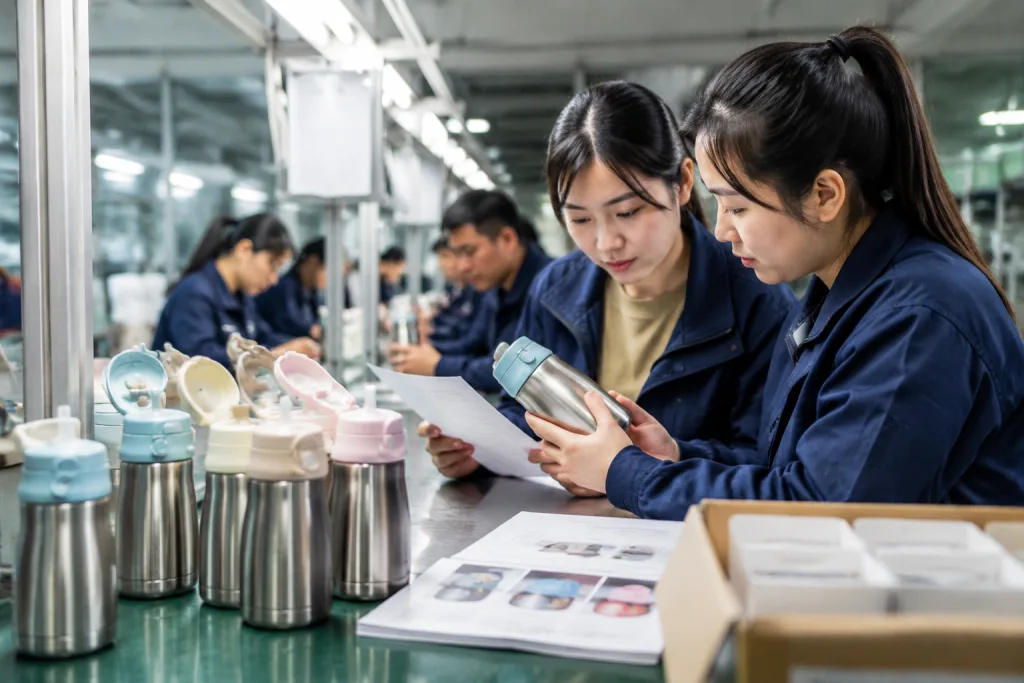
Buying toddler bottles is not just buying adult sports bottles in a smaller size. The risk sits in the soft parts: bite valves, straw assemblies, vent holes, pull force on small components, and leak claims after a child throws the bottle from a stroller. Parents will smell the PP cap before they read your logo. On our line, QC once pulled 32 pcs from a pre-shipment lot because the silicone straw measured 48 Shore A against a 55 Shore A approval sample. If your RFQ only says “500 ml kids bottle, good quality,” you will get a price. You will not get a controlled product.
At BottleForge Industrial in Hangzhou, Zhejiang, we see this 6 or 7 times a month: buyers compare FOB prices before fixing the mouth diameter, cap material, silicone hardness, carton drop standard, or logo method. That is the wrong order. A USD 0.08 cheaper cap can turn into 18 days of rework when the buyer flags bite marks, weak snap fit, or a plastic smell after hot-water testing at 70°C. This guide sets out the sourcing sequence from RFQ to sample to bulk PO, with the line items we want buyers to write down before the mold room cuts steel or the packing team books cartons.
Start With A Real RFQ
A good RFQ for a toddler bottle manufacturer reads like a short engineering note, not a color mood board. The factory needs enough detail to build the same quotation twice. If the RFQ is loose, we run the nearest cap, an open mold body, and a basic white box just to get a low first price. We have seen this go sideways: QC pulled a 350 ml sample last month with a straw 4 mm too short because the buyer only wrote “kids bottle with straw.” Cheap quote. Bad sample.
Put these RFQ line items in the first email: product type, target age range, capacity, material, lid structure, drinking interface, insulation requirement, color count, logo method, packaging, certifications, MOQ, target FOB port, delivery deadline, plus artwork format if you already have it. For toddler bottles, capacity usually sits between 300 ml and 450 ml. Stainless steel inner walls are commonly 304, with 316 requested for premium projects. For plastic parts, ask for PP or Tritan by name, not “food grade plastic.” That phrase starts arguments. Silicone straws and bite valves should be LFGB or FDA-grade silicone, usually around 50-60 Shore A depending on bite feel. On the line, our durometer gauge shows the difference fast; 50 Shore A feels soft, while 60 Shore A gives better rebound after 3,000 bite cycles.
If you are comparing canteen manufacturers for a broader kids range, keep adult-style terms separate. A custom canteen, custom growler, or distributor growler may use different lid torque, wall thickness, and test expectations. Toddler bottles need gentler edges, smaller hand grip zones, and safer component design. This is the wrong question to ask: “Can you shrink your adult mold?” The better question is whether the handle gap, spout height, and lid opening force fit a 2-5 year old user. We once had a buyer flag a 9.5 mm rim radius as “too sharp for daycare,” even though it passed the adult bottle drawing.
RFQ PO-style fields to prepare:
- Item name: 350 ml stainless toddler straw bottle
- Material: 304 inner, 201 or 304 outer, PP lid, silicone straw
- Logo: 1-color silkscreen or laser engraving, artwork file attached
- MOQ target: 1,000 units per color, 3 colors total
- Testing: leak test at 45 degrees for 30 minutes, 1.0 m drop, odor check, migration, AQL 2.5/4.0
- Terms: FOB Ningbo or Shanghai, quoted in USD
Separate Mold From Decoration Decisions
The fastest mistake is asking for a canteen customizable design before confirming the base mold. Wrong question. First ask, “Do you already run this body on the line?” Tooling changes the whole quote. With an existing toddler bottle mold from a canteen factory in China, we can often get samples out in 7-12 days and bulk in 30-45 days after approval. If the project needs a new flip cap, side handle, straw lock, or body shape, add 25-45 days for mold work and at least USD 1,500-8,000 in tooling, depending on complexity. On our floor, the engineer checks the mold code against the 2D drawing before quoting; one PO last year said “same as sample” but missed a 3 mm handle change, and the math did not work.
Decoration is a separate decision. A canteen customized with a logo, a matched Pantone body color, a silicone sleeve, a retail gift box, or an FNSKU barcode does not mean the structure is custom-tooled. For most B2B buyers, existing mold plus controlled decoration is the cleaner first order. It cuts cost and gives real market feedback before you pay for steel. BottleForge’s Zhejiang production partners can handle about 300,000 stainless drinkware units per month across toddler bottles, sports bottles, travel tumblers, and promotional canteen programs, but tooling slots are booked apart from normal assembly. We ship assembly from one schedule and mold trials from another; buyers sometimes flag this because they expect decoration approval and mold approval to move together.
For logo work, silkscreen is economical for 1-2 colors and works well on powder coating. Laser engraving lasts longer than ink because it cuts into the surface, but it exposes the metal or base layer underneath. Heat transfer and full-wrap printing are possible, yet we would not push a large distributor drinkware launch without abrasion and dishwasher testing first. QC pulled a toddler bottle sample after 20 dishwasher cycles last month because the print edge lifted near the lower curve. For toddler use, avoid decorations where teeth or lips hit the surface every day.
Sample request line items:
- Base mold code or drawing number, not just a catalog photo
- Body finish: powder coating, gloss paint, or brushed steel, with target coating thickness in μm if the buyer has one
- Pantone colors with tolerance expectation, plus whether ΔE will be checked by spectrophotometer
- Logo position and size in mm, measured from the bottom seam or center line
- Cap opening force and straw replacement method, checked on 5 pulled samples before approval
- Confirm if tooling is exclusive or shared, and write it on the PI
If a canteen manufacturer will not say whether the mold is existing or newly tooled, pause the project. We have seen this go sideways. You cannot protect schedule, cost, or replacement parts without that answer, and a missing mold note is exactly the kind of inspection finding that shows up after cartons are already printed.
Quote The Parts, Not Just Bottle
A toddler bottle quote should be broken down far enough that your purchasing team can see the real BOM, not just one neat FOB number. A single FOB unit price hides spare straws, color coating, inner carton, master carton, hang tag, instruction sheet, and lab testing. We see this surprise about 6 buyers out of 10 after sample approval, usually when QC pulls the pre-production sample and the buyer asks, “Where is the extra straw?”
Ask your toddler bottle manufacturer to quote the base bottle first, then price each add-on line by line. For example, a 350 ml double-wall stainless toddler bottle might quote at USD 3.20-4.80 FOB Ningbo at 3,000 units, depending on lid complexity and finish. A spare straw set may add USD 0.12-0.25. A printed retail box may add USD 0.18-0.45. A silicone boot may add USD 0.25-0.55. Third-party testing is separate, often USD 250-900 per material group and market requirement. On our line, one small lid mold change can add 7-10 days, so “just quote the bottle” is the wrong question to ask.
This matters more if you work as a canteen distributor or distributor canteen buyer serving several retailers. One customer may need a basic hang tag. Another may need plastic-free packaging, FNSKU labels, carton marks, plus bilingual instructions with 2 mm minimum warning text. If you mix those requirements into one vague price, the factory will either overquote to protect margin or underquote and argue later. Neither helps you. We’ve seen this go sideways because a PO said “color box included” while the approved sample only had a white inner box.
RFQ quote table you should request:
- Base bottle FOB unit price at 1,000 / 3,000 / 5,000 units, with MOQ and lead time shown for each tier
- Color coating surcharge per color, including Pantone match fee and scratch-test requirement if needed
- Logo cost and setup charge, separated for laser engraving, silk screen, or heat-transfer print
- Retail box cost, insert card cost, and master carton cost with carton size in mm
- Spare straw cost, brush cost, silicone boot cost, and replacement lid cost as separate SKU lines
- Testing fees, inspection fees, and document fees, including which party pays for failed retest
- Sample cost and refundable conditions, with courier charge shown before sample dispatch
For canteen promotional orders, buyers often chase the lowest unit cost. Fine for a one-event giveaway. Toddler products carry more complaint risk, and the math does not work if a USD 0.18 saving creates 3% returns. Spend the extra USD 0.10-0.30 where it cuts problems: better silicone, tighter cap fit measured with a go/no-go gauge, thicker coating, or stronger carton packing after a 1.2 m drop test.
Sample Approval Should Be Uncomfortable
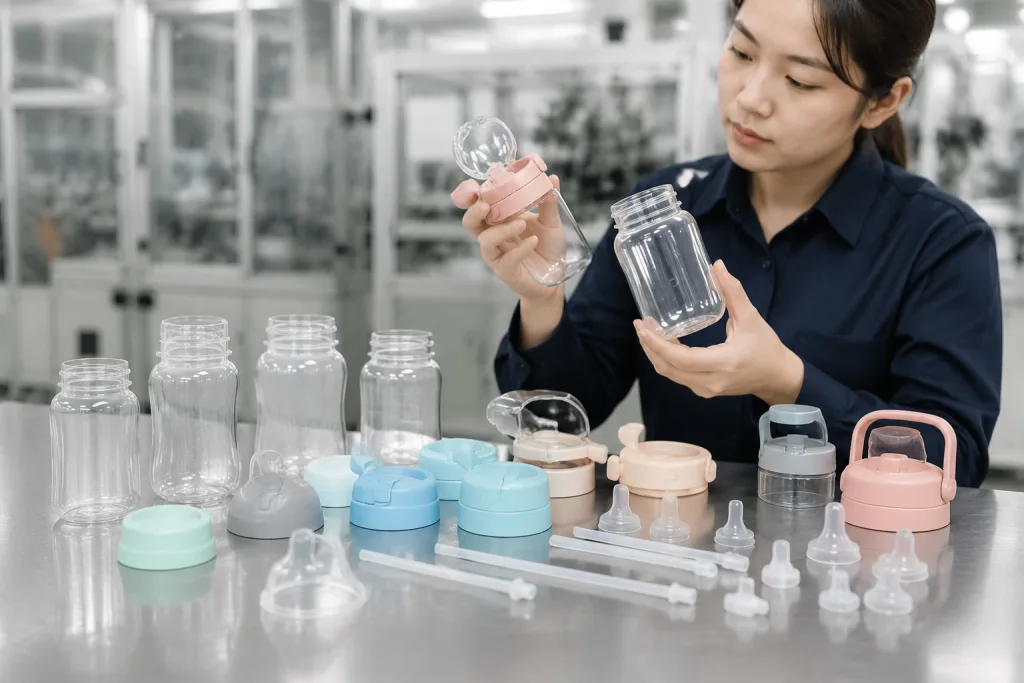
A sample that looks good on a desk is not approved. Toddlers drop bottles from a stroller tray, chew straws, flip them upside down in bags, and leave milk residue inside the cap thread. We try to break the sample before a parent does. Last month QC pulled a 350 ml straw bottle sample after the silicone valve leaked 3 drops in 10 minutes; the buyer had already said, “looks fine” on video. That is the gap between a canteen supplier and a catalog trader.
Start with visual checks: color under a D65 light box, logo size measured by caliper, coating coverage around the shoulder, weld marks, cap alignment, burrs on the straw slot, odor, straw fit, and packaging print. Then beat it up. Fill the bottle with water, close the lid, invert for 30 minutes, shake it hard for 60 seconds, and leave it sideways on A4 copy paper overnight. Run a 1.0 m drop test on the base, side, and cap if the product is sold as a kids bottle. Check whether the cap pops open, the hinge cracks, or the straw leaks around the valve. Small issue? Not for toddlers.
For stainless vacuum bottles, ask for heat retention data even if toddler use is usually warm or cool liquid. A common check is 95°C water for 6 hours, but your market instructions may warn against very hot liquid for children. The performance data still tells you whether the vacuum structure is stable; we run this on the bench with a probe thermometer and log the start and finish temperature. For plastic bottles, check odor after 24 hours with warm water. Strong smell kills reviews even when the material passes a document review, and we have seen buyers reject 2,000 pcs over “plastic smell” before the cartons left Hangzhou.
Sample approval PO line items:
- Approved sample ID, approval date, front/back photos, and sealed reference sample kept by the line
- Material test reports required before bulk shipment, with FDA or LFGB named on the PO if your market needs it
- Leak test method and pass standard, such as inverted 30 minutes plus sideways overnight on paper
- Drop test height and surfaces, including 1.0 m on base, side, and cap for kids bottle programs
- Logo tolerance: position ±2 mm, color ΔE target if needed, checked against the signed artwork file
- Packaging approval: box dieline, barcode, warning text, and carton mark spelling; one PO typo on “BPA free” becomes a full reprint
If you are developing customizable drinkware for a retail program, approve both the plain construction sample and the decorated sample. This is the wrong place to save 7 days. A customized drinkware sample can fail because of coating adhesion even when the undecorated bottle was perfect; we have seen tape test edges lift on a powder-coated cup after the logo bake temperature was changed by 10°C.
Write The Bulk PO Like QC
Your purchase order is not just a commercial document. On a busy line, it becomes the working checklist for the China factory, QC inspector, carton supplier, and forwarder. We have seen this go sideways over one missing line: the buyer approved a soft-touch lid in chat, but the PO only said “PP cap,” so QC pulled the sample and had no basis to reject it. If a requirement is not on the PO or approved spec sheet, it becomes an argument later.
For a toddler bottle manufacturer, the bulk PO should spell out SKU codes, quantities by color, unit price, tooling ownership, packaging structure, artwork version, inspection standard, required documents, shipment terms, and payment schedule. Be specific. A typical payment term is 30% deposit and 70% before shipment after inspection. For new buyers, we usually ask for the full sample fee upfront, and raw material purchase does not start until the deposit clears; that can mean production starts on day 12 instead of day 5. One PO we received last March even had the artwork file typed as “V3” while the approved dieline was “V5,” and prepress caught it with a barcode scanner before plates were made.
Use AQL clearly. A common consumer drinkware inspection level is AQL 2.5 for major defects and 4.0 for minor defects, with critical defects not accepted. Define critical defects in plain words: sharp edges, leakage, wrong material, missing warning label, mold contamination, loose small parts, broken cap, incorrect barcode. For toddler products going to Europe or North America, document expectations may include REACH, LFGB, FDA food-contact, CPSIA-related material declarations, ASTM child-use checks, BSCI audit requests, or ISO 9001 factory system documents. The wrong question is “Do I need all certificates?” Ask which market, age grading, and material contact parts apply. We check this against the BOM, usually down to the silicone straw, PP lid, and 304 stainless body if the model uses steel.
Bulk PO line items to include:
- SKU: TB350-PPSTRAW, 3,000 units total, matched to the approved golden sample tag
- Color split: 1,000 sage, 1,000 cream, 1,000 navy, with Pantone codes on the spec sheet
- MOQ: 1,000 units per color, packed after color-separation QC on the line
- FOB: Ningbo, China, USD pricing, with forwarder contact shown on the PO
- Inspection: third-party PSI at AQL 2.5/4.0 before balance, booked at least 3 days before finish date
- Carton: 24 units/master, 5-ply export carton, drop-tested, with gross weight under the buyer’s limit
- Documents: commercial invoice, packing list, test reports, COO if required, checked against the shipping marks
For Amazon or marketplace supply, add FNSKU label placement, suffocation warning on polybags if used, master carton weight limit, and shipment plan carton marks. Warehouse labels are not decoration. We ship 24 units/master carton on a lot of toddler bottle orders, and one 8 mm label shift can make the scanner miss at the 3PL. The buyer flagged it once after 186 cartons reached Los Angeles; re-labeling cost more than printing the right carton mark in Hangzhou.
Control Packing And Shipping Early
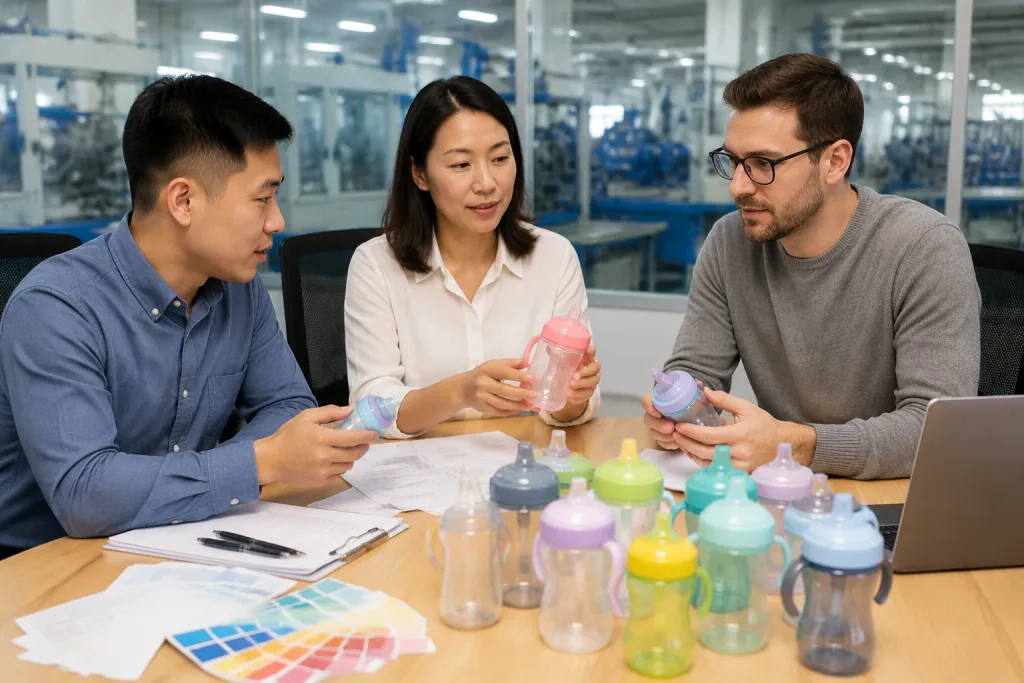
Packing is not glamorous, but it protects your margin. Toddler bottles have caps, straws, handles, and silicone boots that pick up rub marks fast in transit. We run a 1.2 m drop check on the first packed carton; if the PP handle leaves a half-moon mark on the powder coat, QC pulls the sample before mass packing starts. A canteen factory will often default to one bottle in one polybag, then 24 pcs per master carton. That works for sea freight floor loading. It is the wrong setup for parcel networks or retailer DCs where cartons get tossed, scanned, and stacked under 18 kg loads.
For export cartons, ask for 5-ply corrugated board, carton gross weight under 15 kg where possible, and product dividers when coating is scratch-sensitive. Retail boxes need to lock the bottle in place with about 2–3 mm clearance around the cap, not squeeze it until the lid rubs through the print. We saw this go sideways on a 3,000 pcs order: the buyer approved the color box artwork, but nobody checked the inner tray, and QC found 7 scratched caps in the first 80 pcs. If you include spare straws or brushes, decide the packing method early: inside the bottle with a dust bag, or sealed in a paper pouch beside it. Loose accessories create missing-part claims. Simple as that.
Shipping terms matter too. FOB Ningbo or FOB Shanghai is common for Zhejiang and nearby China drinkware shipments; from our Hangzhou line, Ningbo trucking is usually 1 day, while Shanghai can take 2 days when the driver hits port queue. EXW can look cheaper, but the math often breaks once local trucking, export declaration, and loading risk move to you or your forwarder. DDP is fine for a 500 pcs trial order, but ask what is included. Duties and VAT are one bucket; customs broker, port fees, and final-mile delivery are another. We have had buyers flag a quote because “DDP USA” on the PI did not match the PO note saying “DDP warehouse, liftgate required.”
Pre-shipment PO line items:
- Master carton dimensions in mm and gross weight in kg; we normally confirm after packing 1 full carton on the scale
- Carton drop test: ISTA-style internal check or agreed method, with drop height written on the inspection sheet
- Pallet requirement: fumigation-free pallet or floor-loaded container, plus max stack height if the retailer has a DC rule
- Label files: SKU and FNSKU on separate PDFs, carton mark, country of origin, with barcode size checked by scanner
- Incoterm: FOB Ningbo, CIF, DDP, or other agreed term; spell it the same way on PO and PI
- Shipment window: example, ready date within 35 days after sample approval, not 35 days after deposit if artwork is still open
Do not approve production without final packaging files. We ship custom canteen programs where the bottle sample passes in 12 days, then the carton mark typo burns another 6 days because “Made in China” was missing from one side panel. Barcode corrections and carton marks delay orders more often than the bottle body.
Plan Reorders Before First Shipment
A first order should make the reorder boring. Before the first bulk shipment leaves China, ask your toddler bottle manufacturer for the final bill of materials with resin grade and gasket size, approved artwork files in AI and PDF, mold references such as BF-TB-350-02, Pantone or RAL color standards, spare-part list by item code, and the QC report. File them under the SKU, not buried in a 47-message email thread. Six months later, someone will ask why the lid pin is 1.8 mm instead of 2.0 mm.
Reorders expose weak sourcing fast. A canteen customized in March and repeated in September can drift on Pantone color, straw softness, powder coating texture, or box board thickness if nobody fixed the standard. Keep one golden sample at your office and one at the factory; we tape the signed label across the cap so the line cannot swap it by mistake. For larger programs, request signed limit samples for coating specks under 1 mm, logo position tolerance within 0.5 mm, and minor scratches seen only under a 600 lux inspection lamp. It sounds fussy. It stops emotional arguments when QC pulled the sample and the buyer flagged “too rough” with no measurement.
If you are a canteen distributor or work with 3-5 canteen distributors, plan replacement parts before retail starts. Parents lose straws. Lids disappear in school bags. A USD 0.18 straw set can save a USD 4.00 refund, but the math does not work if parts ship by courier one carton at a time. Ask whether spare straws with bite valves, lids with matching thread, and silicone gaskets in the correct hardness can be ordered at 500-1,000 sets per batch. If your wider line includes a customizable growler or customized growler beside adult custom drinkware items, do not assume spare-part MOQs match toddler bottle parts. They usually do not; we have seen 1,000 toddler straw sets share a carton while a growler lid supplier asked for 3,000 pcs.
At BottleForge Industrial in Hangzhou, Zhejiang, our practical advice is simple: source toddler bottles slowly once, then reorder quickly. Lock the product record, inspection rules, and packaging files during the first PO, including carton marks and the barcode size, because one PO typo like “matte yellow” instead of “milk yellow” can cost 2 days on press-proof approval. After that, a stable canteen manufacturer can run reorders through material purchase, coating, assembly, inspection, and FOB handover in 12 days vs 18 days, without teaching the line your project again.
Send Your Toddler Bottle RFQ For Review
Share capacity, material, logo, MOQ, packaging, and target market. We will reply with practical options, not a vague catalog quote.
Frequently asked questions
What MOQ should I expect from a toddler bottle manufacturer?
For an existing mold, a realistic MOQ is usually 1,000 units per color and 3,000 units per order for stainless toddler bottles. Some canteen suppliers accept 500 units per color if you use stock colors and simple laser engraving, but the FOB price may rise by 8-20%. For custom Pantone powder coating, printed retail boxes, or a new cap color, 1,000-2,000 units per SKU is more practical. New tooling changes the discussion: the factory may ask for a first order of 5,000-10,000 units to justify mold setup and production scheduling.
How long do samples and bulk production take?
If you use an existing Zhejiang or China mold, plain samples usually take 7-10 days, and decorated samples take 10-15 days after artwork confirmation. Bulk production commonly takes 30-45 days after sample approval and deposit. Add 5-10 days if you need third-party testing before shipment. A new mold can add 25-45 days before the first proper sample. Do not count production days from the first RFQ. Count them from the date when the sample, color, packaging, PO, and deposit are all approved.
Which certifications should I ask for toddler bottles?
Start with the market, then the material. For Europe, buyers often request LFGB food-contact, REACH declarations, and sometimes EN-related checks depending on product positioning. For the United States, FDA food-contact material declarations and CPSIA-related requirements may apply, especially for child-use products. If the bottle is sold to children under 3, small-part and labeling risk needs extra attention. Also ask for BSCI or similar social audit information if your retailer requires it. Do not accept one generic “food grade” certificate for the whole product. Caps, straws, gaskets, coating, and stainless steel should be traceable.
Is stainless steel or plastic better for toddler bottles?
Stainless steel is stronger, feels premium, and supports insulated designs, but it costs more and can dent if dropped. A 350 ml stainless toddler bottle may land around USD 3.20-4.80 FOB depending on cap and finish. Plastic is lighter and often cheaper, but odor, scratching, and perceived safety become bigger buyer concerns. Tritan or PP can work well for non-insulated bottles if the cap is well designed. For brand owners, stainless is usually better for premium retail. For canteen promotional volume or entry-price distributor drinkware, plastic can be acceptable with strict material documentation.
What should be on my PO besides unit price?
Your PO should include SKU, quantity by color, approved sample ID, material specs, logo method, packaging files, barcode or FNSKU rules, AQL level, required documents, shipment term, ready date, and payment term. Add spare-part quantities if you need replacement straws, lids, or gaskets. For toddler bottles, define critical defects clearly: leakage, sharp edges, loose small parts, wrong material, missing warnings, and broken cap mechanisms. A clean PO prevents disputes. If your canteen vendor only receives a quantity and price, they will make reasonable factory assumptions, and those assumptions may not match your retailer’s requirements.