Key Takeaways
- A realistic toddler bottle MOQ is 1,000-3,000 pcs, depending on color, lid mold, and decoration
- FOB China pricing usually moves by USD 0.35-1.20 per unit based on steel grade, lid complexity, and packaging
- Plan 35-55 days for repeat bulk orders and 60-90 days when new tooling or lab testing is required
- Use AQL 2.5/4.0 inspection and require CPSIA, FDA LFGB, or REACH support based on destination market
A toddler bottle looks simple until you buy 5,000 pieces and QC pulls 32 leaking lids from the pre-shipment sample. Then the low quote stops looking cheap. We have seen the silicone straw carry a sour smell after a 60°C soak test, and we have seen a 48 x 36 x 42 cm export carton push freight cost past the buyer’s target. The wrong question is “Who has the lowest unit price?” Ask whether that price still works after tooling, FDA or LFGB testing, logo printing, color box packing, AQL 2.5 inspection, and a shipping plan that is 18 days by sea instead of the 12 days written on a rushed PO.
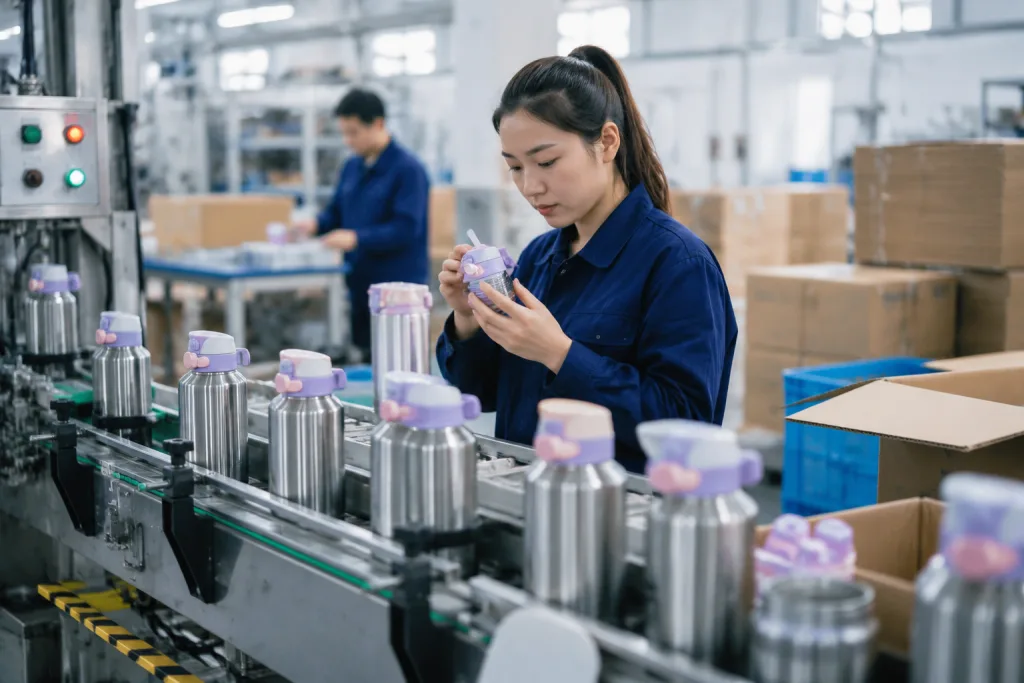
From our factory network in Zhejiang, China, we run toddler bottle in bulk programs for brands already buying bulk drinkware, canteen wholesale, and seasonal hydration lines. BottleForge Industrial in Hangzhou, Zhejiang can support 300,000 stainless drinkware units/month, with practical MOQs starting at 1,000 pieces for stock-color toddler bottles and 3,000 pieces for custom molded lids. On the line, we check lid fit with a 0.2 mm feeler gauge and do a 180° inverted leak test before packing. Small detail. Big claim risk.
Start With The Real Unit Cost
For toddler bottle in bulk sourcing, the first FOB quote is just the number at the top of the sheet. The real cost is after steel grade, lid mold, logo method, carton cube, spare parts, and test reports sit in the same Excel row. We run this check before quoting because buyers often compare USD 2.15 against USD 3.40 and miss the lid spec. A 350 ml stainless toddler bottle with a simple flip straw lid may quote at USD 2.15-2.70 FOB Ningbo at 3,000 pcs. Add a locking button, carry handle, silicone bumper, custom box, and laser logo, and the same bottle can move to USD 3.10-4.20. The math changes fast.
The body material matters. Most buyers choose SUS304 inner and outer stainless steel for toddler use. Some budget projects use PP or Tritan-style plastic bodies, but if you are selling into Europe or North America, ask for food-contact reports and an odor check before the sample leaves Hangzhou. QC pulled one PP sample last year after 48 hours in a sealed PE bag; the buyer flagged the smell before they even filled it with water. For stainless, a typical wall thickness is 0.4-0.5 mm for the outer shell and 0.3-0.4 mm for the inner shell. Thinner steel saves money, then dents after 6 weeks in daycare backpacks. That is the wrong saving.
Lids are where 7 out of 10 toddler bottle cost surprises show up. A toddler lid has more failure points than a standard sports bottle: straw tube, valve, hinge pin, lock tab, gasket, plus a weighted straw on some designs. Every silicone or PP part needs its own material control, and the line checks gasket fit with a 0.05 mm feeler gauge before assembly. If you want two spare straws in every box, add USD 0.08-0.18 per set. If you want a printed instruction card and polybag-free paper wrap, add another USD 0.05-0.12. These look small on a PO, but on 20,000 pcs they turn into USD 1,000-3,600 before freight.
MOQ Tiers That Actually Change Price
MOQ is not a penalty; it is how we spread setup cost across the order. For toddler bottle in bulk orders, we usually quote three real tiers. At 1,000 pcs, we run existing bottle bodies, stock lids, and 2-3 approved colors from the powder room. Good for a market test. The tradeoff is fewer logo positions, fewer decoration choices, and a unit price that still carries the line changeover cost. At 3,000 pcs, custom Pantone color, silkscreen or laser engraving, and retail box work start to make sense; QC pulled one 3,000 pcs sample last month because the buyer's PO said "Panton 7421C" and the artwork said "Pantone 7421 U." At 10,000 pcs, the factory can buy 304 stainless sheet in a stronger lot, keep the welding and vacuum line running 18 days instead of 6 short setups, and cut per-unit handling cost.
As a rough FOB China range, 1,000 pcs sits around USD 3.30-4.60 for a stainless toddler bottle with custom logo. At 3,000 pcs, the same spec lands closer to USD 2.80-3.80. At 10,000 pcs, USD 2.45-3.35 is realistic if the lid is standard and the packaging is not overbuilt. The math doesn't work when a buyer asks for a new lid, gift box, color sleeve, and 1,000 pcs pricing. New private mold work is a different bill. A custom lid mold can require USD 3,000-8,000 in tooling and 20-35 days before pre-production samples are ready; our mold shop checks the first T1 lid with a 0.02 mm caliper because one loose straw seat can fail the leak test.
Do not compare toddler bottles directly with bulk canteen, wholesale canteen, or canteen bulk pricing. Wrong question to ask. A simple metal canteen has fewer components and less child-safety scrutiny, so the costing table is cleaner. The same applies to growler wholesale, growler bulk, wholesale growler, and bulk growler programs. Beer growler bulk or beer growler wholesale bulk buyers usually push us on capacity and sealing pressure; toddler bottle buyers need bite safety, small parts, and cleanability checked before price chasing. We've seen this go sideways when a buyer approved a cheap flip lid, then AQL 2.5 inspection found 7 lids with burrs around the drinking spout.
Decoration And Packaging Cost Traps
Logo choice changes the unit price and the ship date. Laser engraving on 304 stainless bodies is steady work for us; on a 55 mm tall logo we usually quote USD 0.08-0.20 per unit, and QC checks the depth with a 10x loupe before packing. One-color silkscreen may add USD 0.06-0.15, but 3-color artwork means film charges, registration setup, and more rejects when the curve of the bottle pulls the print off by 1-2 mm. Powder coating with a laser logo sells well because it looks clean and handles dishwasher claims better than cheap ink. The catch is coating thickness. We run the line at 60-80 microns and reject panels when the magnetic thickness gauge reads thin near the bottom radius.
For toddler bottles, decoration on bite zones or hinge areas is the wrong place to save money. A cute print that scratches after 200 open-close cycles becomes a refund thread, not a design feature. QC pulled a flip-lid sample last May where the cartoon nose sat right on the thumb tab; after the fixture ran 200 cycles, the buyer flagged white scratch lines in the video. If you sell through retail or online marketplaces, ask for carton drop testing around 76 cm for master cartons and a basic rub test on printed surfaces. For Amazon FBA, the supplier should apply FNSKU labels straight, not half over the carton seam, and keep master cartons at 12-18 kg so the warehouse team does not fight every box.
Packaging bites harder than 6 buyers out of 10 expect. A white box may cost USD 0.12-0.25. A full-color gift box can cost USD 0.25-0.55. Insert trays and warning labels look small on the quote sheet, but they add proofing loops, barcode checks, and packing-line stoppages when the tray is 2 mm too tight. We have seen this go sideways from one PO typo: “matte lamination” on the artwork file, “gloss lamination” on the purchase order. If your brand also sources drinkware wholesale, wholesale drinkware, or drinkware bulk, standardize dielines across toddler bottles and travel tumblers where the dimensions allow it. One box system cuts artwork mistakes and gets carton paper booked faster in China.
Lead Time By Production Stage
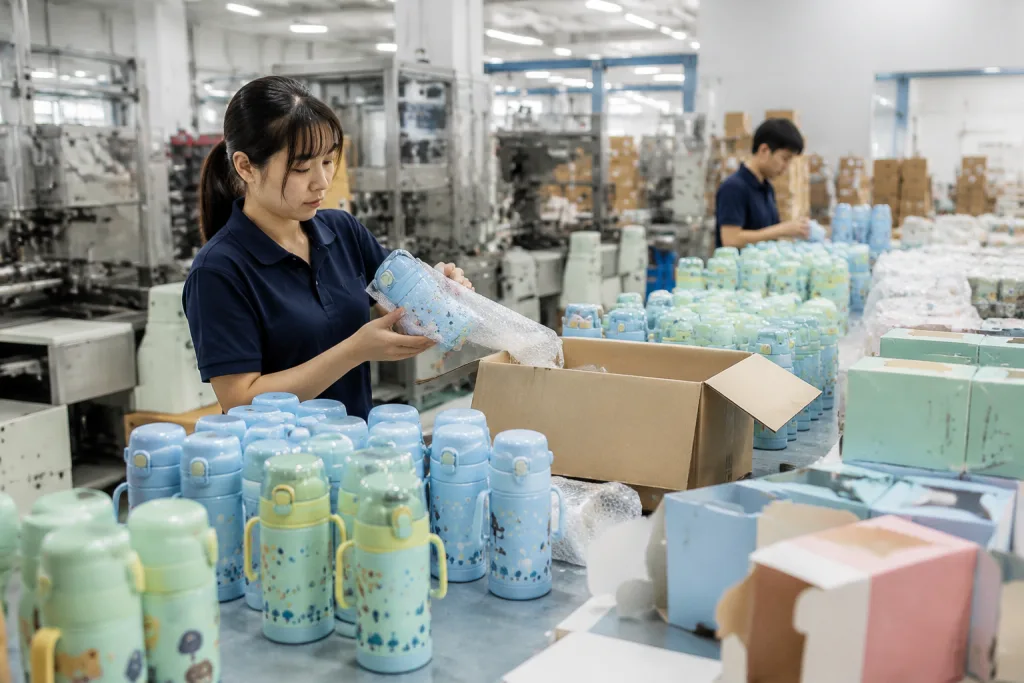
A clean repeat order usually runs 35-55 days after deposit and artwork approval. That means existing mold, signed color chip, no fresh lab test, and payment terms already cleared by both finance teams. For a new toddler bottle in bulk project, plan on 60-90 days. The first 7-10 days are technical lock-in: capacity, lid structure, straw length in mm, silicone hardness, logo files, packaging dieline, barcode rules, and test standards. QC pulled one pre-production sample last month because the PO said “pantone 219C” while the approved swatch was 2195C. Small typo. Big delay. Sampling then takes 7-15 days with stock components or 25-40 days when we cut new tooling.
Mass production is not one clean step. Stainless bottle bodies pass through cutting, shaping, welding, vacuuming, polishing, coating, and assembly. We run vacuum checks before packaging; a digital vacuum tester catches weak insulation before cartons reach the pallet area. Lids need injection molding, silicone part inspection, assembly, leak testing, and matching to the body. At BottleForge Industrial, a normal production slot for 3,000-20,000 pcs is 25-35 days after final sample approval. Before back-to-school and Q4 retail, the line gets tight and this can move by 7-14 days. We have seen buyers push for “just 20 days”; the math doesn’t work if coating, curing, and AQL 2.5 inspection stay in the schedule.
Shipping adds its own clock. FOB Ningbo or Shanghai is common for Zhejiang factories, and we usually need 2-4 days from final inspection to container gate-in after booking release. Ocean freight to the US West Coast may take 18-25 days port-to-port, while Europe often runs 30-40 days depending on routing. Air freight works for samples or launch shortages, but flying 3,000 toddler bottles can eat the full margin on a retail program. The buyer flagged this once after seeing the courier quote at 8.6 kg per master carton. If your launch date is fixed, lock the inspection date first, not just the vessel date.
Compliance Is Not Optional
Toddler drinkware is a stricter category than normal promo bottles. For the United States, we usually prepare CPSIA support for child-related products, plus FDA food-contact compliance for 304 stainless, PP, silicone, ink, and coating. For Europe, buyers ask for LFGB, REACH, EN 14350 references, and migration testing; last month a German buyer flagged a missing pigment page on a PP lid report during document review. Canada often needs bilingual labeling and the right food-contact file. The exact list depends on sales channel, age grading, and claims like “BPA free” or “for 12M+.” This is not paperwork decoration.
Ask the factory for test reports before you pay for tooling. Old reports save time, but check the tested material, Pantone color, model code, and issue date; we reject reports older than 24 months for new toddler projects unless the buyer accepts them in writing. A report for a black PP lid does not cover a pink lid with a different pigment. The math does not work. Silicone straw odor is a shop-floor problem too: food-grade silicone can still smell if curing is cut from 18 minutes to 12 minutes or the parts sit in sealed PE bags too soon. We run a pre-shipment odor check and a 24-hour water contact test on random samples pulled by QC from finished cartons.
Your purchase order should define inspection standards. AQL 2.5 for major defects and AQL 4.0 for minor defects is common. Critical defects should be zero tolerance: sharp edges, loose small parts, leaking lids, contaminated interiors, broken hinge pins, and mismatched warning labels. For toddler products, factory QC photos alone are the wrong place to save USD 180. Use your own third-party inspection or ask for a full QC report with leak test quantity, vacuum test results, carton drop result, and defect photos; on our line, QC logs the leak test after 30 seconds inverted and records hinge play in mm when the buyer asks for it.

Adjacent SKUs And Bundle Planning
About 7 out of 10 brand owners we talk with start with toddler bottle in bulk, then ask for a family hydration set once the first PO moves. Plan the component strategy before artwork approval. A toddler bottle and kids bottle can share the same Pantone powder colors, 12 mm silicone strap width, carton style, barcode logic, and cap insert color; sports bottles and travel tumblers can follow the same shelf color story without forcing the same tooling. Less re-approval. Cleaner distributor pitch. It also gives you better drinkware wholesale pricing across 3 or 4 SKUs, instead of squeezing one toddler item until the math doesn't work.
Do not throw every drinkware idea into the same RFQ. We’ve seen this go sideways. Alcohol flask bulk, alcohol flask in bulk, alcohol flask wholesale, and alcohol flask wholesale bulk programs sit under different buyer expectations, age-market concerns, and compliance checks. Beer tumbler bulk and beer tumbler wholesale items need different lid seal tests; beer growler in bulk and beer growler wholesale usually bring bigger capacity claims, thicker cartons, and leak checks at the thread. QC pulled one mixed-RFQ sample last month because the adult tumbler lid passed the upside-down test, but the toddler straw cap dripped after 90 seconds on the bench.
For the best wholesale drink bottle program, split RFQs by product family. Send one quote sheet for toddler bottles, one for canteen wholesale or wholesale canteen items, and one for adult stainless drinkware. Keep material specs, packaging, Incoterms, and inspection rules consistent, including AQL 2.5 if that is your standard. Supplier comparison gets faster. Our Zhejiang team can quote in 12 hours instead of 2 days when the first email includes capacity in ml, target FOB price, order quantity, destination market, logo method, and a packaging reference; one buyer once wrote “5000 ctns” on the PO when they meant 5000 pcs, and the line stopped until purchasing confirmed it.
Send Your Toddler Bottle RFQ For A Costed Reply
Share quantity, capacity, lid type, logo method, packaging, and destination market. We will return MOQ, FOB price, and lead-time ranges.
Frequently asked questions
What is a realistic MOQ for toddler bottle in bulk orders?
For a standard toddler bottle using an existing mold, a realistic MOQ is 1,000 pcs per style and 500-1,000 pcs per color if the color is in regular production. For custom Pantone powder coating, expect 3,000 pcs because coating setup and color matching need stable batch volume. For a new lid, handle, straw system, or private molded body, MOQ often moves to 5,000-10,000 pcs, plus tooling. If you are testing a market, start with 1,000-2,000 pcs in one proven color rather than splitting 1,000 pcs across four colors. Small color splits usually raise the price and increase QC risk.
How much should I budget per toddler bottle FOB China?
For stainless steel toddler bottles, a workable FOB China budget is USD 2.45-4.60 per unit depending on quantity and specification. At 10,000 pcs, a 350 ml bottle with standard straw lid, powder coating, and simple logo may sit around USD 2.45-3.35. At 1,000 pcs, the same item may be USD 3.30-4.60 because setup cost is spread over fewer units. Retail packaging can add USD 0.12-0.55, spare straw sets add USD 0.08-0.18, and third-party inspection usually costs USD 250-350 per man-day. Tooling is separate and can run USD 3,000-8,000 for a custom lid.
How long does production take after sample approval?
For repeat orders with approved artwork and existing components, production usually takes 35-55 days after deposit. That includes material preparation, body forming, welding, vacuum processing, coating, lid assembly, packing, and internal QC. For a first order with new color matching, packaging dielines, and compliance documents, plan 60-90 days before goods are ready for shipment. If you need private mold work, add 20-35 days before pre-production samples are available. Ocean freight then adds about 18-25 days to the US West Coast or 30-40 days to many European ports, excluding customs and inland trucking.
Which tests should I request for toddler bottles?
At minimum, request food-contact support for all mouth-contact and liquid-contact parts: stainless steel, PP, silicone, coating, ink, and gasket materials. For the US, ask about CPSIA and FDA-related documentation. For Europe, ask about LFGB, REACH, and relevant child drinkware standards such as EN 14350 where applicable. Operational tests matter too: leak testing, lid open-close cycling, straw pull checks, coating adhesion, odor check, and carton drop testing. For pre-shipment inspection, use AQL 2.5 for major defects and AQL 4.0 for minor defects, with zero tolerance for sharp edges, loose small parts, and leaking lids.
Can I combine toddler bottles with other drinkware in one order?
Yes, but only if you separate the specifications clearly. A factory can often produce toddler bottles, sports bottles, travel tumblers, canteen bulk items, and growler wholesale SKUs in the same broader program. The risk is that buyers apply one quality checklist to every item. Toddler bottles need child-safety review, straw and small-part checks, and stricter labeling. Adult products such as beer growler wholesale or alcohol flask wholesale have different capacity, sealing, and market requirements. For better pricing, combine volumes for shared colors or packaging materials, but keep separate inspection criteria, test requirements, and cartons for each SKU.