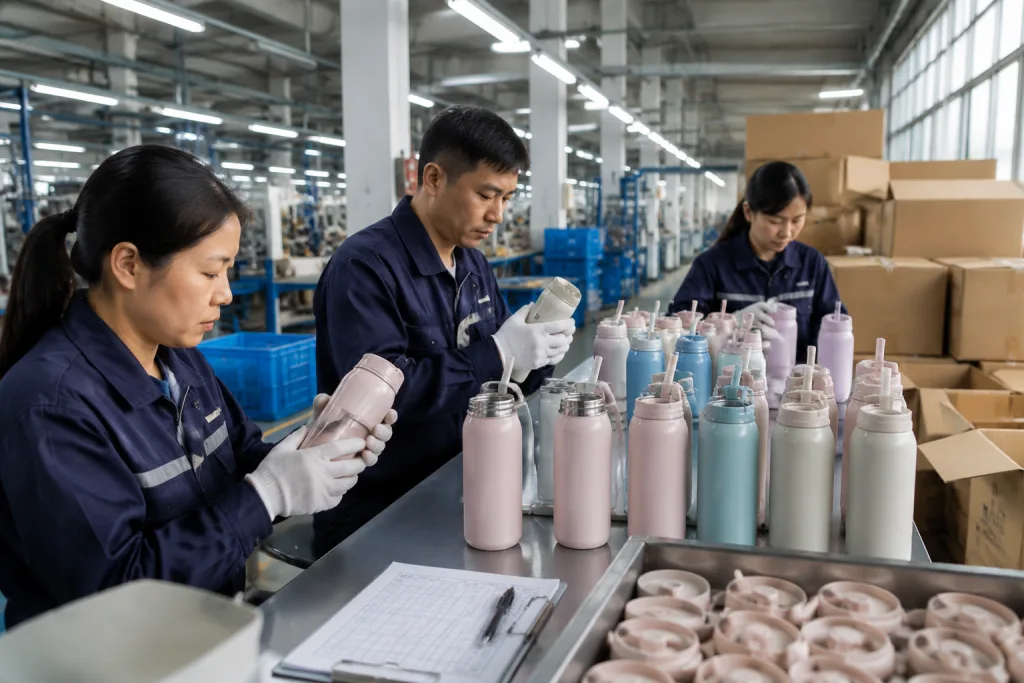
Key Takeaways
- A practical toddler bottle MOQ is 3,000-5,000 units per color for stable component matching
- 304 stainless steel with 0.45-0.55 mm wall thickness is common for toddler vacuum bottles
- Plan 7-10 days for pre-production samples and 30-40 days for mass production after approval
- Use AQL 2.5 for major defects and AQL 4.0 for minor defects before FOB release
You are not buying a cute straw bottle. You are buying 5,000 small failure points that parents will throw into a preschool bag, clip onto a stroller, and wash at 65°C twice a week. If the lid leaks at the vent hole, the silicone straw smells after 24 hours in warm water, or the logo peels after 20 dishwasher cycles, your customer service team gets the email. QC pulled one sample last month with a 0.35 mm gap under the flip lid. The buyer flagged it before we packed the carton.
Here is the order we see often: 5,000 toddler bottles for a distributor drinkware program in Europe or North America, with private logo, retail packaging, and compliance paperwork. BottleForge Industrial in Hangzhou, Zhejiang, China, would run it in this order: spec sheet first, then mold status, 2 rounds of samples, AQL 2.5 inspection, carton drop test, and shipment booking. Asking “how fast can you ship?” is the wrong first question. The line can save 6 days only if the PO has no missing Pantone code, no artwork typo, and no late change from straw length 78 mm to 82 mm.
Start With The Actual Use Case
Price is the wrong first question. Ask where the bottle sits all day and who washes it at 6 p.m. A daycare bottle gets different abuse than a canteen promo item or a school fundraiser gift. For a 2-5 year old user, we normally write one-handed opening, bite-resistant straw, 38-42 mm carry-handle clearance for small fingers, and a leak test with the bottle upside down in a loaded backpack for 30 minutes. QC pulled one sample last month where the straw passed upright testing, then dripped 6 ml after the bag test.
For this buyer scenario, the brief is a 350 ml stainless steel toddler bottle, powder coated, with a flip straw lid and silicone boot. The order is for a canteen distributor selling to preschool chains and independent retailers. So the bottle needs shelf appeal, but it still has to take drops from a classroom table. We run the boot fit with a digital caliper because a 0.5 mm loose edge looks fine in photos and peels fast on the line. A cheap lid hinge can save USD 0.08 and cost you hundreds of returns. We have seen this go sideways.
Our Hangzhou, Zhejiang team asks for 6 items before quoting: target retail price, destination market, logo method, packaging style, test requirements, expected reorder timing. If you are comparing a toddler bottle factory in China against 3 or 4 canteen suppliers, send every factory the same technical brief. Otherwise, one canteen vendor quotes 201 steel, another quotes 304 steel, and the spreadsheet lies to you. The buyer flagged this exact issue on a PO where the material line said “SS” only, and purchasing thought both offers were equal.
Working assumption for the order: 5,000 units, two colors, 350 ml capacity, 304 stainless steel inner and outer shell, PP lid, LFGB-grade silicone straw, retail color box, FOB Ningbo. We ship this kind of job in 28-35 days after artwork approval, assuming the color box file is final and the barcode is not missing from the dieline.
Lock The Bottle Specification
A toddler bottle factory should not push you into a stock model before showing the BOM and wall gauge. For 350 ml vacuum bottles, we usually run 304 stainless steel on both inner and outer walls, with 0.45-0.55 mm as the normal wall thickness. Go thinner and the unit price can drop by USD 0.12-0.20, but QC sees the problem fast: shoulder dents after a 1.2 m drop test and base rings going oval on the caliper.
The lid matters more than 8 out of 10 new buyers expect. For toddler use, the straw needs enough bite softness without tearing after 30 days in a school bag. We usually specify food-grade silicone at 50-60 Shore A hardness, checked with a Shore durometer, plus a replaceable straw set packed in the accessory bag. PP is the normal choice for the lid body. Tritan works for clear windows, but the math does not work unless your retail price can absorb the extra USD 0.18-0.35.
For coating, powder coating gives better hand grip than glossy spray paint, especially when a child’s hands are wet. A standard coating thickness is around 60-80 microns; our line checks it with a magnetic thickness gauge before the carton seal. If your design uses light pastel colors, ask for a stain check with juice, milk, and tomato sauce for 24 hours. Parents notice stains faster than procurement teams do. We have seen this go sideways on pale pink samples.
Logo options depend on your shelf position and complaint tolerance. Laser engraving lasts, but it reads subtle on matte powder coating. Silkscreen is cheaper for one-color marks, and heat transfer works for full-color characters if it passes abrasion testing at 500 rubs. QC pulled the sample last month because one PO said “bear blue” while the artwork file showed “berry blue.” For customized drinkware sold through retailers, we normally quote each decoration separately so you can pick the right mix. The same rule applies when buyers ask us for a custom canteen, customizable growler, or customized growler line: the surface process must fit the use case, not just the artwork file.
Build A Quote That Means Something
A useful quote should tell the buyer what is inside the price, not just print one clean number. For this 5,000-unit order, we would expect a realistic FOB Ningbo range of USD 4.10-5.20 per unit, depending on lid structure, coating, silicone boot, packaging, and test scope. If another canteen factory comes in 20% lower, this is the wrong question to ask: “Can you match it?” Ask for the 304 stainless thickness in mm, vacuum hold result after 12 hours, 5-ply carton burst strength, and whether FDA or LFGB testing has been left out. We have seen QC pull a sample where the quote said “304 stainless,” but the incoming material report was for 201 stainless.
At BottleForge Industrial, our standard toddler bottle capacity is 180,000-220,000 units per month across stainless kids and sports bottle lines. MOQ for a custom color is usually 3,000 units per color. For a new molded lid, tooling can run USD 2,500-8,000 and add 25-35 days before mass production because the mold trial, fit test, and leak test each need their own sign-off. A private logo on an existing mold moves faster: 7-10 days for samples and 30-40 days for production after sample approval. Last month, one buyer flagged a 1.5 mm logo shift on the laser sample, and fixing it before the line opened saved us from reworking 5,000 lids.
Ask your canteen manufacturer to separate these items in the quotation:
- Bottle body and lid unit price, with stainless grade, lid material, and gasket type written clearly
- Silicone boot, straw brush, spare straw, or accessory cost, especially if each set is packed by hand on the line
- Logo setup and running charge, including laser, silk print, heat transfer, or UV print cost
- Retail box, master carton, barcode, and FNSKU labeling, with carton size and gross weight shown
- Third-party testing, inspection, and document fees, including AQL 2.5 inspection if your buyer requires it
For distributor canteen and distributor growler programs, landed cost matters more than FOB price. A carton that costs USD 0.08 more can cut crushed retail boxes by 3-5% during ocean freight, based on what we see after 40HQ arrivals. That trade works. Cheap packaging is one of the dullest ways to lose margin, and we have seen it go sideways when a buyer’s warehouse photo shows 18 crushed inners out of the first 600 cartons.
Approve Samples Before You Dream
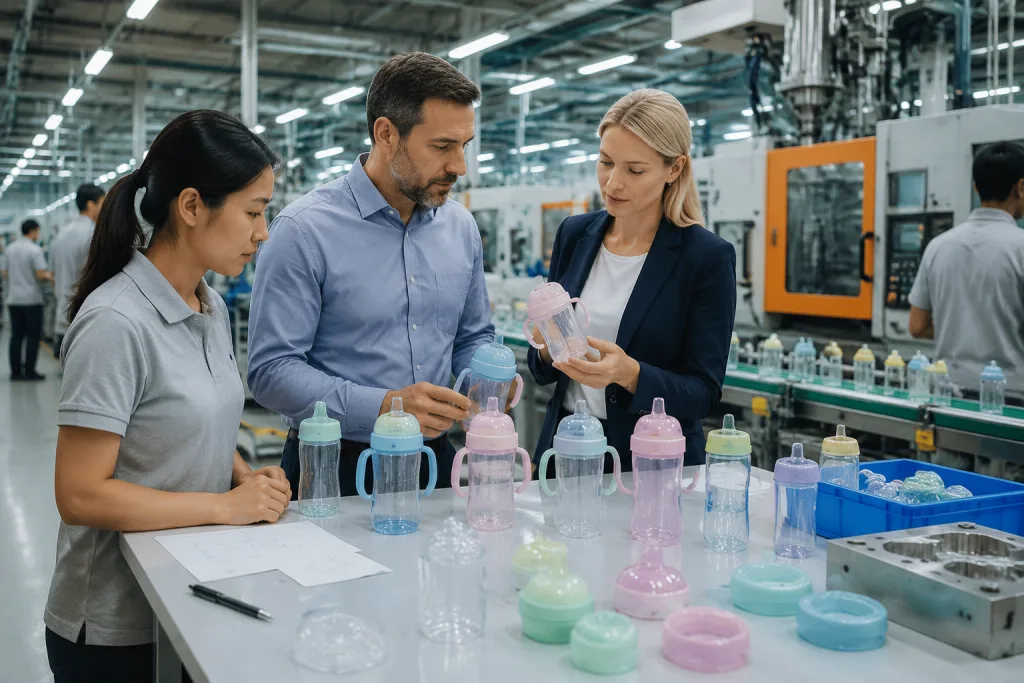
Sampling is where the order gets real. Never approve a toddler bottle from studio photos alone. Hold it. Open the flip lid 50 times, smell the silicone straw, shake it, wash it, and leave it sideways in a child-size backpack for one afternoon. We run samples with final color, final logo, final straw material, final lid structure, and near-final packaging; if the carton insert is still a white dummy, write that on the sample approval sheet. A buyer once missed a temporary straw note, and QC pulled the sample only after the PO already said “clear silicone.”
For this buyer scenario, the sample checklist is simple but strict. Fill the bottle with colored water, close the lid, invert it for 30 minutes, then shake it 20 times over white tissue paper. Check leakage at the straw valve, air vent, thread, and lid hinge; those four points catch most toddler bottle failures on the line. Then wash the lid and straw in 40°C warm water with mild detergent. If the silicone still smells sharp after washing, reject it. Parents will find it faster than your warehouse team.
Color approval should use Pantone references, but powder coating has normal tolerance. On matte finishes, a Delta E under 1.5 is a good target for controlled programs, while 2.0 may be acceptable for some canteen customized campaigns. Print registration tolerance should be agreed before mass production, usually within ±1.0 mm for small logos. The wrong question is “does it look close?”; use a light box or spectrophotometer, because matte mint green under office LED can pass in Hangzhou and fail under a buyer’s retail shelf lighting.
Keep two signed golden samples: one with you and one at the factory in Zhejiang. During production, the QC inspector compares mass goods against that sample, not against a memory from an email thread. We ship faster when the golden sample has the buyer’s signature, date, Pantone code, and logo position marked in mm on the hangtag or approval sticker.
Control Production In The Middle
Too many buyers wait for the final AQL 2.5 inspection; in our last 40 toddler bottle orders, 31 asked for final inspection only. Bad timing. For toddler bottles, a dented inner cup, weak braze, or wrong silicone hardness is already buried before the carton is taped. A proper toddler bottle factory should accept an inline check at 30% to 50% completion. If a canteen supplier pushes back with “check after packing,” the math doesn’t work. You are not making trouble; you are stopping a 12,000 pcs order from becoming scrap.
We run the middle checks by process, not by calendar date: steel forming with mouth diameter checked by vernier caliper, vacuum brazing with a 0.2 MPa leak check, polishing before coating, coating before lid matching, then lid injection, silicone fitting, assembly, and packing. Vacuum performance should be tested before decoration when possible. For a 350 ml bottle, a common internal check is hot water at 95°C, with temperature retention measured after 6 hours. Toddler bottles are often filled with room-temperature water, but weak vacuum insulation usually points to loose weld control or brazing drift on the line.
During coating, QC pulled the sample under a 6500K light box and looked for dust points, orange peel, thin coverage near the neck, and whether the silicone boot sits flat without a 1 mm gap. During lid assembly, we check straw alignment against the mold centerline and valve sealing with a simple inverted water test. A hinge can feel fine after 10 openings and still crack after 1,000 cycles. For any new lid design, we recommend a hinge fatigue test; we have seen this go sideways when a buyer skipped it to save 2 days.
For custom drinkware and customizable drinkware orders, we also check artwork position on the curved body with a paper height gauge before mass printing. A logo that is 5 mm too high may hit the silicone boot or look off on shelf. The buyer flagged this once on a PO where “logo center 78 mm” was typed as “87 mm”; QC caught it before 3,000 pcs went through heat transfer. This is where experienced canteen manufacturers earn their margin: they catch dull mechanical problems before they turn into chargebacks.
Inspect With Buyer-Level Standards
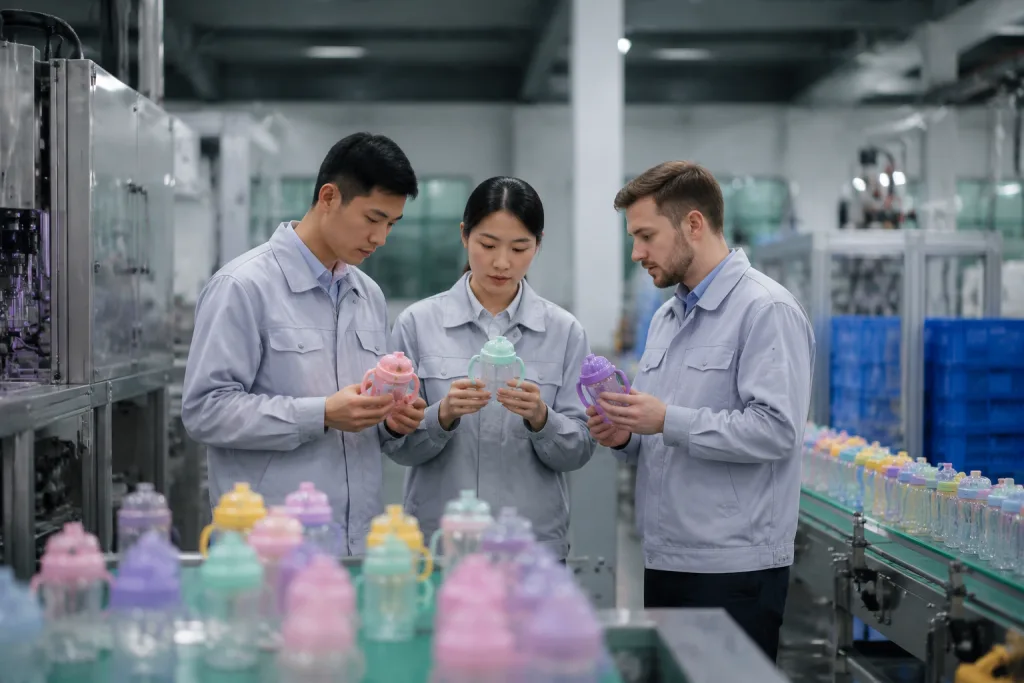
Write final inspection into the purchase order before production starts. Do not wait until 5,000 units are sealed in export cartons. For this 5,000-unit shipment, we run ANSI/ASQ Z1.4 single sampling, general inspection level II. A common AQL setting is 0 for critical defects, 2.5 for major defects, and 4.0 for minor defects. Critical defects include sharp edges over 0.3 mm, unsafe material substitution, broken lid components, contamination, or leakage that leaves water on the QC bench after inversion. QC should pull the sample with a random-number sheet, not from the clean top layer the line just packed.
Leakage testing on toddler bottles needs real time under pressure. A 10-second shake is the wrong test. Pull random units, fill to rated capacity, close the lid, invert for 30 minutes, then test side-down and straw-up positions. Also test open-close function after 50 cycles, straw suction with a simple vacuum gauge, lid thread smoothness by hand feel, boot adhesion after a 24-hour rest, coating adhesion by cross-hatch tape test, barcode scanning, and carton drop performance. We have seen this go sideways when the buyer flagged 18 leaking lids out of 200 checked samples, all from the second injection shift. For North America, CPSIA-related material checks for children’s products are often requested. For Europe, REACH, LFGB food contact, and EN 14350 considerations may apply depending on design and market classification.
If you sell through online channels, carton labeling matters. FNSKU, suffocation warning on polybags, country of origin, and master carton marks should be checked against your routing guide line by line. One buyer once sent back a routing guide because our PO typed “FNSKU” as “FNSUK” on the carton artwork; the bottles were fine, but the warehouse would not book the inbound slot. A canteen distributor may forgive a minor color shade issue measured at Delta E 1.8. A warehouse will not forgive unreadable labels.
Ask for inspection photos, defect tables, and clear disposition: pass, fail, or hold for sorting. Sorting 5,000 units in China before shipment is painful; sorting them after arrival is worse. The math does not work. If QC pulls 125 pcs under general level II and finds 4 major defects against AQL 2.5, decide before the container cutoff whether we rework, replace, or hold the lot at the factory gate.
Ship Clean And Keep Records
Once inspection passes, shipping can still bite you. For FOB Ningbo, confirm carton dimensions, gross weight, HS code, loading date, and document cut-off before the forwarder opens the booking. A 350 ml toddler bottle with retail box often packs 24 units per master carton. We usually measure the packed carton with a tape at final QC; a common size is around 48 x 36 x 32 cm, but the boot, handle, and gift box insert can push it up by 8–15 mm. Do not guess carton data for freight booking if your margins are tight. The math does not work.
For this order, the factory should send the commercial invoice, packing list, booking confirmation, test reports, product photos, and carton mark photos. If your customer is a canteen distributor or regional retailer, file everything under the PO number, not under a WeChat contact name. We had one buyer flag a PO typo where “straw brush” became “straw blush,” and that small mistake delayed document approval by 1 working day. Six months later, when a buyer asks whether the silicone straw was LFGB or FDA-grade, you should not be digging through chat history.
Reorder planning starts before the first container leaves Ningbo. If the product sells, restarting from zero wastes 7–10 days on artwork checks and sample confirmation. Keep the golden sample, Pantone card, approved artwork, carton layout, inspection checklist, and supplier production notes in one technical file. QC pulled the sample? Mark the version, date, and PO number on the hang tag. A stable canteen manufacturer in China can repeat the same item faster when the line has the full file.
That is the real value of working with a disciplined toddler bottle factory: repeatable custom drinkware your sales team can sell without apologizing for preventable defects. We have seen this go sideways when the first shipment looked fine, but nobody kept the carton mark photo or approved straw drawing. Clean records are not office work. They protect the next order.
Send Your Toddler Bottle Brief For Review
Share capacity, market, logo, MOQ, and target price. Our Zhejiang team will return a practical spec and FOB quote.
Frequently asked questions
What MOQ should I expect from a toddler bottle factory?
For a stainless steel toddler bottle using an existing mold, expect 3,000 units per color as a practical MOQ, and 5,000 units total for better component planning. If you need a custom lid mold, MOQ usually rises to 10,000-20,000 units because injection tooling, color matching, and assembly fixtures must be justified. For simple logo customization on stock colors, some factories may accept 1,000-2,000 units, but the unit price will be higher and color choice limited. At BottleForge Industrial in Zhejiang, China, we prefer 3,000-5,000 units for stable powder coating, packaging, and QC control.
How much does a custom toddler bottle cost FOB China?
A 350 ml stainless steel toddler bottle with 304 inner and outer shell, PP flip straw lid, silicone straw, powder coating, one-color logo, and retail box usually lands around USD 4.10-5.20 FOB Ningbo for 5,000 units. A silicone boot may add USD 0.25-0.45. Full-color heat transfer artwork may add USD 0.20-0.60 depending on coverage. Third-party testing, special packaging, and FNSKU labeling are normally quoted separately. If you receive a price below USD 3.50 for a similar specification, check whether the supplier changed steel grade, coating quality, lid material, carton strength, or inspection scope.
Which compliance documents do buyers usually request?
For Europe, buyers commonly request LFGB food contact testing, REACH screening, and sometimes EN 14350 review depending on lid and drinking function. For North America, FDA food contact expectations are common, and children’s product programs may need CPSIA-related checks for lead, phthalates, and tracking label requirements. Many distributors also ask for BSCI or similar social audit documents, especially for retail chains. Ask your canteen supplier before sampling which reports already exist and which must be tested on your exact materials and colors. A report for a black adult bottle does not automatically cover a pastel toddler bottle with a different straw.
Can I use the same supplier for toddler bottles, canteens, and growlers?
Yes, if the factory has the right production base and engineering control. A canteen manufacturer making stainless sports bottles can often handle custom canteen, canteen customizable, and customized canteen programs. A custom growler or customizable growler may need different welding, capacity control, and lid sealing tests, especially at 1 L, 1.9 L, or 64 oz sizes. The key is not the catalog range; it is process control. Ask for monthly output, vacuum test method, coating line capacity, AQL records, and sample lead time. A capable canteen vendor should explain the differences between toddler, sports, travel, and growler products without pretending they are all the same.
What should I check before paying the balance?
Before balance payment, ask for final inspection report, defect photos, carton photos, packing list, commercial invoice draft, test report copies, and production batch photos. For 5,000 units, inspection should follow AQL with a defined sample size, not just 10 random pieces from the showroom. Check leakage, coating, logo position, straw function, lid hinge, barcode scanning, and carton marks. If you are buying for canteen distributors or retail chains, confirm master carton weight and dimensions before freight booking. Balance payment should be linked to passed inspection and correct documents. Once the container leaves China, fixing mistakes becomes slow and expensive.