Key Takeaways
- A practical factory-direct MOQ for toddler bottles is usually 1,000-3,000 pcs per color and shape.
- Ask for FDA, LFGB, REACH, and ASTM F963-related material declarations before tooling or deposit.
- A 350-500 ml toddler bottle should be checked for grip diameter, straw flow, bite resistance, and leak angle.
- Normal production lead time from Zhejiang, China is 30-45 days after sample approval and packaging confirmation.
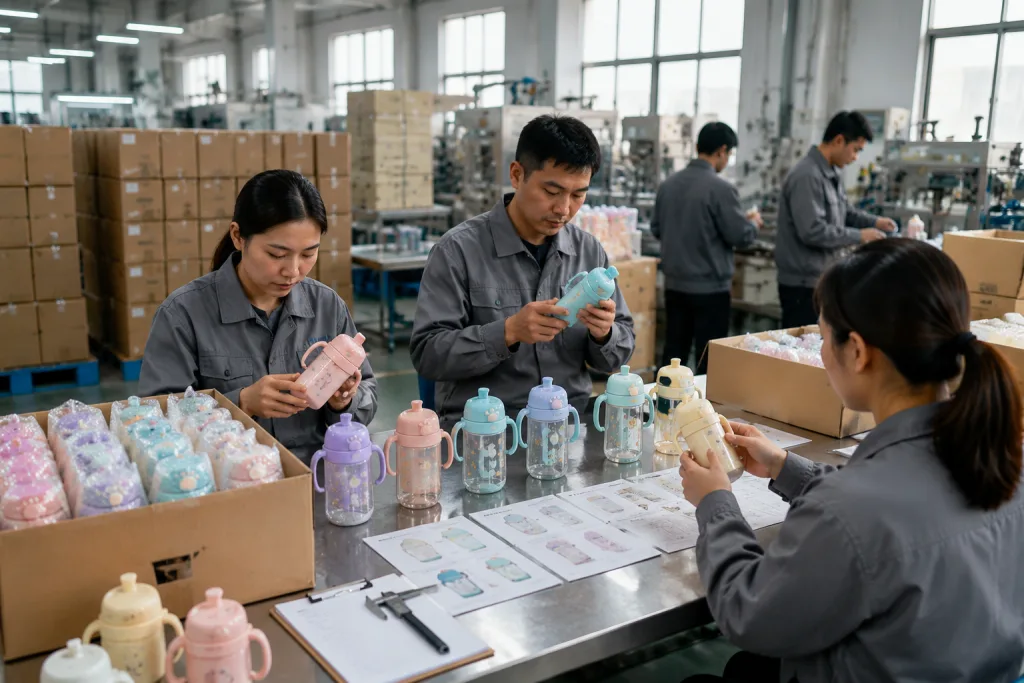
A toddler bottle looks simple until one spec is wrong. We’ve had QC pull a 350 ml sample because the flip cap needed 3.8 kg of force to open; for a 2-year-old, the math doesn’t work. A stiff cap, a straw that cracks after bite testing, or a 5-layer carton that fails a 76 cm drop test can turn a clean PO into 3 weeks of chargebacks and replacement claims.
If you buy toddler bottle factory direct from China, read the quotation like a spec sheet, not a catalog page. Our Zhejiang line sees the same miss about 12 times a month: buyers compare FOB prices but skip resin grade, wall thickness in mm, valve design, AQL level, and packaging drop-test notes. Those lines decide whether your custom drinkware order survives retail shelves and school distributor programs; we’ve seen this go sideways when a PO said “PP lid” but the approved sample was Tritan.
Material Line: Body, Lid, Straw
The first line on your toddler bottle spec sheet should not be color. It should be material. We see buyers skip this, then argue over a USD 0.08 lid change after the mold drawing is signed. For toddler bottles, we usually run Tritan, PP, stainless steel 304, silicone, and sometimes borosilicate glass with a sleeve. Each one changes the unit cost, test route, shelf value, and carton weight; a 350 ml Tritan bottle might pack 48 pcs per carton, while the same size in steel often drops to 36 pcs because the gross weight climbs.
For a lightweight toddler bottle factory direct program, Tritan body with PP lid and food-grade silicone straw is still the structure we quote most often, roughly 7 out of 10 new RFQs on our line. Tritan gives clear color and better drop performance than standard SAN; QC pulled one SAN sample last year with a cracked shoulder after a 1.2 m drop test. PP keeps the lid cost under control, and silicone works for straw tips, sealing rings, and bite valves because it stays flexible after repeated washing. If you want an insulated model, the body usually moves to 304 stainless steel, with a 201 stainless outer wall only when the target price is tight. For Europe and North America, we recommend 304 inside wall at minimum. The math doesn't work if you save a few cents on the liner and then lose the retail listing during compliance review.
Do not accept vague wording such as “eco plastic” or “BPA free material” without a resin code and declaration. Ask for the grade name on the PI, not just in a WeChat message; we once had a PO typo where “Tritan TX1001” became “Tritan TX1010,” and the buyer flagged it during document check. Your test file should include FDA food-contact compliance for the U.S. market, LFGB where German retail is involved, and REACH/SVHC screening for the EU. If the bottle is positioned for children, your buyer may also ask for ASTM F963, CPSIA, EN 14350, or EN 71-3 depending on age grading and claims.
This is where a canteen manufacturer mindset helps. Whether you buy a custom canteen, customizable growler, or toddler bottle, material traceability is not decoration. It is your first defense when a distributor canteen account asks for documents six months after delivery, usually at 6 p.m. Hangzhou time, with the container already sold through.
Capacity Line: Real Toddler Usability
Capacity is not just a marketing number. For toddlers, 350 ml, 400 ml, and 500 ml are the range we quote most often. Under 300 ml, buyers tell us it feels like a promo giveaway; over 550 ml, the math doesn't work once it is filled. A 500 ml bottle carries about 500 g of water before adding the body, lid, strap, and silicone sleeve. On the line, we weigh the finished sample on a 0.1 g digital scale because one “lightweight” PO last spring still landed at 642 g packed.
We usually advise 350-400 ml for daycare and preschool orders. Kids gift programs can sit there too. For outdoor or travel retail, 450-500 ml works when the bottle has a slim waist and molded side grips. The comfortable grip diameter is often 55-68 mm; above 72 mm, QC pulled the sample and we saw toddlers using two hands in the trial photos. That is fine at home, but it gets messy in a stroller cup holder or a classroom cubby.
The volume line also needs a tolerance callout. A stated 400 ml bottle may hold 420 ml to the brim but only 380 ml at safe fill level. If your packaging says 14 oz, confirm whether the factory means brim capacity or usable capacity. This is the wrong question to ask after artwork is approved. We had one buyer flag a carton because the PO said “400ml,” the sleeve said “14oz,” and the measuring cup test showed 385 ml at the printed fill line.
For distributor drinkware programs, capacity hits freight faster than buyers expect. A 500 ml toddler bottle with a dome lid may pack only 24 pcs per master carton, while a 350 ml straight-wall bottle may pack 48 pcs. That gap can move landed cost by USD 0.12-0.35 per piece on ocean shipments. We run carton drop checks with a 5-ply K=A master carton, and the buyer still cares more about CBM than a USD 0.03 cheaper cap. A good canteen supplier in China should quote unit price and carton loading, not just FOB Ningbo or FOB Shanghai.
Lid Line: Leakproof Is Not Absolute
Every canteen vendor prints “leakproof” on the sheet. The better sheet says exactly how the lid was tested. On a toddler bottle with a straw lid, we check three leak points: the straw valve slit, lid thread, air vent hole, plus the silicone gasket seat if the lid has a separate insert. QC pulled one 420 ml sample last month that passed a 30-second upside-down shake at 23°C, then left a wet ring after 90 minutes sideways in a PE-lined backpack because pressure built up inside.
For toddler bottles, we run a flip straw lid with a positive lock or a firm snap button. Simple is better. A soft straw drinks nicely, but if the valve slit opens from 0.35 mm to 0.55 mm after tooling polish, it can weep on the shelf test. A tight valve cuts leakage, but a three-year-old may bite the straw or give up. The right question is not “is it leakproof?” The right question is whether a two- to five-year-old can sip without turning the bottle into a slow drip when inverted for 2 hours.
Ask the canteen factory to put the test method in writing on the quotation or PI. We use checks such as inverted leak test for 2 hours, shake test for 30 seconds, side-rest test at 45 degrees, and thermal expansion check with water at 40°C. For stainless steel insulated bottles, do not use boiling water in toddler products unless the product is clearly designed and warned for it. We have seen this go sideways: the buyer flagged a sample carton because the warning sticker said “hot water OK” while the PO said toddler school bottle. Scalding risk is a liability, not a label fix.
Spare parts matter. A factory-direct order should include a spare straw and gasket plan, even if replacements are not packed with every unit. For a canteen promotional campaign or school program, lost straws turn into customer service tickets by week two. We ship 1-2% spare silicone parts as a separate inner carton when the MOQ is 3,000 pcs; it costs less than re-opening a lid mold or air-freighting 200 loose straws after launch.
Decoration Line: Cute Still Needs Durable
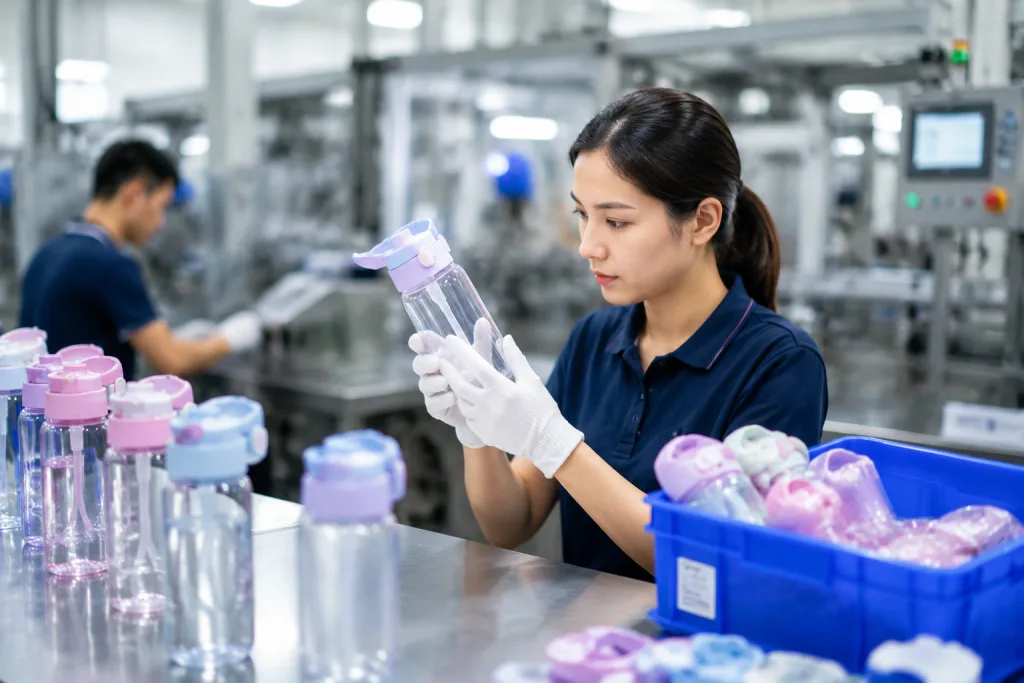
Toddler bottles sell on color and artwork, but decoration is where 6 out of 10 custom drinkware projects start losing margin. The usual methods are silkscreen printing, heat transfer, water transfer, pad printing, laser engraving for stainless steel, and full-wrap digital printing on selected shapes. Each one has its own MOQ, screen charge, fixture cost, and wash result. QC sees this on the line: a cute bear print passes visual check, then the 3M tape test pulls ink from the curve near the grip.
For a simple one-color logo, silkscreen is normally the cleanest option. On a cylindrical plastic body, we run a practical artwork height limit, and registration tolerance is around ±1 mm when the jig is locked properly. Small detail matters. For cartoon-style retail artwork, heat transfer gives better color detail, but we still ask for abrasion and dishwasher checks before mass production; the buyer flagged one sample last year because the pink cheek faded after 20 dishwasher cycles. On stainless steel toddler bottles, laser engraving lasts, but it is not colorful. Powder coating plus silkscreen has better shelf pull, but the math doesn't work if the order is only 1,000 pcs and the buyer wants 4 print colors.
Factory-direct pricing looks attractive until the decoration sheet is filled in. A plain bottle may quote at USD 1.85 FOB, while a customized canteen style toddler bottle with full-wrap print, color lid, silicone bumper, and retail box may land at USD 2.65-3.40 FOB depending on MOQ. If you are comparing canteen suppliers, make sure each quote uses the same decoration method, color count, artwork position, and packaging. We have seen this go sideways when a PO says “full print” but the supplier quoted a 60 mm front logo only.
For Zhejiang production, our normal sample lead time is 7-10 days for existing mold logo samples and 18-25 days if a new silicone sleeve or special lid color is required. BottleForge Industrial can run about 450,000 drinkware units per month across stainless, plastic, and glass lines, but decoration capacity still needs a slot before peak season. We ship more smoothly when artwork is approved 12 days before assembly; 3 days before assembly means the print line waits, and nobody likes paying workers to stand beside a UV dryer with no sheets to run.
Safety Line: Testing Before Deposit
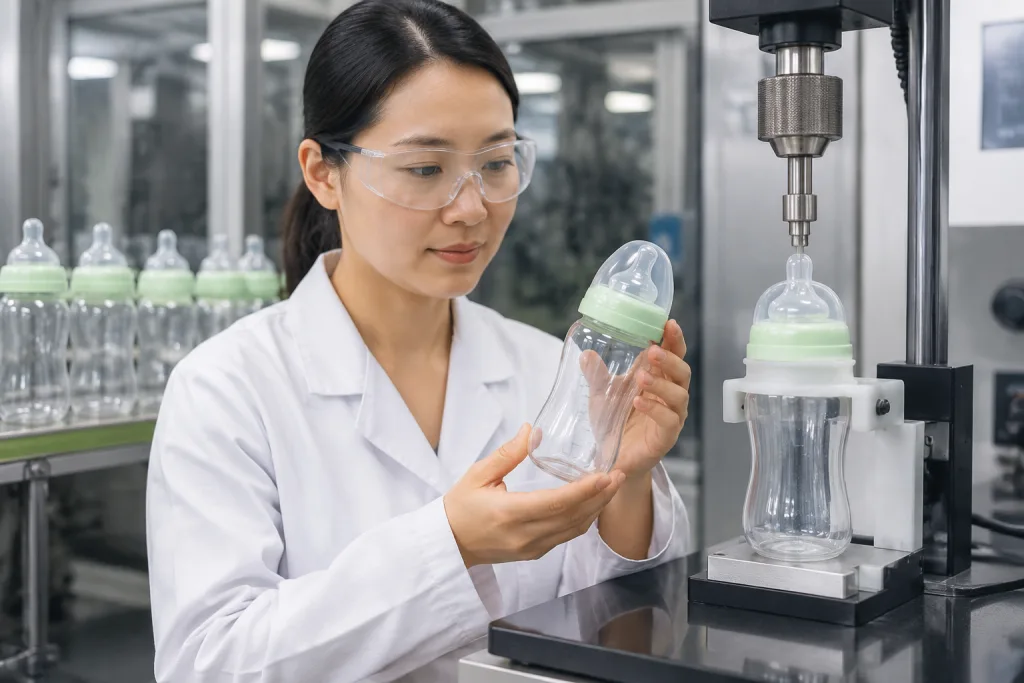
Testing is not a final-inspection checkbox. For a toddler bottle factory direct order with any child-facing claim, we run lab checks before mass production and before the deposit clears where the material is not locked. We have seen this go sideways: one silicone straw compound failed a phthalate screen after the mold trial, and changing the straw meant 9 days lost, not 2. The math does not work if pigment, PP resin, or a printed coating fails after the line has already started.
For North America, buyers usually ask for FDA food-contact documentation, CPSIA lead and phthalate checks when children’s product rules apply, and ASTM F963-related mechanical or chemical review based on product classification. For Europe, we see LFGB, REACH/SVHC, and sometimes EN 14350 on the PO. The exact standard depends on the age claim, drinking mechanism, and whether the bottle is sold as a feeding product or general drinkware. Do not let a canteen manufacturer guess. Send the target market, Amazon or retail channel, and claimed age range at RFQ stage; last month QC pulled one sample because the PO said “3+” while the artwork file said “6M+”.
Physical safety needs the same discipline. Check small parts risk with a small-parts cylinder, strap strength on a pull gauge, lid hinge fatigue, straw bite resistance, sharp edges after molding, and cap opening force. A toddler product should not need adult hand strength. The lid also cannot pop open after a 1 m drop. We usually validate with 1,000 open-close cycles, three drops at 1 m on filled samples, and dishwasher simulation if you claim dishwasher safe; one buyer flagged a 38 N opening force because their preschool tester could not open the cap.
For AQL inspection, about 70% of our B2B buyers use General Inspection Level II with AQL 2.5 for major defects and 4.0 for minor defects. Critical defects should be zero. No foreign matter inside, no sharp flash, no broken straw valve, no obvious contamination, and no packaging mislabeling for child age warnings. On the line, our inspector uses a 600-lumen light and checks the straw bore; a single black speck inside the valve is not a “minor cosmetic issue” on toddler drinkware.
Packaging Line: Retail And Logistics
Packaging has two jobs: sell the bottle and survive the route. For toddler bottles headed to retail, the carton and label need capacity, material, age grade, cleaning steps, choking warning if the cap or straw part triggers it, barcode, country of origin, and importer details when the buyer’s market asks for them. QC checks this against the approved AI file on the light table before mass packing. A distributor growler or adult custom growler can pass with a plain kraft box. Toddler SKUs need stricter label control; we have seen shipments held because “6M+” was missing on one side panel.
For factory-direct orders from Zhejiang, China, we run polybag plus egg-crate, white box, color box, window box, or PDQ display. A color box adds roughly USD 0.12-0.35 per piece depending on size, paper gauge, finish, and print coverage; on a 5,000 pcs order, that is not a rounding error. Window boxes look sharp on shelf, but the front film area crushes first if the board is too soft. The math doesn't work if the buyer wants a premium window box and then asks us to use thin board to save USD 0.04. We normally test 350 g or 400 g paperboard for small bottles, stack 6 master cartons high near the packing line, then adjust after the corner-compression check.
Carton specs should show quantity, gross weight, net weight, carton dimensions, carton burst strength, and drop-test requirement. For export drinkware, a 5-ply master carton is safer for heavy stainless models; we use it when one carton passes 14 kg gross weight. For plastic toddler bottles, 3-ply can work if the inner tray supports the lid and straw area, not just the bottle body. QC pulled the sample last month after a 90 cm drop test because the straw cap rubbed through the polybag. If you ship to Amazon FBA or a 3PL, add FNSKU labeling, carton label placement, suffocation warning for polybags over the threshold size, and palletization rules before we print the first carton mark.
Do not leave packaging until the end. MOQ for custom color boxes can be 1,000-3,000 pcs, and misprinted boxes delay finished goods even when bottles are ready. We have had bottles packed and waiting 12 days vs 18 days only because the PO had one typo in the Pantone code. For canteen distributors and promotional buyers, artwork approval is often the slowest part of the project. Send dielines early.
Commercial Line: MOQ, Price, Lead Time
The commercial line is where factory direct either saves your program or exposes bad planning. Better control is fair to expect: logo position, Pantone matching, carton marks, PP sample sign-off. Mass-production pricing on 200 fully customized toddler bottles is the wrong question to ask. Last month a buyer sent a PO with “matte pink” in the item line and “gloss pink” in the carton mark column; QC pulled the sample before the line opened, but that typo still cost 2 days.
For existing molds, a realistic MOQ is 1,000 pcs per color for simple logo work, 3,000 pcs for custom body color, and 5,000-10,000 pcs when you need a new lid color, special straw compound, or dedicated packaging run. New mold development can range from USD 2,500 for a simple plastic component to USD 12,000 or more for a full toddler bottle set with body, lid, button, straw parts, and sleeve. Tooling time is normally 25-45 days after 3D approval. We check the first T0 samples with a digital caliper at the thread, latch, and straw hole; a 0.20 mm miss on the lid seal is enough to fail leak testing.
FOB prices vary widely. A basic plastic toddler bottle may sit around USD 1.50-2.30 FOB China at volume. A stainless insulated toddler bottle with powder coating, handle lid, silicone straw, and color box may run USD 3.20-5.80 FOB depending on capacity and finish. If a quotation is 18-25% lower than the market, check what is missing: test costs, 0.4 mm thinner steel, cheaper resin, 5-layer carton downgraded to 3-layer, or decoration priced as “extra.” The math does not work forever. We have seen a low quote turn into a rejected shipment after the drop test crushed 14 cartons on the corner.
Payment terms are usually 30% deposit and 70% before shipment for new buyers. Production lead time is commonly 30-45 days after approved pre-production sample; a clean repeat order might ship in 32 days, while a new color with revised artwork can stretch to 48 days. For repeat distributor canteen orders, we can discuss 90-day rolling forecasts, reserved 304 stainless coils, and split shipments by SKU. That is where a long-term canteen vendor relationship beats one-off price hunting, because the line can book material before your next promotion date is already on fire.
Send Your Toddler Bottle Spec For Factory Review
Share capacity, market, artwork, MOQ, and packaging needs. Our Zhejiang export team will check feasibility, price drivers, and lead time honestly.
Frequently asked questions
What MOQ should I expect for toddler bottle factory direct orders?
For an existing mold, expect 1,000 pcs per color for a simple logo order and 3,000 pcs if you need custom body or lid colors. If you need a new silicone sleeve, special straw color, or retail color box, the practical MOQ often moves to 3,000-5,000 pcs because material suppliers and printing factories have their own minimums. For a fully new design, tooling may require 5,000-10,000 pcs to make the economics sensible. Very small trial orders are possible only when you accept stock colors, simple logo decoration, and standard export packaging.
Can you make toddler bottles as part of a broader canteen custom program?
Yes. Many buyers combine toddler bottles with adult sports bottles, custom canteen models, travel tumblers, or a customized growler range so the brand language stays consistent. The practical limit is not design; it is production scheduling and packaging control. If you want one canteen customized family across several SKUs, lock the color standard with Pantone codes, confirm logo placement per mold, and approve one packaging hierarchy. A mixed program may use different MOQs: 1,000 pcs for toddler bottles, 2,000 pcs for sports bottles, and higher quantities for powder-coated stainless items.
How do I compare quotes from canteen manufacturers fairly?
Put every supplier quote into the same spec table. Compare material grade, capacity measured to usable fill line, wall thickness, lid type, straw material, decoration method, packaging, testing cost, carton quantity, FOB port, and lead time. A canteen supplier quoting USD 2.10 may be more expensive than one quoting USD 2.35 if the first excludes color box, FDA testing, or spare gaskets. Ask each canteen manufacturer to state AQL level, sample cost, mold ownership, and whether the price is valid for 30 or 60 days. Resin and stainless prices can move quickly in China.
Are toddler bottles suitable for promotional campaigns?
They can be, but toddler products need stricter control than ordinary canteen promotional items. If the campaign targets families, schools, pediatric clinics, or children’s retail, budget for proper testing and warning labels. A promotional adult bottle can sometimes ship with a basic logo and polybag; a toddler bottle should have clear age guidance, cleaning instructions, and food-contact documentation. For a 2,000-5,000 pcs campaign, choose an existing mold, one-color logo, and standard carton packing if timing is tight. If you need a fully customized canteen look with cartoon artwork, allow 45-60 days including sample approval.
What should a distributor check before placing the first order?
A canteen distributor should approve a golden sample, packaging dieline, test plan, carton mark, barcode, and spare parts policy before deposit. Check whether the factory can support repeat orders with the same resin, Pantone color, and lid components for at least 12 months. Ask for photos or video of the production line, not just showroom images. For the first order, use pre-shipment inspection under AQL General Level II, with critical defects set at zero. If the order ships to Europe or North America, confirm importer labeling and compliance documents before final balance payment.