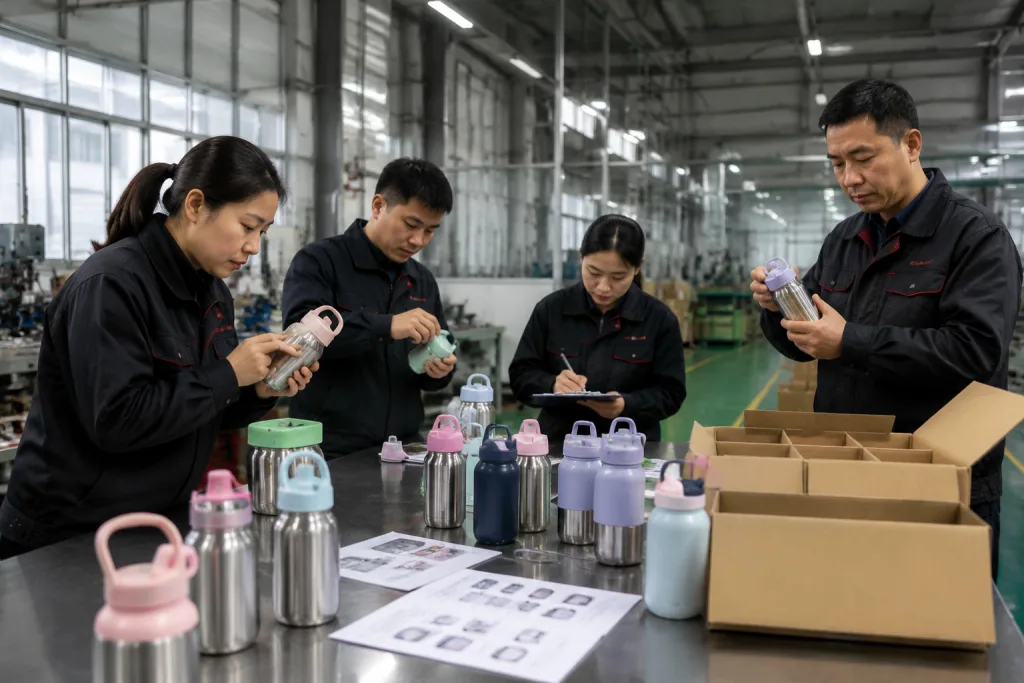
Key Takeaways
- Start RFQs with capacity, material grade, lid design, decoration, and target MOQ such as 1,000-3,000 units per SKU
- For toddler bottles, confirm FDA/LFGB, CPSIA, ASTM, REACH, and small-parts risk before approving samples
- AQL inspection should include leak testing, lid torque, printing adhesion, sharp edges, and carton drop checks
- A realistic custom toddler bottle timeline is 7-10 days for samples and 30-45 days for bulk after approval
Toddler bottle distributors carry more risk than standard custom drinkware buyers. You are not buying a cute bottle with a logo. You are buying child-contact drinkware that parents twist, shake, smell, and drop before they trust it; retailers can reject a full pallet over one leaking lid. We have seen a 55 Shore A silicone straw approved on the sample, then changed to 65 Shore A in bulk because the RFQ only said “soft silicone.” QC pulled 32 pcs from the line that day, and 7 showed seepage around the air vent after a 30-minute inverted leak test. The math doesn't work if the spec is loose.
From our factory in Hangzhou, Zhejiang, we see this problem about 6 times a month: buyers compare FOB prices before they define the bottle. Wrong question. A toddler bottle PO needs material, capacity, lid structure, test standards, MOQ, decoration, carton packing, and inspection terms locked before anyone argues over USD 0.08. We run this step by step: 304 stainless or Tritan, 240 ml or 350 ml, PP lid weight in grams, straw diameter in mm, carton drop height, AQL 2.5, then artwork tolerance. Last quarter a buyer flagged a typo on the PO, “silicon” instead of “silicone,” after the mold trial; that one cost 12 days vs the 3 days it would have taken during spec review. China can ship it efficiently, but your purchasing file has to be tighter than a normal sports bottle order.
Start With A Hard RFQ
A hard RFQ for toddler bottle distributors should read like a buyer’s PO draft, not a color board. Photos help, but photos alone do not quote a job. If we receive “small kids bottle, nice colors, logo needed,” our sales team has to guess the mold, lid, coating, logo size, and carton pack. The first price will look low, then tooling, printing, or test charges appear later. We have seen this go sideways. Last month QC pulled a 350 ml straw-bottle sample because the buyer’s photo showed a carry loop, but the RFQ never said loop required; that mistake burned 12 days before sampling even started.
Your RFQ should state the sell channel. Retail shelf work is not the same as a daycare program, subscription box, or canteen promotional order. If your customer is a supermarket chain in Germany, we will ask about LFGB and REACH before we cut the PI. If it is a US toddler product, we will ask about CPSIA, ASTM F963 small-parts concerns, and FDA food-contact material. If it is a promo campaign, the line will check logo rub resistance, delivery date, and carton marking first. A buyer once flagged “no barcode on inner box” after mass packing; the math does not work when 3,000 boxes need relabeling by hand.
For the first PO line preview, write the commercial details in one clean line: item name and capacity; steel grade and plastic parts; lid type; color split by quantity; decoration size and position; packaging; test requirement; incoterm; delivery window. Example: “Toddler stainless steel straw bottle, 350 ml, 304 inner and outer, PP lid, food-grade silicone straw, 3 colors, 1-color silkscreen, kraft box, FDA + CPSIA, FOB Ningbo, 3,000 pcs.” That line lets a canteen manufacturer quote with fewer assumptions. Simple works. Our merchandiser will paste it into the cost sheet, then production checks mold code, straw length in mm, and whether the logo fits the curved body without distortion.
At BottleForge Industrial in Zhejiang, our normal MOQ for a custom canteen or toddler bottle with existing mold is 1,000 units per color, with better pricing at 3,000-5,000 units. Monthly capacity is about 450,000 stainless drinkware units across sports bottle, travel tumbler, kids bottle, and customized canteen orders. Those numbers matter because toddler bottle distributors usually need repeatable supply, not a one-time cheap quote. On the factory floor, we run capacity by mold set and coating line, not by catalog photo; if a PO says “blue” but no Pantone code, the buyer will approve one shade and the line may spray another.
Define The Toddler-Safe Build
Before asking a canteen factory for the lowest FOB price, lock the build you are willing to put in front of parents. For toddler bottles, we see five routes on RFQs: vacuum insulated 304 stainless, single-wall stainless, Tritan, PP, and glass with a silicone sleeve. For distributors, stainless is the cleaner commercial bet because a 1.2 m drop test hurts plastic hinges and glass faster, and retail buyers accept a higher shelf price. Price first is the wrong question to ask. Last month QC pulled a “cheap” sample with a solid body, then found the flip lid pin had 0.6 mm side play and the straw cap could pop off after 20 cycles.
For stainless toddler bottles, we run 304 stainless steel on both inner and outer walls, 0.4-0.5 mm wall thickness checked by digital caliper, and a silicone straw at Shore A 50-60 on the durometer. Too soft, and the straw folds when a child sucks hard. Too hard, and parents complain about the mouth feel in reviews. Lids should be PP or Tritan with food-contact certificates tied to the resin grade, not just a supplier letter. Skip tiny removable decorative parts unless your budget includes small-parts testing; we have seen a 7 mm cartoon badge fail in the choke tube before mass production.
Your PO line items at this stage should not say only “customized drinkware.” Split the spec block into bottle body and lid assembly, then list the straw, gasket, handle, paint/coating, and packaging under those drawings. On our side, one buyer once typed “silicon straw 55A” on the PO while the approved sample card said “silicone straw 50A,” and that one missing letter stopped packing for 2 days. If you want a canteen customizable for different school districts or retail accounts, define which parts can change without new testing. Logo color is easy. Lid material, straw length, or mouthpiece shape can mean another sample round and, in some markets, another lab test.
For a distributor canteen range, keep the platform tight: one 350 ml toddler bottle, one 500 ml kids bottle, and one matching adult bottle or custom growler only if the same retail buyer wants a family set. The math does not work when a first order carries 9 colors, 4 lids, and a 300 pcs MOQ per color, because the line spends more time changing powder than filling cartons. A simple platform cuts SKU noise for canteen distributors. It also lets a canteen vendor hold the same straw, gasket, and touch-up paint across repeat POs, which is where after-sales problems get cheaper.
Quote By Real PO Lines
After construction is locked, quote against real PO lines, not one blended unit price. We see 7 out of 10 first-time toddler bottle buyers compare three canteen suppliers on “USD/pc” only, then the buyer flags that Supplier A included color box, Supplier B used plain white box, Supplier C priced without lid mold charge. Wrong question. On our quoting desk, we match the PO line by line in Excel and check carton CBM with a tape measure on the sample carton before we send FOB Ningbo.
A clean quotation request should split the PO into commercial lines: base bottle with capacity and steel grade; decoration with logo size in mm; individual packaging with box paper weight; master carton with pcs/carton and gross weight; lab testing scope by market; sample cost; mold or tooling if any; spare parts ratio; freight option by port. For example, a 350 ml stainless toddler straw bottle may quote at USD 3.20-4.80 FOB Ningbo at 3,000 pcs, depending on lid complexity, coating, and logo process. A full-color heat transfer wrap can add USD 0.25-0.55 per unit. A custom color box may add USD 0.18-0.45. Independent lab testing can run USD 180-650 per report depending on market and scope. QC pulled one 350 ml sample last month where the straw was 6 mm too short; that small line item became a bulk leak complaint.
Ask the canteen manufacturer to write what is included and what is excluded. Short words matter. If the quote says “FDA passed,” ask whether it means material declaration, factory internal report, or third-party test on the exact SKU. For Europe, ask whether LFGB and REACH apply to the bottle body, powder coating, silicone straw, plastic lid. For North America, ask about FDA food-contact and CPSIA where applicable; add ASTM F963 if your bottle is sold hard as a toddler or child product. We once received a PO with “LFGB lid” typed as “LFGD lid,” and the lab booked the wrong scope until our merchandiser caught it at 9:40 p.m.
A serious canteen supplier will state payment terms, production lead time, quote validity. Common terms are 30% deposit and 70% before shipment, or before bill of lading release for established accounts. For toddler bottle distributors, we prefer to put AQL inspection terms in the quotation: AQL 2.5 major, 4.0 minor, with leak test at the line, visual inspection under a 6500K light booth, function test on the straw lid, packaging check before master cartons are sealed. We run this before loading. It prevents the 18-day argument after bulk goods are packed, when a 12-day fix would have been possible during assembly.
Sample Like You Mean It
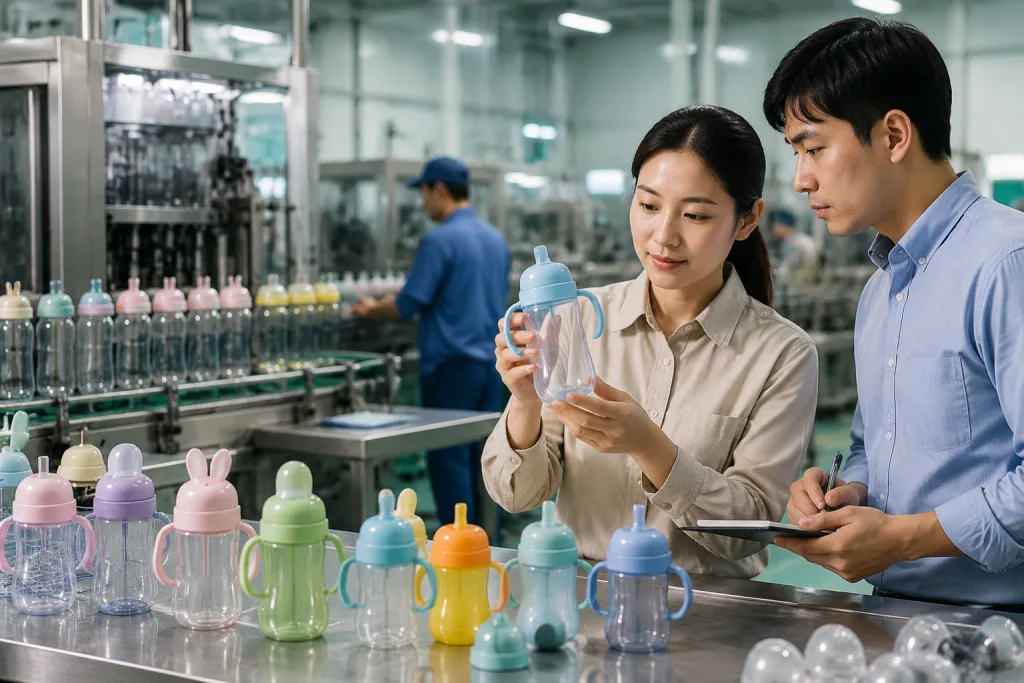
Samples are where 6 out of 10 distributor drinkware projects either get real or go quiet. Do not approve a toddler bottle sample because the shape looks right on a desk. Fill it to 380 ml, shake it upside down for 30 seconds, drop it from an 80 cm bench, run it through a wash cycle, put it in a child-size hand, then see if an adult can clean the straw with a normal brush. QC pulled one cute sample last month because milk residue stayed under a 2.2 mm lid groove. Nice photo. Bad product.
For existing molds in our Zhejiang facility, a plain structure sample normally takes 3-5 days if components are in stock. We check the lid, straw, gasket, and body against the sample room bin card before we promise that timing. A customized canteen with logo, sprayed color, or special packaging usually takes 7-10 days. If you need a new lid mold, do not plan around a normal sample schedule; tooling can add 20-35 days before the first functional sample. The math does not work if your buyer wants samples next Friday and a new flip lid.
Your sample PO should spell out every approved element, not just “same as discussed.” List the Pantone color with code, logo size in mm and exact position, decoration method, lid color, straw length, gasket color, packaging artwork file name, barcode, warning text, and carton mark. If you sell through marketplace or retailer warehouses, include FNSKU, UPC, SKU code, suffocation warning if needed, and country-of-origin marking. “Made in China” should not be an afterthought; give it a defined location on the box or product label. We once saw a PO typed as “Panton 186C,” and the buyer flagged the red after the sprayed sample was already done.
For logo work, choose the method based on use, not taste. Laser engraving holds up on stainless but gives you no color pop. Silkscreen is economical for simple logos, usually good from 1,000 pcs. Heat transfer supports full artwork, but we still run adhesion checks on powder coating before bulk. UV print can look sharp on a straight wall, then fail around curved toddler handles after rubbing. We have seen this go sideways. A canteen custom project for kids should pass tape adhesion and rub testing before bulk, so we normally use 3M tape cross-hatch checks and 95% alcohol rub tests during sample review for printed surfaces.
Approve Tests Before Bulk
Do not release bulk just because the sales sample looks fine on a desk. For toddler bottle distributors, your approval pack should include signed sample photos, final specification sheet, artwork file, packaging dieline, test plan, inspection checklist, and PO. We run into trouble when even 1 file is missing; the line still moves, and the merchandiser fills the gap from memory. Last April, QC pulled a lid sample with a 0.8 mm gasket gap because the PO said “same as sample” but the signed photo showed an older lid. Assumptions cost money in China manufacturing.
Use pre-production samples if the order is large, the retailer is strict, or the lid is new. A pre-production sample uses bulk-intended materials, coating, printing, and packing, so it tells you more than a hand-made sample from the sample room. For a 5,000-10,000 pcs order, spending another 5-7 days on a pre-production sample is usually cheaper than reworking 300 cartons. The math doesn't work the other way. We have seen one soft-touch coating pass a showroom sample, then fail tape testing on bulk bottles after 24 hours because the oven setting was 145°C instead of 160°C.
Your bulk PO line items should leave no room for guessing. Include item code, product name, capacity, material, color, logo method, packaging, carton quantity, total quantity, unit price, total amount, incoterm, port, requested ship date, inspection standard, and document requirement. If you buy as a canteen distributor for multiple accounts, split each color and logo as a separate PO line; QC can then count shortages by SKU instead of arguing over a mixed carton. We had one buyer flag a PO typo where “pink 350 ml” became “pink 530 ml,” and catching it before carton marking saved 42 cartons from relabeling.
For compliance, define who pays for which test and when the test sample is pulled. Some buyers accept supplier-provided reports for repeat standard materials. Others require third-party testing from bulk production. For toddler bottles, we advise at least material-level documentation before deposit and SKU-level third-party testing for new markets or major retailers. Not glamorous. It protects you when a retailer asks for documents three months after delivery, and it also tells our warehouse team which sealed sample bag to send, not the loose bottle sitting beside the torque tester.
A reliable canteen manufacturer will not resist clear testing. We may push back on duplicate tests that add USD 280 per SKU without changing risk, but written standards make the job cleaner for both sides. We ship faster when the test plan says whether the bottle is for toddlers, kids, promotional gifting, or general custom drinkware. Without that line, the buyer flagged it late, the lab asked for a new sample, and the ship date slipped from 12 days to 18 days.
Control Packing And Shipment
Packing is not decoration for toddler bottle distributors. It is damage control, compliance space, and warehouse cost in one line item. A canteen promo buyer might approve a plain white box with a side sticker, but a retail distributor usually asks for color box artwork, EAN or UPC barcode, warning language, age grading, recycling marks, and multilingual instruction sheets. If we ship to Amazon FBA or a 3PL, the buyer will flag carton weight over 15 kg, missing FNSKU labels, weak carton labels, or pallet height over their rule before they complain about the bottle itself. We see it on the line.
Lock inner packing and master packing before bulk starts. For a 350 ml toddler stainless bottle, we often run 1 pc/polybag or tissue wrap, 1 pc/color box, 24 pcs/master carton. Carton size may land around 52 x 36 x 42 cm depending on the handle and box structure, with gross weight around 9-12 kg. If the bottle has a protruding handle or straw cap, we normally add a pulp tray or EPE insert after QC pulled 8 scuffed lids from one trial carton in a 1.2 m drop test. Cheap packing is the wrong place to save USD 0.06.
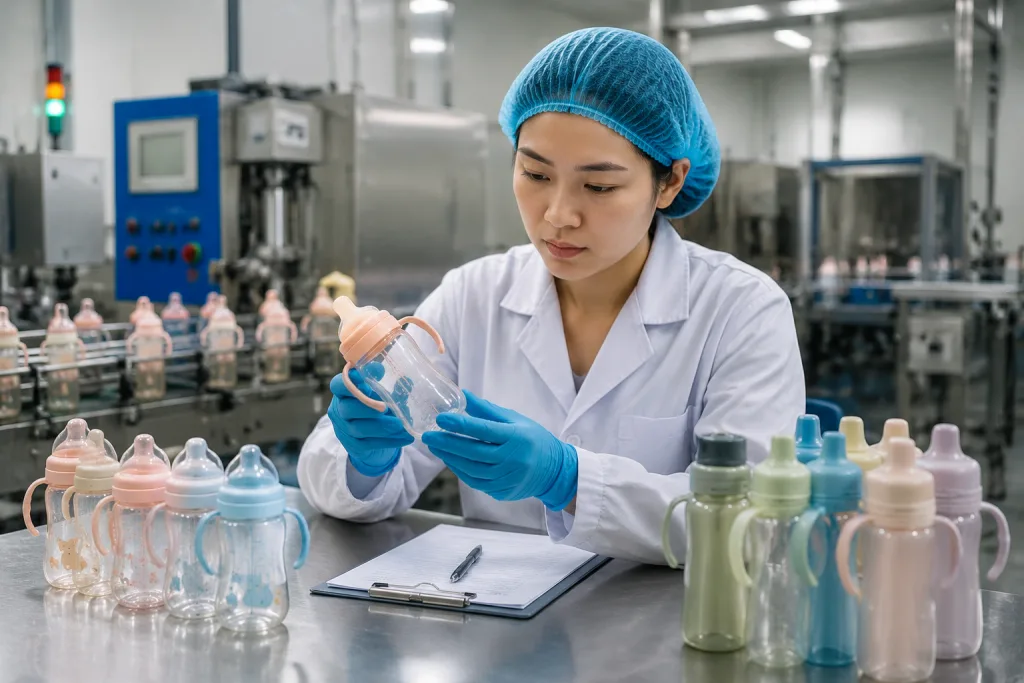
For final inspection, use AQL rather than writing “check quality” on the PO. Our practical checklist covers capacity verification with a 500 ml measuring cylinder, vacuum insulation where applicable, leak test, straw suction, lid open/close cycle, gasket fit, logo position, coating defects, odor, sharp edges, barcode scan, carton mark, and drop test. For vacuum bottles, we use hot water retention spot checks with a probe thermometer; for toddler straw bottles, leak performance matters more than a 12-hour heat claim. We have seen this go sideways when a buyer approved the cup body but forgot to test the silicone straw after sterilizing at 100°C.
Shipping terms should match how much control you want. FOB Ningbo or Shanghai works well if your forwarder already handles drinkware and knows the HS code, carton marks, and booking cut-off. CIF can work for smaller buyers, but check destination charges before you approve it; DDP is easy for a 300 pcs trial order, then the math stops working once orders move to 3,000 pcs. From Zhejiang, trucking to Ningbo port is efficient, often 1-2 days depending on loading schedule, and our warehouse team checks the loading photo against the packing list because one PO typo, “24ctns” instead of “240ctns,” can delay the customs file. Standard bulk lead time is 30-45 days after sample approval and deposit; peak season orders before September should be booked earlier.
Build A Repeatable Distributor Program
Good toddler bottle distributors don’t rebuild the program on every PO. We run smoother when the range has fixed parts: 2 core molds, approved 304 stainless, one lid thread, repeat powder-coat colors, and decoration rules that fit the pad-printing jig. That is how you cut late shipments and protect margin. A canteen vendor can support you better when the product family has structure; we’ve seen this go sideways when a buyer changes the straw angle after QC pulled the sample.
For the first range, don’t chase 6 capacities. Start with one toddler bottle at 300-350 ml, one kids bottle at 450-500 ml, and one adult bottle or customizable growler only if retailers ask for family merchandising. Simple sells. If you also carry outdoor or school products, a distributor growler or customized growler can share the same logo size and color tone, but keep it out of the toddler compliance file. Child-contact items need separate FDA/LFGB documents, silicone test reports, and carton labels checked against the PO.
Use annual forecast bands, not “we will have big volume.” A canteen factory can plan stainless steel sheet, lids, silicone parts, and spray line time if you give numbers like 3,000 pcs initial order, 2,000 pcs replenishment every 60 days, and 20,000 pcs annual estimate. You may not be legally committing to all of it. Fair enough. It still tells the canteen suppliers whether to reserve 0.5 mm sheet and lid inventory or quote spot production with 12 days vs 18 days lead time.
Decide early what customization you will offer downstream. If every small customer can ask for a new Pantone color, logo position, straw color, and box design, the math doesn’t work. Your team will spend more time chasing 1 typo on a PO than shipping cartons. A better distributor drinkware model is controlled customization: 4 standard bottle colors with approved chips, 2 lid colors matched by Delta E reading, 2 logo methods, and one optional retail box. Customers still get choice without turning your warehouse into a sample room.
China manufacturing rewards clear files. Zhejiang factories move fast, but speed depends on locked specifications, artwork approved within 24 hours, and inspection terms agreed before deposit. If you want a canteen customized for each retail account, build the sourcing file first: BOM, logo drawing, color code, carton mark, MOQ, and AQL 2.5 standard if that is your buying rule. The factory can then quote, sample, produce, inspect, and ship without guessing missing details on your behalf.
Send Your Toddler Bottle RFQ For Review
Share capacity, material, logo, market, MOQ, and delivery date. We will return a practical quote with sample and bulk steps.
Frequently asked questions
What MOQ should toddler bottle distributors expect for custom orders?
For existing molds, a realistic MOQ is usually 1,000 pcs per color or logo design. At 3,000 pcs, FOB pricing becomes more stable because printing setup, spray line changeover, and carton production are spread across more units. For a fully custom lid or new bottle shape, MOQ can rise to 5,000-10,000 pcs because tooling, material purchasing, and engineering time are higher. If you are testing a new market, ask your canteen manufacturer for a pilot run using an existing mold, then reserve custom tooling for proven SKUs.
Which material is best for toddler bottles sold in Europe and North America?
304 stainless steel with a PP or Tritan lid and food-grade silicone straw is the most common B2B choice. It is durable, has good retail value, and is easier to position as premium custom drinkware. For Europe, confirm LFGB and REACH requirements for food-contact parts, coating, and plastic components. For North America, confirm FDA food-contact compliance and CPSIA where the item is marketed for children. Tritan bottles can work, but scratch and odor complaints are more likely after heavy use. Glass is attractive but risky for toddler channels unless the retailer specifically wants it.
How long does sampling and bulk production take from China?
For an existing toddler bottle mold, plain samples usually take 3-5 days, while logo and color samples take 7-10 days. Bulk production normally takes 30-45 days after sample approval and deposit. Add 5-7 days if you require a pre-production sample before mass production. New lid or body tooling can add 20-35 days before a functional sample is ready. From Zhejiang, shipment through Ningbo or Shanghai is common, with trucking to port usually arranged within 1-2 days after goods pass inspection.
What should be included in a toddler bottle inspection checklist?
Use AQL inspection, commonly AQL 2.5 major and 4.0 minor, unless your retailer requires stricter terms. The checklist should include capacity, material marking, lid fit, gasket fit, straw suction, leak test, odor, sharp edges, coating defects, logo position, print adhesion, barcode scan, carton quantity, and carton drop condition. For vacuum stainless bottles, add insulation checks with hot water. For toddler straw bottles, leak testing is more important than exaggerated heat-retention claims. Ask the inspector to photograph defects by SKU and carton number so claims can be handled quickly.
Can one factory handle toddler bottles, canteens, and growlers?
Yes, if the factory has the right production range, but you should separate the compliance files. A canteen factory may produce toddler bottles, custom canteen programs, sports bottles, travel tumblers, and customized growler SKUs on related lines. The commercial benefit is shared materials, color matching, and consolidated shipments. The risk is assuming all products follow the same standard. Toddler bottles need child-contact review, small-parts attention, and stricter lid checks. Adult canteen customizable or distributor growler products may not need the same test scope, so keep specifications and reports organized by item code.