Key Takeaways
- For toddler bottle programs, expect a practical MOQ of 1,000-3,000 pcs per color for factory-direct customization
- Food-contact files should cover LFGB or FDA, plus EN 14350/ASTM F963 where age claims require them
- A 304 stainless body at 0.45-0.55 mm wall thickness is a safer distributor choice than ultra-thin promotional specs
- Logo method, lid tooling, color matching, and retail packaging usually add 10-25 days before mass production
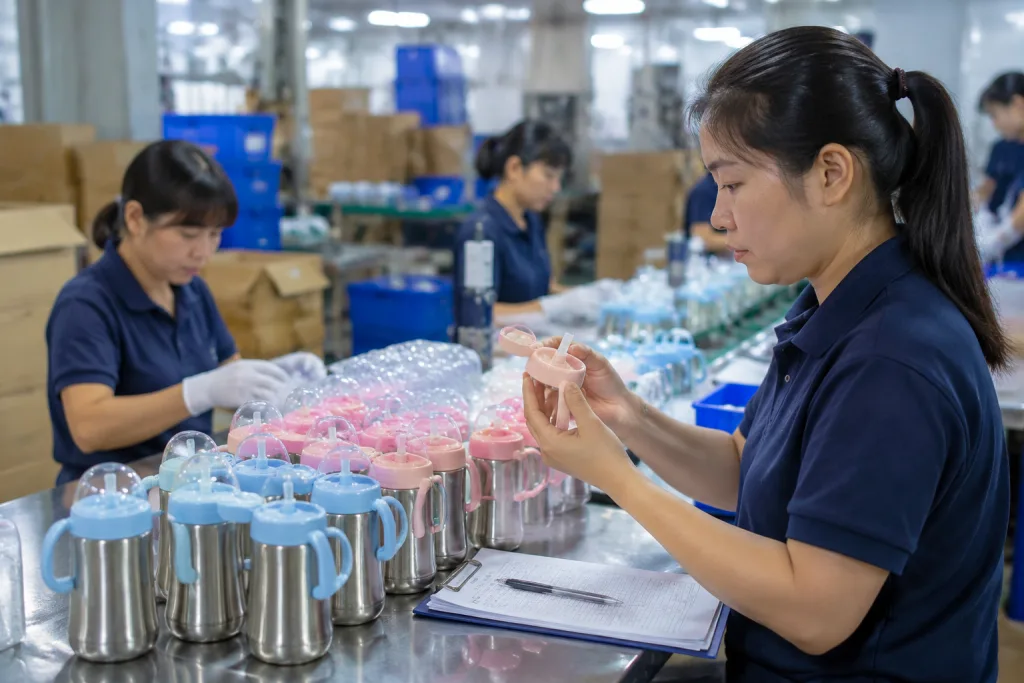
If you distribute toddler bottles, the hard part is not picking a cute shape. Parents will throw that bottle into a backpack, a lunch bag, a stroller cup holder, and a dishwasher 200 times. A low unit price looks fine on the buyer sheet until QC pulled the sample and found 3 leaks in 20 lids after the shake test, or the silicone straw split at the bite line.
From our factory base in Zhejiang, China, we see this on repeat. A buyer asks us for a canteen with a bright logo, then the line stops on the real questions: 304 stainless or plastic, cap thread fit in mm, EN14350 or FDA test file, 1,000 pcs MOQ, and color box drop-test results. Ask the material and cap questions first. Otherwise the math doesn't work, and custom drinkware turns into rework instead of a clean B2B order.
Start With The Selling Channel
Decide the selling channel before you talk about artwork. A supermarket chain and a school supply wholesaler buy different toddler bottles, even at the same 350 ml size. Promotional bundles and online marketplace listings need different specs too. We see this go sideways when a distributor sends one nice rendering and asks for “best price”; our quotation engineer then has to guess the carton style, barcode position, and drop-test standard from a JPG.
For retail shelves, buyers usually ask for a fixed color range, EAN barcode labels, warning text, hang tags, and carton markings that match their receiving rules. One German retailer rejected a master carton because the PO said “12 pcs/ctn” but the artwork file showed “24 pcs/ctn.” Small typo. Big delay. For online distribution, damage rate and review risk matter more than shelf blocking. A bottle can pass a 76 cm carton drop test and still lose money if the powder coat arrives scratched; QC pulled 8 scratched samples from a 50 pc pilot run last spring, and the buyer flagged it before shipment. For canteen promotional orders, logo size and lead time sit near the top, but toddler products still need proper food-contact documents.
We ask new distributor drinkware buyers four questions before quoting: target country, age range, sales channel, and target landed cost. If the target age is under 3 years, we check the lid, straw, small parts, and warning label first, not the logo mockup. The math does not work if you save USD 0.08 on a lid and fail a pull test on the silicone straw. For kids bottle items marked 3+ years, compliance is still serious, but the lid structure and label wording often give us more room. On our line, a 0.3 mm gap around the flip button is enough for QC to stop a sample.
A canteen supplier in China can quote almost anything if you send only a photo. That quote is not usable. A proper RFQ says: 350 ml toddler stainless bottle, 304 inner and outer, flip straw lid, silicone sleeve, 2-color logo, EU market, individual color box, FOB Ningbo. Add expected order quantity too; 1,000 pcs and 10,000 pcs do not run the same way on the printing jig. With that detail, canteen manufacturers quote the same bottle instead of filling in the blanks with cheaper lids, thinner sleeves, or a carton the buyer never approved.
Choose Materials Before Shapes
Material choice sets your FOB, carton weight, safety file workload, and after-sales noise. For toddler bottles, we usually quote 304 stainless steel, Tritan-type plastic, PP, silicone, or borosilicate glass with a protective sleeve. On our Hangzhou line, QC pulled 12 mixed-material samples last month and 3 failed first check because the cap gasket spec on the PO said “silicon” instead of “silicone.” Small typo. Big delay.
For a rugged everyday toddler bottle, 304 stainless steel is the safer B2B call. A practical body wall thickness is 0.45-0.55 mm for small insulated bottles; we check it with a digital thickness gauge before polishing. Go too thin and dent complaints rise after one school term. Go too thick and the bottle feels heavy for a two-year-old. For vacuum insulated models, 300-400 ml works better; 500 ml looks nice in a catalog, but the math doesn’t work once a child carries it filled.
Plastic bottles cut FOB cost and weight, but they bring tougher questions on odor, staining, scratch marks, and regional regulations. If you use plastic, ask the canteen manufacturer for resin traceability, BPA-free declaration, and applicable FDA or LFGB reports. For Europe, REACH and food-contact migration reports matter. For the United States, FDA food-contact compliance and CPSIA-related requirements may apply depending on age positioning. We’ve had buyers flag a 0.18 USD resin price saving, then lose 12 days vs 18 days waiting for the correct migration report.
Glass toddler bottles look good for premium parents, but they are less forgiving for mass distribution. They need a sleeve, stronger packaging, and clear breakage warnings printed where parents will see them. In drop testing, our QC team uses a 1.2 m height and checks the sleeve edge after impact; if the glass shifts inside the sleeve, we reject it. A custom growler or customized growler program can accept heavier glass because adult users expect weight. Toddler bottles cannot.
Do not choose a shape because the rendering looks modern. This is the wrong question to ask first. Ask the canteen factory for real samples, filled weight, cap torque, straw hardness, and dishwasher guidance, then have someone on the line open and close 20 pieces with wet hands. A beautiful bottle that a parent cannot clean properly is a weak product.
Lid Design Is The Risk Center
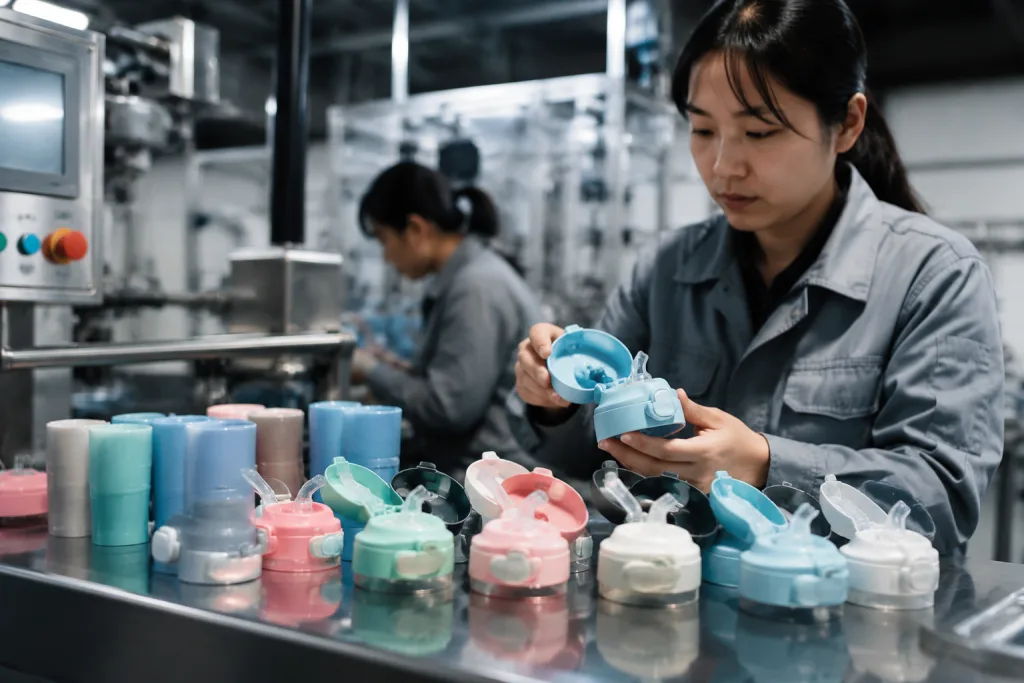
The bottle body gets the buyer’s first look, but the lid causes most after-sales claims. We see leaks at the air vent, torn straws after bite testing, cracked hinge ears, trapped water after dishwasher cycles, and missing silicone rings from carton repacking. Last April, QC pulled 32 samples from a 3,000 pcs pre-shipment lot and found 5 caps with weak button return. Spend more time on the cap drawing than the bottle rendering. This is where toddler bottle orders go sideways.
A flip straw lid sells well because toddlers drink without tilting the bottle. The price is complexity: push button with return spring, hinge pin with 0.05 mm play control, straw seat with air vent, silicone seal, and sometimes a dust cover that must snap shut after 500 open-close cycles. We run the hinge test on a simple fixture, not a fancy lab machine. A screw cap costs less and has fewer failure points, but parents complain when a 2-year-old cannot open it alone. A spout lid drinks easily, so the line must control bite resistance and flow rate, or the buyer will flag “too fast flow” in the first review batch.
For a serious customized drinkware project, ask for an exploded lid view and a material list before artwork approval. Common specs are PP lid, food-grade silicone straw, SUS304 spring, and removable seal. We also ask the tool room to mark the seal groove depth on the 2D drawing, usually around 1.2 mm depending on lid size. If a canteen vendor cannot give the straw Shore hardness, or cannot confirm whether the seal is replaceable by hand, the math does not work. You are buying future service tickets.
Leak testing belongs on the purchase order, not in a WeChat message after production starts. Our Zhejiang line uses 100% air-pressure or water-leak checks on selected bottle types, then carton-level sampling under AQL. For distributor drinkware, we recommend Critical 0, Major 2.5, Minor 4.0, with special checks for cap closure force, straw fit, logo position within ±1.5 mm, coating scratch under 600 lux light, and odor after 24 hours sealed. One buyer once typed “waterproof” instead of “leakproof” on the PO; QC stopped the sample because the test method was unclear.
Think about replacement parts before the first container ships. If you sell 20,000 units, a 1% lid issue means 200 service cases, and each case can eat USD 3 to USD 7 once you count email time and reshipment. We usually suggest 2% spare straws and 1% spare seals packed in a labeled polybag per master carton. A toddler bottle program with spare parts protects margin better than fighting for a USD 0.08 cheaper lid. The cheap lid looks good on the quote sheet; it looks bad when the distributor’s warehouse has 18 open cartons waiting for replacement caps.
Customization Has Cost Boundaries
Customizable drinkware looks flexible on a quote sheet, but every custom feature hits a cost line somewhere. Move a toddler bottle order from a stock color to a private mold and the schedule can jump from 25 days to 45-60 days, with more chances for sample rework. We run into this every month: the buyer asks for a “unique” lid, then the mold shop sends back a DFM note showing a 0.8 mm wall that will not fill cleanly. The better question is not “How custom can we make it?” The better question is how much difference your retail channel will actually pay for.
For most toddler bottle distributors, the safer first order is a stock mold with custom color, logo, and packaging. That gives shelf difference without paying for full tooling. Typical MOQ from BottleForge Industrial in Zhejiang, China is 1,000 pcs per color for logo work on selected models, 3,000 pcs for custom powder coating, and 5,000-10,000 pcs when a new lid color or component color must be molded. New private mold tooling can run from USD 3,000 to USD 15,000 depending on lid complexity. On the line, QC pulled one 350 ml sample last quarter because the buyer’s PO said “mint lid” but the artwork file named it “sage”; that small mismatch cost 2 approval days.
Logo methods include silk screen, laser engraving, heat transfer, UV print, and debossed silicone, but they are not equal in daily toddler use. Silk screen is cost-effective for 1-2 color artwork, often around USD 0.05-0.15 per position depending on size and quantity. Laser engraving is durable on stainless steel but not colorful. Heat transfer gives better gradients, then it needs cross-hatch tape testing and fingernail abrasion checks before we ship. For toddler products, decoration that flakes after 20 dishwasher cycles is a return problem, not a design detail.
Color matching needs realistic tolerance. Pantone on paper and powder coating on curved steel are not identical, and a silicone boot can look 1-2 shades darker under warehouse LED lights. A good canteen supplier should provide a pre-production sample, usually 7-12 days after artwork and deposit. If you demand exact color across stainless steel, plastic lid, silicone boot, and printed box, add approval time before mass production; we have seen this go sideways when a buyer approved the bottle body but forgot the box proof. That is how a 12-day sample round becomes 18 days.
A canteen customizable program still has to be simple enough to repeat. Distributors make money from reorder stability, not from a first order that nobody can reproduce consistently. We ship cleaner repeat orders when the spec sheet locks the Pantone code, logo size in mm, carton mark, and AQL 2.5 inspection points before deposit. Fancy is fine. Unrepeatable is expensive.
Price The Order Like A Distributor
A distributor canteen price is not the FOB unit cost on line 1. Your landed cost includes tooling, sample fees, lab tests, spare lids and straws, packaging, inland truck from Hangzhou to Ningbo, sea or air freight, duty, incoming inspection, warehouse handling, and a returns allowance. We once had a buyer flag a USD 0.18 carton saving after drop-test failures at 76 cm. The math did not work. If you compare only the first line of a quotation, you will pick the wrong canteen manufacturer sooner or later.
For reference, a 350 ml double-wall 304 stainless toddler bottle with straw lid, powder coating, one-color logo, and color box might sit around USD 3.20-5.80 FOB Ningbo or Shanghai depending on quantity, lid structure, packaging, and current steel price. On the line, we check body thickness with a digital caliper; 0.38 mm and 0.45 mm do not cost the same. A simpler single-wall plastic bottle could be below USD 2.00 FOB, but retail value and drop resistance sit in another bracket. A premium retail set with silicone boot, handle lid, spare straw, and printed gift box can move above USD 6.00.
Payment terms matter too. Common China export terms are 30% deposit and 70% before shipment, or balance against copy of bill of lading for approved buyers. FOB is clean for importers because you control the forwarder and see the local charges. DDP looks easy on a buying meeting slide, but it can hide duty, tax, and risk inside one number; we use it only when the route has shipped at least 3 times without customs noise. One PO came in with “DDU” typed in the price column, and the buyer flagged it only after booking.
Our Hangzhou-linked supply chain can support around 450,000 stainless drinkware units per month across standard bottle, tumbler, and kids lines, but capacity does not mean every SKU ships instantly. Standard production lead time is usually 30-45 days after approved pre-production sample. Add 10-20 days if third-party testing is needed before shipment. We run PP sample approval with a signed color chip and a torque check on the straw lid; if QC pulled the sample on day 12, mass production does not start on day 13.
When canteen suppliers quote far below the market, ask what changed: steel grade, wall thickness, lid material, coating process, carton strength, or inspection level. The saving is sitting somewhere. We have seen this go sideways when a quote used 201 stainless in the inner wall while the buyer expected 304 stainless; AQL 2.5 inspection found rust marks after a 24-hour salt-water check.
Compliance Files Must Match Claims
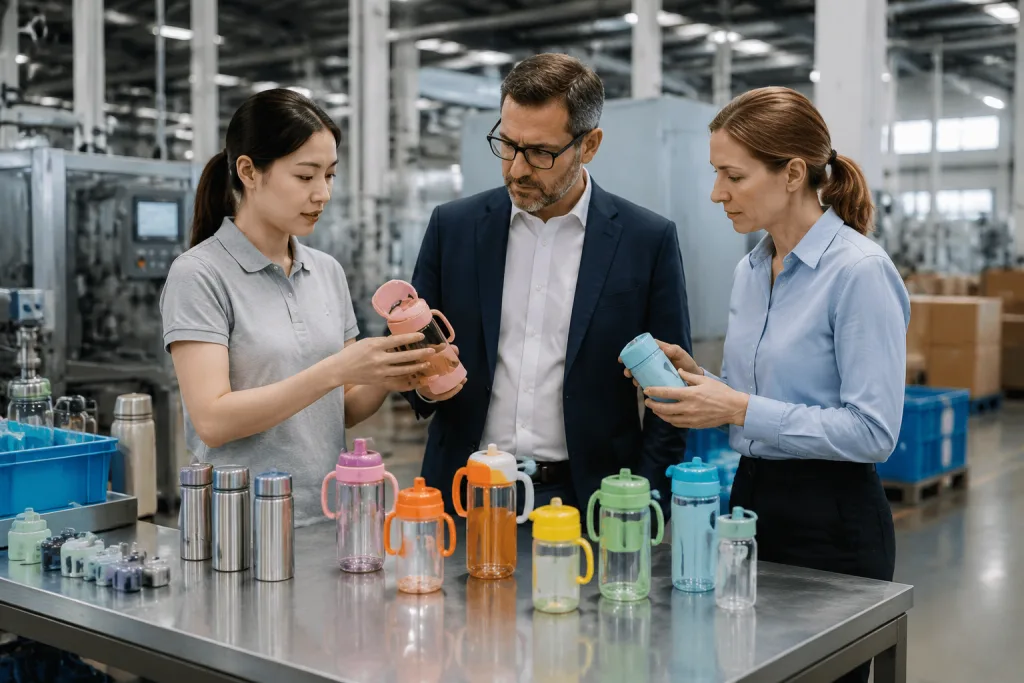
Toddler drinkware sits one step away from children’s product rules, even if the customs line calls it a bottle, not a toy. Your compliance file has to match the selling market, age claim, material spec, and the exact packaging copy. We have seen a PO say “FDA pass for kids 6M+” while the lab report covered an adult sports bottle from 2022. QC pulled it in pre-shipment. A recycled “FDA passed” report from another SKU will not get past a strict importer.
For the EU, buyers usually ask for LFGB food-contact migration, EU 1935/2004 declaration, REACH screening for the plastics or coatings used, plus packaging waste information. If the bottle is sold for young children, EN 14350 may apply for drinking equipment. For North America, expect FDA food-contact suitability, CPSIA considerations, ASTM F963 when the cap has toy-like parts, and California Proposition 65 screening if the retailer sells into California. Canada needs a closer look at bilingual labeling and importer duties; one buyer flagged a 240 ml sample because “dishwasher safe” appeared only in English on the color box.
A working file set from a canteen factory should include material declarations, accepted-lab test reports, available factory audit records, and one production batch reference tied to the lot code. We run this by SKU, not by catalog page. BSCI or ISO 9001 does not replace product testing, but it tells you whether the plant keeps records without chasing 6 people on WeChat. If your retailer asks for Sedex, BSCI, or social compliance, put it in the RFQ. After 3,000 cartons are sealed, the math does not work.
Warning labels get missed because they look like small copy. Age grading, hot liquid warnings, dishwasher limits, small parts cautions, and cleaning instructions need review before mass printing. On the line, we check the printed sleeve against a 1:1 artwork proof with a ruler because a 2 mm icon shift can hide a warning under the barcode sticker. For toddler bottles, we advise against claiming “for boiling water” unless the full lid system was designed and tested for it. Stainless bodies can take heat; small hands and plastic lids may not.
Good canteen distributors keep compliance files SKU by SKU. Boring work. It saves you from customs holds, retailer emails at 11 p.m., and a warehouse team opening 86 cartons to find the right batch sticker.
Approve Samples With Reorders In Mind
The sample approval stage is where you protect the next 3 reorders, not just the first shipment. Do not approve a prototype because the sales photo looks close. Approve a controlled pre-production sample with signed specifications: capacity tolerance in ml, empty weight in g, coating color by Pantone or sprayed panel, logo size in mm, carton layout with barcode position, lid function after 10 open-close cycles, packaging accessories counted on the packing table, and test requirements. We run this off a signed spec sheet because one buyer once approved “blue” by WhatsApp photo, then rejected 1,200 pcs under D65 light in our QC room.
For customized canteen programs, we use a 3-piece golden sample process. One approved sample stays with you, one stays with the canteen manufacturer, and one goes into the QC cabinet for the line inspector. Photos help, but a physical sample settles arguments about color, texture, thread fit, and how the lid clicks after assembly. If the order includes a custom canteen sleeve, printed straw brush, retail box, or FNSKU label, approve those pieces too. QC pulled a sleeve sample last month because the sewing edge was 2 mm wider than the approved sample, and the buyer flagged it before mass packing.
Inspection should happen before final payment and before goods leave China. A normal pre-shipment inspection checks quantity, workmanship, dimensions by caliper, coating adhesion with 3M tape, logo placement against the artwork file, barcode scan, carton drop, leak function, and packaging. For Amazon or marketplace-ready goods, FNSKU, suffocation warnings, carton weight, and master carton dimensions must match the PO. A wrong label hurts more than a small scratch; we have seen a 0.08 USD sticker mistake turn into 12 days of relabeling instead of 2 days of normal dispatch.
Reorders need the same discipline. Powder coating batches can shift by half a shade. Silicone color can drift after a new pigment lot. A lid supplier can change a small internal part without telling the export sales team, and this is where the math goes sideways. The best canteen vendors lock BOMs and notify changes before production. Ask for that promise in writing, with the lid mold number, gasket material, and supplier code listed on the reorder PI.
A toddler bottle distributor should build supplier relationships around repeatability. The first order proves the factory can make the item. The second and third orders prove whether the canteen supplier can manage the business. We ship plenty of first orders; the harder test is whether batch 2 matches batch 1 when the buyer reorders 5,000 pcs, the PO has one typo in the color code, and the line is already booked for another distributor.
Send Your Toddler Bottle RFQ For Factory Review
Share your target market, quantity, lid style, and packaging needs. We will reply with practical MOQ, FOB pricing, and compliance options.
Frequently asked questions
What MOQ should a toddler bottle distributor expect from a China factory?
For factory-direct toddler bottles in China, a realistic MOQ is 1,000 pcs per color for logo on existing stock models, 3,000 pcs per color for custom powder coating, and 5,000-10,000 pcs when plastic lid parts or silicone parts need custom color molding. Private mold projects usually start higher because the canteen factory must recover tooling and setup cost. If a supplier offers 100 pcs with full customization, it is usually a trading-stock order, not controlled mass production. That can be fine for testing, but do not assume the same price, color, or lid quality will hold for a 20,000 pc reorder.
Which material is best for toddler bottles sold in Europe or North America?
For most B2B toddler bottle programs, 304 stainless steel is the safest middle ground. It is durable, has strong retail value, and works well for insulated 300-400 ml bottles. Look for 0.45-0.55 mm body wall thickness on smaller insulated bottles, food-grade silicone for straws and seals, and PP or Tritan-type plastic where the lid requires rigid parts. Plastic bottles can be cheaper and lighter, but they need strong odor, migration, and durability checks. Glass is premium but creates breakage and packaging concerns. Match the material to your channel and ask for LFGB, FDA, REACH, or other test files before production.
How long does a customized drinkware order usually take?
A normal timeline is 7-12 days for artwork setup and pre-production sample, then 30-45 days for mass production after sample approval and deposit. Add 10-20 days if you need third-party testing before shipment. Ocean freight to Europe or North America may add another 25-45 days depending on port and season. If the order uses a new lid mold, new silicone boot, or special retail packaging, the setup stage can add 20-40 days. Buyers often lose time by approving the bottle body but forgetting the box, barcode, warning text, and carton marks.
Can I use one canteen manufacturer for toddler bottles, growlers, and promotional drinkware?
Yes, but check capability by product family. A good stainless canteen manufacturer may handle toddler bottles, sports bottles, travel tumblers, custom growler projects, and canteen promotional orders, but the quality risks are not identical. Toddler bottles need stricter lid safety, straw material checks, small-part review, and warning labels. A customized growler for adults is more about capacity, insulation, handle strength, and coating durability. Ask for monthly capacity, in-house inspection process, sample lead time, and past export markets. One supplier can simplify communication, but only if the factory has the right lines and compliance files.
What should I include in an RFQ for toddler bottle sourcing?
Send capacity, material, insulation type, lid style, target age, target market, quantity by color, logo method, packaging, test requirements, and preferred trade term such as FOB Ningbo. Include artwork files, Pantone colors, barcode or FNSKU needs, carton limits, and any retailer manual. If you need BSCI, Sedex, ISO 9001, LFGB, FDA, EN 14350, ASTM F963, or REACH documentation, say it before pricing. A clear RFQ helps canteen suppliers quote the same item and reduces later cost changes. Photos are useful references, but they are not specifications.