Key Takeaways
- Start with 1,000 units/color MOQ for stock toddler bottle custom shapes, and 5,000-10,000 units for new mold work
- For toddler bottles, lid safety and bite-valve durability matter more than saving USD 0.20 on the body
- Use FDA/LFGB food-contact materials and confirm EN 14350, REACH, CPSIA, or ASTM needs before sampling
- Plan 25-35 days for production after deposit and artwork approval, plus 7-10 days for pre-production samples
A toddler bottle custom project looks easy until the RFQ hits the costing desk. Then the soft straw needs a 55–60 Shore A silicone spec, the retailer asks for EN testing, the brand team sends five Pantone chips, and the distributor pushes back because the master carton must fit mixed-pallet delivery. Lock the decisions early. If the PO says “kids bottle, assorted colors” and nothing about straw hardness, carton size, or lid torque, the unit price will look clean and the missing details will come back during pre-production.
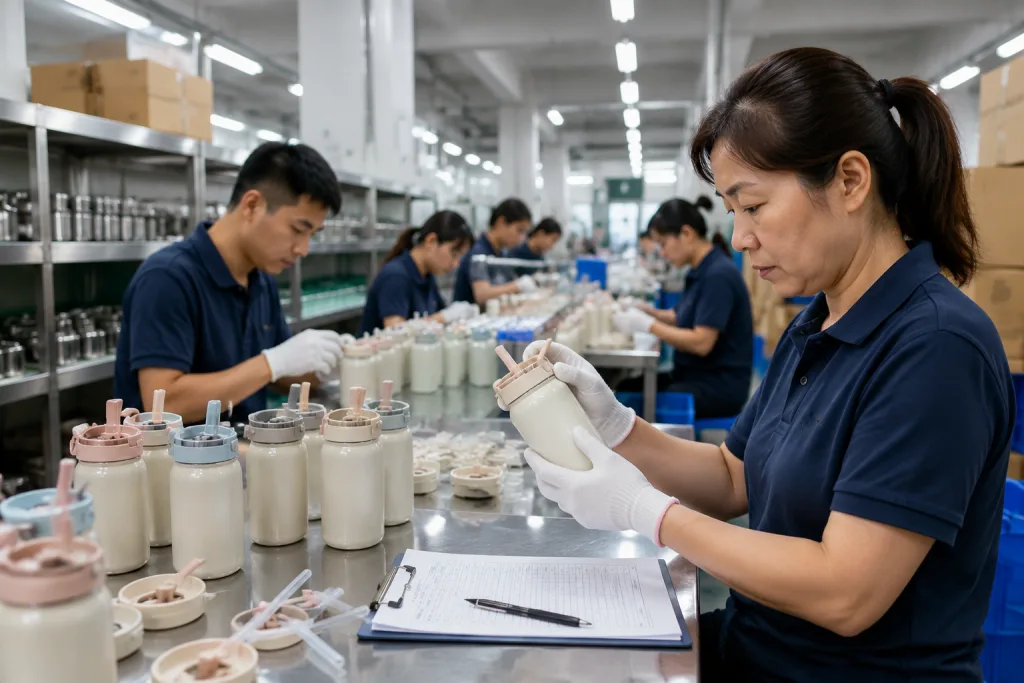
At BottleForge Industrial in Hangzhou, Zhejiang, we see this issue on about 6 of every 10 first-time kids drinkware inquiries from buyers who already sell adult bottles. Wrong starting point. Toddler bottles are not smaller sports bottles; they need bite-safe lids, rounded lip edges under 0.3 mm burr allowance, lower drop-failure rates, and packaging that survives China export handling. QC pulled a sample last month after a straw slit tore at 4.8 kg pull force, and that is the kind of small failure that delays shipment. Our current stainless kids bottle line runs up to 180,000 units/month, with practical MOQ starting at 1,000 units per color for stock-shape customization.
Start with four buying decisions
Before you ask a canteen factory in China for pricing, lock four decisions first: user age, bottle structure, compliance market, decoration method. Basic? Yes. But these four lines drive mold cost, lid tooling, carton drop-test risk, and the quote we send back from Hangzhou. Last month a PO came in with “todler botle” in the item field and no age range; our merchandiser could not even open the BOM until the buyer confirmed it.
For user age, split 12-24 months from 2-4 years. A 12-month user needs a lighter bottle, a waist that small hands can grip, and a slower-flow spout. We usually check grip diameter with a 0-150 mm digital caliper on the sample bench. A 4-year-old can handle 350-450 ml and a push-button lid, but the spring force still needs checking. If you force both groups into one SKU, the math doesn't work.
For structure, choose between single-wall stainless steel, vacuum insulated stainless steel, Tritan, PP, or glass with sleeve. Vacuum stainless costs more and adds weight; on our line, a 350 ml vacuum toddler bottle often lands 80-120 g heavier than Tritan before lid assembly. It does give a stronger retail story. Tritan is clear, so parents can see liquid level. PP keeps cost down, but buyers in Germany and Canada have pushed back on the “cheap feel” during sample review. Glass can fit a boutique shelf, but daycare use is where we’ve seen this go sideways.
For compliance, do not assume one report covers every region. A canteen supplier may have FDA food-contact data, but that does not automatically satisfy LFGB for Germany, REACH for EU chemical limits, CPSIA for the U.S. children’s market, or ASTM mechanical expectations. Tell your canteen manufacturer where the goods will sell before sampling. QC pulled one silicone straw sample for odor after a 70°C soak test; the buyer had only asked for FDA, but the shipment was headed to Hamburg.
For decoration, decide what must survive. Silkscreen works for large color logos and promo artwork, and we run it with a mesh screen and fixture pins to keep the logo within 1 mm. Laser engraving lasts, but you lose color. Heat-transfer prints can look sharp on a customized canteen, but they need abrasion testing before bulk. The wrong decoration can turn a good toddler bottle custom program into a returns problem after 30 dishwasher cycles, and no buyer wants that email from Amazon support.
Choose material by risk, not fashion
About 7 out of 10 new buyers ask for the cheapest material first. For toddler bottle custom orders, this is the wrong question to ask. Start with complaint risk. Parents usually complain about leaking lids, plastic smell, chipped coating, or cleaning parts they cannot reassemble after washing. Last month QC pulled a lid sample after the silicone straw valve sat 0.3 mm off-center; that one small miss would have looked like a “material problem” to the buyer.
304 stainless steel is our safest default for a premium toddler bottle. For vacuum bottles, we normally use 0.4-0.5 mm inner wall and 0.5-0.6 mm outer wall, depending on shape and capacity. A 350 ml vacuum toddler bottle usually lands around USD 3.20-4.80 FOB Ningbo or Shanghai for basic logo customization at 3,000 units, before special packaging. If a quote comes in at USD 2.45, the math doesn't work. Check steel grade, copper plating, lid resin, and QC level; we once found “201” typed on a supplier coil tag while the PO said 304 stainless.
Tritan works when the buyer wants to see the liquid level and keep the bottle light. We ship it for daycare packs and school promo sets where teachers want quick visual checks. Ask for BPA-free documentation and impact testing. Tritan can crack if the wall is too thin around the shoulder or if the lid thread is poorly designed. For a 400 ml Tritan bottle, 2.2-2.8 mm wall thickness around high-stress areas is more sensible than saving 6 grams of resin; our drop-test jig has exposed shoulder cracks after only 3 drops from 1.2 m.
PP is acceptable for entry-level programs, especially when a canteen distributor needs an aggressive promotional price. It scratches faster, though, and it can hold odor if the surface finish is poor. We run PP when the target is a 60-90 day campaign, not a two-year parent loyalty product. The buyer flagged this on one repeat order: after dishwasher testing at 70°C, the matte PP body showed fork-like scuff marks before the logo ink failed.
Glass is clean and easy to sell in photos, but toddler use is the weak point. If you insist on glass, use borosilicate, a silicone sleeve, and stronger carton protection. Even then, ask whether your retailers will accept the breakage liability. We have seen this go sideways: a 24 pcs master carton passed the desk review, then corner-drop testing crushed 3 inner boxes because the EPE tray was 5 mm too short. A canteen vendor may agree to make it; that does not make it the right SKU.
Lids are where programs fail
The bottle body gets the photos, but the lid decides the reorder. We have seen programs die on a 6 g silicone gasket, not on the 304 stainless shell. For toddler bottles, the lid is a small assembly: straw, bite valve, hinge, push button, vent hole, gasket, carry loop, sometimes a dust cover. Each part can leak, trap odor, fail a pull test, or raise a choking complaint. QC pulled one sample last May where the vent slit was 0.4 mm too wide; it passed the buyer’s desk check and still leaked in the carton shake test.
For 12-24 month products, keep the drinking system boring. That is meant as praise. A soft silicone straw with controlled flow beats a fast-flow sports spout for this age group. We usually run food-grade silicone at 50-60 Shore A hardness, checked with a Shore A durometer on the incoming batch, so the straw feels comfortable but does not fold shut after three bites. Ask the canteen manufacturer for the straw pull-out force in N, not just “secure enough.” If a toddler can pull it loose with two fingers, the math does not work.
For 2-4 year products, push-button lids sell well, but they add parts that love to fail. The hinge pin, spring, latch, and gasket need cycle testing, not just a quick click-click on the sample table. A decent benchmark is 3,000 open-close cycles without latch failure; on our line we log this with a simple pneumatic jig before PP sample sign-off. For drop testing, we prefer at least 1.0 m drops on six sides with the bottle filled to 90 percent capacity. Not every unit survives a kitchen-floor tantrum, but your AQL inspection should catch weak hinges and poor gasket seating before shipment.
Cleaning matters more than buyers expect. If the lid needs a tool or hides cavities, parents will find mold and blame your brand within 30 days. Adult customizable canteens can carry more lid complexity; a toddler bottle should have fewer parts, visible gasket placement, and spare straw options packed by color code. We ship spare straw sets at 2 percent of order quantity for some EU programs because the buyer flagged replacement complaints after the first container. If your canteen suppliers cannot provide exploded lid drawings during development, slow down before issuing a PO.
Decoration must survive real handling
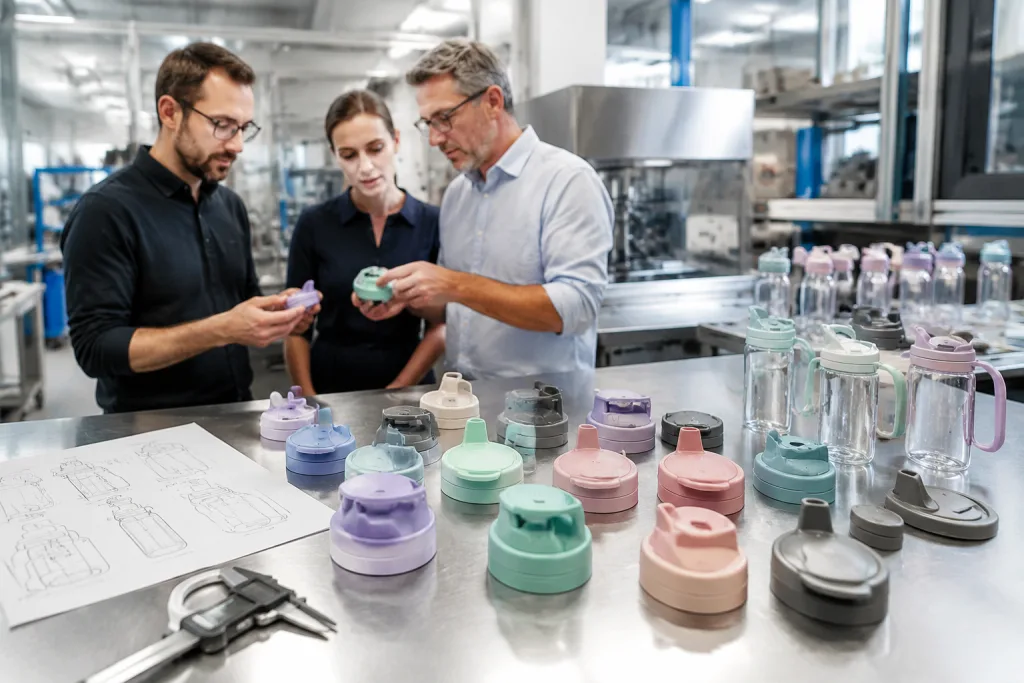
Brand teams often ask for the brightest artwork first. I get it. But toddler bottles get beaten up: daycare bins, stroller cup holders, car seats, dish racks, and 3-5 washes a day in some homes. Pick decoration by how it survives handling, not by how it looks on a PDF mockup. We have seen this go sideways when a buyer approved a cute full-color sample, then QC pulled the sample after 200 rubs on the Sutherland tester and the print edges started to grey out.
Silkscreen printing is still the workhorse for custom drinkware. It is economical and stable for logos up to 2-4 spot colors. For a toddler bottle custom order at 3,000 units, a one-color silkscreen logo may add around USD 0.08-0.18 per unit, depending on size and position. Full wrap prints cost more because the line needs tighter registration control; on one 420 ml bottle project, the buyer flagged a 1.5 mm logo shift near the seam, and the math did not work after two extra sorting rounds.
Laser engraving works well on stainless steel when the logo must stay there. No peeling. No ink rub-off. It suits distributor drinkware programs where the mark has to survive school bags and daycare cubbies. The trade-off is simple: you cannot match Pantone colors. It is a mark, not a graphic print. For premium retail, laser plus powder coating can look clean if the artwork is simple; we run a 0.2 mm line-width check before production because thin strokes can disappear after blasting.
Powder coating gives a better hand feel than basic spray paint, but coating thickness and adhesion matter. Typical coating thickness is 60-90 microns. Ask for cross-hatch adhesion testing and 3M tape pull results. For kids products, I would also test rubbing with wet cloth and mild detergent. A coating that looks good on the pre-production sample can still fail if curing time is shortened during mass production; our oven log showed one batch at 12 minutes instead of 18 minutes, and QC stopped the line before packing.
Heat transfer and UV printing work for cartoon-style artwork or canteen promotional projects, but they need abrasion and dishwasher-condition testing. If you sell through canteen distributors or retail chains, define the washing claim carefully. “Dishwasher safe” is not a decoration choice; it is a tested performance claim. We ship samples with a small test label now after one PO typo changed “hand wash only” to “dishwasher safe,” and the buyer came back after 7 wash cycles with photos of lifted corners.
MOQ, tooling, and price logic
We usually quote toddler bottle custom work in 3 lanes: stock body with logo, stock body with new color and retail pack, or a new mold. The price gap is not magic. On our line, a 350 ml stainless toddler bottle using the same body can still change cost if the buyer asks for a silicone boot, 4C box, or a shorter straw cut by 2 mm.
Stock shape with logo is the speed lane. At our Zhejiang factory network, the practical MOQ is usually 1,000 units per color for stainless toddler bottles and 2,000 units per color for some plastic bottle runs. Lead time is typically 25-35 days after deposit, artwork approval, and sample confirmation. Last month QC pulled the pre-production sample because the logo was 6 mm too close to the bottom radius; fixing that in artwork took 1 day, not a new sample cycle. Choose this route when you are testing a retailer, building a school-season offer, or need goods on the vessel before week 38.
Stock shape with custom color and packaging sits in the middle. You get brand look without paying for mold steel. Expect MOQ around 3,000 units per color for stable powder coating or injected-color parts. Custom gift boxes may add USD 0.25-0.70 per set depending on paperboard, print area, insert, and carton packing method. We run powder panels with a D65 light box before bulk coating, because “cream white” on a PDF and cream white on a bottle are not the same thing. If you need Amazon or marketplace prep, send barcode placement, FNSKU label rules, and master carton weight limits with the PO; we once had a buyer flag a 15.8 kg carton because their warehouse cap was 15 kg.
Fully customized mold work is for real volume, not for a nice idea from a brand meeting. For a new lid or body mold, expect USD 3,000-12,000 tooling for simple plastic lid sets, and more for complex multi-part systems. Stainless body tooling varies by shape and forming difficulty. MOQ normally starts at 5,000-10,000 units, and development can take 45-75 days before mass production. The mold shop checks parting lines, thread fit, vent holes, and straw angle with calipers before we even talk about carton layout. A custom growler or customizable growler can justify tooling because adult drinkware volumes are often larger. For toddler bottles, the math doesn't work unless your forecast is backed by orders, not hope.
Price gaps between canteen manufacturers are not always margin. They can come from steel grade, resin quality, lid part count, inspection level, or packaging. Ask every canteen vendor to quote the same FOB port, same AQL, same carton specs, and same test requirements. If one quote uses 304 stainless and another hides the resin grade in a blurry PDF, you are not comparing suppliers; you are comparing missing information. The cheapest quote is often just the least defined quote, and we have seen that go sideways at final inspection.

Compliance should be specified before samples
About 7 out of 10 new buyers ask us to make the sample first and talk about compliance after they like the shape. That is backwards. We have seen this go sideways when a toddler bottle custom sample used stock silicone from bin S-12, then the PO later required certified production material in a different shore hardness. The test plan should be on the sample request before the mold room cuts anything.
For North America, write FDA food-contact compliance into the RFQ, then add CPSIA for lead and phthalates because this is a children’s product. ASTM-related mechanical safety also depends on the lid design, drop height, and whether the strap or straw can be pulled off with a 15 lb force gauge. If the bottle is sold for children under 3 years, small parts are not a side note. QC pulled one sample last year because a 9 mm silicone straw tip detached during pull testing, and the buyer flagged the charm on the lid as a choking risk.
For Europe, ask for LFGB if Germany is in the sales plan, EU food-contact regulations for the full material set, REACH for restricted substances, and EN 14350 when the bottle is positioned as drinking equipment for young children. Do not accept a canteen supplier’s generic “EU pass” line. This is the wrong question to ask. You need the report number, tested material, tested color, and lab name, because a pink PP lid report does not cover a blue Tritan body with a black silicone straw.
Factory audits also matter. BSCI, Sedex, ISO 9001, and quality manuals do not make a product safe by themselves, but they show whether the line has process discipline and whether someone records the corrective action instead of just wiping the table before visitors arrive. At BottleForge Industrial in Hangzhou, Zhejiang, we normally recommend pre-shipment inspection using AQL 2.5 for major defects and AQL 4.0 for minor defects, with critical defects at zero tolerance. For kids products, we treat leaking, sharp edges, loose small parts, wrong material, and dirty inner surfaces as critical or near-critical; on one 3,000 pcs lot, QC found black polishing dust inside 26 bottles after the air gun station was skipped.
If you buy through canteen vendors instead of directly from a canteen factory, confirm who owns corrective action before the deposit is paid. A trading vendor can help with English, packing artwork, and shipment timing, but the production site still needs to answer technical questions. We once received a PO with “LFGB straw” typed as “LFGD straw,” and nobody at the vendor noticed until the lab booking form came back wrong.
Build the PO around inspection
A purchase order is not a product name with a price and ship date. For toddler bottle custom programs, we treat the PO like the production control sheet the line will follow. If it is loose, the factory ends up working from memory, WeChat photos, and a PDF named “final-final-2.pdf.” We have seen that go sideways when QC pulled the sample and the PO said “blue lid,” while the approved sample was Pantone 2925C.
Put the control points in writing: capacity tolerance in ml, material grade, wall thickness target in mm, lid resin, silicone hardness in Shore A, gasket color, logo method with Pantone references, packaging drawing number, carton dimensions, gross weight limit, barcode position, and shipping mark format. For distributor canteen or distributor growler assortments, define case pack quantity and mixed-carton rules by SKU. Warehouses hate surprises. Last year one buyer flagged a 0.8 kg carton weight gap because the PO missed the inner box spec.
Set approval stages before we cut steel or book the spray line. We run digital artwork approval, physical pre-production sample, golden sample sign-off, inline inspection for runs over 3,000 pcs, then final random inspection before balance payment. For a 5,000-unit order, skipping inspection to save USD 250-400 is the wrong question to ask. One leaking kids bottle program can eat USD 6,000 in replacement freight before anyone talks about chargebacks.
Final inspection needs more than a clean-looking bottle. Fill and invert 32 samples for leak testing under AQL 2.5, open and close each lid 20 cycles, pull silicone straws with a simple tension gauge, rub printed logos with 3M tape, then check inner smell after a 60°C warm water soak. Measure carton drop performance if the goods will move through parcel or marketplace channels. If your product is sold as customized drinkware for kids, parents inspect it harder than any adult promo bottle.
Keep first orders narrow. Two bottle sizes, two colors, and one lid system already create 4 SKUs for the packing table to sort. Eight SKUs on a first PO looks brave in a spreadsheet, but the math does not work when the buyer changes the straw color after mass production starts. Once the supplier proves consistency across 2 production batches, expand into matching custom canteen, customized growler, or a broader customizable drinkware range. China manufacturing runs well when the spec stays stable.
Send your toddler bottle brief for factory review
Share capacity, age range, market, logo, and MOQ target. We will return practical options, risks, and FOB pricing from Zhejiang, China.
Frequently asked questions
What MOQ should I expect for a toddler bottle custom order?
For stock-shape toddler bottles, expect 1,000 units per color for stainless models and around 2,000 units per color for many plastic models. If you want a custom powder-coated color, custom lid color, or retail box, 3,000 units per color is more realistic. New mold projects usually start at 5,000-10,000 units because tooling, trial runs, and defect sorting need enough volume to make sense. Some canteen suppliers will quote lower MOQs, but check whether they are using leftover stock colors, shared components, or simplified QC.
How long does production take after I approve the sample?
For a normal toddler bottle custom order using an existing mold, plan 25-35 days for mass production after deposit, artwork approval, and confirmed pre-production sample. Add 7-10 days for sample preparation if logo printing or custom color is needed. If the order needs EN, LFGB, CPSIA, or ASTM-related third-party testing, add another 7-15 working days depending on the lab. New mold development is slower: 45-75 days before mass production is a realistic planning range, especially for a new lid system.
Which material is best for a toddler bottle?
For premium retail or long-term brand programs, 304 stainless steel is usually the safest choice because it is durable, odor-resistant, and accepted in Europe and North America. A 350 ml vacuum stainless toddler bottle is heavier than Tritan but gives better insulation and perceived value. Tritan is better when parents need to see the liquid level and when weight is a concern. PP is useful for low-cost canteen promotional campaigns, but it scratches and ages faster. Glass is possible, but for toddler use it needs careful sleeve design and stronger packaging.
Can I use the same supplier for toddler bottles and adult canteens?
Yes, but do not assume the same process works for both. A canteen manufacturer that makes adult custom canteen, custom growler, or distributor drinkware may have strong metal forming and coating capability, but toddler bottles add child-safety concerns. You need tighter lid checks, small-parts review, softer silicone specifications, and more conservative drop testing. Ask the canteen factory for kids-product experience, not just general drinkware photos. If they cannot discuss CPSIA, EN 14350, silicone hardness, and straw pull-out force, they may not be the right factory for toddler SKUs.
What should be included in a quotation request?
Send capacity, target age, material, lid type, logo method, color count, packaging style, destination market, testing requirements, annual forecast, and target FOB port. Also state whether you are a brand owner, canteen distributor, or buying for a promotional campaign. A clear RFQ lets canteen vendors quote the same assumptions. For example, “350 ml 304 stainless vacuum toddler bottle, one-color logo, powder coating, retail box, FDA/CPSIA, 3,000 units per color, FOB Ningbo” will get a much cleaner quote than “send price for kids bottle.”