Key Takeaways
- A practical toddler bottle bulk MOQ is usually 3,000-5,000 units per color for custom powder coating
- Set AQL at 2.5 major and 4.0 minor, with 100% leak testing before final inspection
- Expect 35-50 days production after sample approval for custom stainless toddler bottles in China
- Retail packaging can add USD 0.25-0.80 per unit depending on box, insert, barcode, and carton strength
You are not buying a cute small bottle. You are buying a product that a 3-year-old will drop from a 70 cm desk, chew on the straw, shake upside down, and stuff into a school bag next to biscuits and paper homework. A toddler bottle bulk order looks easy until QC pulled the sample after a 30-minute inverted leak test, or the buyer flagged one failed CPSIA report and a lid color drifting 1.5 mm off the approved Pantone card across 6,000 units.
Here is the buyer case we see at BottleForge Industrial in Hangzhou, Zhejiang: a European distributor asks for 8,000 stainless toddler bottles, 350 ml, two colors, silicone straw lid, printed logo, packed for retail and online resale. Same team also buys bulk drinkware, canteen wholesale, and seasonal beer tumbler wholesale bulk programs, so the wrong question is “which bottle is cheapest?” We run better projects when the buyer locks the test standard, artwork file, carton drop requirement, and spare-lid ratio before the line opens; one PO typo on “straw lid” versus “spout lid” can burn 12 days vs 18 days before shipment.
Start With The Actual Use Case
The first mistake is asking for “a toddler bottle bulk price” before the use case is fixed. Wrong question. A preschool bottle for daily water takes more abuse than a one-week promotional giveaway, and a premium retail item for independent stores needs cleaner coating, tighter lid fit, and better shelf packaging. Last month QC pulled a sample after 500 handle swing cycles; the handle pin had opened by 0.6 mm, which would not matter on a cheap promo cup but fails for a child’s daily bottle.
For this scenario, the buyer’s brief is specific: 350 ml capacity, double-wall 304 stainless steel body, food-grade silicone straw, PP lid, carry handle, powder-coated exterior, and no small detachable decorative parts. The target market is Germany and the Netherlands, with a retail price around EUR 14.99-19.99. The order is 8,000 units split into sage green and cream, FOB Ningbo. We would run this on two coating batches, not four, because the color changeover on the powder line costs about 3 hours each time.
That is enough information for a factory in Zhejiang, China to quote properly. Without it, you get a low number that hides later charges: mold adjustment, color matching, logo setup, inner box printing, carton drop-test upgrades, or extra lab testing. We have seen this go sideways when a PO said “cream” but the artwork file named it “ivory”; the buyer flagged the Delta E at inspection, and the shipment sat 12 days instead of the planned 6. A useful RFQ should include capacity, material grade, lid type, decoration method, packaging, market, compliance standard, annual forecast, and required delivery date.
If you already source wholesale drinkware, you may be used to quoting adult sports bottles, bulk canteen orders, or growler wholesale items with fewer child-safety questions. Toddler bottles are different. The lid geometry, straw retention, bite resistance, and cleaning access carry more risk than they do on a standard drinkware bulk project. On the line, we check straw pull force with a simple force gauge; if it slips under 3 kg, the math does not work for EU retail returns. Treat the lid as a working part, not an accessory.
Lock The Specification Before Pricing
For stainless toddler bottles, write the body spec like an engineering note, not a catalog caption. We run this as inner 304 stainless steel, outer 201 or 304 stainless steel by price tier, 0.4-0.5 mm wall thickness before forming, copper-free vacuum insulation, and powder coating at 60-80 microns. On a child product, I’d push for 304 stainless on both inner and outer shells if your shelf price can carry the extra USD 0.20-0.35 per unit; QC pulled a 350 ml sample last month where the outer 201 shell passed salt spray, but the buyer still flagged “304” wording on the PO.
The lid kills more toddler bottle bulk projects than the bottle body. A straw lid may need PP, Tritan, or silicone components, but each one needs a line item on the BOM, not a loose “food grade plastic” note. The silicone should be LFGB or FDA food-contact grade, usually 50-60 Shore A hardness, so a toddler can bite it without the straw folding flat. Test the pull force. If a child can pull the straw out with two fingers, you get leaks and angry parent reviews; if the fit is too tight, parents complain that the cleaning brush cannot reach the socket.
Decoration needs a hard decision before anyone quotes. One-color silkscreen is economical at roughly USD 0.05-0.12 per position, but curved 320-450 ml bottles can stretch thin lines by 1-2 mm near the shoulder. Laser engraving is durable, but it reads weak on cream, pale pink, and light blue powder coat, and usually costs USD 0.12-0.25 per logo. Heat-transfer printing gives stronger shelf impact, but we’ve seen this go sideways when the coating and transfer film are not matched; the buyer flagged scratches after a 3M tape test on day 2 of inspection.
Do not copy specifications from canteen bulk, wholesale canteen, or beer growler bulk orders. That is the wrong question to ask. A bulk growler may focus on capacity, handle weld strength, or carbonation pressure; a toddler bottle lives or dies on leak control, mouth safety, coating adhesion, and cleanability. If your team also buys alcohol flask wholesale bulk or beer tumbler in bulk, keep those spec sheets separate, even if the PO template has the same typo in “stainless” for 6 seasons. The factory can use some of the same stainless forming knowledge, but the QC checklist should be rebuilt for the toddler line.
Build A Quote That Survives Reality
A serious quote for this buyer scenario should not be one line. At BottleForge Industrial, our normal MOQ for a custom toddler stainless bottle is 3,000 units per color, or 5,000 units if you need a new powder color with tight Pantone matching. Our Hangzhou-area partner lines can produce about 280,000 stainless drinkware units per month across bottles and tumblers, with canteens and growlers scheduled on separate fixtures, but child-bottle lid assembly is slower because the silicone straw and vent plug need hand checking. Small parts slow the line. Last month QC pulled 32 lid samples from a 3,200-unit color run and found 2 straws cut 1.5 mm short, which is exactly the kind of issue a one-line quote hides.
For an 8,000-unit toddler bottle bulk order, a realistic FOB China price might sit around USD 3.10-4.60 per unit depending on outer material, lid complexity, coating, packaging, and test requirements. A custom color sample may cost USD 80-150. A pre-production sample with logo and retail box may take 7-12 days after artwork confirmation. Bulk production usually runs 35-50 days after signed sample approval and deposit. We run the sample clock from confirmed AI artwork, not from a WhatsApp photo of a logo; one buyer flagged this after their PO had “matte sage” typed as “matte stage,” and it cost 3 days before the powder room could mix the panel.
You should ask the supplier to separate these price elements:
- Bottle body: steel grade with wall thickness in mm; capacity checked by fill test; insulation target by 6-hour temperature drop; coating type with scratch-test method.
- Lid set: PP or Tritan lid with material code; silicone straw hardness; spare straw if included in the retail pack.
- Decoration: silkscreen for 1-2 color logos; laser for stainless exposure; transfer or sleeve when artwork wraps past 180 degrees.
- Packaging: polybag or kraft box for basic shipment; printed color box with insert, manual, and barcode when retail scanning is required.
- Compliance: LFGB, REACH, CPSIA, ASTM, EN 14350, or FDA-related testing, with the lab name and sample quantity written into the quote.
This structure helps when you compare toddler bottles with adjacent programs like drinkware wholesale, canteen wholesale, beer growler wholesale bulk, or alcohol flask in bulk. If one supplier is USD 0.50 cheaper, ask where the money disappeared. The math does not work if they promise 304 stainless, retail box, full testing, and 100% leak test at the same price as a plain promo bottle. We have seen this go sideways: QC opened a 5-ply export carton and found 250 gsm board instead of the quoted 350 gsm, which saved pennies and crushed corners after 18 days at sea.

Prototype Like You Expect Problems
The sample stage is not for admiring the color chip. It is where we try to make the bottle fail before a child throws it off a dining chair. For an 8,000-unit order, we run one plain structural sample first when the lid is new, then 2-4 pre-production samples in final color and logo. If the buyer pushes for a 12-day sample window instead of 18 days, we can combine steps, but the math gets ugly: one missed straw tolerance can push the whole approval back a week.
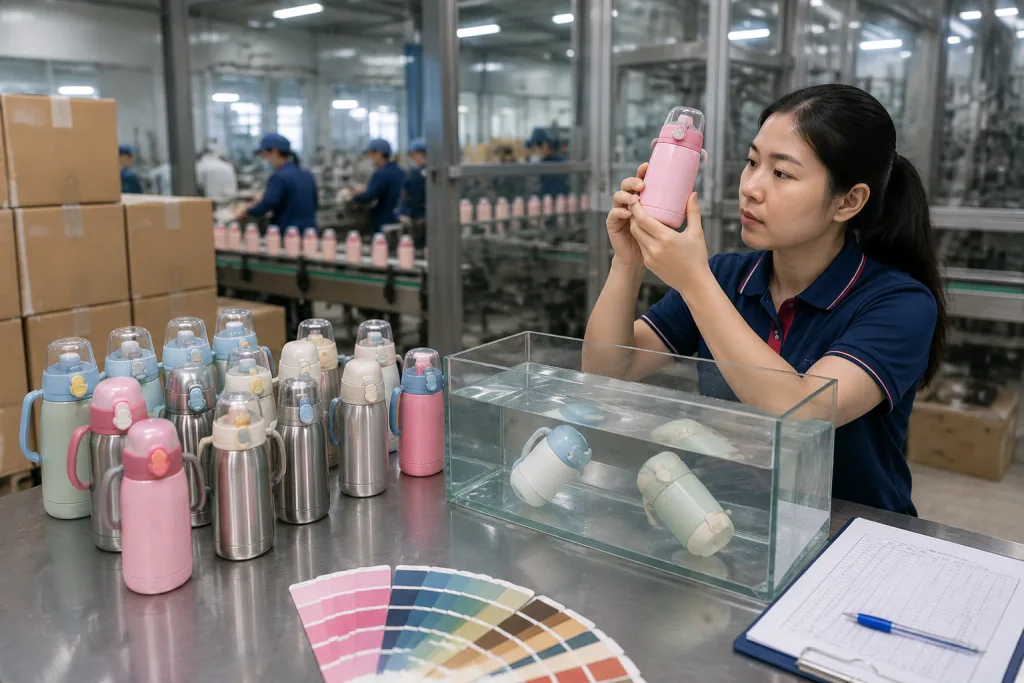
Check the lid first. Fill the bottle with room-temperature water, close it, shake it for 30 seconds, lay it sideways on a white leak tray for 2 hours, then invert it for another 30 minutes. Not lab work. It catches bad straw seals and vent plugs fast. After that, open and close the lid 100 times on the same hinge; QC pulled one sample last May that passed five cycles, then started weeping around cycle 63 because the silicone plug sat 0.4 mm too shallow.
Then check the body. Measure real capacity with a graduated cylinder, not only the catalog number. A 350 ml bottle should hold at least 350 ml to the practical fill line unless your artwork or legal labeling says something else. Check coating thickness with a gauge if you have one; 60-80 microns is a common range for powder-coated drinkware. Run a cross-hatch adhesion test on the coated surface. On darker colors, put the bottle under a 6500K inspection lamp and look for orange peel, pinholes, and dust nibs; we have seen black powder hide 6 small pinholes until packing day.
If your company also sells best wholesale drink bottle ranges, beer tumbler wholesale, growler bulk, or alcohol flask wholesale items, use one sample review form across categories, then add child-specific checks for the toddler line. We photograph every approved detail: lid angle and straw length with a caliper, logo size against the AI file, color under daylight, bottom mark, inner box, carton mark, and barcode. Those photos become the shop-floor reference when the line in Zhejiang starts mass assembly, especially after a PO typo changes “pink lid” to “pink kid.”
Write QC Rules Before Deposit
Agree the QC terms before the deposit leaves your account. After mass production, the math doesn't work. For toddler bottle bulk orders, we usually write AQL 2.5 for major defects and AQL 4.0 for minor defects, with ANSI/ASQ Z1.4 general inspection level II. Critical defects stay at zero tolerance. On our line, QC uses a 0.05 mm feeler gauge and fingertip check around the drinking spout because sharp burrs on a toddler lid are not a “minor cosmetic issue.” Critical means any safety risk: sharp burrs, loose small parts, contamination, cracked lid components, blocked air vents that cause malfunction, or materials inconsistent with approved food-contact specifications.
Leak testing needs its own written rule. A final random inspection is too late. We run 100% leak testing before packing, then random leak checks during final inspection. Write the method into the PO: fill to normal level, close the lid, invert for 60 seconds, shake for 30 seconds, and record failures by carton number. QC pulled the sample last month and found 7 leaking flip lids after the buyer’s PO only said “leak test included.” If a factory says leak testing is included, ask how many seconds, which position, and at what station.
For appearance, define acceptable and unacceptable defects with photos. Be blunt. A small black dot under 0.3 mm on the bottom may pass; a scratch across the logo face should fail. Color tolerance should be checked against an approved master sample, not only a Pantone book, because powder coating on stainless has texture and gloss differences. We keep the master sample in a sealed PE bag near the QC desk, and the inspector checks it under a D65 light box instead of guessing under workshop lighting.
Packaging QC protects margin. Retail boxes should be checked for barcode scan, FNSKU if selling through marketplace channels, carton strength, carton marks, and mixed-color carton accuracy by SKU count. For toddler bottles, damaged packaging creates returns even when the bottle is fine. We once had a buyer flag 3% crushed color boxes because the insert was 0.8 mm thinner than the approved sample. If your warehouse handles wholesale growler, beer growler wholesale, canteen bulk, and drinkware bulk orders, do not assume the same master carton works. A small bottle with handle lids can crush retail boxes when the insert is weak.

Do Not Treat Compliance Casually
Child-related drinkware is the wrong place to accept a supplier’s loose “food safe” stamp. For Europe, put LFGB food-contact testing on the table, check REACH for restricted substances, and add EN 14350 when the age grading and structure put the item into young-child drinking equipment. For the United States, buyers usually ask for FDA food-contact suitability, CPSIA for lead and phthalates where applicable, plus an ASTM-related mechanical safety review based on how the bottle is sold. We run the test matrix from the BOM first; last month QC pulled a toddler straw lid sample and found the silicone bite valve was 0.6 mm thinner than the signed golden sample, which changed the lab discussion. Your importer of record should confirm the exact test plan with a lab or compliance consultant.
Traceability is the whole game. Test reports must match the material, color, coating, straw, gasket, and lid used on the production line. A report for a black adult tumbler does not automatically cover a cream toddler bottle with a silicone straw. A report for PP does not cover Tritan. A report from 2020 may not satisfy your retailer or distributor today, especially if the formulation changed. We have seen this go sideways when a PO said “milk white” but the approved lab report listed “ivory”; the buyer flagged it during document review 9 days before vessel closing.
At BottleForge Industrial in China, we tell buyers to budget compliance before pushing for the last USD 0.05. The math does not work. A basic material food-contact test may be a few hundred dollars. A broader child-market test package can reach USD 1,000-3,000 depending on destination and scope. On an 8,000-unit order, that is still cheaper than a blocked shipment or relabeling exercise. On our side, we attach the SGS or Intertek quotation to the cost sheet, then the line keeps 12 retained samples per color in case the retailer asks for a recheck.
Apply the same discipline across the rest of your sourcing list, but do not copy one file across every SKU. Alcohol flask bulk and alcohol flask wholesale orders bring different concerns from beer growler in bulk and beer tumbler bulk products, especially when the packaging mentions alcoholic beverages. Toddler bottles carry child safety and food-contact expectations. Keep the technical files separate, with bill of materials, supplier declarations, lab reports, production batch records, and inspection reports stored by SKU and purchase order. We ship cleaner when the carton mark, PO number, and test report all match; one wrong suffix like “-PK” instead of “-PINK” can hold a 320-carton inspection for half a day.
Shipment Handover And Reorder Control
After final inspection passes, the order is still open on our board. Carton count, loading photos, shipping documents, and reorder data decide whether the shipment leaves cleanly. For the scenario order, 8,000 units might pack 24 units per master carton, giving about 334 cartons plus samples or spare cartons. On our line, QC checks the loading sheet against the carton stencil before the truck backs in. If each carton is around 8-10 kg, your freight forwarder needs the gross weight by carton range, outside carton size in cm, and HS code confirmation before booking. One wrong digit here can add 2 days at the warehouse.
FOB Ningbo or FOB Shanghai is common for Zhejiang factories. We ship both, but FOB is cleaner for buyers who already have a forwarder because you control the booking and destination charges. If you are newer, DDP looks simple on a quote sheet, but this is the wrong question to ask unless you know who owns customs classification, duty, tax, and the delivery appointment. We had a buyer flag a DDP quote last season because the PO said “children cup” while the customs file said “vacuum flask.” That mismatch is how a small trial shipment turns into 12 days vs 18 days. For North American and European distributors, we usually see FOB used for repeat wholesale drinkware programs, with DDP kept for 500-1,000 unit test runs.
Before loading, ask for photos of sealed cartons, carton marks, pallet condition if palletized, and the container loading sequence. Get the boring photos. If your order includes two colors, carton marks should stop the warehouse from mixing blue lids with pink bodies. We normally ask the packing lead to put the first 10 cartons under the scanner so the barcode grade and FNSKU position match the platform sheet, not someone’s memory from the last job. If the goods are marketplace-ready, barcode and FNSKU placement must match the platform instruction, not the factory’s preferred sticker corner.
The reorder file is where disciplined buyers save money. Record the approved sample number, powder code, logo file version, lid mold number, straw length, box dieline, carton spec, AQL result, defect photos, and customer feedback after launch. We keep these in the job folder with the sealed sample photo and the caliper reading for straw length in mm. When you reorder 12,000 units six months later, this file prevents accidental changes like a lid from mold L-03 replacing L-02 because the PO only said “same as last time.” We have seen this go sideways. It also lets you compare performance against other categories such as wholesale canteen, beer tumbler wholesale bulk, beer growler wholesale, growler wholesale, and alcohol flask wholesale bulk. The best supplier is not always the lowest first quote; it is the one that can repeat the approved product without drama.
Send Your Toddler Bottle Spec For Factory Review
Share capacity, lid type, target market, logo, packaging, and order quantity. We will check feasibility, MOQ, lead time, and risk points.
Frequently asked questions
What MOQ should I expect for toddler bottle bulk orders?
For a custom stainless toddler bottle, expect 3,000-5,000 units per color as a practical MOQ. If you use an existing bottle shape, standard lid, and stock color, some China factories may accept 1,000-2,000 units, but logo and packaging options will be limited. New powder colors, custom silicone parts, or exclusive lids usually push MOQ higher because coating lines, material purchasing, and assembly setup need volume. For a first serious retail order, 5,000-10,000 units is often more efficient than 1,000 units because testing, sampling, and carton setup costs spread better across the order.
How much should a custom toddler stainless bottle cost FOB China?
A typical 300-400 ml double-wall stainless toddler bottle with straw lid often lands around USD 3.10-4.60 FOB China at 5,000-10,000 units. The low end usually means a standard mold, simple lid, one-color logo, and basic box. The high end may include 304 stainless inside and outside, better silicone, custom powder coating, printed retail packaging, spare straw, and broader compliance testing. Be careful with quotes under USD 2.80 for this type of product; they may exclude packaging, use thinner steel, skip 100% leak testing, or rely on a lower-grade lid assembly.
Which tests do I need before importing toddler bottles?
For Europe, buyers commonly consider LFGB food-contact testing, REACH, and EN 14350 depending on age grading and design. For the United States, discuss FDA food-contact expectations, CPSIA lead and phthalate requirements where applicable, and mechanical safety review if the item is positioned for young children. The exact plan depends on your market, claims, packaging, and importer obligations. Budget roughly USD 1,000-3,000 for a broader child-product test package. Do not rely on a generic adult bottle report unless the material, color, lid, straw, and production batch clearly match your order.
How do I prevent leaks in a toddler bottle order?
Start with the lid design, not the body. Confirm silicone hardness, straw fit, vent plug design, and thread engagement during sampling. In production, require 100% leak testing before packing, then repeat random leak checks during final inspection under AQL. A simple factory method should include filling to normal level, closing the lid, shaking for 30 seconds, laying sideways, and inverting for a set time. Also test after opening and closing the lid 100 cycles. Many leaks appear only after the silicone settles or the straw is reinserted several times.
Can one supplier handle toddler bottles and other drinkware wholesale lines?
Yes, if the supplier has separate QC standards for each product type. A capable Zhejiang or broader China drinkware supplier may handle toddler bottle bulk, bulk canteen, beer growler bulk, beer tumbler wholesale, and alcohol flask wholesale programs. But the same checklist should not be copied across all items. Toddler bottles need child safety, leak control, straw retention, and coating adhesion checks. Growlers need capacity and closure performance. Flasks need welding, finish, and alcohol-contact suitability. Ask for category-specific inspection records before placing multiple SKUs.