Key Takeaways
- For a thermos with custom logo, expect 1,000 pcs MOQ per color and 35-45 days production after sample approval
- A 500 ml stainless thermos usually needs 0.4-0.5 mm inner wall and 0.5-0.6 mm outer wall for stable vacuum performance
- Laser engraving works best for long-term outdoor retail branding; silkscreen is cheaper for large promotional thermos runs
- Use AQL 2.5 for major defects, AQL 4.0 for minor defects, plus 100% leak testing at the thermos factory
You are not buying one bottle. You are giving retail shelf space, campaign money, and customer trust to a thermos with custom logo that still needs to look clean after 500 dishwasher cycles, not just in the pre-production photo shot under factory lights. Most outdoor buyers send us the artwork, Pantone code, and target price first; the harder job is turning those three lines on a PO into a stable bulk order with no cap leaks, no logo drift over 0.8 mm, and no carton surprise at final inspection.
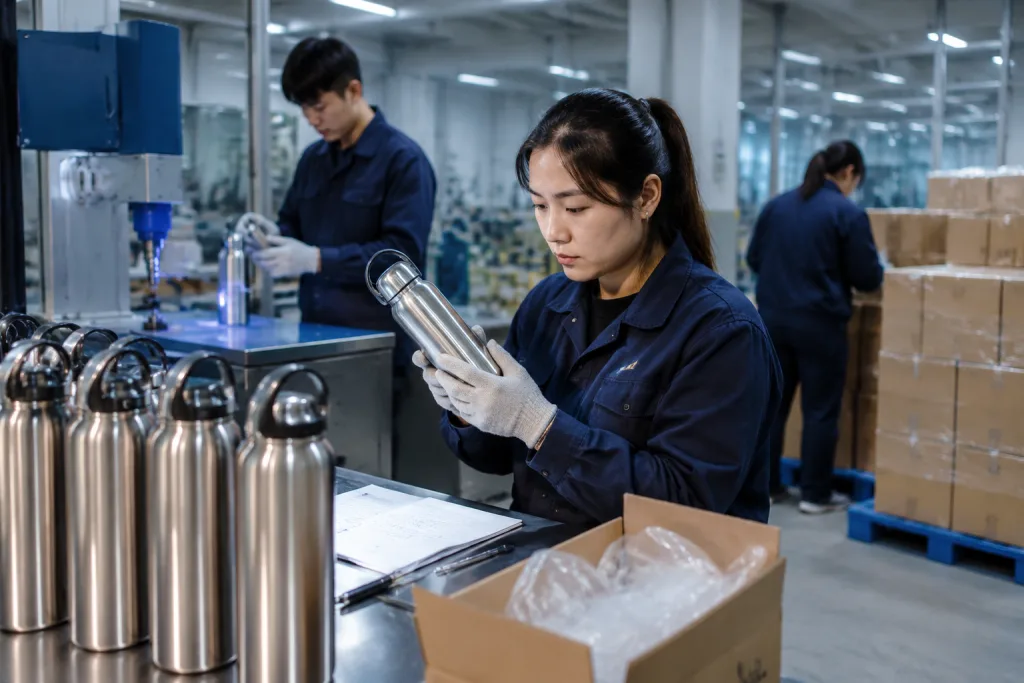
Real order example: 5,000 stainless vacuum flasks for a fall outdoor campaign, FOB Ningbo from Zhejiang, China. Matte powder coating. One-color logo. Retail cartons. The buyer flagged one thing early: “Do not make our warehouse the inspection room.” Fair pushback. We run incoming steel checks, coating adhesion cross-cut tests, and AQL 2.5 final inspection before the pallets leave Hangzhou, because fixing 5,000 scratched bottles after unloading costs more than doing the line checks properly.
Start With The Order Reality
Say your outdoor brand is buying a 500 ml customized thermos for a winter trail campaign. Sales sets a landed cost ceiling of USD 6.80, marketing asks for dark olive matte, and the Rotterdam distributor writes “DELIVERY 10/09” on the PO. Looks easy on one page. Then we reverse the calendar and the line starts pushing back.
For a China manufacturer thermos order, we normally budget 7-10 days for quotation and technical confirmation, 7-12 days for logo sample production, 35-45 days for mass production, 3-5 days for final inspection and inland trucking, then 28-38 days by sea to a main European port. If your launch date is fixed, spending 18 days arguing over a 42 mm logo versus a 48 mm logo is where the math breaks. QC pulled one sample last month where the buyer approved the artwork, then flagged the laser mark because it sat 3 mm too close to the lower curve.
At BottleForge Industrial in Hangzhou, Zhejiang, our practical MOQ for a stainless thermos with custom logo is usually 1,000 pcs per color for standard models and 3,000-5,000 pcs if you need a private mold, custom lid, or non-standard coating. Monthly output for stainless vacuum drinkware is about 450,000 units across thermos, tumbler, and sports bottle lines, but capacity is not instant availability. We run powder coating booths by color family, laser machines by fixture size, and carton packing by ship date; a 500 ml body with matte coating can wait 2 days if the booth is cleaning down from black to olive.
Your first decision should not be “which catalog item looks nice?” That is the wrong question to ask. Decide whether this is a retail thermos, a promotional thermos, or a distributor thermos that must survive mixed-use customers. Retail buyers usually need stronger 5-layer cartons, spare lids, barcode control, and color repeatability under a D65 light box. Promotional buyers push hardest on unit price and logo visibility, then call us at week 6 asking if we can still hit the campaign date. We’ve seen this go sideways; a good thermos supplier will quote those two jobs differently.
Lock The Bottle Specification
The safest brief for a thermos factory reads like a spec sheet, not a mood board. For this bottle, lock it as a 500 ml double-wall vacuum stainless thermos: 304 stainless steel inner wall, 201 or 304 stainless outer wall based on target cost, 0.4-0.5 mm inner wall thickness, and 0.5-0.6 mm outer wall thickness. The lid should be food-grade PP with a silicone sealing ring, and the drawing should call out the gasket OD in mm so the line does not swap in a loose ring from another cap mold. If you sell in the EU, ask for LFGB or EU 1935/2004 food-contact documentation. For North America, FDA food-contact compliance is the normal baseline.
For outdoor retailers, 304 inner stainless is not optional in my view. We have seen buyer pushback when a supplier quote says “stainless liner” but the test report does not name the grade; QC pulled the sample, hit it with an XRF gun, and the buyer killed the order. Some suppliers thermos offers will show a tempting price with thinner gauge material or unclear steel grade. That might pass for a 1,000 pcs giveaway, but the math does not work for a bottle sitting next to camping gear and getting reviewed by serious users. If your brand promise includes durability, save money on the carton insert or color count.
Vacuum performance belongs on the purchase order. Write the test this way for a 500 ml factory thermos: fill with hot water at 95°C, test at room temperature around 20°C, and require the water to stay above 60°C after 12 hours. For cold retention, 4°C water should typically remain below 12°C after 12 hours. Simple test. The shape, lid design, and capacity change the result, so copying a 750 ml claim onto a slim 500 ml bottle is the wrong question to ask. We run the check with a calibrated probe thermometer, and a 2°C miss after 12 hours is enough for QC to flag the batch.
Define the surface before artwork starts. Matte powder coating gives better grip and a premium outdoor feel, but it can show oil marks and needs proper curing. A typical coating thickness is 60-90 microns; on the line, we check it with a coating thickness gauge before laser logo setup. Stainless brushed finish avoids coating scratches, but color branding looks weaker on shelf. If you want a customizable thermos for 3 retail accounts, standardize the base bottle and change only color, logo, and carton. That keeps tooling risk low and stops a small PO typo, like “Pantone 433C” typed as “443C,” from turning into 5,000 wrong bottles.
Choose Logo Method Carefully
For a thermos with custom logo, decoration is where 7 out of 10 messy orders start. The logo method changes unit price, lead time, reject rate, and how the bottle looks after a buyer throws it into a pickup cup holder for 3 months. In this case, the outdoor brand has a clean mountain icon plus a wordmark, so we would quote laser engraving first, price silkscreen if the volume is big, and hold UV printing only for full-color artwork. QC pulled one black 750 ml sample last month because the logo sat 4 mm off center. Small mistake. Big argument.
Laser engraving is the safest choice for a premium stainless thermos. The laser burns through the powder coat and shows the metal below, so there is no ink layer to peel. On a matte powder coated surface, a 45-55 mm wide logo looks clean; we run it on a fiber laser, then check the edge with a 10x loupe because fuzzy strokes make the bottle look cheap. The extra cost is often around USD 0.15-0.35 per unit depending on logo size and machine time. The math does not work for multi-color artwork, but for outdoor retail, laser feels honest and permanent.
Silkscreen printing works when the order is a larger promotional thermos run and the logo is simple. A one-color print may add USD 0.08-0.18 per unit, plus a screen charge around USD 35-60 per color. Color control is better than laser engraving, but adhesion comes down to coating quality, ink match, and oven curing time; on our line, the operator checks curing temperature with an IR thermometer before packing starts. If your campaign involves 20,000 pcs thermos bulk giveaway stock, silkscreen can be the right answer. Below 1,000 pcs, buyers often hate the setup fee.
UV printing handles gradients and full-color branding, but I would not push it for hard outdoor use. It looks strong in product photos, then raised ink areas get scratched by keys, rocks, and metal cup holders after a few weeks. We have seen this go sideways when a buyer approved a glossy UV sample, then flagged 63 scratched pieces after a retail display test. If the thermos vendor recommends UV for every project, ask for an abrasion test video and a cross-hatch adhesion test. No video, no approval.
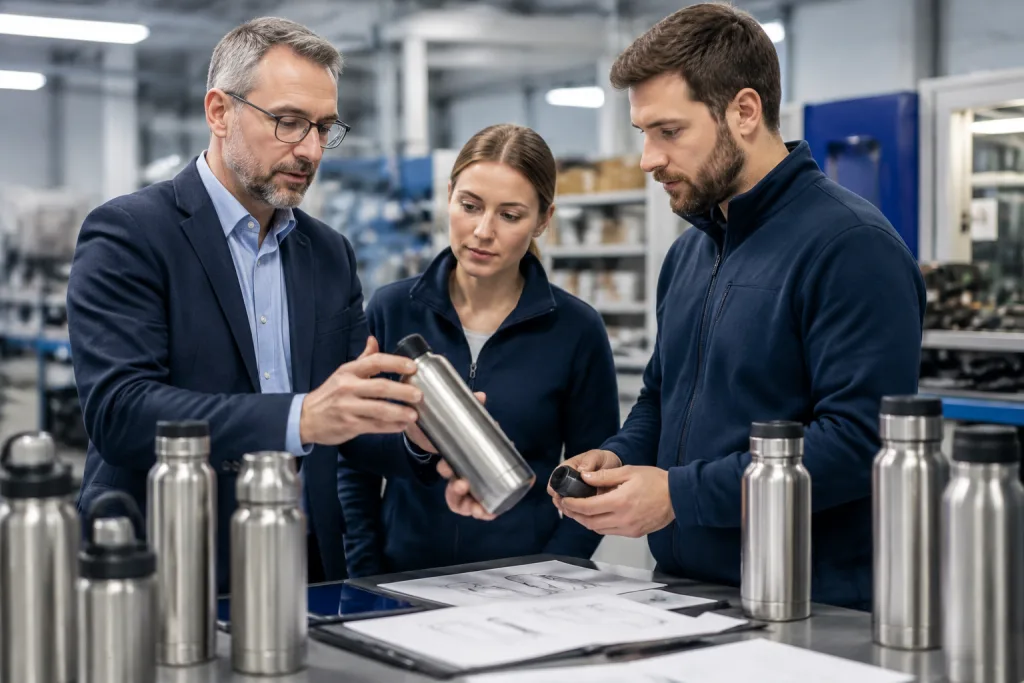
Send vector artwork in AI with outlined fonts, EPS with the Pantone code written on the file name, or PDF with a 1:1 logo size marked in mm. Do not approve a sample from a PNG screenshot. Require a logo placement drawing showing height from base, print width, rotation angle, and whether the seam line is avoided; our prepress guy once caught a PO typo that said 65 mm when the buyer meant 56 mm. A professional thermos manufacturer should give you a dieline before sampling.
Build The Quote Like A Buyer
A proper quote for custom thermos production should break out the cost drivers. If a supplier thermos quote shows one blended number, ask for the sheet again. We run ours with separate lines for unit price, logo charge, pre-production sample, inner box or color box, master carton, testing fee if required, FOB Ningbo or Shanghai, payment terms, and quote validity. On our Hangzhou quoting desk, the buyer usually flags the logo line first, especially when laser marking needs a curved-position jig. Stainless steel prices move. A 30-day validity is normal; an open-ended promise is not a quote I would trust.
For the 5,000 pcs scenario, a common FOB Ningbo price range for a 500 ml stainless thermos with powder coating and laser logo is roughly USD 4.20-6.20 per unit, depending on steel grade, lid structure, coating thickness, carton spec, and inspection requirements. A lower quotation can still be workable, but ask what changed. Did they switch the outer shell from 304 stainless to 201? Did the carton move from 5-ply to 3-ply? Did the vacuum hold test get cut from 18 hours to 12 hours? QC pulled one sample last March where the price looked clean, then the powder coat rubbed through at the handle after 200 cycles on the abrasion tester.
Payment terms for a new buyer are normally 30% deposit and 70% balance before shipment after passed inspection. Some distributors thermos buyers ask for 60 days credit on the first PO. The math does not work for most China factories when steel, lids, coating, cartons, and labor are all paid before the container leaves Ningbo. We had one buyer write “NET 60” in the PO footer after agreeing to balance before shipment; our merchandiser caught it before the PI was stamped. If cash flow is tight, discuss staged shipments or a smaller first production run instead of pushing all risk onto the factory.
Packaging is not a footnote. For retail, specify the individual color box with paper grade, barcode or FNSKU placement if needed, master carton quantity, carton drop test height, and pallet requirement. A 500 ml thermos often packs 24 pcs per master carton; one recent carton we shipped was 56 x 38 x 42 cm and about 12.5 kg gross weight. If selling through e-commerce or Amazon-style fulfillment, the carton must survive parcel handling, not just container stacking. We have seen this go sideways when a buyer approved a nice gift box but skipped the 76 cm drop test.
One more point: decide who owns the artwork and tooling files. For a thermos custom project with exclusive retail graphics, your purchase order should state that brand artwork remains your property and cannot be used for other customers. Say it plainly in the PO, and attach the AI file name and logo version, such as “Logo_V3_black.ai,” so nobody prints last week’s draft. Good manufacturers thermos partners in Zhejiang will accept this because it protects both sides and prevents arguments when the next buyer asks for a similar pattern.
Approve Samples Without Guessing
Sampling is where you stop a 5,000-piece argument before stainless goes on the line. For this order, we run two sample stages: one blank physical sample for body shape, hand feel, lid thread, coating grip, and vacuum result; one branded pre-production sample for logo position, print color, retail box, and barcode scan. Skipping the blank sample saves 5 days on the calendar. Bad trade. We have seen a buyer approve from a 3D mockup, then reject 5,000 wrong units because the lid button felt loose at 0.8 mm side play.
Ask the thermos supplier to send sample photos before courier shipment, but do not release mass production from photos alone. A matte olive coating shifts under a phone camera, a D65 light box, and warehouse LED tubes. If your brand has a Pantone target, write it clearly on the PO and give a workable tolerance. Powder coating does not match paper Pantone the way offset printing does. A Delta E target below 1.0 is too tight for 7 of the 9 coating lines we work with; Delta E below 2.0-3.0 is more realistic for repeat production. QC pulled one sample last month that looked perfect in WeChat photos, then read two shades darker under the spectrophotometer.
When the sample arrives, test it like your customer will. Fill it with hot water, close the lid, shake it upside down for 30 seconds, leave it on white paper for 2 hours, then check leakage. Measure temperature after 6 and 12 hours. Put the bottle in a backpack side pocket, a car cup holder, and your retail display shelf. Real use tells the truth. If the lid squeaks, the coating chips at the base after a 12 mm table knock, or the logo sits too low for a clean product photo, fix it before the deposit triggers production. We have seen this go sideways after the buyer flagged the squeak only after cartons were packed.
Your written approval should include photos with a ruler in frame, diameter and height measurements in mm, material callouts such as 304 stainless, logo file version, carton artwork version, barcode number, and target production date. Do not approve with “looks OK.” A factory thermos team works from production documents, not buyer mood. The clearer your approval, the fewer judgment calls workers make on the line. One PO typo, “black lid” instead of “black body,” is enough to burn 3 days in rework.
Inspect Before The Container Moves
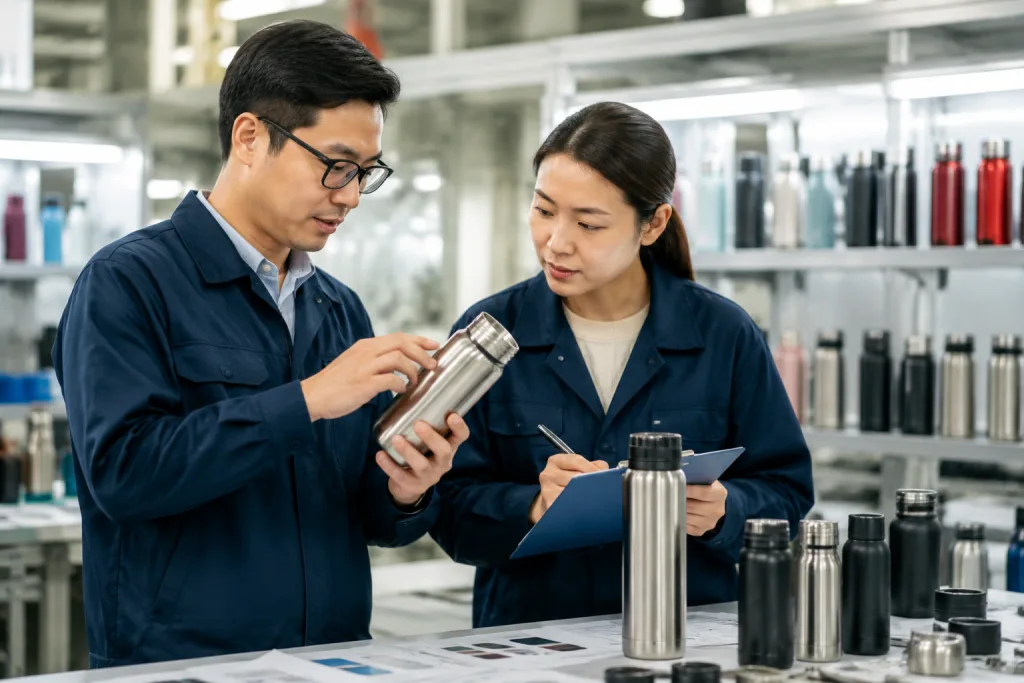
Run final inspection only after at least 80% of goods are packed and 100% are produced. For a 5,000 pcs thermos customized order, we use ANSI/ASQ Z1.4 sampling with AQL 2.5 for major defects and AQL 4.0 for minor defects. Critical defects stay at zero. No debate. Major defects mean leakage at the lid, failed vacuum after the hot-water hold test, wrong logo, sharp rim or burr found by cotton-glove wipe, loose lid threads, rust marks, or a barcode that will not scan on a Zebra scanner. Minor defects cover coating dust spots under 0.5 mm, light carton scuffs, or print alignment drift still inside the signed tolerance.
Do not rely on a quick visual check at the packing table. That is the wrong question to ask. Require controls on the line before cartons are sealed. At BottleForge Industrial in Hangzhou, Zhejiang, we run 100% inline leak testing, batch-sample vacuum performance with 95°C water, and check coating adhesion by cross-hatch tape test. For export orders from China to Europe or North America, we also ask QC to pull cartons for drop testing and master carton dimension checks; a 6 mm carton size error can change pallet loading, and the buyer will flag the extra freight.
Your inspection checklist should cover capacity test with a measuring cylinder, net weight check on a 0.1 g scale, wall thickness confirmation from approved spec, lid torque feel, silicone ring fit, smell test after 24 hours closed, logo position, Pantone color match, barcode scan, carton count, and shipping mark. Long list, yes. It saves claims. If the goods are for a distributor thermos program with 12 customer addresses, carton labeling matters as much as bottle quality; we have seen one PO typo send 30 cartons to the wrong warehouse.
If the inspection fails, separate the defect type before anyone starts arguing. Dirty cartons can usually be reworked in 1 day with new outer cartons and a handheld tape gun. Wrong logo placement on 5,000 units is a commercial problem, not a packing issue. Failed vacuum above the agreed AQL level is a production problem that needs sorting and possibly remake; the math doesn't work if 4% of bottles come back from retail. A serious thermos manufacturer will accept clear AQL criteria agreed before production, especially when QC pulled the sample and recorded the defect photos.
Ship With Fewer Surprises
Once inspection passes, shipping discipline takes over. For FOB Ningbo or Shanghai, we confirm the forwarder, vessel closing date, carton quantity, gross weight, CBM, and document cut-off on one shipping sheet. No guessing. A 5,000 pcs 500 ml bulk thermos order may be around 10-13 CBM depending on packaging; last month QC measured one export carton at 45 x 34 x 28 cm after the buyer changed from white box to kraft color box. That is usually LCL or part of a consolidated container unless you are combining with other drinkware SKUs.
Documents normally include commercial invoice, packing list, bill of lading, and certificate of origin if needed. For EU buyers, keep REACH-related coating and food-contact documents on file. For US buyers, keep FDA food-contact declarations and any retailer-specific compliance forms ready before the shipment arrives. If you wait until customs asks, you are already late; we have seen one PO typo, “stainelss bottle,” slow document checking by 2 days because the consignee wanted every line matched.
Outdoor retailers should also plan after-sales parts. Lids and silicone rings look small on the table, but the buyer flagged them first when 6 samples came back with loose gaskets after a drop test. For a 5,000 pcs customized thermos order, ordering 1-2% spare lids and 2-3% spare sealing rings is cheap insurance. Promotional brands may skip this; retail customers expect support, and the math doesn't work if you airship 80 replacement lids later.
If this first order sells well, the smartest next move is not changing everything. Keep the same approved bottle and build a seasonal color program with fixed Pantone chips and the same carton dieline. That lets your thermos suppliers hold stable BOMs, coating references, and carton templates. We run cleaner repeat orders when the line keeps the same lid torque setting, usually checked with a 0-10 N·m torque meter before packing. Repeatability is where a China factory thermos project becomes profitable for both sides. The goal is not one perfect sample; it is 5,000 acceptable units now and 20,000 more units later with fewer emails, fewer defects, and no panic before the vessel closes.
Send Your Thermos Logo Brief For Review
Share capacity, quantity, logo file, target market, and delivery date. We will check the spec before quoting.
Frequently asked questions
What is the normal MOQ for a thermos with custom logo?
For standard stainless thermos models, a realistic MOQ is 1,000 pcs per color with one logo method. If you need a special powder coating color, expect 2,000-3,000 pcs because coating lines need setup time and minimum powder usage. Private mold bodies, custom lids, or special caps usually start at 3,000-5,000 pcs. Some suppliers thermos listings advertise 100 pcs MOQ, but the unit price, logo accuracy, and repeatability often do not fit distributor or retail programs. For a first order, 1,000-3,000 pcs is a practical test range.
How long does a customized thermos order take from China?
A typical custom thermos order takes 50-70 days before ocean transit if the model already exists. Allow 7-12 days for pre-production samples, 35-45 days for mass production after approval and deposit, then 3-5 days for inspection, booking, and inland transport to Ningbo or Shanghai. Sea freight to Europe often takes 28-38 days port to port, while North America can be 18-35 days depending on coast and routing. Air freight is possible for urgent promotional thermos orders, but it can add USD 2.00-5.00 per unit on a 500 ml stainless item.
Is laser engraving better than printing for outdoor retail thermos products?
For outdoor retail, laser engraving is usually the safer choice. It does not peel, it handles abrasion better, and it looks clean on matte powder coating. The trade-off is that it normally gives a metal-color mark, not a Pantone color logo. Silkscreen printing is better when you need exact color branding or a low-cost thermos promotional run above 5,000 pcs. UV printing works for detailed artwork, but raised ink can scratch faster in outdoor use. If durability matters more than bright color, specify laser engraving and approve the engraving depth on the sample.
What QC tests should I require for a manufacturer thermos order?
At minimum, require 100% leak testing, sampled vacuum retention testing, visual inspection by AQL, coating adhesion testing, logo position check, barcode scan, and carton drop test. For AQL, many buyers use 0 critical defects, 2.5 major defects, and 4.0 minor defects under ANSI/ASQ Z1.4. Vacuum testing should state water temperature, room temperature, test duration, and pass temperature. For example, 95°C starting water should remain above 60°C after 12 hours in a 20°C room for many 500 ml models. Put these standards in the purchase order, not only in email chat.
What price should I expect for bulk thermos with custom logo?
For a 500 ml stainless thermos bulk order with powder coating and one laser logo, FOB China pricing often falls around USD 4.20-6.20 per unit at 5,000 pcs. A simple silkscreen promotional version may be lower, while a premium retail version with 304 outer steel, gift box, spare gasket, and stricter inspection can be higher. The final cost depends on steel grade, wall thickness, lid design, coating, logo method, carton, testing, and order timing. Be careful comparing quotes unless every supplier thermos offer lists the same specification and packaging.