Key Takeaways
- A 500 ml stainless thermos usually moves USD 0.25-0.70 per unit when steel grade, wall thickness, and lid structure change
- MOQ for a custom thermos with logo is typically 1,000 pcs per color, while molded lids often need 5,000 pcs or more
- Powder coating can add USD 0.35-0.80 per unit but cuts visible scratching better than standard spray paint
- Plan 25-35 days for bulk thermos production after sample approval, plus 3-7 days for final inspection and export packing
If you sell outdoor gear or promotional drinkware, the thermos wholesale price is not one number. It is built from spec calls: 201 or 304 stainless, 350 ml or 500 ml capacity, vacuum hold hours, lid mold, powder coating, logo method, color box, AQL 2.5 inspection, and FOB or DDP freight. A cheap quote can be clean. It can also skip the 0.5 mm inner wall, the silicone ring grade, or the drop test that QC pulls from the line before packing.
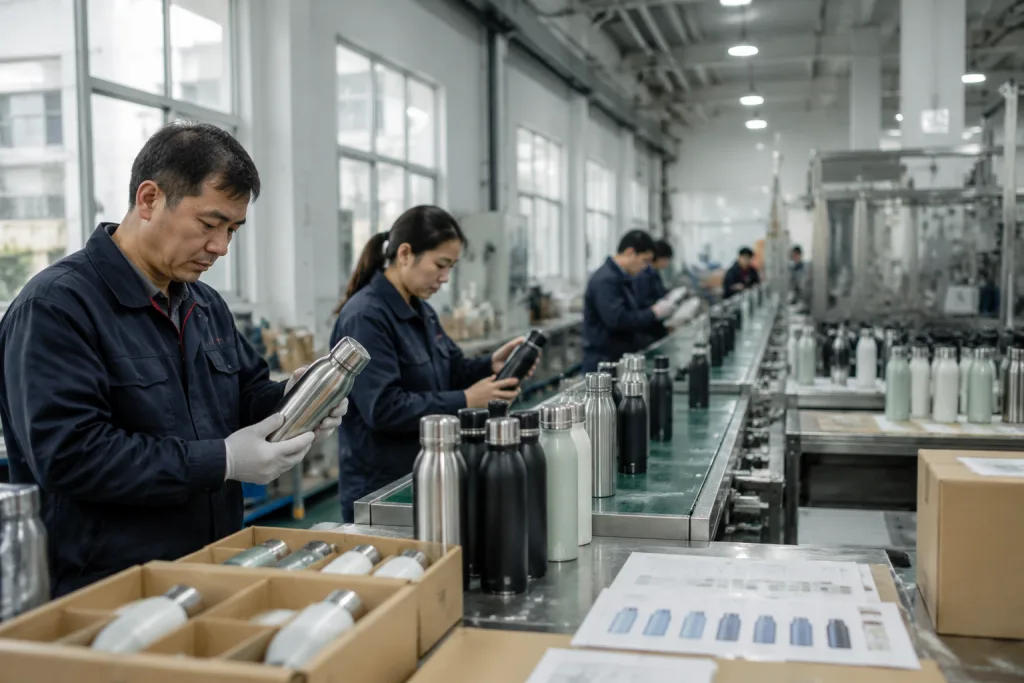
At our Hangzhou, Zhejiang factory, we see buyers compare a 500 ml custom thermos at USD 3.20 against another at USD 4.10 and ask why the higher supplier thermos is padded. That is the wrong question to ask. Last month one PO even typed “304 outside / 201 inside,” while the buyer’s artwork file said “304 stainless” in 3 mm letters on the carton; QC flagged it before the sample left the spray room. Sometimes the USD 4.10 quote has extra margin. More often, the two quotes are not for the same bottle. Read the spec sheet line by line before you commit to thermos bulk production in China.
Capacity Changes More Than Volume
Capacity is the first line on most spec sheets, but it changes the whole build, not just the coffee volume. A 350 ml promotional thermos for a gift campaign uses less 304 stainless steel, a smaller lid, and a carton that may be 12-15 mm shorter per layer. A 1,000 ml outdoor retail flask needs a stiffer shell, a larger vacuum chamber, stronger carton compression, and often a handle lid that survives a 1.2 m drop test. We see buyers ask, “Can you just scale the 500 ml price?” That is the wrong question to ask. The math does not work on the line.
For stainless vacuum bottles from China, common outdoor sizes are 500 ml, 750 ml, and 1,000 ml. A basic 500 ml factory thermos with single logo may sit around USD 3.10-4.30 FOB Ningbo or Shanghai at 3,000 pcs, depending on finish and lid. A 750 ml version may add USD 0.45-0.90, while a 1,000 ml version may add USD 0.80-1.60. The jump is not only steel weight. Bigger bottles slow polishing by about 6-9 seconds per piece, take more powder in coating, need deeper foam trays, and fail vacuum testing more often when the neck welding is off by even 0.2 mm. QC pulled the sample last month on this exact issue.
For a distributor thermos range, do not choose sizes only from a catalog photo. Ask for the actual height, diameter, mouth opening, and packed carton size. A bottle that is 82 mm wide may feel rugged, but it can miss 2 out of 5 vehicle cup holders we keep near the sample room for checking. A 68-74 mm diameter bottle usually sells better for commuting and outdoor day use. For outdoor retailers, hand feel matters. For promotional brands, carton cube matters more than people expect; we have seen USD 0.18 saved on the thermos supplier quote disappear when the buyer flagged the 58 x 42 x 34 cm master carton on the PO.
Steel Grade And Wall Thickness
Most stainless thermos builds use 304 stainless steel inside and 201 or 304 outside. For food contact, the inner wall is the line we do not cross. We run 304 inner steel at 0.4-0.5 mm for most manufacturer thermos programs, checked with a digital micrometer after deep drawing. Cheap suppliers thermos quotes sometimes hide behind “food grade stainless” and never name the grade. That wording fails fast with EU or North American buyers; we had one PO held for 6 days because the material line only said “SS food grade.”
The outer wall changes both cost and dent claims. A 201 outer shell can reduce thermos wholesale price by roughly USD 0.15-0.35 per unit versus full 304 construction. Full 304 inside and outside makes sense for premium outdoor retail, coastal markets, and brands pushing a cleaner sustainability story. For promotional thermos orders where budget is tight, 304 inside and 201 outside can work if coating thickness, salt spray hours, and carton drop expectations are written into the spec. Get it in writing. We have seen this go sideways when a buyer approved 201 outside, then flagged rust spots after a 24-hour salt spray test on black powder coating.
Wall thickness gets missed because buyers rarely measure it. Wrong question to ask is “Is it 304?” Ask how thick it is. A 0.3 mm outer wall feels fine on a sample but dents faster when cartons are stacked 5 layers high in warehouse handling. A 0.45 mm outer wall is more stable, costs more, and adds weight, usually 18-28 g on a 500 ml bottle. If a thermos manufacturer gives you a low price, ask for inner and outer thickness in millimeters, not just steel grade. Also ask whether the bottom is single-piece, welded, or fitted with an anti-slip pad; QC pulled one sample last month where the silicone pad sat 1.2 mm off-center. These details explain why one thermos factory quote survives retail use and another becomes a complaint file after the first pallet arrives in Germany, Canada, or the United States.
Vacuum Performance And Test Claims
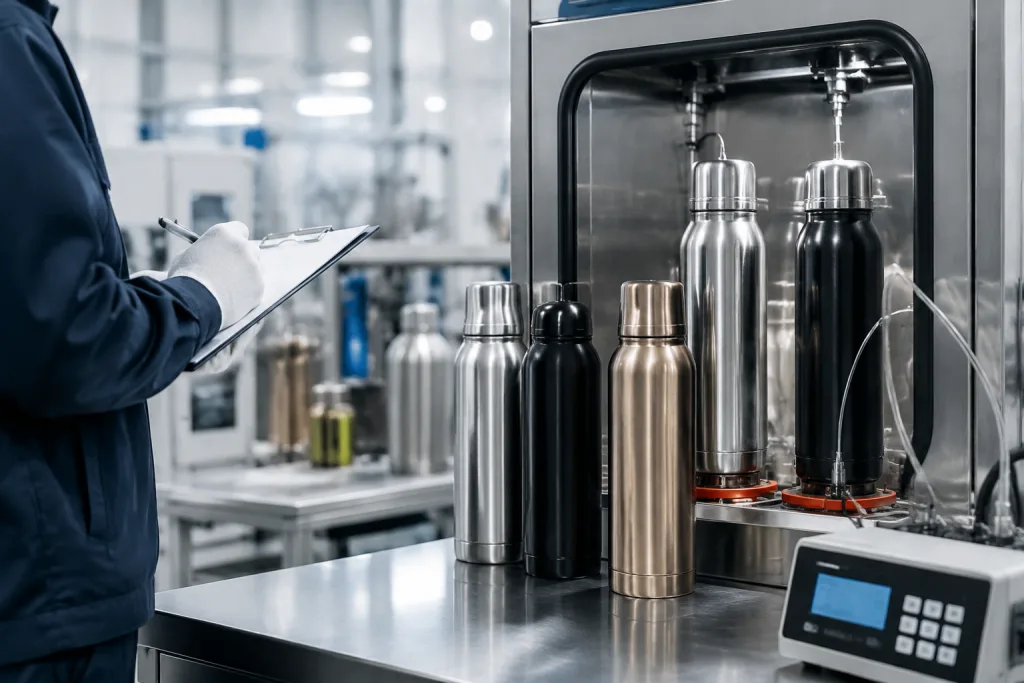
Heat retention claims are where sales copy and engineering start arguing. A spec line that says keeps hot for 12 hours is almost useless unless the test method is written on the sheet. We run a simple factory check: fill with 95°C water, lock the lid, leave the sample in a 20°C test room, then read the probe at 6, 12, or 24 hours. QC uses a K-type thermometer, and we log the bottle weight and mouth ID in mm because a 44 mm mouth loses heat faster than a 32 mm mouth. A solid 500 ml customized thermos should stay above 60°C after 6 hours. Better builds hit 68-75°C after 6 hours, mostly depending on mouth width and lid stack-up.
Vacuum quality comes from body forming, welding, degassing, vacuum sealing, plus 100% leak checks. Our Zhejiang line can produce about 420,000 stainless drinkware units per month, but we slow the line for vacuum batches because a dead vacuum looks fine on the carton table. We’ve seen this go sideways: one buyer pushed for 12 days production instead of 18 days, then QC pulled the sample and found a warm outer wall after 20 minutes. For export orders, define the AQL plan clearly, such as AQL 1.5 for major defects and AQL 4.0 for minor defects, with separate functional tests for leakage and insulation.
Be careful with thermos promotional claims like 24 hours hot and 36 hours cold on every size. That is the wrong question to ask. Cold retention is easier than heat retention, and a narrow-mouth 1,000 ml bottle will beat a wide-mouth 350 ml bottle in the same test room. If you are building a distributor thermos line, print claims by capacity and lid type; the buyer flagged this exact issue on a PO where “24H HOT” was copied across 350 ml, 500 ml, and 1,000 ml SKUs. Overclaiming can win the first order, then the returns eat the margin. A reliable thermos vendor should share test data for the exact capacity, not a similar model from last year.
Lids, Seals, And Drinking Parts
The lid is where 7 out of 10 thermos custom projects start getting expensive. A simple screw cap with a stainless cup is low risk; we run it often for outdoor orders because the thread gauge is easy to check and the 0.8 mm silicone ring seats cleanly. A push-button lid looks better on a sales page, but now you have springs, silicone plugs, inner channels, and extra leak points. More parts, more trouble. A straw lid works for cold drinks, not hot coffee. If your product page calls it a thermos, buyers expect heat retention and safe hot-drink handling, so mixing a straw sports lid into that SKU is the wrong question to ask.
For cost planning, a basic lid may represent USD 0.35-0.60 of the unit cost. A complex one-touch lid can reach USD 0.90-1.60 depending on structure and tooling ownership; last month QC pulled the sample after 3 drops from 1.2 m because the button cover popped loose. If you need a customizable thermos lid with a new shape, new mold cost may run from USD 1,500 to USD 8,000 or more. MOQ often rises to 5,000-10,000 pcs because molded plastic parts need stable color matching and production efficiency. We’ve seen this go sideways when the PO says “black lid,” but the approved sample is Pantone 426C.
Silicone should be food-contact grade and removable enough for cleaning; our inspector uses a small pick tool to check whether the gasket can be removed without tearing. For EU programs, ask about LFGB or relevant food-contact testing. For US programs, check FDA food-contact expectations and, where applicable, California Proposition 65 screening. For children or family outdoor products, ASTM and CPSIA questions may enter the discussion, even if the bottle is mainly stainless steel. A good thermos manufacturer will not treat the lid as an accessory afterthought. For promotional brands, lids also affect logo placement, gift box height, and FBA carton planning if you sell online; a 12 mm taller lid can change the master carton count from 24 pcs to 20 pcs. The cheapest suppliers thermos lid is rarely cheapest after leakage claims.
Finish, Color, And Logo Methods
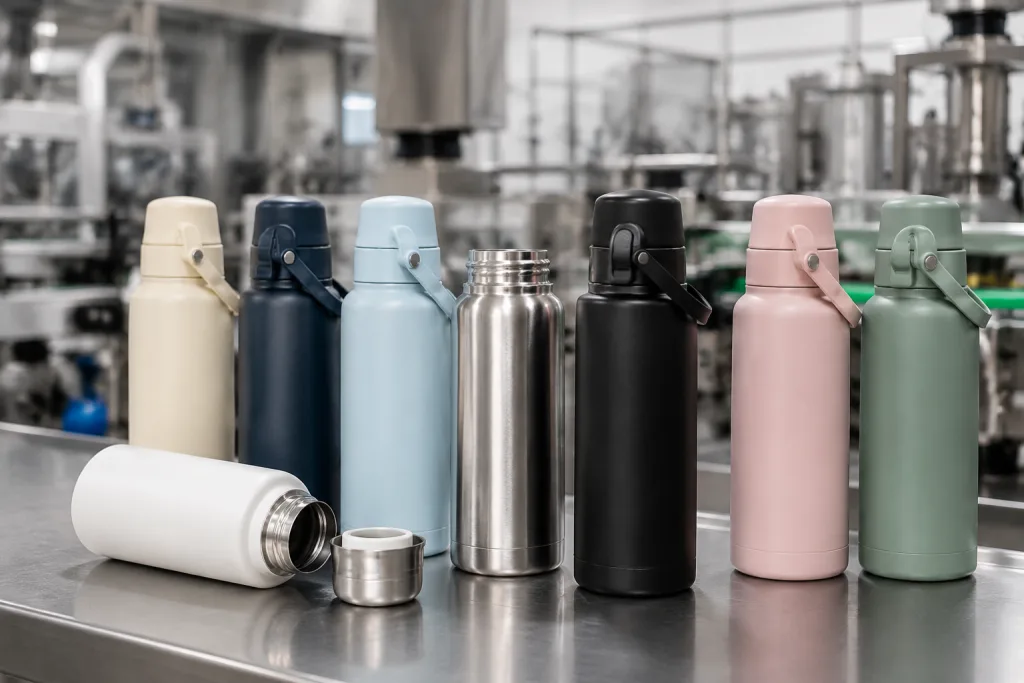
Surface finish moves thermos wholesale price faster than most buyers expect. Plain brushed 304 stainless is the safer low-cost option because we skip the coating line and check only polish marks under a 600-lux inspection lamp. Standard spray paint works for promo orders, but the buyer often flags hairline scratches after carton drop testing. Powder coating costs more, generally USD 0.35-0.80 per unit depending on bottle size and color, and it gives better grip for outdoor retail shelves. Rubber paint feels soft in the hand. It also marks fast, especially dark matte black after the bottles rub against the PE bag during packing.
Color matching needs physical chips, not only Pantone numbers on a screen. For a custom thermos in powder coating, expect a tolerance discussion before bulk because one 0.3 mm thicker coating layer can shift the look under warehouse lighting. White shows dust specks near the shoulder, cream can turn warm after baking, neon needs tighter powder control, and metallic colors expose uneven spraying faster than black or navy. If you are ordering thermos bulk for a campaign, approve one golden sample and keep it sealed. QC pulled the sample for a 5,000 pcs charity order last May after the buyer wrote “Panton 186C” on the PO, and that typo would have gone straight to bulk without a signed chip.
Logo method changes cost and service life. One-color silkscreen may add around USD 0.08-0.18 per position, and it is fine when the artwork has thick lines over 0.25 mm. Laser engraving often adds USD 0.12-0.30 and lasts better on coated bottles, though it exposes the metal beneath, so the math doesn't work for every soft lifestyle brand. Heat transfer and full-wrap printing cost more but suit retail graphics with gradients or wraparound artwork. For a customized thermos with individual names or variable QR codes, laser serialization is possible, but it slows production from about 1,800 pcs per shift to 900 pcs if the data file arrives messy. If your distributors thermos program has several regional logos, group the same body color and change only decoration where possible. That keeps the thermos factory from resetting coating lines too often.
Packaging, Compliance, And Real MOQ
Packaging looks like a USD 0.12 line item until the 5-ply export carton caves in at the corner or a retail buyer rejects the EAN barcode. A plain white box usually sits around USD 0.12-0.25. A printed color box may add USD 0.25-0.60 depending on paper grade and quantity. Then the small parts start stacking up: EVA insert thickness at 1.5 mm, folded instruction sheet, hang tag string, spare gasket bag, and barcode label roll. We run Amazon orders differently. FNSKU labels, 15 kg carton weight caps, and 1.2 m drop-test rules need to be in the quote before the line starts, not after QC pulled the sample.
MOQ is not one clean number. A stock shape with laser logo may start at 500-1,000 pcs. A custom color normally needs 1,000 pcs per color because the powder coating booth has setup loss before the first good bottle comes out. New color, new lid tooling, new box artwork, and 3 colors under one thermos customizable program usually means 3,000-5,000 pcs per SKU if you want the unit price to make sense. Small orders get messy. If a thermos supplier accepts 200 pcs with custom color, ask whether they are hand-spraying, using leftover powder, or hiding the setup cost in the box, freight, or sample fee. We have seen this go sideways when the buyer flagged shade drift under a D65 light box.
Compliance belongs in the price talk from day one. For Europe, REACH, LFGB, and packaging waste rules may matter. For North America, FDA food-contact expectations, Prop 65 screening, and retailer-specific audits can apply. Some buyers also ask for BSCI, ISO 9001, or Sedex documentation from China manufacturers thermos factories. These are not decoration items; they decide which welding line, polishing room, and gasket supplier we can use. A manufacturer thermos quote that excludes testing may look USD 0.20 cheaper, but the math does not work if the retailer asks for documents 14 days before shipment and the lab needs 7 working days just to issue the report.
FOB Price Versus Landed Cost
Most China drinkware quotes come as FOB Ningbo or FOB Shanghai; we ship both ports every month from Hangzhou, usually 2.5-3.5 hours by truck to the container yard. FOB separates the cup price from ocean freight, duty, customs clearance, and inland delivery, but FOB alone is the wrong question to ask. Look at landed cost. A USD 3.85 FOB thermos wholesale price can beat a USD 3.60 quote when the carton is 6 cm shorter, the defect rate stays under AQL 2.5, and the supplier packs to match your warehouse or 3PL receiving rules.
Ask for carton size in mm, gross weight in kg, units per carton, HS code suggestion, plus loading quantity for 20GP, 40GP, and 40HQ containers. On the line, a typical 500 ml stainless thermos often packs 24 pcs per export carton; QC pulled one last month at 18.6 kg gross, and the buyer flagged it because their 3PL limit was 15 kg. Too heavy or too weak, you pay in damage. Too large, you pay in freight. Outdoor retailers should check shelf-ready packaging and master carton markings, especially barcode position and arrow marks. Promotional brands should work backward from the event date: 7-10 days for sampling, 25-35 days for production after approval, 3-7 days for inspection and packing, then transit.
A serious thermos vendor itemizes assumptions instead of hiding behind one attractive number. Ask what changes the price at 1,000, 3,000, 5,000, and 10,000 pcs, including logo setup, sample cost refund, inner box, export carton, spare gasket, and testing. We have seen this go sideways: one PO said “matte black” while the approved sample card said “powder black,” and the finish argument cost 4 days before mass production. You do not need the most expensive thermos manufacturers option. You need a suppliers thermos program where the quote, sample, bulk goods, and documents describe the same product.
Send your thermos spec sheet for a real quote
We will price the same stainless thermos line by line, with MOQ, lead time, logo method, packaging, and FOB China terms.
Frequently asked questions
What is a realistic thermos wholesale price for a 500 ml custom stainless bottle?
For a 500 ml custom thermos with 304 stainless inner wall, 201 or 304 outer wall, powder coating, and one logo, a realistic FOB China range is often USD 3.30-4.80 at 3,000 pcs. A plain brushed finish with simple silkscreen can be lower, around USD 2.90-3.60. A premium lid, full 304 construction, gift box, or retail testing can push it above USD 5.00. If you receive a quote under USD 2.70, check wall thickness, lid material, vacuum test method, carton quality, and whether logo or packaging is excluded.
What MOQ should outdoor retailers expect for thermos bulk orders?
For a stock stainless thermos shape with your logo, MOQ is usually 500-1,000 pcs. For custom powder coating, plan on 1,000 pcs per color because coating lines need setup time and stable color control. For a new molded lid or unique bottle body, the practical MOQ is often 5,000-10,000 pcs, plus tooling cost. If your first order is smaller, choose an existing thermos factory model and customize logo, color, and packaging. That keeps risk lower while you test demand.
How do I compare two thermos supplier quotes fairly?
Put both quotes into the same spec table. Compare capacity, inner and outer steel grade, wall thickness, lid type, gasket material, coating method, logo process, box type, carton size, FOB port, MOQ, sample lead time, production lead time, and testing included. A USD 0.40 difference may be caused by powder coating, full 304 steel, better lid tooling, or a printed box. Also ask both thermos suppliers for insulation test data at 6 hours and 12 hours. If one quote is missing details, treat it as incomplete, not cheaper.
Can I make a promotional thermos with several logo versions in one order?
Yes, but structure it carefully. The easiest route is one bottle color, one lid color, and multiple logo versions by laser engraving or silkscreen. Many China factories can split logos at 300-500 pcs per design if the total order reaches 1,000-3,000 pcs. If each logo also has a different powder color or box artwork, setup cost rises and defects become harder to control. For event campaigns, send final vector files at least 5 working days before sample approval, not after production starts.
What documents should I request from a thermos manufacturer before shipment?
At minimum, request a signed proforma invoice, packing list draft, product specification sheet, material declaration, and final inspection report with photos. For EU orders, ask about LFGB, REACH, and relevant food-contact testing. For North America, ask for FDA food-contact compliance support and Prop 65 screening where needed. If your retailer requires social compliance, request BSCI, Sedex, or audit documents before placing the deposit. For bulk thermos orders over 3,000 pcs, use third-party inspection with AQL 1.5 major and AQL 4.0 minor before balance payment.