Key Takeaways
- Stock stainless thermos MOQ can start at 500 units; custom tooling usually starts around 3,000 units
- A 500 ml double-wall vacuum thermos typically lands at USD 3.20-6.80 FOB China depending on steel, lid, finish, and packaging
- Lead time is commonly 25-35 days for logo-only orders and 55-75 days for new mold or custom color projects
- Use AQL 2.5/4.0 inspection, REACH/LFGB review for Europe, and ASTM/CPSIA checks when kids or food-contact claims apply
If you buy stainless vacuum bottles for an outdoor chain or a promotional campaign, the lowest FOB quote is often not the lowest landed cost. We see this on 20,000-piece thermos wholesale bulk orders: the sheet looks tidy, then the buyer gets hit by a new lid mold, Pantone rework after the first spray panel, a weak laser logo QC pulled under 3M tape, revised 5-layer cartons, or a missed Ningbo vessel cutoff by 2 days. The math doesn't work if the quote ignores those items.
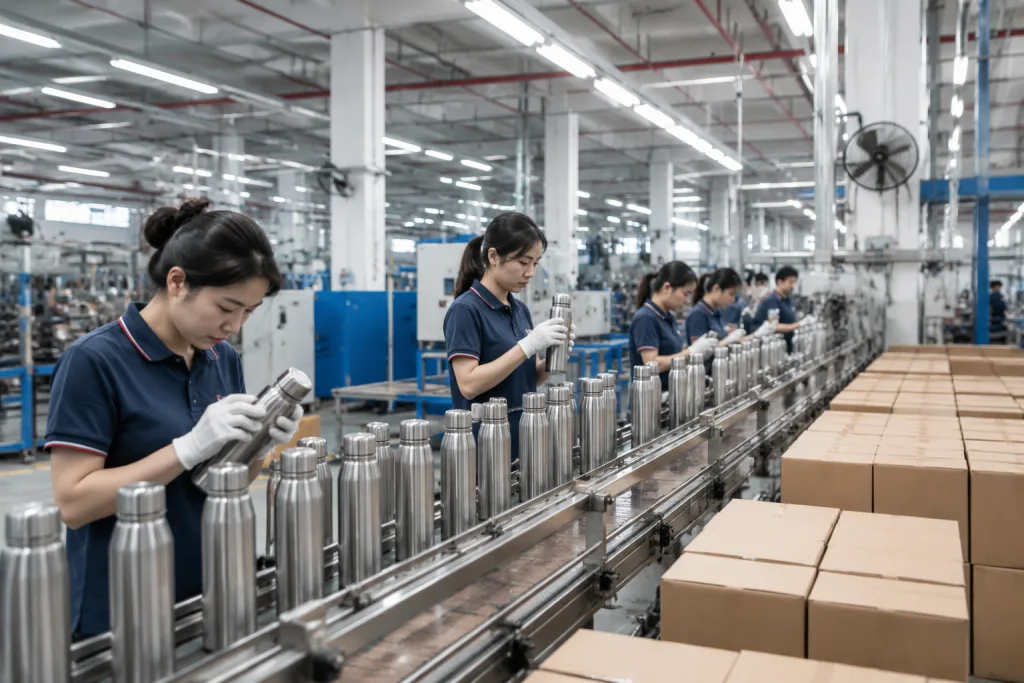
BottleForge Industrial runs production from Hangzhou, Zhejiang, near the stainless drinkware cluster in China. Our normal stainless thermos capacity is about 420,000 units/month, with practical MOQ from 500 units for stocked shapes and 3,000 units for deeper customization. The better question is not “what is your best price?” Ask what changes the price, what adds 12 days vs 18 days, and where cutting cost will fail inspection. On the line, a 0.3 mm gap at the lid seam or a 2 g variance in powder coating is enough for the buyer to flag the sample.
Start With The Real Unit Cost
For thermos wholesale bulk sourcing, the FOB unit price is only one line on the cost sheet. A plain 500 ml stainless thermos from a China factory thermos line usually lands at USD 3.20-4.10 FOB Ningbo or Shanghai with an existing mold, standard powder coating, and a simple carton. Change 5 items, and the same bottle moves to USD 4.80-6.80: 316 inner steel, carry handle lid, Pantone powder coating matched on our BYK color meter, individual gift box, plus laser engraving on two positions. We see this every week. One buyer once argued over USD 0.08 on the body, then added a 350 g rigid box that cost USD 0.42 by itself.
The biggest material driver is stainless grade and thickness. Most outdoor and promotional thermos projects use 304 stainless steel for inner and outer walls, often 0.4-0.5 mm inner wall and 0.5-0.6 mm outer wall before forming. Some buyers ask for 316 inner steel for coastal, marine, or premium retail positioning. It gives a cleaner corrosion story, but this is the wrong question to ask for normal coffee, tea, or water programs. Expect 316 inner steel to add roughly USD 0.20-0.45 per unit on a 500-750 ml size, and QC will still check the sheet with a handheld XRF gun before mass production, not trust the mill label.
Vacuum performance costs money. A real double-wall vacuum bottle needs proper copper plating or insulation treatment, clean welding, vacuum pumping, and aging tests. If a supplier thermos quote is 15-20% below the rest, ask what they removed from the line card. It is usually wall thickness, coating durability, lid gasket quality, or testing time. We run 95°C hot water testing, then QC pulled the sample after 6 hours; cheap bottles often show the problem there, not in the showroom photo.
For outdoor retailers, the lid matters as much as the body. A screw cap is cheaper and takes abuse. A push-button lid, cup lid, straw lid, or carry handle lid adds parts, silicone, assembly labor, and 2-4 more failure points. For promotional thermos orders, buyers often spend too much on box artwork and not enough on leak testing. The math doesn't work. If your brand name is printed on the bottle, we would rather see 30 pcs checked under AQL 2.5 with upside-down leak testing than another round of gold foil on the gift box.
MOQ Tiers That Actually Matter
MOQ is not a punishment from a thermos manufacturer. It is the break point where the line stops wasting money on setup, powder booth cleaning, logo jig adjustment, carton plate making, and AQL 2.5 inspection. At BottleForge in Zhejiang, we run a stocked stainless thermos shape from 500 units per color for laser logo or one-color silkscreen. QC still pulls 32 samples on a 500-piece batch, so this MOQ works for a distributor thermos trial order, a seasonal outdoor shop test, or a corporate promotional thermos project.
At 1,000-2,000 units, coating, cartons, and lid allocation start to price better. This is where a custom thermos becomes a sellable retail item: Pantone color with a ΔE reading under 1.5, logo on bottle and lid, printed gift box, maybe a sleeve if the buyer needs shelf presence. The price drop from 500 to 1,000 units is often 5-8%, not 30%. The math doesn't work otherwise. 304 stainless, vacuum testing, and powder coating have real cost.
At 3,000 units, the project moves into proper customized thermos work. You can discuss exclusive color combinations, modified lid parts, embossing on a 2 mm silicone boot, or private label packaging. For a fully new body mold, new lid tooling, or a thermos custom shape, 5,000-10,000 units is more realistic, especially if you want amortized tooling included in the unit price. We have seen this go sideways when a buyer asks for a new lid at 1,200 units and expects the tooling to disappear into the unit price.
Here is the MOQ map we use on the factory floor:
- 500 units: existing model, existing color or standard powder coating, one logo method; laser jig setup takes about 25 minutes.
- 1,000 units: Pantone color, basic retail box, stronger price position; carton MOQ usually stops being awkward here.
- 3,000 units: custom lid color, silicone boot, multi-position branding, tighter carton control after drop-test findings.
- 5,000+ units: new mold discussion, exclusive SKU, better component purchasing from lid and gasket suppliers.
If you are comparing thermos suppliers, check whether the MOQ means one color, one size, and one logo version. This is the wrong question to ask: “What is your lowest MOQ?” Ask what happens when the order is split into four colors. We had a PO last month with “matte balck” typed as a color, and the buyer flagged the extra color charges only after the proforma invoice was issued.
Decoration Costs And Failure Points
Custom thermos branding looks easy on a quote sheet. Then the logo meets a curved 304 stainless body and the fixture tells the truth. Laser engraving is our safer pick for outdoor brands that want a clean retail look and low after-sales risk. On powder-coated bottles, the laser burns through the coating and shows the stainless layer underneath; QC checks the edge with a 10x loupe because fuzzy borders show up fast on black coating. Typical setup is USD 30-60 per artwork, with unit cost around USD 0.12-0.35 depending on logo size and positions.
Silkscreen wins on price for a one-color logo on a straight, smooth wall, usually USD 0.06-0.18 per print after setup. Cheap is not the same as safe. The ink still needs adhesion and curing, and we run a 3M tape pull test before packing when the buyer asks for retail grade. It goes sideways on heavy texture or complex curves because the screen cannot sit flat. Heat transfer and water transfer carry more colors, yet they cost more and need abrasion testing with a 500g load on the test head. Full-wrap artwork on a thermos customizable body can add USD 0.45-1.20 per unit, and the reject rate jumps if the design has tight registration; last month QC pulled 37 pieces from a 2,000 pcs run because the seam shifted 1.5 mm.
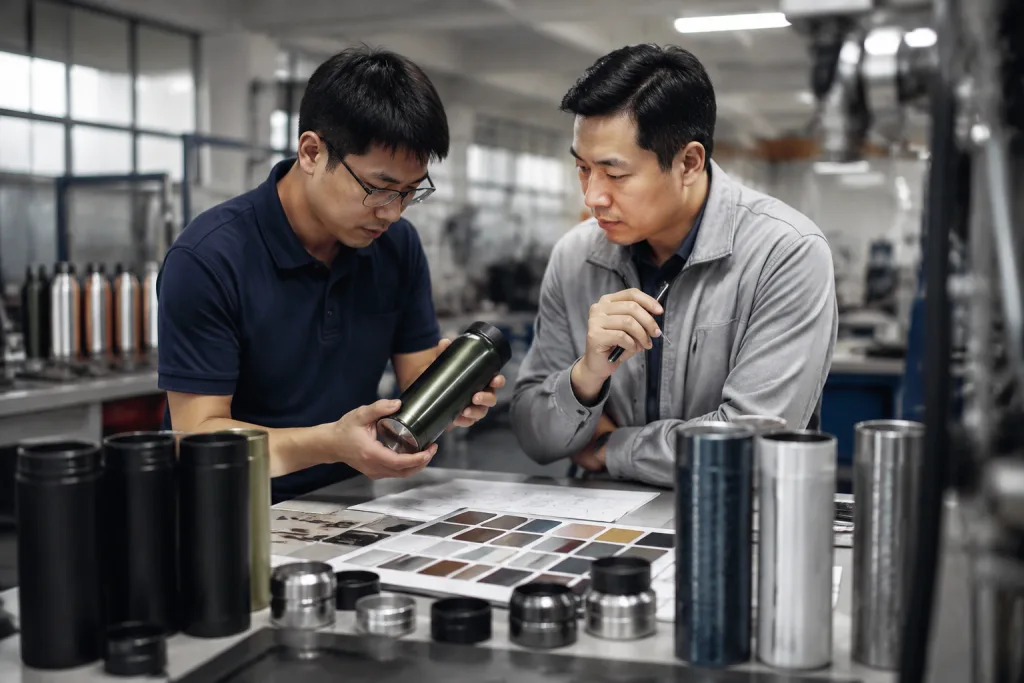
Powder coating is the normal choice for outdoor retail because it gives grip, deeper color, and better scratch resistance than basic spray paint. A standard black, white, navy, or army green moves faster on the line. Pantone matching is slower: lab dip, signed sample, then coating line booking. Expect 5-10 days just for color sampling if the match is strict. We use a D65 light box for approval, not a phone screen. Approving color from a WeChat photo is the wrong question to ask; the math does not work when 6,000 bottles arrive one shade off.
For thermos customized packaging, barcode and retail compliance need attention before the box file goes to print. A printed color box may add USD 0.18-0.55 per unit depending on paper grade, insert, and quantity. For North America ecommerce programs, FNSKU labels, suffocation warnings on polybags, and master carton drop strength matter. We have seen buyers flag a PO because “FNSKU” was typed as “FSNKU” on the label artwork, and that small typo held packing for 2 days while the printer remade stickers. For Europe, check packaging waste requirements and language markings before mass printing.
Good branding is not the decoration method with the lowest setup fee. It is the method that survives shipping, handling, dishwashing claims, and your customer service inbox.
Lead Time By Order Type
A clean bulk thermos order using an existing stainless body, standard lid, and laser logo usually needs 25-35 days after deposit and artwork approval. We run this through material allocation, body forming, seam welding, vacuum pumping, polishing, powder coating, laser marking, assembly, AQL 2.5 inspection, and export packing. On the line, QC pulls 32 pcs from a 3,000 pcs lot and checks vacuum with hot water at 95°C before cartons are sealed. During September to November, add 5-10 days because 7 out of 10 China manufacturers thermos lines are already booked with holiday and Q1 retail production.
A Pantone color order typically needs 35-45 days. The slow part is not just the color sample; it is coating powder procurement, spray line scheduling, and buyer approval loops. We had one buyer ask for three lab dips, then reply every 6 days. The math doesn't work after that. If your team takes a week to approve each dip, the factory cannot win those days back later without risking orange peel, color drift, or failed cross-hatch adhesion on the coating panel.
A new lid or modified component can push the timeline to 45-60 days. A new body mold or special capacity can take 55-75 days before shipment, sometimes more if you require pre-production samples by air, destructive testing, and revised tooling. Tooling for a new stainless thermos body or lid can range from USD 800 for a simple logo plate or silicone part to USD 5,000-15,000 for more serious mold work. We check new lid fit with a go/no-go thread gauge and a 24-hour leak test; if the gasket groove is off by 0.3 mm, QC will flag it before mass production.
Shipping is separate. From Zhejiang or nearby ports in China, sea freight to the US West Coast may be 18-25 days port-to-port in normal conditions; to the US East Coast often 30-40 days; to Northern Europe around 30-38 days. Add customs clearance, drayage, and warehouse booking. Air freight can be 5-9 days, but it usually kills the margin on thermos bulk orders because stainless bottles are bulky and heavy. A 40HQ with 500 ml bottles can run near 11,000-13,000 pcs depending on gift box size, and the buyer often flags this only after seeing the carton CBM on the packing list.
If you have a fixed launch date, work backward from delivery, not production finish. A retailer needing goods in a distribution center by September 1 should usually confirm PO, deposit, and artwork by mid-June for custom color, earlier for new tooling. We've seen this go sideways over small PO errors, like “matte balck” on the artwork line while the approved sample was Pantone Black C. Four words matter: approve the final spec.
Compliance And Inspection Budget
Thermos wholesale bulk buyers sometimes leave testing out of the first costing sheet, then panic when Amazon, a supermarket QA team, or the customs broker asks for reports. Bad timing. Put it in the budget before we open the mold file or print the first PPS label. For stainless vacuum flasks sold in Europe, buyers usually need LFGB or EU food-contact migration testing, a REACH review for coating and restricted substances, plus packaging compliance. For North America, FDA food-contact expectations, California Proposition 65 review, and ASTM or CPSIA checks depend on the product claim and target age group. We had one PO last year where “kids bottle” appeared in one line of artwork comments, and QC flagged it because that wording changed the test scope.
A normal third-party food-contact test package can cost USD 250-900 per model/material combination. If we run the same 304 stainless body, silicone gasket, and powder coating across 350 ml, 500 ml, and 750 ml sizes, the lab plan can sometimes be grouped. Do not assume one report covers every color and lid. That is the wrong question to ask. Silicone, PP plastic, spray paint, and logo ink are separate risk points, and the lab will cut real samples with a stainless blade before migration testing.
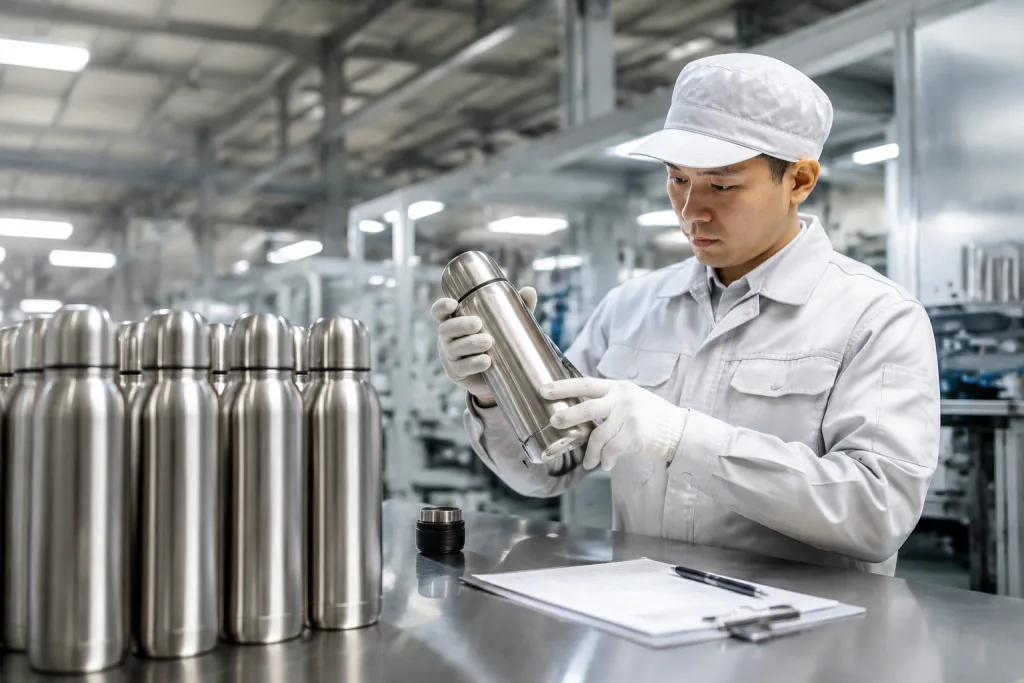
For inspection, use AQL instead of “factory says checked.” A common setup is AQL 2.5 for major defects and 4.0 for minor defects, with critical defects not accepted. For a 3,000-unit order, an inspector might pull 200 samples depending on inspection level. On the line, they should check capacity with a graduated cylinder, weight on a digital scale, coating scratches, logo position in mm, leakage, vacuum performance sample testing, barcode scan, carton marks, and drop condition. We have seen this go sideways when the barcode scanned in our office but failed on the buyer’s warehouse PDA.
A serious thermos supplier should also run in-process checks before final inspection: weld seam review, vacuum aging, coating adhesion, lid torque, silicone fit, and hot water retention sampling. At BottleForge, we usually recommend buyers approve a golden sample and keep one sealed at the factory. We mark ours with the PO number, Pantone code, and approval date, then store it in the QC cabinet beside the torque meter. When a distributor thermos program has repeat orders, that golden sample stops slow drift in color, logo size, and packaging paper.
Inspection costs are small compared with recalls or chargebacks. Budget USD 180-320 per man-day for third-party inspection in China, depending on location and agency. If the order is split across several SKUs, plan enough inspection time; 12 SKUs with mixed lids will not inspect like 1 clean SKU in the same 8-hour day. The math does not work, especially when the buyer asks for carton opening, barcode scanning, and 24-hour hot water retention checks in the same visit.
How To Compare Supplier Quotes
A thermos quote only means something when every factory prices the same spec sheet. Ask each thermos manufacturer for capacity, steel grade, wall thickness range, lid material, gasket material, coating method, logo method, packaging, MOQ per color, sample time, mass production lead time, payment terms, port, and warranty handling. We run this on a one-page quote table, down to 0.38 mm inner wall and 500 pcs per color. If one manufacturers thermos quote is USD 0.40 lower, don’t celebrate yet. Last month QC pulled the sample and found the “304 stainless” body was right, but the lid had a PP insert instead of Tritan.
Payment terms hit your cash flow before the cups hit the line. A common China factory thermos term is 30% deposit and 70% balance before shipment. Larger repeat buyers may negotiate balance after inspection or against copy documents. For first orders, do not expect open account terms. We had one buyer approve a sample on Friday, then wait 9 days to wire the deposit; their 18-day lead time became 27 days because the powder coating line was already booked. If you are a promotional agency with a hard event date, pay the deposit quickly after sample approval; production slots are not held by polite emails.
FOB is usually cleaner than EXW for overseas buyers because the supplier thermos team handles local export paperwork and delivery to port. CIF looks easy on a quote, but the math can go sideways when destination charges show up at the warehouse door. DDP can work for small ecommerce shipments, though serious wholesale buyers should confirm who is importer of record and who carries compliance responsibility. We ship Ningbo FOB most weeks, and our forwarder checks the HS code before the booking; one typo on a PO, “vacuum flask” vs “plastic bottle,” can slow customs by 2 days.
Outdoor retailers should ask about repeatability. Can the thermos factory hold the same matte green six months later? Can the lid gasket be replaced? Can cartons meet your pallet height? Promotional brands should ask about rush capacity, logo proofing, and mixed SKU packing with barcode labels. Thermos distributors should ask whether spare lids and gaskets can be ordered at 1-2% of shipment quantity. This is the wrong question to ask: “Can you make it cheaper?” Ask whether the next 3,000 pcs will match the approved sample under D65 light, because the buyer will flag color drift before they praise a USD 0.08 saving.
The best suppliers thermos relationship is boring in the right way: clear drawings, realistic lead times, documented tests, and no surprise rework. We like boring. A 2D drawing with thread diameter, gasket hardness, carton drop-test notes, and AQL 2.5 target saves more money than a long sales call. If a factory promises a fully custom thermos in 20 days at a below-market price, assume something important is being skipped; we’ve seen this go sideways when the vacuum test station caught 6 leaking pieces out of the first 80.
Send Your Thermos Spec For A Factory Quote
Share capacity, quantity, logo method, target market, and deadline. We will return MOQ, FOB pricing, sample time, and production lead time.
Frequently asked questions
What is a realistic MOQ for thermos wholesale bulk orders?
For an existing stainless thermos model, 500 units per color is realistic for laser engraving or one-color silkscreen. If you need Pantone powder coating, printed retail box, or several logo positions, 1,000 units is a cleaner starting point. For a customized thermos with modified lid color, silicone boot, or private label packaging, plan around 3,000 units. New body or lid tooling usually needs 5,000-10,000 units to make the tooling cost sensible. Be careful when a supplier says “MOQ 500” but later applies that to each size, each color, and each artwork version.
How much should a custom stainless thermos cost FOB China?
A standard 500 ml stainless vacuum thermos normally sits around USD 3.20-4.10 FOB China with an existing mold, 304 stainless steel, standard lid, and simple logo. A stronger retail-grade custom thermos with Pantone powder coating, laser logo, color box, and better lid often lands at USD 4.80-6.80. Larger 750 ml or 1 L models can add USD 0.60-1.80 depending on steel weight and lid design. If you request 316 inner steel, copper plating, or premium packaging, add another USD 0.20-0.90 per unit. Always compare quotes using the same port, packaging, and inspection assumptions.
How long does a bulk thermos order take from sample to shipment?
For a logo-only bulk thermos order on an existing model, sample preparation is usually 5-8 days and mass production takes 25-35 days after deposit and artwork approval. Pantone coating adds color sampling and line scheduling, so 35-45 days is more realistic. A modified lid or custom component can move the production window to 45-60 days. New tooling often needs 55-75 days before goods are ready. Add ocean transit separately: roughly 18-25 days to the US West Coast, 30-40 days to the US East Coast, and 30-38 days to Northern Europe in normal conditions.
Which logo method is best for outdoor retail thermos products?
For outdoor retail, laser engraving on powder coating is usually the safest choice because it resists abrasion better than basic printing and looks clean on matte finishes. It may cost USD 0.12-0.35 per position after a USD 30-60 setup. Silkscreen is economical for simple one-color logos, often USD 0.06-0.18 per print, but it needs adhesion testing and works best on smoother surfaces. Heat transfer is better for multi-color artwork or full-wrap designs, but cost and reject rate are higher. If the thermos will be clipped to packs, placed in cup holders, or handled outdoors, test coating and logo abrasion before production.
What documents should thermos distributors request before paying balance?
Before balance payment, thermos distributors should request the final inspection report, packing list, commercial invoice, carton marks, product photos, and any required food-contact test reports. For Europe, ask for LFGB or EU food-contact migration data and REACH-related material statements when applicable. For North America, request FDA food-contact material confirmation and Proposition 65 review if selling in California. If the order is for ecommerce, confirm barcode scans, FNSKU placement, carton weight, and drop test results. For a 3,000-unit order, use AQL 2.5/4.0 inspection and make sure leakage, coating, logo position, and vacuum performance are included.