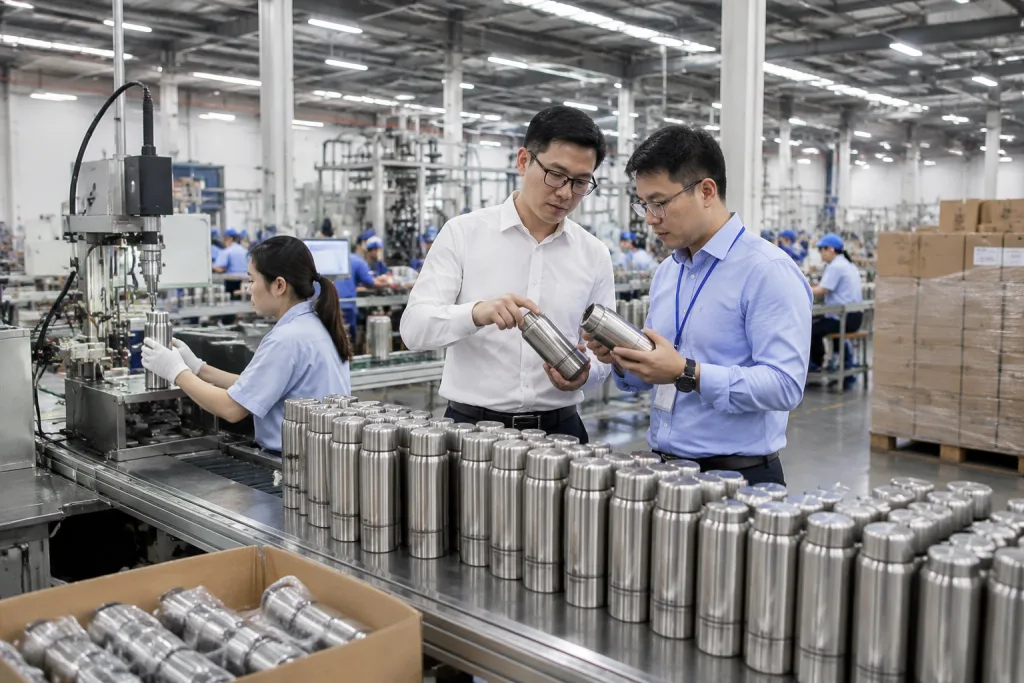
Key Takeaways
- A realistic MOQ for a stainless thermos starts at 500-1,000 pcs, with sample lead time around 7 days
- A standard factory thermos run from Zhejiang can ship in 25-35 days after sample approval
- 304 stainless steel inner and outer walls with 0.4-0.5 mm thickness is the safe baseline for retail
- AQL 2.5 for critical defects and 4.0 for minor defects is a normal QC target for export orders
You search thermos supplier near me because you need speed, fewer surprises, and someone who will not panic when the PO says 5,000 pcs but the artwork file is named “final-final-3.ai.” Fair ask. For outdoor retail or a promo drop, finding a stainless thermos is the easy part. The real test is whether the thermos supplier can keep color within 1 Delta E, hold lid fit to 0.2 mm, stop slow leaks after vacuum testing, and keep the logo sharp when the line is running 800 pcs per hour.
We run this type of order every week in Zhejiang, China. The pattern is familiar: the buyer needs a custom thermos, a real MOQ, a lead time like 18 days for plain stock vs 32 days for custom powder coating, and proof before the cartons leave our dock. QC pulled a 304 stainless sample last Tuesday because the silicone ring sat 0.6 mm proud; that is the kind of small issue that becomes a return claim if nobody checks it. A solid thermos manufacturer should walk you through the spec sheet, pre-production sample, and AQL check. Vague promises do not ship containers.
The Buyer Walks In With One Use Case
Let’s use a sourcing case we see 6 or 7 times every winter. You are an outdoor retailer in Canada or a promotional brand in Germany. You need 3,000 units of a 500 ml stainless thermos for winter gifting and retail shelves. Not a random catalog item. You need a customizable thermos that fits an 80 mm backpack side pocket, keeps drinks hot for 8-12 hours, and passes a 1-meter drop test with no lid seepage. Last November, QC pulled the sample after the third drop because the silicone ring had shifted 1.5 mm. That is the kind of detail that decides whether the order ships clean.
The first buyer mistake is asking for a price before the use case is locked. This is the wrong question to ask. That is how a thermos vendor quote on a 201 stainless shell gets compared with another quote on 304 stainless, then everyone wonders why the gap is 18%. The first brief should cover capacity and heat target, then lid style and surface finish, then logo method with carton packing, including 24 pcs per export carton or your own retail box size. If your customer is outdoors, I would not start with a paper-thin office bottle. We run a double-wall vacuum stainless body, powder coat or matte spray, and a glove-friendly lid with at least 4 mm grip depth. The line checks vacuum performance with a water bath and thermometer before packing.
At this stage, the best thermos supplier near me result is not the one closest to your office. It is the factory that replies clearly, sends 2D drawings within 24 hours, and tells you which parts can change without wrecking the cost. We have seen this go sideways when a buyer asks for a new lid mold after sample approval; the math does not work on 3,000 units unless the MOQ or mold fee is accepted. One PO even came in with “mat black” instead of “matte black,” and the buyer flagged it only after the pre-production sample. If you want to compare structures, see stainless thermos product options and how MOQ changes the unit price.
Specify The Thermos Like An Engineer
After the use case is fixed, the order needs a real spec sheet. A serious thermos manufacturer should not quote from capacity alone. We ask for wall construction, steel grade, lid material, seal material, finish code, and carton drop requirement before pricing. For a retail bottle, I usually spec 304 stainless steel on both inner and outer walls, 0.4-0.5 mm wall thickness checked with a Mitutoyo caliper, PP or Tritan lid parts, and a food-contact silicone seal. If the buyer pushes for a lighter body, 201 stainless can cut cost by about 8-12%, but the math doesn't work for premium outdoor programs after returns and coating complaints.
For a custom thermos, branding is not decoration at the end. It affects scrap rate. Screen print is safe for one or two spot colors, with a simple logo under 80 mm wide. Laser engraving gives a cleaner retail look and survives abrasion better; QC pulled the sample last week after 200 rubs on our coating test jig and the laser mark stayed clean. If your artwork has gradients, thin lines, or a 360-degree wrap, ask whether the print area is curved and whether the line can hold registration within 1.5 mm. We have seen too many thermos promotional projects go sideways because the buyer approved flat artwork and skipped the curved bottle proof.
- Capacity: 350 ml for kids or gifts, 500 ml for office use, or 750 ml for outdoor sets
- Thermal target: 8-12 hours hot, 12-18 hours cold
- Finish: powder coat for grip, matte spray for low-cost color, or brushed steel for scratch tolerance
- Logo: silk screen for spot color, laser for metal exposure, emboss for molded parts, or UV print for full-color artwork
- Packing: color box for retail shelf, mailer box for e-commerce drop tests, or bulk carton for promo orders
If you want to match logo method to the product, use this guide before you send the PO: silkscreen vs laser engraving and custom logo options. Small thing, but check the wording. We had one PO say “laser” while the attached artwork file was named “UV_fullcolor.ai,” and that 6-word typo cost 2 days before the line could start.
Quote The Order Without Guesswork
Now ask for a quote you can actually compare. For a 500 ml stainless thermos from a Zhejiang factory, a typical FOB China price range for a 3,000-piece run might land around USD 3.20 to 5.80, based on steel grade, coating, lid structure, and logo work. A one-color logo on a standard powder-coated body should cost less than a double-finish bottle with a custom lid and silicone carry ring. Normal spread. The red flag is a quote that skips the sample fee, mold charge, inner box spec, or 5-layer export carton upgrade; we had one buyer flag this after their PO said “white box” while the quote meant bulk pack.
A decent factory thermos supplier should split the offer into sample fee, unit price, packaging, and trade term. Ask whether the price is FOB Ningbo, FOB Shanghai, or EXW. Ask what happens if you need mixed colors. Ask whether the factory can hold a 500 pcs MOQ per color or whether it needs 1,000 pcs. A real thermos supplier in China will answer fast because the line schedule is not a mystery; we check it against the coating room slots and laser-marking capacity. At our Zhejiang facility, we run about 180,000 units per month on stainless drinkware, and a standard lead time after sample sign-off is 25-35 days.
Good quoting is specific: steel grade, wall thickness in mm, finish, logo method, carton count, and FOB port. Anything less is a guess with a unit price attached.
For buyers comparing factory scale and export readiness, see our production capabilities and who we are in Zhejiang, China. QC pulled a random 500 ml sample last week and the first thing checked was not the logo; it was mouth diameter, lid fit, and carton drop condition after packing.
Check Samples Before Mass Production
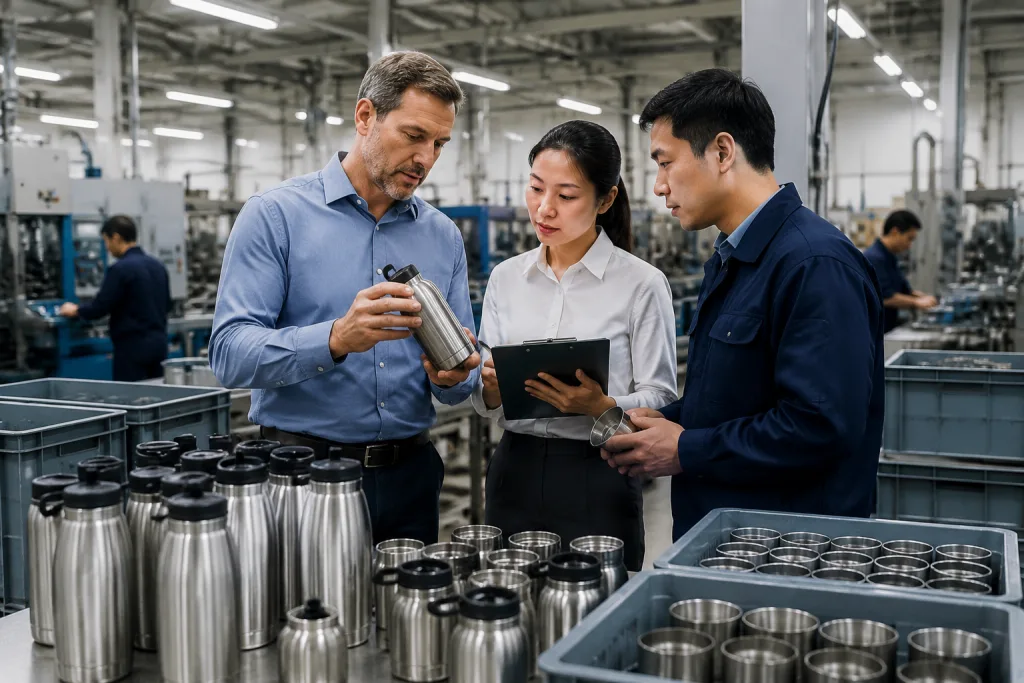
Do not approve a bulk thermos order from photos. We ask for 3 samples on export jobs: one blank body, one branded sample, and one pre-production sample made after the line is set, not from a show-room shelf. This is where a thermos factory with real process control separates itself from a trader with nice pictures. Check lid thread engagement with a thread gauge, seal compression with a 0.2 mm feeler check, and cup-body concentricity on a simple V-block. QC pulled one sample last month where the lid felt smooth by hand, but after a 6-hour carton vibration test it wept at the silicone ring. Photos missed it.
For Europe and North America, I look at 2 items first: leak performance and compliance. If the bottle goes to retail, ask for material declarations and test support for REACH and food-contact safety, plus FDA-related documentation when the PO says US market. Do not ask, “Does the sample look good?” That is the wrong question. Ask for a boiling-water cycle test, vacuum retention check after 12 hours, and a 1 meter drop test. We run 95°C water through the sample, weigh it before and after on a 0.1 g scale, then leave it sealed on the bench. Pretty samples still fail.
- Leak test: inverted for 24 hours
- Vacuum check: no obvious temperature loss from the sealed body
- Drop test: 1 meter, 3 sides, carton and unit
- Print check: rub test with 3M tape, 500 g pressure, and Pantone color match
If your project needs stricter inspection language, use quality control standards as your benchmark. We have seen this go sideways when the buyer’s PO says “logo black” but the approved artwork says Pantone 426C, so lock the sample code and revision date before mass production starts.
Run QC Like You Mean It
Bulk production is where 3 out of 10 thermos suppliers start cutting corners, and that bill lands on the buyer. Before shipment, we lock the inspection plan on the QC sheet: AQL limits, defect categories, and pack-out checks. For export drinkware, I usually see AQL 2.5 for major defects and AQL 4.0 for minor defects, with zero tolerance for leaks, wrong capacity, broken seals, or incorrect logo placement. QC pulled a 500 ml sample last month with the logo 4 mm off center; the buyer flagged it before we even reached carton sealing. For a distributor thermos program with retail accountability, this standard is not strict. It is normal.
During QC, the inspector should verify 100% carton labeling against the order list, count inner boxes, check EAN or FNSKU placement if you sell on marketplace channels, and confirm that the master carton matches the agreed drop test spec. If you are working with a thermos distributor or thermos manufacturer on a private label program, ask for photos of 12 random samples from the line, not only the final packed goods. We run lid torque checks across at least 30 random units with a digital torque meter, and I want the spread kept inside 0.3 N·m where the lid design allows it. Small variation there becomes a customer complaint later. We have seen this go sideways.
For a distributor thermos order, the boring details beat the artwork. The carton must survive transshipment. The finish must not scratch during packing; on the line, we check this with a white cotton glove and 3M tape after the bottle passes the sleeve machine. The lid must seal when the bottle has been hot-filled and cooled, not just when it sits empty on a showroom table. That is what separates a good thermos supplier from a cheap one.
Ship It And Keep The Repeat Order
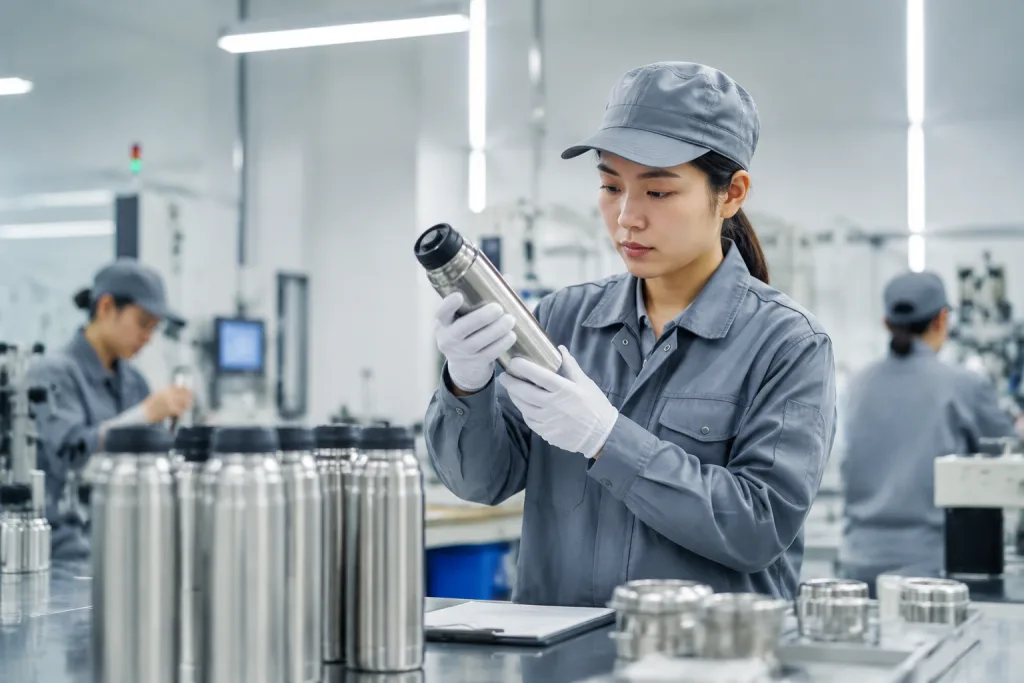
After QC passes, lock the shipping plan before the last carton is taped. Waiting until goods are finished to ask about freight is the wrong question to ask; we’ve seen a buyer lose 6 days because the PO said “Amazon FBA” but had no pallet height or FNSKU position. For a 3,000-piece thermos bulk order, decide early: sea freight for normal stock, air freight for a late launch, or 600 pieces by air with the balance by sea. On the line, QC pulled the final sample with a caliper and checked the color box fit at 0.5 mm clearance before we released the packing list. If you sell into Amazon or a retail chain, carton dimensions, pallet loading, and barcode placement must be frozen before the cargo leaves China.
This is where a good supplier thermos relationship earns its money. The first order should become the production template for the second order. Save the approved sample, AI print file, carton spec, and QC record; we also keep one signed color box in the sample room with the order number taped on the side. If you reorder in 90 days, the factory can run the same customized thermos without arguing over lid gloss, logo size, or whether the silicone ring was grey or black. A dependable factory in Zhejiang keeps the tooling, process sheet, and packaging reference ready, so the repeat order starts clean.
If your business needs a faster landing page for buyer inquiries, route them to contact our sales team and view all drinkware products. A practical thermos supplier does not just ship boxes. We ship repeatable specs. For one promotional client, the buyer flagged a typo on the PO—“matte balck” instead of “matte black”—and QC caught it before mass printing 5,000 sleeves. That kind of control helps your thermos distributors, stores, or promotional clients reorder without drama, and it keeps margins intact.
Request your stainless thermos quote today
Send capacity, logo, finish, and target quantity. We will return a practical spec, FOB price, and QC plan from Zhejiang, China.
Frequently asked questions
What is a normal MOQ for a custom stainless thermos?
For most factory thermos programs, MOQ starts around 500-1,000 pieces per design and 1-2 logo colors. If you need multiple colors or a special lid, the MOQ often rises to 1,500 pieces. A serious thermos supplier near me should tell you the MOQ before asking for artwork. For first-time buyers, 500 pcs is enough to test sell-through without overloading inventory. In Zhejiang, China, we often quote faster on standard molds than on unusual shapes, so a simple 500 ml body usually gives you the best balance of cost and speed.
How long does a custom thermos order take?
Sample production usually takes 5-7 days if the structure is standard. After sample approval, bulk production often takes 25-35 days for a normal 3,000-piece order. Add 20-35 days for sea freight to North America or Europe, depending on the port and season. If you want a promotional thermos for a trade show, you should work backward at least 60 days from your delivery date. A thermos manufacturer in China can move faster on repeat orders, but only if the spec and artwork are already locked.
Which stainless steel grade should I choose?
Use 304 stainless steel for both inner and outer walls if you want a dependable retail-grade bottle. It is the safest default for a custom thermos and holds up well in hot and cold use. 201 stainless can reduce the unit price by roughly 8-15%, but it is a weaker choice for premium outdoor retail and long-term brand use. For a buyer comparing thermos manufacturers, ask for material declarations and wall thickness too. I would normally target 0.4-0.5 mm wall thickness for a balanced product.
What branding methods work best on a promotional thermos?
Silk screen is the cheapest for one or two solid colors. Laser engraving costs more, but it gives a cleaner permanent mark and is better for premium campaigns. UV print works when your design has multiple colors or fine detail, but you need to check abrasion resistance. For a thermos promotional order, I would choose laser for retail and screen print for large giveaways. Ask for a pre-production sample because a logo that looks sharp on a flat proof can shift on a curved body.
How do I know if a thermos supplier is export-ready?
Ask for production capacity, QC flow, and export documents. A real thermos supplier should show monthly output, inspection standards, carton specs, and support for REACH or food-contact compliance where needed. If the factory says it can do 180,000 units per month, ask how much of that is stainless drinkware versus mixed categories. You should also confirm FOB port, lead time, and whether they can handle barcode or FNSKU labeling. A supplier thermos partner that answers quickly and specifically is usually safer than one that only sends pretty photos.