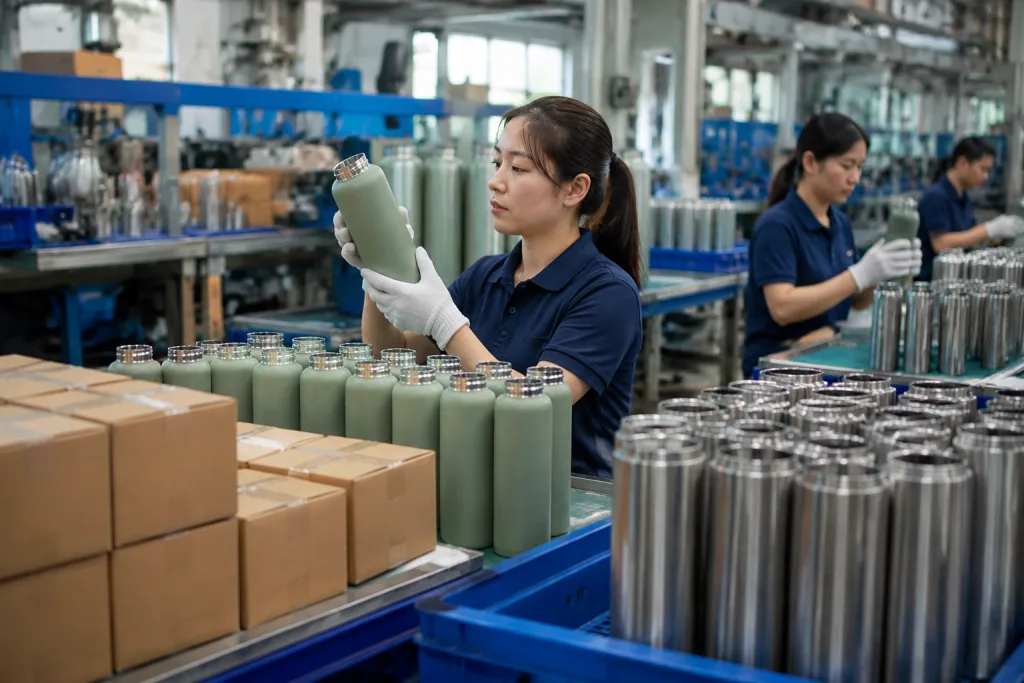
Key Takeaways
- A serious thermos supplier list should compare MOQ from 500 to 3,000 units, not only unit price
- For custom thermos orders, decoration choice can change lead time by 5-12 days
- 304 stainless steel with 0.45-0.55 mm outer wall is common for retail-grade thermos bulk programs
- Use AQL 2.5/4.0 inspection and carton drop tests before releasing final balance payment
A thermos supplier list is dead weight if it only gives you names. For outdoor retailers and promo brands, the work starts with matching one supplier thermos model to margin, launch date, logo process, and compliance file. A low China quote can still burn money if QC pulls 8 leaking lids from a 200-piece pre-shipment check, or if the master carton splits during a 76 cm drop test at 5,000 units.
Ask for pricing after the basic math is clear: bottle construction, logo method, MOQ, AQL, tooling cost, and lead time. Short list first. BottleForge Industrial manufactures stainless vacuum bottles in Zhejiang, China, and we see the same buying mistakes every season on the line, from 304 stainless being written as “340 stainless” on a PO to buyers asking for 18-day production when the powder coating schedule needs 24 days. The wrong question is “who is cheapest?” Better buyers ask about steel grade, MOQ, AQL, tooling, and the real ship date before they chase the quote.
Start With Four Buying Decisions
Before you build a thermos supplier list, lock four buying decisions. First, pin down the use case: hiking retail, corporate gift, school program, employee kit, or sports club resale. A 500 ml promotional thermos and a 1,000 ml outdoor bottle sit on the same catalog page, but we run different checks on lid torque with a digital torque meter, handle pull strength, powder coat thickness in μm, and carton drop weight. Same shape, different risk.
Second, decide the insulation claim you are willing to print on the box. About 8 out of 10 suppliers thermos listings we see say 12 hours hot and 24 hours cold, then send no test sheet when the buyer asks. The result depends on water fill level, starting temperature, room temperature, lid design, and bottle size. For a retail claim that will survive buyer review, ask for test data at 95°C starting water temperature and 20°C ambient temperature. If the bottle stays above 55°C after 6 hours, it passes daily-use expectations in most channels. Outdoor retailers usually push for 8-12 hour performance, and QC should pull one sample from the line, not a polished showroom piece.
Third, choose stock factory thermos with logo or fully customized thermos. Stock bodies are faster and cheaper; we can often ship 3,000 pcs in 12 days vs 18 days when the buyer changes the coating color after pre-production sample approval. A custom thermos with new cap mold, Pantone powder coat, printed sleeve, and retail box is a different job, with mold trial, color plaque approval, and carton artwork checking. Fourth, decide your risk tolerance. If your campaign date is fixed, use proven molds and standard colors. If your brand is building a permanent SKU, tooling can justify the extra 25-35 days, but the math does not work for a one-off 800 pc giveaway.
A good supplier thermos conversation starts here. If a thermos vendor cannot talk through these trade-offs clearly, keep them off your shortlist. We have seen this go sideways over small details, including a PO typo that said “matte black lid” while the approved sample had a stainless push button.
Construction Details That Change Cost
Stainless vacuum bottles look almost the same in catalog photos. The quote difference hides in the shell. On a manufacturer thermos RFQ, we ask buyers to lock the inner steel grade, outer steel grade, wall thickness, vacuum process, lid resin, gasket spec, coating type, and logo process on the PO, not in a WeChat message. Our incoming QC checks 304 stainless steel with an XRF gun, and last month QC pulled 8 samples from a trial lot because the PO said “304 inner” but the supplier sheet only wrote “SS inner.” For food-contact export to Europe and North America, 304 stainless steel on the inner wall is the normal baseline. Some low-cost thermos manufacturers use 201 stainless on the outer wall; it can pass for budget promotional thermos projects, but I would not choose it for salty coastal markets or premium outdoor retail. We have seen that go sideways.
Wall thickness matters. A common retail range is 0.45-0.55 mm on the outer shell and 0.35-0.45 mm on the inner liner. We measure it with a digital thickness gauge before polishing, because after stretch forming the shoulder can run 0.03 mm thinner than the straight body. Thinner steel cuts price and weight, but dents faster. Simple math. For bulk thermos orders moving through parcel networks, dent resistance is not a small detail; one dropped master carton can create 24 customer complaints, and the buyer will not care that the carton passed a clean lab report.
The lid is often the failure point. Ask whether the lid uses PP, Tritan, or stainless components, then ask for the exact gasket material and Shore hardness if the cap seals under pressure. Food-grade silicone is the usual choice. For a thermos customized with a flip lid or push-button cap, request leakage testing at 180 degrees upside down for at least 30 minutes; we run this on a stainless test rack, 12 pcs at a time, after the line warms up. For children’s or commuter products, check small parts and spring fatigue if the cap has a mechanism. The wrong question is “does it leak?” Ask how many cycles it survives after 3,000 open-close clicks.
At our Zhejiang facility, standard stainless thermos capacity is about 450,000 units/month across shared production lines, with typical MOQ from 1,000 units per color for powder-coated models. Those numbers matter because a factory thermos supplier with too little capacity may accept your order and then subcontract the hard parts. We ship mixed-color orders every week, but the line still needs 2 hours to clean powder booths between matte black and light cream, so a 1,000 pcs/color MOQ is not just sales talk. If a supplier promises 300 pcs/color, 7 colors, and 12-day delivery during peak season, the math does not work.
Customization Is Not One Thing
Buyers ask for a customizable thermos and expect one quote. Wrong question. On our line, “custom” can mean a 35 x 18 mm laser logo, one-color silkscreen on a 500 ml body, heat-transfer artwork around a tapered cup, a new PP lid, a CMYK retail box, a GS1 barcode label, or Amazon FBA carton prep. Each choice changes the setup fee, the reject rate, and the ship date; last month QC pulled 27 pcs from a 2,000 pcs logo run because the print sat 2 mm too close to the bottom radius.
Laser engraving is clean and durable, especially on powder coating or bare 304 stainless steel. We run it with a fiber laser, and the operator checks logo depth with a 10x loupe before packing. It fits outdoor retailers that want a premium mark with fewer artwork surprises. Silkscreen costs less for simple logos and works well for promotional thermos orders above 1,000 units. Multi-color graphics need cleaner AI files, tighter registration, and usually add 3-7 days. Full-wrap heat transfer looks strong on shelf, but the buyer flagged it once when the seam drifted 3 mm on a curved body.
For a thermos promotional campaign, the delivery date often matters more than a perfect retail finish. Be honest about that. For a permanent retail SKU, focus on coating adhesion, scratch resistance, and color consistency, because returns get expensive fast. Ask for a cross-hatch adhesion test on powder coating and a Pantone tolerance agreement before mass production; our QC team uses 3M tape and a D65 light box for this check. If you need a customized thermos with a new mold, expect tooling cost from USD 1,500-8,000 depending on cap complexity and body shape.
The practical rule: never approve a thermos manufacturer based only on a digital mockup. We have seen this go sideways when a PO said “matte black” but the approved sample was PMS Black 6 C on a glossy coating. Approve a physical pre-production sample with your logo, coating, lid, box, and barcode. Small problems are cheap at sample stage.
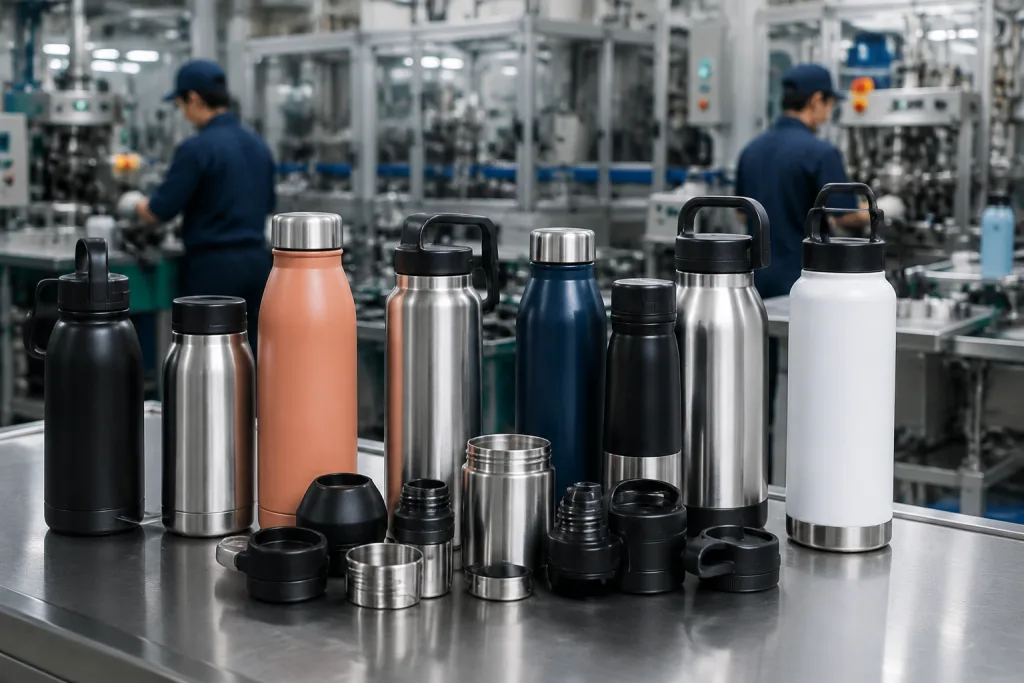
MOQ, Price, and Landed Margin
A thermos supplier list should show order economics, not just FOB unit prices. For stainless thermos bulk buying, we usually quote USD 3.20-7.80 FOB China for 500-1,000 ml double-wall bottles, depending on 304 stainless thickness, lid structure, coating, logo method, packaging, and order volume. We run 0.4 mm and 0.5 mm body material on different jobs, and QC weighs the first 12 samples before packing approval. Large thermos bulk programs can go below that range when the bottle is a clean shape, one lid, one carton spec, and repeat POs arrive on time.
MOQ is not a punishment. It pays for line setup time, powder-coating changeover, raw material purchasing, and inspection cost. For BottleForge Industrial in Zhejiang, China, practical MOQ is usually 1,000 units per color for stock stainless thermos shapes, 2,000-3,000 units for special powder colors, and 5,000 units or more for new lid tooling. On the line, a color change can eat 2.5 hours after we clean the spray booth and adjust the curing oven to 180-200°C. Some suppliers thermos offers advertise 100-unit MOQ, but the buyer should ask one direct question: are they shipping stock inventory or manufacturing the order?
Do the landed margin calculation before artwork approval. Add sea freight, duty, customs broker fees, inland trucking, warehouse handling, and inspection. For North America, a 750 ml stainless bottle that is USD 4.60 FOB Ningbo may land at roughly USD 5.40-6.20 depending on carton cube, sailing rate, and duty code. We have seen this go sideways when a buyer priced from FOB only, then found the master carton measured 58 x 42 x 31 cm and billed more CBM than their sheet allowed. Air freight kills margin fast; a bottle is mostly air inside, but the carton volume still bills heavily.
If you are a distributor thermos buyer serving multiple clients, build your quote sheet with price breaks at 500, 1,000, 3,000, and 5,000 units. That helps push clients toward quantities where decoration setup and freight make sense. The math does not work when a client wants 500 units, three colors, laser logo, and individual gift boxes; we had one PO where the buyer even typed “matte back” instead of “matte black,” and QC pulled the sample before the wrong color went into mass production.
Compliance Files Buyers Should Request
For Europe and North America, compliance is not “paperwork for later.” Ask for test reports before deposit, because after shipment the math doesn't work: a 1x40HQ held at port costs more than a proper LFGB report. For EU markets, request LFGB or EU 1935/2004 food-contact testing, REACH-related material declarations where applicable, and packaging compliance if you sell through formal retail; our export desk checks the report name against the PO because one buyer once typed “LFGB lid only” by mistake. For the United States, ask for FDA food-contact conformity and, when relevant, California Proposition 65 screening. Children’s products need CPSIA-related review and ASTM checks when the age grade, straw lid, carry handle, or small detachable parts make it necessary.
Factory audits still matter. BSCI, Sedex, ISO 9001, or similar systems do not guarantee a clean shipment, but they show whether the manufacturer thermos operation has basic process discipline. If a supplier thermos company dodges audit questions, treat that as a red flag. We have seen 7 thermos suppliers in one sourcing round turn out to be trading companies; some were solid, but the buyer still needed to know who owned the laser welding station, vacuum furnace, powder coating line, and final AQL table. Control sits on the floor.
Ask for a material list: inner wall steel, outer wall steel, lid plastic, gasket silicone, coating, ink, and packaging materials. Push for grades and model codes, not just “food grade” on a PDF. On our line, QC pulled the sample once because the lid gasket measured 1.8 mm instead of the approved 2.2 mm, and the leak test failed after 3 upside-down cycles. For custom logo work, inks and coatings are part of compliance. A beautiful thermos customized with the wrong ink can become a blocked shipment.
For quality control, specify AQL before production starts. A common approach is AQL 2.5 for major defects and 4.0 for minor defects, with critical defects set to zero tolerance. Critical defects include leakage, sharp edges, contamination, wrong material, and unsafe lid failure; spell out the test method, such as 100% leak check after assembly and random vacuum retention check at 6 hours. Put these requirements on the purchase order, not only in email chat. We ship what the PO says, and we have seen this go sideways when the buyer flagged “no scratches” only after the cartons were sealed.

Shortlisting Real Thermos Suppliers
Build the actual thermos supplier list with a score sheet, not gut feel. We run a 100-point check: 20 points for product fit, 15 for factory capability, 15 for compliance documents, 15 for sample quality, 10 for communication speed, 10 for pricing transparency, 10 for lead time reliability, 5 for packaging support. Last month QC pulled 6 samples from one “top” quote and found the lid thread off by 0.4 mm. Nice talk did not save that supplier.
Ask direct questions. What is your monthly stainless thermos capacity? Which processes are in-house? What is subcontracted? Can you send current-production photos for welding, vacuum testing, powder coating, and final inspection, with today’s job card visible? What is the normal lead time after sample approval? For standard custom thermos orders, 25-35 days after deposit and artwork approval is common in China. Complex retail packaging or new mold work can push the timeline to 45-60 days; we have seen gift-box changes add 12 days vs 18 days when the buyer switched from white card to 1200 g greyboard after the PO was signed.
Watch the wording around thermos manufacturers and thermos vendor roles. A trading company may call itself a factory thermos supplier. That is not automatically bad. A strong trading partner can manage 3 factories and cut your email chasing. If you need stable repeat production, Pantone color matching within Delta E 1.5, and engineering changes on a lid gasket, direct factory access matters. The wrong question to ask is “factory or trader?” Ask who controls the line and who signs off when the buyer flags a leaking sample.
For outdoor retailers, prioritize durability testing, spare lids, packaging strength, and repeat color control. For promotional brands, check fast sampling, decoration accuracy, carton labeling, and on-time shipment. Distributors thermos buyers often need both. We ship mixed cartons for 2,000-5,000 pcs orders, and a small typo on a PO, like “mat black” instead of “matte black,” can hold artwork approval for 3 days. The best thermos suppliers will tell you what they cannot do well. A quote that says yes to everything is where we have seen this go sideways.
Sampling and Production Control
The sample stage decides whether a supplier stays on your thermos shortlist. We usually ask for 2 samples: one standard stock sample to check welding, polishing, lid fit, and vacuum performance; one pre-production sample with your logo, Pantone color, retail box, barcode, and warning label. For a custom thermos, skipping the pre-production sample is the wrong question to ask. QC needs that signed sample on the packing table, down to the 0.3 mm logo position tolerance.
Check the sample like an inspector, not like a marketer. Fill it with 95°C water, weigh it full and empty on a 5 kg digital scale, leave it for 6 hours, and record the temperature. Turn it upside down over white paper for 30 minutes. Open and close the lid 50 times. Scratch the coating lightly in a hidden area with a coin or cross-hatch cutter. Put the bottle in the retail box and shake the carton. Simple test. None of this replaces lab testing, but QC pulled samples this way last month and caught a loose tea filter before 3,000 units went into cartons.
During production, ask for first-article photos and mid-production updates. For a 5,000-unit thermos custom order, a mid-line inspection around 30-50% completion is sensible if the delivery date is tight. Final random inspection should happen when 80-100% of goods are finished and at least 80% packed. Include barcode scans, carton marks, FNSKU labels if needed, drop testing from 76 cm, leakage testing, and appearance checks under a 6500K inspection lamp. We run this on the line because the buyer usually flags the same 2 things: color shade and dirty retail boxes.
If the order ships FOB Ningbo or Shanghai, agree who books freight, who handles export documents, and when balance payment is due. We have seen 4-day delays turn into 12 days vs 18 days on the water because nobody confirmed the vessel cutoff. The math does not work when a buyer approves artwork on Friday, pays balance on Tuesday, and still expects the original ETD. Write down the approval sample, packing method, AQL level, shipping mark, and latest vessel date before the deposit leaves your account; even one typo on a PO carton mark can send the warehouse team back to re-label 520 cartons.
Send Your Thermos Brief for Factory Review
Share capacity, quantity, logo method, market, and delivery date. We will return a practical MOQ, FOB quote, and production route.
Frequently asked questions
How many suppliers should be on my thermos supplier list?
For a serious sourcing round, start with 8-12 thermos suppliers, then reduce to 3-4 after the first quote and document check. You want at least one direct factory thermos manufacturer, one strong trading partner, and one backup thermos vendor with stock molds. After sampling, keep 2 approved suppliers: your main manufacturer thermos partner and a backup for urgent orders or capacity issues. Do not manage 10 suppliers for every order; that wastes time and weakens pricing leverage. Score each candidate on MOQ, lead time, compliance, sample quality, decoration ability, and communication. If a supplier cannot answer basic questions on steel grade, AQL, and packaging within 24-48 hours, they should not stay on the list.
What MOQ should I expect for custom stainless thermos orders?
For most custom thermos programs from China, expect MOQ around 1,000 units per color for existing bottle molds and standard powder coating. Laser engraving or one-color silkscreen can sometimes start at 500 units if the factory has stock bodies. Special Pantone coating usually moves MOQ to 2,000-3,000 units because of coating setup and loss. A new cap, new body shape, or customized thermos mold can require 5,000 units or more, plus tooling cost from about USD 1,500-8,000. If you see 100-unit MOQ for a fully thermos customized project, it is likely stock decoration, not true manufacturing.
What is a realistic lead time for bulk thermos production?
For standard bulk thermos orders using existing stainless bodies, plan 25-35 days after deposit, artwork approval, and sample confirmation. Add 5-12 days for more complex decoration, such as full-wrap heat transfer, multi-color UV print, or retail packaging with inserts. New mold development can add 25-35 days before mass production starts. Sea freight from China to North America or Europe often adds 25-45 days port-to-port, depending on route and season. If you need a promotional thermos campaign in 6 weeks total, choose stock shapes, simple logos, and confirm carton labeling early. Air freight is possible but often adds USD 1.50-4.00 per bottle.
How do I compare FOB prices from different thermos manufacturers?
Make every thermos manufacturer quote the same specification: capacity, steel grade, wall thickness, lid type, coating, logo method, packaging, carton quantity, Incoterm, port, MOQ, and lead time. A USD 3.90 FOB quote may not be cheaper than USD 4.30 if it uses thinner steel, weaker coating, or a plain white box instead of retail packaging. Ask for carton dimensions and gross weight so you can estimate freight. For a 750 ml stainless bottle, landed cost can vary by USD 0.40-0.90 per unit just from carton cube and shipping season. Compare total landed cost and defect risk, not only FOB China price.
Which logo method is best for promotional thermos orders?
For promotional thermos orders with simple logos, one-color silkscreen is usually the best balance of cost and speed. It works well from 1,000 units and keeps setup cost low. Laser engraving is better when you want a premium look, high durability, and no ink compliance concern; it often adds USD 0.20-0.60 per unit depending on logo size. UV print and heat transfer are better for multi-color artwork, but they need tighter sampling and more inspection for alignment. If the bottle will be used outdoors, powder coat plus laser engraving is usually safer than a large printed logo that may scratch during rough handling.