
Key Takeaways
- A practical custom thermos MOQ starts at 1,000 units per color for most factory thermos programs
- 304 stainless steel at 0.45-0.55 mm wall thickness is the usual safe baseline for retail-grade bottles
- Vacuum retention should be checked at 6 hours and 12 hours, not only with a glossy 24-hour claim
- AQL 2.5/4.0 inspection plus carton drop testing catches most avoidable bulk thermos shipment problems
A thermos supplier directory can hand you 200 factory names in five minutes. It will not show which thermos manufacturer has chased lid leakage on a 0.6 mm silicone gasket, which one controls powder-coat fallout after the MEK rub test, or which carton failed a 1.2 m corner drop. That work still lands on your desk.
If you buy for outdoor retail or distributor thermos catalogs, read the spec sheet like the line will be built from it. Promo buyers push us on price; retail buyers push us on returns. Both are fair. BottleForge Industrial is based in Hangzhou, Zhejiang, China, and we run stainless vacuum bottles for B2B buyers who need clean documentation, realistic MOQ, and fewer surprises after deposit.
Material Line: Steel Grade Matters
The first line on a stainless thermos spec sheet is usually the steel grade. Don’t treat it like a label nobody reads. For most custom thermos and thermos promotional programs, we run SUS304, also called 18/8 stainless steel, on the inner wall. Its nickel and chromium content holds up against tea, coffee, electrolyte drinks, and normal wash cycles. We have seen buyers ask for 201 inner to cut USD 0.12 per unit; the math doesn’t work after one rust complaint. Some low-cost supplier thermos offers use 201 stainless steel for the outer shell. Fine for sharp price targets. I would not put 201 on the liquid-contact surface, and QC pulled one 750 ml sample last April after the PMI gun showed the inner cup was not 304 stainless.
For outdoor retailers, a clean baseline is 304 inner and 304 outer for premium SKUs, or 304 inner and 201 outer for controlled promotional runs under 5,000 pcs. If a thermos vendor cannot state the inner and outer material separately, ask again. If they still answer with only “food grade,” slow down. We once received a PO that said “304 body” but the buyer meant inner only; the line had to stop for 6 hours while sales, engineering, and the mold room checked the BOM.
Wall thickness is the next buyer-impact detail. A 0.38 mm body may pass a desk sample review but dent fast in camping use, warehouse handling, or parcel delivery. A 0.45-0.55 mm wall is more stable for 500 ml to 1,000 ml stainless thermos bulk orders. We measure this with a digital micrometer at the straight body section, not near the rolled mouth where the reading lies. Heavier 0.60 mm shells feel solid but add freight cost and may reduce your margin by USD 0.08-0.18 per unit on ocean freight when cartons scale up. The buyer flagged this on a 12,000 pcs order because the carton weight moved from 11.6 kg to 13.2 kg.
For compliance, ask your thermos supplier for LFGB or FDA food-contact test reports if selling into Europe or North America. For Europe, REACH testing on coating and plastic components is practical, especially when the artwork uses soft-touch paint or metallic ink. A good thermos factory in China should know which parts need testing: stainless body, silicone gasket, plastic lid, coating, ink, straw, and infuser. We ship test samples with the actual production gasket, not the clean lab sample from the cabinet, because this is where we’ve seen it go sideways.
Capacity Line: Size Drives Margin
Capacity looks simple until two quotes hit your desk. A 500 ml customized thermos and a 750 ml customized thermos can use the same cap, powder-coating line, 5-layer export carton, and pad-printing plate, but the steel blank weight and vacuum oven time change. On our line, QC weighed one 750 ml body at 286 g before polishing versus 214 g for the 500 ml body. The price jump is not linear. Asking only “how much per bottle?” is the wrong question to ask.
For promotional thermos programs, 350 ml and 500 ml sizes usually give the cleanest balance between shelf value and freight cost. We ship 500 ml commuter bottles 24 pcs per carton; one buyer flagged a 19.6 kg gross weight because their warehouse surcharge started at 20 kg. For outdoor retail, 750 ml and 1,000 ml sizes sell better because the buyer wants hot coffee for a trail day or cold water in a truck cab. If you sell through a distributor thermos catalog, keep one 500 ml commuter size and one 1,000 ml field size. That covers the real demand without loading the catalog with dead SKUs.
Here is the practical impact. A 500 ml double-wall stainless bottle usually sits around USD 3.20-4.80 FOB Ningbo depending on lid, coating, and logo method. A 1,000 ml manufacturer thermos with carry handle and cup lid usually sits closer to USD 5.80-8.20 FOB. Last month our costing sheet showed the handle mold added USD 0.42 and the cup lid added USD 0.31 before logo work. These are not fixed prices, but they are close enough to catch offers that look too cheap in a thermos supplier directory. We have seen this go sideways.
Confirm whether the advertised capacity is brim capacity or usable capacity. A bottle sold as 500 ml can take only 460-480 ml when filled safely below the lid thread; QC checks this with a 1,000 ml graduated cylinder, not by eye. That matters for packaging claims, Amazon listings, retail shelf tags, and customs documents. If you plan a thermos custom mold, define capacity tolerance in writing, usually plus or minus 3% for production, and make the PO say “usable capacity” if that is what your buyer expects.
Insulation Line: Test The Claim
Most supplier thermos pages say “keeps hot 12 hours, cold 24 hours.” I would not buy against that line. A workable spec needs the starting water temperature, room temperature, fill volume, lid status, and checkpoint readings. On our quotation sheet we write it as 95°C water, 20°C room, 500 ml fill, lid locked, readings at 6 hours and 12 hours. Last month one buyer flagged a PO that only said “12H hot”; QC could not reject a weak sample because the test condition was missing.
For a normal stainless vacuum flask, we run hot water at about 95°C, close the lid fully, then measure at 6 hours and 12 hours in a 20°C room with a probe thermometer. Simple test. A decent 500 ml bottle should still read above 60°C at 6 hours. A stronger bottle often lands around 65-70°C, depending on body shape and mouth diameter. Wide-mouth bottles lose heat faster than narrow-mouth bottles, and cup lids or push-button stoppers usually cost you a few degrees because there are more sealing paths. QC pulled one 500 ml sample from the line last week: 58°C at 6 hours, and the silicone ring had a 0.4 mm gap.
For cold retention, 6 out of 10 catalog sheets we see use ice water, which makes the number look good but does not match every retail use. If your outdoor brand sells for summer hiking, ask for a cold water test at 4°C starting temperature and measure after 12 hours. That is the better question. A generic “24 hours cold” claim is sales copy, not an inspection standard. We write the cold test on the sample tag with a marker, then the lab tray holds 12 bottles so the readings are taken in the same 20°C room.
Vacuum failure is the defect that hurts. It often shows up after welding, polishing, or coating stress. At BottleForge in Zhejiang, China, the line uses vacuum detection before packing, and our monthly stainless bottle capacity is about 450,000 units across thermos factory lines. For thermos bulk orders, we recommend adding a random insulation test during final inspection, not just appearance checks under AQL 2.5. It adds about 12 hours vs 2 hours for a normal visual inspection, but the math works: one failed container costs more than the test. We have seen this go sideways when bottles looked clean in the light box, then came back at 52°C after 6 hours.
Lid Line: Leakage Starts Here
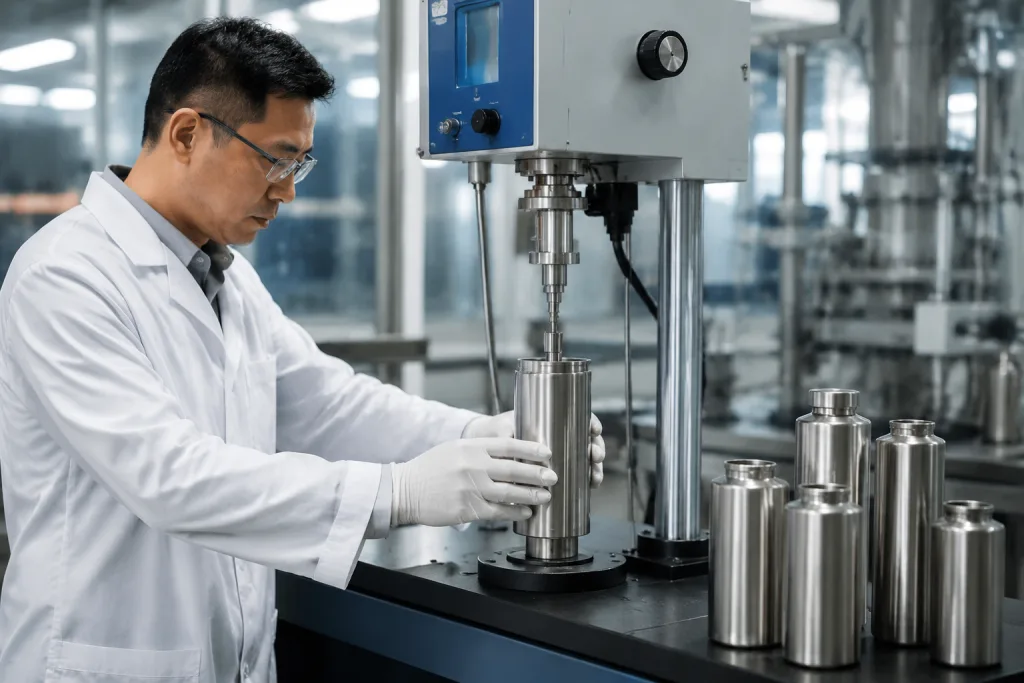
The lid is where 7 out of 10 thermos supplier problems hide in our complaint log. Buyers spend two hours approving body color, then give the gasket hardness, thread bite depth, air vent size, and drinking flow about five minutes. Wrong question. Once the stainless body tooling is locked, the body usually behaves. The lid keeps changing. Last month QC pulled 80 pcs from the line and found 6 lids with only 1.5 turns of thread engagement instead of our 2.2-turn spec.
For outdoor retailers, a screw cap with silicone gasket is still the safest design. Boring sells fewer samples, but it seals well and takes drop abuse better than flip lids with three moving parts. For promotional brands, push-button cup lids look more premium, but we run tighter QC on them: button spring height, silicone plug position, and the internal water channel each need their own check with a go/no-go gauge. If one is off by 0.3 mm, leakage complaints start. For children or commuter use, ask whether the lid can pass an inverted leak test for 30 minutes after filling with 95°C water. Hot water builds pressure, so cold-water-only testing is too easy. We have seen that go sideways.
Silicone should be food-contact grade, commonly 40-60 Shore A hardness depending on design. Too soft, and it flattens after 500 open-close cycles. Too hard, and it will not seal against a small tolerance shift in the plastic mouth. We check gasket hardness with a Shore A durometer before assembly, not after the carton is sealed. Ask whether replacement gaskets are available. For distributor thermos programs, 2 spare gasket sets per carton can cut return claims and make retailers feel you planned the after-sale work.
Plastic resin matters too. PP is common for inner lid parts because it handles hot liquid better than cheaper plastics, and we normally reject PP lid parts if the injection gate leaves a sharp burr over 0.2 mm near the drinking edge. Tritan may be used for clear parts, but check temperature limits before you print “hot drink” on the box. If selling in Europe, ask for LFGB on silicone and plastic parts. If selling in the U.S., FDA food-contact documentation is usually requested. A thermos distributor selling into multiple channels should keep these reports linked to each SKU; one buyer once sent us a PO with the SKU typo “THM-500B” instead of “THM-5008,” and the test report lookup took half a day.
Finish Line: Decoration Has Limits
A customizable thermos lives or dies by finish consistency. Powder coating, spray painting, electro-polishing, mirror polishing, and rubberized coating each fail in a different way, so we don’t treat them as equal choices on the line. Matte powder coating is still the safe pick for most outdoor and promotional thermos orders because it hides small handling marks and gives better grip than glossy paint. QC pulled one black sample last month with a 0.6 mm fisheye near the shoulder; the buyer only saw it after we put it under the inspection lamp.
For price planning, a basic single-color powder coat is often included in quoted FOB pricing at MOQ. Custom Pantone matching can add USD 0.10-0.25 per unit, plus a setup charge if the color is outside standard powder inventory. For a 1,000-unit MOQ, expect color approval to take 5-7 days after receiving your Pantone reference or physical swatch. Do not approve color from a phone photo. Wrong question. Ask for a sprayed metal chip under D65 light, then sign that chip; we’ve had a PO typo where “PMS 186C” became “PMS 168C,” and the math doesn’t work after 1,000 bodies are coated.
Logo method should match the sales channel. Laser engraving is durable and clean on stainless or coated bodies, but it leaves a metallic mark, not full-color artwork. Silk screen works for one or two colors on flat panels or a mild curve, usually under 60 mm wide before distortion gets ugly. Heat transfer and UV printing handle multicolor graphics, but we run abrasion testing before bulk because sharp carton dividers can scratch the print during a 12-day sea leg plus warehouse handling. For a promotional thermos with a campaign logo, silk screen is enough. For retail packaging, laser or tight screen printing cuts complaint risk.
A practical spec line should define logo size in millimeters, placement tolerance, color code, artwork file format, and durability test. We normally recommend an alcohol rub test, tape test, and 3M cross-hatch adhesion test for coated and printed areas. Be specific: “logo 42 mm wide, centered 28 mm below lid seam, tolerance ±1.5 mm” is a real factory instruction. If your thermos suppliers do not discuss decoration limits before sampling, they are probably selling catalog pictures instead of controlled production.
Order Line: MOQ, Lead Time, Terms
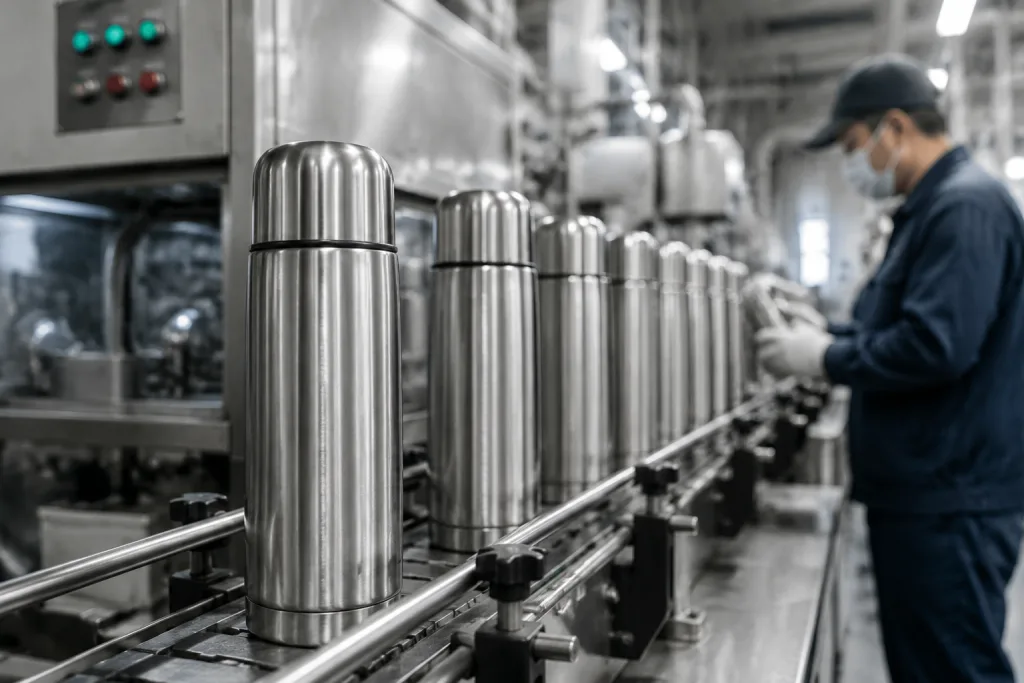
Directories make sourcing look instant. The line does not. At BottleForge Industrial in Hangzhou, Zhejiang, we run a normal custom thermos MOQ of 1,000 units per color for existing molds, because one powder-coating booth changeover burns 45-60 minutes and wastes coating during gun cleaning. Mixed colors can work at 500 units per color when the total order is solid, but the buyer flagged this on 2 of our last 10 RFQs after seeing the coating surcharge. New mold development usually starts from 3,000-5,000 units because tooling, CNC sample adjustment, and trial-run scrap have to be spread across enough bottles. The math doesn't work at 800 pieces.
Sampling normally takes 7-12 days for logo samples using existing bottles. Custom color samples take 10-18 days, and that gap is real: a Pantone chip under the light box and a sprayed bottle after 180°C curing are not always a perfect match. Mass production is usually 30-45 days after sample approval and deposit, not after the first email. Add 7-10 days if you need third-party testing such as LFGB, REACH, or ASTM-related checks for children’s drinkware components; QC pulled one kid-lid sample last quarter because the silicone straw length was 2 mm off the approved drawing.
Payment terms for a new thermos supplier relationship are commonly 30% deposit and 70% balance before shipment. FOB Ningbo or FOB Shanghai are standard for factories in Zhejiang, China. If you need DDP delivery or Amazon FBA prep, say so early because carton marks and FNSKU labels affect the packing plan, while pallet rules and drop-test requirements change carton thickness from the start. We ship plenty of FBA orders, but we have seen this go sideways when a PO says “standard carton” and the buyer later asks for 1.2 m pallet height with no overhang.
For quality control, write AQL into the purchase order. A common inspection level is AQL 2.5 for major defects and 4.0 for minor defects, with critical defects at 0. Leakage, sharp edges, rust, wrong material, and severe coating peel should be treated as major or critical depending on your channel; on our floor, the inspector uses a vacuum leak tester and a 3M tape peel check before approving packed cartons. A good thermos manufacturer will not be offended by this. Serious factories prefer clear rules because vague expectations create arguments after production, especially when a PO typo says “304 stainless” in one line and “201 stainless” in the spec sheet.
Directory Line: Shortlist With Evidence
A thermos supplier directory is a starting list, not a buying decision. Sort the names into two buckets first: real factories that run welding and vacuum in-house, and sellers who outsource the hard steps. Neither bucket is automatically a problem. The control level is different. For repeat orders of 3,000–20,000 pcs, ask who owns the laser welding line, vacuum furnace, powder coating booth, and final packing benches; last month QC pulled a 500 ml sample where the carton showed factory A, but the base stamp came from factory B.
Ask every thermos supplier for the same spec sheet: capacity, 304 stainless or other steel grade, inner and outer wall thickness in mm, lid material, gasket material, coating type, logo method, carton size, net weight, gross weight, MOQ, lead time, FOB port, and inspection standard. Compare line by line. If one quote is USD 0.70 lower, do not ask “why are others expensive?” That is the wrong question. Find the missing spec. We have seen the gap come from 0.38 mm steel instead of 0.45 mm, PP lid resin swapped for cheaper material, no 95°C insulation test, thinner coating, or a 480 ml usable fill sold as 500 ml on the PO.
Certificates need context. BSCI, ISO 9001, and factory audit reports say something about management control, but they do not prove your thermos customized order will pass leakage testing on the line. Product reports matter more for food contact and coating safety. Ask for reports dated within the last 24 months when possible, then check the model, material, and lab name; one buyer once sent us an LFGB report for a plastic lunch box and tried to apply it to a painted stainless bottle. The math doesn’t work.
The best suppliers thermos buyers keep are not the ones who say yes in 10 minutes. They are the ones who push back when your artwork sits too close to the cup curve, your target price fights the lid choice, or your 12-day lead time ignores 18 days of coating, curing, assembly, and AQL 2.5 inspection. That pushback saves money. We run into this on gradient coating jobs often: the buyer flags the unit price, then the line loses 6% at visual inspection because the logo edge bleeds. For a long-term manufacturer thermos program, choose the supplier who explains trade-offs before the deposit, not after the container is sealed.
Send Your Thermos Spec Sheet For Review
Share capacity, logo, target price, and market. BottleForge will check feasibility, MOQ, lead time, and compliance gaps before you commit.
Frequently asked questions
What MOQ should I expect for a custom stainless thermos?
For existing molds, a realistic MOQ is 1,000 units per color for most custom thermos projects. Some factories accept 500 units per color if total order quantity reaches 2,000-3,000 units, but the unit price usually rises because coating, printing, and packing setup costs are spread across fewer pieces. For a new shape or private mold, expect 3,000-5,000 units minimum, plus tooling fees that can range from USD 1,500 to USD 8,000 depending on lid complexity and body size.
How do I compare quotes from different thermos manufacturers?
Force every thermos manufacturer to quote the same spec. Ask for steel grade, wall thickness, lid material, gasket material, coating type, logo method, capacity tolerance, carton size, FOB port, MOQ, lead time, and AQL standard. A USD 3.60 quote and a USD 4.20 quote may not be the same product. The cheaper one may use 201 outer steel, a thinner 0.38 mm body, no REACH coating report, or a lighter lid. Compare missing details before comparing price.
Which logo method is best for promotional thermos orders?
For one-color promotional thermos orders, silk screen is usually the best cost-to-result method. It is clean, fast, and economical at 1,000-5,000 units. Laser engraving costs more but gives better durability and a premium look, especially on powder-coated bottles. Full-color logos normally need heat transfer or UV printing, but those should be tested for abrasion and adhesion. Always define logo size in millimeters and approve a physical pre-production sample before mass production.
What lead time is normal for thermos bulk production?
For thermos bulk orders using an existing mold and standard color, expect 30-45 days after sample approval and deposit. Logo samples normally take 7-12 days. Custom Pantone coating can add 5-10 days because the coating chip needs approval before production. Third-party testing such as LFGB, REACH, or FDA-related food-contact checks can add another 7-10 days. If your launch date is fixed, build the timeline backward from vessel departure, not from factory completion.
Can one thermos vendor handle retail and distributor requirements?
Yes, but only if the thermos vendor understands both packaging and compliance. Retail programs often need barcode labels, shelf-ready boxes, stronger artwork control, and product test reports. Distributor thermos programs may need mixed logo runs, neutral cartons, repeat color matching, and fast reorder support. Ask whether the factory can pack by SKU, apply carton marks, support FNSKU labels, and run AQL inspection before shipment. Those details matter more than a nice catalog PDF.