Key Takeaways
- Vacuum performance should be checked at 95°C fill temperature for 6-12 hours, not guessed from catalog claims
- Logo tolerances need position, color, and abrasion tests written into the purchase order
- For most bulk thermos orders, allow 7-10 days for sampling and 30-45 days for mass production
- Use AQL inspection levels and carton drop testing before paying the final 70% balance
A stainless thermos looks simple until 8,000 units land with weak vacuum, logos sitting 2 mm off-center, lids failing a 24-hour upside-down leak test, and 5-ply cartons crushed before the first distributor warehouse scan. We have seen this go sideways. For outdoor retailers and promotional brands, the damage is not just a bad bottle; it is a missed event date, an angry corporate client, and stock your sales team cannot sell with a straight face.
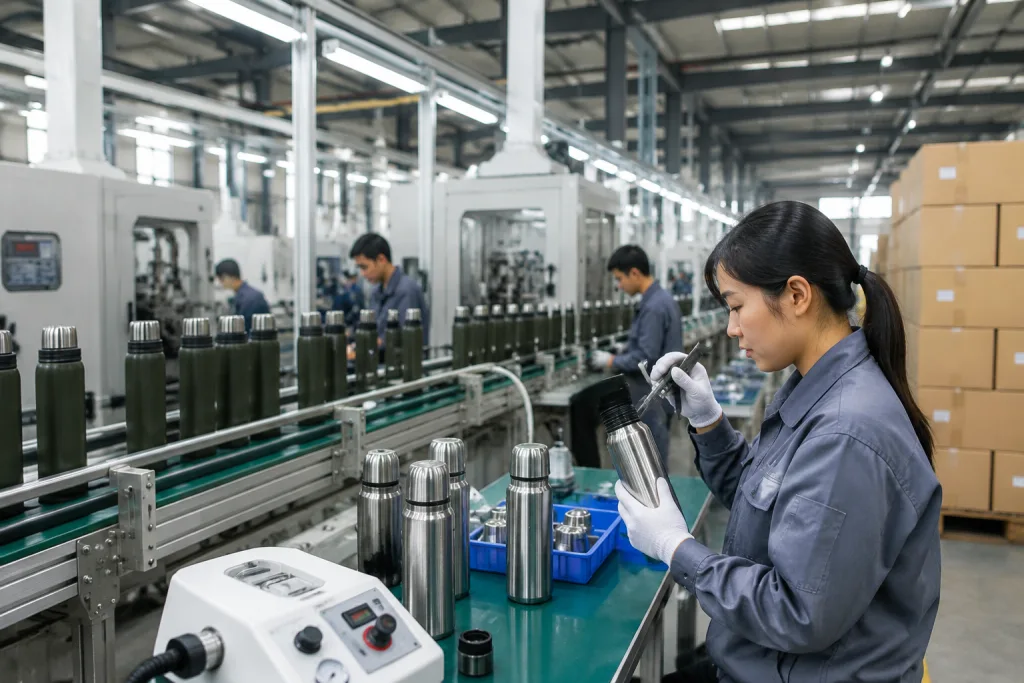
BottleForge Industrial builds custom thermos programs in Hangzhou, Zhejiang, with typical MOQ from 1,000 units per color and monthly stainless output around 450,000 units. We run 304 stainless bodies through vacuum testing, logo jig checks, and AQL 2.5 inspection before packing. China can ship strong thermos promotional products at a sharp price, but the buyer has to lock the failure points before the line starts. The cheapest quote is rarely the cheapest order.
Vacuum Failure Starts In The Body
The main failure point in thermos promotional products is not the logo. It is the vacuum body. We have seen cups pass artwork approval, then QC pulled the sample after a 6-hour heat test because it dropped like a cheap tumbler. The inner and outer stainless shells were either poorly welded, overheated on the polishing wheel, or left with oil dust before vacuum sealing.
For a serious custom thermos order, ask the thermos manufacturer to write the stainless grade and wall structure on the PI, not just in a WhatsApp message. Most outdoor programs use 304 stainless steel for the inner wall and 201 or 304 for the outer wall. A workable wall thickness is 0.40-0.50 mm for the inner wall and 0.45-0.60 mm for the outer wall, depending on capacity and shape. If a thermos factory quotes low, this is the wrong question to ask: “Can you match the price?” Ask whether they cut 0.05 mm from the wall or changed the outer shell to cheaper material. We check this with a digital micrometer on cut-body samples before the line starts.
Do not accept wording like “keeps hot for 12 hours” without a test method. For a 500 ml stainless vacuum flask, we normally run the test by filling with water at 95°C, locking the lid for 6 hours at 20°C ambient temperature, then recording the remaining water temperature. A credible target is often 65°C or higher after 6 hours, but the result changes with size, mouth diameter, and lid design. On one order, the buyer flagged a 7°C gap between the push-button lid and screw lid; the math did not work for the same claim on both SKUs.
If you are buying thermos bulk for an outdoor retailer, request a pre-production sample from the same tooling and same lid structure as mass production. One polished showroom sample tells you almost nothing about the next 10,000 pieces. We ship PPS only after the vacuum test, leak test, and lid fit check are all done on the same version the line will run.
Lids Leak Before Buyers Forgive
Lid failures turn a distributor thermos program into a claims file faster than any logo issue. One leaking lid ruins a laptop bag, a car seat, 12 sales samples, and the buyer’s patience. It is rarely one dramatic defect. We usually find a stack-up: thread tolerance drifting by 0.15 mm, silicone that feels too soft on the Shore A gauge, weak gasket compression, or a copied drinking spout that never saw a proper flow test on the line.
For thermos promotional products, specify the lid with the same care as the bottle body. Ask for food-grade silicone on the gasket, then confirm whether the plastic parts are PP, Tritan, or ABS, with LFGB, FDA, or REACH documents matched to your market. Europe buyers usually push hardest on REACH and food-contact paperwork. North America buyers often ask for FDA food-grade declarations, and 3 out of 10 kids or outdoor programs also request ASTM-related safety checks. We’ve seen this go sideways when the PO says “FDA lid” but the factory only tested the inner bottle.
A practical leak test is not complicated. Fill the thermos to 90% capacity, close the lid with normal hand torque, invert for 30 minutes, then shake horizontally for 30 seconds. We run this on the leak-test bench before packing, not after the cartons are taped. For travel tumbler style lids, test at 45 degrees too, because a sliding sip lid can pass an upside-down static test and still leak when liquid hits the drinking port in a backpack.
For a customized thermos with multiple lid colors, test every color. Pigment changes can alter plastic shrinkage just enough to hurt the seal. Small number, big problem: a 0.20 mm change around the thread or gasket channel can create a leak batch. QC pulled the sample last season on a matte black lid because the go/no-go thread gauge felt tight while the white lid passed. A reliable thermos supplier in Zhejiang should have incoming lid inspection, torque checks, and at least one assembled leak test station on the production line.
Logo Defects Are Usually Spec Defects
Logo arguments usually start at the PO stage, not on the line. The buyer says the mark is too small, 6 mm too low, too dark, or off-brand. Our thermos team points to the AI file and the signed layout. Both sides can be right. Last month QC pulled a sample where the PO said “logo 35 mm” but the mockup showed 42 mm, and nobody caught the mismatch before the first 300 pcs came off the pad-printing jig.
For a custom thermos or customizable thermos program, choose the decoration method by how the bottle will be used, not by chasing the lowest unit cost. Laser engraving holds up well on powder-coated 304 stainless steel and looks clean, but it exposes metal or the base layer, not Pantone color. Silkscreen is a solid choice for simple marks, often around USD 0.08-0.18 per position depending on size and color count, though a 78 mm curved body will stretch thin letters if the screen angle is wrong. Heat transfer works for richer artwork, but we run adhesion testing first on textured powder coating because we have seen this go sideways on matte black bottles.
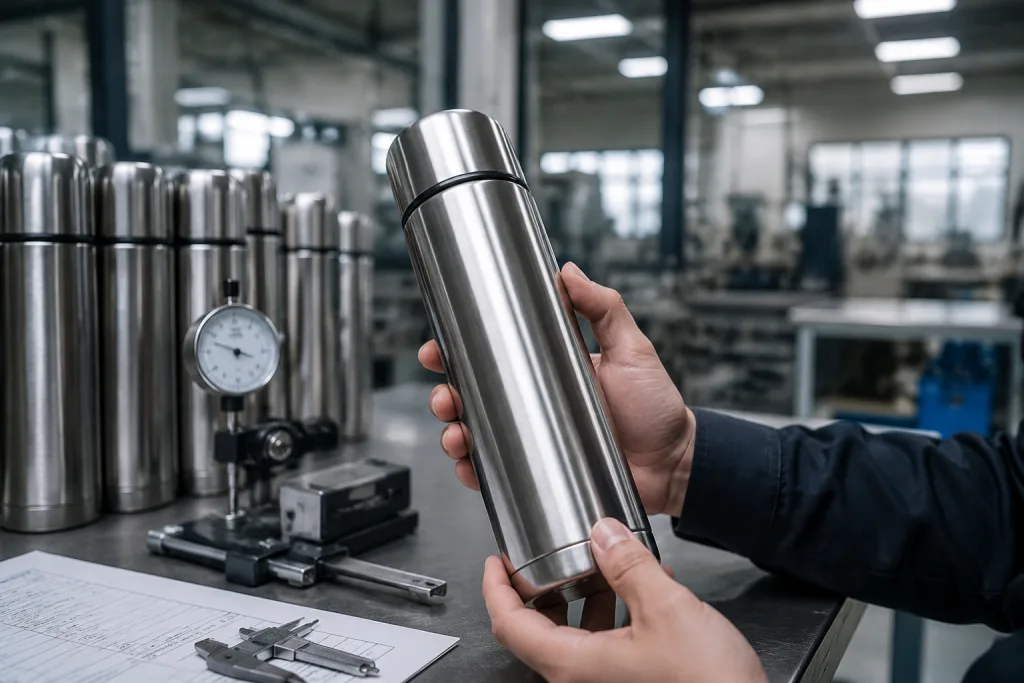
Your artwork file should state logo width in mm, placement from the bottle bottom or shoulder, position tolerance, Pantone reference, and whether a small color shift is accepted on matte surfaces. Don’t leave “same as sample” as the only instruction. For many thermos custom projects, we set logo position tolerance at ±1.5 mm and color tolerance by approved physical sample, not only screen proof. On our floor, the operator checks placement with a digital caliper and a paper height gauge before we release the first 50 pcs.
Run a 3M tape adhesion test after printing. If the bottle is for outdoor retail or sports giveaways, add a 500-cycle rub test with a 500 g load before shipment. Promotional brands sometimes ask whether a logo scratch is “acceptable for the price”; that is the wrong question to ask. The recipient will not know your factory thermos source, but they will remember the brand printed on it. If the logo scratches off in one week, the whole promotional thermos feels cheap.
Coating Chips Kill Outdoor Programs
Outdoor retailers punish bottles harder than office giveaway buyers. We’ve had a 1,000-piece powder-coated bulk thermos order look clean in the sample room, then come back with base chips after one weekend hiking demo. QC pulled the sample and the coating was not the main problem. Surface prep was.
Before coating, stainless bodies need a steady clean-dry-treatment process, not a quick wipe with a rag near the spray booth. Oil from deep drawing or polishing can sit around the shoulder radius and bottom seam; our line checks this under a 600 mm inspection lamp before hanging parts. If the thermos manufacturers cut 20 minutes from degreasing to catch an ETD, the buyer may see coating bubbles, orange peel texture, or chips around the shoulder and base. Those zones take hits first and are harder to cover evenly.
For thermos promotional products built for outdoor retail, write the powder coating thickness into the PO. A workable range is often 60-90 microns. Below that, chips show fast; above that, the math doesn’t work when the lid thread, cup fit, or carton divider clearance is already tight by 0.5 mm. Ask for cross-hatch adhesion testing, 3M tape pull, and a basic drop test from 1.0 meter onto plywood or rubber mat. Concrete testing is harsher and sometimes unrealistic, though we run it for premium adventure lines when the buyer accepts the failure risk upfront.
Color control needs a physical reference. Matte black from powder lot A may not match matte black from lot B, and we’ve seen this go sideways when a repeat order was approved from a phone photo. If you are a thermos distributor selling repeat programs, keep a signed color panel or approved golden sample in China and in your office. Zhejiang factories can reproduce stable finishes when the reference is physical, documented, and checked before mass coating starts; one missing approval sticker on the panel can delay coating by 2 days.
Capacity And Weight Get Quietly Changed
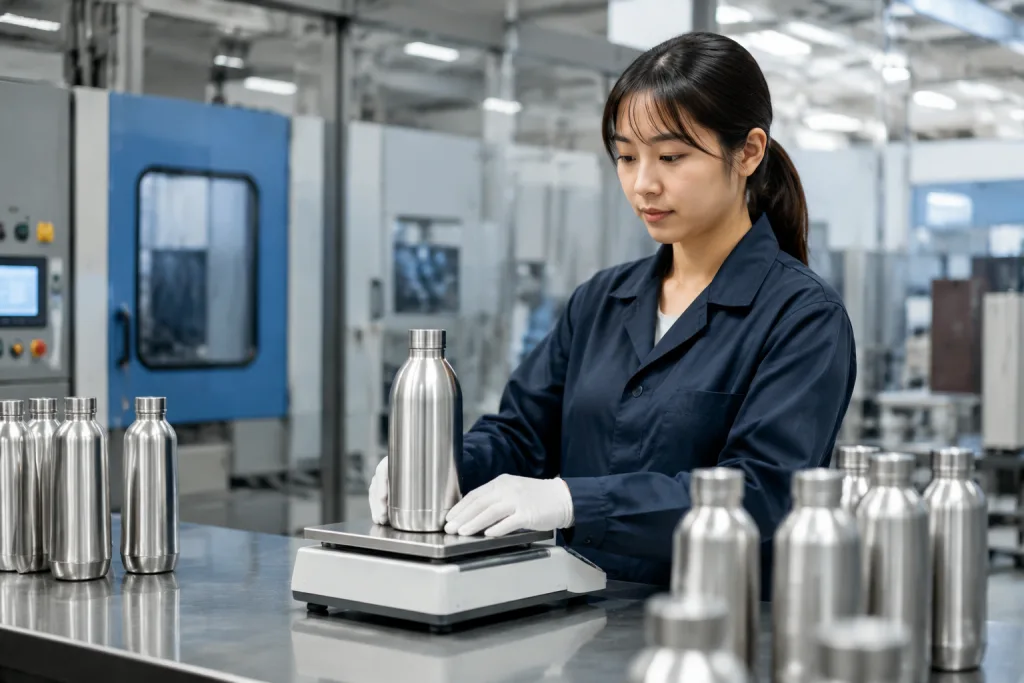
Specification drift is one of the quiet ways a thermos bulk order goes wrong. You approve a 500 ml thermos at 285 g, then the production lot lands at 265 g on the QC scale and still passes the 500 ml fill test. The thermos vendor says it is harmless. Sometimes yes. Sometimes no. We have seen the same 20 g cut show up later as easier denting, weaker heat retention, and a cheaper hand feel when the buyer pulled samples from carton 17.
Put capacity, net weight tolerance, height, diameter, mouth opening, and carton quantity into the spec sheet. For a 500 ml stainless thermos, ±5% weight tolerance after approval is workable, but agree on it before the PO is placed, not after the line starts. If the product must fit retail shelves, bike cages, car cup holders, or gift boxes, measure those touch points in mm; a 74 mm body that becomes 77 mm can fail a cup holder test fast. This is the wrong question to ask: “Does it still hold 500 ml?” The better question is whether it still matches the approved sample.
Some thermos suppliers quote from a standard mold, then swap components during production to meet a cost target. Ask for a short bill of materials summary: inner stainless grade and thickness, outer stainless grade and thickness, lid material with gasket material, coating type with logo process, plus packing method. You do not need every factory secret. You need enough detail to stop uncontrolled substitution; we once had QC pull a sample where the PO said 304 stainless inside, but the supplier’s internal sheet showed 201 for the outer shell.
For private label and distributor thermos programs, approve a sealed pre-production sample with signed weight and dimensions. Keep one sample at your office and one at the thermos factory, with the weight written on the hang tag, such as “285 g net, height 238 mm, body 70 mm.” During inspection, compare random production units against that sample using a digital caliper and scale. Simple works. It costs less than 30 minutes on the packing floor and beats arguing by email after 3,000 pcs have already shipped.
Packing Fails After QC Passes
A thermos can pass product inspection and still land at the buyer’s warehouse with dents, because packing got treated like a leftover line on the PI. We see this on promotional thermos orders every month: the buyer pushes hard on logo position and USD 0.03 unit price, then signs off on 250 g white boxes, loose dividers, or a master carton that was never matched to the route. QC pulled the sample clean at AQL 2.5, but the carton corner crushed after the forklift clamp mark showed up in unloading photos. Painful lesson.
For ocean freight from China to Europe or North America, write the carton material and test requirement into the PO, not just into an email thread. A common export carton is 5-ply corrugated with 32 ECT or similar strength, but heavier stainless products need stronger board or fewer units per carton. If one 750 ml thermos weighs 420 g and you pack 24 units per carton, the gross weight can exceed 12 kg after boxes and inserts. We run this on a digital platform scale before sealing the first master carton; if the reading is 12.8 kg, the math doesn’t work for a weak carton on a 32-day sea shipment plus courier delivery after break-bulk.
Use a carton drop test from 76 cm for typical master cartons under 10 kg, or adjust based on ISTA-style expectations and your customer’s requirement. Drop on one corner, three edges, and six faces. Then open the carton with a blade, not by tearing it apart, and check dented bodies, scratched coating, broken lids, and crushed retail boxes under the same light QC uses for logo inspection. If you ship to Amazon FBA or a distributor warehouse, confirm barcode placement, FNSKU labels, carton marks, and pallet height limits before production packing starts; we had one PO where “FNSKU on inner box” was typed as “FNSKU on carton,” and the buyer flagged it 2 days before loading.
Packing cost is not free. Upgrading from a thin egg-crate divider to a molded pulp tray or thicker paper sleeve may add USD 0.08-0.25 per unit, but it can stop a 3% damage rate. On 10,000 units, that is 300 customer complaints you never needed. We ship promo orders for repeat programs, and we’ve seen this go sideways: saving USD 800 on packing, then spending USD 2,400 on replacements, air freight, and apology discounts.
Inspection Must Match The Risk
Too many buyers treat inspection like a tick box: book SGS or Intertek, apply AQL, pay the balance. Better than blind shipment, yes, but this is the wrong question to ask. For thermos promotional products, the checklist has to follow the failure mode. QC pulled a 500 ml sample on our line last month that looked clean under the light booth, yet the vacuum dropped after 6 hours in the 95°C hot-water hold test. A photo report full of carton marks would have missed it.
For most manufacturer thermos orders, we suggest final random inspection under ANSI/ASQ Z1.4 or ISO 2859-1 sampling, often General Inspection Level II with AQL 2.5 for major defects and 4.0 for minor defects. Critical defects, such as sharp metal burrs, leaking lids, unsafe materials, or wrong logo, should be zero tolerance. No debate there. For large orders above 20,000 units, add during-production inspection at 20-30% completion, while the line is still welding, polishing, and powder coating, so a bad lid gasket or 1.5 mm logo shift is caught before 180 cartons are sealed.
Your inspection checklist should include vacuum retention spot test with a probe thermometer, lid leak test after 10 upside-down shakes, coating adhesion with 3M tape, logo position measured in mm from the bottom seam, logo abrasion after 50 rubs, capacity check, weight check on a digital scale, odor check, barcode scan, carton drop, and packing count. If your thermos promotional program has multiple SKUs, inspect every SKU, not only the first color the factory presents. We have seen this go sideways when the buyer approved black only, then the white batch failed coating adhesion at the handle curve.
Lead time matters here. At BottleForge Industrial in Hangzhou, Zhejiang, a normal stainless thermos project takes 7-10 days for custom sample preparation, 30-45 days for mass production after deposit and artwork approval, and 3-7 days for final inspection, rework if needed, and loading. China manufacturing moves fast, but the math doesn't work if the PO arrives with a fixed event date 38 days away and a 10,000 pcs order needs logo approval, inner carton printing, and AQL sorting. Build inspection and possible rework into the schedule before you issue the PO.
Send Your Thermos Spec Before You Quote
Share capacity, logo method, target price, market, and delivery date. We will flag the production risks before sampling starts.
Frequently asked questions
What MOQ should I expect for thermos promotional products?
For stainless thermos promotional products, a realistic MOQ is usually 1,000 units per color for standard shapes with one logo position. If you need a fully custom mold, special lid, or exclusive powder color, MOQ often moves to 3,000-5,000 units because tooling, coating setup, and component purchasing become less flexible. At BottleForge Industrial in Zhejiang, we can sometimes combine stock body colors with custom logos for faster 1,000-unit starts. Be careful with very low MOQ claims under 300 units for factory-direct orders; they may use stock trading inventory, not controlled manufacturer thermos production.
How much does a bulk thermos order cost from China?
A normal 500 ml double-wall stainless thermos from China may land in the FOB USD 3.20-6.50 range depending on steel grade, lid design, coating, logo method, and packing. Laser engraving may add about USD 0.10-0.25 per unit, while full-color heat transfer can add USD 0.25-0.60. Gift boxes, pulp trays, and FBA labeling also change the cost. A bulk thermos quote below USD 3.00 is possible, but you should check wall thickness, vacuum performance, plastic grade, and carton strength before treating it as a real saving.
Which logo method is best for a custom thermos?
For outdoor retail, laser engraving is usually the safest decoration because it will not peel and handles abrasion well. It works best on powder-coated stainless bodies when a subtle premium look is acceptable. Silkscreen is better for simple one- or two-color promotional logos and lower budgets, but it needs adhesion and rub testing. Heat transfer is best for gradients, detailed graphics, or retail artwork, though it costs more and depends heavily on coating compatibility. For a custom thermos order above 2,000 units, approve a physical decorated sample, then set logo position tolerance around ±1.5 mm.
What quality documents should thermos suppliers provide?
For Europe, ask thermos suppliers for food-contact declarations, REACH statements for relevant materials, and LFGB testing when required by the buyer or retailer. For North America, ask for FDA food-grade material declarations and any retailer-specific chemical compliance documents. Factory documents such as BSCI, ISO 9001, or Sedex can help evaluate management systems, but they do not replace product testing. For promotional brands, the practical package is a signed specification sheet, material list, test reports for food-contact parts, approved sample, AQL inspection report, and carton drop test record.
How long should I plan for a distributor thermos program?
Plan 7-10 days for sampling after artwork confirmation, 30-45 days for mass production, 3-7 days for inspection and loading, then shipping time. Ocean freight from China to Europe or North America commonly takes 25-40 days port to port, plus customs and inland movement. Air freight can move in 5-10 days, but it is expensive for stainless thermos bulk orders because the product is heavy. If your distributor thermos program is tied to a trade show or seasonal launch, place the PO at least 90 days before the required warehouse date.