Key Takeaways
- Start thermos private labeling at 1,000 pcs per color for stable pricing and fewer production compromises
- Ask for 304 inner/outer stainless steel, 0.40-0.50 mm wall thickness, and 12-hour heat test data
- Budget 35-45 days for mass production after artwork, sample, and carton marks are approved
- Use AQL 2.5/4.0 inspection and confirm REACH, LFGB, FDA, or ASTM needs before deposit
Thermos private labeling looks simple until the quote sheet hits your desk. One supplier writes 304 stainless steel, another offers 316 for the inner wall, and a third leaves the retail box out until page 2 as “packing upgrade.” We had a buyer flag a USD 0.18 box charge after the PO was signed; on 20,000 bottles, the math doesn’t work. If you are buying for an outdoor retail line or a promotional thermos campaign, those small line items decide whether your margin survives.
We manufacture stainless vacuum bottles in Zhejiang, China, and we run into the same practical questions on the line every week: what MOQ is real, which logo method survives the 3M tape test, what insulation claim matches the 95°C water test, and which documents your EU or North American buyer will ask for. QC pulled a 500 ml sample last month where the laser logo was 1.5 mm off center, small enough for a catalog photo, not small enough for retail. A good custom thermos project starts with tighter specifications, not nicer catalog photos.
What private labeling really includes
A buyer says “thermos private labeling,” and 7 times out of 10 they mean more than a logo. For a stainless thermos, we quote the logo method, Pantone coating, box artwork, barcode or FNSKU position, instruction leaflet, carton marks, and small part changes like a lid strap or silicone grip. QC pulled one 500 ml sample last month because the FNSKU was 4 mm too close to the box fold.
Here is the plain split. A custom thermos is often your logo on a factory body we already run. A customizable thermos means you pick from existing capacities, lids, colors, coatings, and packaging, then we lock the spec sheet before sampling. A fully customized thermos means new tooling, a new lid structure, or a body shape not on the line today. Different money. On one PO, the buyer wrote “customized” but only needed laser engraving on our 750 ml mold; that changed the sample cost by USD 900.
For most outdoor retailers and promo brands, existing mold plus controlled branding is the safer route. You get lower risk, 12-18 days sampling instead of 35-45 days for new parts, and a product the line already knows how to assemble. New mold development is worth discussing only if you can support 10,000-30,000 pcs over 6-12 months. If the first order is 1,200 pcs, this is the wrong question to ask; the tooling math does not work after mold steel, CNC time, and two rounds of leak testing.
- Basic private label: logo on bottle, neutral carton, 1,000-3,000 pcs MOQ; we usually check logo size with a 0.5 mm film ruler before mass printing.
- Retail private label: logo, custom color, printed box, barcode, 2,000-5,000 pcs MOQ; the buyer often flags box color first, not the bottle.
- Structural custom: new lid or body tooling, usually USD 1,500-8,000 tooling depending on parts; we need 2D drawings or a sealed sample before quoting.
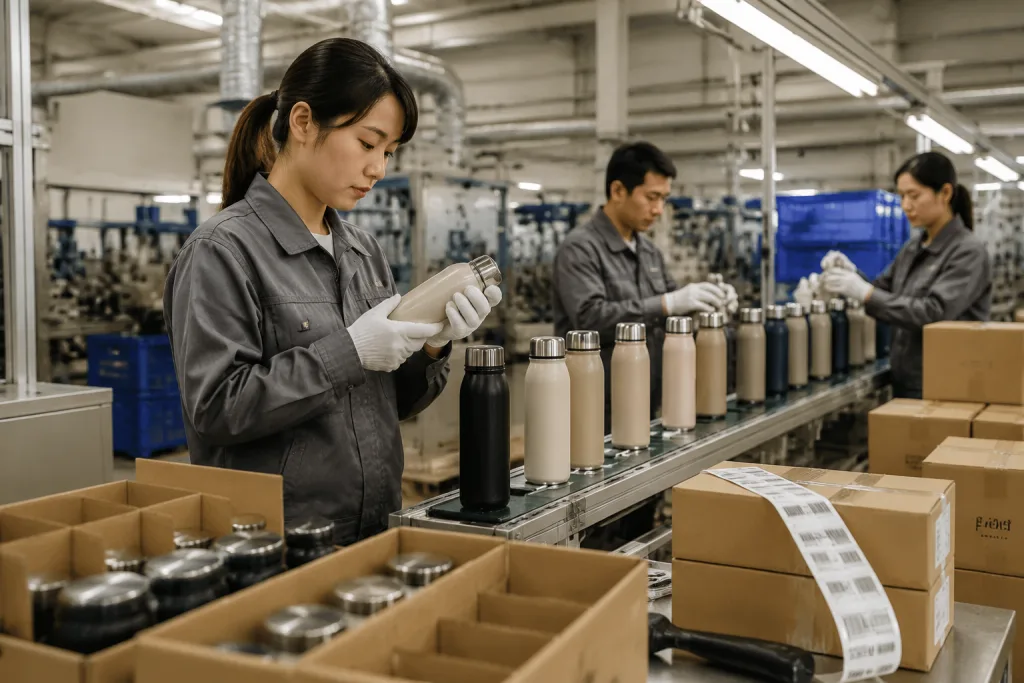
At our Zhejiang facility, monthly stainless thermos output is about 450,000 units across standard vacuum bottle and travel tumbler lines. That volume matters. Small trial orders can still run through proven welding, vacuuming, polishing, coating, and packing processes instead of being treated like experiments. We ship from lines using helium leak testers and vacuum holding racks, so a 2,000 pcs private label order follows the same control points as a 40,000 pcs retail run.
MOQ, pricing, and quote traps
The first buying question is usually, “What is your MOQ?” Wrong question. Ask, “What exact spec is that MOQ based on?” We run 500 pc laser logo jobs on a stock black 500 ml bottle when the logo fits the jig and the carton stays standard. That order will not price like a thermos bulk order with custom powder coating, printed color box, and insert card. Last month QC pulled a 500 ml sample with a 38 mm logo; engraving was fine, but the buyer’s PO had “matte balck” typed in the color line, so the quote had to be frozen until they confirmed the finish.
For a manufacturer thermos project in China, realistic starting points are usually 1,000 pcs per SKU for laser logo on stock colors, 2,000 pcs per color for custom coating, and 3,000-5,000 pcs for full retail packaging. If you need four colors at 500 pcs each, say that clearly in the RFQ and on the PO. We’ve seen this go sideways: a buyer approved 2,000 pcs total, then the coating line rejected it because each color needed its own spray booth setup, powder change, and 30-minute cleaning cycle.
FOB pricing for a 500 ml stainless vacuum thermos normally sits around USD 3.20-5.80 depending on steel grade, lid complexity, coating, logo method, and packaging. A 750 ml outdoor bottle may sit around USD 4.50-7.50. These are not promises; they are a sanity check. If one thermos vendor is 25% lower than the other 3 quotes on your sheet, check the inner wall thickness with a caliper, ask whether the lid is food-grade PP, and confirm the vacuum test time. The math doesn’t work if the price is low and every spec is still claimed as premium.
Do not compare “500 ml stainless thermos with logo” quotes unless steel grade, coating, lid material, packing, testing, and Incoterms are identical.
A clean RFQ should state capacity, target FOB port, order quantity by color, logo size, packaging type, compliance market, and inspection requirement. Zhejiang and wider China have hundreds of capable suppliers thermos buyers can use, but loose RFQs produce loose prices. We ship cleaner when the buyer sends a 1-page spec sheet with logo artwork in AI format, carton marks, AQL 2.5 inspection notes, and the target delivery date written as 2026-05-18 instead of “ASAP.”
Logo methods buyers should compare
Logo method changes the unit cost, the rub resistance after packing, the shelf look under retail light, and the line speed. For outdoor retail, we usually push laser engraving or powder coating with laser reveal because QC can judge it with a 3M tape pull in 30 seconds. For a promotional thermos with a 4-color campaign logo, silkscreen or heat transfer fits better. Sample photos are the wrong way to decide this; we’ve seen a buyer approve a nice JPEG, then flag the real logo because the 0.8 mm slogan filled in on the curved body.
Laser engraving gives a clean, permanent mark. It works well on powder-coated bottles and bare stainless bodies, especially 304 stainless with a straight logo area above 25 mm. Typical logo cost is USD 0.08-0.25 per unit depending on size and position. It is a poor choice for gradients or legal text under 1.5 mm height; on one 750 ml bottle, QC pulled the sample because the “BPA FREE” line looked like a scratch after engraving.
Silkscreen printing suits 1-color or 2-color logos on smooth surfaces. It is cheaper at volume, often USD 0.05-0.18 per color per position, but adhesion depends on the powder coating batch and oven curing time. We normally run tape test and 3M cross-hatch checks for retail projects, and we record the result beside the AQL 2.5 inspection sheet. If the buyer asks for bright white on matte black, we run one extra pass; otherwise the logo can look gray under warehouse LED lights.
Heat transfer handles multi-color graphics better, especially a 180° or 360° wrap design. It costs more and needs careful testing on curved thermos bodies, because the film can wrinkle near the shoulder if the jig pressure is off by 1-2 mm. For dishwasher-safe claims, be cautious. Most powder-coated custom thermos products should be marketed as hand wash unless the test report says otherwise; the math does not work if 3% of goods come back after a retailer dishwasher complaint.
Embossed or debossed metal badges can look premium, but they add tooling and assembly risk. Use them only if your distributor thermos line needs stronger shelf impact and the order volume is enough, usually above 5,000 pcs per design. We ship these with a badge pull test on the first carton, because one PO once listed “gunmetal badge” while the artwork file said brushed silver, and the buyer flagged it after mass production photos.
- Ask for a pre-production sample with final logo size, measured in mm on the actual bottle body.
- Confirm Pantone code and coating finish before sampling: matte black is not the same as soft-touch black.
- Check logo position tolerance, usually ±2 mm on cylindrical bodies, and ask QC to mark the centerline on the sample.
- Keep barcode, warning text, and recycling marks separate from decoration artwork so the print room does not treat them as logo layers.
Insulation claims need test numbers
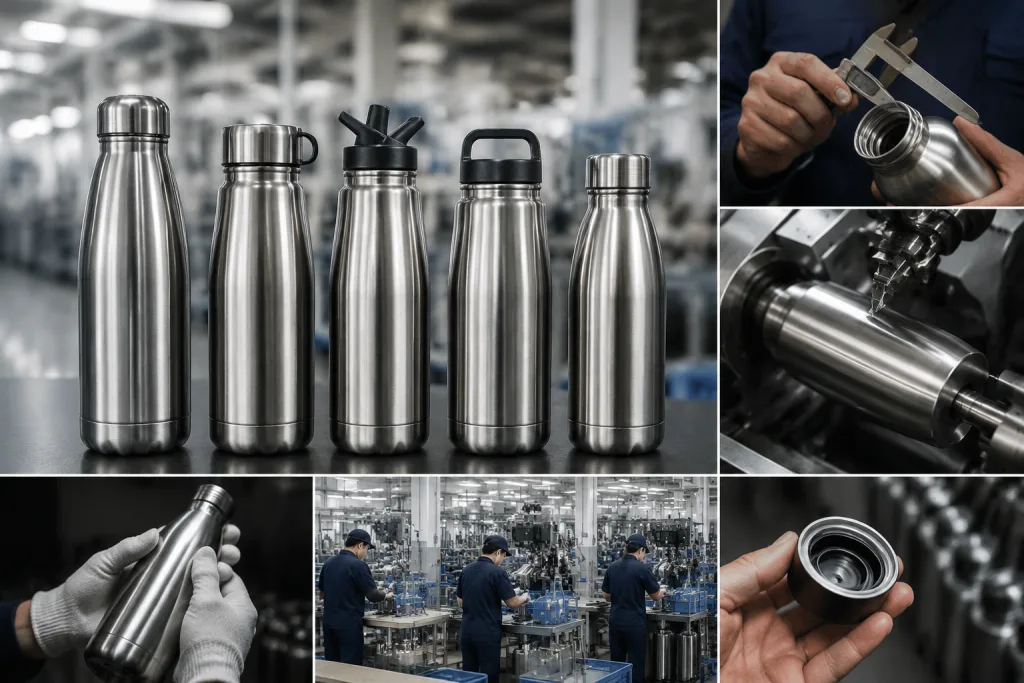
Outdoor buyers care about performance, but “keeps hot for 24 hours” is usually sales copy, not a test result. In our Hangzhou line, insulation changes with body diameter, vacuum pull, copper plating thickness, lid compression, and how big the mouth is compared with the capacity. A 500 ml wide-mouth food jar loses heat faster than a 500 ml narrow-mouth bottle; QC pulled this on a 82 mm jar last winter and the buyer flagged a 9°C gap at 12 hours.
For a 500 ml stainless thermos, we run a simple check: fill with 95°C water, close the lid, leave it at about 20°C, then record 6, 12, and 24 hours with a calibrated probe thermometer. A solid retail-grade bottle should stay above 65°C after 6 hours and above 50°C after 12 hours. Larger bottles often test better because the heat loss per ml is lower. Cold retention needs its own test with 4°C water or an ice-water setup; mixing hot and cold claims on one PO is where we have seen this go sideways.
Ask your thermos manufacturer for the internal test method, not just the catalog line. If they only send “24H hot” in a PDF, the math does not work for serious retail review. At our China plant, vacuum bottles go through leak testing and insulation sampling during production; QC uses a water bath and pressure check before cartons move to packing. Export orders can add batch-level temperature records if the buyer requests them before production, not after 6,000 pcs are already in master cartons. For large retailers, that one-page record saves arguments later.
Checklist for insulation specification
- Inner stainless steel: 304 or 316, food-contact grade; we confirm the grade before tooling release.
- Outer stainless steel: 201 for price-sensitive orders, 304 for premium outdoor lines, or the grade written on the buyer’s PO.
- Wall thickness: commonly 0.40-0.50 mm before forming for many bottle bodies; thinner sheets dent faster on the line.
- Vacuum construction: double-wall, with copper plating if the target claim needs stronger 12-hour results.
- Lid seal: food-grade silicone ring, removable if cleaning is part of the retail story.
- Test condition: starting temperature, room temperature, and measurement time stated clearly, with no “24H” shortcut.
If you sell into outdoor channels, do not oversell the claim. This is the wrong place to copy a competitor’s catalog. A tested number, even if it looks less dramatic, builds trust faster; one buyer accepted 12-hour data over a 24-hour claim after our sample report showed 52°C at 12 hours and 38°C at 24 hours.
Compliance for EU and North America
Compliance is where 4 out of 10 thermos distributors burn their schedule. A thermos supplier’s quote may say “FDA approved,” but that line can mean a 304 stainless steel declaration, a 6-page third-party food-contact report, or a copy-paste note from last year’s PI. We’ve seen this go sideways when the PO said “FDA cup” and the buyer expected lid, gasket, coating, and ink all covered. Wrong question to ask: “Is it approved?” Ask which part was tested, by which lab, under which model number.
For the EU, buyers ask for LFGB food-contact testing, REACH restricted-substance checks, and German sensory testing when the bottle goes into stricter retail. One German buyer rejected a sample after the lab noted odor on the silicone ring at 40°C. For North America, FDA food-contact material compliance is standard, and California Proposition 65 screening comes up on coated bottles, colored lids, and printed gift sets. If the product is for children, ASTM or CPSIA-related requirements depend on age grade, coating, straw parts, and small accessories like a 22 mm charm or carry clip.
BSCI, Sedex, ISO 9001, or factory audit reports sit in a different bucket from product compliance. They show how the thermos factory runs documents, worker records, and production control; they do not prove a silicone gasket passes migration testing. QC pulled the sample. The audit file was clean, but the gasket report covered a black silicone part while the order used translucent silicone. Both documents matter, but the math does not work if you swap one for the other.
For promotional brands, the buyer may require ink safety documentation, especially when logos are printed on coated surfaces. We run pad printing, laser engraving, and UV printing on different lines, so the report must match the actual process, not just the bottle body. For retail, packaging claims need care: “BPA free” is fine for plastic lid components when the PP or Tritan report supports it, but “eco-friendly” without material detail is weak. A French buyer flagged that wording on a color box proof at 11 pm Hangzhou time.
- Request test reports less than 2 years old when possible, and check the lab issue date before deposit.
- Check that reports cover stainless steel body, silicone gasket, PP lid parts, coating layer, and logo ink where used.
- Match applicant name to the supplier, and make sure the model description matches your actual bottle size and lid type.
- Add your required compliance list to the proforma invoice or purchase order, not only to a WeChat message.
A serious thermos supplier in Zhejiang should tell you what is ready in the file and what needs fresh testing before mass production. Fresh third-party testing normally adds 7-10 working days and several hundred USD depending on the lab and test scope. For a normal private-label thermos order, we ship 6 sample pieces to the lab: body, lid, gasket, straw if used, coated shell, and printed logo panel. If the buyer adds California Proposition 65 after the carton artwork is approved, expect delay. The line will wait.

Sampling and production timeline
A standard thermos custom project does not start when you pay the deposit. It starts when our merchandiser has signed artwork, Pantone color, packaging style, carton mark, barcode, and the final spec sheet in one folder. If the PO still says “blue” instead of PMS 7690C, the clock is not running. We see this at least 6 times a month.
For an existing manufacturer thermos model, blank stock samples can usually ship in 3-5 days if the warehouse has bodies on the rack. Logo samples take 5-10 days for laser or silkscreen; QC pulled one last week because the laser mark was 1.5 mm off center on a 500 ml cup. Custom color samples normally take 10-15 days because the coating room needs surface cleaning, spraying, curing at set temperature, and color review under a D65 light box. Printed retail packaging can add another 5-7 days for a digital proof or physical sample, depending on how fast your team signs the dieline.
Mass production lead time is typically 35-45 days after deposit and final approvals for 3,000-10,000 pcs. Before summer outdoor programs and Q4 promotional campaigns, use 50-60 days; the line is usually full, and the math does not work if approval comes 12 days late but the delivery date stays fixed. Ocean freight to North America often adds 25-40 days port to port; Europe is often 30-45 days depending on destination. Air freight works for 200-500 urgent launch pieces, but it can wipe out the margin on a bulk thermos order.
Timeline checklist
- Day 0: confirm RFQ, specification, target price, Incoterms, and make sure the PO has no typo in model number or capacity.
- Day 3-10: approve sample body and logo method after checking logo size in mm against the approved artwork.
- Day 10-20: confirm color, packaging, carton marks, barcode; the buyer flagged this once because the outer carton showed 24 pcs while the PO said 25 pcs.
- Day 20-25: pay deposit and release production after the factory sends the stamped PI and production file to the line.
- Day 55-70: finish production and inspection for normal orders, with AQL 2.5 checked before booking the truck.
If you are selling to distributors thermos programs with fixed retail delivery windows, build backward from the warehouse date, not the factory ship date. This is the right question to ask: when must cartons be on the distributor’s floor? Late packaging artwork is one of the most common launch killers; we have held finished 304 stainless bottles for 9 days because the retail box barcode was still waiting for approval.
Final buyer checklist before deposit
Before you pay 30% deposit, stop the line on paper first. Private label mistakes cost real money because the product carries your brand, barcode, carton mark, plus your customer’s delivery date. We once had QC pull 240 pcs from a thermos promotional order because the laser logo sat 6 mm too low; that order still moved after a discount. A retail order with the wrong LFGB mark or a carton label printed “24PCS” instead of “12PCS” gets stuck at the warehouse door.
Use this checklist with any thermos vendor, whether you source from Zhejiang or through a trading company. A reliable thermos manufacturers partner will not push back on precise questions. We answer faster when the scope is clean; last month a buyer changed from matte black to Pantone 426C after deposit, and the lead time moved from 12 days to 18 days because the powder room had already run the first panels.
- Product: confirm capacity in ml, body diameter in mm, lid type, mouth opening, 304 stainless steel grade, coating finish, color code.
- Branding: send AI or PDF logo file; lock size in mm, position from bottom or lid seam, printing method, Pantone color, tolerance.
- Packaging: choose polybag or tissue, retail box paper weight, master carton size, drop-test height, FNSKU or EAN/UPC label position.
- Compliance: confirm LFGB, REACH, FDA, Prop 65, ASTM, CPSIA, or the retailer’s own test protocol before sampling.
- Quality: write AQL level, critical defects, leak test method, insulation test hours, coating adhesion standard, carton inspection points.
- Commercial: lock MOQ by SKU, FOB port, payment terms, lead time in days, spare parts ratio, claim handling window.
For AQL inspection, about 8 out of 10 overseas buyers we work with use critical 0, major 2.5, minor 4.0. Critical defects include leakage, sharp edges, wrong material, or contamination; QC checks this with a water fill, shake test, magnet check, and visual table under 600–800 lux light. Major defects include poor logo registration, coating peel, dented body, wrong color, or failed insulation. Minor defects are small cosmetic marks inside the signed limit sample.
The best thermos private labeling projects are not the cheapest ones. Asking only for the lowest FOB is the wrong question to ask; the math does not work if the next order needs new artwork, new cartons, and another round of buyer complaints. The better supplier thermos team understands Amazon FBA, supermarket DC rules, or gift-channel delivery windows, while the factory thermos team can repeat the same logo height, coating thickness, and carton label format on the next 3,000 pcs. That is what makes a private label line worth reordering.
Send your thermos private label brief
Share capacity, quantity, logo, target market, and packaging needs. We will return a practical FOB quote with MOQ and lead time.
Frequently asked questions
What is a realistic MOQ for thermos private labeling?
For an existing stainless thermos model, 1,000 pcs per SKU is a realistic starting MOQ for laser logo on stock colors. If you need custom powder coating, plan on 2,000 pcs per color because coating lines work better in stable batches. Full retail packaging with printed box, barcode, and insert card usually becomes practical at 3,000-5,000 pcs. Some China suppliers will accept 500 pcs, but the unit price may rise 15-35%, and color or packaging options become limited. For outdoor retailers testing a new line, we usually suggest one or two core colors first, not six small fragmented colors.
How long does a custom thermos order take from sample to shipment?
For a standard custom thermos using an existing mold, allow 5-10 days for logo samples and 10-15 days if custom coating samples are needed. After sample, artwork, packaging, and carton marks are approved, mass production normally takes 35-45 days for 3,000-10,000 pcs. During peak export months, 50-60 days is more honest. Add ocean freight separately: roughly 25-40 days to many North American ports and 30-45 days to Europe. If your distributor thermos program has a fixed launch date, confirm the warehouse delivery date first, then work backward.
Which logo method is best for a promotional thermos?
For a promotional thermos with a simple one-color logo, laser engraving or silkscreen printing is usually best. Laser costs around USD 0.08-0.25 per unit and is very durable on powder coating. Silkscreen can be cheaper, around USD 0.05-0.18 per color per position, and works well for campaign logos with solid colors. For full-color artwork, heat transfer gives better visual detail but needs adhesion testing on curved surfaces. If the bottle will be used outdoors, avoid tiny text and thin lines; they may pass artwork review but look weak after production.
Can you make a thermos bulk order for Amazon or retail distribution?
Yes, but Amazon and retail distribution need different packing discipline than a normal bulk thermos export carton. For Amazon FBA, you may need FNSKU labels, suffocation warning on polybags, carton weight under the required limit, and drop-tested packaging. For retail, you may need EAN/UPC barcode, country of origin, recycling marks, product warnings, and retailer carton routing labels. Confirm whether the order ships as FOB Ningbo or Shanghai, or whether you need DDP support. Label mistakes can delay receiving even when the thermos customized product itself is correct.
How do I choose between 304 and 316 stainless steel?
For most thermos private labeling projects, 304 stainless steel is the practical standard for the inner wall because it is food-contact safe, cost-effective, and widely tested. 316 stainless steel gives better corrosion resistance, especially for salty or acidic use cases, but it raises cost and is not always necessary for coffee, tea, or water bottles. Many outdoor retail bottles use 304 inner and 304 outer for a premium specification. Some lower-cost supplier thermos quotes use 304 inner and 201 outer. That can be acceptable if disclosed, but it should not be sold as full 304 construction.