Key Takeaways
- A realistic thermos private label MOQ starts at 1,000-3,000 units per color for powder coating
- 750 ml stainless vacuum flasks usually use 0.4-0.5 mm 304 inner steel and 201 or 304 outer steel
- Plan 35-50 days production after artwork approval, plus 3-7 days for pre-shipment inspection
- Use AQL 2.5/4.0 and test at least 20 units for 6-hour heat retention before shipment
You are not buying a bottle with a logo. For a thermos private label order, you are buying a promise the shelf has to prove: coffee stays hot for 6 hours in our 95°C water test, the powder coat survives a 3M tape pull, the item passes EU or North American checks, and the cartons reach your DC before the outdoor season or promo launch. We have seen this go sideways when a buyer asks only for the cheapest FOB price; the math does not work if 4% of cartons come back from retail with dented lids.
Here is the buyer case we run from our Hangzhou, Zhejiang office: an outdoor retailer orders 5,000 stainless vacuum flasks, 750 ml, matte powder coating, retail gift box, barcode labels, and carton marks for warehouse receiving. QC pulled the first sample last month and flagged a 1.8 mm logo shift against the artwork, small on the bench but obvious on a matte black body. The same workflow fits a promotional thermos brand, a distributor thermos buyer, or a thermos vendor building a repeat SKU in China, but the wrong question is “how fast can you ship?” Ask which sample, print, carton, and inspection steps are locked before the line starts.
Start With The Actual Order
Put the PO on the bench first. We are talking about 5,000 pieces of a custom thermos: 750 ml capacity, double-wall vacuum body, screw cap with pour-through stopper, powder coated finish, laser engraved logo, retail box, and master cartons that can survive LTL or pallet receiving. FOB Ningbo is fine if your forwarder already pulls mixed China cargo there; we ship that lane weekly, and our carton test starts with a 1.2 m drop on the corner seam.
For a thermos private label project like this, color is the wrong first question. The first check is whether the existing mold fits your sales channel. Outdoor retailers usually want a slimmer bottle, about 78-82 mm body diameter, because it has to sit in backpack side pockets without fighting the elastic. Promo buyers often accept a wider body if the logo panel is bigger and the unit price drops by USD 0.18-0.35. A manufacturer thermos project with a new mold can work, but the math does not work unless your first order is 10,000-20,000 units or you send a real 12-month forecast. We measure this on the line with a digital caliper before sampling, not after the buyer flags it.
At BottleForge Industrial in Zhejiang, our normal MOQ for a stainless thermos factory order is 1,000 pieces per color for stock shapes and 3,000 pieces per color for new powder coating. We run about 420,000 stainless drinkware units per month across thermos bulk, tumbler, and bottle lines. That capacity still will not save a vague inquiry. Send capacity, steel grade, lid type, decoration method, packaging plan, compliance market, target FOB price, and delivery date with specifics attached, such as “304 stainless inner, LFGB market, white kraft box, 6 pcs per master carton.” QC pulled one sample last month because the PO said “black lid” while the approved sample had a charcoal PP stopper.
If you ask only for “best price for customized thermos,” suppliers thermos teams will quote different products. One thermos supplier may quote 201 outer steel, another 304 outer steel. One may promise 12-hour heat retention, while another builds a weaker vacuum and hopes nobody tests it with a 95°C water fill. The cheap quote usually hides a missing specification. We have seen this go sideways at pre-shipment inspection when the buyer expected AQL 2.5 on coating scratches, but the PO never defined the inspection standard.
Lock The Steel And Vacuum
For most private label stainless thermos orders, we run 304 stainless steel on the inner wall. That is the side touching coffee, tea, soup, and sports drinks with salt, so 304 is the safer baseline for Europe and North America. The outer wall can be 201 stainless steel when the target FOB is tight, but I push back on that for outdoor retail; once the buyer’s abrasion test leaves scratches near the base ring, 304 outer steel saves arguments later. QC pulled one 201 outer sample last month with orange spots after a 24-hour salt spray check.
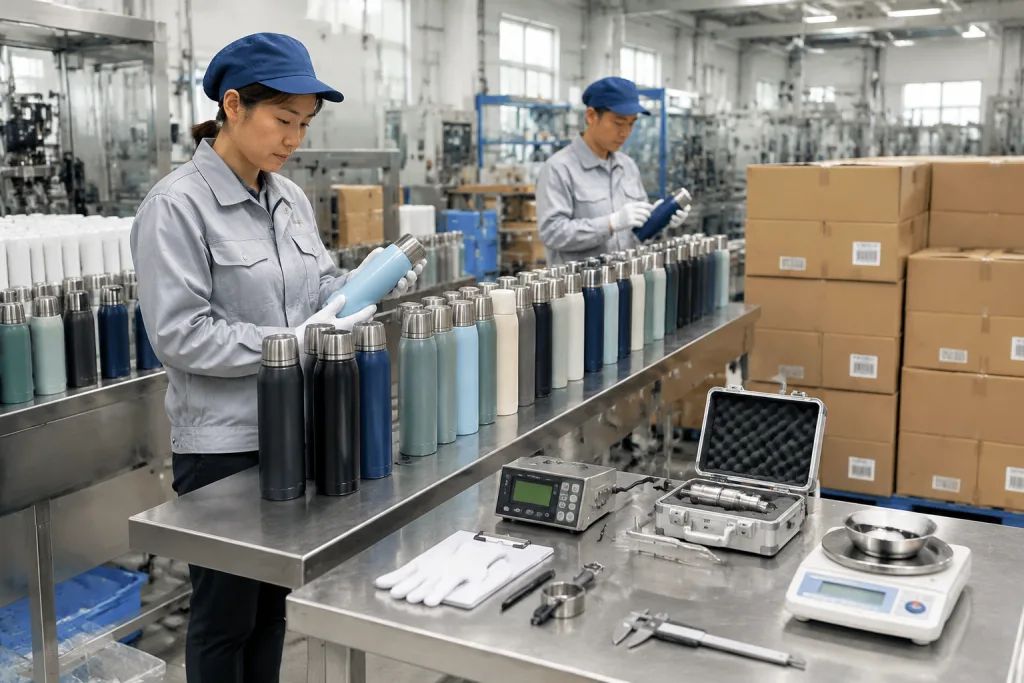
Typical wall thickness is 0.4 mm to 0.5 mm before forming. Thicker is not automatically better. A 0.6 mm wall can make the flask feel dead-heavy in hand, and the math does not work for backpacking buyers. For a 750 ml factory thermos aimed at outdoor retail, 390-450 g empty weight is a reasonable range; we check it on a 0.1 g digital scale after powder coating, not before. Promotional thermos orders may accept 460-500 g when the buyer wants shelf heft more than trail weight.
Vacuum performance is where weak supplier thermos quotes break. Ask for the test method, not the sales line. We fill the thermos with 95°C water in a 20°C test room, close the lid for 6 hours, then QC records the water temperature with a probe thermometer. For a 750 ml stainless vacuum flask, 68°C or higher after 6 hours is a good result. For 12 hours, 52°C or higher is a fair buyer target. Cold retention is easier, but condensation on the outer wall means vacuum failure. Reject it.
You should specify the stopper material on the PO, not leave it to the factory. Food-contact PP is common, but check whether silicone gaskets are LFGB or FDA grade based on destination; we have seen one order delayed 12 days vs 18 days because the buyer typed “FDA silicone” in email but the PO said only “silicone ring.” For EU orders, ask your thermos manufacturer for REACH and LFGB documentation. For North America, request FDA food-contact declarations, plus CPSIA or ASTM review when the item is sold for children.
Decoration Is A Cost Decision
Decoration changes the unit cost, lead time, and reject rate. For a thermos custom order with one-color artwork, we run laser engraving when the buyer wants a clean mark that survives real use. The laser burns through the powder coat and shows the 304 stainless underneath, so outdoor retailers get that scratched-in, rugged look without adding ink. On a 5,000-piece order, laser engraving may add about USD 0.12-0.25 per unit depending on logo size and position; last month QC pulled 12 samples because one logo sat 3 mm too close to the bottom radius.
Silkscreen printing is cheaper for simple promotional thermos logos, often USD 0.06-0.15 per color per position, but the artwork has to be controlled before the line starts. Thin lines below 0.25 mm and tiny reversed text often fill in on curved powder coated bodies. We see this on black matte cups with white ink; the buyer flags the “R” in their trademark because the counter closes up after curing. Heat transfer and full-wrap graphics are possible, but they raise MOQ and scrap risk. If you want a thermos customizable program with multiple client logos, keep the base color fixed and change only laser or one-color print. That keeps production sane.
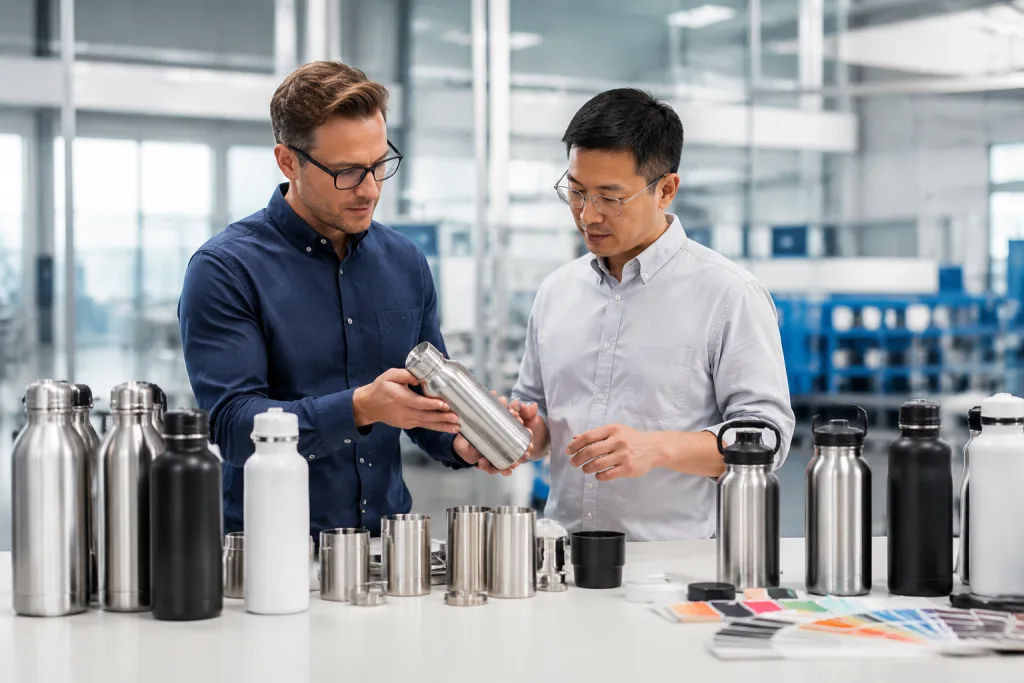
Color matching is where buyers burn days. A digital mockup is not a color approval, and this is the wrong question to ask if the buyer says, “Can you just match the PDF?” For matte powder coating, use Pantone C as the reference, then allow real tolerance because powder texture changes the way color reads under a D65 light box. We usually advise approving one physical color chip or pre-production sample before mass production; skipping that can turn a 12-day approval into 18 days after the first shipment sample gets rejected. If you need retail shelf consistency, write a Delta E tolerance into the order. Delta E under 2.0 is tight; under 3.0 is more realistic for powder coating across batches.
For a customized thermos sold in outdoor stores, I would avoid light matte colors unless you have tested stain resistance. White, sand, and pale gray look good in catalogs but show coffee, dirt, and carton rub marks after one warehouse move. We ship samples in 5-layer export cartons, and even then QC sometimes finds gray scuffs on pale bodies after a 60 cm drop test. Dark green and charcoal behave better on retail shelves. The math does not work if a pretty color gives you a 4% cosmetic reject rate.
Build Packaging Around Warehouses
Too many buyers treat packaging like artwork. Wrong question. For a bulk thermos order going into retail or distributor warehouses, the pack has to stop powder-coat rub marks, scan on the first pass, and stack without the bottom layer collapsing. We usually run one unit in a printed 350 gsm retail box, then 24 pieces per master carton. For a 750 ml flask, a master carton may be around 54 x 36 x 48 cm and weigh 13-15 kg gross, depending on the lid and box design. Last month QC pulled the sample carton after the line found black coating dust on the inside flap, so we added a 0.5 mm PE bag before sealing.
If your customer is an outdoor retailer, you likely need an EAN or UPC barcode on each retail box and a carton label with SKU, quantity, PO number, color, gross weight, net weight, and country of origin: Made in China. If you sell through marketplace fulfillment, add FNSKU or shipment labels exactly as required. Do not ask the factory to “handle labels” without sending a label placement guide. A 15 mm placement error can trigger relabeling fees. We have seen this go sideways when the buyer’s PO said “matte navy” but the carton mark file said “navy blue,” and the warehouse froze 2 pallets for manual checking.
For promotional brands, packaging can stay simple: white box or kraft box with egg-crate dividers. That saves USD 0.10-0.35 per unit versus full printed retail packaging. The math does not work if the item ships as individual parcels later; a thin white box will split at the corner after one courier drop. Ask your thermos supplier to run a basic carton drop test: one corner, three edges, and six faces from 60-80 cm. It is not a replacement for ISTA testing, but it catches weak cartons before they become warehouse claims. We run this on a concrete floor beside the packing line, and weak B-flute cartons usually fail by the second edge drop.
A good thermos vendor in China will ask how cartons are palletized before the carton dieline is locked. If you require European pallets, North American pallets, or floor-loaded containers, carton dimensions should be checked before production. Packaging feels boring until a buyer flags crushed corners, unreadable labels, or a 12-day relabeling delay at the warehouse. Then everyone cares.
Quote The Order Without Fog
A serious RFQ should come back with a quote we can actually build against. For this scenario order, a realistic FOB Ningbo price might sit around USD 5.20-7.40 per unit for 5,000 pieces. The spread usually comes from 304 stainless vs thinner inner wall material, a push-button lid with 3 silicone parts vs a basic screw lid, powder coat weight around 28-35 g per bottle, logo process, and retail box spec. If a thermos manufacturers quote lands 20% below the rest, ask what disappeared. We have seen this go sideways. Last March, QC pulled a low-price sample and found the inner wall at 0.32 mm instead of the quoted 0.40 mm, plus a carton test that failed after a 76 cm drop.
Ask for the quote to split product cost, decoration cost, packaging cost, sample cost, mold cost if any, and domestic freight if not FOB. No fog. Payment terms for a first order are commonly 30% deposit and 70% balance before shipment after passed inspection. For repeat buyers with stable credit, terms can be discussed, but the math does not work for open account on a new thermos factory relationship. One buyer once sent a PO with “FOB Shanghai” in the header and “FOB Ningbo” in line 14; our merchandiser caught it before the PI, because that typo changes trucking by about RMB 1,800 for 5,000 pieces.
Sampling needs a sequence, not guesswork. A blank sample confirms shape and hand feel. A pre-production sample confirms coating, logo, box, barcode, and lid fit. For a thermos private label project, approving mass production from a photo only is the wrong question to ask. Pay the USD 80-150 courier fee and hold the sample. We run the lid thread through a simple go/no-go check, smell the gasket after 24 hours in a sealed PE bag, measure print offset with a 0.5 mm ruler, and test whether the bottle fits common backpack pockets or cup holders if that matters to your channel.
Lead time should be written in the quote, not buried in WeChat. For BottleForge Industrial in Zhejiang, typical timing is 7-10 days for logo samples, 35-50 days for mass production after sample and deposit approval, and 3-7 days for inspection, booking, and export paperwork. China holidays can add 10-20 days, especially before Lunar New Year. If your retail launch is fixed, build the purchase schedule backward from the shelf date, not the factory promise date. We ship from the line only after final AQL 2.5 inspection, carton marks match the PO, and the forwarder confirms the Ningbo vessel cut-off, which is often 2 days earlier than buyers expect.
Inspect Before The Balance Payment
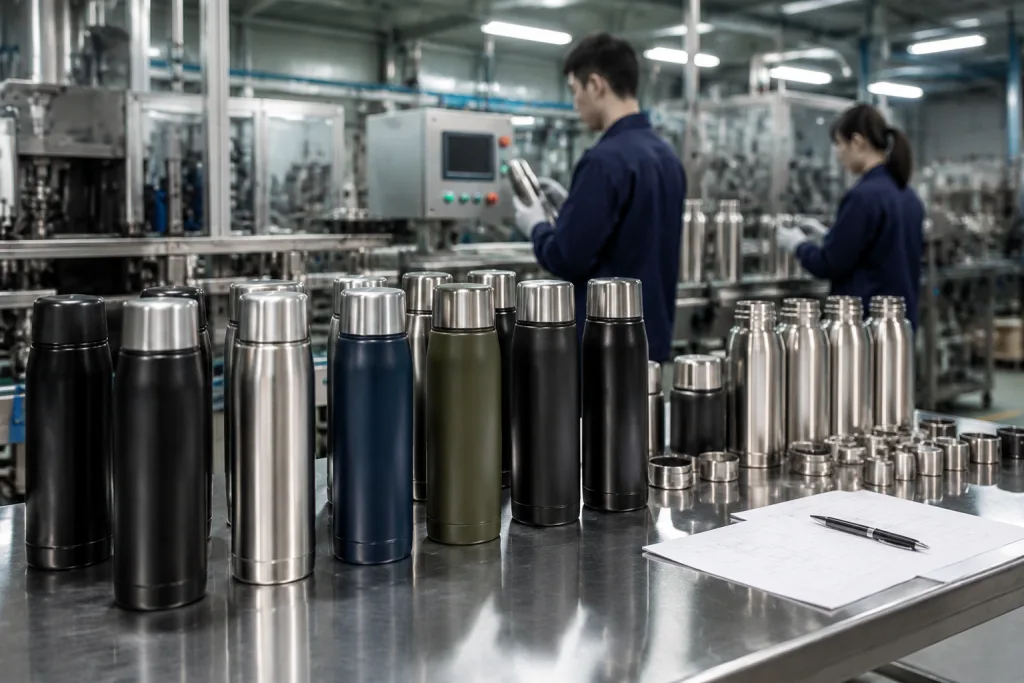
Do not wait for the container to land before you learn the vacuum rate failed or the logo plate was wrong. Run pre-shipment inspection after at least 80% of the order is packed, not while the line is still chasing lids. For drinkware, AQL 2.5 for major defects and AQL 4.0 for minor defects is common. Critical defects should be zero. On a 5,000-piece order, the inspector often pulls 200 units under general inspection level II, though the final sample count depends on the selected standard and how the lot is split. We had one buyer flag a 3 mm logo shift only after arrival; the rework math did not work.
Major defects should be written in plain language: leaking lids under a 10-minute invert test; vacuum failure after hot-water hold; sharp rim edges caught by a cotton-glove wipe; visible rust; wrong logo artwork; barcode that will not scan; coating chips larger than the signed limit sample. Minor defects can be smaller issues such as one tiny black speck under 0.5 mm, slight shade drift against the approved color chip, carton scuffs outside the retail face, or print position off by 1-2 mm. Define these before QC pulls the sample. If you leave it open, the fight starts when the inspector sends 42 close-up photos on WeChat.
For thermos customized orders, add functional tests to the checklist. Fill at least 20 units with hot water and invert them for 10 minutes to check leaks. Test another 20 units for heat retention over 6 hours; record start temperature and end temperature, not just “pass.” Randomly check capacity with a digital scale: 750 ml should not quietly become 700 ml. Check coating adhesion with a 3M tape pull on cross-hatch samples if the finish is critical. Confirm barcode scanability on at least 30 retail boxes and 10 master cartons. Simple stuff. We run this beside the packing tables with a thermometer, a 0.1 g scale, and the signed gold sample on the desk.
The factory should also keep production records: vacuum test logs by date and operator, coating batch records tied to the spray line, incoming steel certificates, and the packing list matched against the PO. A disciplined thermos manufacturer will not be offended by this request. Weak thermos suppliers may call it unnecessary, or they will send a blurry Excel screenshot with one digit missing from the SKU. Push back. It is necessary if you want fewer returns and fewer uncomfortable emails from distributors after 18 days on the water instead of catching the issue 12 days earlier at inspection.
Ship It Like A Repeat SKU
Once QC signs off, the job is not finished. For FOB Ningbo or FOB Shanghai, we send the commercial invoice, packing list, booking sheet, HS code note, plus certificates the buyer already asked for on the PO. Stainless vacuum flasks usually sit under vacuum vessel classifications, but your customs broker should lock the final HS code for your country. Last month QC pulled the sample carton at 14.6 kg gross weight, then the forwarder asked why the packing list showed 15.2 kg. Fix that before booking, not at the port gate.
For 5,000 pieces of 750 ml thermos bulk goods, a 40-foot container is not always full; with our standard color box, we usually see 18 to 22 cbm, depending on lid height and gift-box foam. Most buyers add 2 to 4 other SKUs in the same shipment. Carton marks matter more in that case. Each carton needs to match the PO line, SKU, color, quantity, carton number, plus the barcode if your warehouse scans outer cartons. If your DC receives by ASN, send the Excel format before mass packing starts. We can run it on the line, but guessing your warehouse rules is the wrong question to ask.
Plan it like a repeat distributor thermos SKU from day one. Keep one golden sample in your office and one sealed at the factory, with a signed label on the base and a dated photo set. Record the steel grade, coating code, logo file version, box dieline, barcode file, gasket material, carton size, plus the inspection standard. We also keep the first bulk gasket in a small PE bag because silicone shade changes get flagged six months later. When the reorder is urgent, this file stops the classic “same as last time” mistake.
Private label sourcing gets messy for plain reasons. Small calls stack up: 201 versus 304 stainless outer shell, laser logo versus pad print, 5-ply carton versus 3-ply carton, AQL 2.5 versus a tighter limit, barcode placement, plus holiday timing in Zhejiang. We have seen this go sideways when a buyer approved the bottle but forgot the retail box drop-test rule; 312 cartons were repacked by hand before loading. Control those details on the first order, and the second thermos private label run ships faster, costs less to manage, and depends less on luck.
Send Your Thermos Spec Before You Quote
Share capacity, quantity, logo method, packaging, and destination market. We will return a practical FOB quote and QC checklist.
Frequently asked questions
What MOQ should I expect for a thermos private label order?
For existing stainless thermos shapes, expect 1,000 pieces per color as a practical MOQ. If you need custom powder coating, 3,000 pieces per color is more realistic because coating lines need setup, cleaning, and color stability. A fully new mold usually needs 10,000-20,000 pieces to make the tooling cost sensible. Some suppliers thermos teams may accept 500 pieces, but the unit price will rise and color options may be limited to stock inventory. For outdoor retail, I usually suggest starting with 3,000-5,000 pieces on one proven shape rather than spreading 5,000 pieces across too many colors.
How much does a custom stainless thermos cost from China?
For a 750 ml custom thermos with double-wall vacuum insulation, powder coating, laser logo, and retail box, a realistic FOB China price is often USD 5.20-7.40 at 5,000 pieces. A simpler promotional thermos with plain white box and 201 outer steel may be lower. A premium 304 inner and outer steel model with complex lid, handle, or full-wrap printing can exceed USD 8.00. Always compare quotes using the same steel grade, wall thickness, lid material, decoration, packaging, and test requirement. Otherwise a cheap thermos manufacturer quote may not be comparable.
Which logo method is best for outdoor thermos retail?
Laser engraving is usually the safest choice for outdoor retail because it does not peel, has a clean technical look, and handles abrasion better than many printed logos. It works best on powder coated stainless steel and normally adds about USD 0.12-0.25 per unit depending on artwork size. Silkscreen printing is fine for promotional thermos campaigns, especially one-color logos, but curved surfaces and textured coating can make fine details risky. For a customizable thermos program with many customer logos, keep one bottle color and use laser engraving to reduce setup delays.
What quality checks should I require before shipment?
Use AQL inspection before paying the balance. A common setup is AQL 2.5 for major defects, AQL 4.0 for minor defects, and zero tolerance for critical defects such as unsafe sharp edges or contamination. For a 5,000-piece order, inspectors commonly sample around 200 units under general level II. Add drinkware-specific tests: leak test 20 units upside down for 10 minutes, heat retention test 20 units for 6 hours, scan 30 barcodes, and check coating adhesion with 3M tape on cross-hatch samples. Photos alone are not enough for thermos bulk shipments.
Can one factory support both retail and promotional thermos orders?
Yes, if the thermos factory has flexible decoration, packaging, and QC systems. Retail orders need stronger packaging, barcode control, consistent coating, and better documentation for REACH, LFGB, FDA, or other market requirements. Promotional thermos orders usually need faster logo changes, lower MOQ per artwork, and sharper pricing. The base bottle can be the same, but the workflow is different. Ask your thermos supplier for monthly capacity, sample lead time, decoration options, and whether they can hold golden samples for repeat orders. A good manufacturer thermos partner will separate retail SKU control from campaign-based customization.