Key Takeaways
- For custom thermos orders, 1,000 pcs is the practical MOQ for most colors and logo methods
- 304 inner stainless steel at 0.4 mm is a safer baseline than mixed unknown grades
- Vacuum performance should be checked at 6, 12, and 24 hours, not only at filling
- FOB China lead time is usually 25-35 days after sample approval for standard models
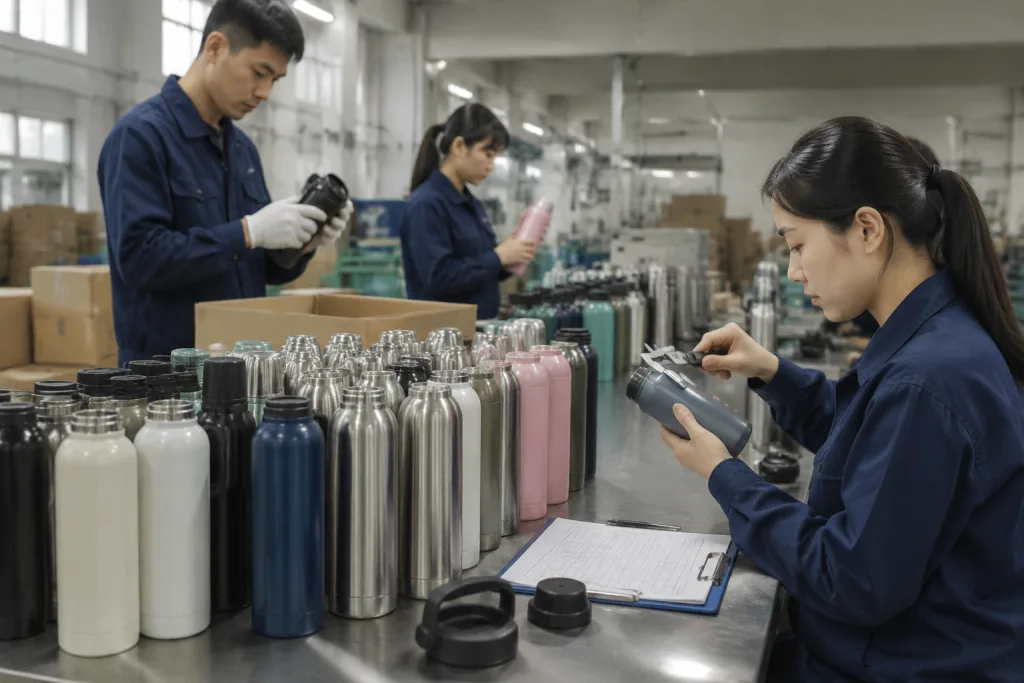
Buying thermos online wholesale looks simple until the quote sheet lands. One supplier lists a 500 ml thermos with 201 outer steel, another factory offers 750 ml with 304 inside, and both write “premium” in the same cell. That word tells you almost nothing. Last month QC pulled a matte-black sample from the line, measured the mouth at 53.2 mm with a digital caliper, and the lid still leaked after the 45° tilt test. For outdoor retailers and promotional brands, this gap turns into warranty claims, weak logo adhesion, 18-day delays instead of the promised 12 days, or master cartons that split during a 1.2 m drop test.
From our factory base in Hangzhou, Zhejiang, we see this mistake on roughly 7 out of 10 new thermos projects: buyers choose by photo and unit price, not by how the bottle will be used. This is the wrong question to ask. A hiking flask needs a tougher lid and grip coating; a corporate promotional thermos needs clean laser logo positioning within 1 mm, plus a gift box that does not crush at 12 kg stacking pressure. For winter retail distributor orders, we run thicker cartons, clearer barcode placement, and AQL 2.5 inspection before we ship. The buyer often flags the MOQ first, but the real cost shows up when the line has to rework 3,000 lids because the PO said “push button” and the artwork file showed a screw cap.
Model Comparison Buyers Actually Need
For thermos online wholesale, the wrong question is “cheap or premium.” We sort it by where the bottle has to survive: retail shelf, outdoor field, or campaign giveaway. We run these three stainless models on the Hangzhou line often; last month QC pulled 32 samples after a buyer flagged coating chips around the shoulder radius.
| Spec | Trail Bottle | Retail Thermos | Promo Flask |
|---|---|---|---|
| Capacity | 750 ml | 500 ml / 1,000 ml | 350 ml / 500 ml |
| Steel | 304 inner, 201 or 304 outer | 304 inner and outer | 304 inner, 201 outer |
| Wall thickness | 0.4 mm inner, 0.5 mm outer | 0.4 mm inner, 0.45 mm outer | 0.35 mm inner, 0.4 mm outer |
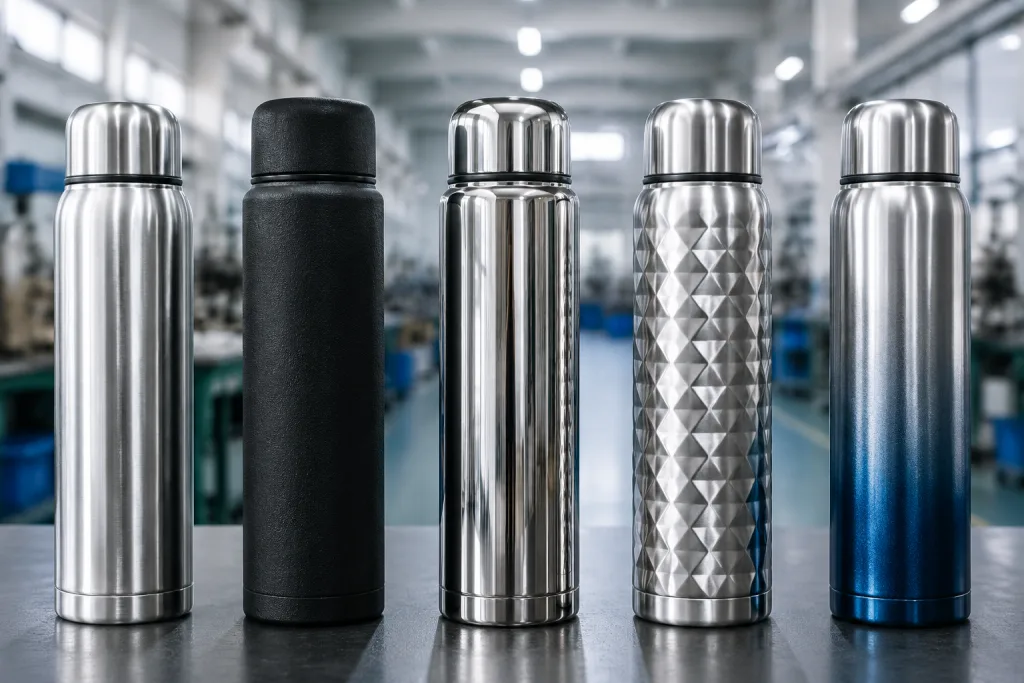
| Finish | Powder coating | Matte paint or brushed steel | Spray paint |
| Best MOQ | 1,000 pcs | 1,500 pcs | 3,000 pcs |
| Logo | Laser or 1-color print | Laser, screen print, sleeve | Pad print or screen print |
| Use case | Outdoor retailer | Thermos distributor | Promotional brand |
If you are a distributor, do not load thermos bulk stock with custom parts. Keep two neutral colors, one cap style, and a standard carton; we’ve seen this go sideways when a PO listed “black lid” in one line and “silver lid” in the artwork file. For a promotional thermos campaign, logo size and landed cost beat 24-hour heat retention. For outdoor gear, the math does not work if you save USD 0.18 per unit but get 5% returns from cracked lids or scratched coating.
Steel Grade Versus Real Performance
Every thermos quote says 304 stainless steel somewhere. The better question is where we run it. The inner wall touches the drink, so 304 is the lowest sensible grade for Europe and North America. For a promo flask, a 201 outer shell can pass if the powder coating holds and the buyer accepts weaker rust resistance; we had one German buyer flag orange spots after a 48-hour salt spray on a scratched sample. For a manufacturer thermos going into outdoor retail, we quote 304 inner and 304 outer when the bottle will see wet backpacks, snow, or coastal air.
Steel grade does not decide heat retention by itself. The line still has to control laser welding, copper plating thickness, vacuum draw, stopper fit, and mouth diameter. QC pulled a 500 ml narrow-mouth sample last month with a 36 mm opening, filled it at 95°C, and it held above 70°C at 6 hours and above 55°C at 12 hours. A wide-mouth food flask at the same wall thickness usually loses heat faster because the cap area is bigger. Simple math. Some 1,000 ml models stay above 50°C after 24 hours, but the math doesn't work if you print that claim before your own batch test confirms it.
For compliance, ask your thermos manufacturer for LFGB or FDA food contact reports, REACH for colored coatings where relevant, and a recent salt spray result on the exact finish you plan to buy. We ship these with the sample file, not after mass production starts. Good paperwork will not save a weak weld; our AQL 2.5 inspection once found 7 leaking pieces in 200 after the vacuum cup showed a bad seam. Missing paperwork is still a red flag, especially when the PO has only “stainless steel” typed with no grade or coating code.
Logo Methods Compared Side By Side
A custom thermos gets expensive fast when the logo method is picked before the order size is fixed. For 1,000 pcs, we usually run laser engraving on powder coating or brushed 304 stainless steel; the 30W fiber laser leaves a clean permanent mark and setup is just a jig check, not a screen charge. For a 5,000 pcs promotional thermos order, silkscreen printing can cut unit cost and give denser color, but the math doesn't work if the ink fails a tape test. We have seen a buyer flag 600 pcs because the white logo scratched after the coating supplier changed the powder batch.
- Laser engraving: suits outdoor retail orders where the logo is one color, the line needs stable positioning, and buyers care more about wear resistance than bright color.
- Silkscreen printing: works for 1-3 color logos on cylindrical surfaces, usually from 1,000 pcs, with a curved screen and a fixed bottle jig.
- Heat transfer: fits full-color artwork, but QC should pull samples for adhesion, boiling-water soak, and corner lift checks.
- Powder-coated deboss effect: fits premium thermos custom programs, but tooling takes longer and MOQ pressure is real.
For customizable thermos programs, do not approve a logo from a flat digital mockup only. Ask for a pre-production sample photographed straight front, full side profile, and one 45 degrees angle under normal packing-room light. Curved bodies bend artwork. A 45 mm wide logo may look balanced on a 500 ml bottle but too small on a 1,000 ml flask; QC pulled one sample last month where the mark sat 3 mm off center and looked worse in marketplace photos than on the bench. If your sales channel includes online marketplaces, keep barcode, FNSKU, warning text, and carton labels separate from the decorative artwork. Mixing retail compliance labels with brand art causes rework, and we have seen one PO delayed 12 days vs 18 days because “FNSKU” was typed as “FNSK” on the label file.
Use Case Fit Beats Low Price
A thermos vendor can cut the quote by thinning the inner wall from 0.40 mm to 0.32 mm, swapping the cap, or dropping from a 5-layer export carton to a lighter 3-layer box. Cheap is the wrong question to ask. The real check is whether that spec survives your channel. For outdoor retailers, the cap usually fails first; QC pulled 32 samples last month after a buyer flagged seepage during a 45° tilt test. We run threaded caps with silicone sealing rings at 50-60 Shore A hardness, and we keep spare rings on the BOM. Flip lids sell well on the shelf, but the hinge pin, spring, and button all need cycle testing before we call it ready.
For distributor thermos orders, SKU stability pays the bills. If you sell to regional shops, the same black 750 ml bottle needs to be available again in 90 days, not replaced by a “similar” mold with a 2 mm taller shoulder. A suppliers thermos catalog with 80 shapes looks nice in a PDF, but it means little if the factory changes tooling, powder-coat recipes, or carton dimensions between batches. BottleForge Industrial can produce about 450,000 stainless drinkware units per month in peak season, and the line still runs smoother when repeat-order specs are locked before the first PO. We have seen this go sideways from one typo: “matte back” instead of “matte black” on a PO.
For promotional brands, simplify the job. Pick a proven 500 ml body, one lid, two color options, and a 1-color logo with a fixed print area, such as 45 mm wide on the front face. That keeps thermos customized costs under control and gives inspection fewer places to find trouble. Complicated gift boxes need drop-test checks; metallic colors need an extra signed color panel; multi-position logos force the pad-printing team to set up twice. If the event date is fixed, simple wins. We ship cleaner that way.
MOQ Price And Lead Time Reality
For thermos online wholesale, MOQ is not a punishment. It is the point where the math starts to work: sheet steel purchase, powder coating changeover, logo jig setup, and QC hours on the line. On our Zhejiang thermos lines, standard color stock can start around 500 pcs per model if the logo is a single-position laser mark. New powder coating colors usually need 1,000 pcs because the spray booth and curing oven cannot be cleaned for a 200 pcs trial without wasting half a shift. Fully customized thermos projects with special lid tooling, exclusive shape, or molded silicone parts often start from 3,000-5,000 pcs. We had one buyer ask for 300 pcs with a new silicone grip and 4 Pantone colors; the mold charge alone made the unit price look silly.
Typical FOB China pricing for stainless vacuum bottles ranges from about USD 3.20 to USD 7.80 depending on capacity, steel grade, coating, lid build, and packaging. A 500 ml promotional flask with 304 inner and 201 outer may sit near the lower end. A 1,000 ml outdoor thermos with 304/304 steel, powder coating, carry handle, color box, and PE bag sits higher. If a quote is 20% below the market, ask exactly which component changed. This is the wrong question to ask: “Can you match this price?” Ask whether the wall thickness dropped from 0.5 mm to 0.4 mm, whether the lid seal changed from silicone to TPE, or whether the carton passed a 12 kg drop test. QC pulled one sample last season where the supplier saved USD 0.18 by using a thinner bottom pad; the buyer flagged dents after warehouse handling.
Lead time is not one number. Sample production is usually 5-10 days after artwork confirmation. Mass production is normally 25-35 days after sample approval and deposit. Add 3-5 days for final inspection, carton marking, and booking handover. For Q4 retail, place orders earlier; China factories get crowded from August onward. A normal repeat order might ship in 28 days, while a new powder coating plus gift box project can run 38-45 days if the first printed box proof has a barcode typo. We ship faster when the PO, logo file, Pantone code, and carton marks arrive together; if the buyer sends the lid color 6 days later, the line waits or the schedule moves.
Quality Checks Before Shipment
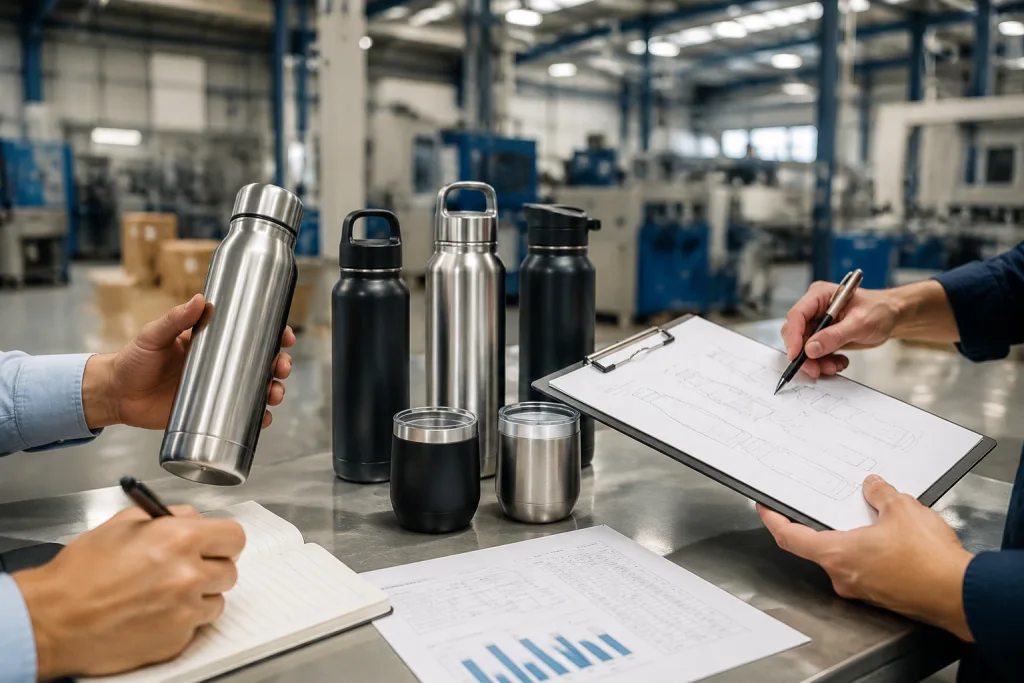
A thermos supplier should sign off on inspection terms before you pay the deposit, not after 1,200 cartons are sealed with 48 mm BOPP tape. For most thermos bulk orders, we run AQL 2.5 for major defects and AQL 4.0 for minor defects. Critical defects stay at zero. The checklist should cover vacuum performance, leakage, coating adhesion, logo position within ±1 mm, actual capacity, odor, sharp edges, carton drop result, and barcode readability if the cups go into retail shelves or online fulfillment.
Leakage testing is not shaking one sample over the packing table. That is the wrong question to ask. A workable check is filling the bottle with 95°C water, inverting it for 30 minutes, then checking the lid seal and thread area with dry tissue. QC pulled the sample last month and found two lids sweating at the silicone gasket, even though the outside carton looked perfect. Coating adhesion can be checked with a cross-cut tape test, while printed logos should pass dry-cloth rubbing and alcohol-cloth rubbing. For a distributor thermos program, keep golden samples in your office and at the China factory, both signed and dated, so the second or third order has a physical reference the line cannot argue with.
Do not approve mass production from a beauty sample alone. Approve from a sample that uses the same steel, coating, logo method, lid gasket, and retail packaging as the PO.
Quality control is not mistrust. It is how serious manufacturers thermos buyers avoid the ugly call after the goods reach port and the buyer flags 37 cartons with crushed corners or unreadable FNSKU labels. We have seen this go sideways; at that point, the math does not work for either side.
Send Your Thermos Spec For A Factory Quote
Share capacity, logo, MOQ, target market, and delivery date. We will reply with practical options, not a catalog dump.
Frequently asked questions
What is the best MOQ for thermos online wholesale orders?
For standard stainless models, 1,000 pcs per color is the best working MOQ because coating, logo setup, and carton printing become efficient at that level. If you choose in-stock colors and laser engraving, some thermos supplier programs can start at 500 pcs. For a customized thermos with new lid color, special box, or full-color artwork, plan on 1,500-3,000 pcs. If you need exclusive shape tooling, 5,000 pcs is more realistic. The lower the MOQ, the less control you usually have over color, packaging, and delivery schedule.
Should I choose 304/304 steel or 304 inner with 201 outer?
Use 304 inner steel as the baseline because it contacts beverages and is easier to support for FDA, LFGB, and EU food-contact expectations. A 201 outer shell can work for a promotional thermos where the product life is shorter and the coating fully protects the surface. For outdoor retail, wet environments, or premium distributor thermos programs, 304 inner and 304 outer is the safer spec. The price gap is often USD 0.25-0.60 per unit depending on size, but it reduces corrosion complaints and gives your sales team a cleaner material story.
How long does a custom thermos order take from China?
A normal custom thermos order from China takes 5-10 days for sampling and 25-35 days for mass production after sample approval and deposit. Add time for inspection, customs documents, and freight. Sea freight to Europe or North America can add roughly 25-40 days depending on route and season. Air freight is faster but usually only makes sense for urgent promotional campaigns or small replenishment lots. If you need goods for a fixed event, approve artwork and packaging at least 60-75 days before your required delivery date.
Which logo method is most durable for outdoor bottles?
Laser engraving is usually the most durable for outdoor stainless thermos products because it does not rely on ink adhesion. It works especially well on powder coating and brushed steel, and it is suitable from about 500-1,000 pcs. Screen printing is cheaper for larger promotional thermos runs and gives stronger colors, but it needs rubbing and adhesion tests. Heat transfer can show detailed artwork, yet it is more sensitive to coating quality and curved surfaces. For outdoor retail, choose laser first unless the brand guideline requires color.
What should I check before paying a thermos manufacturer deposit?
Before deposit, confirm the exact steel grade, capacity tolerance, wall thickness, lid material, gasket material, coating type, logo method, packaging, MOQ, FOB port, sample fee, production lead time, and AQL standard. Ask for food-contact reports such as FDA or LFGB, plus REACH information for coatings when selling into Europe. Also request a written defect policy and pre-shipment inspection agreement. A serious thermos manufacturer in Zhejiang or elsewhere in China should be able to state these points clearly before production starts, not after a problem appears.