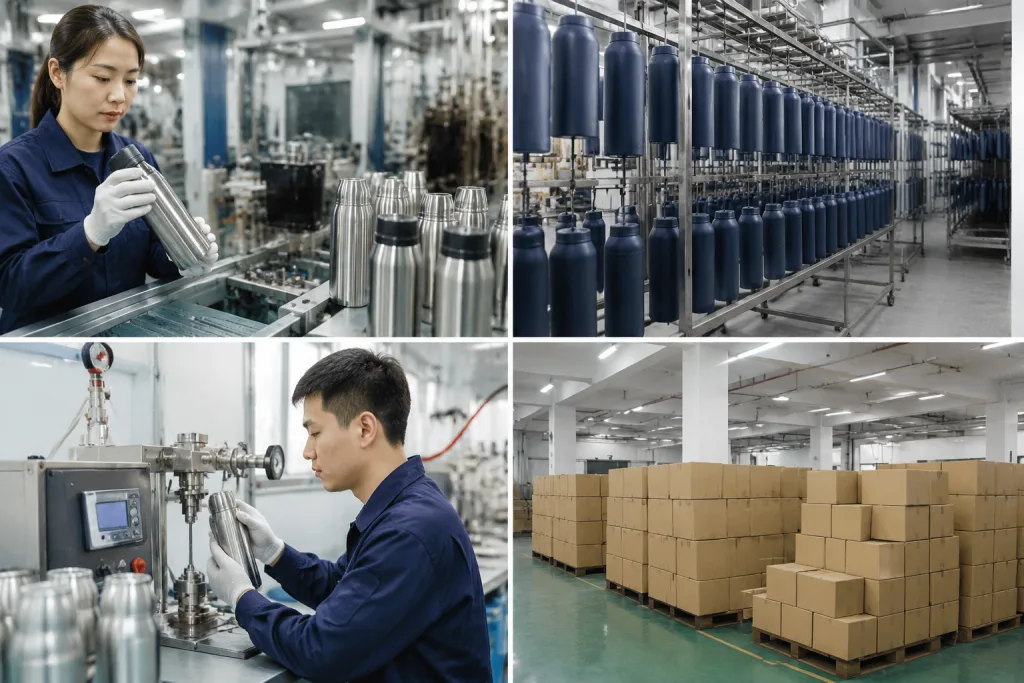
Key Takeaways
- Specify SUS304 inner steel, 0.4-0.5 mm wall thickness, and 6-12 hour heat-retention targets before pricing
- Most custom thermos failures come from lid tooling, coating adhesion, vacuum loss, and weak packaging
- For thermos bulk orders, use AQL 2.5 major / 4.0 minor plus 100% leak testing at the factory
- A realistic OEM timeline is 7-10 days for samples and 35-45 days for mass production after approval
A stainless thermos looks simple until the first container lands with lids backing off at 0.6 N·m, vacuum drop after 24 hours, rubbed-through powder coat, and cartons crushed on the second warehouse stack. We’ve had QC pull 32 samples from a 1,200 pcs pilot run and find the same issue: the silicone gasket looked fine on the bench, then leaked after a hot-fill test.
If you are searching for a thermos oem factory china, a prettier catalog is the wrong question to ask. You need a tighter failure map. Our Hangzhou, Zhejiang team builds custom thermos programs for North America and Europe with 80,000 stainless vacuum units/month capacity, typical MOQ from 1,000 pcs/model, and 35-45 day production after sample approval. We run the spec sheet before tooling: 304 stainless thickness, lid thread fit, powder coating adhesion, carton burst strength, barcode position. That work prevents most arguments before steel is cut in China.
Vacuum Failure Starts With Thin Specs
The first failure mode is usually boring. The bottle passes visual inspection, the logo is straight, and the carton count matches the PO, but the heat-retention curve misses the outdoor retail claim. Same shell, weaker build: 0.32 mm steel instead of 0.45 mm, a vacuum gap shaved by 1.5 mm, or copper plating that looks patchy when QC cuts a retained sample. If your RFQ only says “500 ml stainless thermos, keep hot,” this is the wrong question to ask. You left the performance spec to the cheapest bidder.
For a manufacturer thermos program, put the target in numbers. We run the common retail test with 95°C water, 20°C ambient, and a calibrated Fluke probe, then check whether a 500 ml bottle stays at no lower than 55-60°C after 6 hours. Premium outdoor SKUs often need 12 hours above 50°C, and the math changes fast once the buyer wants a slim body under 70 mm diameter. For cold claims, test with 4°C water and log at 6, 12, and 24 hours if the gift box prints “24H cold.” We have seen this go sideways when the packaging claim was approved before the lab sheet.
Steel thickness matters, but it is not the whole story. For most bulk thermos orders, we recommend SUS304 inner and outer stainless steel, 0.4-0.5 mm body wall, and food-contact silicone matched to LFGB or FDA expectations by market. On the line, we check body wall with a digital thickness gauge before polishing, because polishing can hide a light shell until the weight sheet exposes it. Some buyers ask for SUS316 inner steel for saltwater use or high-acid drinks. Fair request. It usually adds roughly USD 0.30-0.70 per unit depending on capacity and market steel cost, so do not approve it just because a competitor put “316” in a listing.
A serious thermos factory in China should inspect vacuum before packing, not depend on a few random heat tests after cartons are sealed. Ask if the line runs 100% vacuum detection, lot-based heat-retention samples, and aging checks after welding with the leak tester set to the agreed threshold. At BottleForge Industrial in Zhejiang, QC pulled a sample last month because one weld seam showed a slow vacuum drop after 18 hours, even though the bottle looked clean. Heat retention is an engineering claim, not a slogan. Your artwork can say what your test data supports; the rest becomes a returns problem.
Leaking Lids Kill Repeat Orders
The second failure mode is the lid. A customized thermos with a cheap lid turns into a refund machine fast. We see this on 500 ml promo bottles every season: buyers spend 20 minutes arguing over logo height, then the complaint sheet comes back with leaking caps, dirty threads, plastic smell, and push buttons that jam after 300 presses. Bad trade. If your bottle sits in hiking packs, gym bags, or a distributor’s thermos assortment, lid reliability has to be specified before artwork approval.
Pick the closure around the real use. A screw lid with a 55 mm silicone gasket usually beats a one-touch flip lid on cost and strength. A cup lid fits classic outdoor thermos bottles, but the line has to control cup wobble and thread start; QC pulled one sample last month with a 0.6 mm cap tilt. Straw lids sell well for cold drinks, but cleaning is messier, and hot-liquid warning labels get awkward. More moving parts, more returns. The math doesn't work on low-margin promo orders.
For thermos custom projects, write the lid spec like an engineer, not a catalog buyer. Include gasket material, gasket hardness, thread engagement, drop-test requirement, and leak-test method. We run a basic factory check with room-temperature water, normal closing torque, 30 minutes upside down, then 30 seconds of horizontal shaking on the bench. For safer orders, add 100% leak testing on the production line and an AQL inspection that treats any leak as a critical defect. One wet carton is enough.
Do not approve a lid from one perfect sample. Ask for 10 pre-production samples from soft tooling or production tooling, not hand-fitted showroom units. Measure the fit across the batch with calipers, and have someone on the line close each cap with normal hand force. If the cap needs a fight, retail customers will cross-thread it. If the silicone ring is removable but not captive, it can drop into the sink during washing. We've seen this go sideways after a buyer changed only the lid color on the PO, then forgot the gasket drawing revision.
Coating Problems Are Usually Preventable
Powder coating and paint failures show up first. A buyer might accept one corner ding on an export carton, but he will reject a premium black thermos if the base chips after 14 days on shelf. We see the same root causes on the line: oil left after polishing, curing oven set at 165°C instead of the powder supplier’s 180°C spec, coating under 45 microns, or masking tape sitting 1 mm off the thread. QC pulled the sample, and the buyer flagged it before we even packed the master carton. The math doesn’t work if you save USD 0.06 on pretreatment and lose 300 pieces in rework.
For a customizable thermos, choose the finish around the sales channel, not around the catalog photo. Powder coating is our default for outdoor retail because wet hands grip it better, and it takes more carton rub than basic spray paint. Matte powder coating usually adds USD 0.20-0.45 per unit on a 500-750 ml stainless bottle, depending on color and MOQ. Mirror polish looks clean in a showroom, but in thermos bulk shipments we have seen hairline scratches after 12 days at sea when the PE bag was too thin. Brushed stainless survives better, but promotional buyers often call it “too industrial” for gift sets.
Ask your thermos manufacturer for coating thickness and adhesion records, not just a nice pre-production sample. For powder coating, we run 60-90 microns as a normal target and check it with a Positector gauge at the shoulder and lower body. Cross-hatch adhesion testing should reach 4B-5B after curing; if it drops to 3B near the logo area, stop and find out why. For outdoor SKUs, add a 1 meter drop test on plywood or concrete simulation, then inspect the shoulder and base under 600 lux light. If you sell through distributors thermos channels, your bottle may pass through 4 warehouses and 2 showrooms before the end user opens the box.
Logo decoration needs the same factory-floor thinking. Laser engraving is clean and durable on powder coating or bare stainless, but you get metal tone, not Pantone color. Silkscreen works for one- or two-color logos on straighter surfaces; on a tapered 500 ml body, our printer usually asks for a 35 mm height limit to avoid distortion. Heat transfer and UV printing handle complex graphics, but textured coating and dishwasher claims are where we’ve seen this go sideways. For a thermos promotional order, request a decoration sample, then run 3M tape testing, 75% alcohol rubbing for 50 passes, and at least 20 dishwasher cycles if you plan to claim dishwasher safe.
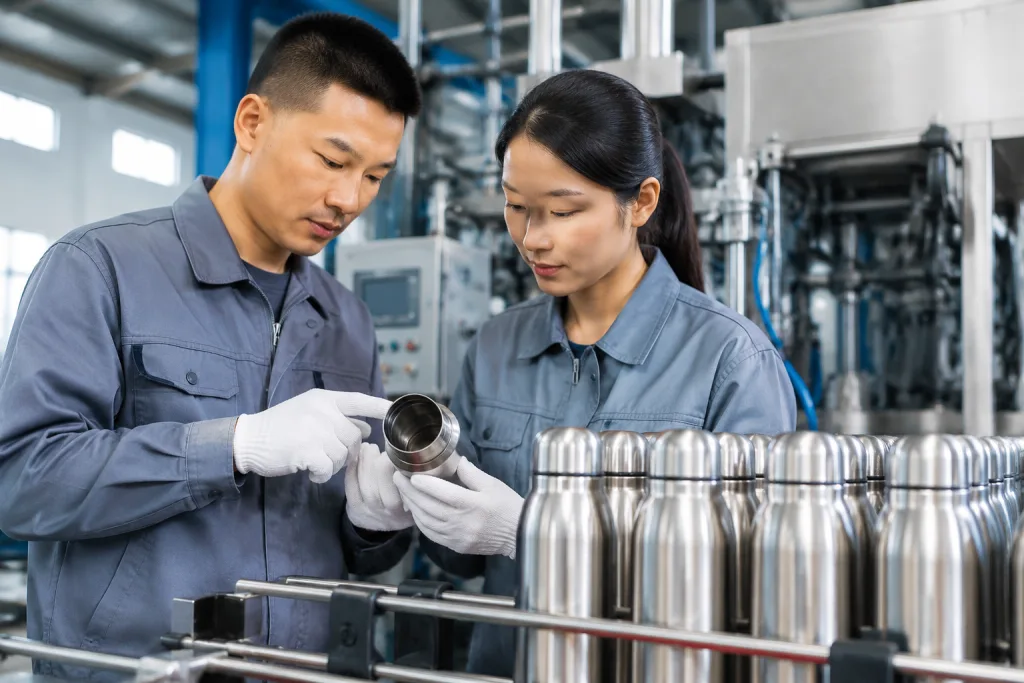
Capacity Drift Creates Retail Trouble
Capacity errors look harmless until the retail label says 20 oz and QC fills the bottle to 18.7 oz on a digital scale. We see this on roughly 6 out of 40 new OEM inquiries because one supplier quotes nominal volume, another quotes brimful volume, and the buyer assumes usable fill. Stock molds make it worse. Some catalogs round a 560 ml body up to “600 ml” because the sales sheet looks cleaner.
Define capacity in milliliters and ounces, then write the fill method on the PO. “591 ml / 20 oz usable fill below the thread line” gives our sampling room a real target; “20 oz bottle” does not. During sample approval, ask for measured capacity data with water weight, photo of the fill line, and the scale reading. The buyer once flagged a PO typo where 590 ml became 950 ml, and catching it before mold confirmation saved 12 days of back-and-forth. A difference of 3-5% may pass for some promotional channels, but retail packaging is where the math doesn't work.
Dimensions drift when the line moves from hand sample to mass production. Powder coating adds about 0.08-0.15 mm per side, depending on the powder and curing oven setting. A base that grows by 1.5 mm may miss a car cup holder; a cap that gains 3 mm can crush a gift-box insert. Lock the tolerance on height, diameter, mouth opening, and weight for custom thermos orders. Typical tolerances might be ±2 mm on height, ±1 mm on diameter, and ±5% on weight, but check them against the actual drawing, not the catalog PDF.
China sourcing gets fast when the factory says the uncomfortable part early. We run into this often: the buyer asks for 20 oz, the existing body gives 575 ml usable fill, and a true 591 ml body needs new tooling. New mold costs for stainless thermos bodies commonly range from USD 800 to USD 3,500 depending on shape complexity, while lid tooling can add more if it includes buttons, hinges, or multiple plastic parts. If a quotation looks too low, ask whether it is a near-match stock body; we've seen this go sideways when the carton artwork was already approved before QC pulled the sample.
Compliance Cannot Be Added Later
Compliance problems usually show up after the deposit is paid and the steel is already cut. For a Europe distributor thermos order, we normally check LFGB food-contact testing, REACH for powder coating or printed inks, and packaging recycling files; last month QC pulled a coated 500 ml sample and the ink layer failed the solvent rub after 50 passes. A North American promotional brand usually asks for FDA food-contact statements, California Proposition 65 risk review, CPSIA if the bottle is sold for children, plus ASTM or retailer drop and migration rules. The exact file set depends on the destination market, age grading, and the words printed on the carton.
Do not ask a thermos supplier, “Is it certified?” That is the wrong question to ask. Ask for the report name, laboratory, tested material, report date, and model match. A report for a PP lid does not cover a new Tritan flip cap, and a 2021 coating report is weak support for a 2026 color run. For stainless thermos products, we check 304 stainless, silicone gasket, plastic lid parts, coating, printing ink, and sometimes the drinking rim after laser logo or full-wrap decoration; our caliper check on lid fit is usually within 0.2 mm before samples go out.
Factory audits matter too, especially for promotional brands selling into corporate programs. BSCI, Sedex/SMETA, ISO 9001, or retailer audits do not guarantee perfect quality, but they cut social-compliance risk and prove the factory knows how to keep records. We have seen this go sideways when a buyer sent a PO with “Sedex required” typed in the remark line after mass production had started. BottleForge Industrial works from Hangzhou, Zhejiang with audited partner workshops in China for forming, coating, and assembly, because one building rarely runs vacuum welding, powder coating, and final packing at the same level.
Build compliance into the RFQ. State destination market, retailer rules, age grading, packaging language, and whether you need test reports before shipment or before purchase order. Basic food-contact testing usually takes 5-10 working days; a retailer protocol can stretch the timeline to 18 working days when extra migration, drop, and carton tests are added. If you leave this until final inspection, the line may have 12,000 finished bottles in export cartons, but the shipment can still be blocked at booking.
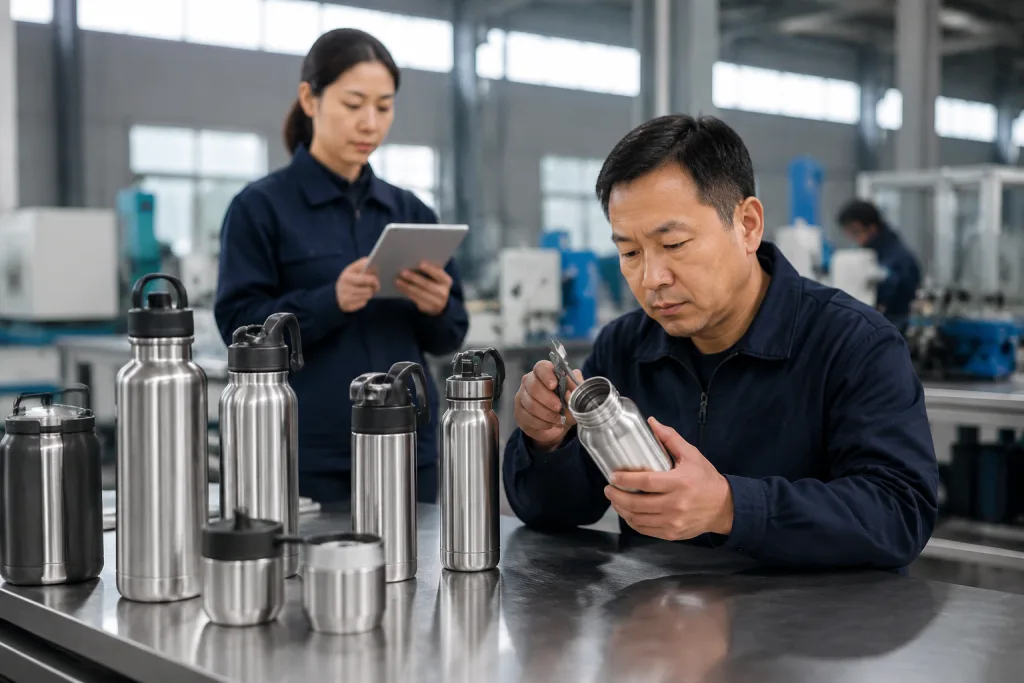
Packaging Fails Before The Bottle
A stainless thermos can pass factory QC and still land unsellable if the packaging gets treated like a last-minute carton choice. We have seen this with thermos distributors and outdoor retailers moving goods through 3 or 4 warehouses before the shelf. Weak dividers let painted bodies rub, loose gift boxes collapse at the corners, and thin master cartons split around the tape seam. QC pulled one 500 ml powder-coated sample after a 76 cm corner drop; the bottle was fine, but the cap had a clear rub mark from the inner flap.
For retail-ready customized thermos orders, lock the packaging construction on the PI, not in a WeChat message two days before packing. A safe setup we run often is 1 bottle in a polybag or paper wrap, 1 white or printed gift box, then 24 pcs per export carton with dividers for painted or powder coated finishes. Master carton material should usually be 5-ply corrugated for export, not domestic-grade board. Keep carton gross weight under 15 kg when possible. The math doesn't work on 23 kg drinkware cartons; warehouse staff drag them, drop them, and stack them on the wet side of the pallet.
Drop testing should match the sales channel. For normal export cartons, use ISTA-style carton drop points from 60-76 cm depending on carton weight. For e-commerce or Amazon FBA preparation, test the individual gift box as well, then scan every barcode size on the carton artwork with a handheld scanner before mass packing. If you need FNSKU labeling, suffocation warnings, country-of-origin marks, or carton routing labels, send final files before the line starts packing. We once had a buyer flag a missing “Made in China” mark after 20,000 units were sealed; re-labeling took 2 extra days and killed the loading plan.
FOB price comparisons often hide packaging differences. One thermos suppliers quote may include a plain egg-crate insert; another may include a printed 350 gsm gift box and a stronger carton with 7 mm corrugated board. Those are not the same offer. When you compare thermos manufacturers, put packaging on the same spreadsheet line as steel grade and lid type, with separate columns for decoration, inspection level, and Incoterm. Choosing the lowest quote without checking the carton spec is the wrong question to ask; we ship the bottle and the packaging together, and damage claims never separate them.
Inspection Plans Need Teeth
The last failure mode is writing “QC included” on the PO and thinking the job is covered. It isn’t. Define the checkpoints, the sample size, the reject rule, and who pays when the lot fails. On a serious manufacturer thermos order, we run 304 stainless incoming checks with a PMI gun, in-process checks after TIG welding and powder coating, 100% leak testing at 0.6 MPa, sample heat-retention testing, and final random inspection before shipment.
For most custom thermos and thermos bulk orders, use ANSI/ASQ Z1.4 or ISO 2859-1 sampling with AQL 0 for critical defects, 2.5 for major defects, and 4.0 for minor defects. Critical defects are leaks, sharp edges over 0.2 mm burr height, unsafe odor, wrong material, or contamination; QC pulled a sample last month with polishing compound left inside the neck, and that lot stopped. Major defects are wrong logo, poor coating adhesion, serious dents, bad lid fit, incorrect capacity, or failed heat retention. Minor defects are small cosmetic marks that match the approved limit sample.
Create golden samples and defect boards. Email photos don’t control a textured coating or brushed finish; this is the wrong question to ask if the buyer only says “make it like the picture.” Approve one physical sample for color, one for logo position, and one for packaging layout if the project is large, then mark each with date, version, and signed hang tag. If you are ordering 5,000 pcs or more, a pre-shipment inspection is cheaper than sorting 87 cartons in Rotterdam, Hamburg, Los Angeles, or Toronto after the buyer flagged mixed lids.
At BottleForge Industrial, a normal thermos oem factory china project runs RFQ and engineering review first, then 7-10 days for sample production, purchase order and deposit, 35-45 days mass production, final inspection, and FOB Ningbo or Shanghai shipment. No magic here. It is controlled repetition on the line: calipers for mouth diameter, torque checks on lids, carton drop test records, and a packing list that must match the PO down to the logo typo if the buyer approved it. The buyer who writes the clearest failure-based spec usually gets the cleanest factory thermos shipment.
Send your thermos spec before quoting mistakes multiply
Share capacity, lid type, market, logo method, and target MOQ. We will review the failure risks before pricing your OEM run.
Frequently asked questions
What MOQ should I expect for a custom stainless thermos?
For a standard body with custom logo, color, and packaging, a realistic MOQ is 1,000 pcs per model/color. If you need a fully customized thermos body or private lid tooling, expect 3,000-5,000 pcs because setup loss, coating line changeover, and tooling amortization become significant. For promotional thermos orders with simple laser engraving on stock colors, some factories in China may accept 500 pcs, but unit cost and color choice will be worse. At BottleForge Industrial in Zhejiang, we usually recommend 1,000 pcs as the starting point for stable pricing and proper QC.
How much does a bulk thermos order cost FOB China?
A typical 500 ml stainless vacuum thermos with SUS304 steel, powder coating, screw lid, one-color logo, and individual box often lands around USD 3.20-5.80 FOB Ningbo or Shanghai, depending on steel market, lid design, finish, and packaging. A 750 ml outdoor bottle with cup lid may run USD 4.80-8.50. New tooling, retail gift boxes, 316 stainless inner wall, or complex UV printing add cost. Be careful comparing thermos supplier quotes without matching wall thickness, coating type, leak testing, and carton specification.
Can one thermos manufacturer handle retail and promotional channels?
Yes, but the spec should not be identical. Retail outdoor products need stronger packaging, tighter cosmetic limits, clearer compliance files, and tested performance claims. Promotional brands usually care more about logo durability, event deadlines, and carton labeling by campaign or distributor. A good thermos factory can run both, but you should tell the supplier whether the goods go to retail shelves, corporate gifting, e-commerce, or distributor thermos warehouses. That changes AQL priorities, barcode work, packing method, and sometimes the lid design.
What quality checks should I require before shipment?
Require 100% leak testing, random heat-retention testing, visual inspection under approved defect limits, capacity measurement, logo position checks, carton drop testing, and barcode verification if retail or FBA is involved. For final inspection, use AQL 0 critical, 2.5 major, and 4.0 minor unless your retailer requires stricter limits. Ask for photos of production, not only finished cartons. For thermos bulk orders above 3,000 pcs, a third-party pre-shipment inspection is usually worth the USD 250-400 cost because it catches problems before FOB handover.
How long does an OEM thermos project take from China?
For a stock stainless body with custom color, logo, and packaging, plan 7-10 days for samples after artwork confirmation and 35-45 days for mass production after sample approval and deposit. Sea freight to North America or Europe can add 25-40 days depending on port and season. New lid or body tooling can add 15-30 days before sampling. If you need LFGB, REACH, FDA, or retailer testing, add 5-15 working days and do not wait until the shipment is packed.